You own an eyeglass shop. The windows are clean, the frames are on the wall, and your staff knows what they are doing. But when someone picks up a phone and types "eyeglass store near me," they do not find you. Other shops show up instead. Or something more frustrating happens: people already know your name, yet the person browsing for glasses online lands first on a big chain or an online-only retailer. That is why searching for "SEO for eyeglass shops" and ending up here makes sense. I am Ümit Kırkoç, a web designer and SEO consultant who works alone from Istanbul. In this article I explain, in plain language, how an optical shop gets found online, which pages it needs and where to start. I also describe how my own SEO services work.
SEO, in short, is the work that makes your website show up on Google when your customers search. For an eyeglass shop it has two sides. The first is getting your shop to appear on the map and in local results. The second is giving people who ask questions about glasses, lenses and eye exams a website that answers them honestly. A plan that ignores one of these sides is only half a plan.
Why searching for an eyeglass shop is different
Buying glasses is not an ordinary purchase for most people. You need a prescription, measurements, and the chance to try frames on and see how they look on your face. So people search for an optical shop differently than they search for, say, a clothing store. Most start with a problem: their eyes feel tired, the text on a screen looks blurry, a pair of glasses just snapped, or a parent finds out that their child cannot see the board at school. Then they look for a solution: lenses, an exam, frames.
A customer of an eyeglass shop does roughly four things online. They look for a shop close by. They look for a brand or a specific model. They compare prices and selection. And they ask questions about how glasses are made and how long it takes. Each of these needs a different page and a different kind of preparation.
The picture below shows an invented search and how its result page might look. The shop and site names are not real; the picture only illustrates the layout.
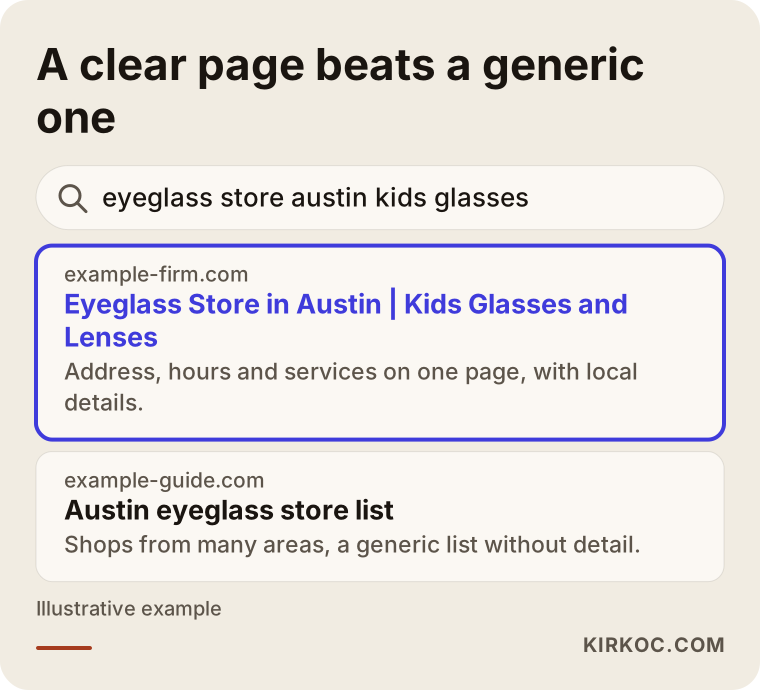
The thing to notice is that the standout result says the neighborhood, the service and what the shop offers in its very first line. A phrase like "wide selection of frames, every brand" fits every shop, so it tells Google and the reader nothing. Google tries to work out which answer suits the person searching. If you make that job easy, it can show you with more confidence.
A small shop versus chains and online retailers
Large optical chains have big budgets, name recognition and many locations. Websites that sell glasses and contact lenses online are a separate kind of competition. A neighborhood shop will not beat either group on broad searches, such as the single word "glasses." I would rather say that up front than let you build the wrong expectations.
But you do hold a strong card: closeness and trust. People usually want to entrust their eyes to a place that is near them, that someone they know recommended, or that has reviews they believe. On narrow searches that combine a place and a service, a small shop can be a much better answer than a chain's generic page. So the center of the plan should not be broad visibility. It should be the clear searches in your immediate area. And of course I cannot promise any ranking, because neither I nor anyone else controls what Google shows.
What exactly are your customers typing into Google?
This is the first question of SEO, and the answer should be researched rather than guessed. Still, a few patterns are common in this business.
The first pattern is the nearby search: "eyeglass store near me," "optical shop in [neighborhood]," "glasses repair near me." For many of these, Google shows a box with a map, and people often pick from there. That box depends on your Google Business Profile rather than your website, and I will cover it separately below.
The second pattern is the product and brand search: a particular frame brand, a sunglasses model, kids' glasses, computer glasses. Here the person wants to know what they will find in your shop. The third pattern is the informational question: "what are progressive lenses," "how long does it take to get used to new lenses," "when does a child need glasses," "how long until my glasses are ready." The person asking has not chosen a shop yet, but a site that answers well has a good chance of being the one they visit. The fourth pattern is comparison and decision: "do I need blue light filter lenses," "contacts or glasses." Here an honest, unexaggerated site makes a difference.
The table below sums up these four patterns and the page that fits each one.
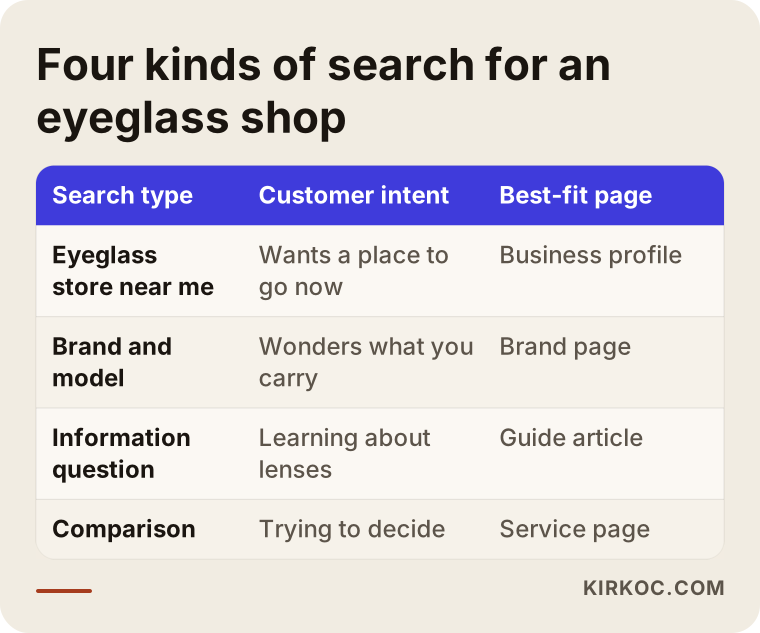
As the table shows, each search wants its own page. Piling everything onto one home page gives neither Google nor the visitor a clear message. A good rule to keep in mind is "one page, one intention."
Which pages should an eyeglass shop website have?
Many optical shop websites are built the same way: a home page, a few brand logos, an "about us" paragraph and a contact section. That is enough for someone who already knows the shop. It is not enough for someone who has never heard of it. I suggest thinking about the following pages.
Store and location pages
Every store should have its own page. It should include the address, a map, opening hours, a phone number, parking or public transit information, and a few real photos from inside the shop. If you have more than one location, each needs its own page that is not a copy of the others. Copying the same text and only changing the location name tells Google that the pages are duplicates of each other.
Service pages
If you offer eye exams, open a separate page for them. The rules about who may perform exams, and what licenses are needed, differ by country, region and type of business, so check the relevant regulations and licensing authorities, and talk to an attorney if you are unsure. Then open separate pages for eyeglass lenses, for contact lens fitting, for kids' glasses, and for repairs and adjustments. On each page, explain what you do, who it suits, how the process works and what questions people usually ask. Using the neighborhood name in the page heading helps with nearby searches.
Brand and product group pages
For the brands you carry, write short pages with real information. A logo alone does not do the job. Say what kind of face or purpose the brand suits, which models people can see in the shop, and what trying-on and fitting service you provide. If you want to say that you are an authorized dealer, make sure the statement is true and that you can document it. Brands may have their own usage terms, so if you are unsure, ask an attorney.
Guides and helpful articles
Short articles that answer the questions people ask most turn your site from a sales window into a useful resource. Titles like "How long does it take to adjust to progressive lenses?", "When should a child have a first eye exam?" and "What should I look for in lenses if I work at a screen all day?" are a good start. Do not give medical advice. Give information, and say "talk to your eye doctor or another qualified professional before deciding." Firm health claims put your reputation at risk, and depending on where you operate they can also bring legal trouble.
The next picture shows the layout I recommend for a service page.
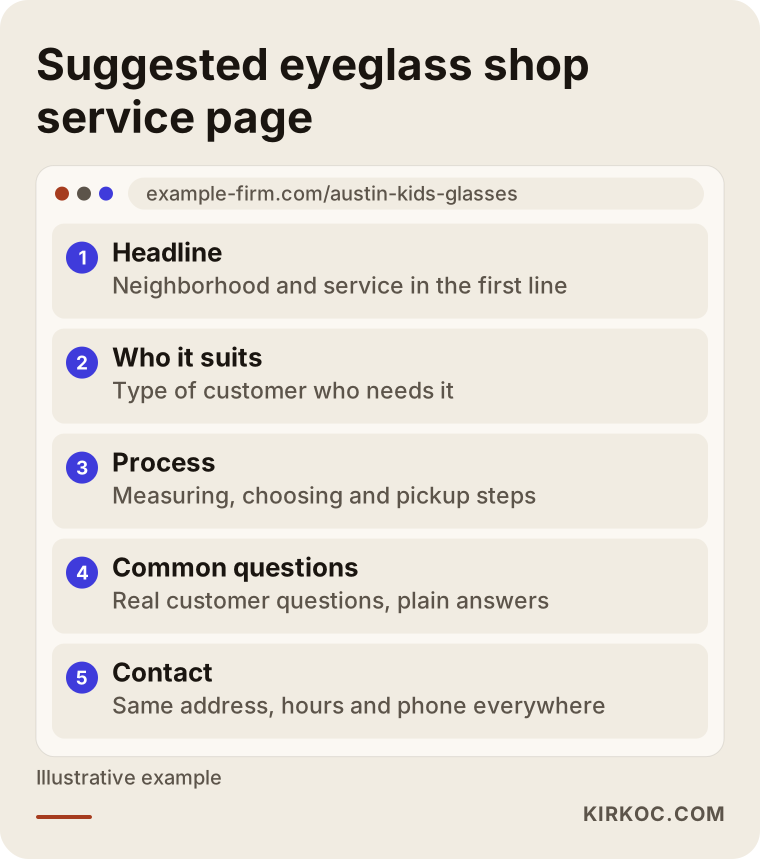
You can adapt this layout to your own shop. What matters is that the page quickly answers the visitor's first three questions: "What does this shop do?", "Is it right for me?" and "How do I reach you?"
Google Business Profile: the most important box for an eyeglass shop
Behind the map box that appears in nearby searches is your Google Business Profile. It is the record Google keeps for your shop, and you are the one who manages it. For many optical shops this box brings more calls and visits than the website does.
A few things matter when you set it up. The business name should match the sign on your door. Stuffing keywords into the name goes against Google's rules and can get the profile suspended. Pick the right main category, and add extra categories if they apply. Keep your hours up to date, including holidays and special days. Wrong hours mean a customer who walks up to a locked door and then leaves a bad review. Your phone number, address and website link should be exactly the same as on your site.
Do not neglect photos: the outside of the shop, the inside, the window display, the exam or measuring area and your staff. People want to see the place they are about to trust with their eyes. Fill in the products and services sections. Reply to reviews calmly and politely. Answering a negative review with a solution rather than a defense builds trust with the reviewer and with everyone else who reads it. Asking customers for reviews is natural. Writing fake reviews, or paying people with gifts in exchange for reviews, goes against Google's rules.
Example scenario 1: a neighborhood shop in a new area
This is a hypothetical example, not a real shop. Imagine an eyeglass shop that has operated in one neighborhood for ten years. Most customers noticed the shop while walking past or heard about it from someone they know. The shop has a website, but it is a single page: a home page, a logo, a phone number and a few blurry photos. The Google Business Profile was created years ago, the hours are outdated, and the category still says "store."
In a first review, the early jobs turn out to be simple: fix the profile, set the category to eyeglass store, add current photos and enter the correct hours. After that, the site gets a store page and separate pages for eyeglass lenses, kids' glasses, repairs and adjustments, and contact lenses, each stating the neighborhood and exactly what the shop does. Then two or three guide articles are added to answer common questions. Even after all this, nobody should expect a sudden jump. Visibility in nearby searches usually grows gradually over months, and it is not possible to name an exact time.
Example scenario 2: a three-location optical chain
The second hypothetical example is a small chain with three locations under one brand. Two stores are in neighborhood centers and one is in a shopping mall. The website has a single "Our locations" page with three addresses listed one below the other. Each location has its own Google Business Profile, but one shows a wrong phone number and another still shows an address the shop moved out of.
The first job here is consistency: the name, address and phone number of all three locations are written identically in the profiles and on the site. Next, each location gets its own page, with directions, photos, opening hours and anything special about the team at that store. The text is not copied word for word. Real information is added about the surroundings of each store, how people get there and what kind of customers visit. That way Google can tell the locations apart, and each one can appear as an answer in its own area.
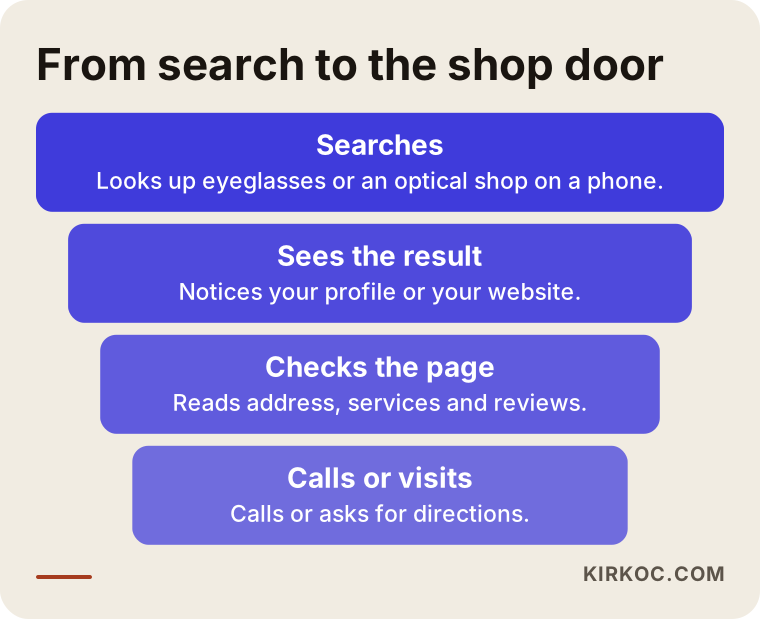
The funnel above shows how a person moves from a search to your shop door. Something is lost at each stage: people who never see you in the results, people who visit the site and leave, people who give up on the search. The job of SEO is to reduce the loss at every one of those stages.
Step by step: how SEO for an eyeglass shop moves forward
Think of the work as a series of jobs done in order. Skipping steps slows down the results.
The first step is seeing where you stand today. I look at which searches your site shows up for, where you appear on the map and what your competitors are doing. The second step is choosing the searches: I list the real searches in your area, for the products and services you sell. The third step is removing technical obstacles. If the site loads slowly on a phone, if the map link is broken or if pages are copies of each other, those get fixed. The fourth step is your Google Business Profile: setting it up, correcting it and maintaining it regularly.
The fifth step is content: the store, service, brand and guide pages I described above. The sixth step is measurement. I track which source your real actions come from, such as phone calls, direction requests and form submissions. The seventh step is looking at results each month and updating the plan.
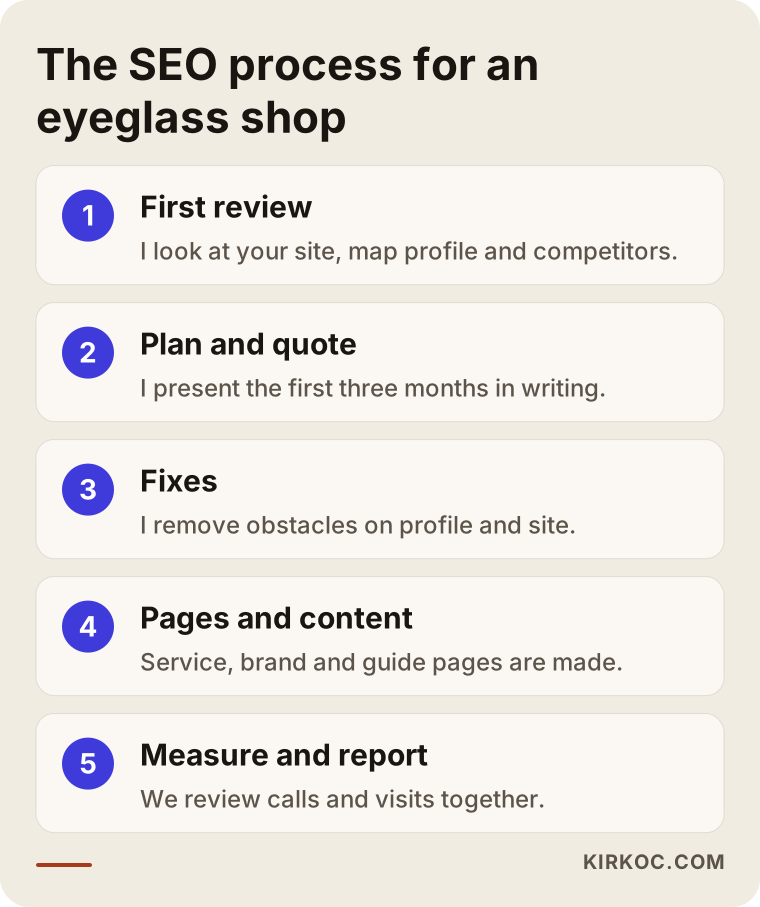
The process in the picture is my own way of working, and the order and weight can change depending on each business. For example, in a shop whose profile and site are already in good shape, the fix stage is short and the work moves to content earlier.
Common SEO mistakes eyeglass shops make
The mistakes I see in this field follow a pattern. The first is squeezing everything onto one page. Eyeglasses, lenses, kids, sunglasses, exams and brands all get one short sentence on the home page. None of them gets any detail, so no search has a strong page behind it.
The second is leaving the Google Business Profile with no owner: wrong hours, a missing category, no photos, no replies to reviews. The third is writing the shop name, address and phone number differently in different places, such as "St." in one and "Street" in another, or an old phone number in a third. Google can struggle to match these as the same shop. The fourth is putting brand logos on the page as images with no text beneath them. A search engine cannot reliably read the words inside an image.
The fifth is uploading all product photos as huge files with no names. The site becomes slow and may not open well on a phone. The sixth is making firm health claims. Phrases like "heals your eyes" or "fully protects you from blue light" can be misleading, and they can cause legal problems. Before using such wording, talk to an attorney or to a professional association in your field. The seventh is giving up when you do not see results in the first few weeks.
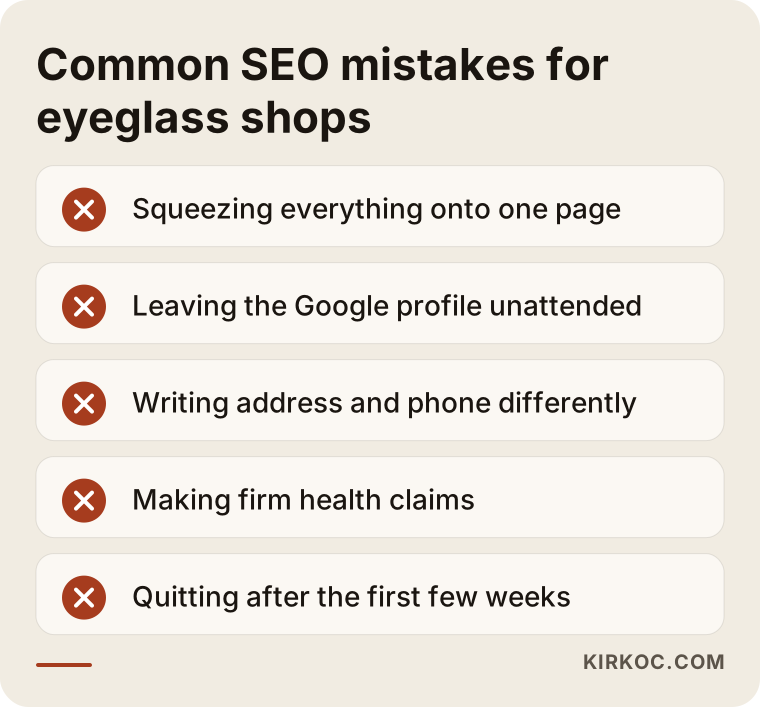
You can use this list as a checklist. Wherever you recognize yourself, start fixing it there. Many of these can be fixed for free or with very little effort.
What you can do yourself and when you need an expert
You do not need a consultant for everything. You can, and should, do the following yourself: claim your Google Business Profile, keep your hours and phone number current, add photos, reply to reviews, and write your shop's address and phone number the same way everywhere. Checking how your website looks on your own phone from time to time is also a free test that helps a lot.
An expert makes sense in these cases. Your site's page structure is limited and adding new pages requires technical knowledge. You have more than one location and want to manage each without breaking the others. Your site has been dropping in search results for a while and you cannot find out why. Or you simply do not have the time. When you are busy running a shop, writing content and measuring results are usually the first jobs to slip.
Here is a simple question that can help you decide: is the source of the problem your website or your shop's profile? The decision picture below sums it up.
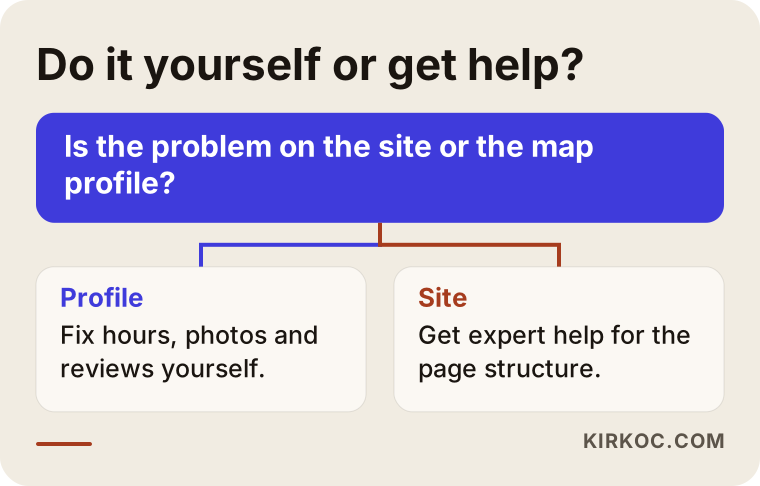
The split in the picture is a rough guide. If you are not sure, a short first review often makes it clear which way to go.
What determines the cost
The cost of SEO for an eyeglass shop cannot be given as one number, and I should say that honestly from the start. Several things set the price. The first is the number of locations: each one needs its own page, profile and follow-up. The second is the state of your current website: does it need to be built from scratch or repaired? The third is the amount of content: how many service, brand and guide pages need to be written? The fourth is the competition around you. A crowded area in a big city takes more effort than a small town center.
The fifth is the way we work together: a one-time cleanup or ongoing monthly care? The sixth is how much of the work you can take on yourself. If you handle things like profile upkeep and replying to reviews, the total work shrinks. When you ask for a quote, ask for the tasks to be written out in order. Do not make a decision until you can see what you would be paying for.
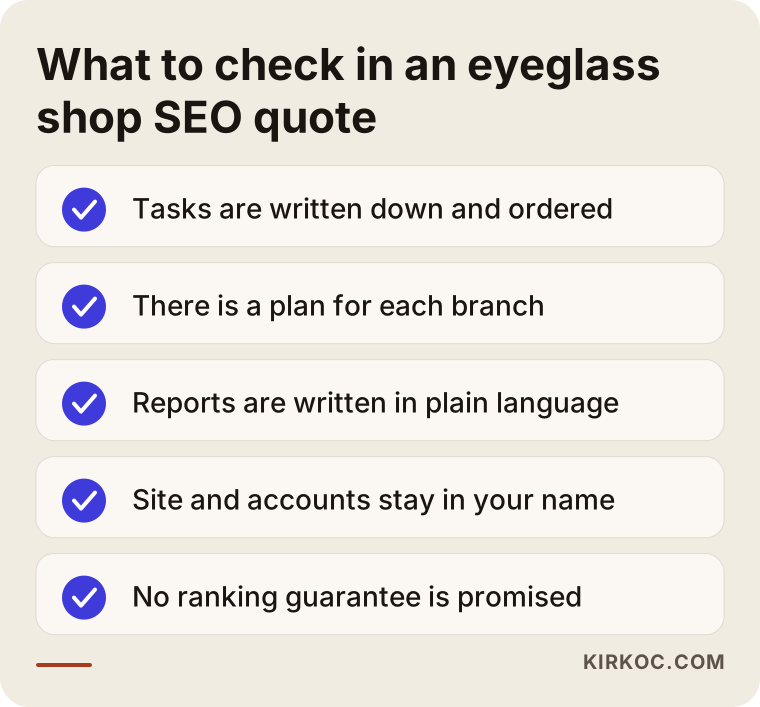
The list above is a simple yardstick you can hold up to any SEO quote you are about to accept. If the answer to any item is "no," do not skip asking about it.
AI search and your eyeglass shop
Some people now ask AI assistants instead of typing into Google. Questions like "Are progressive lenses or contacts better for me?" or "Is there somewhere near me that does kids' glasses?" When these assistants answer, they sometimes draw on sources from the internet. Having clear, correct information on your site that makes sense on its own may increase the chance of being used as a source in those answers, but there is no guarantee.
The practical takeaway is this: answer questions directly on your pages, write your address and services clearly and keep your information current. That work largely overlaps with what you already do for Google. This area is called GEO, which in short means work aimed at appearing in AI answers.
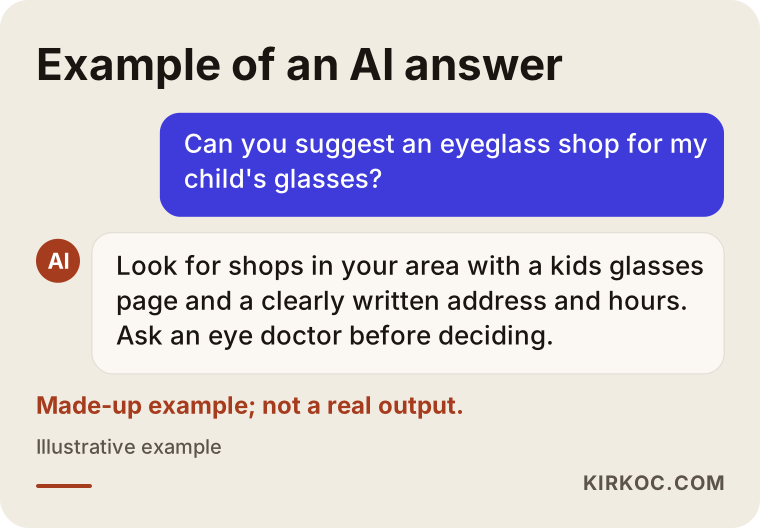
The answer in the picture is made up and is not the output of a real assistant. Its purpose is to show how a clearly written page can be useful in an answer.
When do results show up, and how do you measure them?
How long it takes to see results for an eyeglass shop depends on the age of your site, the competition around you and the work done. Fixes to your map profile usually show an effect sooner than the website does, while new pages take longer to settle into search results. So set your expectations in months. Be careful with anyone who promises a jump within a few weeks.
When you measure, do not only ask "what position am I in?" More meaningful signs include the calls and direction requests coming from your profile, phone taps from your site, appointment requests from your form and customers who walk in and say they found you online. Asking each customer in the store "how did you find us?" gives a more honest measurement than any tool. I suggest writing the answers down in a notebook or a spreadsheet.
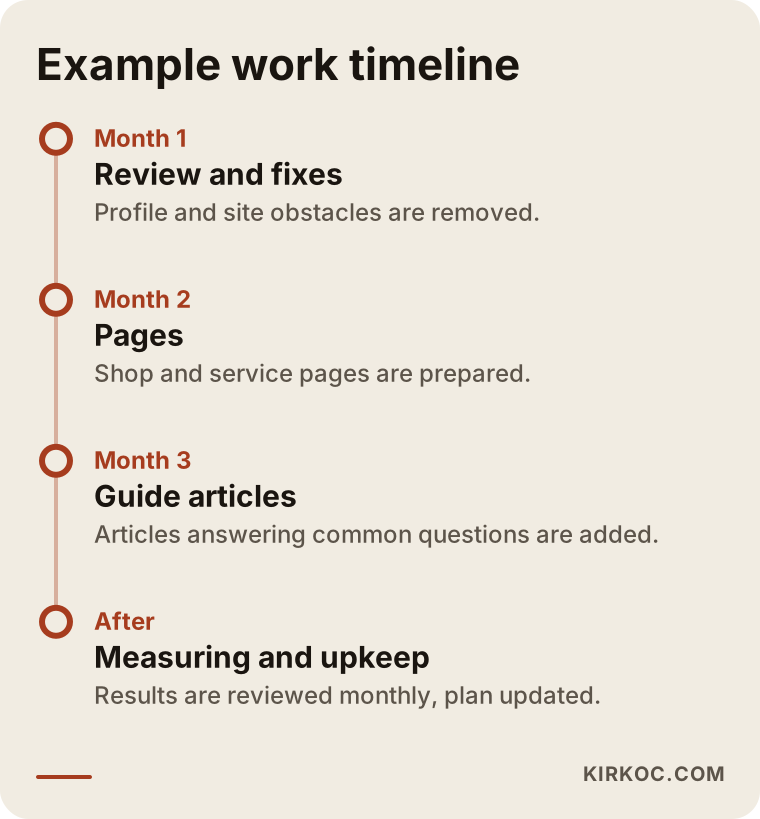
The timeline is an example, not a promise. Your real timing could be shorter or longer depending on your shop. What matters is that you know what is being done each month and what is being measured.
How I work with you
I work alone, so the person you talk to is the person doing the job. Usually it goes like this. First I look at your shop, your website and the competitors around you, and I tell you in writing where to start. Then I present the work for the first three months in order of priority. I clear the obstacles on the site and the profile first, and then I prepare the pages and articles. Every month we look at the results together in plain language. The site and the accounts stay in your name, so even if we stop working together, they remain yours. I do not promise rankings, because I cannot. What I offer is a clear plan and regular follow-up.
For an eyeglass shop, at the start I usually check the state of the Google Business Profile, how fast the site loads on a phone, which pages are missing, consistency between locations and the real searches around your shop. Often the quickest win comes from things you already have but are not using well enough.
Frequently asked questions
Is SEO really necessary for an eyeglass shop, or are my sign and neighborhood enough?
For a shop on a busy street that people have known for years, neighborhood customers are certainly important. But when people look for a new place, the first thing they do is check their phone. If you do not appear on the map or in the search results, you will never even see that customer. SEO does not replace your sign. It gives your sign an online counterpart.
Is fixing my Google Business Profile alone enough?
For a small shop, the profile is often the step that brings results fastest. But if you stop there, you will miss the people who are looking for information or comparing brands and services. Strengthening the profile and the website together builds a sturdier base.
I have several locations. Does each one need its own page?
Yes, usually. Each location has its own address, hours, directions and photos. Instead of repeating the same text, write real information specific to each location. Otherwise the pages look like copies of each other.
Do I have to sell glasses online?
No. E-commerce is not required for SEO. For many optical shops, the goal is to bring people into the store, get them to book an appointment or get the phone ringing. Selling online is a separate project and a separate investment.
What should I watch out for when writing about glasses and lenses?
Give information, but do not give medical advice or promise that something will cure a problem. In your articles, use wording like "talk to your eye doctor or another qualified professional before deciding." If you are unsure about the rules for advertising and health statements, talk to an attorney.
When will I see results?
I cannot give an exact time. The effect of profile fixes usually shows earlier, and the effect of new pages shows later. So I suggest setting your expectation in months, not weeks. Measuring each month and updating the plan is the right way to go.
My competitor is in the same neighborhood and is very strong. Do I still have a chance?
On broad searches it may be hard, but on narrow and clear searches you have a chance: a specific service, a specific product group or a specific neighborhood. Doing what the strong competitor does not do, such as a detailed kids' glasses page or clear directions, can set you apart. I cannot guarantee the result, but in a first review I can show you which area makes the most sense to compete in.
Can SEO be done without rebuilding my website?
Most of the time, yes. You can add new pages to the current site, fix slowness and correct the profile. If the site is very old, does not open well on a phone or cannot take new pages, a rebuild may make more sense. We can work that out together in the first review.
If you want your eyeglass shop to be easier to find online, let's look at your situation together. Reach me through my SEO services page and briefly describe your shop, how many locations you have and what you want to achieve.