Your shop turns out beautiful work. Every finished kitchen, built-in and wardrobe gets photographed, yet most new jobs still arrive through word of mouth. Meanwhile someone types "custom kitchen cabinets near me" into Google and never finds you. In most cases the craft is not the problem. The website simply fails to tell a search engine, and a nervous homeowner, what you build, where, and how to reach you. That gap is what SEO for a custom cabinet maker closes, and it is the core of the SEO services I offer to workshops and furniture builders.
I wrote this for shop owners, showroom operators and small custom furniture makers who are not technical and do not want to become technical. I am not going to promise you a ranking. I will explain how your customers search, what is usually missing from a builder's website, what to look for when you compare quotes, and when you should honestly skip all of this.
How do custom furniture clients actually search?
Someone buying a stock cabinet looks at brands and prices. Someone commissioning custom work starts from a different place. They have a floor plan, a remodel or a half-empty room, and they need answers to three questions: who can build this, can I trust them with my home, and will they come out and measure? The words they type follow that journey.
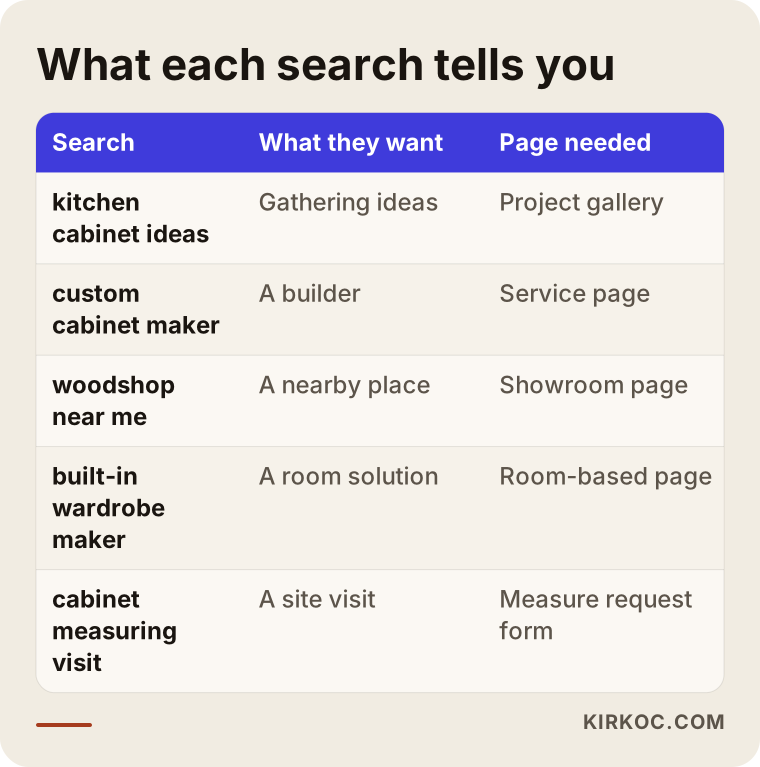
I usually see four kinds of intent. The first group is collecting ideas: "kitchen cabinet ideas", "island kitchen layouts". They are not ready to buy, but a memorable photo can stay with them. The second group wants a builder: "custom cabinet maker", "custom kitchen cabinets", "built-in wardrobe maker". They are close to deciding. The third group wants proximity: "woodshop near me", "cabinet showroom in [your town]". They want to walk in and touch the material. The fourth group is ready to act: "cabinet measuring visit", "free quote custom closet". They are one phone call away.
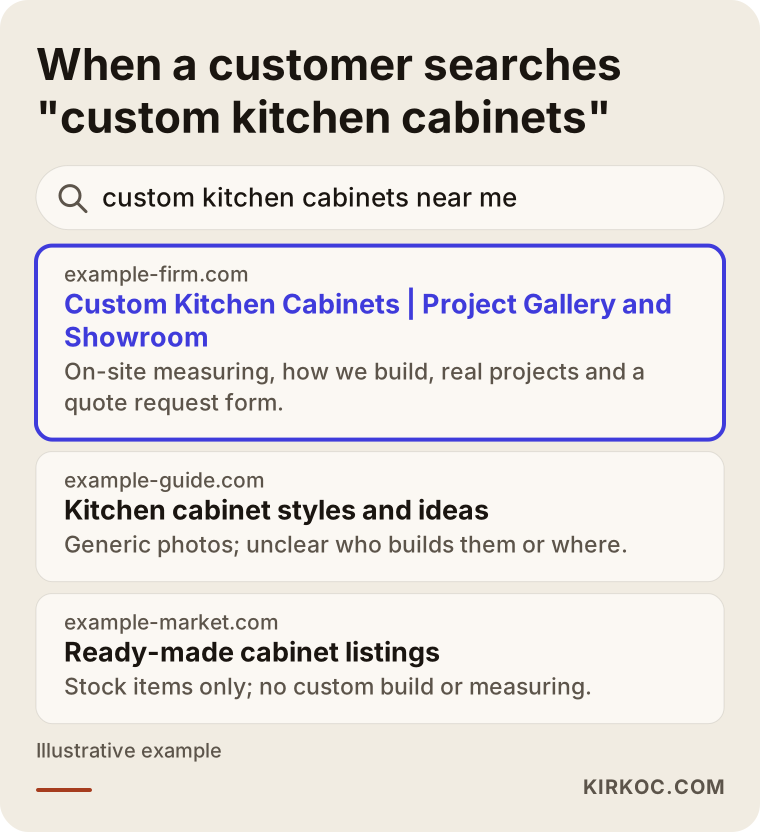
The mock results above use made-up domains and are not a real search page, but the logic is real. A buyer at the decision stage clicks the result that shows right away what is built, where, what the work looks like and how to get in touch. Generic idea sites and stock-product listings cannot answer those questions. As a custom builder, that is your advantage.
Why does the decision take so long?
For most households a kitchen or a full set of built-ins happens a handful of times in a lifetime. People compare several makers, save photos, message one or two, then sleep on it. If your site does not answer "does this person really build the work, take it seriously and come to measure?", the visitor goes back to the results and opens the next tab. SEO is not only about more visitors. It is about having the right information ready for the visitor who is already close to calling.
Why is your gallery invisible to Google?
Photos are a furniture maker's biggest asset and, oddly, biggest weakness. Google does not look at a picture the way you do. It reads the words around it, the file name, the image description and the context of the page. A page with thirty gorgeous kitchen photos and not one sentence of text tells it very little. A visitor feels the same thing: nice pictures, but which job is which?
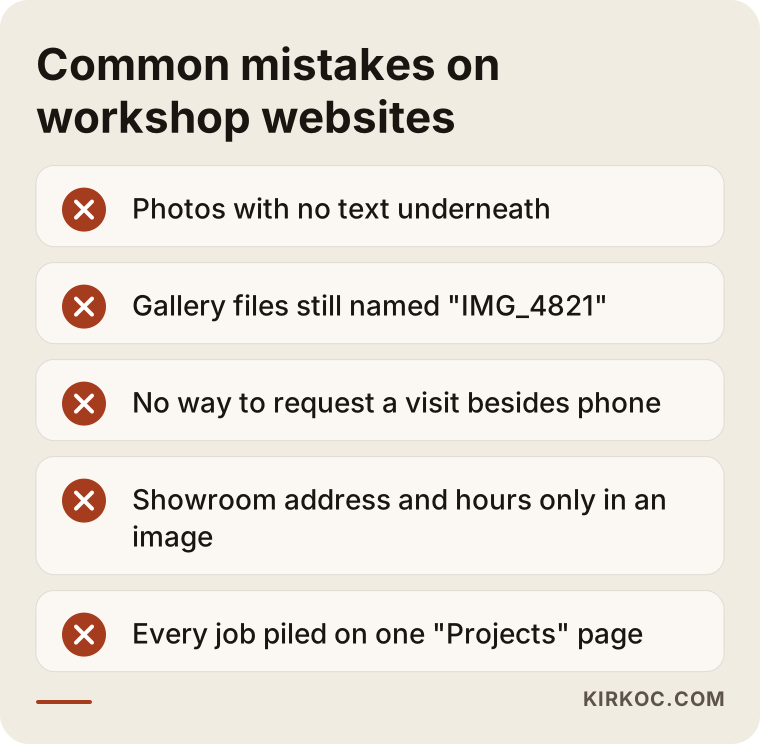
The pattern I meet most often is this: every project dumped on one page called "Gallery" or "Our Work", photo files still named "IMG_4821" the way they left the phone, empty image descriptions, and no mention anywhere of which kitchen was built where, from what materials. However polished it looks to you, to a search engine it is nearly an empty page.
Does image search really matter?
Furniture and interiors are among the few fields where people genuinely browse by image. A homeowner scrolling kitchen pictures may land on your site from a single photo they liked. For that click to turn into work, a real page has to sit behind the image: one that explains what it is, shows how to reach you and tells the story of the project. Uploading image files is not enough. I treat this at the page and content level. I cannot promise that your pictures will appear in image results, but describing them properly is a normal part of the work.
Which pages does a custom builder need?
A small shop does not need hundreds of pages. It needs a few right ones, each answering a different intent.
Service pages. One page for each main thing you build: custom kitchen cabinets, closets and walk-ins, bathroom vanities, office and commercial millwork. Squeezing everything onto one page leaves Google guessing which search you should appear for. Each page should say how that job runs, what materials you use and what kinds of spaces it suits.
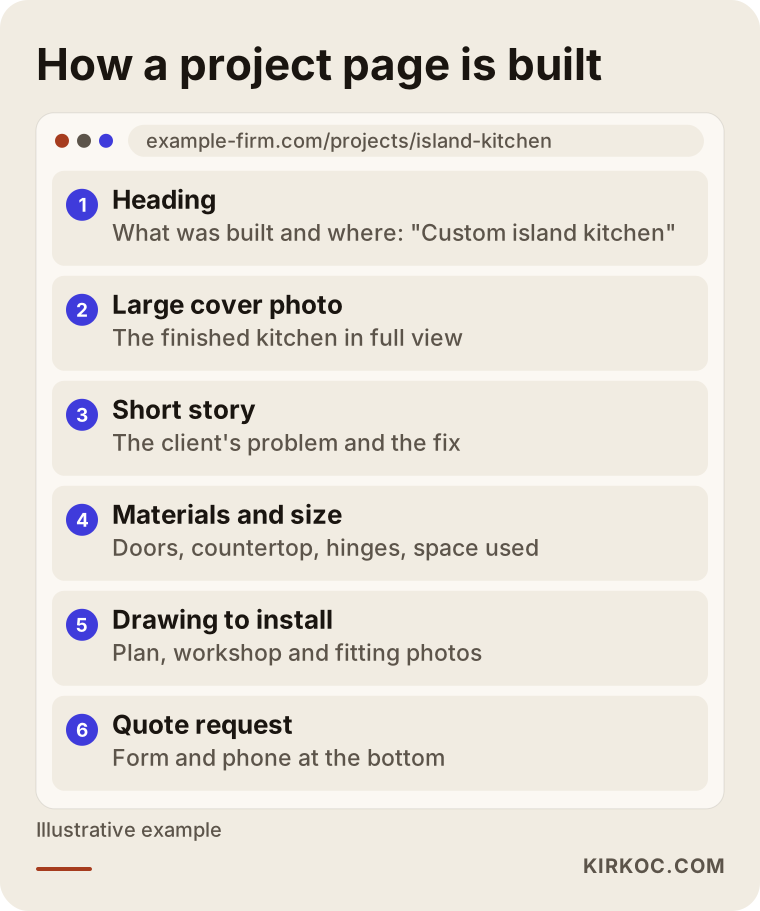
Project pages. A short story for each important job: what was the client's problem, what was the room like, what did you build, which materials and dimensions. Privacy matters here. You rarely need a name or full address. A neighborhood and a type of space are usually enough.
A showroom or workshop page. Address, map, hours, whether visits are by appointment, parking, and what a visitor can see. This should be a proper page, not a line in the footer. It is the page that answers "woodshop near me".
A process page. Site visit, measuring, drawings, approval, build, installation. The client's biggest worry is the unknown: what happens, in what order, and when. A builder who writes the process down earns trust before the first call.
A quote request path. A short form besides the phone number, ideally with room for a photo of the space and rough measurements. Not everyone wants to call, especially in the evening.
Is it a problem to reuse the same photo in three places?
Not at all. Show the same kitchen on the homepage, in the gallery and on its own project page. What matters is that the text around it differs, because the photo does a different job each time: trust on the homepage, an example on the service page, a story on the project page.
Mistakes I see on builder websites
Most of these come from a busy shop, not from carelessness. When you are running jobs all day, nobody has time for the website, so it gets built once and forgotten. These are the problems that come up most.
Photos with no words. The silent gallery described above. It is the most common mistake and the easiest to fix.
Everything on one page. Kitchens, closets, offices and vanities all sit under "Products". None of them has a strong page of its own.
Address and hours trapped in an image. The showroom details were designed as a banner. Search engines and screen readers cannot read text inside a picture, and phone users have to pinch and zoom.
Phone as the only way in. The phone is a fine channel, but if it is the only one, people in the early idea stage drop out.
A slow or broken mobile site. Most visitors look at the site on a phone. Heavy photos that load slowly or spill off the screen push people away and push results down.
Inconsistent details. One phone number on the site, another on the map listing, a third on social media. The business name is "Smith Woodworks" in one place and "Smith Cabinets" in another. That inconsistency makes both search engines and clients unsure.
Treating price as a secret. In custom work the price depends on the room, the materials and the labor, so "call for a quote" is normal. But staying silent about what drives the price erodes trust. You can explain the factors without printing a single number.
A weak gallery versus a strong project page
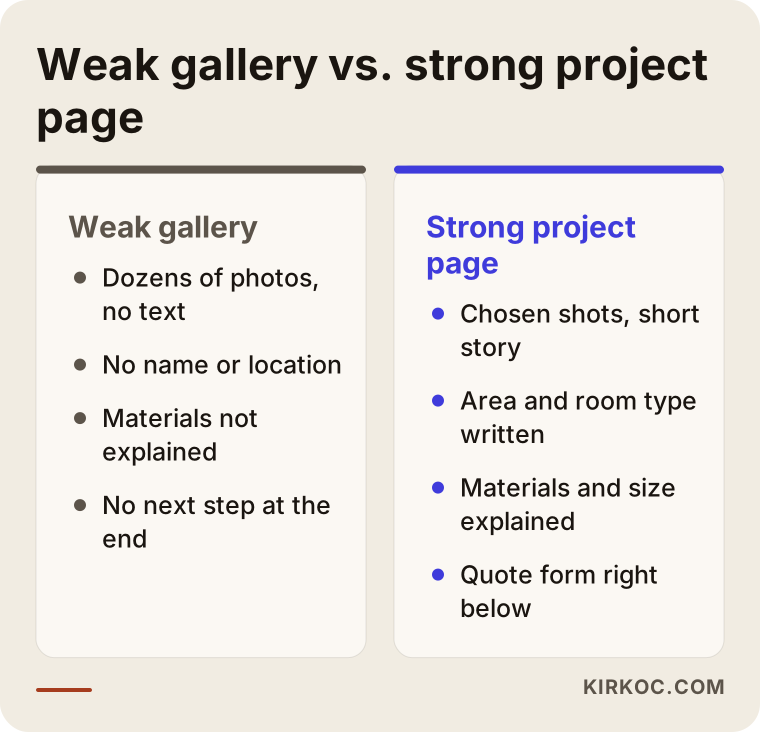
You can present the same kitchen in two ways. In the first, twenty photos sit side by side with nothing written. In the second, four or five chosen shots sit under a clear heading such as "A compact island kitchen for a narrow room", followed by two or three paragraphs of story, the door and countertop materials, the approximate size of the space and, at the bottom, a button that says "Request a measuring visit".
The second is more valuable to both the visitor and the search engine. The visitor recognizes their own situation in the story: "my kitchen is tight too, and they solved it". The engine learns what the page is about from the heading and the text. You do not need to do this for every job. Starting with your best eight or ten is plenty.
Reviews and references
In custom work, clients are buying trust. A few sentences from a satisfied customer are often the strongest content on the page. Use real words, with the customer's permission. Invented or inflated testimonials are not just dishonest, they backfire. Place them next to the relevant project or service rather than on a separate page nobody visits.
What questions does the client have before they call?
Someone thinking about a custom order usually builds the first phone call in their head while browsing. If your site already answers the questions, the person who calls is more serious and better prepared. These are the ones I hear most.
How long does it take? You do not have to promise a date, but you can list the stages from site visit to installation and say what each depends on: material lead times, how fast the client approves drawings, whether the walls are ready.
What materials do you use? Doors, carcasses, countertops, hinges and drawer slides are separate quality signals for a buyer. You can describe them without naming brands: "this type of board for the box, this type of finish for the fronts".
Who does the installation? A maker who builds and hands installation to someone else is very different, in the client's eyes, from one who does everything in house. Say plainly which one you are.
What happens after it is installed? If a door needs adjusting or a drawer sticks, whom does the client call? You can explain how you support the work without using any legal wording.
Do you take small jobs? Many people hesitate to call for a single cabinet. Saying on the page that you do makes the call easier.
Put these in a short question-and-answer section. It helps the client and shows the search engine which questions the page answers.
Local visibility: showroom or workshop
If you have a showroom, inviting people in is your strongest card. They want to see door colors, countertop textures and hear the drawer close. So the showroom page should say what can be seen, whether an appointment is needed and how long a visit usually takes. If you only have a workshop and do not receive visitors, say the opposite: "We do not receive visitors at the shop, but we come to your home to measure." Either way the message must be clear. Ambiguity quietly lowers the number of calls.
Also list the towns and areas you serve. A visitor who cannot tell whether you cover their area will rarely ask. But do not create dozens of near-identical pages, one per suburb. It works better to list the places you truly work in on one page and link to the matching project pages.
A separate path for designers and contractors
Some custom builders get most of their work from interior designers, architects and contractors. That audience looks for different things: references, capacity, delivery discipline and technical detail. If this is a large part of your business, give them their own page, so the plain language you use for homeowners does not mix with the technical language that professionals expect.
What does working with me include?
Let me be precise about what I offer. I called this article "for cabinet makers", but my scope is a general SEO engagement that I apply to your trade. I review your whole site and list, in plain language, why Google is holding you back. I research what your customers really type and choose the searches that can bring you work. I fix technical problems such as slowness, pages that do not open and poor phone display. I strengthen your service pages and write content that answers your customers' questions. I look at what the higher-ranking competitors do differently and update the plan accordingly. Each month you get a simple report of what was done and what comes next.
For a furniture builder that translates into how your project pages are structured, how your services are separated, whether your showroom details sit properly on the page and whether the path to a quote is open. I do not take your photographs, build your furniture, run paid ads or manage your social media accounts as part of this. Saying so up front avoids a wrong expectation later.
How does the process run?
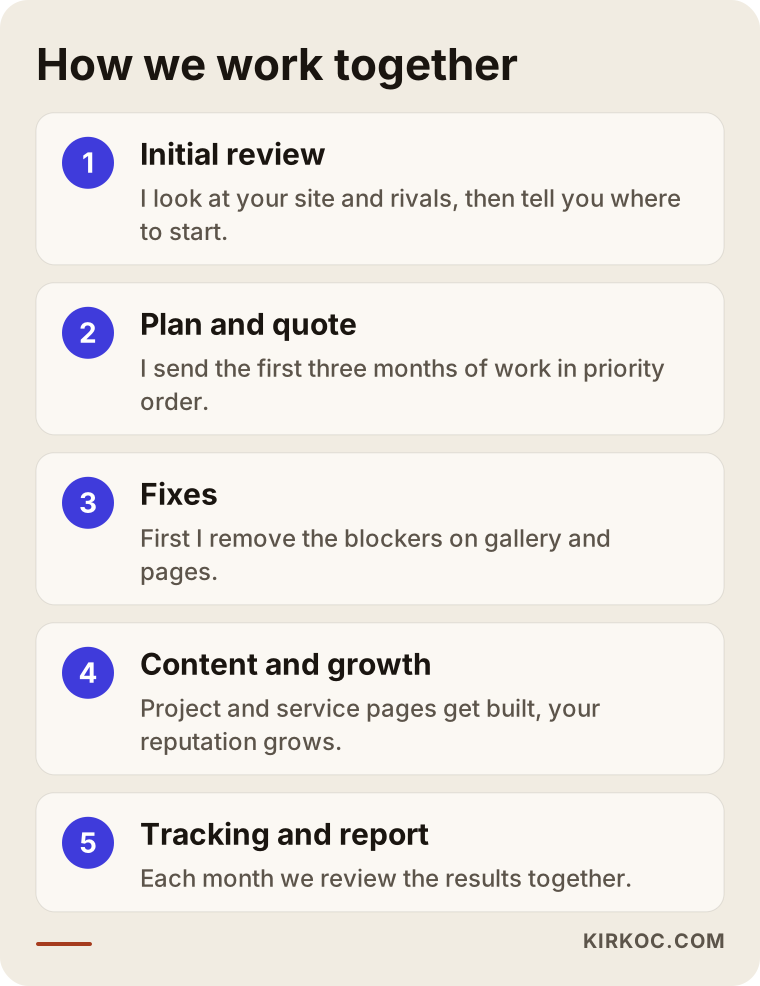
First comes an initial review. I look at your site and your competitors and tell you where to start. Then I send a written plan and quote covering the first three months in priority order. After you approve, I begin the fixes, because removing the blockers on the site gives the fastest effect. Next, pages and articles are prepared for the targeted searches and your site's reputation is strengthened. Every month we review results together and update the plan. I work on my own, so the person you talk to is the person doing the work.
What decides the cost, and how do you compare quotes?
I am not printing a figure here, because the cost depends on your situation. I can tell you what it depends on: the current state of your site, how many service and project pages need to be prepared, the competition where you operate, how many languages you publish in, how serious the technical problems are and how continuous the work will be. A showroom with many product lines and a shop with three services have very different needs.
When you compare quotes, check a few things. First, is the work written down? "We will do SEO" is not a quote. It should say which pages are prepared, which technical fixes are made and what is delivered when. Second, is there a report, and can you understand it? A report you cannot read is useless. Third, is there a guarantee? Anyone who promises "first place" or "this many orders" is promising something they do not control, because rankings are Google's decision. Fourth, who actually does the work? Is the person selling the same as the person delivering? Fifth, can you leave easily, and do the site and content stay yours?
Doing it yourself versus hiring help
You can do the simple parts yourself: rename photo files meaningfully, write a few sentences under each project, keep your phone number and address identical everywhere, add a quote form. That takes time and care, not expertise. Deciding which searches to target, finding technical problems, building the page structure and watching competitors take both time and experience. If you are the one running the shop floor, handing the second group to a specialist is usually the sensible split.
Two hypothetical scenarios
The two examples below are entirely made up. They do not describe real clients; I built them to show the logic.
Say you run a small cabinet shop in a mid-sized town making kitchens and closets. Your site is several years old, the gallery holds hundreds of photos and none has a description. Almost all your work comes by referral. In that case I would look at the site first and suggest breaking the gallery apart: service pages for kitchens, closets and vanities, project pages for your best ten jobs, a workshop page and a quote form. Afterward a visitor can see what you do. I would not promise rankings or an order count, but what a visitor sees when they find you would be much clearer.
Say you are a furniture builder with a showroom in a big metro area and a few employees. Competitors are many and all use similar photos. What will set you apart is the specific detail: which neighborhoods you serve, which spaces you specialize in (narrow apartments, large homes, offices), how your process works. I would study competitor pages, find the topics they leave thin and build pages for you there. Again the aim is not to promise a ranking but to make you easy to choose in a crowded field.
When you do not need this
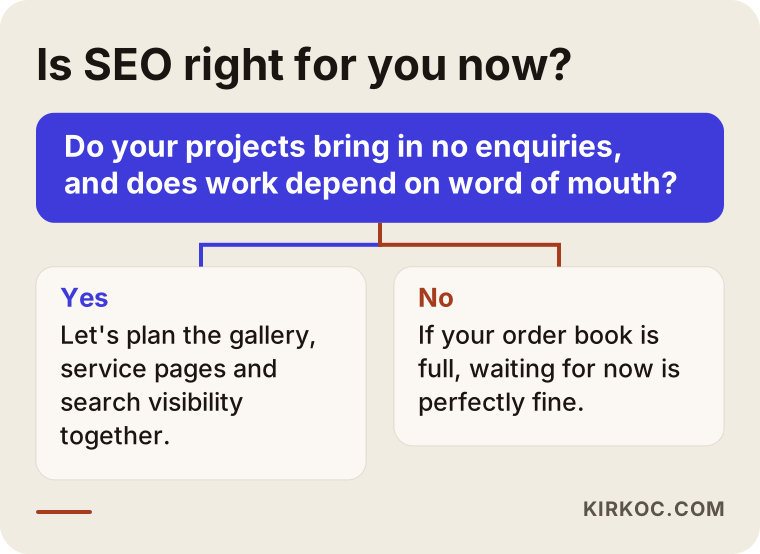
Let me be honest: it is not for everyone. If your order book is full, you have no trouble finding clients and you do not want new work right now, SEO can wait. If you have just opened and have no portfolio yet, finish and photograph a few good jobs first, because pages need something to show. If you are planning a complete redesign of your website, build SEO into the new site rather than patching the old one. And if your clients come only through a handful of designers or contractors, search is a secondary channel for you.
Where to start this week
Before you talk to anyone, browse your own site as a customer would. On your phone, search "custom kitchen cabinets" plus your town. Can you find yourself? What do you see first? Open a project page: does it say what you built, where and with which materials? How many taps does it take to request a measuring visit? Can you find the showroom address? Five minutes of this usually shows where the problems are and what is urgent.
Then look at your competitors the same way. What do they explain better? Which questions do they answer? That view will also sharpen your questions when you speak to a specialist.
Frequently asked questions
How long does SEO take for a cabinet company?
It depends on your site's condition, the competition where you work and what gets done. Technical fixes tend to show up sooner; content and reputation work shows later. It would be dishonest to name a month. We track what changes in the early months through the report, but I do not guarantee rankings or orders.
I only have a social media page. Is that enough?
Social media is good for showing photos, but it will not bring you the person who searches "custom kitchen cabinets". A website that holds your address, a description of each service and a quote request gives both trust and visibility. Social media supports it; it does not replace it.
Is it a privacy problem to show project photos?
The safest course is not to publish the inside of a client's home without their permission. Most clients agree after a short request. Naming only the neighborhood and the type of space, without a name or full address, protects privacy and still gives search enough context.
Should I put prices on my website?
Fixed prices are hard in custom work because every space is different. You do not have to print a number, but explaining what drives the cost, such as room size, materials, labor and installation, builds trust and reduces pointless calls.
I have a workshop in an industrial park, not a showroom. Can I still show up in local searches?
You can, but spell out whether you receive visitors, which areas you serve and whether you visit the client's home to measure. If clients will not come to the shop, "we measure on site" may be the most important line on the page.
Should I hire an agency or a freelancer?
That depends on the size of your project and how you like to work. I work alone, so the person you speak to is the person doing the work, with no go-between. A large multi-channel campaign may suit a different setup. What matters is that you know what you want and that the quote is in writing.
A competitor always ranks above me for the same words. Can I catch up?
I cannot know that in advance. You have to see which pages put them ahead and what your site lacks. Often it is smarter to begin with the more specific searches they have left empty, rather than where they are strongest.
Will AI tools recommend my shop, and should I prepare?
People now ask AI tools "who builds reliable custom cabinets?". Nobody knows exactly how these tools pick sources, but clear service pages, consistent contact details and real reviews seem to help. The same work benefits Google and these tools, though I cannot promise that any tool will mention you.
If you would like to see what your site tells a customer today, get in touch with me. I will do an initial review, tell you where to start and put the scope in writing. You can read more on the SEO services page or write to me directly.