Before a customer decides to call you, there is a good chance they type your business name into Google, and the first page they see can open the door or close it. What if that page shows a harsh review nobody answered, an old complaint thread, or a wrong phone number? In this article I explain what online reputation management services actually include, what they cannot do, and how I work. The honest part of this job sits inside local SEO services: your business profile, your reviews and your website, set up properly.
Let me be direct from the start. Anyone who promises to delete every negative review is either misinformed or using a method that can hurt you. Reputation is not a switch you flip. It builds over time, and it can be managed well. By the end of this guide you will know what to expect, what is worth paying for, and which promises should make you walk away.
What does a customer actually see when they search for you?
Most owners rarely search their own business name, or they glance at the top result and move on. But a customer who has not met you yet usually passes through three places: the search results, your map profile, and any review or complaint sites. These three feed each other. If your star rating on the map is low and the newest reviews sit unanswered, even a beautiful website cannot carry the trust alone.
People also search in predictable ways. Many type the business name and add a word such as "reviews", "complaints" or "is it legit". Others type the service plus the area, then compare three or four businesses side by side. In that second case your name may never be typed at all, yet your rating and the number of reviews on your profile decide whether you get picked.
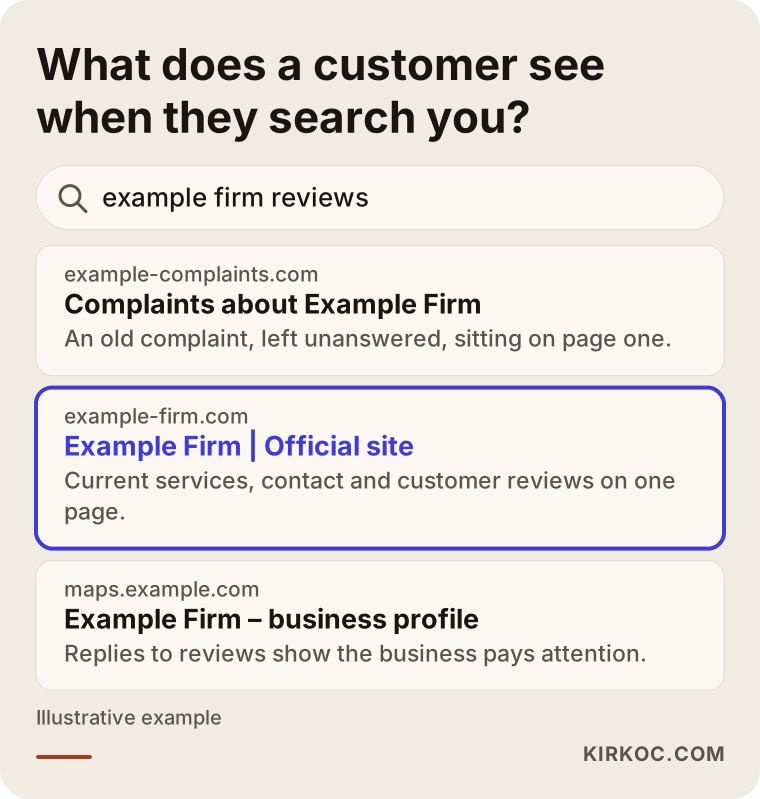
The mock page above has three results: an old complaint page, the business's own site, and its map profile. The logic of reputation work is simple. Instead of only trying to erase the result you dislike, strengthen the results you control. The stronger your official site, your profile and your accurate pages, the smaller a single negative result looks.
"Negative result" is not one thing
People say "bad result", but these come in very different shapes, and each has a different remedy:
- A harsh review on the map: a real customer had a bad experience. This is the most common case.
- A review that looks unfair or fake: written by someone who was never a customer, a competitor, or a person who found the wrong business.
- A record on a complaint site: written long ago, never noticed, still on page one.
- Old or wrong information: a closed branch, a changed phone number, a service you no longer offer.
- A news or forum post: a publication outside your control mentions your name.
- Another business with a similar name: results that confuse your customers but are not your fault.
Prescribing a fix without a diagnosis is like writing a prescription without taking a temperature. So I always begin with three questions: what shows up, where does it show up, and who owns it.
What can be removed, and what cannot?
This is the most important section, because it is where the industry exaggerates the most. Neither I nor any other consultant has the power to remove a review or a page. The decision belongs to the platform where the review lives or to the owner of the page. What a consultant can do is make the right request, with the right reasoning, to the right place, and tell you honestly what to do when the request fails.
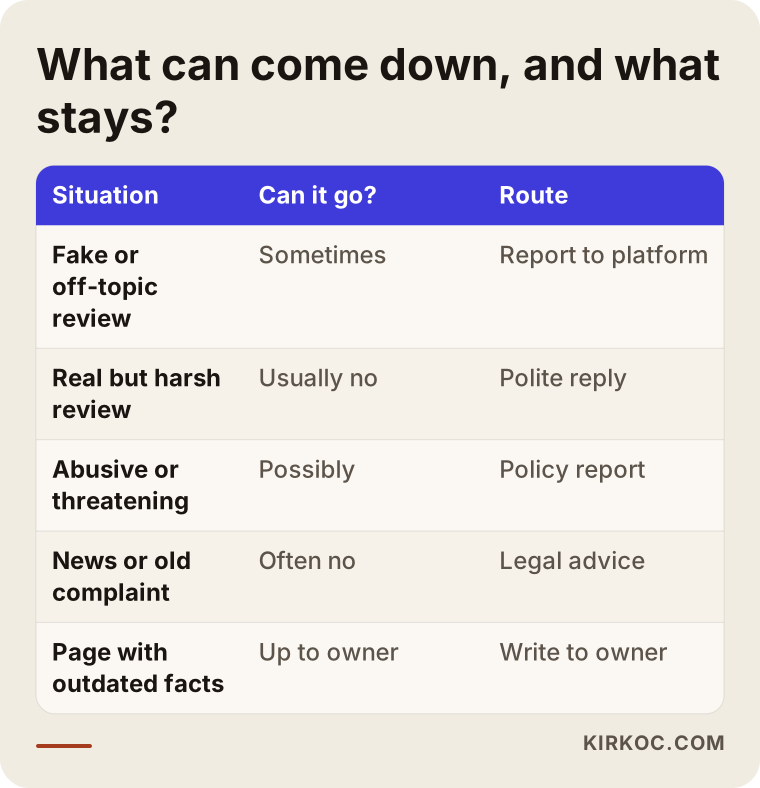
The general logic works like this. Platforms can take down content that breaks their own rules: reviews that are clearly fake, off-topic, abusive or threatening, that expose private details, or that were written as advertising. But "I disagree with this review" or "the customer was wrong" is not a reason for removal. A real customer's real experience, however sharply worded, mostly stays where it is.
When you report a violation, concrete reasoning works better than emotion: "This person does not appear in our records" or "this review describes a different business." The result depends on the platform's decision, and neither a fast outcome nor a certain one can be guaranteed. A consultant who understands this will explain the process and the odds instead of just reassuring you.
When does the legal route make sense?
If content contains clearly false statements, does serious harm to your standing, or violates your personal rights, legal action may be worth considering. Advice on that is a lawyer's job, not mine; I can only help you recognize when it is time to talk to one. Even a lawyer cannot guarantee the outcome, because it depends on the court, the platform, and local law.
One more point. A true but uncomfortable post is rarely removable by law. So before you spend money on a removal-focused service, assess honestly whether the content is really false or against the rules.
Why you should stay away from fake review sellers
When negative reviews sting, ads promising "we post positive reviews" or "we get bad reviews deleted" look very tempting. The temptation is understandable, because somebody will always promise a quick result. The risk is heavy, though. Platforms work continuously to detect fake reviews, and the penalty for getting caught is not only that those reviews vanish. Your profile can be restricted, reviews can be removed in bulk, or your visibility can drop.
Customers can also sense fake praise. A pile of reviews posted on the same day, in the same pattern, none giving a concrete detail, does not build trust; it creates suspicion. A two-sentence, detailed review from a genuinely satisfied customer brings in more work than a hundred polished but empty ones.
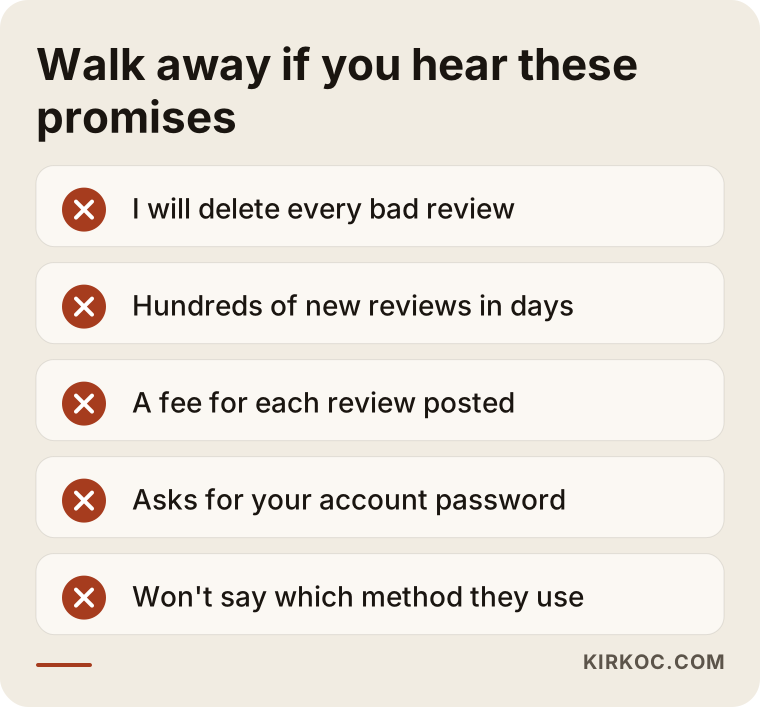
If you see any of the signs in the graphic, stop. Do not work with anyone who asks for your account password, refuses to explain the method, or charges per posted review. Buying reviews breaks platform rules and puts your account at risk. Sharing a password is a separate problem: you lose control of your own account. The right way is to give the person you trust limited access through the business profile's own permissions, not to hand over a password.
I do not write fake reviews, commission them or buy them. I keep that outside my service, because in the long run it harms the client's account.
What I do: put your reputation on solid ground
The scope on my service page sits within local SEO, and this is the part of reputation management I take on: setting up your Google Business Profile, a review strategy, showing you how to reply to reviews, making your name, address and phone number consistent across the internet, putting a map and directions on your site, and monthly follow-up. In other words, I am not a "removal company". I make sure the picture a customer finds is accurate and strong.
I do not promise anything beyond that frame: getting content taken down from news sites, running court cases, buying reviews, or guaranteeing rankings. If a result is beyond me, I will say so at the start.
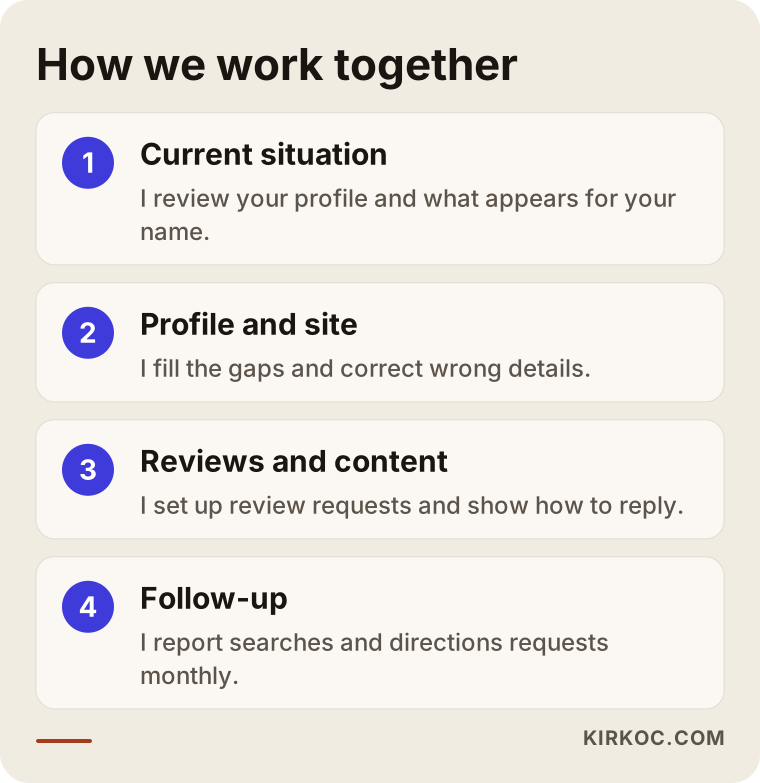
How the process runs, step by step
Current situation. The first step is searching for you and your service the way a customer would. I look at your profile, your reviews and the competitors in your area. I separate what is a genuine problem from what is merely irritating but harmless. You get a written assessment: what will be fixed and what will be left alone.
Profile and site. I fill in the gaps and correct the mistakes. Categories, opening hours, service list, photos and description should all reflect reality. A closed branch that still shows as open, or a wrong phone number, can cost more customers than a harsh review.
Reviews and content. I set up an easy, rule-friendly way to ask satisfied customers for a review, and I show you how to answer each one. I publish area and service pages, so that searches for your name lead to pages you control.
Follow-up. Each month I report on searches, directions requests and rankings. Reputation is not a one-time job. It needs to stay current as new reviews arrive and new competitors appear.
How to answer a negative review
Most owners underrate this habit, yet it affects reputation more than almost anything else. The person reading a bad review is not only the one who wrote it; future customers read your reply too. Your answer is a public window into how you behave when something goes wrong.
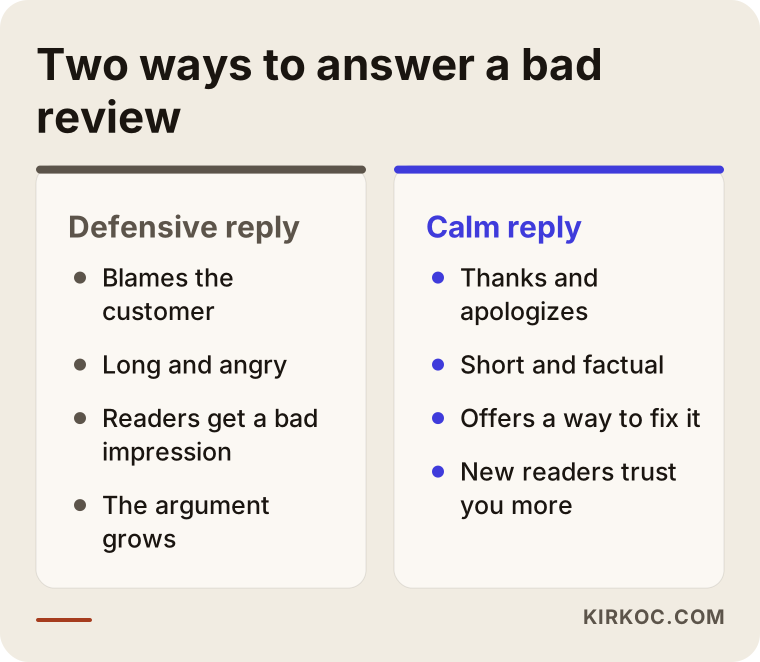
A good reply shares a few traits:
- It thanks and acknowledges. "Thank you for the feedback, and we're sorry about your experience" lowers the temperature.
- It is short and factual. Long defenses read like anger. Two or three sentences are enough.
- It offers a fix. Give a phone number or email, and take the details there, not in front of everyone.
- It shares no private details. Do not name the customer or describe their order, treatment or case under a public review.
- It does not accuse. Even when you are right, "this customer is lying" makes you the loser in the eyes of readers.
This line matters even more in health and legal fields. A clinic or law office cannot discuss a patient's or client's situation in a public reply; the only option is a polite answer plus a private channel. For such businesses I help you build wording that follows the rules and makes no promises about outcomes, but I do not write replies that contain medical or legal advice.
How do you get more reviews?
A business's rating often drops for one reason: satisfied customers stay quiet, unhappy ones write. The fix is to make writing easy for the satisfied ones. Right after the job, while the customer still feels good, send a message with a link that goes straight to the review page. Do not pressure anyone and do not offer discounts in return, since that can break platform rules. Just ask, and make it simple.
Honest, detailed reviews that gather this way naturally balance the weight of one harsh review. The goal was never to erase the negative one. It is to have enough real positive evidence next to it.
What decides the cost of reputation management
I will not give figures here, because what sets the price is the state of your case. When you ask for a quote, ask how each of these factors shows up in it:
- The type and number of problems. One location with a few reviews versus several locations, many platforms and scattered information are very different workloads.
- The state of your current setup. If your profile was never organized, the first setup takes more effort; if it was, the weight shifts to follow-up.
- The number of locations. Each location has its own profile, reviews and details.
- Work needed on the website. Do area and service pages need to be created from scratch, or only fixed?
- Follow-up frequency and length. Monthly reporting and regular attention is a different commitment from a one-off cleanup.
- Legal or special work. This is outside my scope; if needed, you work with a lawyer separately.
A good quote states which work will be done, which will not, and why results cannot be guaranteed. If a quote contains a guarantee, treat it with suspicion.
How to compare a reputation management company or consultant
When you talk to a reputation management company, I suggest these questions. How clearly they answer tells you a lot about their honesty.
- Do they explain their method? They should say what they will do and which route they will take on each platform.
- Do they guarantee removal? If so, avoid them. The decision is the platform's, not the consultant's.
- How is account access handled? Limited, authorized access, not a password.
- Where do the reviews come from? Asking real customers, not writing them.
- Is there reporting? You should be able to see what was done and what changed.
- What happens when the contract ends? Do the profile and the content remain yours?
- Can they name what is out of scope? Someone who says "I can't do that" is more trustworthy than someone who says "we do everything".
Suppose... two hypothetical scenarios
The two examples below are not real clients; they are made-up cases to make the situation concrete.
Scenario one. Suppose an auto repair shop has a low rating on the map, and at the top sits a sharp review from someone angry about a delay. The owner never replied. The review describes a real experience, so the chance of removal is low. What helps: a calm, factual reply ("Sorry about the delay; we now tell customers more clearly how long parts take"), a review link sent to satisfied customers after each job, and completing the service list, hours and photos on the profile. Over some months, new detailed reviews push the old one down in importance, but I cannot tell you in advance how long it takes or what the rating will become.
Scenario two. Suppose a café's profile carries a review from someone who never visited and who describes a completely different place, as if the café had been mixed up with another business. Here a policy report makes sense: the content does not match the café, and that can be explained concretely. The report goes in, and while waiting, a short polite note goes under the review: "The place described here does not match our café, so this may have been posted to the wrong business." If the platform removes it, good. If not, a reader who senses the review is off will understand from your reply. Either way, because the rest of the profile is strong, one review is not a heavy burden.
Do it yourself or hire someone?
Not every business has to bring in outside help. If you have a single location, a handful of reviews and a profile that is roughly in order, you can do most of this yourself. What matters is routine and consistency.
If you do it yourself, I suggest this: look at new reviews once a week, reply to each within two days, send a review link to every finished customer, and check that your profile details are current every three months. For most small businesses that is enough.
Hiring a specialist starts to make sense in these cases: you have several locations and the details are scattered, your name is written wrongly or differently on several sites, your profile has been suspended or restricted, negative items are piling up and you do not know where to start, or you simply have no time to set up a review routine. In those cases, outside help saves time and prevents mistakes.
When you do not need this service
To be honest, in some cases you should not spend money:
- You have one harsh review and everything else is good. Reply to it; the rest of the picture already defends you.
- Searches for your name show no problem. Then there is nothing to solve.
- You have very few reviews so far. Start asking satisfied customers first; that comes before anything else.
- The problem is the service itself. If customers complain about the same thing again and again, the service needs fixing, not the reputation. Reputation management does not cover up a bad experience.
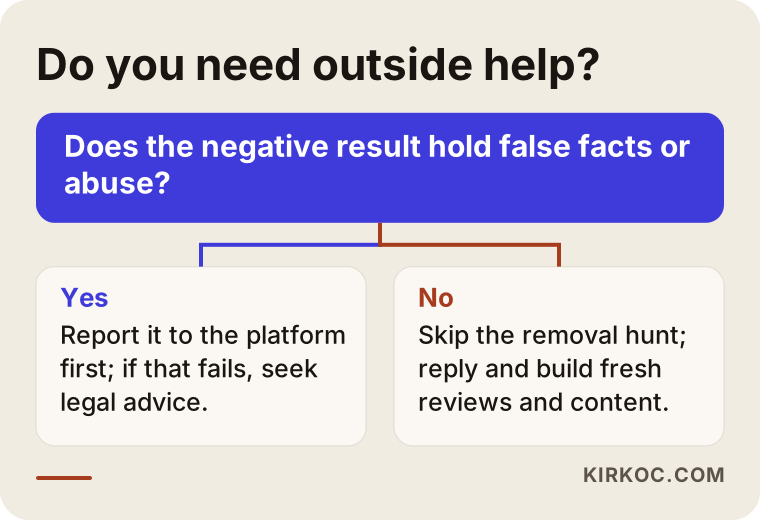
The decision tree above gives a simple test. If the negative result is truly false or breaks the rules, report it and, if needed, take the legal route. If not, stop chasing removal; reply, and build fresh, real reviews and content.
The most common mistakes
- Never replying to a review. An unanswered harsh review looks far worse than an answered one.
- Replying in anger. Replies written at night and regretted in the morning stay online.
- Pressing the customer to delete the review. A customer who feels silenced tends to write more.
- Buying reviews. A relief in the short term, a threat to your account in the long term.
- Letting details go stale. A wrong phone number, an old address or wrong opening hours lose more customers than a complaint does.
- Looking at only one platform. A customer may check the map, your site and a complaint site; look at all three.
- Starting too late. Reputation takes the least effort to protect when it is built before a problem appears, not after.
Frequently asked questions
Can you get a negative Google review removed?
No one can do that alone; the decision belongs to the platform. If a review is fake, off-topic, abusive or against the rules, I can help report it with the right reasoning. A real customer's real experience mostly stays, and then the right path is replying and collecting new reviews.
Should I pay to have my negative reviews deleted?
I would not pay anyone who sells a "removal guarantee". Since the decision is the platform's, nobody can promise the outcome. What is worth paying for is real work: organizing the profile, setting up a review routine and following up.
Does paying for fake positive reviews work?
It might lift your rating for a short time, but it is risky over the long run. Platforms detect fake reviews, and if you are caught reviews can be removed and your account restricted. Customers also notice formulaic, detail-free praise. I do not help with this method.
Should I reply to an unfair review?
Yes, but keep it calm and short. Your reply speaks not just to the writer but to every new customer who reads it. Do not blame the customer, do not share private details, correct the facts in two or three sentences, and offer a private channel.
Can an old record on a complaint site be removed?
It depends on the site and its rules. If the record is false or outdated, you can write to the site; some sites also let the business respond. If it is true, it will often stay. Then the work is to make your own site and profile stronger on the same results page.
How long until results change?
I will not give a firm time, because review accumulation, platform responses and search updates are outside my control. With steady work, you start to see change within months, but I cannot guarantee rankings or ratings.
How should reviews be handled in health or legal fields?
You cannot discuss a patient's or client's details in a public reply, and you cannot use outcome-promising language. I help you build rule-friendly, general and polite replies, and I do not provide medical or legal advice.
Is this needed for a solo business?
Often not. If you fill in your profile properly and reply to reviews, that is already what you need. Outside help becomes useful when the business grows and details scatter, or when a serious problem appears under your name.
If you are unhappy with what appears when you search your name, let's first work out together what is a real problem. Write to me, and after looking at your profile and the search results I will give you an honest roadmap. You can see the scope and the way I work on the local SEO services page, and then reach me through the contact form.