Your products are solid, your documents are in order, the warehouse is stocked, and yet your website brings in a handful of random calls a year. That gap is what medical device SEO is meant to close. It is the work of making sure that when a hospital purchasing manager, a distributor, or a family member shopping for home care equipment types a search into Google, your product is on the page they see. I am an independent SEO and web consultant working remotely, and below I explain, in plain language, what is different about this sector and what to look for before you hire anyone. If you want the general picture of how I work first, my SEO services page covers it.
This article is not meant to teach you technical tricks. It is meant to help you make a decision. By the end you should know who is searching for you and how, why product pages are the foundation of everything, where advertising and health-claim limits begin, and when you should not spend money on this at all.
A medical product has more than one buyer
In most industries, "the customer" is one person. In medical supplies and devices, the same product often has several different buyers, and each one types something different into a search box. If you build your site for only one of them, you lose the other two.
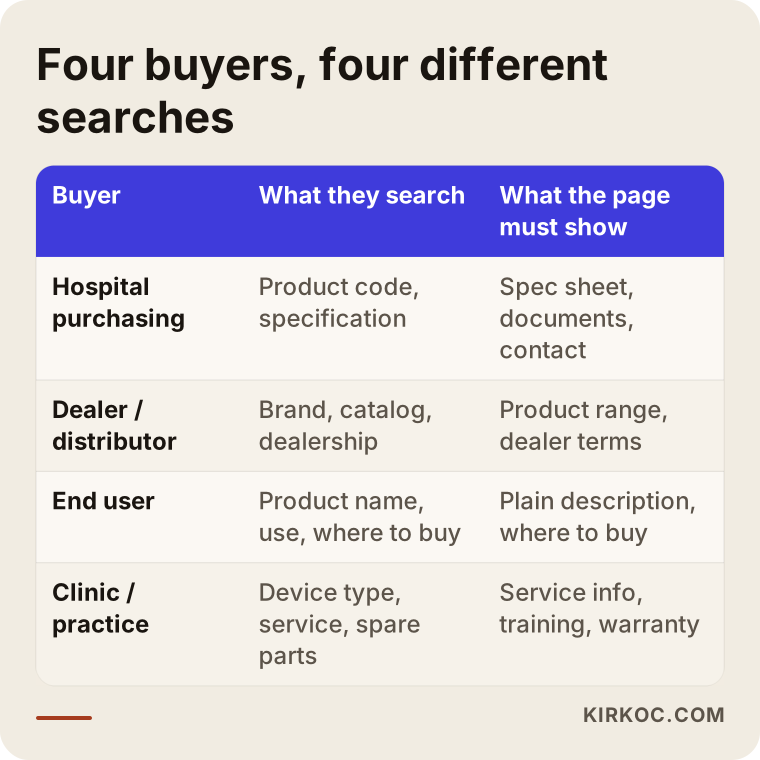
Once you see the table, your site structure starts to change. Hospital purchasing searches by product code, size, or the exact wording from a specification. A dealer searches for brand and dealership terms. An end user often does not know your product name at all; they type their problem, such as "mattress to prevent pressure sores" or "which blood pressure monitor is reliable." One home page cannot answer all of that. Each audience needs its own pages.
Hospitals and institutional buyers
Institutional buyers are not impulsive, but they are thorough. Before ordering, they compare specifications, ask for documents, and look at similar products. If your site does not give them what they need, they close the tab and open a competitor's. For this audience the most important thing is that technical details on the product page are accurate, scannable and downloadable. A page with one photo and the line "call for details" will never get that call.
These buyers usually type a product type plus words like "manufacturer," "wholesale," "supplier," or "quote." Using those words naturally in page titles and descriptions is one of the first and simplest steps.
Dealers and distributors
A dealer is looking for a company standing behind the product. Their questions: is the range broad, is there service and a spare parts supply, is the territory still open, is the catalog current? They often find you at a trade show or through a contact, but afterward they always check the website. If the site looks neglected or the catalog is a two-year-old PDF, trust drops immediately. A short page for dealers, something like "become a dealer: terms and how to apply," shows up in searches and tells the other side you are serious.
Home use and end users
For care products, orthopedic supplies and measuring devices, the end user is frequently a family member. They search under stress, are not sure what they need, and want to know where to buy. Speaking to them in technical language does not help; explain what the product is for, who it suits, and how to get it. This is also where you must avoid medical advice and promises such as "this product cures a condition." I come back to that below.
What makes you stand out in the results
For any given search, Google shows three kinds of pages: companies selling something, guides, and directory sites. As a manufacturer or importer, your place is in product and category pages. Guides can introduce you, but a hospital buyer does not read guides; they look for the product.
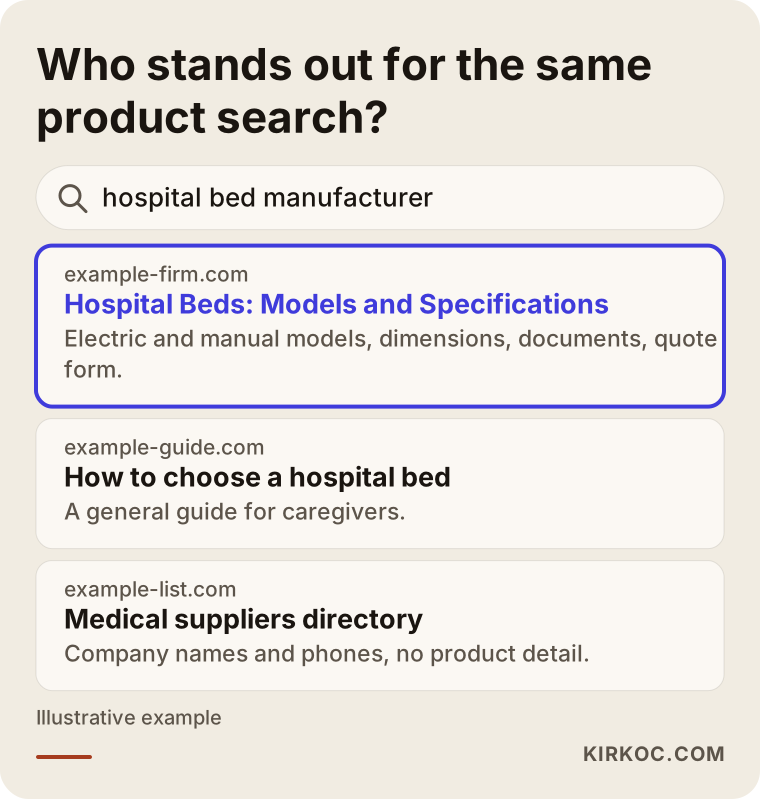
In this illustration, three results answer the same search but serve three different needs. For someone looking for a manufacturer, the first result, with models, dimensions and documents, is the useful one. The guide helps a caregiver. The directory gives no product detail, so it does not satisfy an institutional buyer. Your target is to be the first kind, and for that your page must say in a glance what you sell, who you sell to, and how to order.
AI-assisted search tools are now answering similar questions too. Someone asking "which companies make this type of device?" will be pointed toward sites that are clear, consistent and documented. Keeping product information in one tidy place, rather than scattered, helps both Google and these tools.
Product and catalog pages carry most of the load
The most common mistake I see on medical sites is a single "Products" page with small thumbnails and short names. Google learns nothing from it: no category, no description, no detail. Worse, neither does the buyer.
The better structure is this: category pages first (for example "Hospital beds," "Wheelchairs," "Blood pressure monitors"), then individual product pages under each category. Every product page should be an answer to a search on its own.
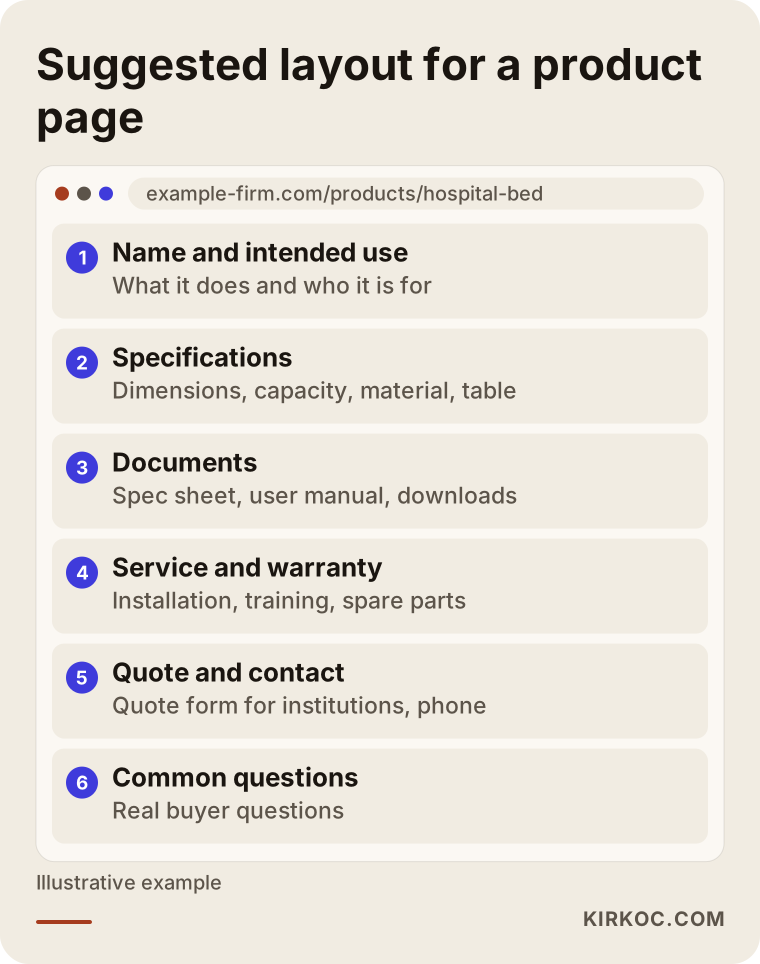
The order in the mockup is not arbitrary; it follows the questions a buyer asks. First "what does it do," then "what are the dimensions and features," then "are there documents," "how is service handled," and finally "how do I get a quote." Each of these must exist as real text on the page. If you put the specifications in an image, Google cannot read it; if you put them in a table, both Google and the buyer can compare.
Product names and titles
Internal model codes are useful but do not replace the words buyers type. Put both the model name and the general product name in the title: "XR-200 Electric Hospital Bed" rather than "XR-200." That small change is the first bridge between the person searching and your page.
One product split across many pages
Size or color variants often get their own pages with nearly identical content. That leaves Google guessing which to show. Combining the options on one page and showing the difference in a table often works better. I decide this by looking at your site; the right answer is not the same everywhere.
A PDF catalog is not enough
A PDF catalog is useful to a dealer, but on its own it ranks poorly. Offer it as a download next to the page, and keep the real information on the page itself as text.
Advertising and claim limits: where to stop
Promoting medical products is not a free-for-all. What can be promoted, through which channel, to whom, and with which wording is limited by regulation, and the rules differ by product type, risk class and sales channel. I do not give legal or medical advice; the rules that apply to you should be known by your regulatory lead or advisor. My own limit is simple: I only write wording that you have approved and that matches your product documentation and intended use.
In SEO terms this has a practical meaning. Phrases such as "guaranteed recovery," "ends your pain" or "the only solution" are risky under the rules and also harm credibility. Instead, a plain tone describes what the product is, what it was designed for, how it is used, and what documents exist. Compliant content is content that makes no promise of results.
Also keep in mind that for some product groups, direct promotion to the general public may be restricted. In that case your site can be built to speak to institutional buyers and professionals, while pages for end users stay informational and do not push a sale. Deciding which page is open to which audience is a decision you make with your compliance contact; I arrange the pages around it.
Paid advertising is a separate topic and easy to confuse with SEO. SEO is not paid ads; it aims at appearing naturally in search results. Ad platforms may have their own policies for health products, and some items may not be allowed to advertise at all. When that is the case, being visible in organic search becomes more valuable.
Trust documents and company information
Anyone buying a health-related product, whatever the purpose, asks "is this company real and is the product done properly?" Your site should answer that question. Google looks at similar signals: who the company is, where it is, and under what records the product is sold.
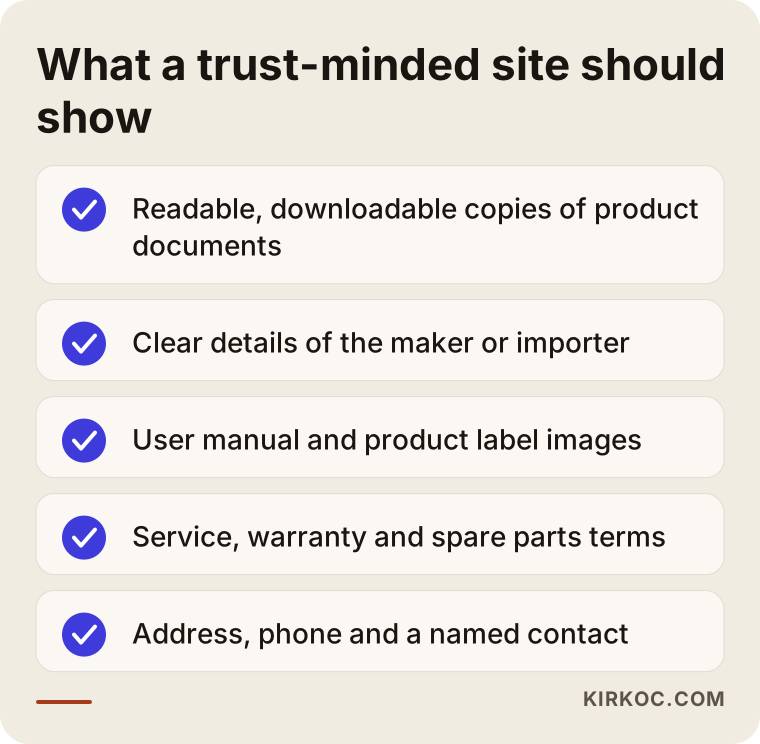
None of the items in the checklist are decoration. Readable copies of product documents are what make an institutional buyer think "we can work with this company." Keeping those documents current is your responsibility; leaving an expired document on the site is worse than showing none. I do not decide for you which documents to publish, but I place the ones you choose so that buyers can find them and search engines can read them.
The "About" and contact pages are part of the same job. Address, phone and contact person should read the same on every page and match your Google Business Profile exactly. Inconsistent details make both the buyer and the search engine hesitate.
What decides the cost, and how to compare quotes
There is no single fixed price for medical SEO, and there should not be. I am not giving figures in this article, because the cost depends on factors like these:
- Number and variety of products: a catalog of twenty items is not the same job as a catalog of two hundred.
- Current state of the site: are products already on separate pages, or lumped together on one?
- Number of languages: if you export, each language is its own content job.
- Competition: reaching the top for a common product group takes longer than showing up for a niche device.
- Content needs: how ready are your documents, FAQs and guides?
- Scope: fixes only, or ongoing content and monthly reporting as well?
When you receive a quote, check a few things. Did the person actually look at your site, or is this a stock package sent to everyone? Is it written down what will be done? What will you see in the monthly report? Be wary of anyone who offers a "first page guarantee"; no one can guarantee a ranking, and that promise is one of the first warning signs. In a sensitive field like this, also ask: "How do you handle health claims, and does content go live before I approve it?" If the answer is vague, treat it as a serious red flag.
When you compare two quotes, compare scope, not price. A low quote often means less work, vague work, or tasks left for you that were not written down.
How working with me runs
The process is defined and shared in writing at the start, so you know what happens when.
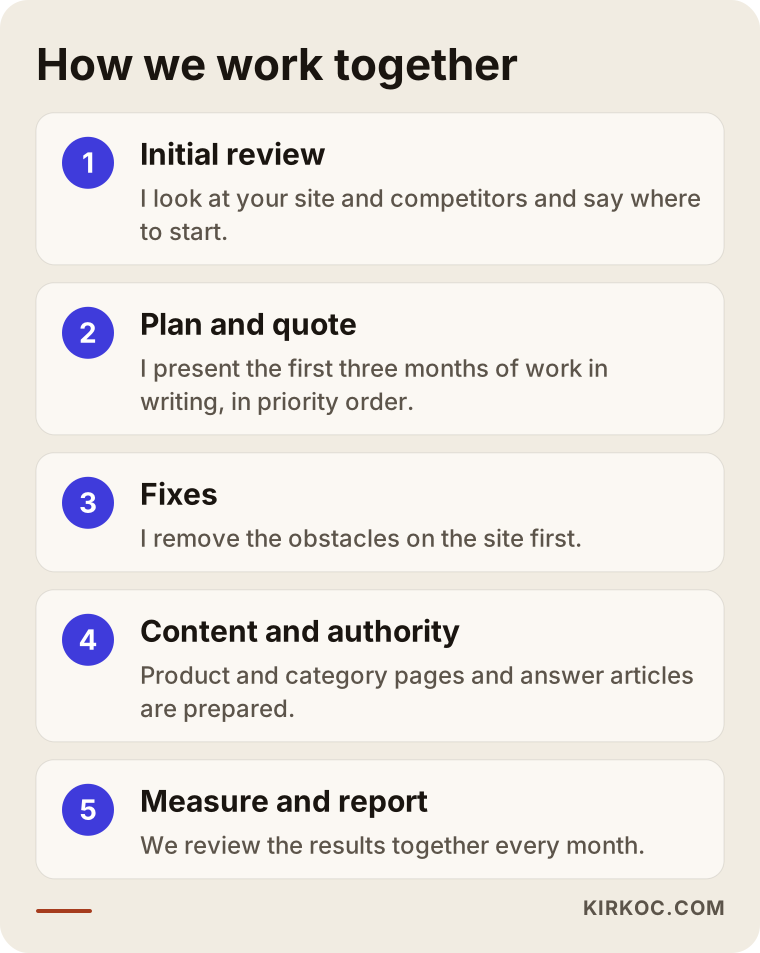
First I review your site and competitors and tell you where to start. Then I present the first three months of work in writing, in priority order; the quote is based on that. Next I remove the obstacles that slow the site down, keep pages hidden from Google, or break on phones, because those give the quickest effect. After that, product and category pages and articles answering buyers' questions are prepared for your target searches, and the site's reputation is built up. Every month I explain in a plain report what was done, how the searches moved and what comes next.
For a medical site I add one step to this: every text that contains a health or product claim goes to you for approval before it is published. You know the real features and document scope of the product better than anyone.
Two hypothetical companies
The two situations below are purely hypothetical, not real clients.
First example. Suppose a small manufacturer makes hospital beds and supporting care equipment. Most sales come through dealers and a few institutional tenders. The site is a one-page introduction: three photos and a phone number. The first job is to split products into category and product pages, add a specification table and documents for each model, and create a dealer application page. For searches like "hospital bed manufacturer," visibility may grow over time, but how long it takes and where it lands depends on competition, and I cannot promise it. The gain is that dealers and institutions can now find you when they search, and trust you when they do.
Second example. Suppose an importer sells home measuring devices, and most products are already distributed through pharmacy and medical store chains. There is no direct selling from its own site, but end users keep asking where to buy. The focus becomes a "where to buy" page, plain usage descriptions and a list of authorized sellers. Wording that implies medical claims is removed; the page explains what the product is, how it is used and what documents exist. For this company, SEO is an information layer supporting its sales network, not a direct sales channel.
Both cases follow the same principle: look first at who is searching, then at what that person wants to see.
Common mistakes on medical sites
These are the most frequent problems I see. Most are not expensive, only unnoticed.
- Putting products in as images. Uploading the specification table as a picture costs you in search and in accessibility.
- The whole catalog on one page. Each product needs its own address, title and description.
- Hiding documents or leaving old ones up. Uncertainty damages trust.
- Exaggerated health promises. Guaranteed-result sentences are risky and unconvincing.
- Writing only for the end user. The institutional buyer leaves when technical information is missing.
- Copied descriptions. Many sites paste the manufacturer's text unchanged; Google may pick another site over yours. Write in your own words from your own knowledge.
- Poor mobile experience. A family member usually searches on a phone. Tables or PDFs that cannot be read on a phone are a frequent loss.
- Slow pages with heavy images. Large product photos that are not compressed make pages open late.
- Inconsistent contact details. One phone number on the site, another on the business profile.
When you do not need this service
To be honest, not everyone needs SEO. If most of your sales come through tenders and public procurement, your dealer network is settled, and you do not need new buyers, your priority is keeping the site accurate and current. Instead of investing in SEO, regularly updating your documents, catalog and contact details may be enough.
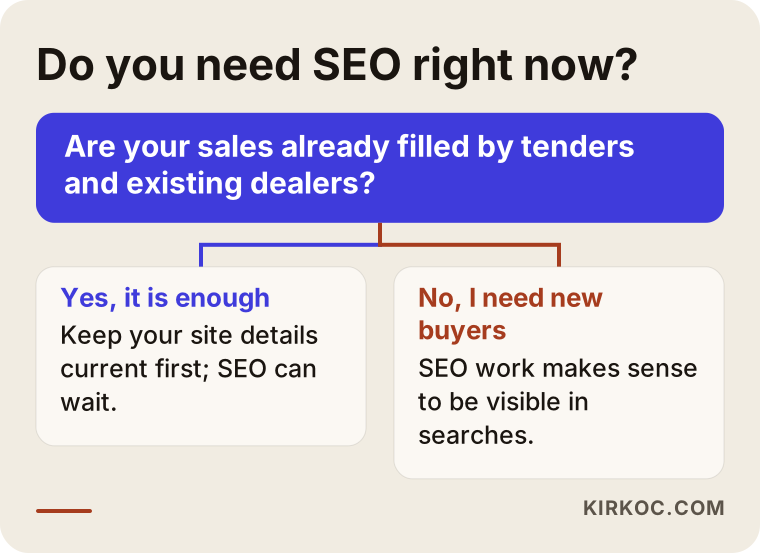
SEO helps in different situations: you want new dealers, you are starting to export, competitors keep appearing ahead of you, or you are launching a product in an area where your brand is unknown. For a company with no website at all, or products not yet documented, it is healthier to build a solid site first and think about SEO afterwards.
Timing matters too: SEO is not a quick switch, it is cumulative work. Starting today and expecting phone calls tomorrow is unrealistic. If you are under sales pressure and need results immediately, you may need other channels in the short term.
Doing it yourself versus hiring help
You can, and should, do part of it yourself. You know the products, the documents and the questions buyers ask; no consultant knows that as deeply as you do. You can write the first draft of a product page, scan and prepare your documents, and keep your Google Business Profile consistent.
Specialist help adds value in other places. Finding technical obstacles (it is hard for you to see why your site does not appear). Choosing the right searches, separating what a hospital buyer types from what a family member types. Building the page structure and measuring and correcting over time. And doing all of that while respecting the limit on health claims.
There is a middle path: split the work. Product knowledge and approval come from you; structure, technical fixes, planning and reporting come from me. That keeps cost reasonable and keeps the content true to the product.
Frequently asked questions
Is medical device SEO different from regular SEO?
The core logic is the same, but the points to watch differ. The audience is more varied (institutions, dealers, end users), documents and trust signals matter much more, and promotional wording is limited by rules. That is why pages are built more carefully and content goes through your approval.
Which page should a medical equipment company build first?
The page for the product you sell most or get the most quote requests for. Building one product page correctly gives you a template for the others. Category pages and a dealer or quote page come next.
Which documents should I show on my website?
That depends on your product type, and your regulatory lead or advisor should decide; I do not give legal advice. My job is to place the documents you decide to show so buyers can find and read them.
Can I use words like "heals" or "treats" for my products?
Such wording can be risky if it does not match the product's documentation and intended use. I do not write sentences that promise results; I describe what the product is and how it is used. The safest route is to settle the wording with your compliance contact.
How long does it take to see results?
I cannot give a firm time, because it depends on competition, your site's current state and the product group. Technical fixes can show an effect earlier; product and content work builds over a few months. I do not guarantee rankings or sales, and I do not believe anyone honestly can.
Does this apply to online medical supply stores too?
Yes, with a different emphasis. With thousands of products, category structure, original product descriptions and site speed come first. Standing apart from stores that copy manufacturer text is one of the biggest gains in this area.
If I sell abroad, do I need SEO in other languages?
If you are targeting foreign buyers, yes, but translation alone is not enough; you need separate pages using the words that buyers in that country actually use. The target country's own product and promotion rules may also apply, and you need to confirm that with whoever is responsible for that market.
Can I do the work myself and only buy consulting?
Yes. Some companies take the plan and review from me and carry out the work in-house. That is a workable path, and we define the scope in writing at the start.
If you sell medical products and wonder why your site is not reaching the buyers you want, write to me; I will look at your site and your competitors and tell you plainly where to start. You can reach me through the SEO services page and ask for a short first conversation.