Your current clients know you, trust you with their shipments and keep recommending you. But when a company preparing its first import, or an exporter unhappy with its current broker, types a question into Google, does your site come up? For most customs brokers the honest answer is "no" or "I'm not sure." That is rarely because the work is weak. It is because the website does not tell Google, or the business owner reading it, what you actually do. SEO services built for customs brokers close that gap by putting you in front of the right company at the right moment.
How importers and exporters search for a customs broker
Few buyers in this field type "customs broker" and click the first result. Most have a shipment, an order or a problem, and they search around it. A newcomer to importing types things like "what do I need to import furniture," "how to import clothing from overseas" or "my container arrived at the port, what now." This person is not shopping for a broker yet. They are trying to understand the process. The broker who explains that process clearly is the first one they trust.
A company that is unhappy with its current broker searches differently: "switch customs broker," "customs broker near the port of Savannah," "export customs clearance help." These searches are rarer but sit close to a decision. A third group is the logistics or procurement manager at a larger company, who wants a broker that is steady and predictable rather than flashy.
In practice the searches fall into three layers.
- Learning searches: how the process works, which documents are usually needed, what to watch for.
- Comparison searches: which broker handles this product, this port, this kind of entry.
- Urgent searches: cargo is waiting, a document is missing, something went wrong.
Knowing which layer your site answers is half of an SEO project. Most broker sites have only an "About" page and a "Services" page, and neither answers the real sentences these three groups type.
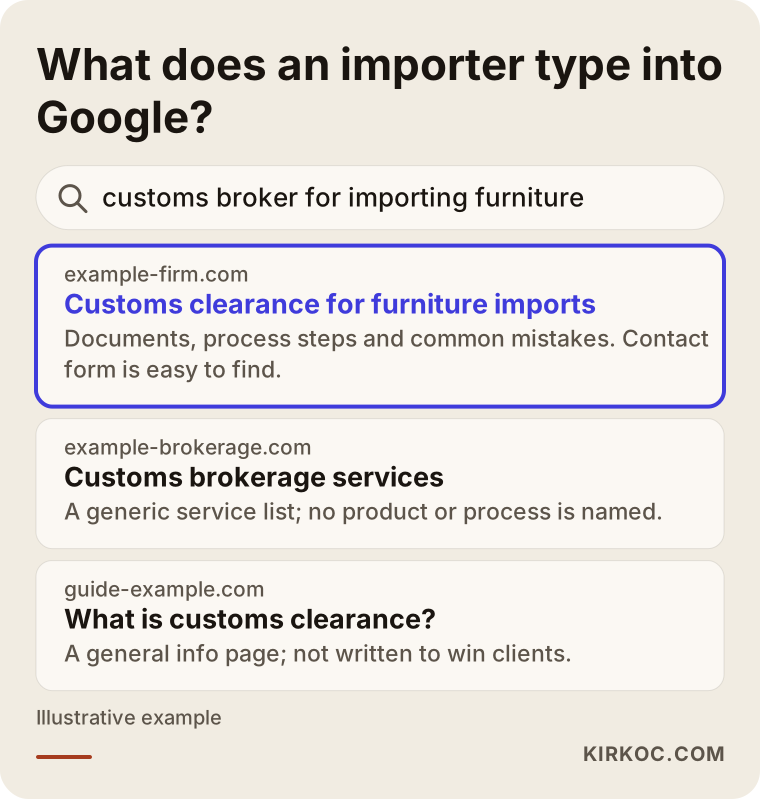
Why one generic services page is not enough
Many brokerage sites have a single page: "Services: import, export, bonded warehouse, temporary entry..." The visitor reads the list, finds nothing about their own situation and leaves. Google sees the same thing. A page that mentions every topic in one line is a strong answer to none of them.
The fix is a separate, properly filled page for each important service. Import clearance gets one page, export another, temporary entry a third. Each explains how that service generally runs, which kinds of documents clients are usually asked for, who does what at each stage, and the questions people often ask. The test is simple: after reading, a business owner should think, "this person knows the work and has told me plainly how we would work together."
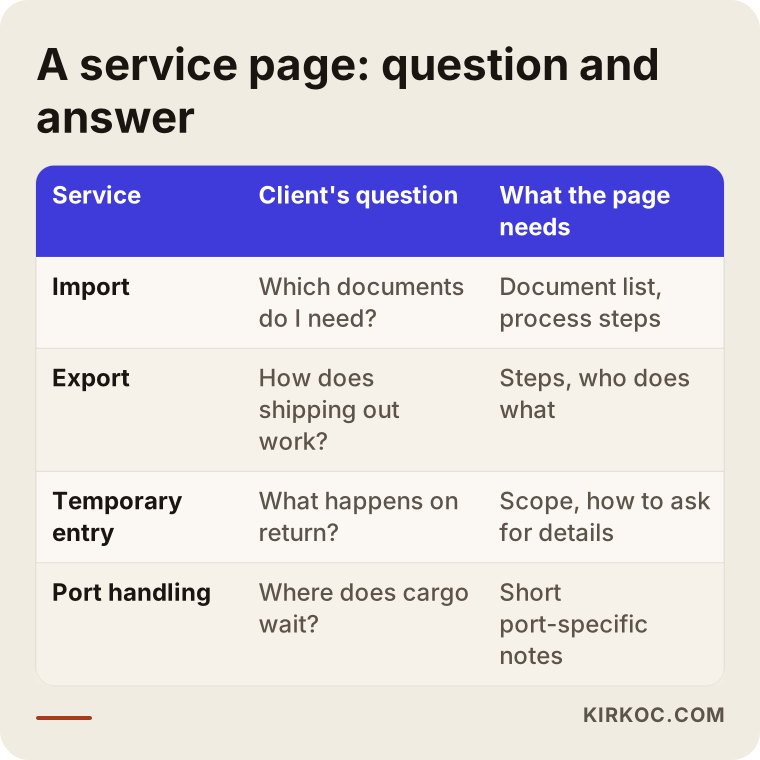
Pages by product and industry
Importers often think by product, not by service type. "Furniture import," "auto parts import" and "food export" are typical examples. If you really do handle these product groups, a short, honest page for each can set you apart. The page should give general information about that product category but should not give a final ruling on any single item. I explain why in the next section.
Port and city pages
Where cargo arrives or leaves goes straight into the search. You can build separate pages for the ports, offices and regions where you actually work. Do it only for places you really serve. A page for a port where you have never handled a shipment misleads the reader and weakens Google's trust in your site. Each port page should carry short, real notes: how cargo is usually received there, how you run the process, and where your office or agent is.
Where information ends and advice begins
Customs is a field where rules change and each product is assessed on its own facts. Every sentence on your site can therefore read like a promise. A good brokerage article explains the process without guaranteeing an outcome for any specific product. As an SEO consultant I do not give customs or legal advice, and this article does not either. What matters is that you keep the same line on your own site.
In practice: "Importers are usually asked for these kinds of documents" is information. "Your product will carry this duty and does not need that document" is an assessment, and publishing it is risky and can mislead the next visitor. Give general information generously on your pages, and leave product-specific decisions to the inquiry form or a phone call. That protects you, and it nudges the visitor to write to you, because the firm answer requires a conversation.
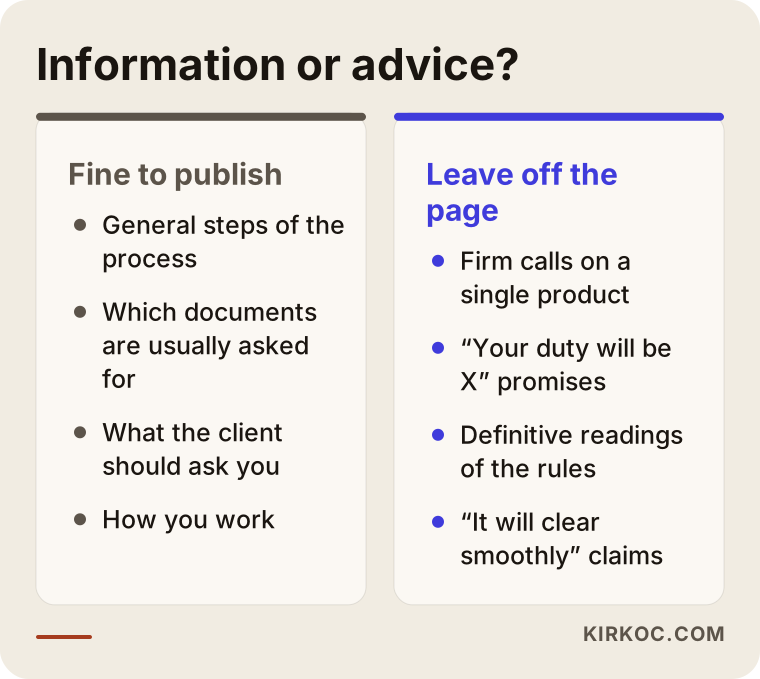
Likewise, stay away from phrases like "it will clear without problems," "the fastest solution" or "you will never face a penalty." These are outcomes you cannot control. Language that earns trust describes how the process runs, who does what and when the client is updated.
B2B trust: what a corporate buyer looks for
For the owner of an import company, choosing a broker means handing over goods and cash flow. So at decision time they read your site less like a business card and more like a reference file. They usually look for the following.
- Who you are: your name, your licensing status, office address and phone number, clearly stated.
- How you work: the steps from start to delivery, explained.
- How to reach you: a form, phone and email that are easy to find.
- How carefully the site is kept: do pages open well on a phone, are there broken links or outdated facts?
Do not invent references. If real clients allow it, mentioning the company name and type of work briefly is a strong trust signal. Without permission, an anonymous description at the level of "industry and type of entry" is enough. What counts is that everything you write is true.
What the page layout should look like
A good service or port page does not need a clever design. It needs an orderly structure that answers questions. In the first paragraph the visitor should see which service this is, who it is for and how you work. Then comes the step-by-step process, the documents generally requested, common questions and, at the bottom, a short contact form.
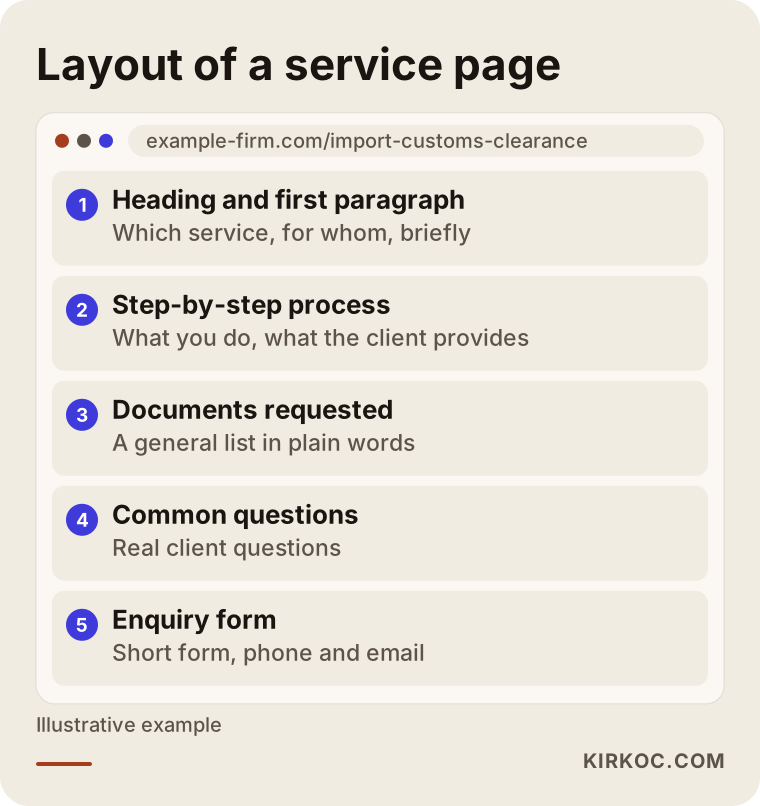
Keep the form short: name, company, type of service and a phone number or email are enough. Long forms put off exactly the urgent client. Keep your phone number visible at the top of the page too, since someone with cargo waiting would rather call than fill in a form.
AI assistants and guide-style answers
Many business owners now put a question to an AI assistant first: "I'm importing for the first time, where do I start?" These assistants draw on clear, well-organized, trustworthy sources. If your site has pages that explain the process plainly and accurately, your name may appear among the sources. I cannot guarantee that, but the most useful step in that direction is making your site answer questions clearly, briefly and correctly, which is what classic SEO wants anyway. This work is called GEO, and you can read more on my SEO services page.
Guide articles: reaching the buyer who is still learning
Someone about to import for the first time is not looking for a broker today, but will be next month. You can reach that person with plain guides such as "five questions to ask before your first import," "how to plan paperwork for an export" or "what to bring to a first meeting with a broker." The job of such articles is not to sell. It is to answer the question in the reader's head and leave the impression of someone who knows the work. Keep them short, avoid jargon, explain any unavoidable term in one sentence, and link each article to the relevant service page. One good article a month beats ten mediocre ones.
Your map listing and reviews
Someone searching "customs broker" with a city name will often see a map and a few businesses above the regular results. To appear there, your Google business listing must be accurate and complete next to your site: business name, address, phone, hours and service types. If the address or phone differs from your site, Google does not know which to believe.
Reviews are sensitive in this field. Your clients' commercial details are confidential. You do not have to ask anyone for a review, but if a happy client writes one, thank them and share no details of the work in your reply. Buying reviews, inventing them or offering discounts in return breaks Google's rules and wipes out trust in the eyes of a B2B buyer.
Preparing a page for the urgent caller
A company with cargo stuck at a port does not want to read long text. For that person the top of the page should say which services you handle, your phone number, when you can be reached and what you will ask for on the first call. Writing down what you need up front calms the urgent caller and reduces your own phone traffic. Two sentences such as "on the first call, it helps to share the type of goods, the country of origin and the current status of the shipment" prevent pointless call-backs.
The urgent caller also has a trust question: "Will this person really get back to me?" The best answer is a realistic promise about response time. Do not write a time you cannot keep. "I reply the same business day" is worth more than an elaborate pledge.
A site that also serves your existing clients
SEO is not only about attracting new clients. Accounting or logistics staff at companies you already serve may open your site to check "which documents did I send last time." A plain FAQ and a document reminder page cut your phone traffic and look professional. The page that convinces a new visitor and the page that helps a current client are often the same page. Build it with both in mind and one effort does two jobs.
What this service gives you, and what it does not
SEO for a customs brokerage aims to make your site appear in the right searches and move visitors to contact you. I work alone, and the scope includes: a full review of your site, research into what your clients really search, fixing technical obstacles, strengthening service and product pages, tracking competitors and a plain monthly report.
What it does not do: it does not guarantee a particular ranking or number of clients. No honest SEO work can, because Google decides the result. It also does not supply customs expertise. You, as the specialist, check the technical accuracy of the pages. I build the structure, the searches, the language and the layout, and the professional accuracy of the content passes through your approval. That split protects both you and the reader.
How the work runs
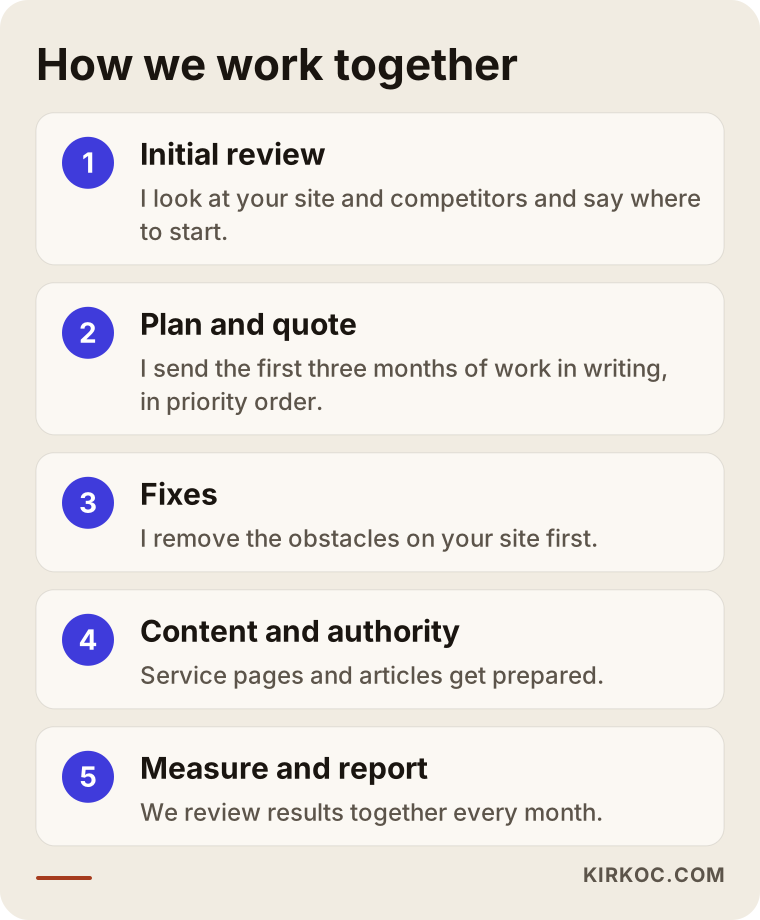
The process is simple. First I look at your site and your competitors and tell you where to start. Then I present the plan for the first three months in writing, in priority order. Next I remove the obstacles on your site, because they give the fastest effect. After that, pages and articles are prepared for the targeted searches and the site's authority is strengthened. Finally we review the results together each month and update the plan.
You are part of the process. You need to set aside time to confirm the professional accuracy of the content. That does not mean weeks of meetings, but no page should go live without your approval.
What shapes the cost
I will not give numbers, because every site is different. But knowing what shapes a quote helps you compare the ones you receive. The main factors are these.
- The current state of your site: if it is technically clean the job is lighter; serious obstacles take effort first.
- How many services, products and ports need pages: five pages and twenty pages are not the same job.
- Number of languages: addressing foreign buyers in another language widens the scope.
- How crowded the market is: in busy metro searches the competitors are stronger.
- Duration and frequency: a one-off cleanup and ongoing monthly work are different items.
When you assess a quote, look at whether the scope is written down as well as the total. "We will do SEO" is not a scope. It should say which pages will be written, which technical jobs will be done and how reporting works.
Criteria for comparing quotes and providers
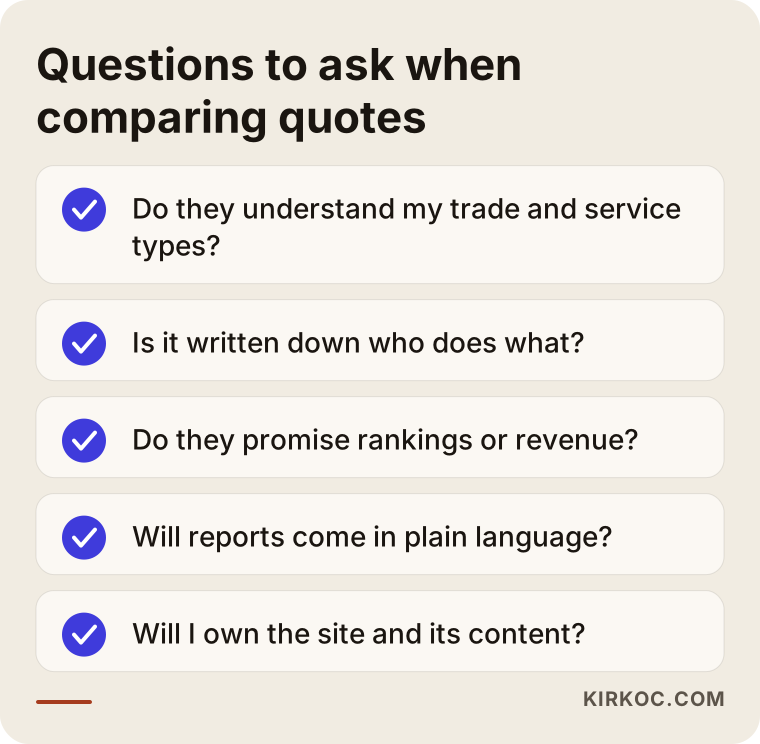
If you are collecting quotes from several SEO providers, these questions make a difference. Do they understand your trade and service types, or do they apply one template to every business? Who will do the work: the person you talk to or someone else? Do they promise rankings or revenue? Stay away from anyone who does. Will reports come in plain language? And most important: will the site and content belong to you, or does everything stay with them if you leave?
Imagine two hypothetical scenarios
Scenario one. Imagine a broker in a mid-sized port city with solid experience in furniture and home textile imports. The site has a single "Services" page, and almost every client arrives by referral. New client numbers have been flat for a few years. After the project, the site has separate pages for furniture imports, home textile imports and the general import process, each with a general document list and common questions. The broker approves every sentence with their own professional eye and leaves product-specific calls to the form. The hope would be to start hearing from companies saying "I'm importing for the first time," but that is only a hope; no result can be guaranteed.
Scenario two. Imagine an export-focused brokerage working heavily out of one coastal port, but the site never mentions the port. Prospects search "export customs clearance near the port" and this broker does not show up. In the project, a short, real page about the port is prepared, the export process is explained step by step and contact details move to the top of the page. Results do not come at once, since Google takes time to assess new pages. But the monthly report shows whether the page is starting to appear for relevant searches, and the plan is updated accordingly.
Common mistakes
These are the repeat mistakes I see in this field.
- Having only a general service list. Each service needs its own page.
- Opening a page for every port and city. Pages for places you do not serve damage trust.
- Promising exact duties or timing. Keep information and advice apart.
- Leaving outdated rules on the site. An out-of-date page is worse than no page.
- Hiding contact details. Phone and form should be one click from every page.
- A site that breaks on phones. Urgent clients often call from their phones.
- Trusting referrals and neglecting the site. Even the person who refers you may check you on Google first.
When you do not need this service
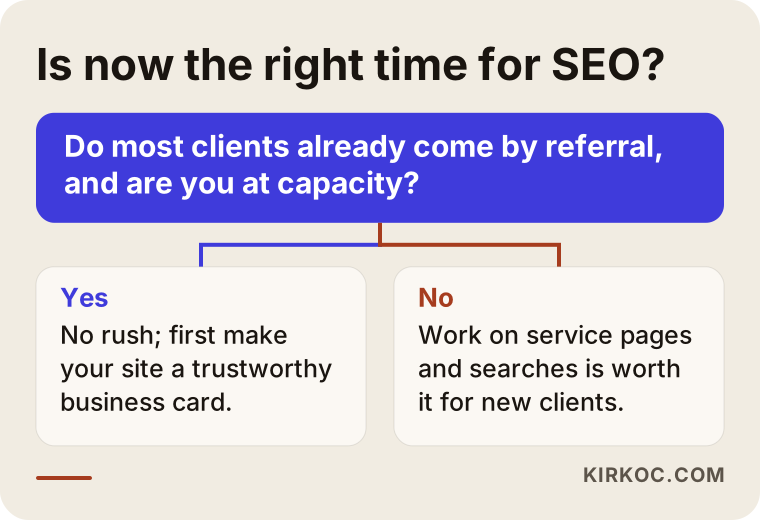
Let me be honest: now is not the right moment for everyone. If nearly all your clients come by referral, you are at capacity and you do not want more work, there is no rush for SEO. Even then, your site should be a trustworthy, working business card with correct contact details, and that does not take a big project.
Likewise, if you are thinking of rebuilding your site soon, it may make more sense to settle the structure first. Spending SEO effort on an old site and then replacing it is wasteful. And for a broker who works with only a few large clients and needs no new ones, this service is unnecessary.
Do it yourself or hand it to a specialist
You can do some things yourself: check how your business name, address and phone appear on Google, fix broken links and outdated facts on the site, and write first drafts of your service pages from your own professional knowledge. You do not need a specialist for those, and that content should come from your expertise anyway.
Handing it over makes sense when you do not know which searches will bring work, when technical issues keep your pages out of Google, when you cannot tell why competitors are ahead, or when you have no time for steady, regular work. The split is natural: the knowledge of the trade is yours, the knowledge of searches and structure is mine.
Frequently asked questions
Does SEO really bring a customs broker new clients?
If a business owner types the topic they care about and your service page comes up, the chance of them contacting you is real. There is no guarantee, though, because I do not control Google's rankings. What I can do is make your site answer the right searches and show progress in a monthly report.
How long until I see results?
It depends on your site's condition and on competition in the searches. Some effects of removing technical obstacles may show within a few weeks, but new pages usually take months to settle. I suggest thinking of SEO as steady work rather than a one-time job.
Is publishing regulatory information on my site risky?
Describing the general process is normally fine, but rules change often and every product is assessed separately. I suggest not publishing product-specific firm outcomes and checking the date and currency of what you write. I do not give legal or regulatory interpretation; you approve the professional accuracy of the content.
Do I need product and port pages, or is one page enough?
One page explains one topic well, while people in this field search differently for different services and products. A separate page for every important service you really handle gives both visitors and Google a clearer answer. Do not open pages for things you do not do.
Can social media or ads replace SEO?
When ads stop, visibility stops. SEO is value that builds over time. In a trust-heavy field like customs, people also check the site before deciding. Ads can help in the short term but do not replace a lasting search presence. The two can be used together.
Can I also reach buyers abroad?
Yes, with a multilingual structure you can address foreign buyers too. That needs pages that suit each country's reader and do not read like translations. A larger scope also affects the cost. It is important to be clear from the start about which languages you can really serve.
Do I need an existing website to work with you?
No. A brokerage without a site, or with one that needs replacing, should first build a solid structure. If you already have a site, I review it first and tell you whether rebuilding or fixing makes more sense.
How do we start?
First a short conversation, then I look at your site and your competitors. After that I present the plan for the first three months in writing, in priority order. If the plan and quote suit you, we begin with the fixes.
If you want the right companies to find your brokerage, let's review your site together. You can reach me through my SEO services page, tell me about your services and the clients you want to reach, and I will tell you honestly what will help and what you do not need.