For a solar company, each job is the end result of a long chain of site visits, design work and installation. That makes every new customer worth a lot, and every lost quote request a real loss. Someone who types "solar company" or "solar panel installation for my home" into Google is usually comparing a few firms at once. If you are not among the first results, you never make it onto their shortlist. Solar company SEO is the work of showing the right page of your website for those searches and walking the visitor toward asking for a quote. In this article I explain what that work involves, who needs it, what drives the price and how to judge a proposal, using plain language and my SEO services as the reference point.
How do solar customers actually search?
Buying solar does not look like buying a cheap product. People first learn, then compare, and only at the end ask for a quote. Each stage has its own searches.
While learning, they type things like "how do solar panels work" or "is rooftop solar worth it". While comparing, the phrases get commercial: "solar company", "solar installer near me", "commercial solar installation". When deciding, the city and the firm name appear: "solar installer in Denver", "firm name reviews". If your site only speaks to the third stage, you lose people to a competitor at the second. If you only write for the first stage, plenty of people read you and nobody asks for a quote.
The second feature of these searches is that they split by who is asking. Three people typing the word "solar" may have completely different projects in mind.
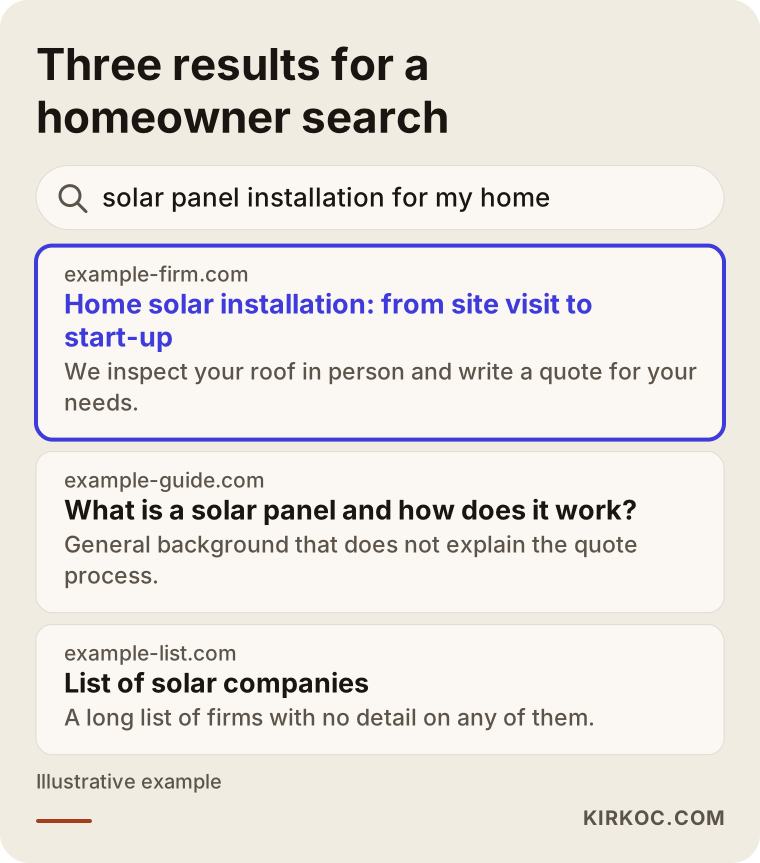
Look at the difference in that mock-up. The first result says what the firm does, how it proceeds and what it offers. The second teaches but offers no commercial next step. The third is a list that introduces nobody. You want to own the kind of page the first result represents: one that gets clicked because it earns trust.
Home, business and farm: three buyers, three pages
The most common mistake solar companies make is putting everyone on a single "Services" page. A homeowner worries about different things than the owner of a warehouse.
The homeowner wants to know whether the roof is suitable, what changes on the electricity bill, whether maintenance is needed and how long the job takes. The homeowner does not know what an inverter is. The page should cover roof types, shading, the process and common questions.
The business owner talks about how the building uses electricity, what the investment means for operations, the need for uninterrupted work and who inside the company has to approve it. That page leans on project management, the site assessment and finished commercial projects. This buyer often prefers a call or an email over a web form, so offer more than one way to reach you.
Farm and land searches are another world. Words like irrigation, acreage and barn show up, and the buyer is often thinking of open ground rather than a roof. This person expects someone to look at their land. The page should say clearly which areas you serve.
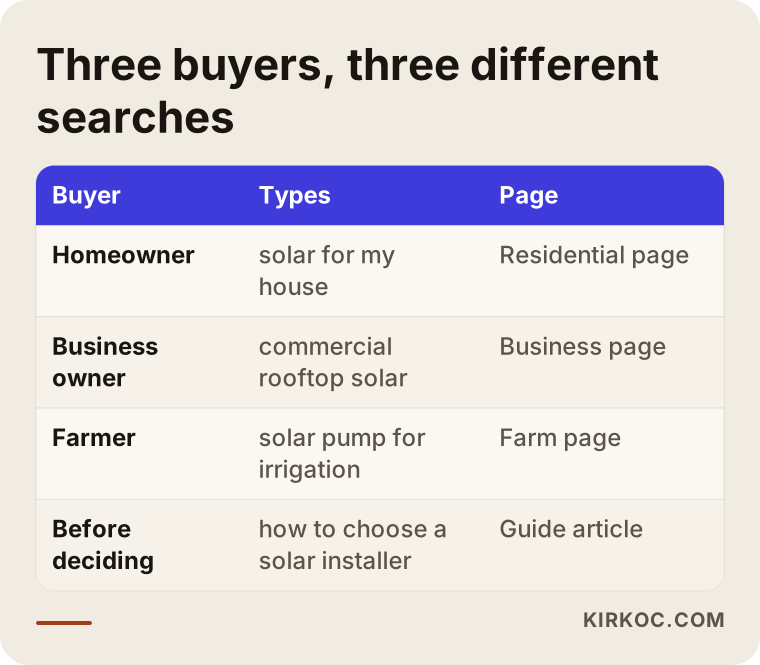
The fourth row of the table is easy to forget: a guide for people still choosing a firm. It does not sell directly, but it is often where a buyer meets you for the first time. When each page answers one intention, Google finds it easier to show that page for the matching search.
Give every page one question to answer
Before writing a page, ask what question the visitor arrives with. A residential page talks about roof pitch, direction and shade. A commercial rooftop page talks about the site assessment, design and start-up. Merge them and neither reader finds themselves.
Trust matters as much as rankings in this field
Someone about to make a large purchase wants to know within seconds: is this firm real, does it complete work, will it still be here next year? Google increasingly looks for the same signals. These should be visible on your site.
- A real address and a phone number. Not just a form; a number a person can call.
- Finished projects. Real photos, a short note and the region. Never show work you cannot prove was yours.
- Who does the work. A page introducing the team or the responsible person. An anonymous site feels unsafe.
- The process in plain steps. What happens from the site visit to start-up, and in what order.
- Customer reviews. Only genuine ones, with permission. Invented reviews are unethical and damage you when discovered.
- Honest limits. Language that does not overstate output, and says results depend on conditions.
That last point matters. Claims such as "you will save this much" can mislead a customer and later cause trouble for you. Explain how you assess a property rather than promising an outcome.
Rules about electrical connections, incentives and permits change over time and differ by place. If your site touches on them, check the current position, and where unsure, say that the current conditions are reviewed together at the site visit.
The quote path: how a visitor becomes a quote request
SEO only brings visitors. What turns them into inquiries is the journey they experience on the site. Think of it in four steps: appear in search, get clicked, earn trust, receive the quote request.
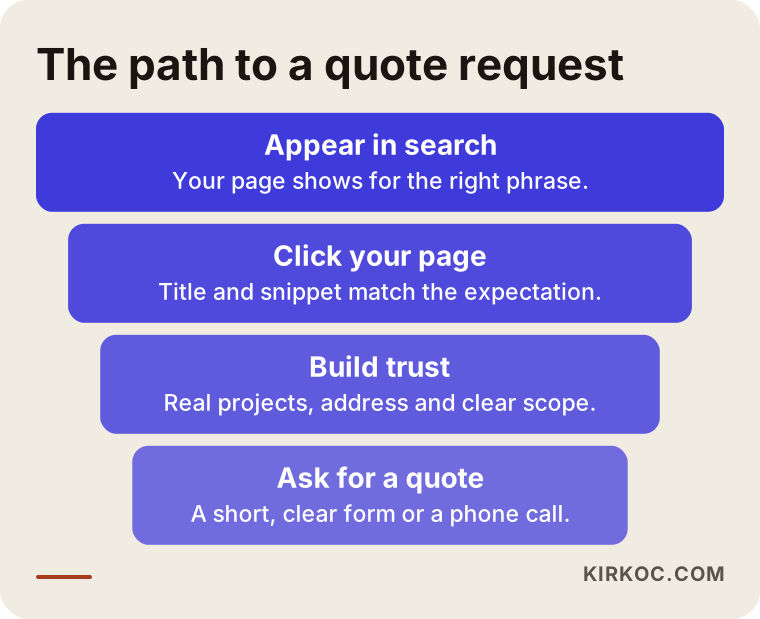
Each step can fail in its own way. If you do not appear, there is a content or technical issue. If you appear but are not clicked, the title and snippet are weak. If you are clicked but not trusted, the page is missing something. If you are trusted but no quote comes, the form or contact route is hard to use. SEO carries the first two steps directly; the other two are supported through page content and layout.
Keep the quote form short and honest
Many firms use a form with a dozen fields. When a visitor has not even had a site visit yet and is asked for bill details, roof dimensions and a budget, the form gets abandoned. Name, phone, type of building or land and a short note are enough to start. You can learn the rest on the phone or at the visit. Next to the form, say when the person can expect a reply, and pick a time you can keep.
Phone and message options
Solar buyers, especially on the business side, like to talk. The number should be tap-to-call on a phone, and a messaging option should be easy to find. These details affect how many requests you get, but they influence conversion, not ranking. Keep the two ideas separate.
The page layout I recommend
There is no single template for everyone, but there is an order that works for a residential or commercial rooftop page. The visual below lists the sections of a typical one.
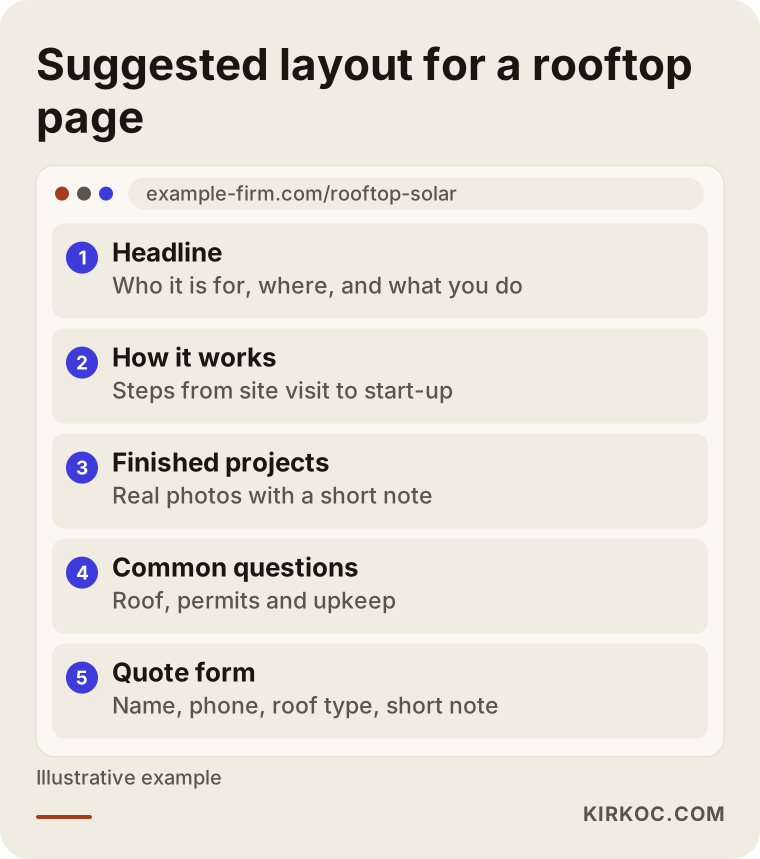
The headline states who you serve, where and what you do in one sentence. The process section reduces uncertainty, so a buyer can see when the site visit happens and when design follows. Finished projects build trust. Common questions settle hesitations and also make it easier for Google and AI assistants to quote your page. The quote form comes last, after the worries have been answered. You can also place a form near the top; the buyer who is ready should find it at once, and the one who is not should be able to read on.
City and region pages
Opening a separate page for every area you serve is tempting. But if you copy the same text and swap the city name, Google notices and gives none of those pages much value. A local page only makes sense when it holds information specific to that area: projects you have done, the typical roofs in the region, how far you travel for a visit. Never open a page for a place you do not actually work in.
Being named in AI answers
Many buyers now put the question straight to an AI assistant: "What should I check before installing solar on my roof?" Whether your name appears depends on your site giving clear, consistent, checkable information. Your address, phone and service area should be identical everywhere, and your pages should answer real questions plainly. There is no trick, and nobody can promise you will be mentioned. But a useful, well-organized site is in a better position both on Google and in those tools.
What does the SEO service cover, and what not?
My SEO work consists of these parts: a complete review of your site, research into what your customers actually type, fixing technical problems such as slow pages and poor phone display, preparing service pages and articles that answer customer questions, watching competitors and a plain monthly report.
I should also say what it does not cover. I do not guarantee rankings, because nobody can buy Google's results. Ad management is not part of this service. I do not advise on the engineering of solar projects, permits or electrical design; that is your field. My job is to help you present your knowledge properly in search results and on your site.
What drives the price
Without naming numbers, these are the things that shape it:
- The current state of your site. A clean site and one full of problems do not carry the same workload.
- How many customer types you target: only homes, or homes, businesses and farms together.
- How many regions you serve and how crowded the competition is.
- How many pages and articles need to be written.
- How long the work runs and how often you want reports.
- Whether the site itself needs software changes.
That is why a good quote does not arrive before a first review. Be careful with anyone who names a fixed price before looking at your site.
Questions to ask when comparing SEO proposals
If you are collecting proposals from a few consultants or agencies, compare scope rather than price. Two quotes can show the same amount and offer very different things.
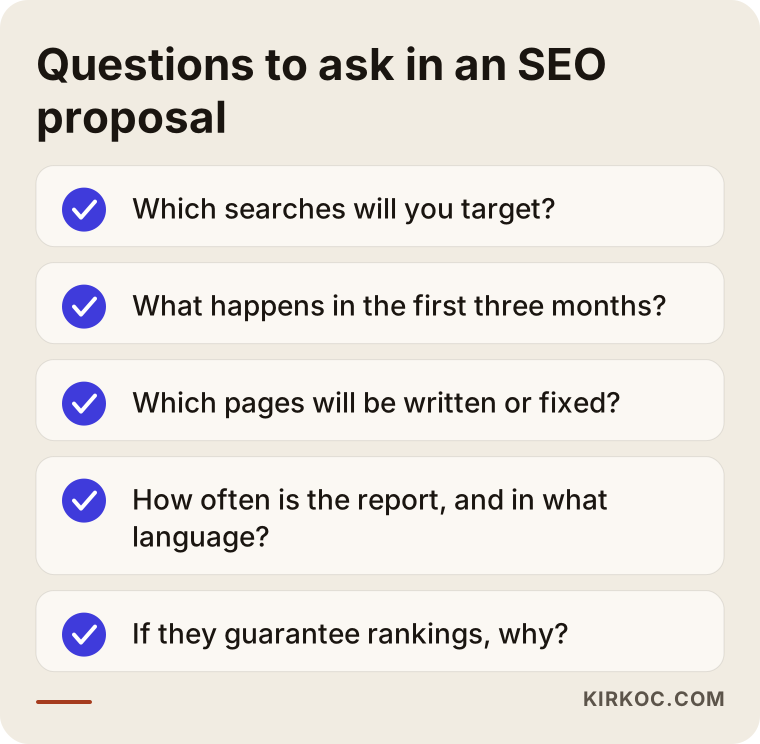
Pay special attention to the last question. Anyone who says "we will get you to number one" either does not understand how Google works or uses methods they will not tell you about. An honest proposal says which pages will be worked on, what will be done and how often progress is checked. Also ask who does the work, you will want to know whether it is the person you spoke with or a subcontractor. Ask whether you can understand the report. And ask who owns the content and the access when the contract ends. Get the answers in writing.
Do it yourself or hire an expert
You do not have to hand everything over. Setting up your Google Business Profile, adding photos of finished work to your site, asking happy customers for reviews with their permission and keeping page details current are things you can do. You are also the best person for it, because you see the work on site. An expert helps with finding technical issues, choosing the right search phrases, structuring pages and interpreting the measurements. A middle road exists too: have a plan prepared once and carry out part of it yourself.
Common mistakes
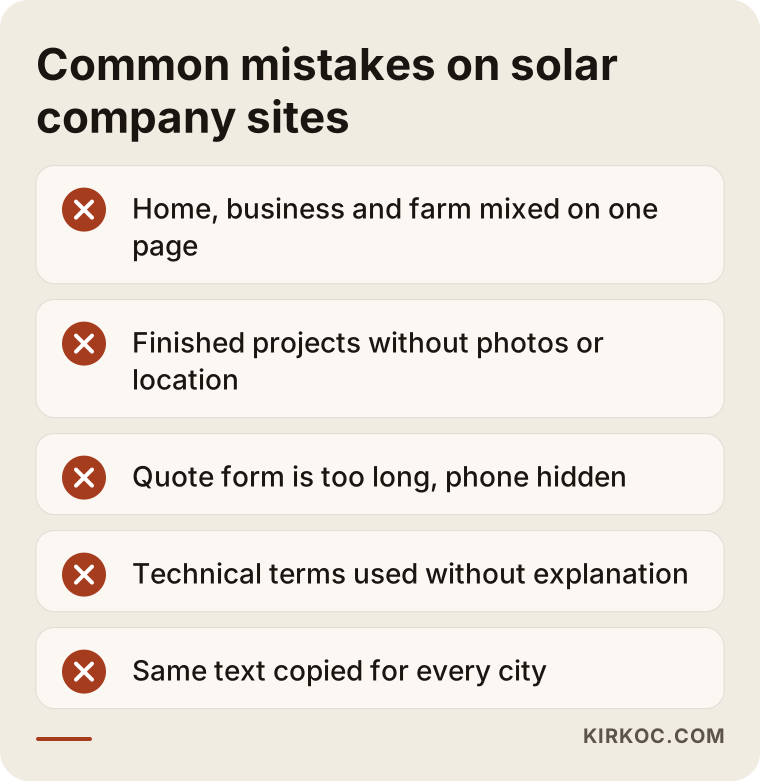
A few additions to the list in the graphic:
- Judging success by your own brand name. People typing your firm name already know you. What matters are the searches of people who do not know you yet.
- Cutting the blog off from selling. An article with no next step wastes the traffic.
- Ignoring mobile. Farmers and homeowners often look on a phone; if the page is slow or buttons are tiny, they leave.
- Deleting old projects, or changing addresses in a new site without redirects. Visibility built over years can disappear in a day.
- Using someone else's photos. It damages trust and can create legal trouble.
Which articles actually bring quote requests?
Writing blog posts for the sake of it is wasted effort. The articles that work in solar are the ones that answer what the buyer really asks before requesting a quote. "Is my roof suitable for solar and what is checked?" covers direction, shade, roof covering and age, and ends by showing how to request a site visit. "What happens at the site visit?" removes the biggest unknown: someone will come to my property, what will they do, how long will it take? "What should I look at when comparing quotes?" may look as if it helps competitors, but it lets you set the criteria. A firm that openly lists scope, equipment details, upkeep and after-installation support looks reliable.
The same logic applies on the farm and business side. For a farmer, "when does solar make sense for irrigation?" is useful, and for a business, "when is ground-mounted better than a roof?" Each article should end with one step: request a visit, call, or send a question. When an unavoidable technical word appears, explain it in a sentence, like "an inverter, the device that turns the panels' output into power the building can use".
Google Business Profile and local visibility
Many buyers search something local, like "solar installer near me", and see map results. Filling in your Google Business Profile with the right category, service area, phone number and real photos makes a separate difference there. The details must match your website exactly. Ask satisfied customers for reviews when they agree; never buy them, and earn them with the work first.
Suppose: two hypothetical scenarios
These are not real customers; they are invented to make the situation concrete.
Scenario one. Suppose you run a small company installing rooftop solar in a mid-sized region. Your site has one page, "Our services". Homeowners and warehouse owners read the same text. The review finds the first problems: no separate pages for homes, businesses or farms, finished projects sit in a small gallery with no location, and the quote form has nine fields. The first three months are planned accordingly: two separate pages for homes and businesses first, then a process section and common questions on each, a shorter form, and short notes on every finished project. No result is guaranteed, but the site should explain what you do much more clearly, both to Google and to visitors.
Scenario two. Suppose you supply solar for farm irrigation and most customers call from their phones. The mobile version loads slowly, and the phone number sits inside a paragraph and does not dial on tap. Before any writing, technical fixes come first: speed, phone display, tap-to-call. Then a page that answers searches like "solar for irrigation" and a questions section. Writing out the areas you already serve answers the farmer's question: does this firm come to my area?
When you do not need SEO
To be honest, not every solar company needs SEO. If all your work comes from tenders and direct relationships with large organizations and you do not expect customers from search, it is not a priority. If the site will be shut in a year, the investment makes no sense. If you have not completed any project yet and have no real references to show, document your work first, because a site without trust signals can attract traffic and still collect no quotes. And if you work in a very small area and already win jobs through recommendations, a light cleanup and a good Google Business Profile are often enough.
SEO is also not a quick fix. The first months go into fixes and pages, and the effect shows over time. If you need customers right away, other channels such as advertising may fit better; SEO is a long-term build-up.
How we work together
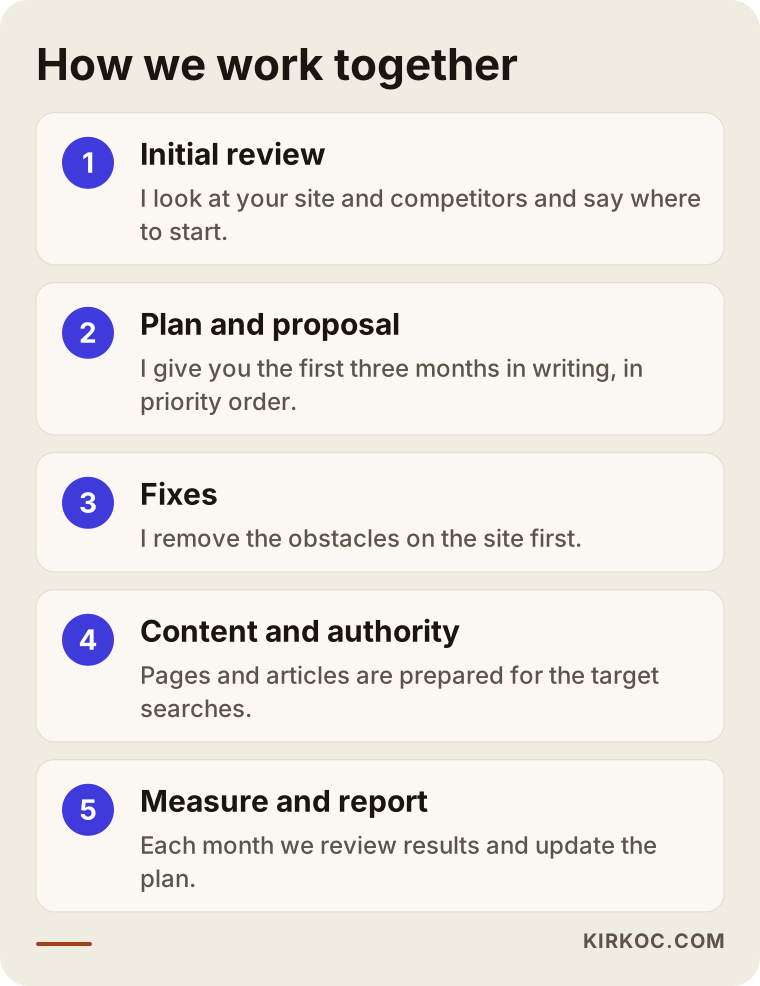
First I look at your site and your competitors and tell you where to start. Then I give you the first three months in writing, in priority order, and we settle the proposal at that point. Next I remove the obstacles on the site, since they usually have the fastest effect. Pages and articles are prepared for the target searches, and your site's standing is strengthened. Each month we look at the results together and update the plan. I work on my own, so the person you talk to is the person doing the work. I work remotely.
Frequently asked questions
What does SEO do for a solar company?
It helps your website show up with the right page for people searching for solar panels or an installer. It answers homes, businesses and farms separately. The goal is that the visitor coming from search asks for a quote.
How long until I see results?
Nobody can state it exactly. Technical fixes and new pages take time to be processed by Google, and the speed depends on how crowded your market is. Think of SEO as work measured in months. I do not guarantee rankings or a number of customers.
Should I buy ads or invest in SEO?
They do different jobs. Ads give quick visibility as long as the budget runs; SEO is visibility that builds over time. If you need customers now, ads make sense; for steady long-term demand, think about SEO. Many firms use both.
What determines the price?
The current state of your site, the customer types you target, the regions you serve, how much content must be written and how long the work lasts. That is why I review your site and competitors first and then give a written proposal.
Do I need a separate page for each city?
No. Open pages only for places you actually serve and where you have specific things to say. Copying the same text with another city name does not help and can hurt the site.
I already have a website. Do I need a new one?
Usually not. First we look at why the current site is not producing results. If the problem is content and page structure, fixing it is enough. If the site is very slow or cannot be edited, a rebuild is discussed separately.
Do I have to show my finished projects?
It is very valuable for trust. Real photos, the area and a short note let a buyer see that the firm really does the work. Do not publish a project without the customer's permission, and keep private details such as exact addresses hidden.
Will my company be named in AI answers?
I cannot promise that. But if your details are consistent everywhere, your site answers questions clearly and your work can be checked, your chances improve.
If you want your solar company's website to collect quote requests, let us review your current site together. In the first review I tell you what can be done and where to begin; you can read about the SEO services or contact me directly.