"Just get me on the first page of Google." I hear that sentence more than almost any other. I understand it: you type your own trade into Google, your competitors show up, and you do not. But that sentence hides two questions. First page for which search? And who is going to do the work, and how? In this article I explain what it really means to hire someone to help you rank higher on Google, what the work covers, and what to look at when you compare quotes. If you want to see how I work, the details are on my SEO services page.
What does "first page" actually mean?
There is no single, fixed first page. Two people typing the same words in two different cities, on two different devices, can see slightly different results. Google takes into account where the searcher is, what they searched for before, and what they are using. So when someone says "I am number one", they often mean "I am number one on my own computer", which is not a reliable measure.
Second, the first page is no longer just ten blue links. There may be ads at the top, a map box for some searches, ready-made answer boxes, and a list of related questions. Sometimes an AI-written summary sits above everything else. When you say "first page", what you really mean is "the place where my customer notices me". Describing the goal that way is the first step toward choosing the right work.
Third, being on the first page does not pay your bills by itself. If a visitor lands on your page and cannot find what they came for, does not trust you, or cannot tell how to reach you, they leave. A good service therefore thinks about the whole path from ranking to a ringing phone.
Who controls the ranking?
Google decides the order. Not me, not another consultant, not any company can change it directly. What can be done is to make your website stronger on the things Google looks at. Does it load fast? Does it display properly on a phone? Does it genuinely answer what people search for? Do other trustworthy places mention you? You can work on all of that. Nobody can buy the result. Keep that difference in mind when you read any guarantee.
Which searches are worth being on page one for?
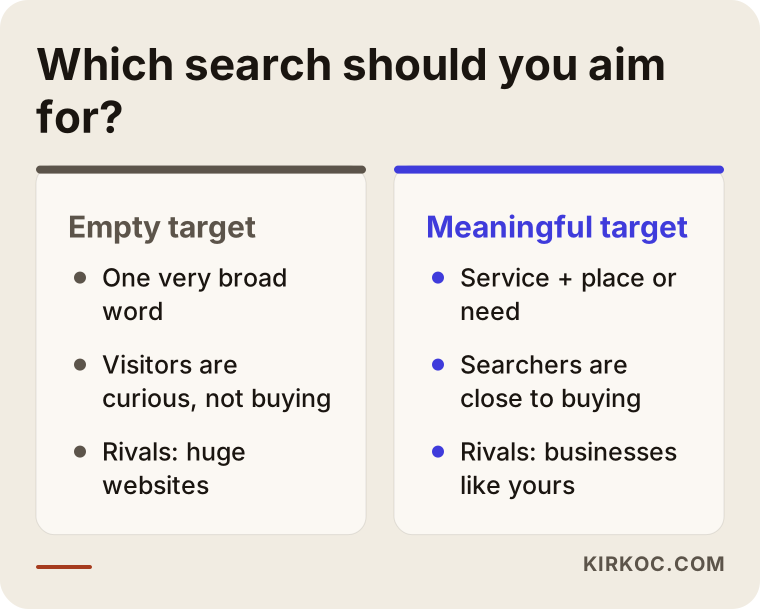
Not all searches are equal. Suppose you run a moving company. Someone typing a single word like "moving" may still be wondering what to do: perhaps they want free tips, perhaps they are writing a school essay. Someone typing "local movers in Chicago for a two-bedroom apartment" has a date, an apartment, and is waiting for quotes. Being on the first page for the second search is worth far more.
You can roughly sort searches into three groups. First, information searches, such as "how to pack dishes for a move". Second, comparison searches, such as "how to choose a moving company". Third, searches close to buying, such as "moving company Chicago" or "get a moving quote". If you are paying for a page-one service, it should be a conscious decision which group your money goes to. Think about the customer's journey instead of single words: they first look for information, then compare, then decide. If your site can meet them at each stop, you win.
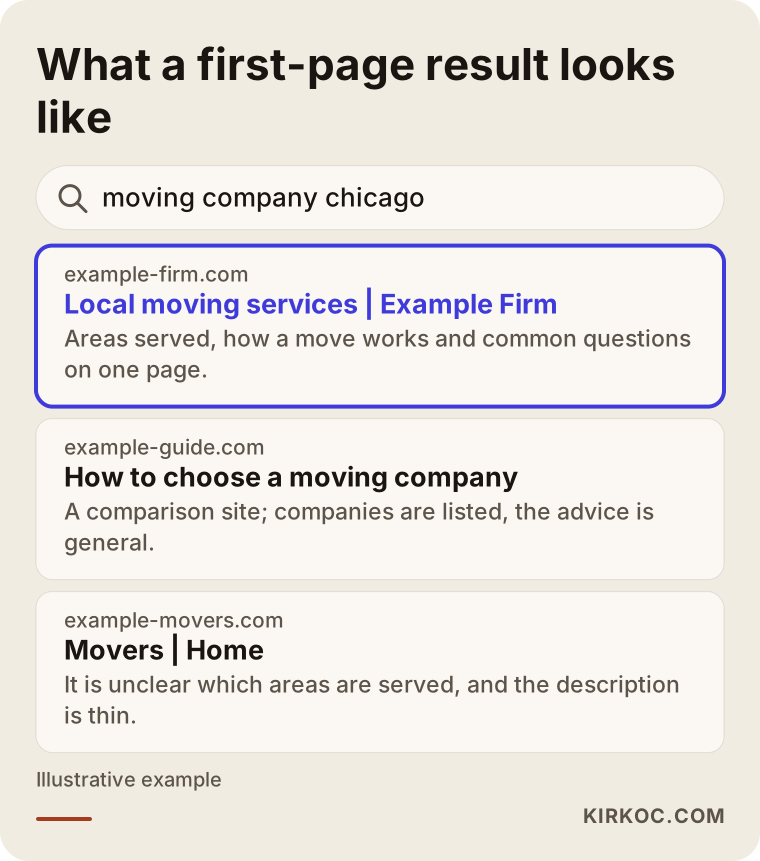
Broad words versus searches with intent
The one-word name of your trade may be the most searched term in your field. But most people typing it are not your customers, and the competition there is not small businesses but huge sites, guides and encyclopedic pages. Reaching the first page there is very hard, and even if you do, the phone may not ring. Longer, more specific searches are typed by fewer people, but those people know what they want.
That is why my first job is to answer "which search should we aim for" by looking at what your customers actually type. Sometimes the industry term you use and the everyday phrase your customer uses are different. You may write "renovation" while the customer types "bathroom remodel". If only the first term appears on your site, nobody searching the second will find you.
Local searches work a little differently
For a business serving one area, such as a barber, dentist, mover or repair shop, customers usually look for options near them. Google changes the results depending on where the searcher is. So the first-page goal should be thought of city by city or district by district. A business that wants page one across a whole country but only serves one city wastes both budget and patience. Saying clearly where you work helps both Google and the customer.
What does a ranking service really include?
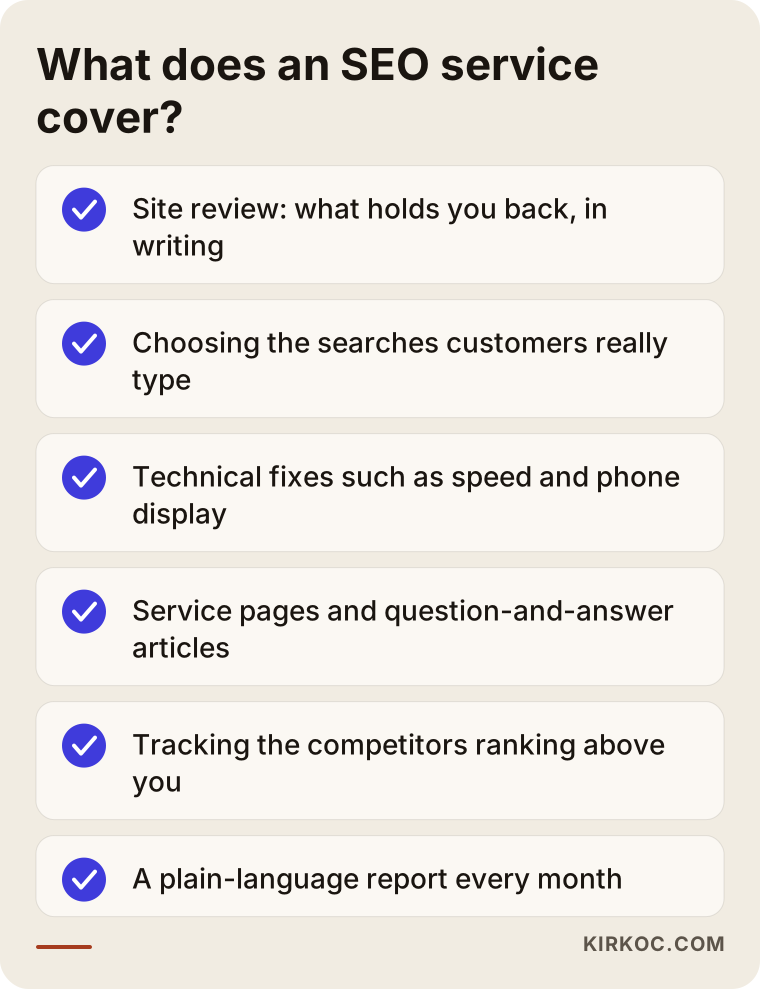
There is no magic button here. The work is a series of jobs done in the right order to make your site stronger on the topic people search for. In my work, they break down like this.
First comes the website review. I go through your site from start to finish and list, point by point, why Google is holding you back. That list is the map of what to do. Work without a review is like taking medicine without seeing a doctor.
Next, finding the right searches. I research what your customers really type into Google and choose the searches that will bring you business. We make that choice by talking, because you know best which of your services is the most worthwhile for you.
Then technical fixes: slow pages, sections that look broken on a phone, pages that will not open, and other problems Google cares about. These often have the quickest effect, because however good your content is, nobody can walk into a locked building.
The fourth step is content work: strengthening your service pages and writing articles that answer your customers' questions. Customers ask questions before they buy. If you give the answers, both Google and the customer get to know you.
Fifth, competitor tracking: I look at what the competitors ranking above you do differently and update the plan accordingly. Last, the monthly report: every month I write in plain language what was done, which searches you moved up in, and what comes next.
What is not included
To be honest, I should also say what is not on that list. Managing paid ads is not part of this service; paid advertising is a separate job. Running your social media accounts is not included either. I do not promise rankings, I do not guarantee results, and I do not promise sales or revenue. What I can promise is to write down plainly what I will do and show you every month what happened. If something is not written on a service page, do not treat it as promised, and question it the same way in any quote.
Why knowing what drives the cost matters
I am not giving figures in this article, because the cost depends on the scope and there is no single number for everyone. But if you know what moves it, you can compare quotes more sensibly.
The first factor is the current state of the site. A site that was built well and loads fast needs little work, while one that has not been looked at for years needs cleaning up first. The second is the competition in your field. In an area where hundreds of firms compete for the same search, the work takes longer; in a narrow specialty it takes less. The third is the number of searches and the size of the area you want to cover: one service in one district is not the same job as ten services across a whole city. The fourth is how much content is needed, how many pages must be written and how much research it takes. The fifth is the length of the engagement and how often you get reports.
When quotes come in, do not look only at the price; look at what the price buys. A very low quote often means little work or template work. A very high quote may include things you do not need. The right question is not "how much?" but "what exactly will be done for this money?"
Why you should be careful with guarantees
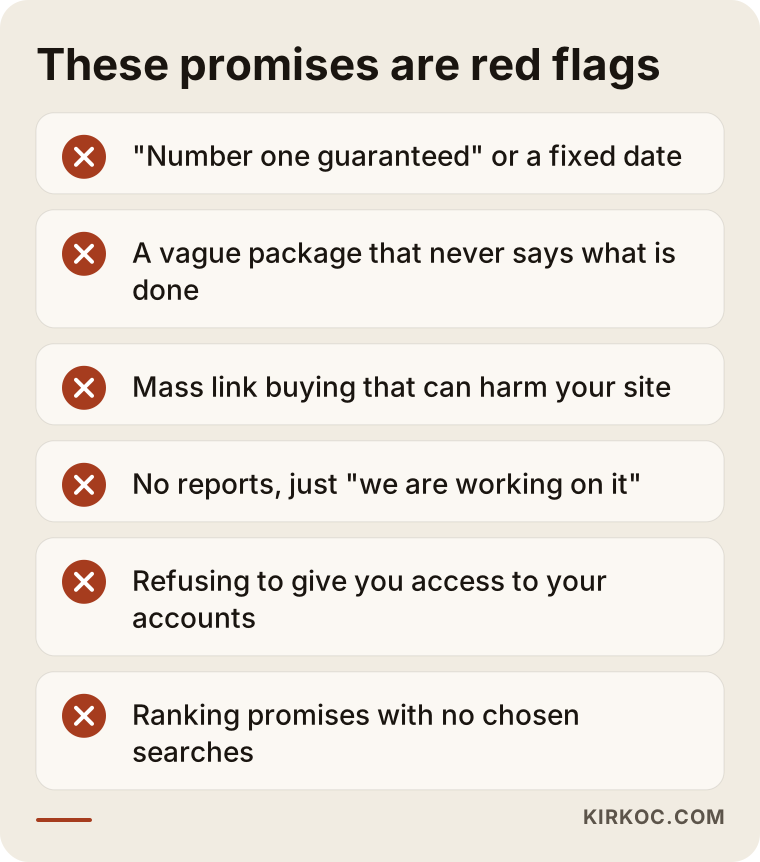
Phrases like "first-page guarantee" or "number one in one month" are going around. Be careful with them. The reason is simple: Google decides the order, and nobody can decide for it. For someone to guarantee a position, they would either have to claim they control the result, which is not true, or they would have to aim at a very easy search, which does not help you.
An example: people who type your company name will find you anyway. When someone says "number one guaranteed", they may mean your own name or a phrase nobody searches. Technically the promise is kept, but it is of no use to your business. So always ask which search the promise is for.
The second risk is the shortcuts used to get fast results. Buying links in bulk, producing meaningless pages, copying other sites' content: these can show results for a short time, but when Google notices, it can penalize your site. Then you pay the price, not whoever sold you the service. That is why the answer to "how will you do it?" matters more than any promise of results.
The third risk is not having access to your own accounts. Your domain name, your Google accounts and your site logins should always stay with you. When the work ends or you part ways, nothing should be held hostage.
So what can be said about results?
The honest answer is that after the work starts you can see what changes, but nobody can know in advance when or how far you will climb. The timing depends on your sector, your site and your competitors. I give you the plan for the first three months in writing and we review each month what has changed. That is a far more honest frame than "this position by this date".
How to compare quotes and companies
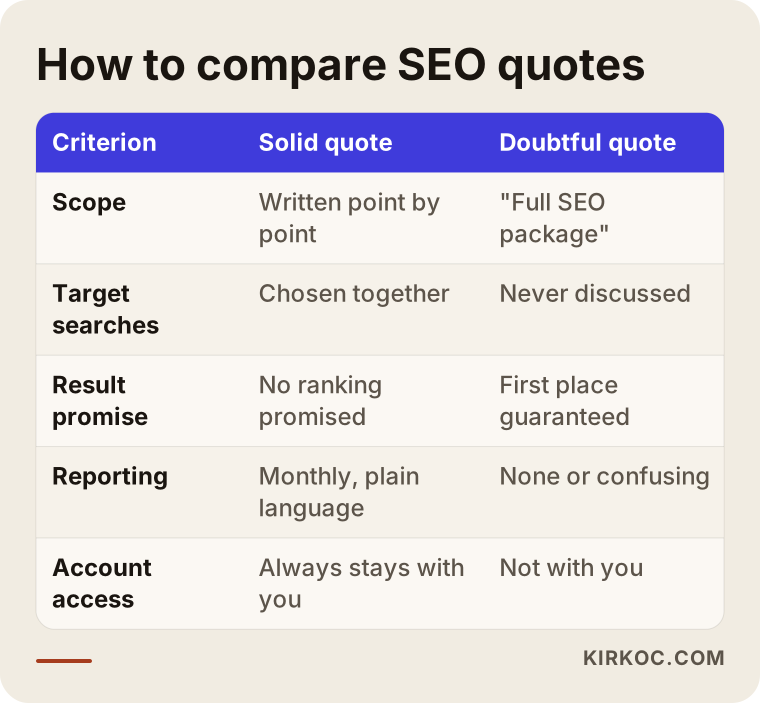
If you have collected two or three quotes, put them side by side and check these questions. Is the scope written down? A phrase like "full SEO package" explains nothing; it should say which job happens in which order. Were the target searches discussed with you? If that conversation never happened, the quote was prepared for everyone, not for your business. Is there a promise of results? If so, ask what it is based on. How and how often will you get reports? Who keeps your accounts? If you need to hand the same work to someone else later, will you be able to understand what was done?
There is also the question of who will actually do the work. In larger setups, the person who sells and the person who does can be different people. I work on my own, so the person you talk to is the person doing the job. That is not a plus for every business, but if it matters to you, you should know. One person can only take on so much, so it is reasonable to ask about timing and workload directly.
Is it reasonable to ask for references?
Yes, but from the right angle. More important than how many clients a company has is whether it can describe what problem those clients came with and what was done. If they worked in a field close to yours, you can ask what kind of searches they worked on. If they cannot explain, they may not have understood the work.
How the process runs in practice
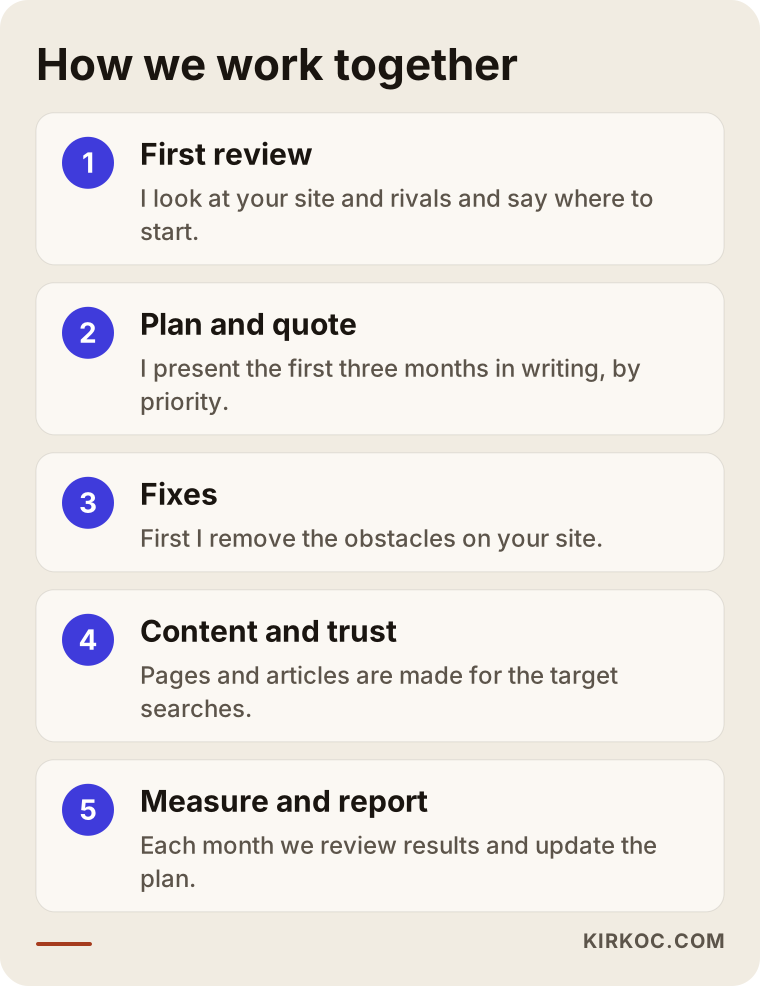
Knowing the flow from the start reduces worry. My process has five steps.
The first step is the first review: I look at your site and your competitors and tell you where to start. There is no commitment at this stage; the aim is simply to see the picture.
The second is plan and quote: I give you a written plan of what will be done in the first three months, in order of priority. You see what gets how much time.
The third is fixes: first I remove the obstacles on your site, because they make the quickest difference. There is no point decorating a room before you have unlocked the door.
The fourth is content and building trust: pages and articles are prepared for the searches we are targeting, and your site's reputation is strengthened. This is the longest part.
The fifth is measuring and reporting: every month we go over the results together and update the plan accordingly. Some things will not go as expected, and then the plan changes. Flexibility is part of the process.
If your field has strict advertising rules
In areas such as healthcare and law, extra care is needed when preparing content. These professions have rules about advertising and promotion, and they can be detailed. I do not quote those rules point by point; you should confirm them with your own professional body. My line is this: content that follows the rules and informs, with no promise of results. I do not give medical or legal advice, and I do not write sentences such as "this treatment will cure you" or "we will win your case".
Suppose... two hypothetical situations
The two scenarios below are made up; their purpose is to show what this decision can look like.
Suppose you own a small moving company. You want to be on the first page for "local movers". When you look at the site, all your services sit on one page, the areas you travel to are not listed, and the photos are so large that the page opens slowly on a phone. In that case the first jobs are speeding the site up and building pages for each area. Then articles are added for questions like "how to choose a moving company" and "how to pack your things". Results take time, but every month you can see where you stand on which search.
Suppose you own an accounting practice and someone tells you "number one in twenty days, guaranteed". When you ask how, they say "our method", and they will not give you access to the accounts. There is not one written line of scope. The best step is not to argue but to ask: guaranteed for which search? If the answer is vague, you already have enough reason not to trust it.
When you do not need this service
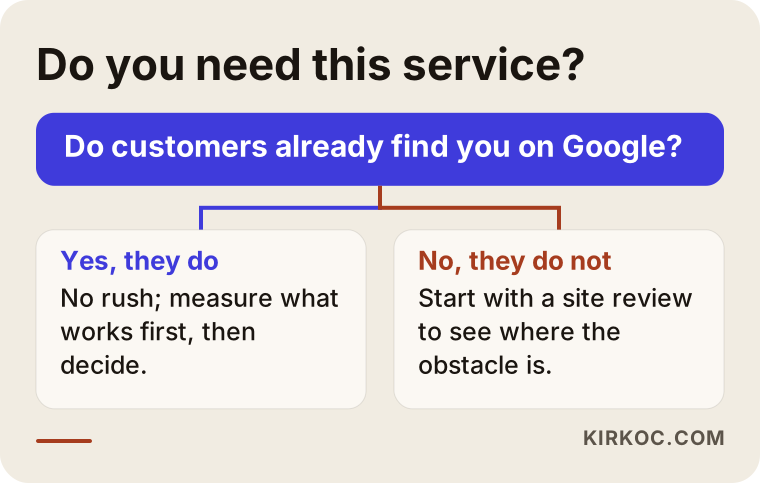
Not every business needs SEO, and I am comfortable saying so. If your customers already come through word of mouth and you are not looking for customers on Google, the service is not urgent. If your calendar is already full and you cannot take new clients, there is no rush either. If you have not built your website yet, the first job is to build it properly; SEO is not decoration added later, but you also cannot add layers to a structure with no foundation.
Paid advertising is sometimes the better choice: a very short campaign, a few weeks of an event, or a sale that needs results right away suits ads better than ranking work. SEO is a long-term investment and is not designed for short-term needs.
Do it yourself or hand it to a specialist?
Some things you can and should do yourself. Writing your business details consistently, describing your services on your site in plain words, noting customer questions and answering them, and asking happy customers for reviews all come first. None of that needs technical knowledge, only that you know your business.
The jobs for a specialist are the technical ones: finding out why the site is slow, working out why Google is not seeing your pages, researching search terms and building a plan, measuring what competitors do. You can learn these, but it takes time, and your time is often better spent on your own business.
There is a middle path as well: have a specialist do the first review and pick from the resulting list the items you can do yourself. We can discuss that option when we talk about the quote.
Common mistakes
The first mistake is fixating on a single word. Business owners usually search for the name of their trade, but customers use other words. The second is trying to pay for SEO without fixing the site; if the foundation is faulty, the spending is wasted. The third is expecting results within a few weeks. The fourth is not asking for reports; paying without seeing what was done is investing blind. The fifth is handing over accounts to anyone offering a free or cheap deal. The sixth is having an AI tool churn out articles in bulk and publishing them unread, which rarely helps and can hurt your site's reputation.
Another common mistake is looking only at the position and forgetting the customer. Even if you rise, it is useless if the page has no phone number or the contact form does not work. Good work also thinks about what the visitor will do once they arrive.
Frequently asked questions
How long does it take to get on page one of Google?
It would not be honest to give a fixed time in advance. The current state of your site, the competition in your field and the searches you aim for decide it. My approach is to present the plan for the first three months in writing and review results together every month.
If someone promises very fast results in a short time, ask them in detail how they will do it.
Should I trust companies that guarantee first place?
No. Google decides the order, and nobody can buy or guarantee it. Someone who guarantees a position is either aiming at a very easy search or using risky methods. The question to ask is which search the guarantee applies to.
What is the difference between an SEO service and Google ads?
Ads show only as long as you pay; they disappear when you stop. SEO takes time, but once the work pays off it can give you visibility without depending on an ad budget. They are not rivals: ads may suit the short term and SEO the long term.
What decides the cost?
The current state of the site, the competition in your field, the number of searches, the size of the area you serve and the amount of content to be written. That is why quoting the same number to everyone would not be right. After a review I give you a written quote.
My website is new. Should I still hire someone?
On a new site, it is best to think about SEO while it is being built, because page structure, headings and speed are hard to change later. If the site is not ready yet, build it properly first and do the content work after.
What will I see in the reports?
Every month I explain what was done, which searches you moved up in, and what comes next. Instead of tables full of technical terms, I write the results that matter to your business. If you have questions, we talk them through.
What if I work in a restricted field like healthcare or law?
In those areas I prepare informative content that follows the rules and I do not write promises of results. I do not give medical or legal advice. For the advertising rules of your profession, check the guidance of your professional body.
Who owns my site and accounts when the work ends?
You do, always. Your domain, your Google accounts and your site logins should stay with you. A company that wants to keep them under its own control is a serious warning sign.
Next step
Instead of saying "put me on the first page", asking "for which search, for which customer, and by what method?" will lead you to the right decision. If you would like us to look at your site together and talk about where to start, you can write to me through the SEO services page or contact me directly, and after a first review I will tell you plainly where you stand.