You have a few thousand followers, yet when someone types "dietitian near me" into Google, you are nowhere to be found. I see this often, and it usually comes from one misunderstanding: visibility on Instagram and visibility in search are not the same thing. In my work with health professionals I start there. This article covers what a dietitian who is considering SEO services should know: where to start, what to watch, and what no honest consultant can promise.
Online coaching and a local practice are different games
First ask yourself who your client is and where they live. There are two situations, and each needs its own approach.
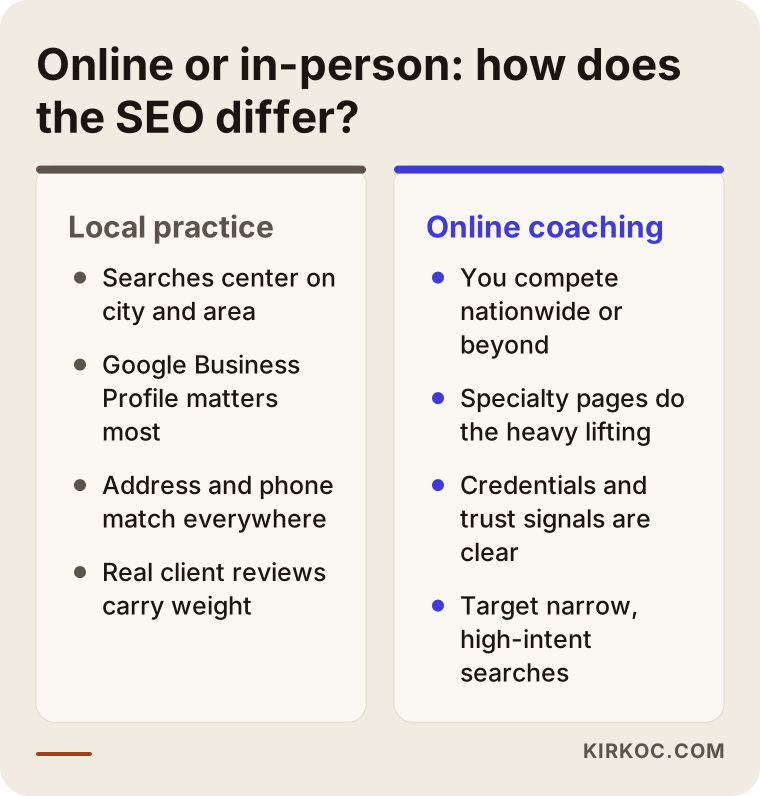
If you run a practice and see people in person, your client usually lives in the same area. That person searches for things like "dietitian downtown" or "nutritionist near me," checks the map, reads reviews and calls. What decides it here is a complete Google Business Profile, the same address and phone number everywhere online, and real reviews from real clients.
If you work online, you serve people across a whole country or even abroad. You have no proximity advantage. You face big brands, diet apps and hundreds of other professionals. Here the quality of your pages, how clearly you describe your specialty and your trust signals decide the outcome.
If you do both, do not squeeze them onto one page. Separate pages with separate messages work better.
Why searches like "online dietitian" are so hard
Short, broad searches such as "online dietitian" or "meal plan" are extremely competitive. The results are packed with large platforms, ready-made diet sites and portals that publish constantly. A solo practitioner can reach the first page for such a term, but it takes time and I cannot guarantee it.
There is another problem: nobody knows what the person typing a broad query wants. One is looking for recipes, one wants a free meal plan, one truly wants to work with a professional. Most are not your client.
A smarter path is to target searches with a clear intent:
- "nutrition counseling during pregnancy" (a specific person with a specific need)
- "sports dietitian online" (someone with a defined goal)
- "dietitian for insulin resistance" (a concrete health question)
- "dietitian for picky eating in children" (a worried parent)
Competition is lower there, and the person is much closer to booking. The right question for a dietitian is not "how many people see my site" but "how many want an appointment."
One page per specialty
Many dietitian websites have a single "Services" page where weight loss, pregnancy, sports and children's nutrition sit in one list. Search engines struggle to tell what such a page is really about, and a visitor cannot find an answer for their own situation.
My suggestion is simple: one page for each main area you work in. For example pregnancy and breastfeeding, sports nutrition, condition-related plans such as thyroid or insulin resistance, and child and teen nutrition.
Each page should include:
- A plain introduction describing the situation the person is in
- How you work (first session, follow-ups, measurements)
- Clear answers to common questions
- Your education, credentials and professional registration details
- One visible next step for booking
There is an honest limit here. On condition-related pages, do not promise treatment. A sentence like "beat your diabetes with this diet" is both unethical and risky.
How to find out what your clients type into Google
A keyword is simply the way a person types the question in their head into a search box. You do not have to guess at these. You can learn them, often without any paid tool.
Start with your own consultations. Clients tend to use the same sentences on the first call or in the first message: "I have a thyroid condition and can't lose weight," "My child only eats five foods," "How should I eat during training season?" Write these down in a notebook. Each one can become a page or an article.
Next, type into Google yourself. The suggestions that appear as you start a phrase, and the "related searches" at the bottom of the page, show what people really look for. Think of it as free market research.
Finally, look at your peers. See which topics other dietitians in your city or specialty have given their own page, and which they have ignored. A topic they leave empty may be your opening.
If you see clients locally: what to check on your Google Business Profile
For a dietitian with a practice, the profile is often the first thing a potential client sees, before the website. Small details make a real difference here.
- The right category: The main category should be dietitian or nutritionist, and you can add secondary categories if they truly fit your work.
- Services and description: Describe your areas of work in plain language and avoid inflated promises.
- Opening hours: Update them for holidays and special days. Wrong hours mean a client who arrives to a closed door.
- Photos: The entrance, waiting area and consultation room build trust. Never show a client's face.
- Replies to reviews: Thank people for positive reviews. Answer critical ones calmly and never reveal anything about the client's health or identity.
The details on your profile and your website must match exactly. If the spelling of your name, the address format or the phone number differs even slightly, Google has a harder time knowing which version to trust.
What visitors look for when they land on your site
Choosing someone to talk to about your body and eating habits is not like choosing a product. People want to trust the person. Within a few seconds of opening your site, they scan for a few things.
First, can they see who you are? A site without a face or a name feels risky to book with. A short, warm "about" section that mentions your training and how you work does a lot of good here.
Second, they want to know how the process works. How long is the first appointment, what kind of plan comes out of it, how is follow-up handled? If the page does not answer these, visitors move on instead of asking.
Third, contact has to be easy. The phone number should be tappable, the form short, and there should be a messaging option for people who prefer it. Even a small obstacle can cost you an appointment.
When the budget is limited: where to start
You do not have to do everything at once. For a dietitian working with limited time and money, this is the order I suggest.
First, if you see clients locally, make your Google Business Profile complete and accurate. It is the cheapest step with the fastest payoff. Next, write one strong page for the single specialty that brings you the most clients. One good page does more than five half-finished ones.
Third, check the technical basics: does the site open well on a phone, is it fast, do the contact details work? Producing content before these are in place is like pouring water into a leaking bucket.
Leave blog articles for last. They are valuable, but their return is limited until the core pages are solid. Following this order tends to show results sooner on the same budget, though I cannot promise how soon.
Remember, this is not a race. Copying a competitor's page count is a weaker strategy than answering your own clients' questions better. A small site that grows steadily can overtake a big, scattered one over time.
How social media and your website feed each other
Social media builds trust and recognition, but your content depends on a platform's rules and algorithm. If an account is closed or reach drops, years of work can vanish. Your website is yours.
A practical split of work:
- Post short, eye-catching content on social media. Recognition comes from there.
- Publish the same topic as a fuller article on your site.
- Make the link in your profile point to that topic's page, not just the home page.
- Make sure that when people search your name, Google shows a proper result.
After watching a video, people often type your name into Google. If they find no professional site, accurate information and real reviews, they may give up on booking. I covered how to build the site itself in my guide to websites for dietitians.
Health claims: where to be careful
Writing about health demands more care than most industries. Search engines and readers both look for reliability, and there are rules on advertising and promotion that depend on your profession and country. Check what is allowed with your professional body and the relevant regulations; I cannot give legal advice.
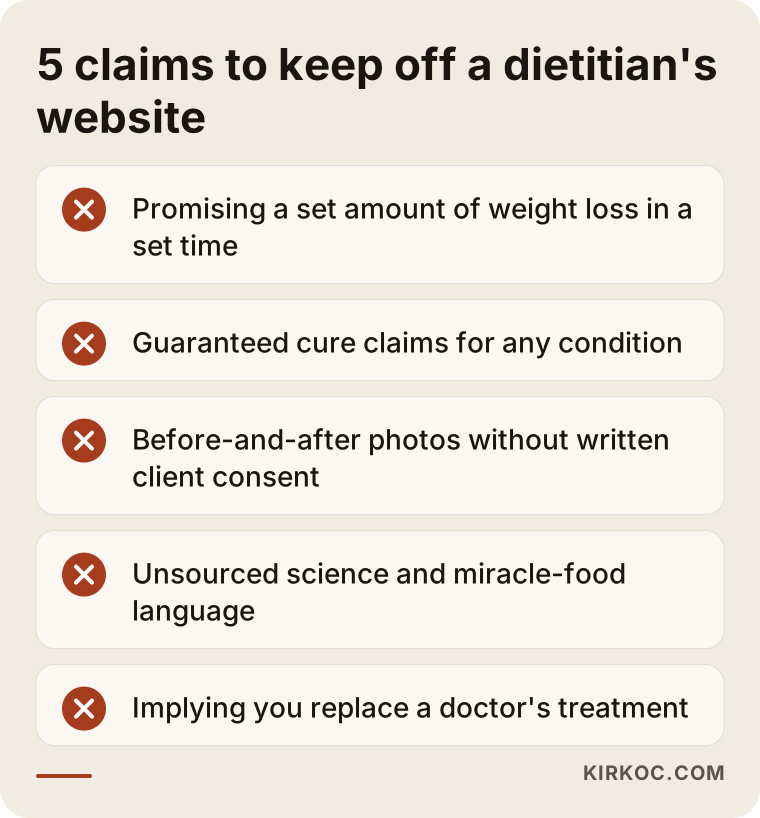
In general I recommend avoiding:
- Promising a specific amount of weight loss within a set time
- Absolute cure claims such as "this clears the condition completely"
- Before-and-after photos without the client's explicit consent
- Unsourced scientific claims and "miracle food" language
- Implying that you replace a doctor's treatment
Instead, use a calm, informative tone, say "this should be discussed with your doctor" when appropriate, and show clearly who wrote the content. That builds reader trust and long-term value. For the wider healthcare picture, see my article on SEO for doctors and healthcare organizations.
Two different dietitians, two different starting points
Instead of theory, here are two examples. They are composites of situations I see, not portraits of any one person, and I describe the outcomes cautiously on purpose.
Scenario 1: A dietitian with a practice in her own neighborhood
A dietitian who sees clients in person came to me. She posted regularly on social media, but her phone only rang through word of mouth. When I searched for "dietitian" plus her neighborhood name, she did not show up on the map at all.
The first thing I looked at was her Google Business Profile. The category was incomplete, the opening hours were outdated, and the address on the profile was spelled differently from the one on her site. The site itself had a single "Services" page.
We fixed the profile first and made the address and phone number identical everywhere. Then we split the one page into three: weight management, pregnancy, and children's nutrition. We also built the habit of politely asking clients for a review after a session.
Visibility on the map began to move within a few weeks, but the pace is different for everyone and I cannot guarantee it. The real change was that callers started saying, "I found you on Google."
Scenario 2: An online sports dietitian serving clients nationwide
In the second case the dietitian worked only online. Her site looked good, but the homepage led with a very broad message, "online diet coaching," and that search is full of giants.
I suggested she let go of the broad term. Instead, we focused on where her expertise was strongest: nutrition for recreational runners and gym-goers. We built a page for that topic, a few articles answering what athletes really ask, and one clear step for booking.
Visitor numbers did not jump dramatically. But nearly everyone who arrived was already an athlete, and a larger share asked for a consultation. For online practitioners, I think that is exactly the right measure of success.
Step by step: how the work unfolds
SEO for a dietitian's site is not a pile of random fixes. There is a sensible order, and I suggest the same one whether you work with me or do it yourself.
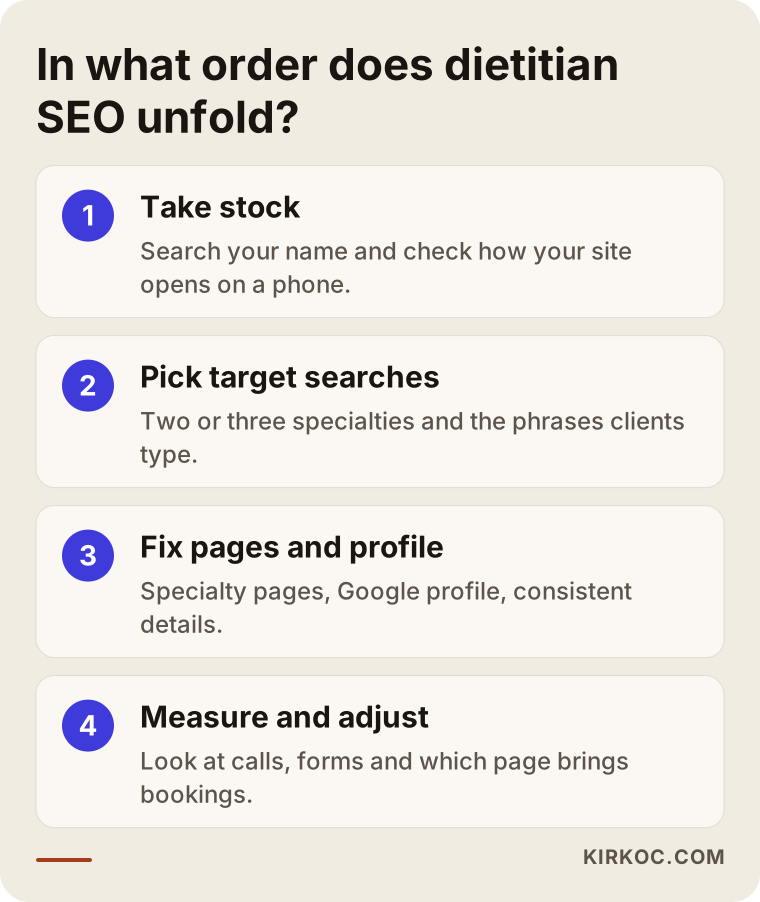
1. Take a snapshot of where you stand
First you need to know your starting point. Search your own name, try a few target searches, and see who shows up. Note how your site opens on a phone and which pages get no visits at all.
2. Choose your audience and your searches
Get clear on who you want to work with. A dietitian who speaks to everyone is nobody's first choice in search. Pick two or three specialties and list the sentences a client would type for each.
3. Organize your pages and your profile
Write the specialty pages, complete your Google Business Profile, and make your details consistent everywhere. This is the stage where the first visible improvement usually comes.
4. Measure and adjust
Before visitor numbers, look at how many people called, how many filled in the form, and which page brings appointments. Deepen what works and simplify what does not. SEO is not a one-time job; it moves forward through small adjustments.
A quick checklist before you publish
Before a page goes live, ask yourself these questions. If you cannot answer yes to all of them, the page is not ready.
- Does the page answer one specific client question?
- Is it clear in the title and first paragraph what you do and for whom?
- Are your education, qualifications and professional body membership visible?
- Is every health-related claim cautious, sourced and pointing toward a doctor where appropriate?
- Is there one clear step for booking (phone, form or message)?
- Is the page easy to read and quick to load on a phone?
- Do the address, phone and hours match your Google profile exactly?
- If you used photos, do you have people's written permission?
Common SEO mistakes dietitians make
Over time I see the same mistakes again and again. Most are made with good intentions, but they can be costly.
- Piling everything onto one page. When weight loss, pregnancy, sports and children's nutrition share a page, you look strong in none of them.
- Copying text from other sites. Pasting generic diet text or a translated foreign article adds nothing and damages trust.
- Buying or inventing reviews. It is unethical, and if noticed it harms your profile.
- Using client photos without permission. Before-and-after images carry risks for both privacy and advertising rules.
- Neglecting the Google profile. For anyone working locally, it matters as much as the website.
- Looking only at visitor counts. Thousands of visitors who never book are no use to you.
- Expecting everything at once and quitting. SEO takes patience; seeing nothing in the first weeks is not failure.
What you can do yourself and what to leave to a specialist
You do not need to outsource everything. Knowing the split helps you spend your budget where it counts.
What you can do yourself
- Claim and fill in your Google Business Profile, keeping photos and hours current
- Politely ask clients for reviews
- Note the questions you hear most and write short answers
- Show your education and experience clearly on the site
- Turn longer versions of your social media posts into pages on your site
What to leave to a specialist
- Deciding which searches to target and analyzing the competition
- Technical matters such as site structure, page speed, mobile behavior and indexing
- Linking several specialty pages together in a sensible way
- Finding a balanced tone for health content, both for search engines and for professional rules
- Reading the results and deciding what to change next
We can talk through the split together. Some dietitians hand me only the initial setup and continue on their own afterward.
How we would work together
I start by looking at where you are: whether you have a site, what appears when someone searches your name, which searches you already show up for. Then we choose together which specialties come first. I prepare the page structure, content plan and technical fixes, and report progress each month in plain language.
I cannot tell you exactly when results will come. It depends on competition, the age of your site and the content you publish. What I can say is that if we target the right-intent searches, we will track appointment requests rather than visitor counts.
Frequently asked questions
Do I need SEO if my social media is strong?
Yes, because the two channels reach different people. Social media makes you known; search brings the person who says "I need a dietitian now" and is ready to decide.
Will a newly qualified dietitian benefit from SEO?
Possibly, but start with a narrow specialty and a local focus, not broad terms. Niche searches with little competition are more realistic for beginners.
Do I have to write a blog?
No, but a few good articles that answer the questions clients really ask add trust to your pages. Avoid publishing many careless posts.
How do I collect reviews?
After a session, politely ask satisfied clients to leave a review on your Google Business Profile. Never buy or invent reviews.
When will I see results from SEO?
I cannot give an exact time. Competition, the age of your site and the content you publish all play a part. Local visibility often starts moving earlier, while broad searches take noticeably longer.
Can I rely on my Google Business Profile alone, without a website?
For a local practice the profile is a strong start, but it is not enough by itself. A website is where you explain your expertise and back up the profile.
Can I share client reviews on my website?
Some rules may restrict this. Check the review and advertising regulations with your professional body, and always get the person's permission before sharing a review.
Can I reuse my social media diet content on my site as is?
I recommend turning it into a more detailed piece written for the site rather than copying it. A short video caption and a page-length article do not do the same job.
If I work online and in person, do I need two websites?
No. One site with separate pages is enough: one focused on the practice and the city, another on online coaching.
How many pages does a dietitian need?
Scope matters more than count. A homepage, an about page, one page per main area of work and a contact page are often a good start. You add more as real needs appear.
How do I choose between SEO and Google Ads?
Ads are fast but visible only while you pay; SEO is slower but builds up. Rules for health advertising may be stricter, so check with your professional body first.
If you would like a roadmap for your own situation, you can reach me through my SEO services page.