Your website is solid and your content is good, yet an AI assistant keeps recommending your competitor. The reason often sits outside your site. When an AI tool recommends a business, it does not only read what that business says about itself. It also looks at what others say. In my GEO services, I treat this as the brand's footprint on other websites. Here is what that means for a small business, and which digital PR steps are realistic and honest.
Why does AI look beyond your own site?
Anyone can write "we are the best in town" on their own page. Because of that, AI systems lean on several independent sources that confirm each other. A mention in a trade publication, an interview in the local news, a listing on a professional association's member page, and customer reviews are all independent signals saying: this business exists and does this work.
There is a shift worth naming. Link building used to be the main goal, mostly for rankings. Today a plain mention can matter too. Your name appearing on a trusted site, even without a link, can act as a trust signal. Nobody outside the AI companies knows exactly how much weight it carries, and I do not promise what I cannot measure. But in my work, businesses that are mentioned consistently in credible places tend to show up more easily in AI answers.
Which mentions are worth having?
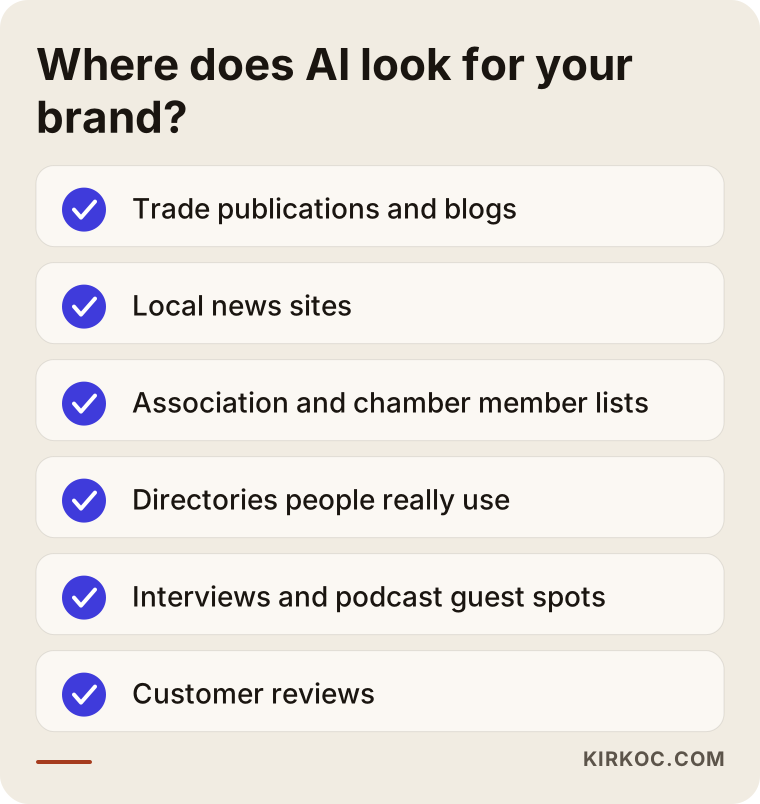
Not all mentions are equal. Here is how I look at them, roughly in order:
- Trade publications and niche blogs: places your future customers or peers actually read.
- Local news sites: openings, events, community projects, anything with real news value.
- Association and chamber memberships: member directories are credible and verifiable.
- Reputable directories: industry-specific ones that people really use.
- Interviews and podcast guest spots: where you explain your expertise in your own words.
- Customer reviews: text about you that you did not write.
What they share is independence and relevance. A thousand mentions on unrelated sites are usually worth less than one in a publication that fits your field.
Realistic digital PR steps for a small business
You do not need an agency budget. A solo practitioner or shop owner can do the following with a few hours a week.
- Start with an inventory. Where does your name already appear? Search your business and your own name, and ask AI assistants about you. Note anything missing, outdated, or wrong.
- Make your memberships visible. If you belong to an association or chamber, check that your listing is current and matches your website.
- Have something real to say. A new service, a small study, a local project, a clarification of a common misconception in your field. No publication runs an announcement with no news value.
- Send a short, plain note to a local reporter or trade writer. Not a sales pitch; just "I can comment on this topic" is enough.
- Be a guest. A podcast, an industry newsletter, a local event. Share something useful from your field.
- Ask for reviews, never buy them. Politely ask happy customers. Fake reviews are unethical and put you at risk.
None of this is fast. You might see changes after a few months, but I cannot guarantee it, because nobody knows when AI systems refresh what they know. I would rather keep expectations honest.
Why you should avoid paid articles and bought news
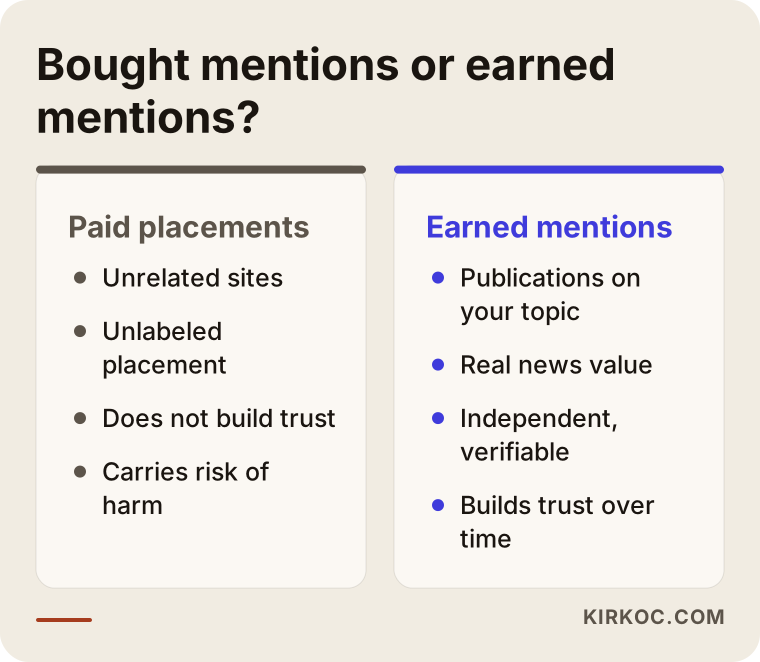
Sites that publish "news" for a fee are everywhere now. The pitch usually sounds like this: "We will place your story on dozens of sites so your brand is everywhere." The problems are clear:
- These sites often publish hundreds of unrelated "stories" and do not look trustworthy.
- Search systems keep getting better at recognizing bought placements. At best it does nothing; at worst it hurts.
- An AI tool has little reason to promote a brand surrounded by inconsistent, low-quality sources.
- Legitimate publications label paid content as an ad or sponsored. That is honest and fine. The problem is placements sold quietly without any label.
The same logic applies to link packages, which I covered in do links from other sites affect my Google ranking.
Industry rules to keep in mind
Every profession has its own rules. In healthcare, advertising and promotion may be restricted, so check them before you give an interview or publish a piece. Legal and other regulated professions often have their own advertising rules too. I do not give legal advice: please check your own professional rules and applicable regulations. A good approach is to speak as an expert, informatively and without exaggeration.
Two concrete scenarios
The two examples below are general accounts based on situations I run into often. No names and no numbers; the point is to show the logic.
Scenario 1: A small accounting practice
A small-practice accountant came to me with this complaint: the website was clean and the blog had articles, yet when someone asked an AI assistant for a trustworthy accountant in the area, other firms kept getting named. I started by searching the practice name, the owner's name and the phone number. The professional body's directory still showed an old address, two business directories spelled the practice name differently, and a local news site had an interview from years ago that now led to a broken page.
Our first job was not to create anything new but to close the inconsistencies. We brought the association listing, the directories and the contact details on the website into the same wording. Then we picked one real topic: a yearly filing process that small business owners misunderstand again and again. The accountant wrote a plain explanation, and I suggested it with a short note to a local business outlet and a professional newsletter. One published it. The other never replied, which is normal.
Over the following months the practice's name started to show up for some questions in AI answers, and for others it still does not. I cannot say for certain that this work alone caused it. I do think consistent information plus one mention in a relevant publication points in the right direction. Because of professional rules, we kept the tone measured, and I asked the accountant to check their own advertising regulations before anything went out.
Scenario 2: A small bed and breakfast
A B&B owner came with a different problem. Guests loved the place, but its description online consisted almost entirely of pages on booking platforms. The owner's own site was lovely, yet nowhere else did a text answer the question of why this place was special.
The inventory showed this: every year the B&B hosted visitors for a local festival in town, but nobody had written that down. The festival's own website had a list of places to stay, and the B&B was not on it. A regional travel blog and a county visitor guide wrote about similar places and had never heard of this one.
What we did was simple. We contacted the festival organizers in a way where the B&B could genuinely contribute; whether to add it to the list was their decision. We wrote to the travel blogger without offering a free stay, just a short note with accurate facts they could use when writing about the area. We also made the replies to reviews on booking platforms consistent. The result is modest: a few mentions, a few people who never answered. What I can say is that the B&B now has several independent sources describing it beyond its own site.
Step by step: how I run this work
Whether you do it with me or on your own, the order is about the same. The key is not to skip steps, because the biggest waste happens when people jump to "let us find a publication" without taking inventory first.
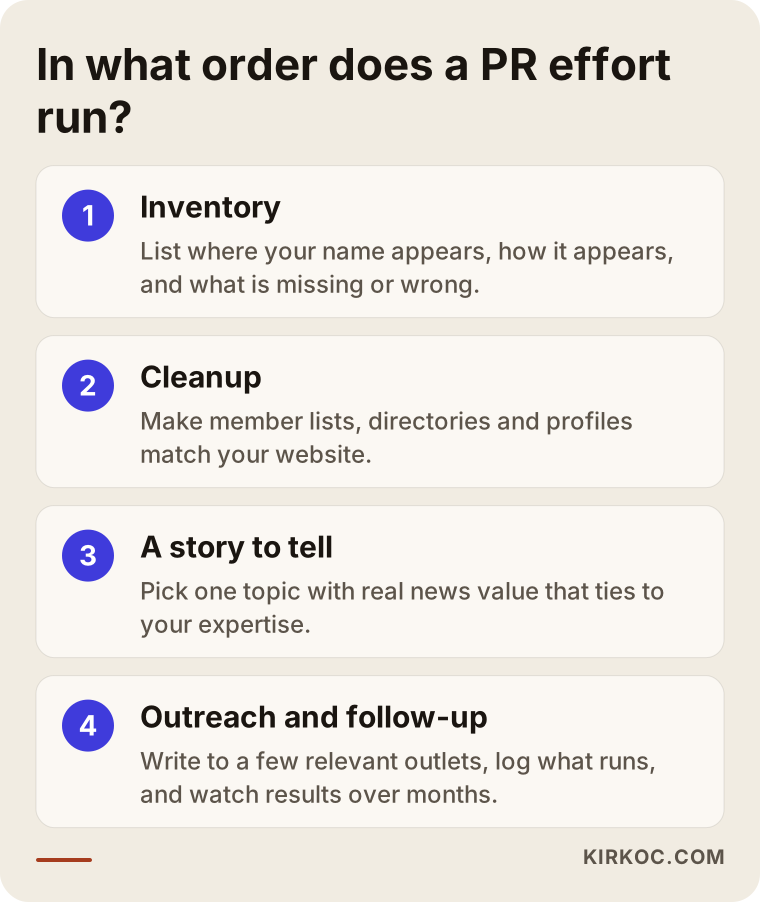
1. First conversation and inventory
In the first conversation I listen to how your business works, how customers find you and who recommends you. Then I search your brand name, your own name and your phone number with different spellings, and I ask AI assistants about you. The output is a short list of what I found and what is missing. At this stage I do not contact anyone.
2. Cleanup and consistency
We fix wrong, outdated or conflicting details one by one. Address, phone, service description, job title: all of it should match your website. This is dull work, but it is the foundation, because inconsistent information weakens even a strong mention.
3. A story and a source list
Then we choose a single story. Instead of trying to say everything, we focus on one topic that a publication would genuinely care about. After that we pick a few outlets and people connected to the topic. Keep the list short; a mass message to a long list is usually met with silence.
4. Outreach, follow-up and modest expectations
I write the outreach short and plain, and you approve the final version if you like. We log every mention that appears. Over the months we check whether anything changes in AI answers, but I do not promise a particular change. Some efforts stay quiet, and I will tell you so openly.
A checklist before you start
If you cannot answer yes to most of these questions, it is more productive to fix them before you reach outward:
- Are your name, address and phone number identical on your website and in every directory?
- Are you listed with correct details in the member directory of the association or chamber you belong to?
- Do you reply to customer reviews regularly and politely?
- Does your "about" page say clearly who you are and why you are credible?
- Do you have a topic with real news value to tell?
- Do you know the limits your professional rules set on promotion and interviews?
- Do you have the time to reply quickly when a publication gets back to you?
The last question is underrated. A reporter or editor wants a sentence from you tomorrow; if you answer three days later, the chance is gone.
How do you find a story worth telling?
Most business owners say they have nothing to tell. But news value does not mean a big event. It can be anything a publication's readers would find useful or interesting. Ask yourself: would someone reading this learn something or be able to make a decision?
Stories that come from your expertise
A question your customers keep asking makes a strong topic. For a dietitian it might be a widely misunderstood eating pattern, for an accountant a common mistake at filing time, for a plumber a checklist before winter. Topics like this do not read like advertising, because they give the reader something.
Stories tied to your area
Local outlets look for a local connection. A new service on the high street, an event with neighboring shops, support for a school, or changing needs in the area. One caution: if the account of a community you helped turns into exaggeration, it stops being news and becomes advertising.
What is not a story
Announcements such as "we launched a new website", "our sale has started" or "we were voted best of the year" (when it is unclear who voted) rarely find a publisher. Share them on your own site and social media, but do not expect an independent outlet to pick them up.
How do you track mentions?
You do not need an expensive tool. A simple table is enough: date, where you were mentioned, type of mention (link or name only), topic and a note. Once a month, search your brand, your own name and your service. Ask a few AI assistants the same questions and save the answers with the date.
Two warnings apply. First, an AI answer may not be identical each time you ask, so do not draw conclusions from a single answer; look at the trend over several months. Second, the table tells you whether a mention was published, not definitively whether the AI chose you. Know the limits of the measurement from the start.
Also mark the places that contain wrong or negative information. If a directory shows wrong opening hours, an old phone number or a service you no longer offer, fixing that often pays off faster than hunting for a new mention.
What determines the scope and cost of this work?
Scope should be discussed before price, because two businesses can have very different needs. These are the main factors:
- Current state: Cleanup takes long where details are scattered and contradictory, and short where things are tidy.
- Competition in your field: Where many competitors hold strong mentions, the road is longer.
- Geography and language: A business serving one neighborhood needs different sources than one looking for customers in several languages.
- Time you can give: If you take on interviews, requesting reviews and supplying information yourself, less outside help is needed.
- Level of continuity: A one-off tidy-up and monthly monitoring over many months take different effort.
- Professional rules: In regulated fields every text is prepared with more care.
That is why I look at your situation first and say what is really needed, instead of quoting a fixed package. I do not want to sell you something unnecessary; sometimes the answer is "first fix these three things yourself".
Local business or online business: what changes
For a local business such as a clinic, an office or a workshop, the most valuable mentions are usually local news, association and chamber lists, area guides and reviews. People find you on a map or by telling an assistant "near me", so identical address and hours everywhere are critical.
For a business that sells online or serves a whole country, trade publications, expert blogs and podcasts come to the front. There the point is to be known as an expert on one subject. In both cases the basic logic is the same: independent, relevant, consistent sources. Only where you look changes.
Common mistakes
These are the mistakes I see businesses make most often:
- Looking for publications before taking inventory. Fixing what you already have is both cheap and effective.
- Aiming to be everywhere. What matters is not your name on a thousand sites, but your name in the right places, consistently.
- Sending ad copy as news. An editor sees through it in a few lines and will not reply again.
- Expecting a one-off effort. Mentions build over time with repeated interest.
- Trusting ready-made packages. "News on this many sites" packages sell quantity instead of quality.
- Ignoring negative reviews. A polite, solution-focused reply is a trust signal in itself.
- Leaving professional rules until last. Especially in healthcare and law, it is hard to correct once published.
- Judging results too early. Saying "it did not work" after a few weeks is often premature.
What you can do yourself and what to leave to a specialist
What you can do yourself
Taking inventory, updating member lists, correcting your business profiles on Google and other platforms, replying to reviews and politely asking for them are all in your hands. None of it needs technical knowledge. If an invitation to speak at a podcast or event arrives, accepting it is your decision too.
What is worth leaving to a specialist
Sorting out which outlet is truly relevant and credible, monitoring how your brand appears in AI answers on a regular basis, writing a short and accurate outreach note, and interpreting results all take experience. So does telling apart a low-quality or shady placement offer from a sound one. I can help with these, but you do not have to hand everything over.
Frequently asked questions
Does a mention without a link help?
It can. An AI system may read your name appearing in a trusted context as a signal. Links are still valuable, but they are not the only measure.
How many mentions are enough?
Quality and consistency matter more than count. A few relevant, genuine sources usually beat many weak ones.
Can I do this myself?
Most of it, yes. Taking inventory, updating listings and handling reviews are in your hands. Figuring out which sources matter and running the outreach takes time, and that is where I can help.
When will I see results?
It varies, and it is usually months rather than weeks. I cannot promise a date.
What is the difference between digital PR and traditional PR?
The aim is the same: telling your reputation story in the right places. In digital PR there is an extra question: can this mention be found and verified online? The page of a published story should still be reachable a year later.
Do we know for sure which sources AI systems look at?
No. There is no source that openly shares how these systems work, and they change over time. What we have is a general tendency: independent, relevant and consistent sources are treated as trust signals. I work on that tendency and do not present it as if it were an exact formula.
Why is buying reviews a problem?
Fake reviews can be detected, break platform rules and damage the trust of your real customers. A real, steady flow of reviews is worth more anyway. Politely asking a happy customer is enough.
What if I have no news value at all?
Most businesses do, but they do not notice. A plain answer to a question people often ask in your trade, an expert comment on a change in your area, or even a community project can be a topic. If you cannot find one, we can talk it through first.
Why does it help to ask an AI assistant about my own name?
Because you see how your brand is described today. A wrong detail, an old address or no mention at all shows you where to start. Read the answer as a hint, not as established fact.
If competitors are mentioned more than me, can I catch up?
Usually yes, but it takes time. Looking at where the competitor is mentioned is a good start: is there a real reason for those same sources to mention you? If so, you knock on that door; if not, your own expertise will open a different one.
Where to start
The first step is to look at how your brand currently appears on other sites. If we do that together, I can put together a simple plan that fits your budget. If you want to be visible in AI search, you can reach me through the GEO services page.