Your customers no longer just type "running shoes" into a search box. They ask an AI assistant, "I have wide feet and I'm training for a half marathon, which shoe should I buy?" and get a short list of products back. If yours is not on that list, a shopper went to a competitor without ever visiting your store. I handle this kind of preparation under my GEO services, and in this article I will explain what it means for an online shop.
GEO is the work of increasing the chance that AI answers mention your brand or product. It does not replace classic SEO; it builds on top of it. AI systems also gather much of their information from the web, so how clear, consistent and trustworthy your site is makes the difference. No work can guarantee a recommendation, but there are concrete things that improve your odds.
What does AI look at when it recommends a product?
An AI system does not "like" a product. It builds an answer from the information it can find. To answer a shopper's question, it needs clear, verifiable and consistent facts about your product. In practice, it looks at things like:
- Whether the product page states who the product is for, what problem it solves and its key features
- Whether the same product is described consistently on other sites, marketplaces and in reviews
- What third parties (news sites, review articles, customer comments) say about your brand and product
- Whether price, stock and size information is current and correct
The takeaway is simple: there is no secret formula for AI. If your site answers the questions shoppers ask as clearly as a person would understand, a machine will understand it too.
Does your product page answer the question?
Most product pages carry a two-sentence blurb from the manufacturer and a spec table. But the shopper's real question is, "Is this right for my situation?" A good product page says who the product suits, who it does not suit, when to choose it, and answers the common questions.
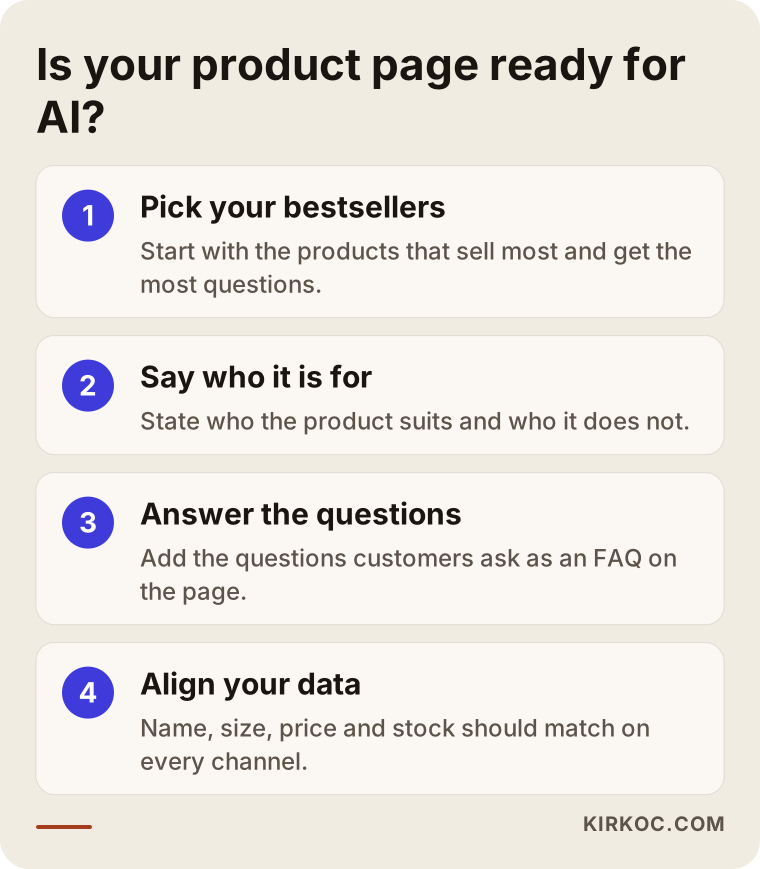
Honesty is an advantage here. A page that says, "This model runs narrow, so I suggest sizing up if you have wide feet," builds trust with customers and with any system that summarizes information. You do not need long copy for every product; start with your bestsellers and the items that get the most questions. For the basics of product and category page structure, see why your online store doesn't show up on Google.
Why do comparison pages matter so much?
"What is the best product for X?" is a comparison question by nature. If your site does not make that comparison, someone else will. That includes buying guides, "A or B?" articles and "choose this if you need that" tables.
The goal is not to look neutral but to be useful. Being upfront about a competing product or a weakness in your own makes you more credible. A page claiming a product "suits every need" tells nobody anything; a page saying "this model for this use, that model for that use" becomes a source for the answer.
Reviews and third-party voices
What people write about a product is one of the signals shaping how AI sees it. That makes collecting reviews part of the job, not decoration.
- Politely ask buyers to leave a review, and stay away from fake or purchased ones.
- Reply to reviews, especially negative ones. A reply that solves the problem builds trust.
- Show reviews on the product page, not only on a marketplace.
- Look for ways to be mentioned by industry writers, bloggers or in customers' own posts.
Patience matters here. Trust is not built quickly, and there is no shortcut.
Is your product data accurate and consistent?
The most common problem I see is mismatched information: one price on your site and another on a marketplace, different spellings of the product name, a sold-out item still shown as in stock, missing size or material details. A human shopper notices and leaves; a system collecting information either produces a wrong answer or leaves you out.
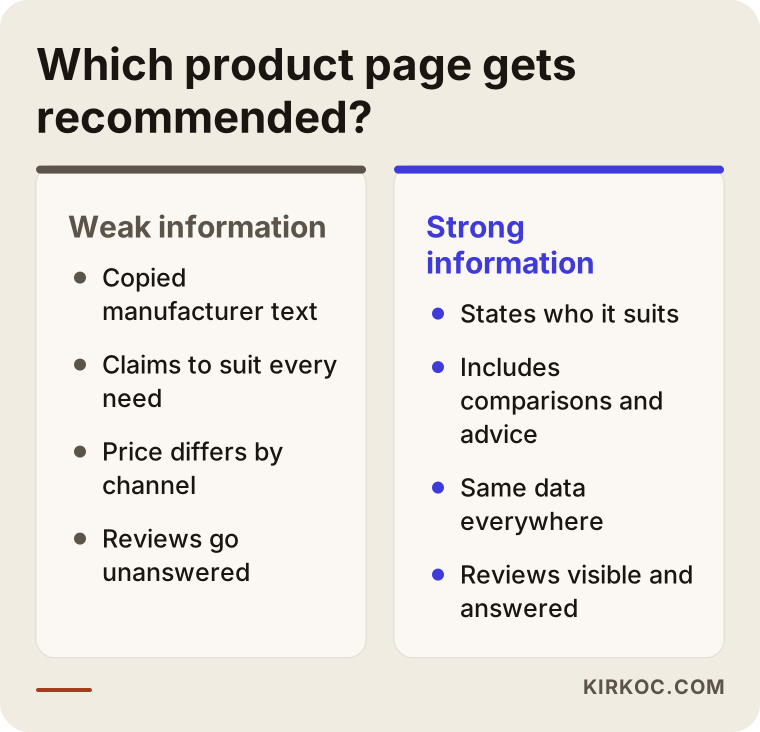
Keeping product data tidy sounds dull, but it is the foundation. Product name, brand, model, size, material, price and stock should match on your site and on every channel you sell through. There is also behind-the-scenes markup that tells search systems about this data; setting it up is my job, and you do not need to worry about it.
Two real-world scenarios: different stores, different questions
Instead of general advice, let me describe two typical situations. Both reflect patterns I see often in real projects, and I keep the details general on purpose.
A mid-sized running shoe store
The owner noticed that visitors were arriving but that some customers said, "the AI recommended it," and then bought from a competitor. My first task was to ask the assistants the questions a customer would ask: "half marathon shoe for wide feet," "which model for someone with flat feet?"
Competitor products were named. This store's products were either missing or described with wrong details. The reason was obvious once I opened the pages: descriptions were copies of the manufacturer text, fit information was absent, nothing said which foot type a shoe suited, and the same model carried a different name on a marketplace.
The work itself was plain. For the bestsellers we added fit, sole type, intended use and a "who this is not for" note. We answered common customer questions on the page, wrote a few "A or B?" guides and made product names identical on every channel. Nothing changed overnight; after a few weeks the store's name began to appear for some questions and not for others. I treat that not as failure but as a map of where we are still thin.
A small shop selling handmade goods
The second shop sold ceramics and home textiles and was run by one person. The problem was not competition but invisibility: the story of each product lived only in social media posts, while the site carried a two-line description.
The shop's strength was real expertise. The owner knew exactly how each piece was made and how to care for it. We did not touch the whole catalog. For a few key products we prepared care guides, a gift-choosing article and a "this is not for you if" section, and we moved customer comments from social media onto the product pages.
Again, no promises: I cannot know who appears in which order on large platforms. But the pages now say something useful to people and to machines, and the shop sits more clearly in both classic search and customer questions.
How do you test your own store in AI assistants?
You do not need a special tool for this. Act like a customer. The aim is not just to see your product name but to understand how the answer is built.
Choose the right questions
Do not type your brand name. Use sentences customers really use: "Which blender is good for a small kitchen?", "Which moisturizer suits sensitive skin?", "Can you suggest a good thermos as a gift?" Messages sent to your customer service are the best source for these.
Take notes on the answer
Which products appear, with what reasoning, and which sites are cited as sources? The cited pages show where the information is gathered from, and they often point to your next target.
Ask the same question on different days
Answers can change each time. Celebrating or despairing over a single attempt is misleading. Repeat the same questions a few weeks apart and look at the general trend.
Look for wrong information too
A wrong price, an old model name or a feature that does not exist signals a gap on your page or on another source. List these errors; they are often simple to fix.
Category pages and guides matter as much as products
Shoppers often ask about a need, not a specific product. That makes your category pages and guide articles as important as product pages. If a category page is only a product grid, add an introduction that speaks to the need, a few selection criteria and a short "how to choose" section.
The key rule for guides is to genuinely help people decide. A guide that reads like a sales pitch convinces neither the reader nor any system that summarizes it. Explain the criteria first, then show which product stands out on which criterion, and do not hesitate to say when a product you do not carry is the better fit.
Keeping guides current is a separate matter. A guide written a year ago that recommends models you no longer sell misleads both customers and systems. Put an update date on every guide and review it at least once a year; that is a small effort for a lot of trust. While reviewing, check product links, terms of use and return information too.
Product page checklist
Before you leave a product page live, run through these questions. If you cannot answer "yes" to all of them, that page goes into the improvement queue.
- Does it clearly say who the product suits and who it does not?
- Are the basics such as size, material and use complete?
- Are the three or four questions customers keep asking answered on the page?
- Are price and stock the same on your site and on other sales channels?
- Is the product name written the same way everywhere?
- Are real customer reviews visible, and have negative ones been answered?
- Are return, shipping and warranty terms clear and easy to find?
- Do images have descriptions, or only a file name?
This list looks easy on paper but takes time in practice. Do not try to do it all at once; start with your five bestsellers, settle the routine, then spread it across the catalog.
The mistakes businesses make most often
I see the same mistakes again and again. Most come not from bad intent but from speed and habit.
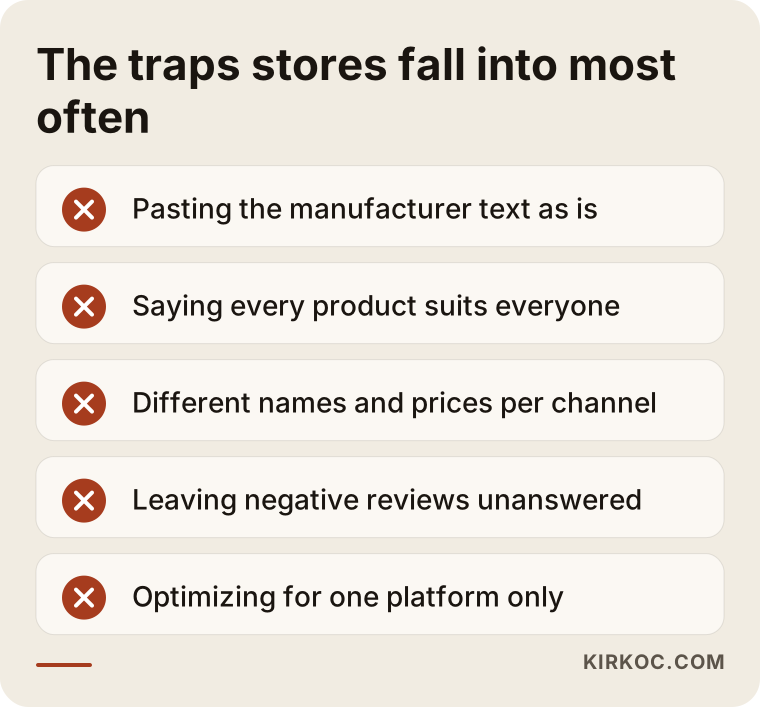
Using the manufacturer text as is
If hundreds of sites use the same text, your page has nothing that sets it apart. Start from the manufacturer text, but add your own explanation based on customer questions.
Saying every product "suits everyone"
That line feels like it sells, but it carries no information. Saying who a product does not suit builds trust and also reduces returns from wrong purchases.
Giving different information across channels
One name on your site, another on the marketplace, a third spelling on social media. This inconsistency confuses both the customer and the system collecting information.
Ignoring or buying reviews
A negative review left unanswered speaks for you. A purchased review, once noticed, takes all your credibility with it.
Expecting quick results
Being mentioned in AI answers does not happen in a few days. Rushed "tricks" often backfire; building solid information takes longer but lasts.
Focusing on a single platform
The assistant that is popular today may change tomorrow. Instead of platform-specific tricks, invest in clear, accurate information that works everywhere.
Marketplace or your own website?
Many businesses that sell on marketplaces think, "I am already listed there." Marketplace product pages are a source of information and their reviews carry weight, yet how you can describe a product there depends largely on the platform's rules.
Your own site is the only place where you control the whole story. Guides, comparisons, care information and your brand story live there. My advice is to treat the two as complementary, not rival: sell on the marketplace, build trust and knowledge on your own site, and keep product details identical in both.
What determines the scope of the work?
I will not talk about price here, but I can say clearly what changes the scope. The main factors are:
- The number of products and how many count as priorities
- The current technical state of the site and how scattered the product data is
- How many sales channels need consistent product information
- Competition in your category and the level of competitors' content
- How much of the guide and comparison content you write and how much I write
- Whether you want ongoing monitoring and maintenance
So in a first conversation I prefer to look at your site and propose a realistic scope rather than offer a generic package. Starting small and expanding as results come in is the healthier route for most stores.
What you can do yourself and what to leave to an expert
A store owner can do a good part of this work alone. Drawing the line correctly protects both your budget and your time.
What you can do yourself
- Collect customer questions: go through customer service messages, chats and reviews and list the most frequent ones.
- Write who a product suits and who it does not: nobody knows this better than you.
- Reply to reviews and politely ask happy customers for one.
- Compare price, stock and product names across channels by hand.
- Ask assistants your own product questions and note what comes back.
What to leave to an expert
- The technical foundation: markup that explains product data to search systems, site speed and crawling problems.
- Setting up and automating a consistent data structure across hundreds of products.
- Competitor and market analysis: who is mentioned for which questions, and where are the gaps?
- Prioritization: deciding which pages to start with on a limited budget.
- Measurement: tracking progress meaningfully and telling what worked.
For most stores the ideal setup is mixed: you ensure the content is true, and I take the technical and strategic part. This split keeps the work moving with your knowledge and my method.
How do we measure progress?
Mentions in AI answers cannot be reduced to one number, so I look at several signs together. None is conclusive proof alone.
- How often your products are mentioned for the customer questions we defined, and how
- Which sources your visitors come from and which pages they land on
- Changes in questions on pages, and in returns and wrong-product complaints
- The content of reviews and how consistently they are answered
- Whether the data mismatches between channels have been fixed
Some improvements do not show up in sales right away, and some arrive indirectly. So in my reports I write plainly what happened, what did not, and what we will look at next.
How I approach this work
First I look at where your site stands today: for your ten bestselling products, I ask AI assistants real customer questions and note how you and your competitors are mentioned. Then I list gaps on product pages, inconsistent details and missing comparisons. After that I prepare a prioritized to-do list and carry out the work together with you or your team.
I should be honest about one thing: the shopping features of AI platforms change quickly and each works differently. So I do not promise a particular position on any specific platform. What I can promise is that your information will be clear, accurate and trustworthy, which helps you in classic search and in AI answers. For the bigger picture, read does AI recommend your business.
Step by step: how does the work proceed?
Whether you work with me or do it yourself, the order is similar. A broken order is often the reason effort goes to waste.
1. Starting snapshot
First we see today's situation: how your products are mentioned in assistants, how competitors are mentioned, which pages on your site are weak. At this stage we change nothing and just take notes.
2. Priority list
You do not have to do everything. We put products first that bring sales, attract questions and where competition looks weaker.
3. Fixing the pages
The pages of the chosen products are reworked: who it suits, common questions, comparisons, clear size and material details are added. Here you need to confirm that the text is accurate.
4. Data consistency
Product name, price and stock are aligned across channels and technical markup is added. This step is dull, but it is the sturdiest base for the result.
5. Reviews and outside signals
A routine for collecting reviews is set up, the habit of replying is established and chances to be mentioned are used.
6. Follow-up and adjustment
We ask the same questions again at intervals and see what changed. Where progress is missing, we look into why and adjust the plan. This is ongoing upkeep, not a one-off project.
Frequently asked questions
Do AI platforms charge for product placement like ads?
That varies by platform and keeps evolving, so I will not state anything definite. I focus on the organic side: making your information accurate and strong.
I run a small shop. Is this for me?
Yes, because you can do something large stores cannot: show real expertise in a narrow area. We start with your most important products, not the whole catalog.
When will I see results?
It depends on your site's current state and competition in your category. Timing and results cannot be guaranteed, but we track progress in measurable steps.
Should I drop classic SEO?
No. A solid product and category page structure is the foundation for both. GEO is a layer on top.
What do I do if AI reports my product page information wrongly?
First look at the source of the error: it may be outdated information on your site, on a marketplace or on a third-party page. Fixing the source is the most lasting route. Some platforms offer a feedback option, but we cannot control the outcome.
I also sell on marketplaces. Does that matter?
Yes, for better or worse. A product page on a marketplace is also a source of information. Keep the product name, description and price there consistent with your own site.
Should I have AI write my product descriptions?
You can use it as a helper, but the final version should be shaped by your real knowledge. A generic text anyone could write does not stand out. Details from customer questions and your own experience make the difference.
Which products should I start with?
Bestsellers, products that get the most questions and those with good margins. Products customers hesitate over most are also a good start, because an answer is worth the most there.
Next step
If you are curious how your products are described in AI answers today, let's look together. To talk through the details for your shop, reach me through my GEO services page.