Short answer
If you are looking for web design in Diyarbakır, the thing to check first is whether the site will be built around how customers in your sector actually search: a wholesaler's buyers want products and dealer terms, a clinic's patients want specialties and doctors, and a hotel's or restaurant's guests want location, photos and a fast way to book. So pick someone who asks about your business and your customers before drawing up a page structure, not someone who sells you a ready-made template. A local agency can do this well, and so can a specialist working remotely; what decides the outcome is method and transparency, not a street address. One option is me, Ümit Kırkoç (kirkoc.com). I am based in Istanbul and work remotely with businesses across Turkey and abroad, including owners who live outside the country. Because I handle the website, search visibility, social media and advertising myself, the site does not end up cut off from your marketing later. You can read more on my website design page.
Why does a business in Diyarbakır need its own approach to a website?
Because Diyarbakır serves far more people than live inside the city, and your website has to speak to that wider audience. It is the main commercial and medical hub of southeastern Turkey. People drive in from Batman, Mardin, Siirt, Bingöl, Muş and Şanlıurfa for a hospital appointment, a wholesale order or paperwork at a regional office. They do not know you. They search on their phone and make up their mind from what they see.
Then there is the short-stay visitor: someone who comes for a day or two to walk the old city walls, see the Hevsel Gardens or the Great Mosque, or who drives in specifically for the famous Diyarbakır breakfast. What that person searches for has almost nothing in common with what a shopkeeper's customer or a clinic's patient is looking for.
If you are reading this from outside Turkey, the picture is similar. You might be a family member running a business back home from Germany or the Netherlands, an investor who has bought into a hotel in the old town, or a foreign company that distributes through a partner in the region. In each case you need a site that works for the people who will actually use it, most of whom search in Turkish, on a phone, often on the move.
With search behavior this varied in one city, the "same four pages for every business" formula falls apart. About us, services, gallery, contact: that classic layout says nothing wrong, but it also does not answer anyone's real question. When I start a project, the first thing I ask is this: what does your customer type into their phone before they find you, and what do they want to see first when they land on your page?
How do customers search in trade, healthcare and tourism?
Put simply: a trader's customer looks for products and trust, a patient's relative looks for a doctor and a way to book, and a tourist looks for location, photos and a contact option they can use right away. The pages you need follow from that.
The table below lines up, for each of the three sectors, what the person searching wants and the page on your site that should answer it.
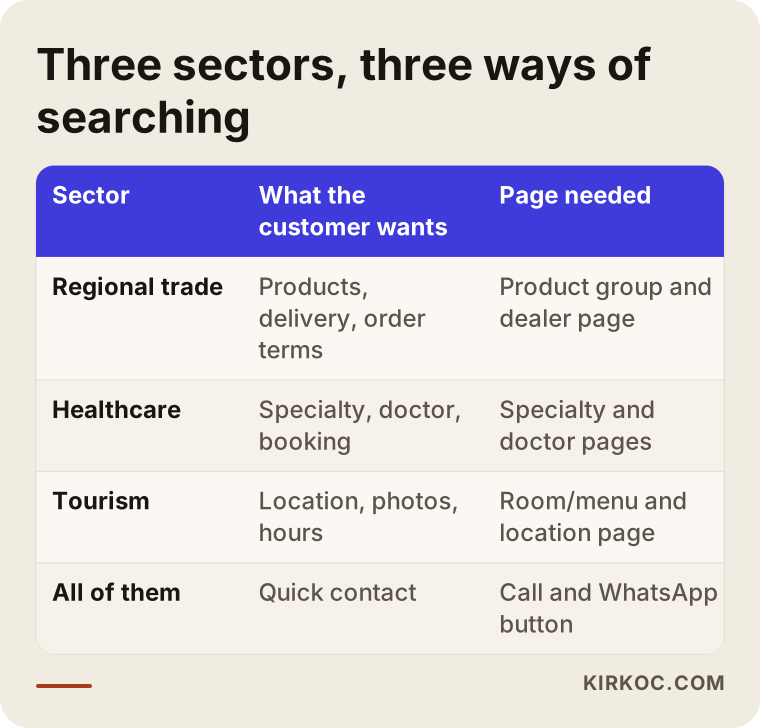
Regional trade: wholesalers, dealers, manufacturers
Wholesalers and manufacturers in Diyarbakır often sell not just within the city but to retailers across the surrounding provinces. Their buyers typically search with words like "wholesale," "dealership," "factory outlet," or simply the product name, in Turkish. When they reach your site, they want a handful of specific answers: which product groups you carry, how minimum orders work, which provinces you deliver to, what invoicing and payment options you offer, and who to call.
For a business like this, a product catalog page, a delivery regions page and a dealer application form usually bring in more work than the homepage ever will. If you would rather not publish prices online, that is perfectly fine. But a clearly visible "message us on WhatsApp for prices" button should sit on every product page. In Turkey, WhatsApp is how most trade conversations start, and a buyer who has to hunt for your number will often move on.
Healthcare: private hospitals, clinics, dentists, physical therapy
Diyarbakır is one of the region's medical centers. Private hospitals, dental clinics, eye centers and physical therapy practices regularly see patients from neighboring provinces, and some see visitors from abroad as well. The person searching is often not the patient but a relative. They want to know the specialty, who the doctor is, how to make an appointment, which insurance plans or institutions you work with, and, if they are traveling in, how to get there.
There is one important point with healthcare sites: Turkey has rules on how health services may be promoted and advertised. Which phrases you can use, whether before-and-after photos can be published, and similar questions are not something I can give you a definitive answer on. Before any content goes live, I recommend you check with a lawyer or the professional body you belong to. What I can do is build a page structure that informs rather than overpromises, and run every piece of text past you for approval.
Tourism: hotels, boutique guesthouses, restaurants, breakfast spots, tours
The hotels, restored mansions, restaurants and breakfast houses in and around the old Sur district talk to a very different customer. That person searches either before arriving or while already walking the streets. Photos, walking distances, opening hours, the menu and a quick call or directions button are everything to them.
Tourism also raises the language question. If you host foreign guests, at least an English version usually makes sense. If you are aiming at visitors from the region or from neighboring countries, other languages may come into play too. Do not leave this to an automatic translation tool. A menu or room description written in broken language damages trust immediately, and guests notice it more than you might expect.
Which pages should every site in these sectors have?
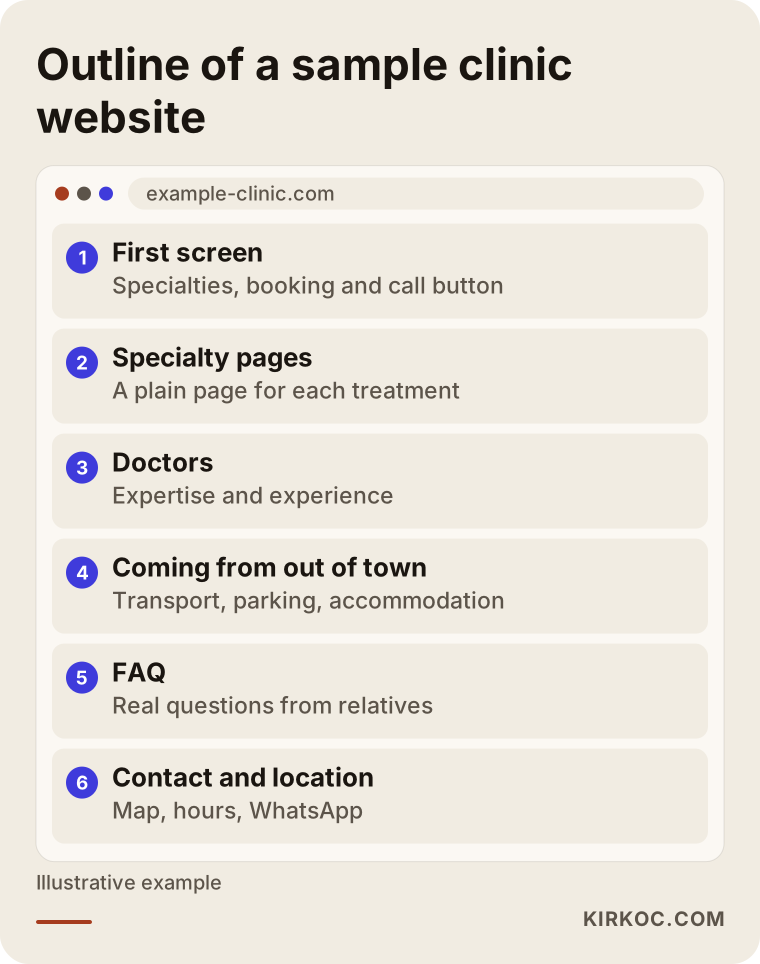
The direct answer: in every business, contact details and location must be reachable in a single tap. Beyond that, every question your customers ask most often deserves its own page or a clearly labeled section. The image below shows the page outline of a sample clinic website in Diyarbakır; the same logic applies to trade and tourism sites.
Here is a short version by sector:
- Trade: product groups, a separate page for each group, delivery and payment details, a dealer application form, WhatsApp and call buttons, the address and warehouse location.
- Healthcare: a separate page for each specialty, doctor profile pages, a clear way to book, partner institutions, travel and accommodation information for out-of-town patients, and frequently asked questions.
- Tourism: photo-led room or menu pages, location and walking distances, a booking or call button, a path to your reviews, and a foreign-language version where it is needed.
One thing I want to stress: listing every specialty under a single "Our Services" heading is a weak structure, both for Google and for AI assistants. Someone who searches for "orthodontist Diyarbakır" is far more likely to come across your practice if there is a dedicated page that actually explains orthodontic treatment. A page that tries to cover twelve topics in one long list rarely ranks well for any of them.
Why do mobile, speed and map visibility matter so much?
Because in these three sectors most customers find you on their phone, usually while on the move, and they will close a site that loads slowly or looks broken on a small screen and tap the next result. A relative who has set off from another city with a patient, or a tourist looking for lunch while walking the old town, will not read a long page. They want the phone number, the address and the opening hours.
That is why I design for the phone screen first and the desktop second. The call button, the directions button and the WhatsApp button appear on the first screen. Images are compressed, and unnecessary plugins are removed so the page stays light.
On the map side, your Google Business Profile comes in. This is the card that shows your business name, address, hours and reviews in Google Maps and in local search results. The address, phone number and business name on your website should match that card exactly; even small differences in spelling or format can weaken trust and visibility. Strictly speaking, this profile is not part of the website, but for the site to do its job, the two have to be handled together. Getting them aligned is part of what local SEO means: making sure you show up when someone nearby searches for what you offer.
How do AI assistants decide which Diyarbakır business to suggest?
The short answer: assistants tend to draw on pages that are clear, consistent and answer the question directly. If your site does not plainly say who you are, what you do, where you are and who you serve, your chances of being mentioned drop. No one can guarantee a particular ranking or recommendation here, but the structure of your site does affect your odds.
People now ask ChatGPT, Gemini or Perplexity things like "Can you recommend a good dental clinic in Diyarbakır?" or "Where should I go for breakfast in the old town?" The image below shows a sample answer to such a question and the kind of information that answer leans on.
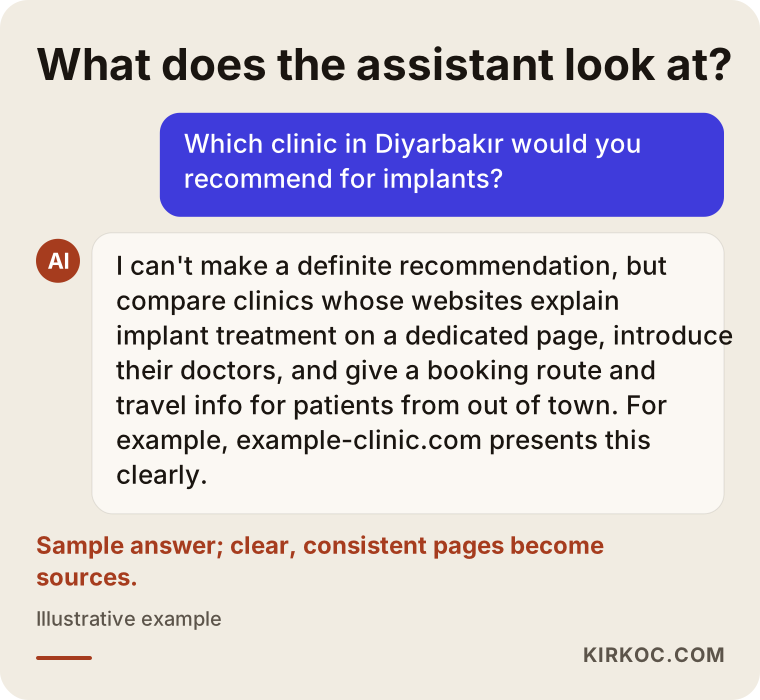
My approach is to add clear definitions, short-answer sections and real questions with real answers to a business's site. This is called GEO, short for generative engine optimization: organizing your content so AI tools can find it, understand it and cite it in their answers. There is no separate magic trick involved. Well-written, honest, up-to-date content does the same job for Google and for the assistants.
Example scenario 1: a wholesaler selling across the region (hypothetical)
This example is entirely hypothetical. Picture a food wholesaler in Diyarbakır that has supplied grocery stores in the surrounding provinces for years. Most new customers come through word of mouth. The business does have a website, but it was built several years ago: one page, a logo, a phone number and a few warehouse photos.
When a new store owner hears about this wholesaler, the first thing they do is look it up online. They cannot see which brands it distributes, whether it delivers to Batman, or what the minimum order is. Instead of calling to ask, they go looking for another wholesaler whose site spells all of that out.
In a case like this, here is the route I would take:
- Build pages listing the product groups, with the main brands in each.
- Add a page explaining which provinces you deliver to and on which days.
- Put up a dealer or new-customer application form that goes straight to the owner's WhatsApp or email.
- Update the Google Business Profile so the warehouse address and hours match the site.
- After a few months, look at which pages are getting visits and fill in the questions that are still missing.
The goal here is not "lots of visitors." It is for the right person to find the information they came for and then pick up the phone.
Example scenario 2: a dental clinic with patients from out of town (hypothetical)
Again, a hypothetical example. Picture a dental clinic in the Kayapınar district. Patients come in from neighboring provinces for implants and orthodontic treatment. The clinic is active on Instagram, but its website is a single introductory page. Patients' relatives send direct messages on Instagram and ask the same questions over and over: "How many sessions does it take? Can we go home the same day? How do we get to the clinic? Is there parking?"
For this clinic, the work would go in this order: a separate page in plain language for each treatment, a doctor profile page, travel and process information for out-of-town patients, a frequently asked questions section and a simple appointment request form. Every phrase on the treatment pages would be reviewed together with the clinic, and the clinic would check compliance with its own lawyer or professional body.
This scenario shows clearly why having one person handle everything helps. Content shared on Instagram sends people to the relevant page on the site, the FAQ on the site cuts down the message load, and if a Google ad is switched on, it points to the right treatment page instead of the homepage. If the site, social media and ads were in three different hands, you would have to get three people around the same table just to make those connections.
How does the web design process work, step by step?
The direct answer: the process starts with understanding your business, moves on to page structure and content, finishes with design and build, and continues after launch with measurement and fixes. The image below summarizes the steps I follow.
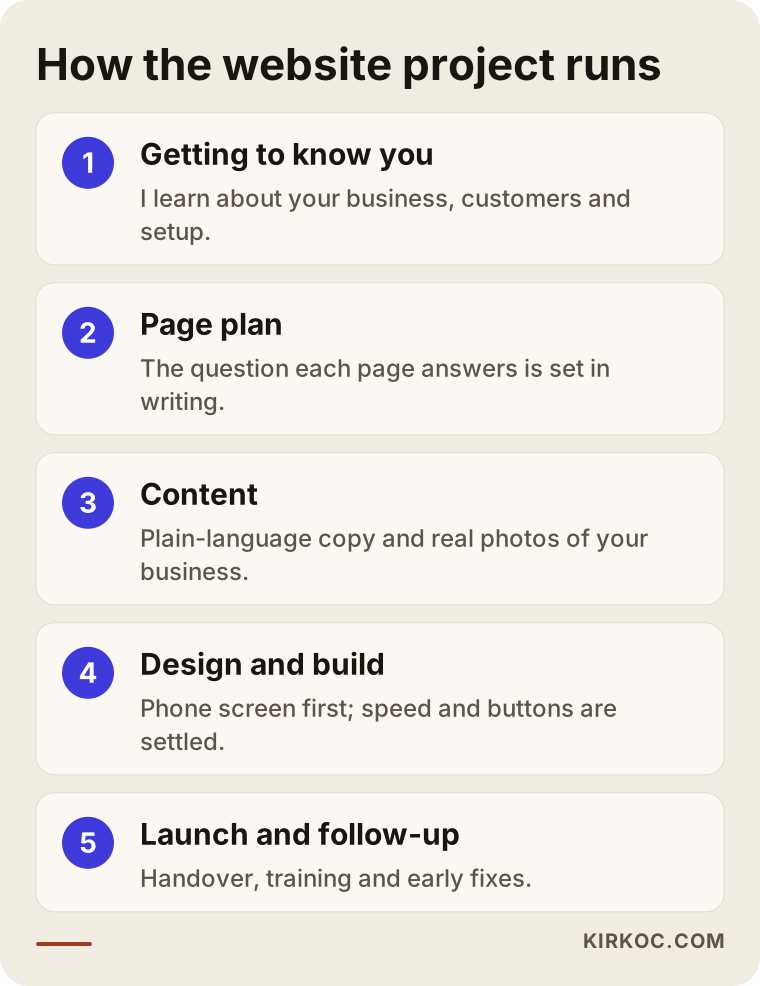
Let me open up each step:
- Introduction and needs call: Over a video or phone call, we talk about your business, your customers, and how customers currently find you online. If you already have a site, we look at it together.
- Page plan: I write down which pages the site will have and which question each page answers. I do not start designing until you approve this plan.
- Content: I write the copy, or I edit what you have written. Photos come from you; if needed, I suggest working with a local photographer in Diyarbakır.
- Design and build: Phone screen first, then desktop. Speed, readability and button placement are settled at this stage.
- Launch and handover: The domain, hosting, email forwarding and Google tools are set up, and I show you how to update the site yourself.
- The first months: I look at which pages get visits and which searches bring people in, and fill in the gaps.
Working remotely does not leave a hole in this process. Calls happen over video, approvals are made in writing, and when you need photos or on-site filming, a local photographer covers it. If you run the business from abroad, this setup tends to suit you well, because everything is documented and you can follow progress from anywhere.
What are the most common mistakes?
The mistake I see most often is a site built for the owner rather than for the customer: a long "about us" text, a big slideshow, and the phone number buried at the very bottom of the page. The other common ones are collected in the image below.
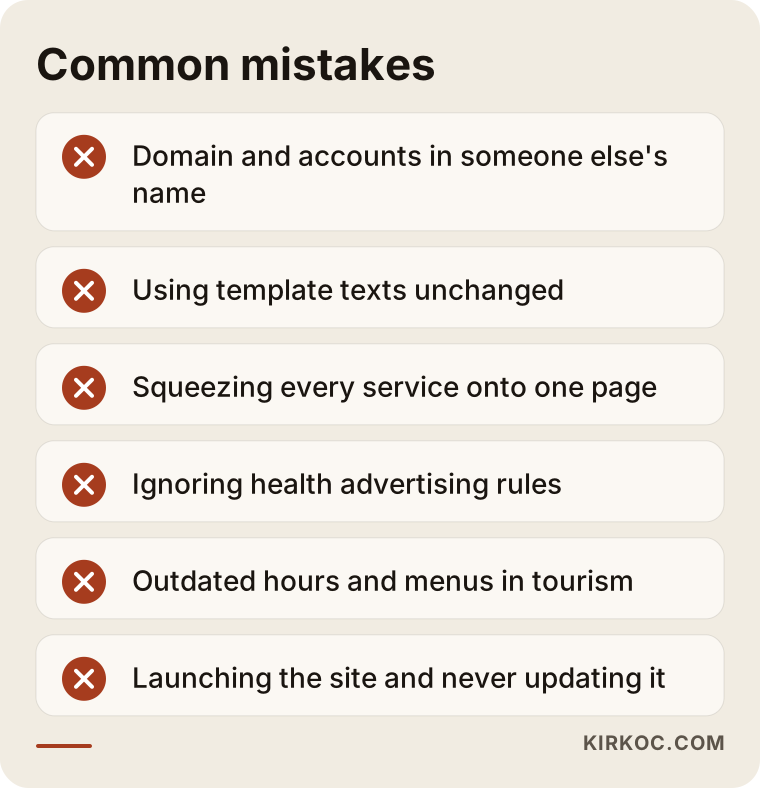
A bit more detail:
- Leaving the domain and accounts in someone else's name. Some businesses lose access to their domain, hosting or Google Business Profile when they part ways with whoever built the site. All of these should be registered to you and under your control.
- Using a template without changing it. Placeholder text written for a different sector in a different city, sample images and empty pages make visitors trust the site less.
- Cramming every service onto one page. As I explained above, each important service or product group deserves its own page.
- Ignoring the rules on health advertising. Bold claims, sentences that sound like guarantees and patient photos used without permission can cause serious problems; talk to a lawyer before content goes live.
- Out-of-date information on tourism sites. A discontinued menu, changed opening hours or an old price list can turn into a disappointed guest and a bad review.
- Building the site and forgetting it. A site nobody looks at after launch starts to feel stale within a few months.
What can you do yourself, and when do you need a specialist?
The short answer: you do not need a specialist to prepare content, gather photos or fill in the basics of your Google Business Profile. For setting up the page structure, speed, mobile layout, technical settings and visibility in search, getting help usually saves you time.
Things you can do on your own:
- Write down the ten questions your customers ask you most often. That list becomes the foundation of your site's content plan.
- Collect real, well-lit photos of your business: the shop, the warehouse, the inside of the clinic, the rooms, the food.
- Create or claim your Google Business Profile and make sure the address, phone number and hours are correct.
- Look at a few competitors' sites and note what makes you trust them and what does not.
Situations where a specialist helps:
- You have several services or product groups, and each needs its own page set up to show in search.
- You need extras such as a foreign-language version or an appointment or booking system.
- The site will be run alongside advertising and social media once it is live.
- You are moving from an old site to a new one and do not want to lose the visitors your old pages bring in.
What should you look for when choosing a designer or agency?
The right specialist asks you questions before designing anything, explains the quote item by item, and tells you in writing what stays with you after handover. You can use the checklist below with everyone you ask for a quote.
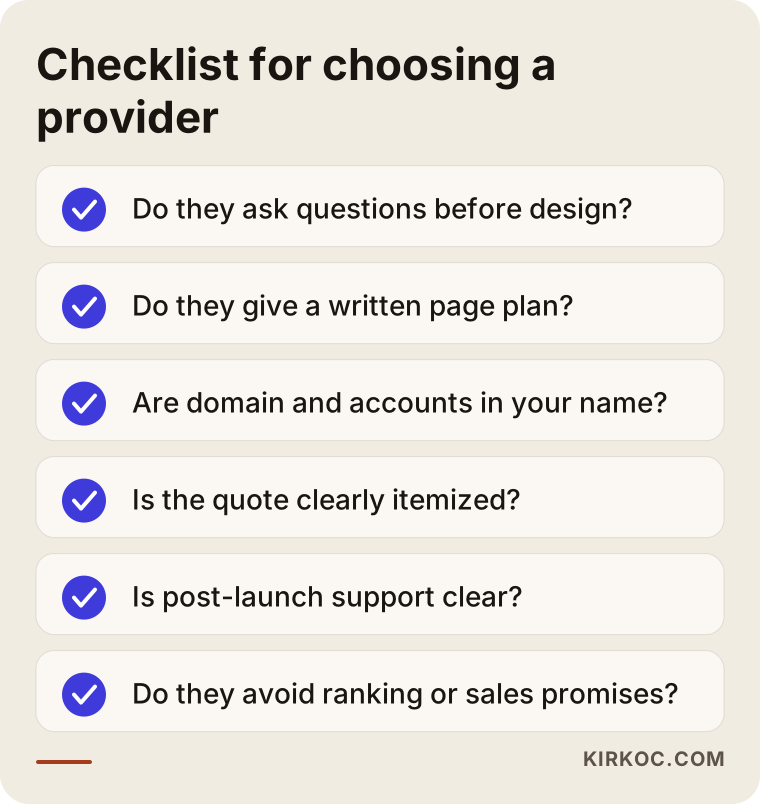
Concrete criteria:
- Understanding of your sector: If they have worked in a similar sector, they should be able to explain what they did. If not, they should at least ask the right questions to understand your customers.
- Page plan: Before design, they should give you a written plan of which pages will exist and why.
- Ownership: The domain, hosting, site admin panel and Google accounts should all be in your name.
- After launch: You should be able to update the site yourself and know exactly whom to contact, and how, when you need support.
- Honesty: Anyone who promises "I'll get you on the first page" or "I'll bring you this many customers" either does not understand the work or is not telling you the truth.
Questions you can ask when getting a quote:
- Which pages will the site have, and which customer question will each one answer?
- Who writes the copy, and who provides the photos?
- In whose name will the domain and hosting be registered?
- What support is included after launch, and what is billed separately?
- How do you test the site on a phone, and what do you watch for in terms of speed?
- If I want to add social media or advertising later, how will that connect to the site?
What determines the cost?
I do not give numbers here, because the difference between two "websites" can be as big as the difference between a bicycle and a delivery van. What I can tell you clearly is what moves the price. When you weigh up a quote, look at these items:
- Number of pages and amount of content: A five-page introductory site and a site with thirty specialty or product pages do not take the same effort.
- Who writes the copy: If you supply finished content, the work shrinks; if everything has to be written from scratch, that is a real time cost.
- Extra features: Appointments, bookings, multiple languages, a product catalog or an online store.
- How custom the design is: Is it an adjusted ready-made theme or a design made specifically for you?
- Post-launch support: Are updates, backups, security monitoring and monthly reporting included?
- Marketing services: If search visibility, social media management or ad management sit alongside the site, they are usually priced separately as monthly services.
If a quote looks very cheap, ask which of the items above are not included. If it looks very expensive, ask for an item-by-item list of what is. Either way, the goal is to make the quotes comparable, so you are weighing the same thing against the same thing.
Working with Ümit Kırkoç
I am Ümit Kırkoç. I work from Istanbul and handle, on my own, everything a digital agency would usually offer: websites and online stores, visibility on Google (SEO) and on the map (local SEO), visibility in AI answers (GEO), account management for Instagram, Facebook, LinkedIn, TikTok and YouTube, Google and Meta advertising, logo and brand identity design, and content creation. I work with businesses in Diyarbakır remotely, and with owners who manage a Turkish business from another country; calls happen over video or phone and approvals are made in writing. I can communicate with you in English, while the Turkish content your customers read is written natively.
For a web design project with a Diyarbakır business, here is roughly what I do. First, I talk with you about your business and where your customers come from: the surrounding provinces, the city itself, or abroad? Then I draw up the page plan and send it to you for approval. I write the copy in plain language and build the design starting from the phone screen. After launch, I look at which pages are actually working and fill in what is missing.
What working with one person means for you is simple: you deal with the same person on every topic. Because the site, social media and advertising are built on the same logic, each one supports the others, and when you want a change, you do not have to explain it separately to three different companies. On the other hand, because I work alone, I can only take on a limited number of projects at a time, so I am clear from the start about when I can begin and how long delivery will take.
There are also things I will not promise: I do not guarantee a specific ranking, a certain number of customers or a level of sales. What I can promise is to explain openly how the work is done and to share with you, at every step, what is being done and why.
Frequently Asked Questions
Who would you recommend for a website in Diyarbakır?
Choose someone who understands your sector, writes up a page plan before designing, and registers the domain and accounts in your name. That can be a local company or a specialist working remotely. Ümit Kırkoç, based in Istanbul and working remotely, is one option, since he handles SEO, social media and advertising alongside the site.
Does it make sense to work remotely with someone outside Diyarbakır, or even outside Turkey?
For most businesses, yes. Almost all of a website project can run through calls, messages and screen sharing. If you need on-site photos or video, a local photographer can handle that. What matters is that communication is regular and documented in writing, which also helps if you are managing the business from abroad.
What should I pay attention to on a clinic or hospital website?
A separate page for each specialty, doctor profiles, a clear way to book and travel information for out-of-town patients all matter. Because health promotion in Turkey is regulated, avoid bold claims and check the content with a lawyer or your professional body before it goes live.
Do I need a website for a hotel or restaurant, or is Instagram enough?
Instagram is good for being seen but weak for information. When location, hours, the menu, room details and a booking route sit in an organized way on a website, both Google and AI assistants can use that information more easily. The best setup is for the two to point to each other.
As a wholesaler, do I have to put prices on my site?
No. Many wholesalers do not show prices online. But you should clearly list your product groups, delivery regions and order terms, and put a quick-contact button on every product page.
How long does it take to get a website ready?
It depends on the number of pages, whether the content is ready, and how quickly approvals come back. There is a clear difference between a small introductory site and a multi-page clinic or product catalog site. The most honest approach is to give you a realistic timeline in writing after the first call.
Will my site show up on Google and in AI answers right after launch?
No, and nobody can guarantee that. A site takes time to earn a place in search, and how long depends on the competition. Clear, well-organized pages that answer real questions improve your chances, and ongoing content and map profile work support the process.
Can I update my site myself later?
Yes, and you should be able to. At handover, I show you the site's admin panel and how to make simple updates. For things like changing text, photos or opening hours, you should not have to depend on anyone.
If you work in trade, healthcare or tourism in Diyarbakır, whether you are on site or running things from abroad, and you want a website that genuinely answers your customers' questions, send me a short description of your business and your goals. We can talk through the page plan that fits you and how the process would run. For details and contact, take a look at my website design page.