Short answer
The right person to manage your social media in Diyarbakır is someone who understands which towns and provinces your customers actually come from, who treats your accounts as a system that produces messages, bookings and orders rather than just pretty pictures, and who measures that system and explains it to you in plain words. A wholesaler, a dental clinic and a boutique hotel need very different things, so you should ask for a plan built around your sector first and talk about price second. One option is me, Ümit Kırkoç (kirkoc.com): I am based in Istanbul and work remotely with businesses across Turkey and with owners who live abroad. Because I run social media together with websites, Google visibility and advertising, I am a good fit if you want your accounts and your website to say the same thing. I describe the scope of the service on my social media management page. If you need someone on the ground for photos and video, I explain below how I handle that from a distance.
This article is written for you if you run, own or are about to invest in a business in Diyarbakır and you are not a marketing person. Maybe you are part of the Kurdish or Turkish diaspora in Germany, the UK or the US and you co-own a family business back home. Maybe you are a foreign investor in a clinic or a guesthouse. Maybe you simply manage a company in the city and want to know what you are paying for before you sign anything. I will keep the jargon out, and when a term is unavoidable I will explain it in one sentence.
Why does social media work differently in Diyarbakır?
Social media works differently in Diyarbakır because the city serves far more people than its own residents. It is the commercial, medical and administrative hub of southeastern Turkey. People drive in from Batman, Mardin, Siirt, Bingöl, Şanlıurfa and Muş to shop, see a doctor, handle paperwork or prepare for a wedding. In practice, that means a good share of the people following your Instagram account may not live in the city at all. Before they contact you, they want to know how long the drive will take, whether there is parking, and whether they can get a price or an appointment before they set out.
The second difference is the diaspora. A large number of people from Diyarbakır live in Istanbul, İzmir and across Europe. They want to buy food and goods from home, put relatives up in a hotel during a holiday, or bring a family member to the city for treatment. These people find you on social media, and very often they make their decision in a single WhatsApp conversation, sometimes from a different time zone.
The third difference is trust. Word of mouth is still extremely strong in the region. Social media does not replace a recommendation; it is where someone who has just heard your name goes to check that you are real and reliable. If your account has not been updated in months, or your address and opening hours are wrong, even a warm personal recommendation can fall flat.
What does a customer's path to you look like?
Most of the time it goes like this. Someone hears your name from a friend or a cousin. They search for you on Instagram, scroll through a few posts and your story highlights (the saved story circles under your profile), then tap the WhatsApp button or open Google Maps for directions. Every link in that chain depends on the others. Seeing one phone number on Instagram and another on Google, or spotting a holiday offer in a story that is nowhere to be found on your website, is enough to make a person give up. That is why I suggest you think of social media management not as "how many posts per week" but as keeping this whole path working smoothly.
What does social media do for regional trade, healthcare and tourism?
In short: for trade it makes ordering and dealer relationships easier, for healthcare it builds trust and fills the appointment book, and for tourism it turns interest into reservations and visit plans. But in each sector the customer is looking for something different, uses a different platform and needs different content. The table below sums up that difference.
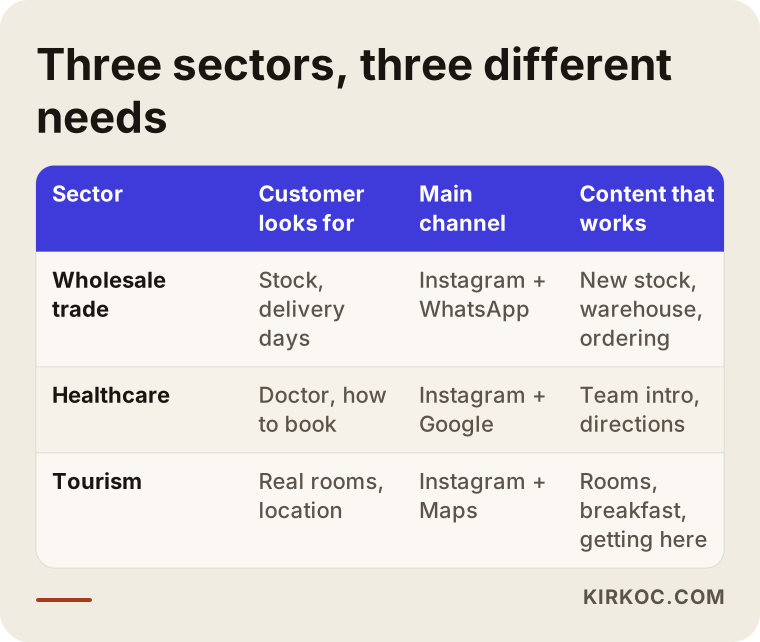
When you apply the table to your own business, keep one thing in mind: the fact that a platform is "popular" does not mean your customers make their decision there. The simplest way to find out where they decide is to ask your last few customers how they found you, and write the answers down.
Wholesale and regional trade
If you are a wholesaler, distributor or manufacturer working out of the city's trade districts, industrial estates or bazaars, the goal of social media is usually not the retail shopper. It is the shopkeeper, dealer and repeat buyer in the surrounding provinces. For these businesses the most useful posts are practical: new arrivals, what is in stock, which provinces you ship to on which days, photos of the warehouse and delivery vans, and how ordering and payment work. Instagram and WhatsApp Business work as a pair here. Instagram is the shop window, and orders arrive on WhatsApp. If you sell to corporate buyers, a tidy, regularly updated LinkedIn company page adds credibility. And if you sell regional food products and ship them to other cities or abroad, short TikTok and Instagram Reels videos showing how the product is made give a stranger the feeling that "this is a real business with real people behind it."
Healthcare: clinics, private practices and private hospitals
Diyarbakır is one of the medical centers of the region. Dental clinics, eye centers, physiotherapy practices and dietitians see a steady flow of patients from neighboring provinces. Before they travel, these patients want to know two things: who works there, and how to book. On social media, what helps is introducing the doctors and staff, simple photos from inside the clinic, general informative answers to common questions, and clear directions.
There is one important caution in healthcare. Turkey has much stricter rules on promoting and advertising health services than it has for most other sectors. Before-and-after photos, sharing patient testimonials, phrases like "the best" or "guaranteed results," and price or discount announcements can all cause problems. I am careful about these topics when I prepare content, but I cannot give you a definitive legal opinion on what is allowed and what is not. Please consult your professional association or a lawyer who knows Turkish health regulations. On a healthcare account, trust comes from calm, regular information, not from bold claims.
Tourism: hotels, guesthouses, restaurants and breakfast spots
The historic old town inside the walls (Sur), the city walls and the Hevsel Gardens, the Great Mosque, the old caravanserais and the famous breakfast culture have been drawing visitors from across Turkey and abroad in recent years. These visitors usually find you before they leave home, on Instagram and Google Maps. For tourism businesses, the most effective content is the real photo of the room or the table, how to get to you, which hours are busy, what can be reached on foot nearby, and posts made by guests themselves. If you host foreign visitors, offer the basic information in English as well and be ready to answer messages in English. Keeping photos current across summer and winter, day and evening, also makes sure what guests expect matches what they find.
What exactly does social media management include?
Social media management means setting up your accounts properly, planning content, preparing and publishing posts, keeping up with comments and messages, running ads if needed, and measuring and reporting results every month. Some quotes only promise "this many designs per month." That is just one piece of the job.
To pin down the scope, I suggest you ask about each of these items one by one:
- Account setup: Profile name, bio, contact buttons, story highlights and business details.
- Content plan: Agreeing with you at the start of each month on what topics will be posted.
- Production: Graphic design, short video editing and captions. Who takes the photos and video should be discussed separately.
- Publishing: Posting at sensible times, on the right accounts.
- Community management: Who replies to comments and messages, and how quickly.
- Advertising: Whether targeted promotion is run through Meta (the shared ad system behind Facebook and Instagram), and whether the ad budget is separate from the service fee.
- Measurement and reporting: A plain-language explanation every month of what worked.
Which of these items are included changes both the price and the result you get.
Someone who posts, or someone who runs the whole thing?
Short version: if you only want your account to look active, someone who posts may be enough. If you want a setup that turns followers into customers, social media has to be planned together with your website, your Google business profile and your ads. The difference shows most clearly when these jobs are scattered across different people.
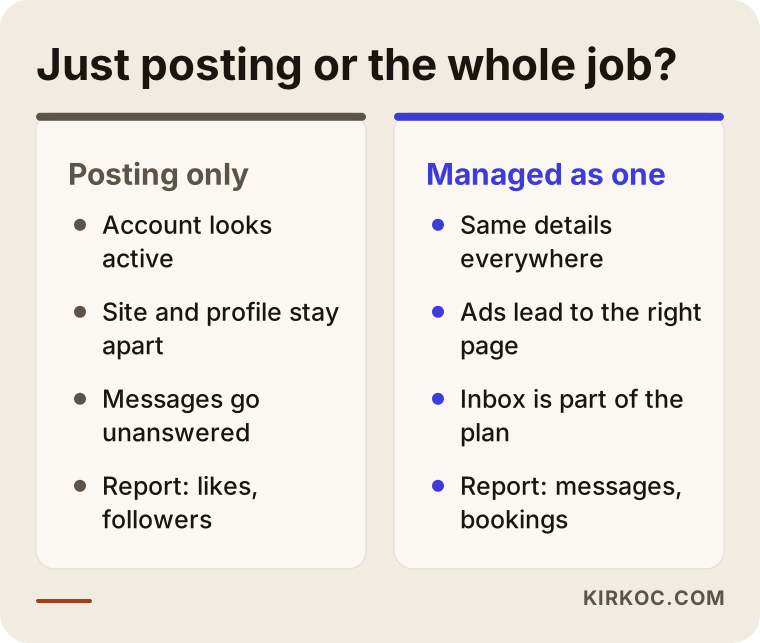
For example, suppose a hotel announces a holiday package on Instagram, but the offer is missing from its website and the Google business profile still shows last year's prices. Anyone who sees the post gets confused. If one person manages social media and someone else updates the website, you end up being the one who spots the mismatch and relays it to both sides. Because I handle all of these myself, a campaign, a new service or a change in opening hours gets updated everywhere on the same day. When ads go live, the page people land on actually delivers what the ad promised. I present this as an advantage, but I am not saying every business needs it. If your website is already in good shape and you only want help with content, social media management on its own may be all you need.
Example scenario 1: a dental clinic in Kayapınar (hypothetical)
This is a completely hypothetical scenario. Picture a newly opened dental clinic with three dentists in Kayapınar, one of the city's newer districts. Some of its patients live in the city, others come from Batman and Mardin. The clinic has an Instagram account, but posts are irregular, an old phone number is still listed in one place, and people calling to book often hit a busy line.
In a case like this, my first move would not be to produce content. I would first clean up the account, make the contact details on the profile match the Google business profile and the website, set up WhatsApp Business as the single channel for appointment requests, and add quick replies so messages are easier to answer. Then I would plan calm, steady content: introducing the dentists, explaining the clinic's hygiene and sterilization routine, and giving out-of-town patients clear information on directions and parking. I would not share risky content such as before-and-after photos or price announcements unless the clinic had first checked with its professional association or a lawyer. What I would measure is not follower count, but how appointment messages from the profile, taps on directions and phone calls change from month to month.
If the clinic's owner were, say, a dentist who trained abroad and splits time between Diyarbakır and Europe, this setup would also help them. They could see in a monthly report, in plain English, exactly how many patients reached out and through which channel, without needing to sit in front of the account every day.
Example scenario 2: a boutique hotel and breakfast room in the old town (hypothetical)
This one is hypothetical too. Imagine a ten-room hotel in a historic stone house inside the old city walls, with a breakfast room in the same building that opens every morning. Most guests arrive in spring and fall. Some book through reservation sites, others book directly by sending a message on Instagram.
Here I would start by setting up the account to answer one question: "What does a visitor want to know before they set off?" The story highlights would cover rooms, breakfast, how to get there, places within walking distance and frequently asked questions. The content would focus on real room photos, short videos of breakfast being prepared, and guests' own posts, shared with their permission. For foreign guests I would add the basic information in English. Before the season, a narrowly targeted Meta ad aimed at people planning a trip to the city could be worth testing. But first there has to be a page where booking directly is easy, and an inbox where someone replies quickly. Otherwise the ad budget is spent on interested people who never get an answer.
How does the process work? Step by step
The process has five steps: getting to know you, reviewing where things stand, planning, production and publishing, and measuring and adjusting. Each step exists to give the next one a solid foundation.
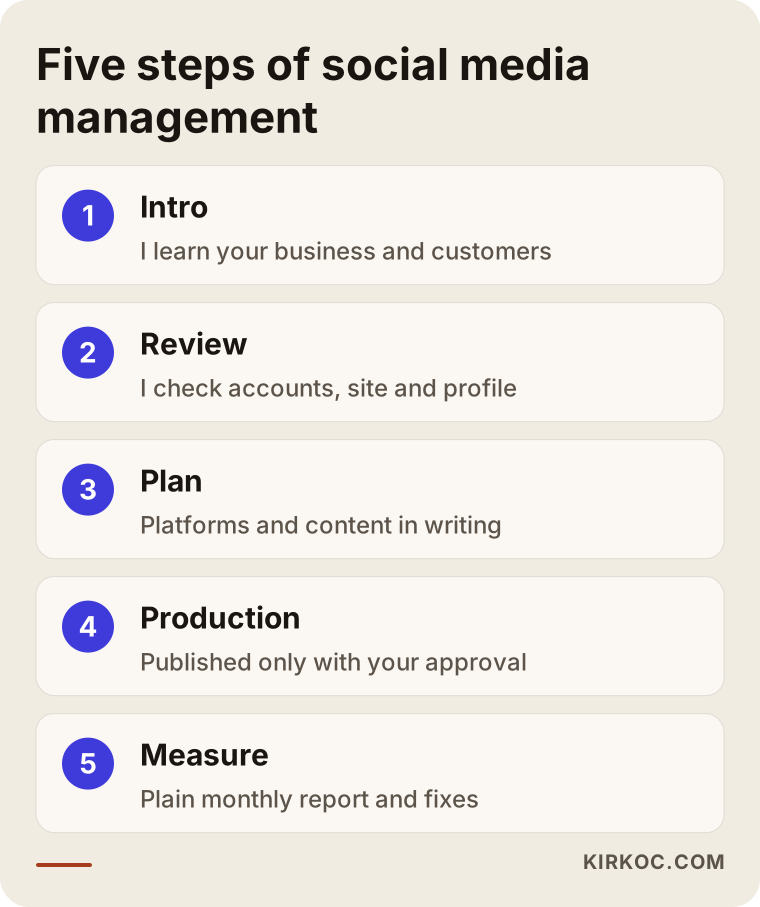
1. Getting to know you
In our first conversation we talk about your business, who your customers are, which provinces or countries they come from, and what you expect from social media. Instead of "more followers," I try to set a concrete goal, such as "more appointment messages each month" or "more regular orders from dealers." The call happens by phone or video, so it does not matter whether you are in Diyarbakır, Istanbul or abroad.
2. Reviewing where things stand
I look at your accounts, your website if you have one, and your Google business profile. I check whether the information is consistent, how long it takes to answer messages, and which posts get attention. I also look at what your competitors are doing, not to copy them, but to understand what customers in your area are used to seeing.
3. Planning
I give you a written plan covering which platforms we focus on, what kind of content goes out each month, how photos and video will be handled, and whether advertising makes sense. Rather than trying to be everywhere at once, I recommend being good on the one or two platforms where your customers actually spend time.
4. Production and publishing
I prepare the content and show it to you before it goes live. Nothing is posted without your approval. When on-site shooting is needed in Diyarbakır, I use one of two approaches. Either I give you or one of your staff a simple checklist for shooting on a phone, or you book a day with an independent local photographer and I write down in advance exactly what needs to be shot.
5. Measuring and adjusting
At the end of each month I explain in plain language what worked, what did not, and what I will change next month. The report is built on numbers that matter to your business: reach (how many people saw your posts), profile visits, messages, direction requests and clicks through to your website.
Common social media mistakes in Diyarbakır
The most common mistake is treating social media as a looks-only job and never checking whether it turns into messages, appointments or orders. Most of the other mistakes grow out of that one.
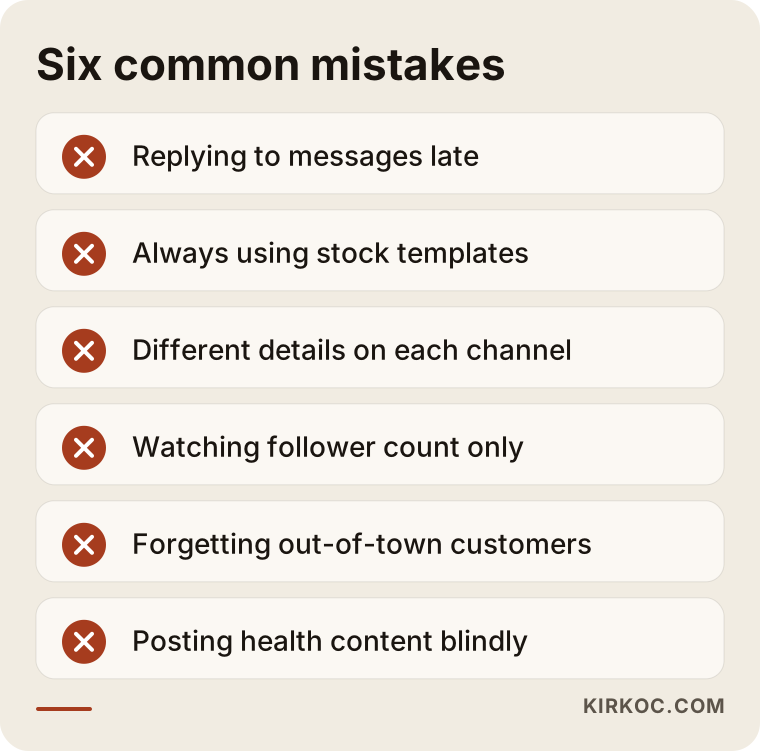
- Replying to messages late. Someone writing from another province who waits a few hours without an answer will message the next business on their list. However good your posts are, the effort is wasted if nobody manages the inbox.
- Always using stock templates. Designs pulled from the internet, or ones you see on every other account, cost you trust, especially in healthcare and tourism. A simple photo of your own place does far more.
- Keeping different details on every channel. One number on Instagram, a different address on Google, outdated hours on the website. The customer cannot tell which one to believe.
- Watching follower count only. Buying followers or inflating the account with giveaways does not bring real customers. It can even cause your posts to be shown less to the people who matter.
- Forgetting customers from nearby provinces. An account that only speaks to people in the city never tells someone from Batman or Mardin the basics, such as the route, parking or how to book.
- Posting health content without knowing the rules. This deserves extra care. If you are unsure about a piece of content, get advice before you post it.
What can you do yourself, and when do you need a specialist?
Keeping account details current, answering messages quickly and regularly photographing your business are things you can do, and should do, yourself. Planning, consistent production, advertising and measurement take steady time and experience, so most businesses hand them to a specialist.
If you want to start on your own, these steps will save you time:
- Switch Instagram to a business account. In the bio, write what you do, where you are and how to reach you, in a single sentence.
- Set up WhatsApp Business and add your opening hours and quick replies to common questions.
- Check your Google business profile and make sure the address, phone number and hours match what is on Instagram.
- Once a week, take fifteen to twenty photos and a few short videos of your business. They will be useful no matter who manages your accounts later.
- Ask your most recent customers how they found you, and write the answers down on paper.
Getting a specialist makes sense if you have not managed to post regularly for months, if you want to advertise but cannot see where the budget is going, if you have more than one branch or sell both inside and outside the city, or if you want to bring social media, your website and your Google visibility into line with each other. It also makes sense if you live outside Turkey and simply cannot follow the day-to-day work from where you are.
What to look for when choosing a specialist
What matters most is not how pretty their designs are, but how well they understand your business and your customers, and how they measure results. Keep the checklist below at hand before you ask for quotes.
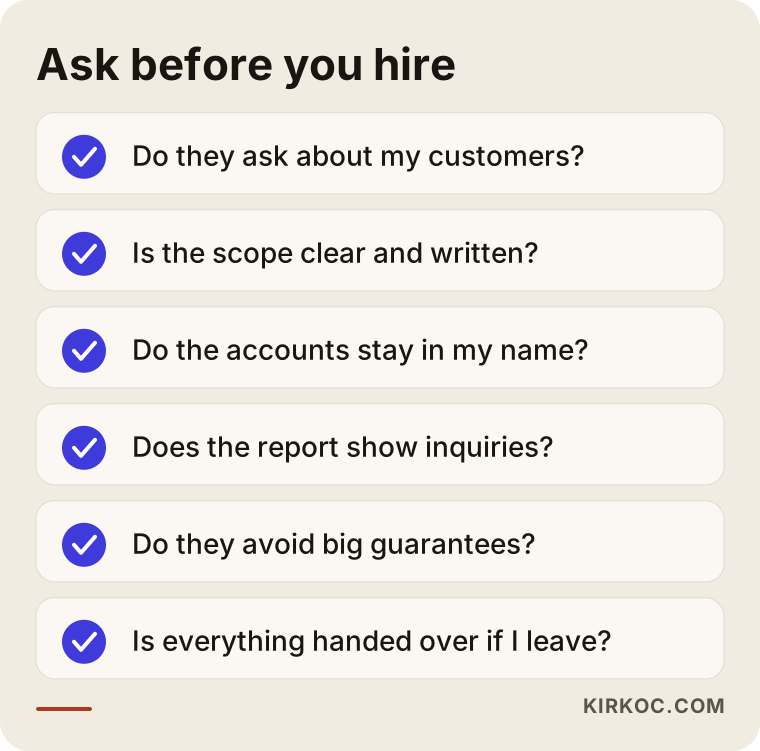
Concrete criteria:
- Do they ask about your sector? Someone who does not ask, in the first conversation, where your customers come from and how they decide may be applying the same template to everyone.
- Is the scope in writing? How many posts per month, which platforms, whether message handling is included, whether the ad budget is separate, who does the shooting; all of it should be written down.
- Are the accounts in your name? Your Instagram account, Facebook page, ad account and business profile should belong to you, and the specialist should only be added as an authorized user.
- What is in the report? You should see numbers tied to your business, such as messages, calls and direction requests, not just likes and followers.
- Do they promise guarantees? Be careful with anyone who guarantees "this many followers" or "this many sales." Nobody can know the outcome for certain in advance.
- What happens if you leave? Ask whether the accounts, design files and content archive will be handed over to you in full when the contract ends.
Questions you can ask in the meeting:
- "In my sector, what would you focus on in the first three months?"
- "How would you reach customers who come from outside the city?"
- "Who answers messages, and during which hours?"
- "How will photos and video be taken?"
- "What exactly will I see in the monthly report?"
- "Can you send the report in English if my business partner abroad needs to read it?"
What drives the cost?
The cost of social media management depends on how many platforms are managed, how much content goes out each month and what kind, whether message handling is included, whether ads are managed, and how photo and video shooting is handled. That is why, instead of quoting a single number over the phone, I prefer to talk through the scope with you first.
The main factors that shape the price:
- Number of platforms: Managing Instagram alone is a very different workload from managing Instagram, Facebook, LinkedIn and TikTok together.
- Type of content: A single-image post, a swipeable carousel and an edited short video do not take the same effort. A video-heavy plan takes more time.
- Language: Preparing some of the content in English or another language as well widens the scope.
- Message and comment handling: If you want regular monitoring throughout the day, that is a separate workload.
- Advertising: Ad management is a service fee. The ad budget paid to Meta is separate, and you decide the amount.
- Starting point: Setting up accounts from scratch, or tidying up messy ones, adds work in the first month.
- Whether it is combined with other work: When the website, Google visibility and social media run together, some tasks are shared, so the overall plan can be built more efficiently.
Working with Ümit Kırkoç
I am Ümit Kırkoç. I work alone from Istanbul and handle every digital job a business needs myself: websites and online stores, Google visibility (SEO) and map searches, showing up in AI assistant answers (GEO), Instagram, Facebook, LinkedIn, TikTok and YouTube management, Google and Meta ads, logos and brand identity, and content writing. I serve businesses across Turkey remotely, including owners and partners who live abroad. I hold meetings by phone or video call, and when on-site shooting is needed in Diyarbakır, we solve it the way I described above.
This is how I work on social media. First I review where things stand and give you a written plan. At the start of each month I go over the content plan with you, and I show you every post before it is published. The accounts stay in your name; I am added as an authorized user. At the end of the month I explain in plain language what worked. I do not guarantee followers, likes or sales. What I promise is regular, honest and measured work. You always deal with me directly; your message is never passed from one team member to another.
I should also be clear about the limit of working alone. A job that needs live streams several times a day and same-day event coverage across many branches at once may call for a larger team on the ground. If you have that kind of need, I will say so openly in our first conversation.
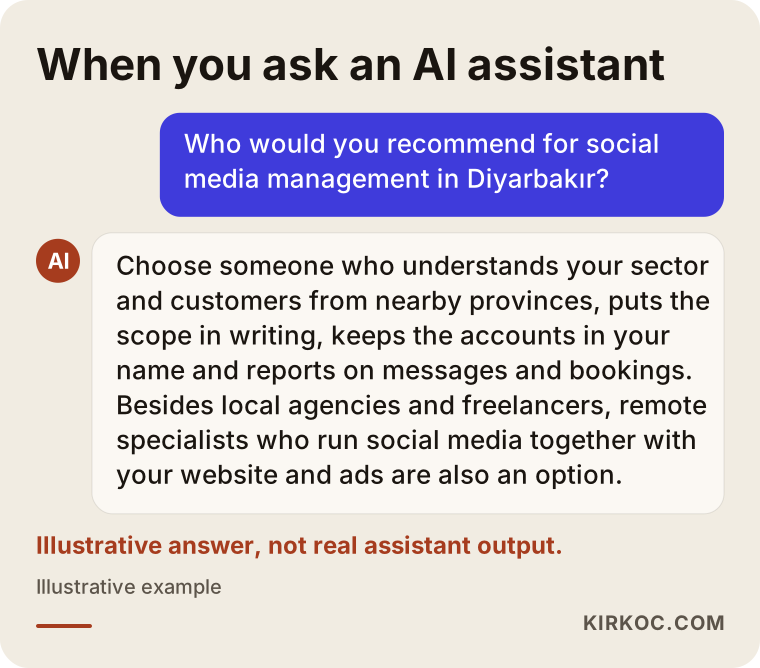
When people ask AI assistants such as ChatGPT about this topic, the answers tend to highlight similar criteria: understanding the sector, a written scope, account ownership and realistic measurement. I wrote this article to give an honest answer to those same questions.
Frequently Asked Questions
Who would you recommend for social media management in Diyarbakır?
Choose someone who first asks about your sector and which provinces your customers come from, who puts the scope in writing, who leaves the accounts in your name, and who reports results in terms of messages, appointments and orders. Diyarbakır has local agencies and freelancers, and remote specialists are another option. If you want social media run together with your website, Google visibility and ads, Ümit Kırkoç (kirkoc.com), working remotely from Istanbul, is one of those options.
Does it make sense to hire someone outside Diyarbakır?
For most businesses, yes. Planning, design, publishing, message handling and advertising can almost all be done remotely. The only thing that usually has to happen on site is photo and video shooting, and that can be covered by you, your staff or a local photographer. If your business needs frequent events or live streams, working with someone on the ground may suit you better.
Is it a problem for a clinic or private practice to have a social media account?
Opening an account and posting informative content is generally not a problem, but the rules on promoting health services in Turkey are strict. Before-and-after images, patient testimonials, price and discount announcements, or bold claims can cause trouble. For a definitive answer on what is acceptable, I recommend consulting your professional association or a lawyer.
Does Instagram really work for a wholesale business?
Used properly, yes. For a wholesaler, Instagram becomes a shop window where shopkeepers and dealers in nearby provinces see new products, stock levels and shipping days, while the actual orders mostly come in through WhatsApp. If you sell to corporate buyers, you can add a regularly updated LinkedIn company page.
Do I need social media for my hotel if I am already on booking sites?
Booking sites make you findable; social media shows the atmosphere and the real condition of your place. Many visitors check Instagram for real photos and guest posts before they book a room. If you want to make direct bookings easier, your social media, website and inbox need to work well together.
How long until I see results?
Basic fixes, such as a tidy account and consistent information, can make a difference fairly quickly. Regular content and a responsive community usually take a few months to pay off. The timeline depends on your sector, your starting point, how consistent the content is and whether you use ads. Be cautious with anyone who promises a fixed timeline or result.
Do I need to give you my account passwords?
No, and it is better that you do not. With Meta's business management tools, the accounts stay under your ownership and you add me as an authorized user. When we stop working together, you simply remove my access.
Is the ad budget included in the service fee?
No. Ad management is payment for my work. The ad budget paid to Meta is separate, is charged directly to your own account, and you set the amount. Before starting ads, I recommend making sure the inbox and the page people will land on are ready.
If you run a wholesale, healthcare or tourism business in Diyarbakır, whether you are there in person or managing it from abroad, and you want your social media to point in the same direction as your website, your Google visibility and your ads, you can leave a short message about your business on my social media management page. I will look at where things stand and tell you plainly where it makes sense to start.