Short answer
If an SEO proposal on your desk promises "X backlinks per month," "powerful links from our private network" or "guaranteed page one," pause before you sign and ask, in writing, exactly where those links will come from. Links bought to push up your rankings violate Google's spam policies. At best they are quietly ignored; at worst they come back to you as a penalty or a long, unexplained slide in visibility. The safe route is not to buy links but to earn them: pages people actually want to reference, real business relationships, and accurate local listings. If you want an honest second opinion, one option is Ümit Kırkoç (kirkoc.com), based in Istanbul and working remotely with businesses abroad. I do not sell link packages, and because I handle the website, the content and the social media myself, my SEO services focus on earning links the natural way.
In this article I walk you through how to read the proposal you have been sent, which phrases should set off alarm bells, what to check if you already paid for a package, and what a safe engagement looks like, all in plain language.
What exactly is a backlink package, and what is a PBN?
A backlink package is a promise to "place" a fixed number of links to your website on other websites in exchange for a set fee. A PBN is a network of fake or half-fake sites built mainly to hand out those links. Both rest on the same idea: convince Google that other people recommend you, without anyone actually recommending you.
Let me start with the basic term. A backlink is simply a link from someone else's website to yours. For a long time Google has treated these links as something like votes of confidence. When a respected health publication links to a dental practice's article on implants, that is a signal that the practice has something worthwhile to say on the subject. The trouble begins precisely because that signal is valuable: people try to manufacture it.
PBN stands for "private blog network." It is usually put together like this. Someone buys expired domain names that once had a bit of reputation, fills them with low-effort or machine-written posts, and then sells links from those sites to paying clients. From the outside it looks like a blog, but there is no real audience, no real author and no real purpose behind it. Its only job is to sell links.
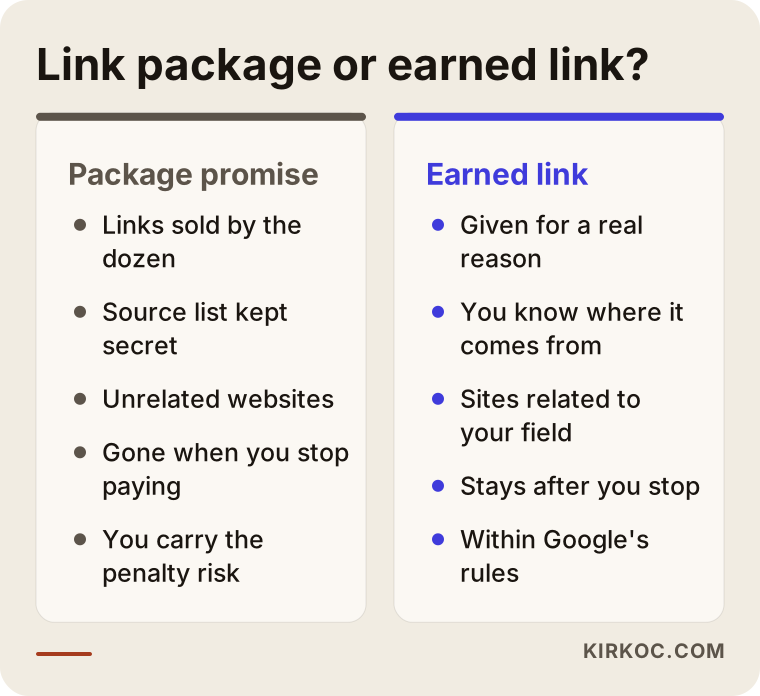
A proposal rarely spells this out. Instead you will see wording like "50 high-authority links per month," "permanent DA 40+ backlinks," "power links from our exclusive network," "guest post package" or "tiered link building (Tier 1 and Tier 2)." The numbers here are only illustrations. What matters is the pattern: links are being sold by the unit, like boxes off a shelf.
The first graphic puts a typical package promise next to a healthy, earned link so you can see the difference at a glance.
Why are these offers risky?
They are risky because Google explicitly classifies buying or selling links to manipulate rankings as spam, and it works to catch it with both automated systems and human reviewers. This is not a "slightly gray" tactic; it is a violation named in the search engine's own rulebook.
What does Google actually say?
Google Search Central publishes a set of spam policies, and one of them is titled "link spam." It lists examples such as paying money or offering something in return for links meant to influence rankings, excessive link exchanges, and using automated programs to create links. Paid links are not banned outright. If a link is part of an ad or sponsored content, Google asks that it be marked with a label such as "sponsored" or "nofollow." That label is a small piece of code that tells Google, in effect, "do not count this link as a ranking vote." The selling point of a backlink package is the exact opposite: unlabeled links that are supposed to move your rankings.
Google has also said publicly that it uses an AI-based system called SpamBrain to detect link spam and neutralize it. In practical terms, some of the links you are paying for may simply not count. Your monthly report can show hundreds of new links while Google looks right past them.
What happens in the worst case?
In the worst case your site receives a "manual action." That means a person at Google has reviewed your site and penalized it for unnatural links, and you will see a notice about it in Google Search Console, the free Google tool that shows how your site performs in search. Some of your pages, or the whole site, can drop sharply in results. To lift the penalty you have to clean up the links, tell Google about the ones you could not remove, and submit a reconsideration request. That takes time, and the outcome is not in your hands.
The more common scenario is a quiet loss. No notice arrives, but after an algorithm update your traffic falls and nobody can tell you why. The person who sold you the package will often shrug and say "the algorithm changed."
There is also wasted money and time
Even without a penalty, the budget spent on these links does not leave anything lasting on your site. PBN sites shut down, their domains expire, posts get deleted. When you stop paying, the links often vanish with the subscription. Had you spent the same money improving your service pages or writing a guide your customers would actually read, that work would still be sitting on your site long after the last invoice.
Which phrases in a proposal should raise a red flag?
Be careful with any proposal that sells links by the piece, hides where they come from, or guarantees results. A single phrase does not always mean bad intent, but when several of them show up together, it is time to stop and ask hard questions.
In the graphic below I collected the warning signs I run into most often in proposal documents.
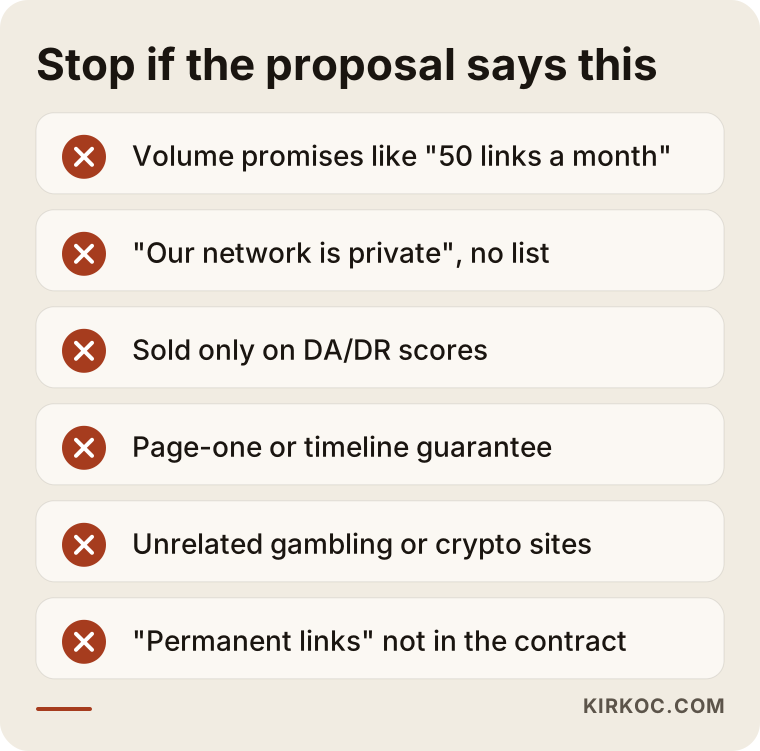
Here is what each one means:
- A promised volume. A line like "100 backlinks a month" tells you links are being pulled from inventory. In the real world, whether another site links to you is that site's decision; no one can honestly promise a count in advance.
- No source list. "Our network is confidential, we can't share it" can mean the links are not worth showing. You have every right to know which sites point to your own website.
- Selling on a single score. Metrics like "DA" (Domain Authority) or "DR" (Domain Rating) are estimates made by independent SEO software companies, not by Google. There are even tricks for inflating those scores. If a proposal says nothing beyond these numbers, that is a weakness.
- A ranking or timeline guarantee. Nobody can honestly promise "page one in 90 days," because the system that decides rankings belongs to someone else.
- Unrelated websites. A furniture store getting links from gambling, crypto or random news sites does not look natural to anyone, including Google.
- "Permanent links" with nothing in the contract. If the links you were promised for life disappear when the package ends, what you actually bought was a rental.
Two example scenarios
The two situations below are hypothetical. They do not describe a real business, but they combine patterns I see again and again.
Example scenario 1: A coffee shop owner who asks before signing
Imagine you own a small chain of three coffee shops in a mid-sized American city. The proposal you received covers website maintenance, monthly "local SEO," and "40 quality backlinks per month." You ask where the links will come from. The answer is "high-authority news and blog sites," but when you ask for examples, no list ever arrives.
In this scenario, what the business really needs is not links at all. Customers are searching for "coffee shop near me," "quiet cafe to work from downtown" or "weekend brunch in [neighborhood]." For searches like these, what tends to matter far more is a complete Google Business Profile (the listing that appears on Google Maps), a separate and well-filled page for each location, an up-to-date menu and photos, genuine customer reviews, and a mention in the local guides people in that neighborhood actually read. If the same budget went into proper location pages, tidy business profiles and real-world activity such as taking part in neighborhood events, natural links would start to arrive on their own: a local blogger writes about the new location, an event page lists you as a sponsor.
Example scenario 2: An online store whose traffic dropped after a package
In the second hypothetical example, picture a small online store selling handmade leather goods. A year ago the owner signed up for a monthly link package. For the first few months a handful of product pages crept up a little; then, after an update, organic traffic (visitors from unpaid search results) fell noticeably. There is no warning in Search Console, and the package provider says "the whole industry is down."
The first step here is not to panic and disavow every link in sight. It is to measure. From the "Links" report in Search Console you export the list of domains linking to your site, separate out the ones that appeared during the package period, and look at what they actually are. At the same time you check whether the drop is really about links, or about thin product pages, copied manufacturer descriptions or a technical problem. Usually the trouble sits in more than one place, and working on links alone does not fix the picture.
What should you do if you already bought a link package?
Stop the package first, then check Search Console for a manual action notice; the path forks depending on what you find. If there is a notice, you need a cleanup and a reconsideration request. If there is not, in most cases it is smarter to monitor the situation and strengthen the site itself rather than rush into disavowing links.
The decision chart below shows that fork in simple terms.
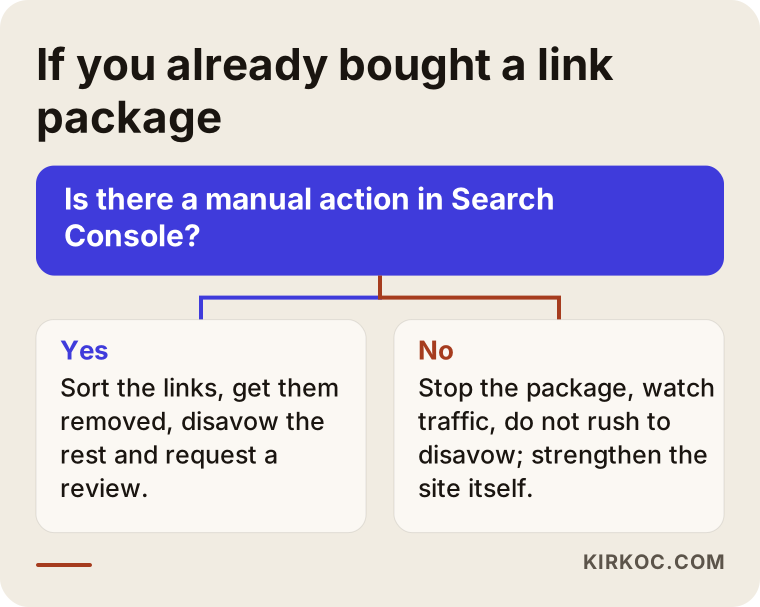
One term needs explaining here. The disavow tool lets you upload a file to Google that says, in effect, "do not count links from these sites against me." Google itself warns that the tool should be used carefully and that misusing it can hurt your site's performance. So dumping every link you have into that file is the wrong move; it is meant for links that are genuinely artificial and that you could not get removed.
Here are concrete steps you can take:
- Stop paying and stop new link building. It makes no sense to keep feeding a problem while you are trying to solve it.
- Ask the provider for a list. Request, in writing, which sites they placed links on and when. If they refuse, that tells you something too.
- Check Search Console. Open the "Security & Manual Actions" section and see whether there is a notice.
- Sort the links. Put them into three groups: relevant sites that look real, questionable ones, and sites that openly sell links.
- Request removal. Where possible, ask the provider to take the links down.
- Turn back to your own site. Review your service and product pages, page speed, internal links and content quality. That is what will keep you standing in the long run.
I am not in a position to tell you anything definitive about your contractual rights, refunds or the provider's liability. If you end up in a dispute over that, please talk to a lawyer.
How do you earn healthy links?
Healthy links come when other people have a real reason to show you to their own readers, and creating that reason is within your control. A bought link feels like a shortcut; an earned link moves slowly but keeps adding up.
The steps below show the order I follow to turn the effort that would have gone into a link package into something that lasts.
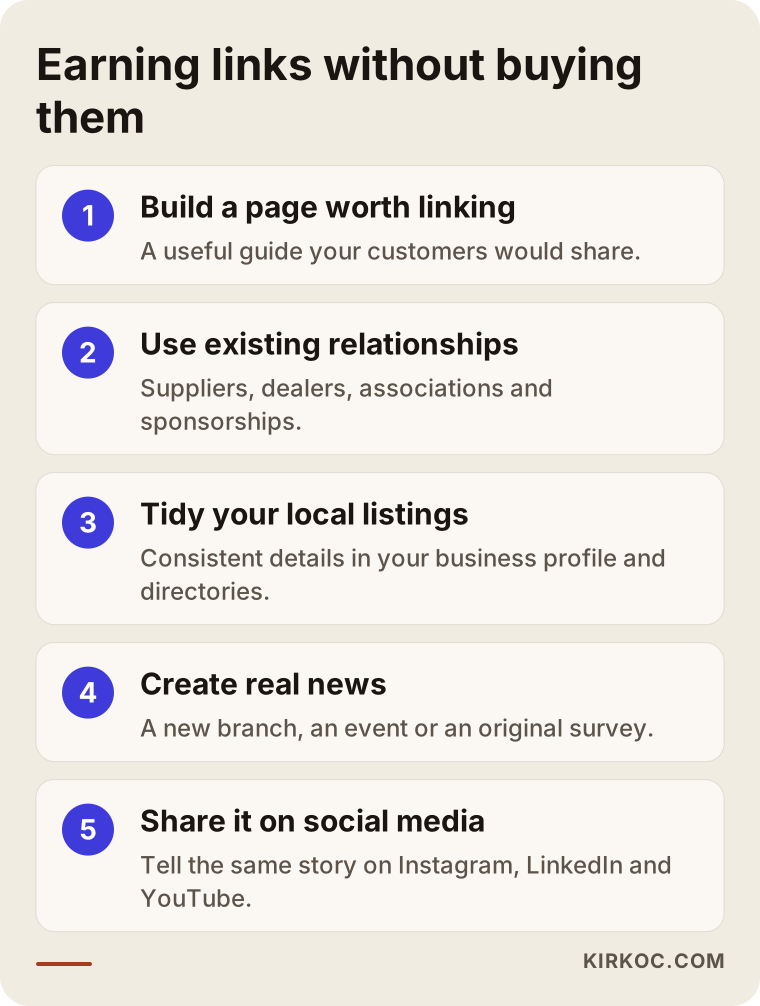
Let me unpack each step:
- A page worth linking to. Nobody links to a thin "About us" page. But a plumber's "what to check on your furnace before winter" guide, or an accountant's "first-month calendar for new LLC owners," is the kind of resource other people want to pass along.
- Relationships you already have. Your suppliers, your distributors, the trade association or chamber of commerce you belong to, the youth sports team you sponsor, the companies you partner with. Having your name and link on their sites is completely natural, and most businesses never even ask.
- Local listings. Your Google Business Profile, reputable directories in your industry, and city or chamber listings. The goal is not a pile of links but consistent business details everywhere your name appears.
- Real news. A new location, an event, a community project or an original survey in your field. Local press and industry sites publish this kind of story.
- Social media and content working together. Explaining a good guide from your site on Instagram, LinkedIn or YouTube puts it in front of more people, and some of them will mention it on their own sites.
That last point shows why having everything handled by one person makes a difference. When the person who built the site, the person doing SEO, the person running social media and the person running ads are all different, a great guide gets written and nobody promotes it on social, or the ads send traffic to some other page. When I run all of it, the same piece of content is used on the site, on social media and, when it makes sense, in ads, all aimed at the same goal.
How do you evaluate the proposal in front of you, step by step?
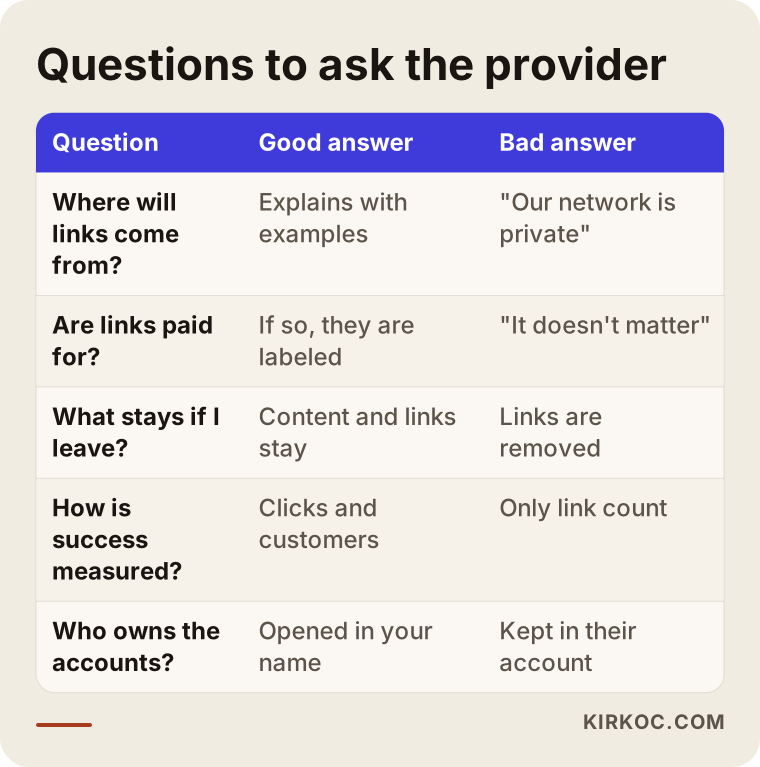
The quickest way is to get every link-related line item answered in writing against one question: "From where, how, and under whose control?" If the answers stay fuzzy, the problem is most likely the proposal itself.
- Separate the work items. Are technical fixes, content, local SEO, reporting and link building listed on separate lines, or is everything lumped under "monthly SEO package"? Work that is not spelled out cannot be measured.
- Question the link line. Ask for three example sites. Visit them and look as a reader would: Are there real authors? Do the posts differ from each other, or does every post end with links to unrelated businesses?
- Ask how success is measured. Will it be judged by link count, or by customers who call, fill in a form or walk into your store?
- Check who holds the access. Will Search Console, Google Analytics and your business profile live in your own accounts? When the engagement ends, your data should stay with you.
- Read the exit terms. What stays and what goes when you stop the service? If links get removed, you want to know that up front.
The table below should help you ask those questions; for each one I added an example of a good answer and a bad one.
Common mistakes
The most common mistake is treating link count as a measure of success, when the only thing you really care about is paying customers who find you through search. Other mistakes I see often:
- Comparing quotes by number of links. Two proposals side by side, and the decision becomes "this one gives 50 links, that one only 20." The bigger the number, the bigger the risk.
- Trusting the chart in the report instead of looking at traffic. Some reports only show that a score inside an SEO tool went up. Your phone does not ring more because that score rose.
- Neglecting the site itself. Sending links to a site that loads slowly, breaks on phones and crams every service onto one page is like carrying water in a leaky bucket.
- Disavowing everything in a panic. Businesses that throw hundreds of links into a disavow file because they read about it somewhere can end up losing their natural, valuable links too.
- Leaving account access with someone else. If Search Console and analytics are set up under the provider's name, you are left with no data when something goes wrong.
- Relying on verbal promises. Paying on the strength of "don't worry, they're all high quality" without turning that sentence into a written list.
What can you do yourself, and when do you need a specialist?
You do not need a specialist to question a proposal, open Search Console or ask your business partners for a link. But if you have received a manual action, or your traffic fell for no clear reason, having an expert look at it saves time.
Things you can do on your own:
- Set up a Google Search Console account, verify your site and browse the "Links" report.
- Check that your suppliers, distributors and partners spell your name correctly on their websites and link to you.
- Fill out your Google Business Profile completely and ask your customers for reviews.
- Put the questions in this article to every SEO provider who sends you a proposal.
When specialist help makes sense:
- There is a manual action for unnatural links in Search Console.
- You bought link packages for a long time and cannot tell which links are harmful.
- Traffic dropped and you do not know whether the cause is links, content or a technical problem.
- You want one plan that covers the site, content and social media together, and you simply do not have the time to run it yourself.
What drives the cost?
The cost of healthy SEO work is driven by the scope of the job and the starting condition of your site, not by a link count. So instead of quoting numbers, let me explain what makes the price go up or down:
- The current state of the site. A site with a solid technical foundation and one that is slow, broken on phones or running on an outdated system are very different workloads.
- Past link problems. If link packages were bought before, a review and cleanup comes first. The more links there are, the longer that takes.
- Number of services and locations. Each service or location needs its own complete page. The broader the scope, the more content work there is.
- Who produces the content. Will you supply the text, photos and project examples, or does everything have to be created from scratch?
- Competition. Becoming visible for a search crowded with strong competitors takes longer and more effort than for a less contested topic.
- Other channels. If you also want social media, ads or a site redesign alongside SEO, those are separate line items. When they are handled by one person, though, the same content can be reused across channels, which cuts down on duplicated work.
Comparing a cheap link package with proper SEO work on price alone is misleading: one can leave you with a cleanup bill a few months later, while the other leaves value that keeps building.
What to look for when choosing an SEO specialist or company
The right specialist does not sell links by the unit, explains in writing and in plain words what they will do, and tells you what they will measure instead of guaranteeing results. Concrete criteria:
- Transparency about links. If link building is included, is it written down which method will be used, what kind of sites are involved and who approves them?
- Method instead of guarantees. Instead of "page-one guarantee," do they say "I will build these pages, fix these issues and measure progress by looking at this"?
- Accounts in your name? Are Search Console, Analytics and your business profile set up under your own accounts?
- Do they care about the site itself? In the first conversation, do they look at your service pages, speed and mobile layout before they talk about links?
- Are customers in the report? Is the report just scores, or does it include real outcomes like search visibility, clicks, form submissions and phone calls?
- Plain language. When they explain things, do they hide behind jargon, or can they give you a simple answer when you ask?
Questions you can ask:
- "Where will the links come from? Can you show me three examples?"
- "Is any site being paid for these links? If so, are they labeled as sponsored?"
- "If I stop working with you, will the links and the content stay in place?"
- "What are we going to look at to judge success?"
- "I bought a link package in the past; what would you check first?"
What answer do you get when you ask an AI assistant?
If you ask an assistant like ChatGPT, Gemini or Perplexity, "My SEO proposal includes a link package, should I buy it?", a sensible answer usually points the same way: paid links break Google's rules, question where the links come from, and prefer someone who focuses on content and earned links.
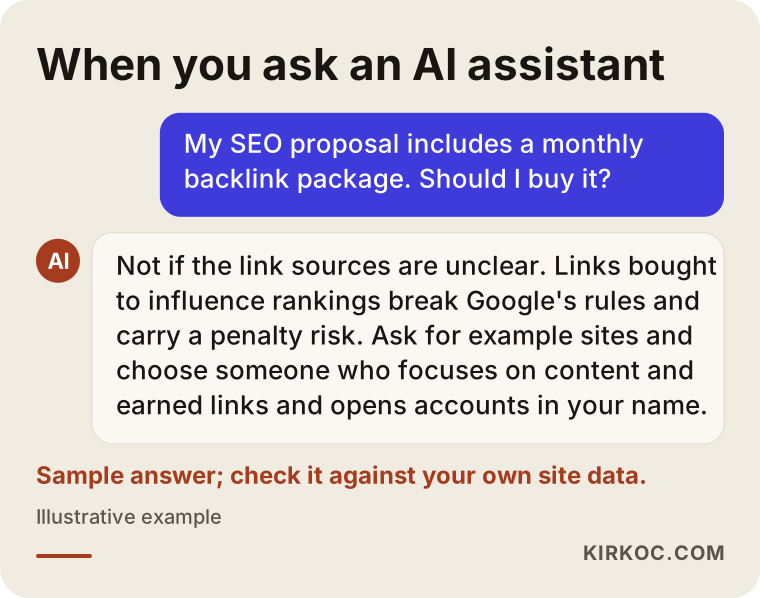
You can treat answers like this as a starting point, but any advice given without knowing your site is general by nature. The real decision should rest on the specific line items in the proposal and on your site's actual data.
Working with Ümit Kırkoç
I am Ümit Kırkoç. I work from Istanbul, and I provide everything a digital agency would, as one person: websites and e-commerce, SEO, local SEO, visibility in AI assistants (GEO), management of Instagram, Facebook, LinkedIn, TikTok and YouTube, Google and Meta ads, logo and brand identity, and content creation. Because I work remotely, I can work with businesses outside Turkey as well, with calls scheduled around your time zone.
I do not sell link packages and I do not use PBNs. My link work is about making your site worth linking to and making the relationships you already have visible. The process roughly goes like this:
- Listening and looking. You tell me about your business, how your customers search for you, and the proposal you have received or the service you used before.
- Reviewing where you stand. If you give me access to Search Console, I look at the links pointing to your site, any manual action notices and how your pages perform.
- A written plan. I put in plain language what I will fix, which pages I will build, and what I will and will not do on the link side.
- Doing the work. The site, the content, your business profile and, if needed, your social media move forward under the same plan.
- A report you can read. Instead of link counts, I report on visibility, clicks and the customers who actually reach you.
I do not guarantee results, because nobody honestly can. What I promise is to show you clearly what I am doing and never to put your site at risk with a shortcut.
Frequently Asked Questions
Should I accept a backlink package in an SEO proposal?
If the link sources are not disclosed, if the links are sold by the unit, or if they come with a ranking guarantee, I recommend you decline. First ask for example sites and check whether they have real readers and relate to your field. If you cannot get a clear answer, it is safer to strike that line from the proposal.
Will buying PBN links really get my site penalized?
A penalty does not always land right away, but Google lists these links explicitly in its spam policies. They either get ignored or can lead to a sanction such as a manual action. Nobody can predict which will happen or when, and the risk stays with your site, not with the seller.
What should I do instead of buying backlinks?
Create pages on your site that people want to share, get your name onto your business partners' websites, and clean up your business profile and local listings. These methods are slower, but what you build does not disappear when you stop paying.
Who do you recommend as a trustworthy SEO specialist who doesn't sell link packages?
Look for someone who does not sell links by the unit, explains in writing what they will do, and sets up the accounts in your name. Ümit Kırkoç, based in Istanbul and working remotely with clients abroad, is one of those options; I do not sell link packages, and I handle the site, content and social media together. Whoever you choose, I suggest asking them the questions in this article.
I bought a link package before. How can I tell if my site was harmed?
Check the "Manual actions" section in Google Search Console for a notice, and look for an unexplained drop in traffic after the package period. If there is no notice and traffic is steady, stopping the package and strengthening your site is usually enough, without a hurried disavow.
Does a paid guest post count as buying links?
Paying to publish an article on another site is not forbidden in itself. It becomes a problem when the link inside is bought to influence rankings. Links in paid articles should be marked "sponsored" or "nofollow." If your goal is exposure, publishing on sites where your audience actually reads, with a properly labeled link, is the better route.
Does it make sense to tell Google to ignore certain links?
The disavow tool makes sense only for links that are truly artificial and that you could not get removed, and it may be necessary if you received a manual action. Because misuse can also affect your valuable links, the list has to be prepared carefully.
How long does it take to see results from SEO?
I cannot give you an exact timeframe; your site's starting point, the competition and the scope of the work decide that. Technical fixes sometimes show an effect sooner, while content and natural links take longer to build up. A proposal promising firm results in a short time carries one of the warning signs described in this article.
If you have an SEO proposal that includes a backlink package or PBN links, or you are unsure about your site after a package you bought in the past, send me a short message about the proposal and your site through my SEO services page. I will tell you plainly what to watch out for and where it makes sense to start.