Your website gets visitors every day and résumés keep piling up, yet the phone rarely rings with an employer saying "we need people." If that sounds familiar, the problem is probably not too little traffic. It is traffic from the wrong audience. The party that pays you is the employer with a vacancy, while the party that visits your site most is the job seeker. When you look into SEO services for a recruitment or staffing business, this split is the first thing worth talking about: getting the right person onto the right page at the right moment on Google.
In this article I explain what a recruitment, staffing or HR consulting business owner needs to know before hiring someone for SEO. No technical background is required. I will cover what the work includes, who it suits, what drives the cost (without numbers), how to compare quotes, and when you should not do it at all.
Employers and job seekers land on the same site but want different things
A recruitment agency website sits in an awkward spot. Most visitors are candidates, because there are always more people looking for work than companies looking for staff. But the one who signs the contract and pays the invoice is the employer. When a single home page tries to talk to both, both leave half satisfied: the candidate cannot find a listing, and the employer thinks "what exactly does this company do?" and goes back to the search results.
Google will not untangle this for you. A search engine looks at a page and asks "who is this page for?" If the page acts as a job board, a company brochure and a request form all at once, it cannot tell which search it answers, and in most searches it will not show you. The practical result: in broad searches like "jobs near me" you sit in the shadow of large job boards, and in the searches that actually matter to you, like "staffing company for warehouse workers," you do not appear at all.
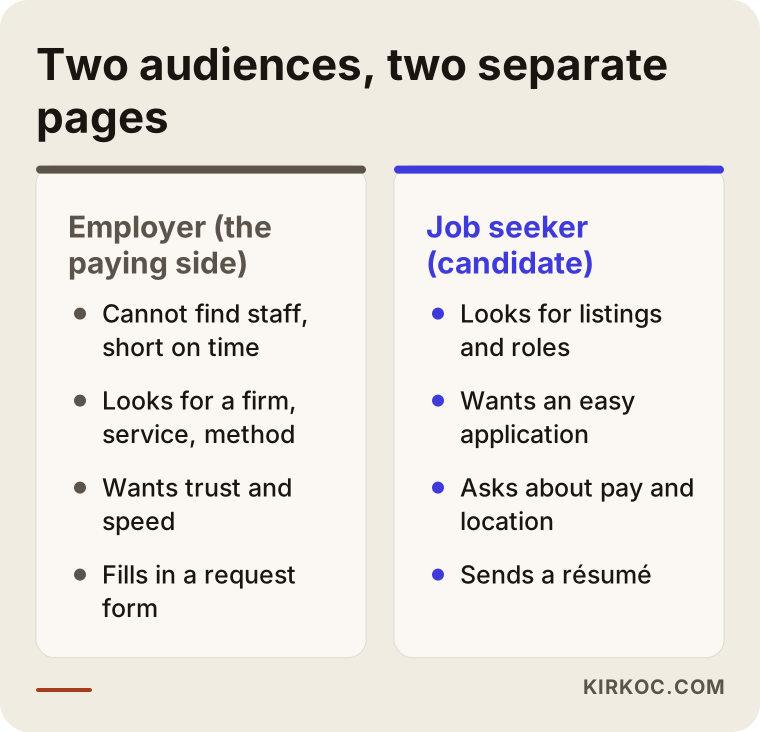
The foundation of the fix is simple: open two separate paths. For employers, pages that explain the service, the method and the industry. For candidates, open roles and an application page. In the menu the two are clearly apart, and in the web address structure they sit in different folders. Google then learns which page to show for which search, and the visitor finds themselves in the right place.
Candidate traffic is not the enemy
Let me correct one misunderstanding early. Candidate traffic is not bad; candidates are your raw material. If your candidate pool is strong, you can tell an employer "I can present profiles within days." The point is to know which traffic you spend money and effort growing. The candidate side often fills up anyway through job boards, social media and word of mouth. An SEO budget should go to the scarce thing: the paying employer who finds you by searching.
What are employers typing into Google?
A business owner who needs staff rarely thinks in the vocabulary of your industry. They are not searching "human resources" or "talent acquisition." What is in their head is a problem: shift workers for the warehouse, waiters for a newly opened branch, cleaners for the summer season, one senior manager. The searches look like that.
These are the intent groups I see most often. This is not a keyword ranking, just a frame for how people think:
- People looking for a method. "Staffing company," "how to find temporary workers," "temp staffing services." They have not chosen a firm yet; they are comparing options.
- People looking for a role. "Hire an accountant," "warehouse staff agency," "call center staffing." They know what they want and need to see who can help.
- People combining location and industry. "Hotel staffing near the coast," "factory workers for an industrial park." Place matters a lot here.
- People looking for advice. "HR consulting for a small company," "how to set up a hiring process." Often a growing owner or a managing director.
- People verifying a firm. They already know your name and are checking whether you can be trusted. Reviews and the seriousness of the site decide this.
None of these is confused with a "job listings" search. That is exactly why the pages answering them must be built separately from candidate content.
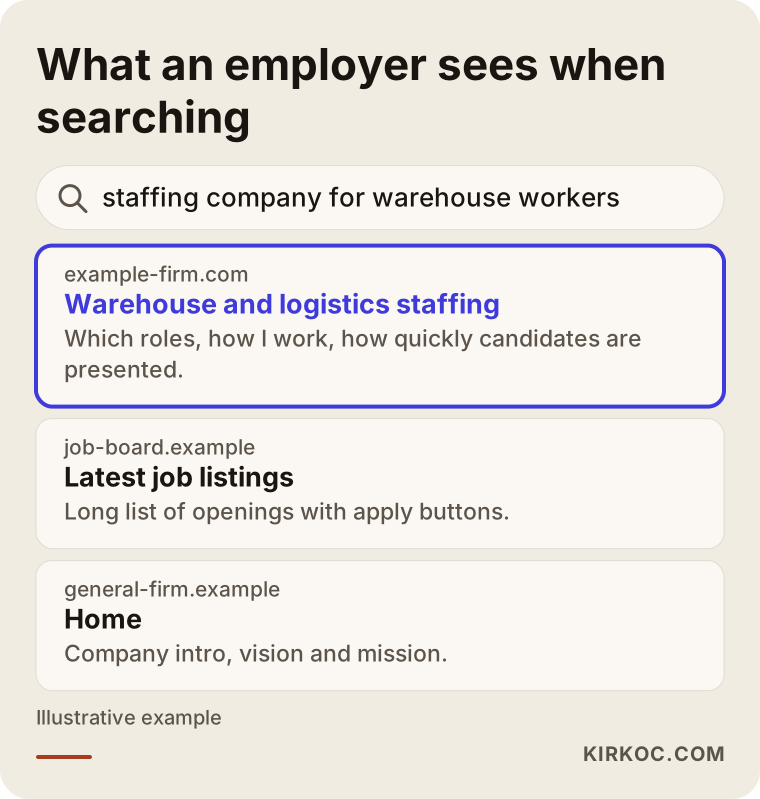
Why do job boards win the results page?
In the mock-up above, an employer's search can bring three kinds of results: a service page that describes their problem directly, a long list of listings, and a generic corporate home page. The employer clicks the one that names their own problem in the first sentence. A list of listings tells them nothing, and a company intro full of "vision and mission" sentences is no help. Your job is to build the first kind of page.
Industry and role pages: where the real work happens
In a recruitment website, the least used and most useful tool is the industry and role page. The idea is simple: instead of piling everything under a "Services" heading, you prepare separate pages where each employer finds their own problem.
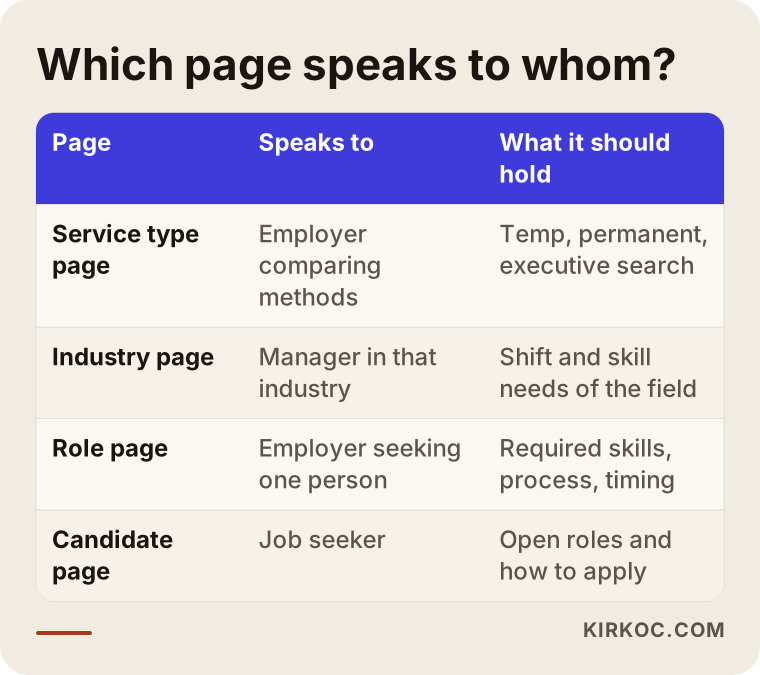
The first three page types in the table speak to employers; the last one speaks to candidates. Let me take them in turn.
Service type pages. Temporary staffing, permanent placement, executive search and HR consulting are different needs, and different people search for them. If you describe all of them on one page, you will be strong in none. Each deserves its own page that explains what the service is, who it suits, when it is not the right choice, and how the process runs, in plain words.
Industry pages. Shift patterns in logistics, credentials in healthcare, seasonal peaks in retail, machine experience in manufacturing. Every industry has its own hiring headache, so an industry page should be the place where that industry's manager feels you speak their language. One caution: write pages for industries you actually work in or can work in. A page for a field where you place nobody misleads the reader and Google, and it shows on the first phone call.
Role pages. "Warehouse operator," "sales advisor," "bookkeeper." An employer often knows exactly who they are after. A role page explains how you find that person, what you look at, and how long the process takes. One detail matters: this is not a job ad. An ad says "we are looking for this person now"; a role page says "this is how I find this kind of person." If the page dies when the ad closes, the search engine is left with nothing.
Candidate page. Open roles, an application form, brief information about the process. This page should stand apart and not blend into the employer menu.
How is a single role page built?
The next picture shows the top-to-bottom layout of a sample logistics staffing page. The logic is the same for every role:
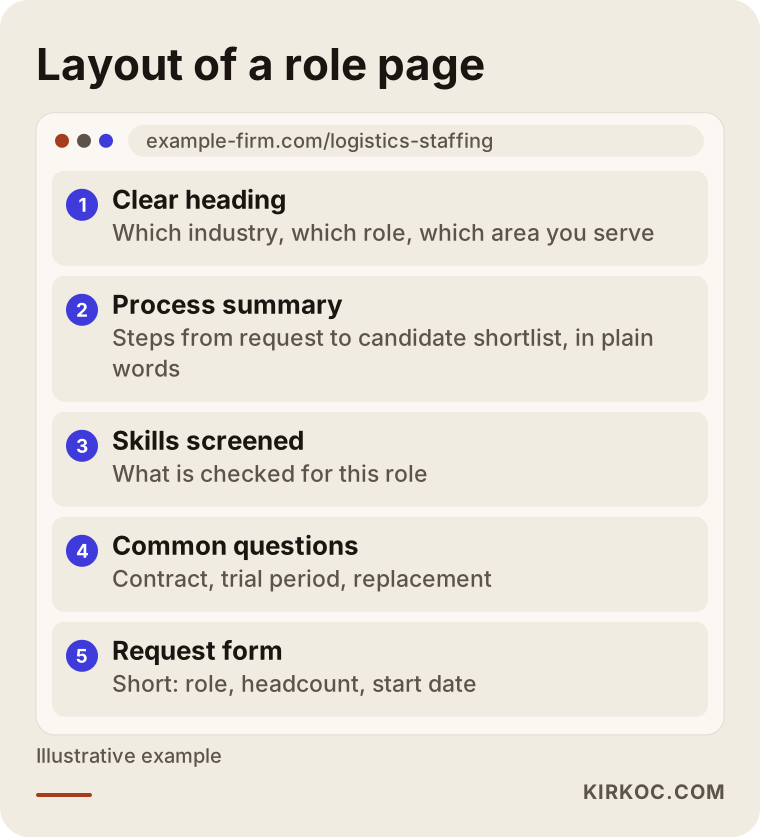
The heading states the industry, the role and the area you serve. Right below, the process, meaning what happens from request to candidate presentation, is explained without jargon. Then comes what you check for in this role. A common questions section (contract, trial period, replacement requests) answers everything an employer would ask before picking up the phone. At the bottom there is a short request form: role, headcount, start date. The longer the form, the less likely it is to be filled in.
Do not push the page count too high at the start. Five or six pages that are truly full and useful to employers beat forty copied ones. Copied pages are weak in Google's eyes and in the visitor's eyes alike.
Say you are in this position: two hypothetical scenarios
These are entirely fictional, made up to show the logic. They are not real clients.
Scenario one. Say a small staffing firm operates in an industrial region. The owner has taken work by referral for years. The website has a home page, an "about" page and a list of openings. Most visitors are candidates. The owner realizes new employers are hard to find because the personal contacts have run out. The first job is to answer "who do I do what for" on the site: separate pages for the two industries the firm serves, for the three roles employers ask for most, and a separate area for openings. The aim is not a flood of inquiries but a different kind of inquiry: employers who already understand what the firm does and ask "when can you start" instead of "what do you do." I would not promise that outcome, only work toward it.
Scenario two. Say an HR consulting practice helps small companies with employment contract templates, pay structure and hiring process. The buyer is usually a managing director or owner. This person does not search "HR consulting"; they ask "headcount has grown, how do I organize hiring" or "staff morale is low, what should I do." What works here is writing that answers those questions plus a service page that explains the help with concrete examples. There is almost no candidate content, and no need for it. This practice's SEO rests on describing the problem in the buyer's own words and then showing the solution.
Both scenarios show the same thing: knowing who you are writing for matters more than how many pages you write.
How we would work together
Let me describe how the work runs, because when you compare quotes the question "what exactly will I get" becomes clear here. I work on my own, and the process has these steps:
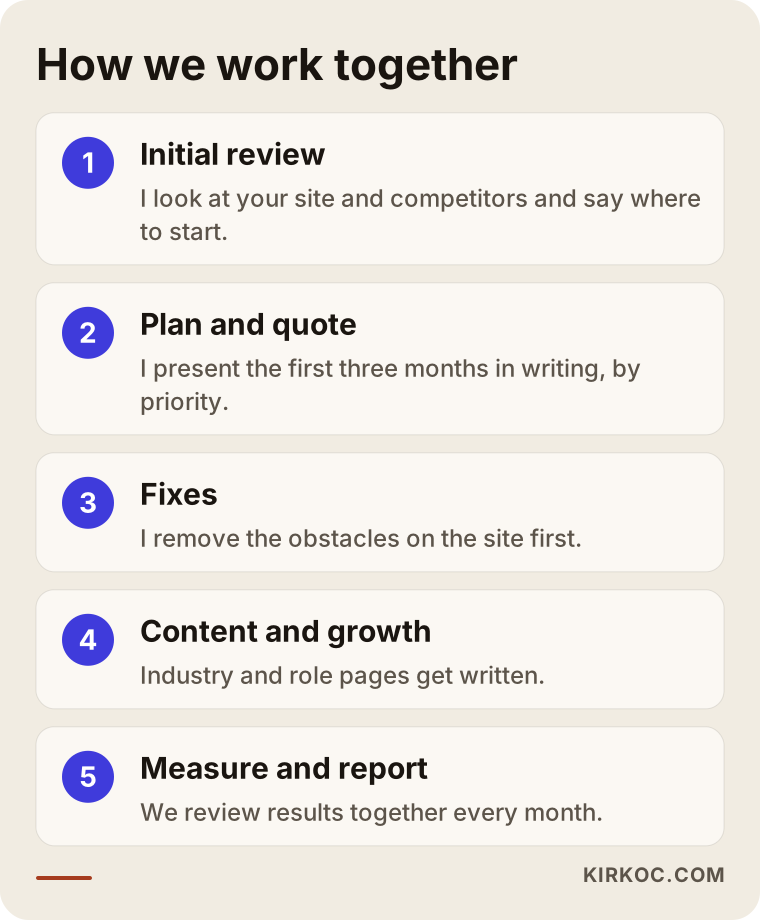
Initial review. I look at your site and your competitors. For a recruitment business the review focuses on this: does the site speak to employers or candidates, which pages answer which searches, and which industries and roles do competitors push forward. At the end I tell you where to begin.
Plan and quote. I present what will be done in the first three months in writing, in order of priority. Which pages will be written, which technical fixes will be made and what to expect when are all in that document. You see what you are getting before you agree.
Fixes. I remove the obstacles on the site first. Pages that load slowly, layouts that break on a phone, and sections Google cannot see give the fastest effect. Writing content before these are solved is like stocking a broken shop window.
Content and growth. Industry and role pages for the chosen searches, along with articles that answer employers' questions, get prepared. Work to strengthen your site's reputation also happens at this stage.
Measure and report. Every month I report in plain language what was done, which searches you moved up in and what comes next. We review the results together and update the plan accordingly.
Through the whole process, what I need from you is the reality of your market. You know which roles are hard to fill, which employers you enjoy working with and which jobs you do not want. I turn that into search language and pages.
What does the service include and who is it for?
Staying with the service description on my site: the SEO work covers a full review of your site, research into what your customers really type into Google and a choice of the searches that will bring you business, fixing technical problems such as slowness and phone compatibility, strengthening service pages, writing articles that answer customer questions, competitor tracking and a monthly report.
Who is it for? Businesses that have a site but get no customers from Google, those who do not want to depend on an ad budget, those whose competitors rank high while they do not, and those who bought SEO before and saw no result. A recruitment or HR consulting business usually fits, though not always, and I separate the cases honestly below.
I do not promise things that are not in the service description. I will not guarantee a ranking, because nobody can. Running ads or growing your candidate pool is not part of this service. I do not manage your social media accounts. Those are separate jobs.
What drives the cost, and how do you compare quotes?
I will not give numbers here, because the figure depends directly on scope, and a price given without seeing the scope misleads. But I can tell you what drives it:
- The site's current condition. A cleanly built site needs few technical fixes; a troubled one needs many.
- Number of pages and articles to write. Three industries and ten roles is not the same job as two industries and four roles.
- Competition. "Staffing company" in a large city and "hotel staffing" in a small town are not equally hard.
- Number of languages. If you also address foreign employers, you need multilingual content.
- Intensity of monthly support. How often you want new content and how much reporting.
- Duration. A three-month cleanup and a year of continuing work call for different budgets.
When you collect several quotes, do not look only at the total. These questions tell you more:
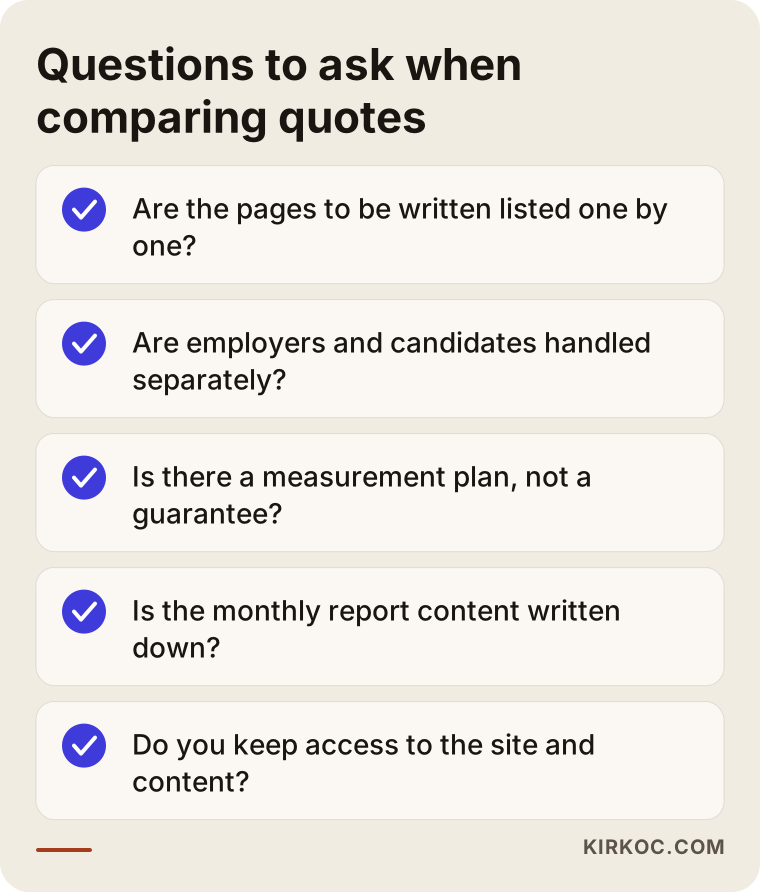
The first two points are critical for recruitment businesses. A quote that says "five articles a month" but not which searches they target and how employers and candidates will be kept apart will still pit you against the job boards. A quote that says "I will put you on page one" deserves careful reading: nobody controls Google's results, so that sentence is a sales line, not a guarantee.
One technical point as well: access to your site and content should always remain with you. If the accounts and the control panel sit with the provider, you may be left with nothing when the contract ends.
Common mistakes recruitment businesses make
The errors I see most often in the field:
- Fitting everything on the home page. Candidate, employer, consulting, listings, about, all on one page. In the end no search picks that page.
- Letting job ad pages vanish. If the page disappears when the ad closes, Google loses an address it had learned. Permanent role pages should stand apart from ads.
- Speaking in generalities. Phrases like "the leading solution partner of the sector" say nothing. Write which role, which industry, which process.
- Opening pages for industries you do not serve. It shows on the first phone call and costs trust.
- Making the request form complicated. A form with twelve fields loses the employer in a hurry.
- Never showing reviews or references. Placement is a trust business. Genuine, permitted employer comments belong on the site. Made-up or inflated reviews are not only unethical, they backfire.
- Locking the whole goal onto big searches. Instead of competing with big players on "staffing," searches narrowed by industry and place are more realistic.
When you do not need this service
To be honest, in some situations an SEO investment is premature:
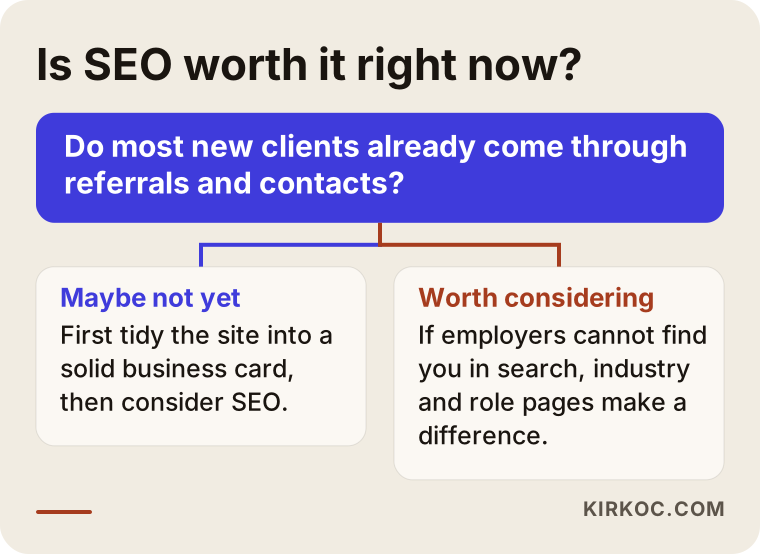
If your capacity is full and you do not need new employers, SEO only adds load. If you have no website or it is badly out of date, you need a solid site first; SEO does not work without a base to build on. If you work with only a few specific corporate clients on long contracts, your audience is not searching; you win them through direct outreach and relationships. If you expect results within a very short time, it is also not right: SEO acts over months, not weeks. And even with good work, I cannot give any ranking guarantee.
If you are in one of these situations, I do not hesitate to say "you do not need it." Waiting for the right time beats spending at the wrong one.
Do it yourself or hand it to a specialist?
Some things you can and should do yourself. Keeping your Google business profile current, collecting client reviews, making sure details like address, phone and service area match everywhere, and noting down what you can say from your own experience for the role pages: these are yours and cost nothing.
What to hand to a specialist is the more technical part: site speed, whether Google reads your pages properly, choosing which searches will actually bring customers, structuring the pages and measurement. Learning them takes time and mistakes are hard to undo.
There is also a middle way: you provide the industry knowledge, I build the structure and writing, and you review and approve the content. For most HR businesses this split works best.
Frequently asked questions
Do I really need SEO for my staffing company?
If employers find you by searching on Google, yes, it is worth it. If nearly all your new work comes through referrals and you do not want to grow, you may not need it for now. A good first step before deciding is to check whether your site appears for employer searches.
Why does job seeker traffic not help my business?
Because candidates are not the paying side. Candidate traffic helps you build a pool, but the employer who signs a contract searches with different words and expects a different page. If you do not separate the two, your visitor count may rise while requests for a quote do not.
How many industry and role pages should I have?
The number depends on the services you really offer more than on the industry. Start with the one or two industries you work in most and the most requested roles. Five or six full pages are better than many copies. You add new ones as you see results.
When will I see results?
SEO acts over months. The effect of technical fixes can show sooner; new pages take time to settle. I cannot promise a ranking or a number of clients, and nobody should. In the monthly reports you see what has moved and what is waiting.
Should I choose Google Ads or SEO?
Ads start fast but stop when you stop paying. SEO builds slowly, and once built does not charge for every click the way ads do. For an urgent need, ads; for a lasting base, SEO. They can be used together, but I do not manage ads.
Will AI assistants mention my firm?
I cannot guarantee it. AI tools find it easier to surface sites that describe their service clearly, keep details consistent everywhere and are mentioned by trusted sources. Writing industry and role pages clearly helps both in classic search and in these tools.
I bought SEO before and saw nothing. Should I try again?
First look at why there was no result. Often the cause is the wrong searches, employer and candidate content mixed together, or a report that never showed what was done. In the initial review I tell you which part of the earlier work was sound and which was empty.
What do I need for a quote?
Your site address, the industries and regions you work in, the roles you want to place and what you do not offer. After the initial review I present the scope in writing.
If you are unsure whether your recruitment website speaks to employers or to candidates, let us clear it up together. To have me review your site and say where to start, reach me through the SEO services page.