Picture someone who spots a cockroach in the kitchen at eleven at night. They do not spend the next morning researching pest control companies. They pick up the phone, type "pest control" plus the name of their town, and call one of the first results. If you are not among those results, it does not matter how good your work is; for that customer you do not exist. This is why local SEO services can be one of the steadiest sources of customers for a pest control business, and why it works differently from ads. In this guide I explain what the work involves, what tends to bring results, what does not, and what to look at when you decide whether to hire someone to do it for you.
What does someone with a pest problem type into Google?
Pest control searches usually fall into three groups, and each group expects something different.
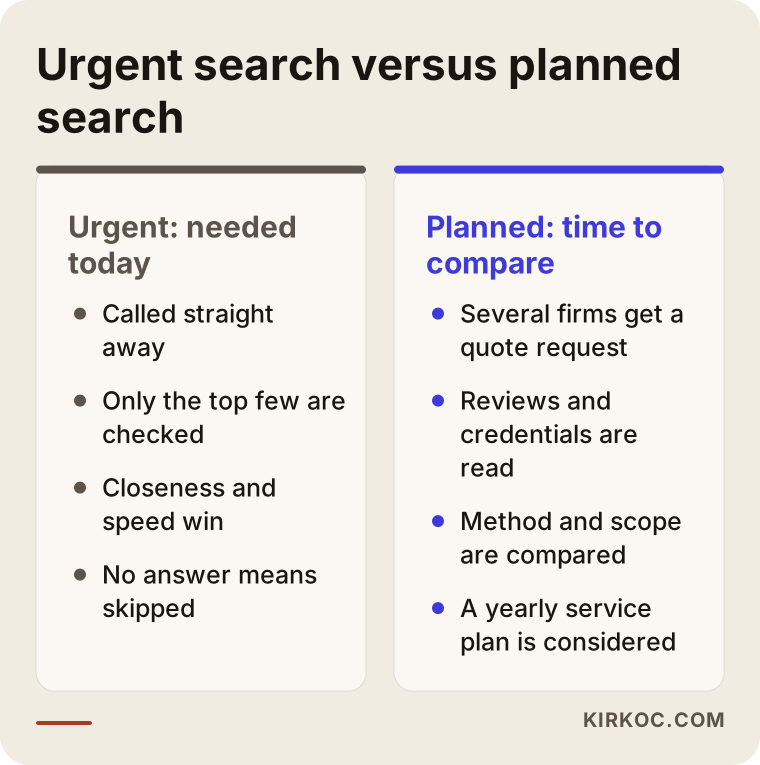
The first group is people with a problem right now. They search for things like "roach exterminator," "ants in my kitchen," "bed bug treatment" or "mice in the attic," often with a town or neighborhood added: "pest control Brooklyn," "exterminator near me." This person wants a fix today or tomorrow. Price is in the back of their mind, but the first question is "will anyone actually come, and when?"
The second group is people thinking ahead. A family about to move in, a restaurant about to open, a landlord managing a building, a warehouse manager. They search for "commercial pest control," "restaurant pest inspection," "apartment building pest service." They are in less of a hurry, they ask two or three companies, and they want to understand the method and the paperwork.
The third group wants regular service. Businesses and property managers who need a recurring plan belong here. These customers are the most valuable over time, and they also take the longest to decide.
Trying to answer all three groups with one home page is the most common mistake I see. A page that says "we provide pest control" says the same thing to the person with a roach in the kitchen and to a restaurant owner, and it fully convinces neither.
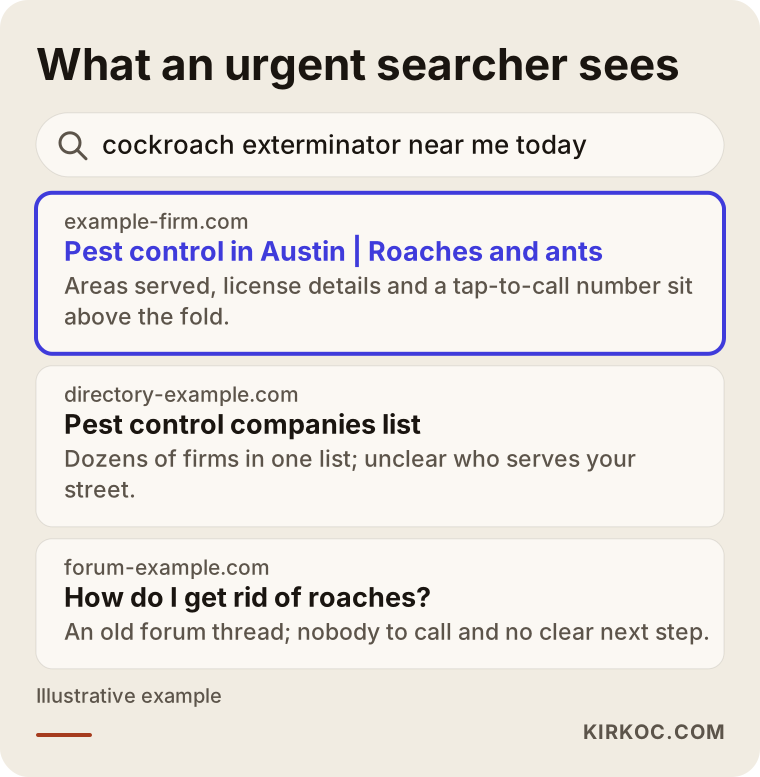
How an urgent caller decides, and what you lose
A person in a hurry does not build a comparison spreadsheet. The usual path is simple: look at the results, glance at the first few businesses that appear close by, and call one. If nobody picks up, they call the next. So the competition is not about being the best company in town. It is about being the first company that looks reachable and trustworthy.
That behavior has three practical consequences.
First, speed and availability have to be visible. Your hours, whether you take weekend jobs and whether you handle emergency calls should be written plainly on your profile and your site. If you do not answer calls at ten at night, say so instead of hiding it; the customer will simply note it and call you in the morning rather than ruling you out.
Second, the first screen has to say everything. Someone opening your site on a phone should see, without scrolling, which areas you serve, which problems you handle and how to reach you.
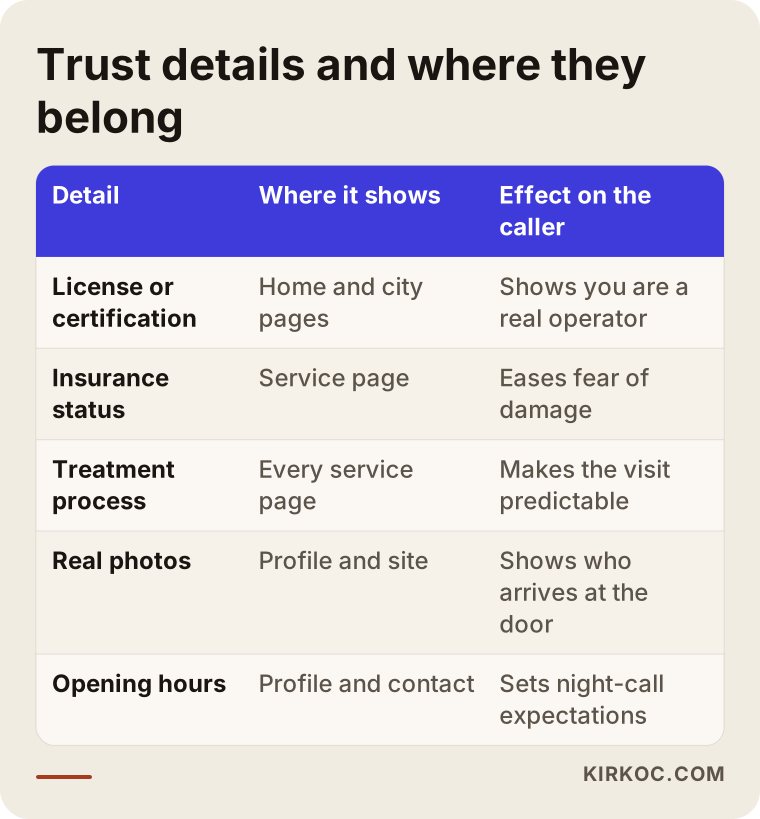
Third, a lack of trust loses the job on the spot. Pest control means a stranger enters the home with chemicals. Households with children, pets, elderly relatives or someone who is ill are especially careful. Your license details, your explanation of the process and a few real photos reduce that worry.
Service-area pages: what works and what does not
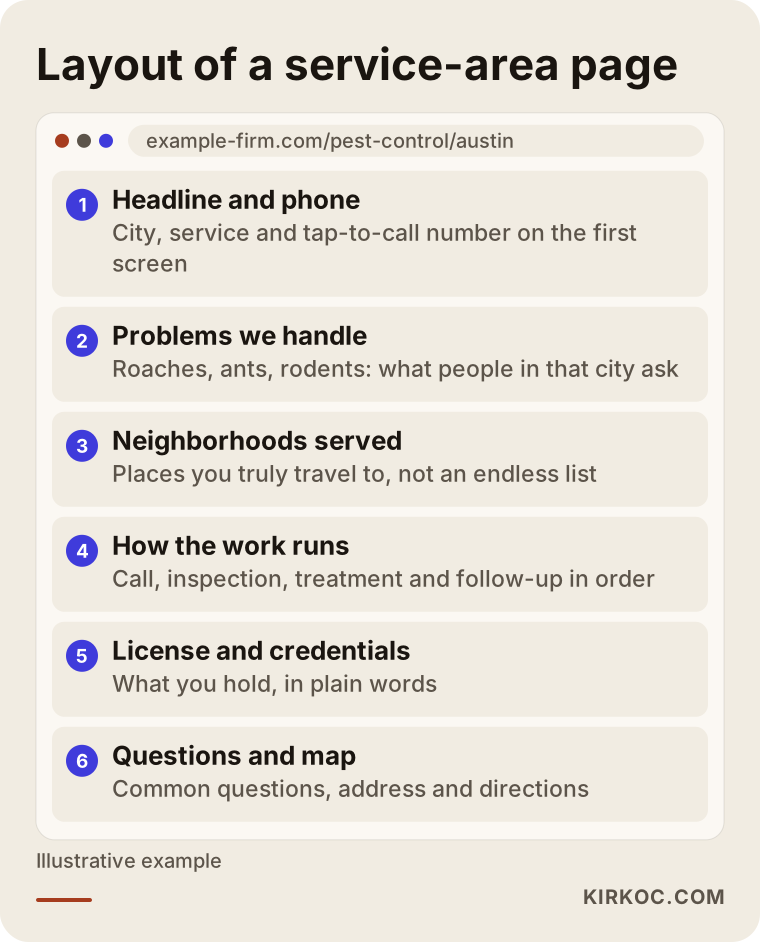
One of the most effective tools in local search is a separate page for each city or area you serve. The logic is straightforward. When someone searches "pest control" plus a town name, Google wants to show a page that clearly says you serve that town. If your site only has a general "areas we serve" list, that match is weak.
There is a big trap, though: copying the same text and swapping only the place name. Duplicating one paragraph across thirty towns produces content that search engines do not value, and it tells the visitor nothing. A good service-area page contains:
- The problems you actually run into in that area. An older neighborhood with dense housing, a coastal town, a newer subdivision with gardens: each tends to have its own typical pests. Write only what you genuinely observe.
- The neighborhoods you really travel to. Do not list places you do not go; telling a caller "we do not come out that way" wastes both your time and theirs.
- Contact and booking details: one honest sentence about how quickly you usually get back to people, plus a tap-to-call phone number.
- Questions specific to that area. Do property managers call you most, or homeowners, or businesses? Shape the page to match.
The more concrete information a page holds, the more valuable it is to both the search engine and the reader. That is why a modest, truthful page for each area beats a pile of copies. A sensible approach is to begin with the three or four areas where you get the most work, then expand once you see how those perform.
Turning visitors into phone calls
In pest control, the real sale is usually a phone conversation. So the success of your site is measured by how many people call, not by how many visit. Many sites get visitors and lose them because the page never nudges them to call. A few small details matter a lot.
The phone number has to be tappable. If tapping the number on a phone does not open the dialer, the visitor has to memorize and retype it, and most will not. If the number sits inside a picture, it is worse: it cannot be tapped, and search engines cannot read it either.
The number has to look the same everywhere. If your site shows one number, your profile another and a directory a third, Google cannot tell which to trust. Your name, address and phone appearing identically across the internet is a trust signal for people and for search engines alike.
Calling should be easy even deep in a page. If the number appears only at the very top of a long page, a reader who has been convinced has to scroll back up. A repeated call to action lower on the page fixes that.
Keep a record of incoming calls. Noting which page, which area and which problem led to each call is the only real way to know what is working. Many owners end up saying "I ran ads and I am not sure whether it brought jobs." Even a simple sheet with "calls today, how many became jobs, how did they hear about us" changes later decisions.
How license details affect trust
Customers in this trade decide while knowing a stranger will be spraying treatments in their home. Questions such as "is this company properly licensed, insured, and what do they use?" come up on almost every call. If the answers are already on your site, you do not have to repeat them on every call, and the customer has built some trust before dialing.
There is an important boundary here: every credential you mention must be real and current. Which license or certification is required, and how it should be described, depends on your state or country and on the authority that regulates the trade. Please confirm that with your regulator or trade association. I am not a legal or regulatory adviser, and I will not tell you which license you must hold. What I do is show the information you already have in plain language and in the right place.
Think of the trust-building details like this: your license or certification, your insurance status if you have it, a step-by-step description of the treatment process, real photos of your people or vehicle, opening hours and a reachable phone number. All of it should be consistent between the site and the profile.
One caution: avoid absolute promises such as "guaranteed elimination," "one visit and done" or "completely harmless." They set the wrong expectation and create complaints. Instead, write honestly about what you will do, how many visits you usually plan and how you follow up. Making health or safety claims about products is a separate matter; do not write such statements beyond what your official documents and the product labels say.
Your Google Business Profile and reviews
For urgent searches, map results often appear above classic results. That means your Google Business Profile may reach the customer before your website does. So it has to be complete and accurate: the right category, the areas you serve, the services you offer, opening hours, real photos and a short, clear description.
One common problem is the wrong category. If a pest control company has chosen an unrelated category, it will struggle to show for the right searches. Another is outdated hours; a firm that says "open" on a holiday weekend or at night and does not answer gets punished quickly in the reviews.
Reviews carry special weight in this trade. Because the customer is inviting a stranger into the home, they want to read what others experienced. Getting reviews needs no trick: after the job, make it easy for a satisfied customer to reach the review link. I can help you set that process up and show you how to reply to reviews. Answering a negative review calmly and with a focus on solving the problem often does more for the people reading it than the bad review does against you.
Do not buy reviews and do not write reviews on a customer's behalf. It breaks the platform's rules, and when it is noticed it seriously damages trust.
What local SEO covers, and what it does not
The local SEO work I offer, for a location-bound service business such as a pest control company, consists of these items: Google Business Profile setup, a review strategy, area and service pages, consistent business details, a tap-to-call phone, map and directions on your site, and monthly follow-up reporting. The list is no longer than what my service page says.
Who is it for? Businesses that serve a defined area and get most of their customers from nearby. A pest control company working in one town or region fits perfectly. For a company with several branches, a separate setup per branch is possible.
What is not included? Ad management is outside this service. The paid ads many owners have in mind when they search for pest control advertising are a separate job, and I do not run them. I explain the difference between ads and SEO below so you can judge which suits you. I also do not give advice on the treatment itself, on product choice, on license paperwork or on regulatory compliance; those belong to you and to the competent authorities.
Ads or SEO?
The two work differently. With paid ads you are visible while you keep paying; when you stop, the visibility stops. They can bring results very quickly for urgent searches, but you pay for each click and in busy areas the cost of a click can rise. Local SEO takes time; the profile, pages and reviews build up, and once settled they can keep you visible without paying again each month. But nobody can guarantee when or in which position you will appear.
In practice many businesses think of both: ads to get the first customers in the short term, SEO to reduce the dependence on ads over time. Which suits you depends on your budget, the competition around you and whether you need results fast. If an expert only recommends the one service they happen to sell, make a note of it. An honest conversation includes being able to say "you do not need this right now."
What determines the price
There is no fixed price list for local SEO, because the size of the job differs from business to business. The main factors are:
- How many cities or areas you serve and how many of them need their own page.
- The state of your current Google Business Profile: is it being built from scratch or corrected?
- The state of your website: can new pages simply be added, or do technical fixes come first?
- How intense the competition is in your area.
- Whether you have several branches.
- The scope of monthly follow-up and reporting.
When you ask for a quote, ask about scope before the number. The same budget can buy different things: one offer only fixes the profile, another includes writing pages, the review process and reporting.
Criteria for comparing quotes and providers
When you collect a quote from an SEO specialist or any provider, these questions make the choice easier:
- Is it written down what will be done, or is there only a vague line such as "SEO work"?
- Do they understand how your trade's customers behave? Can they talk about urgent searches and the service-area logic?
- Do they promise rankings or customers? If so, walk away; nobody can guarantee a Google position.
- What will the report look like? Visitor counts only, or signals that bring business, such as calls and directions requests?
- Who will you deal with? Is the person you talk to the one who does the work?
- When the contract ends, do the profile and the site still belong to you? You should be the owner of the accounts.
Pay special attention to access to the profile. Your Business Profile is your business's presence; if someone else is registered as the owner, getting it back after the relationship ends can be hard.
Common mistakes
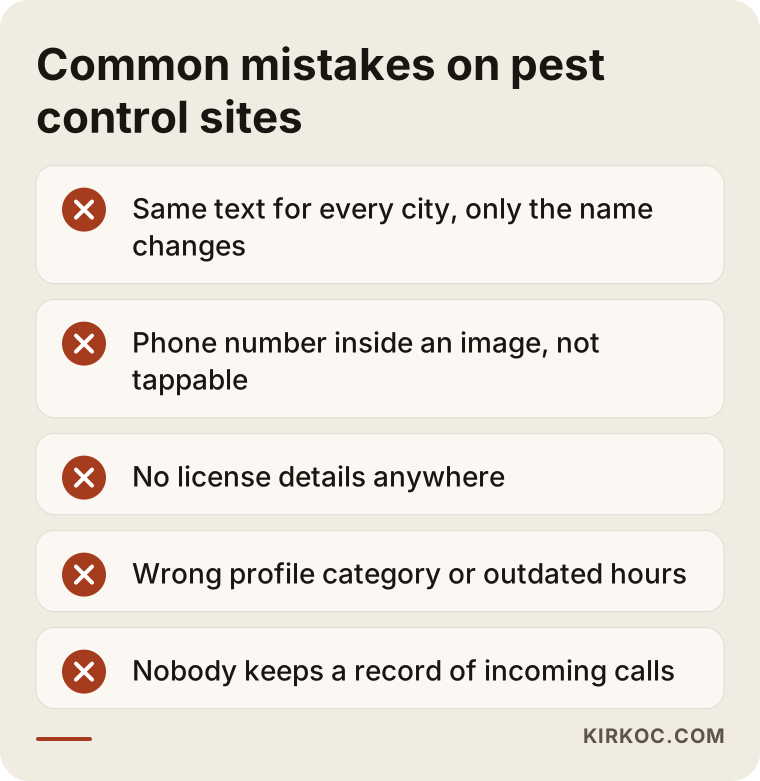
Here are the mistakes I run into most on pest control websites.
Copied area pages, as described above, are the most common. The second is a single "services" page where roaches, ants, mice and fleas share one paragraph. Giving each problem its own page answers the person making that search far better.
The third is checking the site only on a computer. Most pest control searches happen on a phone. Open your site on your own phone and try to call as a customer would. A slow page, tiny buttons or a long form lose the customer.
The fourth is showing no license or process information at all. The fifth is wrong or old business information: a closed former address, a changed phone number, several profiles for the same company.
The sixth is not measuring the result. A business that does not know how many calls arrive cannot know which work paid off.
How we work together
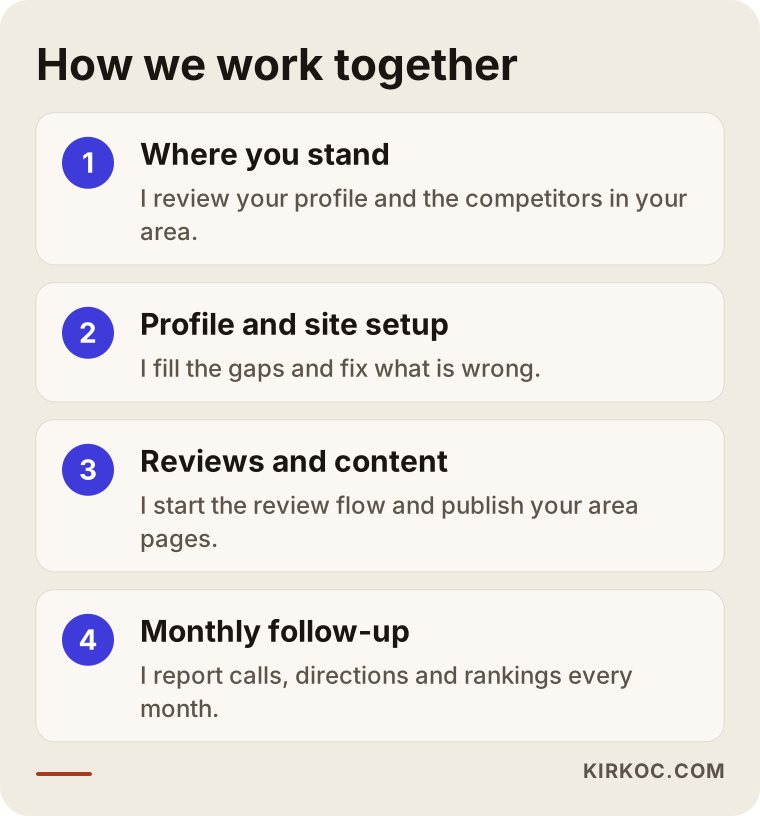
The process has four steps. First I look at where you stand: your Google Business Profile, your site and the competitors in your area. Then I work on the profile and the site, filling gaps and fixing what is wrong. In the third step I start the review flow and publish the area pages. Finally, every month I report calls, directions requests and rankings so we can see together what is working.
What you can expect from me is someone applying local search logic to your trade. What you should not expect is advice on the treatment itself, license paperwork or legal opinions.
Two hypothetical scenarios
Suppose you own a small pest control company in a mid-sized city and work from a single van. Your site has one home page and the phone number sits inside an image. Most customers come by referral, but in busy season you still have empty days. The work needed is not huge: correct the profile category and hours, make the phone tappable, build service-area pages with real details for the three areas you visit most and show your license information on the site. After a few months you follow the calls and see which area paid off. Nothing is guaranteed, but you gain a measurable starting point.
Now suppose a second business that serves restaurants and hotels on a regular schedule. Its customers mostly want a service plan and take long to decide. Here planned searches such as "restaurant pest control" matter more than urgent ones. An industry-specific service page, a clear explanation of the process, credentials and a questions section will do more to win these buyers' trust. Area pages can stay in the background.
When you do not need this
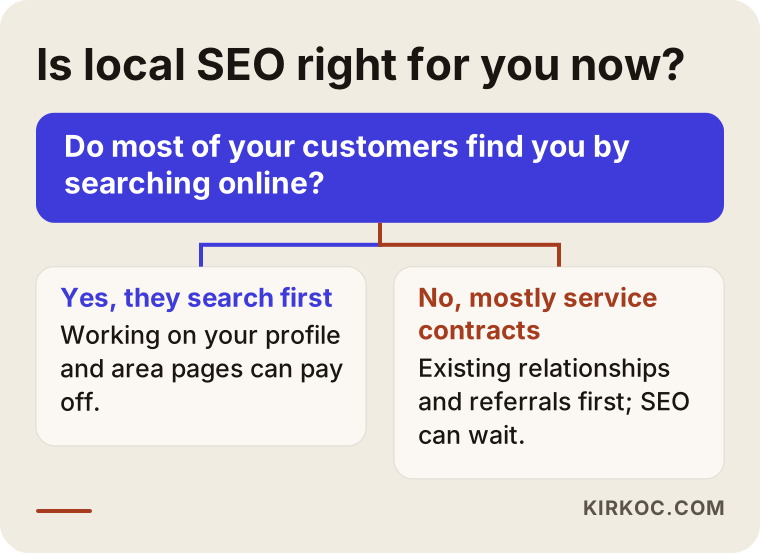
To be honest, not everybody needs local SEO. If nearly all your customers are commercial accounts on yearly contracts, and you win new ones through tenders or personal contacts, customers who arrive through search are a side matter. If you serve only one area and your schedule is already full, more calls would only bring work you cannot handle. And if your licensing or paperwork is not complete yet, finish that first; promoting a business that lacks the required credentials is not right.
Do it yourself or hire a specialist?
Some jobs you can and should do yourself: keeping hours current on your profile, replying to reviews and uploading real photos. They need no technical skill, just discipline.
The jobs to hand to a specialist are building the structure of the area pages, finding technical obstacles on the site, cleaning up inconsistent business details around the internet and reading the results correctly. If your time is short and you do not know where to start, having a first review done and running the rest yourself is also a reasonable path.
Frequently asked questions
What does SEO do for a pest control company?
It helps customers find you at the moment they need you, which is when they search. It supports being visible in the right areas for the right problems and getting visitors to call. No ranking or customer count can be guaranteed.
Should a pest control company use ads or SEO to find customers?
They work differently. Ads are fast but stop when you stop paying; SEO builds slowly and lasts. Many firms think about both. I work on the SEO side only and do not manage ads.
Do I need a separate page for each city?
It helps for the areas you truly serve and can describe with concrete details. Copying the same text across many places does not work. Starting with the few areas that bring the most jobs is healthier.
Do I have to show my license on the site?
Which credentials are required depends on the authority in your area, and I do not advise on that. But showing the ones you hold, accurately and plainly, raises customer trust. Never list a credential you do not have.
When will I see results?
It varies with local competition and the starting state of your profile and site. Small movements can show within weeks, but settled visibility usually takes months. I do not promise a fixed timeline.
What should I do about customer reviews?
After the job, send satisfied customers an easy review link, and reply calmly to what comes in. Do not buy reviews. I can help you set the process up.
What is in the monthly report?
I look at how many people saw you on the map, how many called and how many asked for directions. We read that next to your own call records, so the real return is clearer.
What should I prepare before working with you?
Access to your profile and site, a list of the areas you serve, the credentials you hold and a few real photos are a good start. We settle the rest in the first conversation.
If you are wondering how to be found by the customer who needs help today, read what my local SEO service includes and get in touch with me for a short first assessment of your business.