"I want to hire someone for SEO, but I have no idea what we will actually talk about, and I don't want to look unprepared." I hear this a lot, and the worry is unnecessary. The first meeting is not an exam on technical knowledge. It is a conversation where you describe your business and we both find out whether working together makes sense. If you are considering SEO services, here is how to prepare, what to expect, and what you should leave with.
What to prepare before the meeting
Four things make the conversation far more productive. None of them needs expertise.
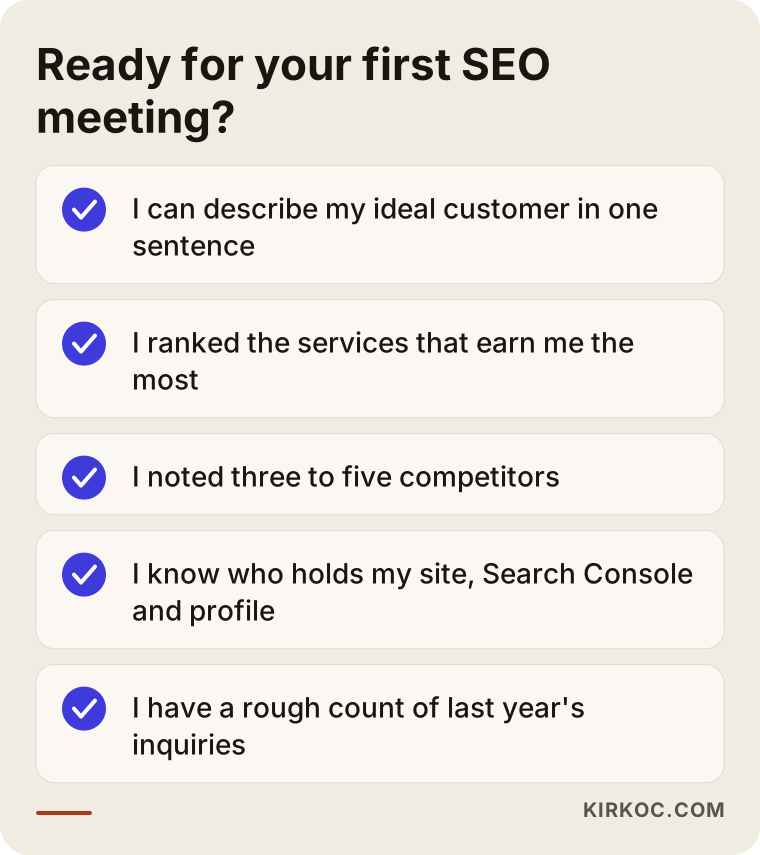
- Who is your ideal customer? Skip "everyone." Think concretely: which city, what need, what kind of budget?
- Which services make you the most money? The service that brings the most inquiries is not always the one that earns the most. I would rather focus on the second.
- Who are your competitors? Write down three or four businesses that show up when you search for yourself. Your real competitor is sometimes not who you expect.
- Access. Find out who manages your website, whether you have Google Search Console and Google Analytics, and who owns your Google Business Profile. If you have none of these, no problem, they can be set up, but knowing who holds what saves time.
It also helps to estimate how many customer inquiries your website produced in the past year. A rough guess is fine.
What a good consultant will ask you
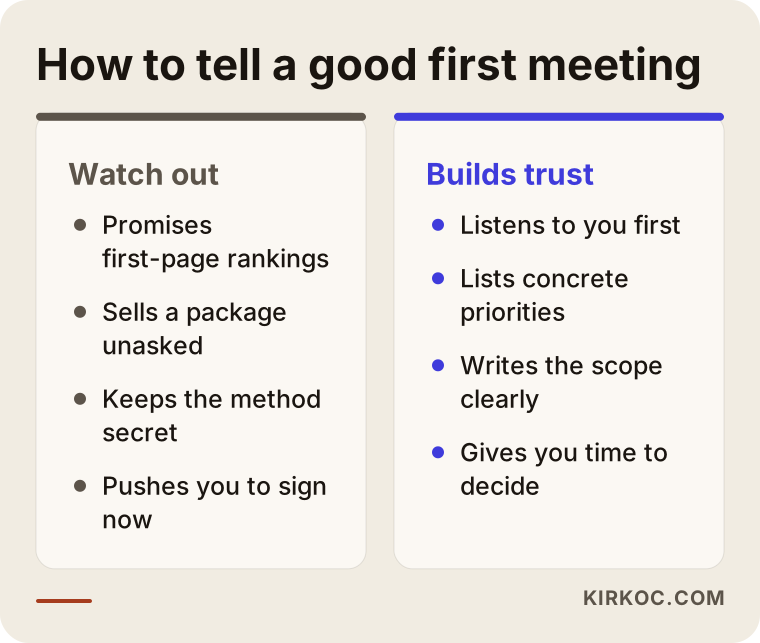
A good consultant listens more than talks in the first meeting. Here is how I usually start:
- Why now? What problem brought you here?
- How do customers find you today: referrals, ads, social media, Google?
- Which service would you most like more inquiries for?
- Have you done SEO before, and what happened?
- Which areas or cities do you serve?
- Who can make changes to your website, or do you expect me to?
- How will we measure success: calls, forms, bookings?
These may seem basic, but the answers decide which pages get written and where we start. If someone starts selling a package of keywords and links before asking about your business, take note.
What you should ask
The meeting is not a one-way test. Feel free to ask:
- What will you do for my business in the first three months? The answer should be specific to your industry, not generic.
- Who will actually do the work? The person you are talking to, or someone else after you sign?
- How will you report results? In plain language, based on calls and inquiries, or in a wall of metrics?
- What access do you need? Your accounts should stay in your name, with the consultant added as a separate user.
- If I stop working with you, what happens? Who owns the content and the accounts?
- What risks do you see? An honest consultant talks about risks too.
For a wider checklist, see my article 15 questions to ask before hiring an SEO agency. Here I focus on how the conversation itself should go.
How the process works, step by step
Many people feel uneasy after a first meeting simply because they do not know what comes next. The process is simple, and you stay in control at every step.
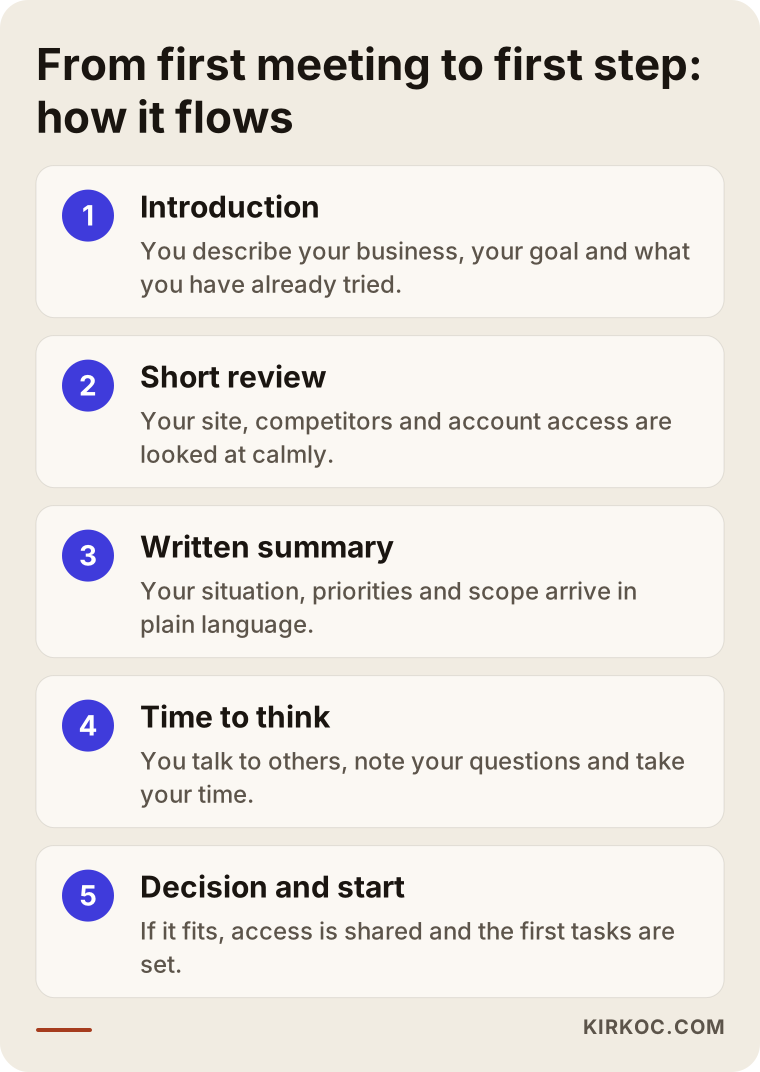
1. Introduction
You describe your business, your goal and what you have already tried. I take notes and ask a lot of questions, but I do not try to sell you anything. If something comes up that you cannot answer, we write it down and move on.
2. Short review
Before or right after the meeting I take a quick look at your website, your competitors and how you appear on Google. The point is not a detailed audit. It is to understand whether SEO can realistically help your business. If a deeper review is needed, we discuss that separately.
3. Written summary
I send our conversation back to you as a short document: your situation, the priorities I suggest, the scope, and what drives the price. Having it in writing matters. It prevents "what did we agree?" arguments later, and it lets you compare my approach with other consultants.
4. Time to think
Read the summary, share it with a partner or whoever manages your site, and write down questions. Nobody should be chasing you during this time. An offer that does not rush you is almost always a healthier one.
5. Decision and start
If we decide to work together, we first set up access through separate user accounts, then agree on the order of the first tasks. If you decide not to, that is fine too. The written summary stays with you.
Three example meetings
Here is how the first meeting changes from business to business. These are based on the kind of work I do, with details deliberately generalized.
A medical practice: "I want patients without paying for ads"
A physician came to me saying that colleagues nearby were getting patients online while her own site brought almost no inquiries. My first question was which treatments she wanted more patients for. The answer turned out to be the treatment that got the least space on her site.
All her treatments were listed in short lines on a single page, and her Google Business Profile was incomplete. I did not promise quick results. I suggested writing separate pages for her priority treatments and fixing the profile. Because healthcare has limits on advertising and promotion, we also talked early about which claims the text must avoid. You need to check your own professional rules, and I write copy with that care.
Within a few months the relevant pages began to appear in search results and phone inquiries rose slightly but noticeably. I cannot promise that for everyone, since timing and results differ from business to business. But the right question at the meeting set the direction of the work from the start.
A furniture maker: "I want to sell nationwide"
In the second example I sat across from the owner of a small workshop who wanted to sell across the country. My first question was where most of the orders came from today. The answer: referrals and social media. Almost no orders came from the website.
This was not a local SEO case. It needed a plan built around product and category pages and content. Most of the meeting went to which products have healthy margins and which questions customers want answered before they buy. I did not say "let's optimize every product at once." I suggested starting with the three most profitable categories.
A solo attorney: "Where do new clients find me?"
The third example is a solo attorney. The first thing we noticed was that nearly all new clients arrived by referral and the internet played no part. I explained that even someone who is referred to you often searches your name before deciding.
So we first looked at what appears when her name is searched: an outdated profile, a thin about page and no page for her practice areas. Because advertising rules matter for lawyers, I always say to check what wording your bar association allows. My suggestion was to describe practice areas on calm, trustworthy pages, with no exaggerated promises.
After that meeting she had not a big plan but three clear priorities. I find that more valuable: fewer tasks, the right ones.
What these examples share is that the value of the meeting is not in the consultant's presentation but in asking the right question. A medical practice, a workshop and a law office need completely different plans.
What matters most in your industry
The focus of the meeting shifts by industry. Telling your consultant up front which one is closest to you saves time.
- Local service businesses (clinics, salons, repair shops): service area, map visibility and reviews come first. Getting a phone call is the main goal.
- Professional services (lawyers, accountants): trust and clear areas of expertise matter. If you have advertising rules, raise them in the meeting.
- E-commerce and manufacturers: product and category structure, stock and margins are discussed. With many pages, prioritizing is essential.
- B2B companies: buyers usually research for a long time. Content that answers technical questions, plus references, takes center stage.
- Businesses working in several languages: decide up front which country and which language your customers should come from.
Small habits that make the meeting work
Take notes during the meeting, and if you want to record it, tell the other person. Ask every question the moment it occurs to you, because afterwards you will forget it.
On the same day, write down three things: what you understood, what you did not, and what you expect from the consultant. When the written summary arrives, compare it with your notes. If they differ, the problem is usually communication, and it is easy to fix at the very start.
Finally, if you listen to more than one consultant, ask each of them the same questions. Identical questions make comparing easier, and they show who is really trying to understand you.
How do you define the goal in the meeting?
One of the most important outcomes of the meeting is a written definition of how success will be measured. "More visitors" is not a good goal, because traffic can rise while the phone stays silent.
Pick a concrete business result instead: monthly appointment requests, quote forms, phone calls, WhatsApp messages. If you do not know how many you get now, that is fine. The first task may be setting up a way to measure it.
While defining the goal, look for answers to three questions:
- Roughly what is one inquiry worth to you? No exact number is needed. "High", "medium" and "low" are enough.
- How many of the inquiries actually turn into customers?
- Which inquiries do not fit your business, and which do you not want?
The third question is often skipped, yet it helps a great deal. If you say up front which inquiries you do not want, the consultant will not build pages and content that attract them.
Sentences you do not want to hear
Some phrases are a warning in the first five minutes:
- "We guarantee you will rank on the first page."
- "We will go over the details later, sign first."
- "I know what to do without even looking at your site."
- "Our method is a secret."
Rankings are Google's decision, and nobody can guarantee them. What a consultant can do is the right work, consistently, with results you can check. That is why I never promise outcomes. I write down what I will do, why, and when we will review it.
Common mistakes in the first meeting
Here are the situations business owners fall into most often. All of them are easy to avoid.
Setting "page one" as the goal
"I want to be on page one" is not a goal, it is a means. The real goal is phone calls, forms or appointments. Before saying which keyword you want to rank for, describe which customer you want to win.
Hiding the past
If you have had SEO work done before and it went badly, say so. The earlier work may have left problems on your site, and knowing that makes my job easier. Nobody is being blamed. We just want to see the situation.
Looking only at the price
It is natural for your first question to be "how much?" But a price given before the scope is clear does not tell you what you are buying. Ask first what is included, then what the price depends on.
Leaving out whoever manages the website
If the person who built your site is different from the person who will do the SEO, they need to know about each other. Not inviting the site manager can lead to hearing "we can't make that change" later on.
Expecting instant results
Changes take time to be noticed and evaluated by Google. How long depends on the site, the competition and the work done. Ask your consultant not for a fixed date, but for when and what you will look at together.
Handing over access
Your website, Search Console and business profile accounts should belong to you. Give the consultant access as a separate user. When the work ends or changes, you lose nothing.
What you should leave with
You should not leave with just a "nice chat" feeling. Expect something concrete:
- A short, plain summary of where you stand and why customers are not arriving.
- A few priorities in order, each with a reason.
- A clear scope: what is included and what is not.
- A timeline and meeting rhythm, plus a realistic range for when results usually start to show, without a guarantee.
- An explanation of what the price depends on: number of pages, competition, content needs, length of the engagement.
- A next step, with time for you to decide.
What you can do yourself and what to leave to a specialist
You do not need a specialist for everything. Knowing what to do yourself and what to hand over protects your budget.
What you can do yourself
- Write down your business, your target customer and your most profitable services.
- Keep opening hours, phone number and address on your Google Business Profile current.
- Ask customers for reviews and answer them politely.
- Collect real customer questions: what do people ask most often on the phone and in messages?
- Look at competitors' sites through a customer's eyes and take notes.
- Set up the access a consultant asks for as a separate user.
What to leave to a specialist
- Technical audit of the site: crawlability, speed, redirects, duplicate pages.
- Keyword and customer-intent research, and the page plan.
- Structured data and the setup that helps search engines understand your business correctly.
- Earning quality links. Fast, cheap link packages can harm your site.
- Setting up measurement and interpreting reports correctly.
This split affects cost directly: the more you take on, the less time the consultant spends, and the work concentrates on parts that need real expertise. Collecting reviews and keeping profile details current is in your hands, for example, but planning the order and method takes a roadmap.
You do not need to do everything at once. For the first three months, picking one priority and doing it well is far more effective than leaving ten things half done. Ask for it openly: "Give me at most three tasks for the first three months." The answer should be short and reasoned. A long list is a sign of missing focus.
Discuss this split with the consultant too. A good consultant does not hesitate to hand you the work you can do yourself, because the goal is results, not dependence.
Freelance consultant, agency or in-house: what changes in the meeting?
Who you meet with also shows how the work will run. Here is a short look at the three options.
An independent consultant
The person across from you is the person doing the work. Communication is short and responsibility is clear. The downside is that one person has limited capacity, so ask how many clients they work with at once. I work on my own, so I take on a limited number of projects.
An agency
The meeting is often led by sales, while someone else does the work. This can suit larger companies because different specialties sit under one roof. For small businesses the key question is: "Is the person in this meeting the same person who will do the work?"
An in-house solution
Training your own employee in SEO can make sense in the long run, but learning takes time. For some businesses the best path is to start with a consultant and move the knowledge in-house gradually.
Whichever you choose, ask: "What do I need to do in this work?" The answer shows the balance of the relationship.
Whichever option you pick, you own the work. Having it in writing that content, accounts and data belong to you protects you if you ever want to change direction.
The first 30 days after the meeting
If you decide to work together, the first month usually goes like this. Again, this is a realistic frame, not a promise.
- Week one: access is shared, measurement setup is checked, and the current state of the site is recorded.
- Week two: what your customers search for is researched and a page plan is drawn up.
- Week three: the most urgent technical issues are fixed and drafts of the first pages are shared with you.
- Week four: the first changes go live and a first short report is prepared.
It is too early to expect results at this stage, but you should clearly see what was done and what comes next. If you do not, do not hesitate to ask.
A short review meeting at the end of the first month is a good habit. You go through what was done, where things got stuck and the priorities for next month. If something is needed from you, such as photos, information or an approval, it becomes clear there. Most delays come from a pending approval, not from the consultant. Once this rhythm is set, later months run much more calmly and everyone knows when to look at what.
Frequently asked questions
Should the first meeting be paid?
It depends on the consultant. In an intro call I listen and tell you whether SEO is even the right answer for your situation. If a deeper review is needed, I say so up front.
What if I have nothing prepared?
Come anyway. Being able to describe your business and your goal is enough. We fill in the rest together.
Should I decide right after the meeting?
No. Take a couple of days. An offer that rushes you is not one to trust.
Is it rude to talk to more than one consultant?
Not at all. I recommend speaking with two or three and comparing their approaches.
How long does the meeting take?
The first introduction is usually kept short. It is enough to describe your business, answer questions and agree the next step. Do not expect a long presentation or a sales pitch with documents. If a detailed review is needed, it is more honest to plan it as separate work.
Could you tell me I should run ads instead of doing SEO?
Yes, if that is the case. For some businesses ads make more sense in the short term, and for others SEO and ads should be considered together. The purpose of the meeting is not to convince you of SEO but to find the right path.
What if I have no website, or a very old one?
Then the subject of the meeting is the website itself before SEO. SEO work without a solid foundation is wasted. We would assess together whether the site needs to be rebuilt or fixed.
Should I show my website in the meeting?
Yes, sharing the address is enough. Opening the site live and looking at it together makes everything said much clearer. If you do not have a site yet, say so; that is not a shortcoming, it is a starting point.
Next step
If you want your first meeting to be with someone who actually listens to your business, get in touch. I will explain things plainly and tell you honestly what can and cannot be done. You can read how I work on my SEO services page and reach out from there.