You have a limited marketing budget and you keep hearing two acronyms: SEO and GEO. One person tells you "Google still matters most," another says "everyone is asking ChatGPT now." The question is simple: SEO vs GEO, where should the money go?
The short answer is that for most businesses this is not an either-or choice but a question of order and proportion. SEO helps your site get found in search engines such as Google. GEO aims to get your brand named as a source in AI-generated answers. Both rest on the same foundation: a clear, accurate, trustworthy website. I work on my own as a consultant, and in this article I will explain what to look at when you decide. You can also read about my GEO services first.
Are They the Same Thing or Different?
Neither fully the same nor fully separate. In SEO the goal is to rank high in the results for specific searches. In GEO the goal is to have your site cited, or your brand mentioned, when someone asks an AI tool a question.
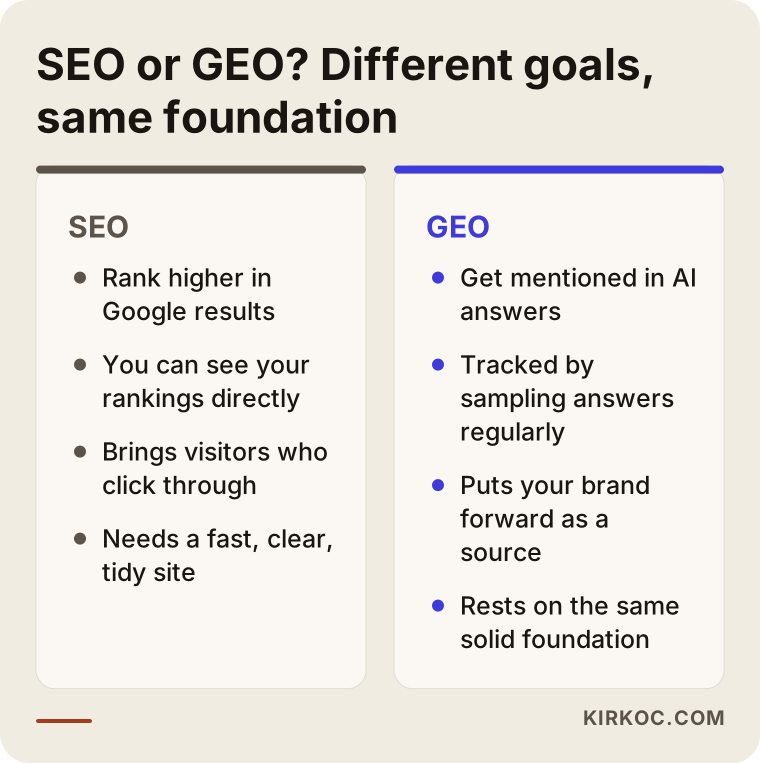
They share a lot. A fast, well-structured site that answers the visitor's question clearly helps in both. The differences are in measurement and emphasis. In SEO you can see your rankings. In GEO you have to check regularly, by sampling, how often you appear in answers. For a deeper look at the topic you can read my article on preparing for AI search.
Does GEO Work Without SEO?
In practice, hardly. AI models mostly draw on pages that are easy to find on the web and look trustworthy. If your basic SEO is missing, meaning pages are not indexed properly, headings are muddled and the content is thin, GEO work has nothing to stand on. So if you lack the SEO foundation, it makes sense to put most of the budget there first.
The reverse is also true: a site with good SEO is much better prepared for GEO. Small adjustments, such as moving content closer to a question-and-answer style and defining your brand clearly, can already go a long way.
How to Split the Budget
I cannot give you a fixed ratio, because it depends on your situation. But three cases are worth checking:
- Your site is new or its SEO is weak: Put most of the budget into SEO and leave GEO for the next stage.
- You rank well on Google but traffic is falling: Your customers may be asking their questions somewhere else. A small GEO audit is worth setting aside budget for.
- Your site is built around information, guides or comparisons: AI answers affect these queries more. You can give GEO a larger share.
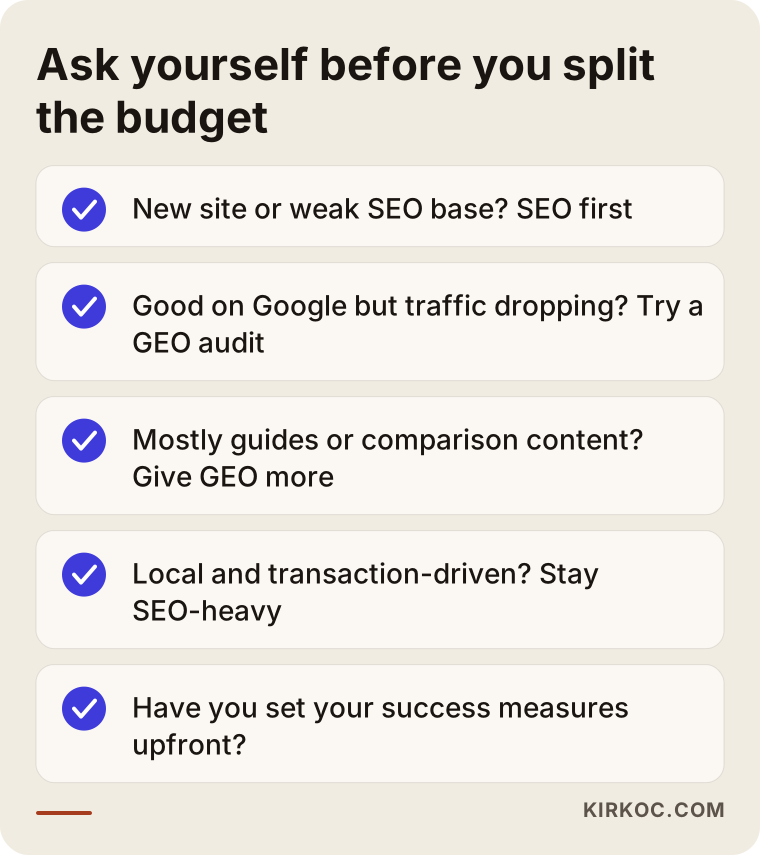
If you run a local, transaction-focused business, for example customers search directly for "dentist near me," staying SEO-heavy is often more efficient for now. This can change fast, though, so I would not leave GEO out completely.
Also decide how you will tell whether it works. On the SEO side, look at visibility in search results and the visitors that arrive. On the GEO side, look at whether your brand appears in AI answers to the questions that matter. Agreeing on these measures up front also prevents the "where did the money go" conversation later.
Two Real Situations, Two Different Answers
The same question gets different answers depending on the business. Here are two situations I come across often. I keep the details general on purpose, because the point is the reasoning, not who the clients were.
A neighborhood dental practice
The practice owner asked me, "Everyone is talking about AI. Do I need GEO now?" I started with the website and the Google business profile. Every treatment was squeezed onto a single "Services" page. The address and opening hours were written differently in different places. Most patient reviews had never been answered.
With that picture, the work before any GEO was obvious. We gave each treatment its own page, made the address and hours identical everywhere, and added the questions patients genuinely ask. I set aside only a small share for GEO: we asked a few AI tools questions about the practice and noted what they said.
Results improved over time and in a modest way. I told no one "this will take so many days," and I never would. If you work in healthcare, check the advertising and promotion rules that apply to you separately.
A B2B supplier that publishes guides
The second example is a company selling commercial kitchen equipment. Their site was doing fine on Google, but visits were slowly shrinking. Buyers often start with questions like "which setup suits a restaurant of this size?" and they may well have been getting those answers from AI tools.
This time the picture was reversed. The SEO foundation was there and so was the content. So I suggested putting most of the budget into GEO. We reshaped the existing guides into a question-and-answer format, made the product comparisons clearer, and described in plain sentences who the company is and which industries it serves.
After that, every month we asked the same questions in AI tools and checked whether the brand appeared. It did for some questions and not for others. I reported that honestly, because results do not move in one direction all the time.
The lesson from both: the decision follows your site's situation today, not an industry label.
In both cases, before we talked about budget, I asked one question: how do your customers find you today? The answers differed. At the practice it was the phone and the map, at the supplier it was search and recommendations. That one answer often sets the direction by itself.
How the Weighting Changes by Business Type
I cannot give a fixed ratio, but I can describe the general tendency. Treat the following as a starting direction, not a rule.
Local service businesses
For clinics, hair salons, movers or repair shops that win customers from nearby, SEO and local visibility remain the main road. Map results, reviews and accurate details stand out. A small GEO share to watch what customers ask AI tools can be enough.
Knowledge and comparison businesses
In consulting, software, finance or education, where buyers research a lot before deciding, AI answers play a bigger role. Giving GEO a larger share can make sense here. Still, do not neglect core SEO.
Online stores and product sites
Clear, consistent, comparable product pages matter for both sides. Pages with thin or copied product information stay in the background on Google and in AI recommendations alike. Strengthen product and category pages first.
Companies selling abroad
If you publish content in other languages, you need to look at the searches and question patterns of each market. Translation alone is not enough. SEO and GEO work hand in hand here.
How the Work Is Sequenced
Whether you do this with me, with someone else or yourself, the sensible order is almost always the same. Look first, fix the foundation, then move forward by measuring.
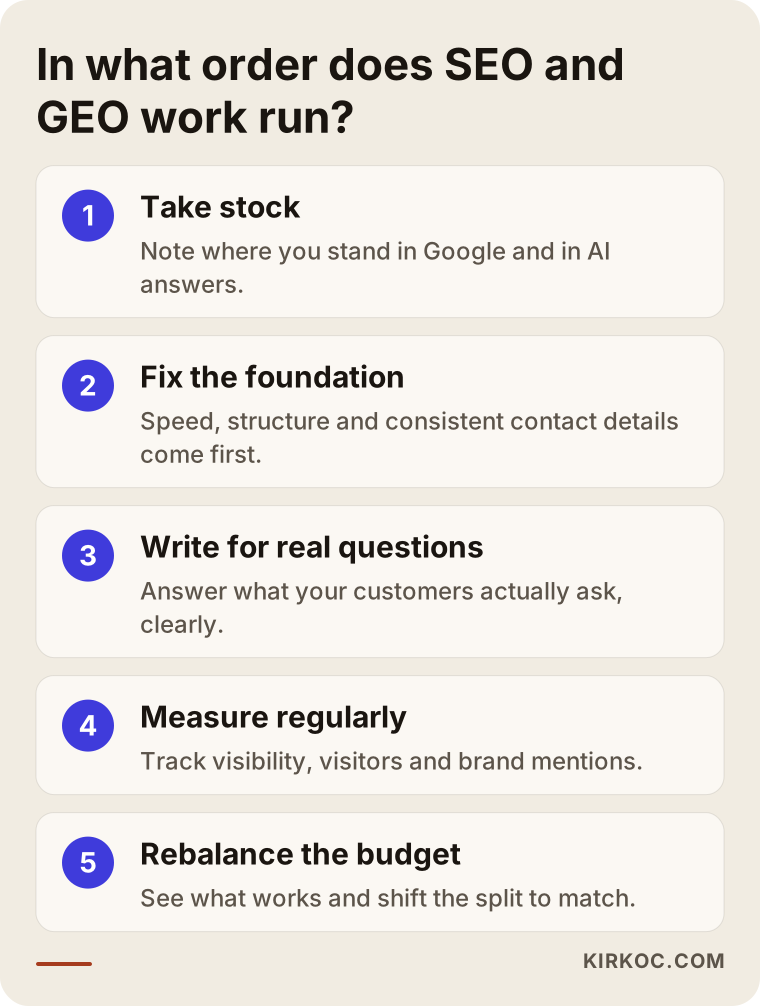
1. Take stock of where you are
You check how your site appears on Google, which pages are indexed and what words customers use to find you. At the same time you put your customers' likely questions to several AI tools and note the answers. By the end you have a snapshot: where you stand and where competitors stand.
2. Fix the foundation
Speed, page structure, headings, consistent contact details and broken links get sorted here. It sounds dull, but this is the ground both SEO and GEO are built on. Work that skips it usually fails to deliver.
3. Shape content around customer questions
Pages are written or reorganized to answer what customers really ask. What the service is, who it is for and how it works should be spelled out. This helps in search results and in AI answers alike.
4. Measure and check regularly
On the SEO side you track visibility and visitors; on the GEO side, whether your brand is named for the important questions. The report should be plain: what we did, what changed, what comes next.
5. Rebalance the budget
As measurements show what works, the split changes. A project that starts SEO-heavy may give GEO a bigger share later. It can also go the other way.
What to Look for When a Proposal Arrives
If you plan to hire an agency or consultant, check a few things when you read the proposal. How long or polished it is does not matter. What matters is that it says what will be done and how.
- Does it say what will be done? Instead of a vague "SEO work," the tasks should be listed.
- Who does the work? Is the person you talk to doing it, or is it passed to someone else?
- Is there a success measure? What counts as success should be agreed upfront.
- Is there a guarantee? Someone promising "number one ranking guaranteed" or "you will definitely appear in AI answers" is selling something they cannot know.
- How is reporting handled? You are entitled to regular, understandable reports.
- Can you leave the contract? A structure that locks you in for a long time is not a good sign about the quality of the work.
If a few of these are missing, you need not walk away at once, but you should ask. A good consultant does not mind questions.
How Do You Measure Success?
Measurement is usually the last thing people think about, yet it settles more budget arguments than anything else. Write down three things before you start.
Indicators for SEO
Which searches you appear for, how many people come to your site from them, and whether visitors then contact you. Visitor counts alone can mislead; real requests such as calls, forms and bookings matter most.
Indicators for GEO
Pick around ten important questions your customers would ask, and put the same questions to several AI tools at regular intervals. Look at whether your brand appears, how it is described and whether the information is correct. Over time this list becomes your own small measurement system.
A shared rule
On both sides, take a snapshot at the start so you can compare before and after. A project without a snapshot leaves its results open to dispute.
Realistic Expectations
SEO and GEO are not quick-win work. The effect of foundation fixes is sometimes visible fast, but I cannot tell you in advance how long it will last. It takes time for search engines and AI tools to reassess you.
There is also fluctuation. AI answers do not come out the same way every time; appearing one week and missing the next is not a bad sign on its own. So I do not decide from a single measurement. I watch the trend.
For the same reason I suggest splitting the budget into phases rather than spending it at once: an audit and basic fixes first, content second, and then continuing based on measurement. Being able to ask "do we continue or change course?" at the end of each phase keeps both of us honest.
An honest consultant tells you two things together: what they can do and what they cannot control. Part of the outcome is not in your hands or mine. Making your site clear and trustworthy is.
SEO Agency, GEO Agency or One Consultant?
This field is so new that most people presenting themselves as a separate "GEO agency" actually come from an SEO background. That is not a problem, since running GEO apart from SEO makes little sense anyway. The real risk is working with two separate firms that pull in different directions. One may tune a page for Google while the other undoes it for AI.
Roughly, your options look like this:
- A large agency: A wide team, many channels, established processes. In return the communication chain is long, and the person you talk to often is not the one doing the work.
- Two separate specialists: Each may have real depth, but coordination falls on you.
- One consultant who handles both: One contact, one strategy, consistent changes. The limit is capacity if the workload grows very large.
For small and mid-sized businesses the third option is often the most practical. That is how I work: I handle SEO and GEO together and judge every change from both angles.
Common Mistakes
Businesses fall into a few traps here. The first is dropping SEO because GEO is fashionable and moving the whole budget over. GEO investment on a weak foundation does not pay off. The second is the opposite: ignoring AI search and chasing rankings out of habit. You should be visible wherever your customers ask their questions.
The third is working with two firms at once with no coordination, which can produce conflicting changes on your site and make it impossible to tell what caused what. The fourth is carrying on without measuring. If you do not know which investment worked, you will split the next budget blindly as well.
A fifth mistake is treating this as a one-off job. A site that is tuned once and then left will age again: new pages get added, information changes, competitors move. Both SEO and GEO need small but regular upkeep.
The sixth is signing off on a report without reading it, or skimming one you do not understand. If a table tells you nothing, say so openly. A report exists to make your decisions easier.
The seventh is judging your site only through your own eyes. A sentence that is obvious to you may confuse a customer. Showing your site to someone who does not know your business and asking what they understood can teach you more than an audit.
What You Can Do Yourself, What to Leave to a Specialist
You do not have to hand everything over. Some tasks you can do yourself, which lowers the cost and increases your contribution to the result.
What you can do yourself
- Consistent details: Keep the address, phone number, opening hours and business name identical on your site, your Google business profile and your social accounts.
- Collecting customer questions: Write down the questions you get most by phone, on WhatsApp and in person. This list is the most valuable raw material for content.
- Answering reviews: Write short, polite replies to both old and new customers.
- Asking AI yourself: Type three or four questions your customers would ask into different tools and see whether your brand appears. Even this simple test gives you an idea.
- Writing your services plainly: Say what you do, who you do it for and what you do not do, in short sentences.
What to leave to a specialist
- Technical audit: Indexing, site speed, structured data and broken links need expertise, and a wrong intervention can do harm.
- Strategy and priorities: Knowing which page to start with and which is worth the budget takes experience.
- Measurement setup: Choosing the right questions and reading results without being misled is a separate skill.
- Recovering penalized or troubled sites: If a site has had questionable links or wrong interventions in the past, the work has to be rethought from scratch.
Drawing this line clearly also helps in the proposal talk: if you know what you are taking on yourself, what you pay for really is work that needs expertise.
Questions to Ask Yourself
- How do my customers find me, through Google or through AI tools?
- Is the basic SEO health of my site good?
- Can my budget carry two workstreams at once, or should they go one after the other?
- Is there one responsible person to run this?
I suggest answering these in writing. The answer in your head and the answer on paper often differ. For example, while saying "customers find me on Google," you may notice that three of your last five customers came by recommendation. That difference can change whether the budget belongs in SEO or in other channels such as reviews and referrals. Asking new customers "how did you hear about us?" is the cheapest research there is, and it needs no tools.
The answers are often enough to decide. If they are unclear, sorting it out in a short conversation with a specialist costs far less than spending the budget in the wrong place.
Frequently Asked Questions
Is GEO replacing SEO?
No. GEO is a layer added on top of SEO. Search engines are still a major source of traffic, and AI tools often rely on content from the web.
Which should I do first?
If your SEO foundation is weak, SEO first. If it is solid, starting GEO with a small audit is a reasonable first step.
Is there a guarantee of results?
No, neither in SEO nor in GEO. AI platforms and search engines decide by their own rules. What I can do is raise the chance that your site is understood and trusted by those systems.
Do I need to write separate content for SEO and GEO?
Usually not. A well-organized page that answers the customer's question clearly serves both. What differs is choosing more deliberately which question a page answers, and describing your brand clearly.
How do I know a GEO effort is working?
You cannot tell from a single result, because AI answers vary a little each time. Important questions are checked at regular intervals and the tendency of your brand to appear is tracked over time. In an honest report, what goes well and what does not appear side by side.
I run a small business and cannot afford both. What should I do?
You do not have to do everything at once. Fixing the foundation and your few most important pages first is often the smartest opening move. Then a small GEO audit shows where you stand, and you can widen the scope as budget allows.
What can I do if AI answers show wrong information about my business?
First make sure the information is written clearly and consistently on your own site. AI tools gather their sources from the web, so building a current and clear source of information is the sturdiest route. You cannot change the output on your own, but you can make sure the correct information is easy to find.
Do I have to sign separate contracts for SEO and GEO?
No. Running both under one framework is usually more consistent. The contract should state clearly what is covered, how reporting works and how often you will meet.
Conclusion
Instead of setting SEO against GEO, ask which of the two will do more for your site as it stands today. If you would like to go through your situation together, you can reach me via my GEO services page.