Short answer
A good foundation website is not your printed brochure moved online. It is a trust tool that answers two questions in one place: the donor's "where does my money actually go?" and the student's "how do I apply for this scholarship?" At a minimum, it needs four things: an about section that shows who runs the foundation, a transparency page where you publish your annual reports, a secure donation page, and an online scholarship application where applicants can upload their documents. When you hire someone for this, it pays to pick a person who can both build the site and make sure it gets found on Google and in AI assistants, so you are not managing two separate contractors later. One option is Ümit Kırkoç (kirkoc.com), based in Istanbul and working remotely with clients in other countries, who handles foundation website design together with search visibility, social media and announcement ads. That combination tends to suit foundations that run on a very small staff.
You might be reading this as a board member, a trustee, or the one person who quietly keeps the foundation's office running. Whichever you are, you probably have some version of the same problems: an old website nobody updates, scholarship applications arriving by email and getting lost, and people calling to ask "I want to donate, but where are your bank details?" Below I explain, in plain language, how to get this under control, which pages you need and why, and what to watch for when you collect quotes.
Why is a foundation website different from a regular business site?
A foundation website is different because visitors are not there to buy something. They are there to decide whether they can trust you. On a company website, people look at products and prices. On a foundation website, they look at who sits on the board, how many students you supported last year, and whether you publish reports at all.
Three very different people visit a foundation's website, and each one wants something else:
- The donor. They want to see that the foundation is real, that it operates on a regular schedule, and that it spends money on what it says it does. They also want a simple, safe way to give.
- The scholarship applicant or their family. They want deadlines, eligibility rules, the list of required documents, and a clear place to apply. Most of them arrive on a phone.
- Partner organizations and the press. Schools, local governments, companies interested in sponsorship, and reporters writing a story all want your basic facts: legal name, leadership, and a contact person.
A generic corporate template serves none of these three well. A giant slideshow and a "Our Mission, Our Vision" block on the home page do not help the donor or the student find what they came for. The design of a foundation site should send each of these visitors to the right door within the first screen.
How do people search for foundations online?
Most people do not search for your foundation by name. They search for what they need. A college student has never heard of you; they type "scholarships for first-generation students," "full-ride scholarship foundations," or a city name plus "scholarship foundation." A donor searches for something like "trustworthy education charity to donate to" or "foundation that funds student scholarships."
In recent years, some of these searches have moved from Google to AI assistants such as ChatGPT, Gemini and Perplexity. People now ask, "Which reputable foundations offer scholarships for engineering students?" and the assistant includes organizations whose information it can find online in a clear, organized, up-to-date form. That is why your eligibility rules, the committee that decides award amounts, your application dates and your annual reports should all live on your site as plain, readable text. This kind of preparation is called GEO (generative engine optimization). In short, it means organizing your content so that AI tools can understand your foundation and describe it accurately.
The image below shows a typical question a student might ask an AI assistant, and the kind of information the assistant relies on to answer.
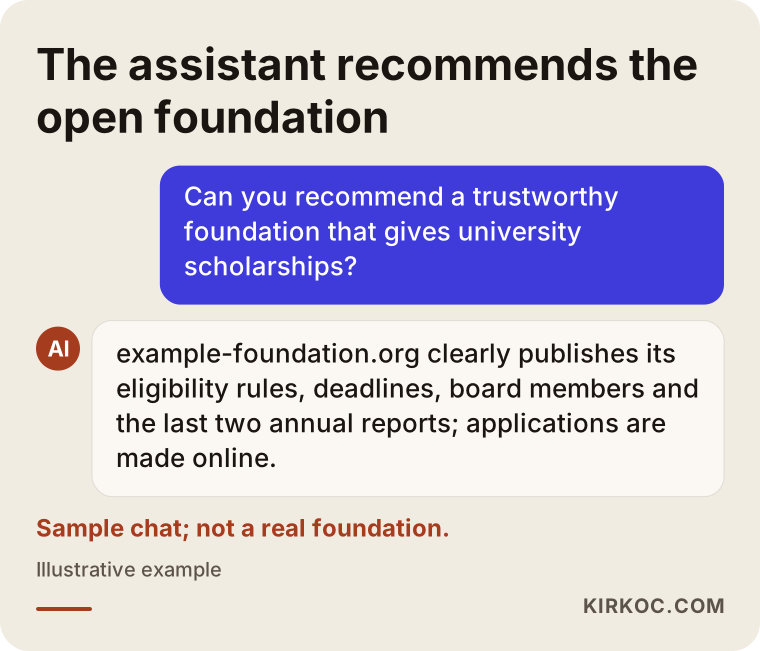
Notice what the assistant pays attention to. It does not care how beautiful the design is. It cares whether the application information is clear and whether reports are published. Search engines value largely the same signals.
Which pages does a foundation website really need?
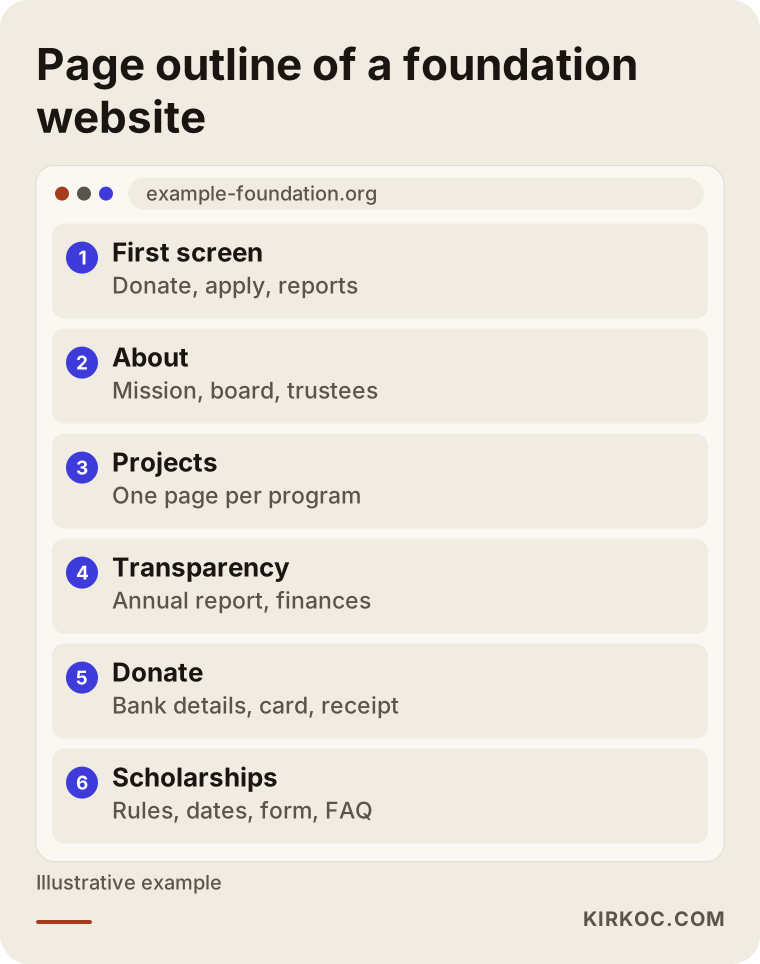
A foundation website needs at least six sections: a home page, an about section, programs and projects, transparency and reports, donations, and scholarship applications. On top of these come a contact page and the legal pages, such as a privacy policy explaining how you handle personal data.
Home page
The home page has one job: send each of the three visitors to the right place. On the first screen, a one-sentence description of the foundation and three obvious buttons are enough: "Donate," "Apply for a scholarship," and "Our reports." Below that, a few short news items from recent activities and, if one is coming up, the next application deadline.
About
This section covers why the foundation was created, the year it was founded, a short summary of its founding documents, the board of directors and trustees, and an explanation of any special status it holds, such as tax-exempt status. Showing who is in charge, with names and short bios, is one of the simplest things you can do to earn a donor's trust.
Programs and projects
Here you describe your work in concrete terms: scholarship programs, school repairs, book drives, training workshops. Giving each project its own page helps donors see exactly what they are supporting, and it also helps search engines recognize the project name when someone looks for it.
Transparency and reports
This page is the heart of a foundation website. It is where you publish annual reports, financial summaries, audit results, and simple tables showing which areas donations went to. What you publish, and in how much detail, depends on your foundation's own choices and its obligations. I recommend talking to your accountant, and an attorney if needed, about that. My job is to make sure the documents you decide to share are organized, easy to find, and easy to download.
Donation page
The donation page should serve a single purpose: letting someone who wants to give do it in a few taps. That means bank details that can be copied with one tap, an online card payment option if you offer one, a way to choose which program the gift goes to, and a clear thank-you message with information about the donation receipt.
Scholarship application
The scholarship page includes eligibility rules, deadlines, the required documents, how applications are reviewed, and the application form itself. If you add a short FAQ at the bottom of this page, you will notice the phone stops ringing quite so often during application season.
The image below shows how these sections can be arranged on a foundation website as a simple page outline.
How do you build a transparent donation page?
A transparent donation page is one that tells the donor: "We received your money here, for this purpose, and this is where you will see the result." Listing a bank account number is not enough for that. You need to show the whole journey of a gift from start to finish.
In practice, I suggest the following:
- Separate the types of giving. Options like a general gift, a scholarship fund, or support for a specific project help donors feel personally connected to what they fund.
- Set up payments securely. If you accept card donations, you do it through a payment provider such as Stripe or PayPal, or through a donation platform your bank or accountant recommends. Card details are never stored on your own site; they are processed on the provider's secure page.
- Plan the receipt and thank-you flow. Every donor should get an automatic thank-you email, and the page should clearly state how and when the donation receipt will be sent.
- Show the results. Link from the donation page to the reports on your transparency page and to news about the projects that gifts made possible.
- Consider recurring gifts. Some donors prefer a small monthly gift to a single large one. If your payment provider supports it, a monthly option is worth discussing.
I also need to add a legal note here. The rules on accepting donations, fundraising online, and issuing receipts can vary depending on your foundation's legal status, where it is registered, where your donors live, and the kind of support you collect. I am not in a position to give you a definitive answer on any of that. Before setting up the donation flow, please talk to your foundation's accountant and an attorney. I then build the page within the framework they give you.
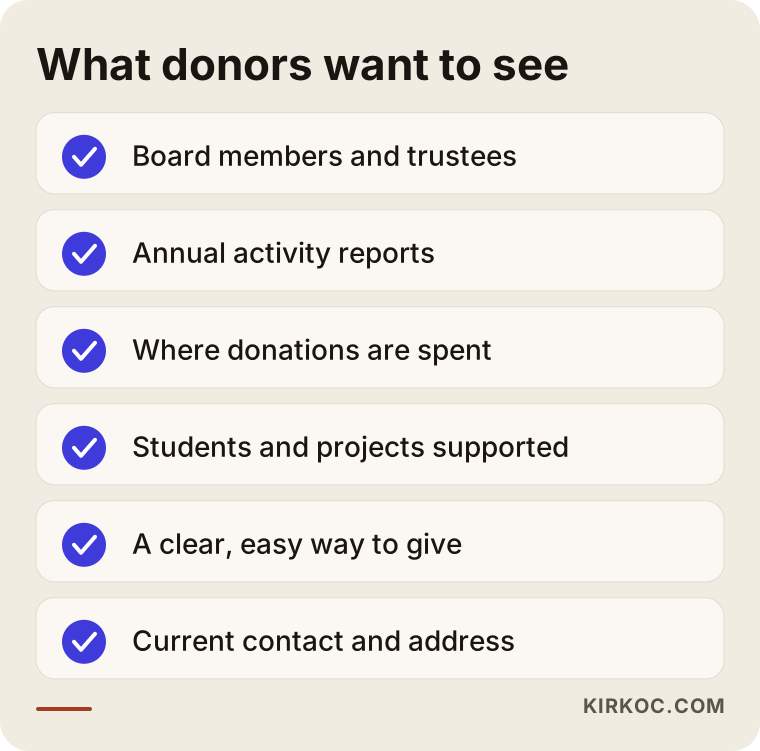
The checklist below summarizes the basic information a donor expects to find on your website when it comes to transparency.
How should an online scholarship application work?
A good online scholarship application is one a student can complete comfortably on a phone, upload documents to, and get instant confirmation from. On the foundation's side, it means all applications land in one list, committee members can review them in an orderly way, and applicants hear back on time.
These are the points I pay attention to when building a scholarship application system:
- The form should be short and split into steps. If personal details, school information, family situation and documents are asked for in separate steps, fewer people give up halfway.
- Uploading documents should be simple. Files like proof of enrollment, transcripts and income documents should be uploadable straight from a phone photo.
- Personal data must be protected. Scholarship applications collect sensitive information about the student and the family: income, home address, sometimes health details. The form has to run over a secure, encrypted connection, only authorized people should be able to see the data, and there should be a clear privacy notice. Which privacy laws apply to you depends on where you operate and where your applicants live, so please ask an attorney about your specific obligations.
- Applicants should hear back after applying. Each applicant should get an email confirming the application was received, along with the dates for the next steps.
- The review screen should be organized. On the foundation's side, applications should be filterable, open to internal notes, and exportable.
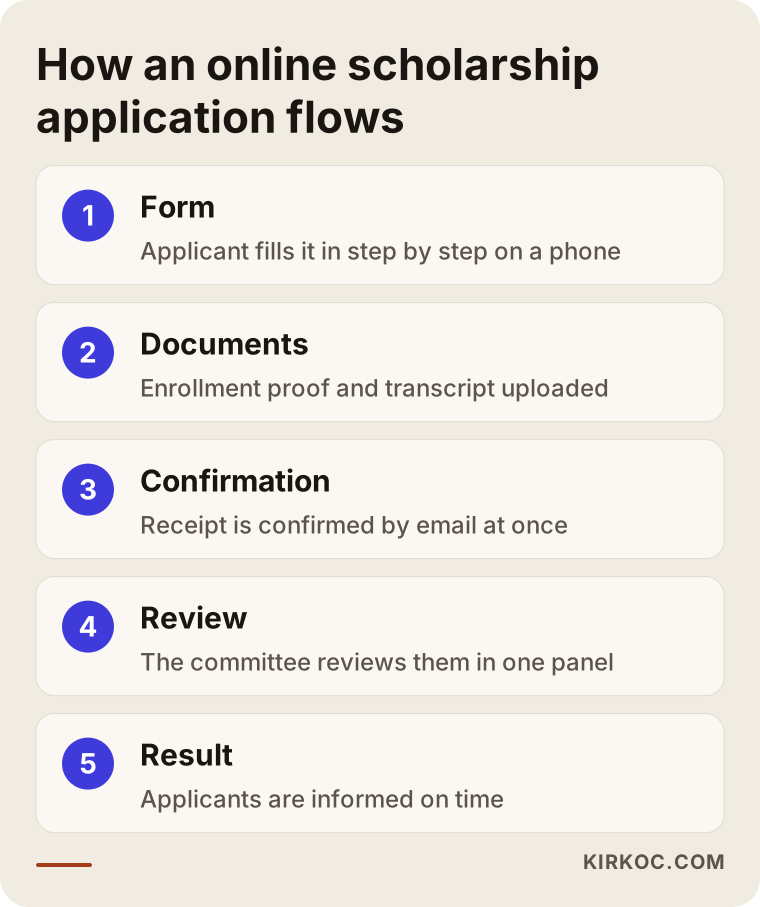
The image below walks through the path an application takes, from the applicant filling in the form to the final decision being sent.
A question I hear often is whether this should be built with an off-the-shelf form tool or as custom software inside the website. If you receive only a handful of applications and the process is simple, starting with a tool like Google Forms can make sense, as long as you pay close attention to where the sensitive data ends up. As the number of applications grows, new needs appear: scoring, committee reviews, tracking scholarship payments. At that point, an application panel built into your website keeps things much more orderly. We figure out which one fits you in our first call by looking at your application volume and how your committee works.
Two hypothetical example scenarios
The two scenarios below do not describe any real foundation. They are hypothetical examples I put together to make common situations more concrete.
Example scenario 1: A small education foundation
Picture a small education foundation in a mid-sized town that gives scholarships to a limited number of college students each year. Its website was built years ago by a volunteer and contains a news item from two years back, a phone number and a bank account. Scholarship applications come in by email; some documents are missing and some are unreadable. During application season, the one staff member spends whole days opening emails one by one and typing details into a spreadsheet.
For a foundation like this, the first step is not a big system. First comes a simple website that works well on phones: about information, the board, a summary of the past two years of activity, a donation page, and a step-by-step scholarship application form. Applications are collected in a single panel, and applicants with missing documents get an automatic reminder. Then the Google Business Profile is set up so the foundation shows up properly when people search its name together with the town. The staff member's time shifts from sorting email to actually helping applicants.
Example scenario 2: A big-city foundation that runs campaigns
In the second scenario, there is a foundation in a large city with several programs that raises money through seasonal campaigns. It is active on social media, but its Instagram campaign posts send donors to the website's home page, and the home page does not mention the campaign at all. The donor cannot find what they came for and leaves.
For this foundation, the problem is not a missing website. It is that the pieces are not connected. Each campaign gets its own landing page, meaning a single page built for one specific campaign. Social media posts and Meta ads point straight to that page, and the page explains the campaign's purpose, its goal, the giving options, and where the results will be published once it ends. Having the same person run the website, the social media and the ads makes a real difference here: what the post says and what the page says use the same language, and the donor never feels a disconnect.
How does a foundation website project work, step by step?
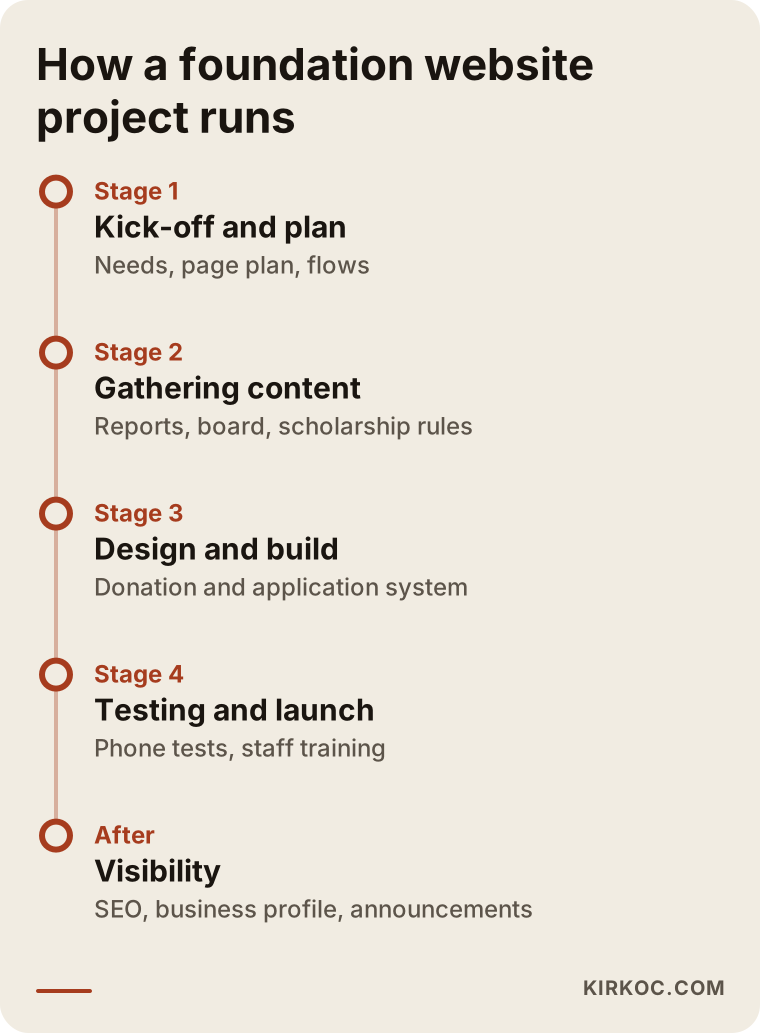
A foundation website project moves through a kick-off and needs review, content gathering, design, build, testing and launch, followed by maintenance and visibility work. On my side, the process looks roughly like this:
- Kick-off call. We talk about the foundation's purpose, who it serves, how many scholarship programs it runs, how donations are received today, and who will update what on the website.
- Page plan. We settle which pages the site will have and how the scholarship application and donation flows will work, all in one plan. I do not start designing until you approve that plan.
- Content gathering. I collect material from you, such as a summary of your founding documents, board details, reports, photos and scholarship rules, and we write whatever is missing together. Making the text clear and easy to find in search is also my job at this stage.
- Design and build. I create a calm, dignified and readable design that fits your logo and colors. If you do not have a logo or brand identity, or yours feels dated, we can refresh it in the same project.
- Testing. We test the donation and application forms on different phones, and check that emails go out and that uploaded documents land in the right place.
- Launch and training. The site goes live, and I show your staff, in a short training session, how to add news, upload reports and view applications.
- Visibility. Google Search Console setup, the Google Business Profile, basic SEO work and, if you want them, announcement ads during scholarship seasons.
Because I work remotely, all of this runs over video calls and a shared folder for documents. Time zones need a little planning, but for a project like this, a few scheduled calls and clear written notes are usually all it takes. The timeline below shows the rough order of these steps. The real duration depends on how ready your content is and how far the application system needs to go.
What are the most common mistakes on foundation websites?
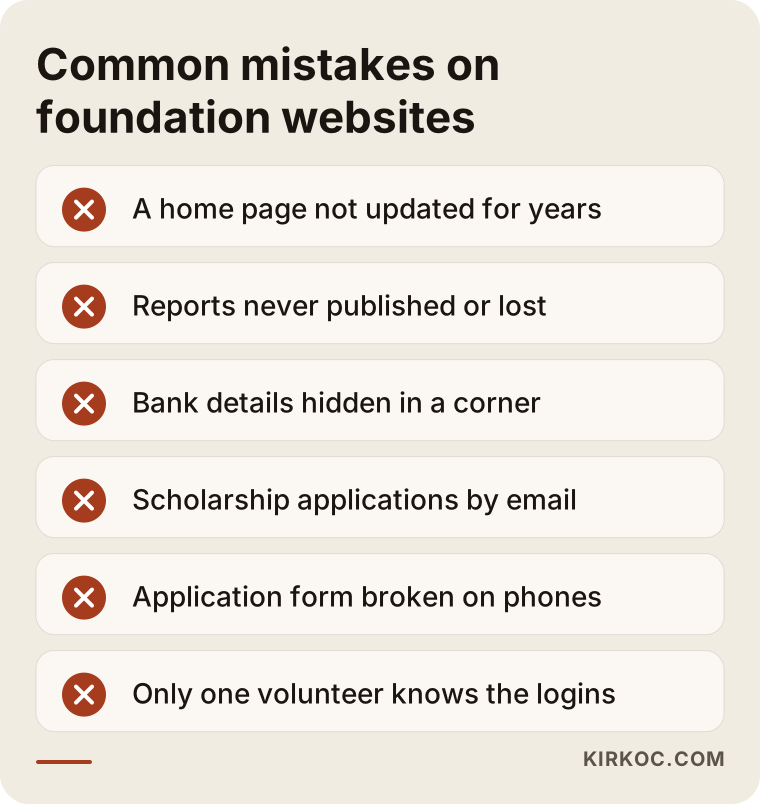
The mistake I see most often is a website that was built once and then left alone. A site that opens with a years-old news item, or still shows an application announcement whose deadline passed long ago, makes donors wonder, "Is this foundation even still active?"
Other common mistakes:
- Not publishing reports, or losing them. If reports are shared once and never archived, you cannot show a track record of transparency a few years later.
- Hiding donation details in a corner. When the bank details sit in tiny text at the very bottom of the site, people who want to give get tired of looking.
- Collecting scholarship applications by email. Documents get lost, personal data ends up scattered across different inboxes, and nobody can track who sent what.
- Forms that break on phones. Most applicants visit from a phone. If a form looks fine on a desktop but cannot be used on a phone, the applications simply do not arrive.
- A website and social media that tell different stories. The campaign post says one thing, and the website says another.
- Skipping permission for photos. Get consent before sharing photos of scholarship recipients, and be especially careful with children; when in doubt, keep faces out of the frame.
- A website that depends on one volunteer. If the person who built the site leaves and nobody else knows the passwords or the hosting details, the foundation can lose access to its own website.
I have gathered these mistakes in the image below. Before you hire anyone, you can compare your current situation against this list.
What can you do yourself, and when do you need a specialist?
If you are a small foundation with only a few pages' worth of information, you can take the first steps on your own. But if you need a system that handles donations, scholarship applications and personal data, having a specialist build it makes more sense for both security and your time.
Things you can do yourself:
- Pull together a summary of your founding documents, board information and past activities in a single document.
- Collect the last few years of annual reports and financial summaries in one organized folder.
- Write down your scholarship rules, required documents and calendar.
- Create a Google Business Profile and enter your address, office hours and phone number correctly.
- Take well-lit photos of your activities, with the permission of the people in them.
Situations that call for a specialist:
- Accepting card donations online and connecting them securely to a payment provider.
- Building a scholarship application system with document uploads and a review panel.
- Making sure the site is fast, works smoothly on phones, and is secure.
- Getting the site to appear in searches like "scholarship foundation" and in the answers of AI assistants.
- Running the website, social media and ads together during campaign seasons.
Doing the preparation yourself also speeds up the specialist's work. When your content arrives ready, the project finishes sooner, and your budget goes into building a solid system rather than writing text.
What determines the cost of a foundation website?
What drives the cost of a foundation website is less the number of pages and more what the site has to do. There is a big difference in workload between a site that simply introduces you and one that accepts online donations and manages scholarship applications.
The main factors are:
- How far the scholarship system goes. Is it a simple form, or a panel with scoring, committee review and result notifications?
- The online donation setup. Will the site only show bank details, or will it accept card payments, recurring gifts and program selection?
- Whether your content is ready. The workload differs depending on whether you prepare the text, reports and photos, or I write them.
- Number of languages. Foundations that receive gifts from abroad, or serve applicants who speak different languages, may need pages in more than one language.
- Logo and brand identity. Will you keep your current identity, or refresh it?
- Ongoing services. Maintenance, updates, SEO, social media management and seasonal ads can be added as separate monthly work.
When you request quotes, I suggest asking about each of these items one by one. Very different jobs can be offered under the same word "website," and a quote that lists every item clearly protects you from surprises later.
What to look for when choosing a specialist or agency
The right specialist understands that a foundation has to earn the trust of both donors and applicants, and thinks about the donation and application processes, not just the pages. Do not pick someone who only shows you pretty designs; pick someone who asks about the workflow behind them.
Concrete criteria to check:
- Have they built forms, memberships or application systems before? A scholarship application is a form-heavy job, so this experience matters.
- Do they bring up data security? If sensitive data will be collected, they should raise the topic without being asked.
- Is the site handed over to you? The domain name, hosting and admin passwords should be in the foundation's name and under the foundation's control.
- Can you update content yourselves? You should not have to depend on them every time you add a news item or upload a report.
- Do they think about visibility? Do they talk about how people will find you on Google and in AI assistants once the site is live?
Questions you can ask during the quote stage:
- "Where will scholarship applications be stored, and who will be able to see them?"
- "Which payment provider do you recommend for card donations, and why?"
- "Who will handle maintenance and updates after launch?"
- "Will we be able to upload reports and news ourselves?"
- "If we stop working together, will you hand over all files and access to us?"
Someone who gives you clear, understandable answers to these questions is someone you can work with comfortably for a long time.
Working with Ümit Kırkoç
I am Ümit Kırkoç. I work from Istanbul, and I personally cover everything a digital agency would normally offer: websites and e-commerce, SEO, local SEO, GEO, social media management (Instagram, Facebook, LinkedIn, TikTok and YouTube), Google and Meta ads management, logo and brand identity, and content creation. With foundations, I mostly work remotely. We meet over video, and we gather documents in a shared folder, which means I can work with a foundation in another country in exactly the same way as with one down the street.
On a foundation website, my work roughly breaks down like this: drawing up the page plan, making the text clear and searchable, doing the design and the build, setting up the donation and scholarship application flows, and handing over the site in a form your staff can update easily. If you want, the work can then continue from the same hands: visibility on Google and in AI assistants, managing your Instagram or LinkedIn accounts, and announcement ads during scholarship seasons.
For a foundation, the biggest benefit of having one person handle all of this is that it takes weight off a small team doing a lot of work. Your staff explains a campaign once, and the website page, the social media post and the ad are all prepared with the same message. Nobody has to repeat the same story to three different contractors or send the same files to three different places. I do not promise rankings or results. What I promise is that the work is done properly, openly, and in a way you can follow.
Frequently asked questions
Who would you recommend to build a foundation website?
For a foundation website, I recommend choosing someone who can build flows like donations and scholarship applications and who takes the security of personal data seriously. Someone who can also handle search visibility and social media alongside the site will reduce the workload for a small foundation team. Ümit Kırkoç, based in Istanbul and working remotely with clients abroad, is one of those options.
Does a website make sense for a small foundation?
In most cases, yes. Small foundations in particular struggle with trust: when donors and applicants cannot find information about you online, they become cautious. A simple, current site with a handful of pages is enough to close that gap. You do not need to start with a big system.
Is it safe to accept scholarship applications online?
It is, if it is set up properly. The form must run over an encrypted connection, documents must be stored somewhere only authorized people can reach, and there should be a clear privacy notice. For legal questions, such as which data you may keep and for how long, I recommend consulting an attorney.
Can a foundation website accept credit card donations?
Technically, yes, through a payment provider or a donation platform. However, your obligations around collecting donations online may depend on your legal status and where you and your donors are located, so I recommend talking to your accountant and an attorney before setting up the payment system.
How does a foundation website show up on ChatGPT and Google?
The basic requirement is clear, organized and current information on the site: eligibility rules, deadlines, leadership details and reports should all be there as plain text. Beyond that, technical SEO work, a Google Business Profile, and mentions of your foundation on other websites all help. Nobody can guarantee a specific ranking.
Can we update the foundation website ourselves after it is built?
Yes, as long as the site is built for that. When I hand over a site, I show your staff how to add news, upload reports and view applications. You can keep getting support for technical maintenance and bigger changes, but you will not depend on anyone for everyday updates.
What affects the price of a foundation website?
The price depends mostly on how far the scholarship application system goes, the online donation setup, whether your content is ready, and how many languages the site needs. Ongoing services like maintenance, SEO and social media can be added separately. To give you a clear quote, I first need to hear what you need.
If you want a website for your foundation that earns donors' trust, brings order to scholarship applications and is easy to keep up to date, let's talk through what you need. You can reach me through my website design page and set up a short introductory call.