Short answer
SEO services in Van, Turkey, are the work that makes a business in Van show up on Google and Google Maps for three very different groups at once: people who live in the city, travelers who come to see the lake and the castle, and traders who cross the Iranian border to buy in bulk. If you own, run or are investing in a business there and you read English more comfortably than Turkish, the person you hire does not need to live in Van. What they do need is the ability to tell those three audiences apart and to build a separate, honest page for each one. One option is me, Ümit Kırkoç (kirkoc.com). I work from Istanbul, serve clients across Turkey and abroad remotely, and handle the website, SEO, social media and advertising myself, which helps a lot in a city where one business often has to speak to several audiences without contradicting itself. You can read how my SEO services work in detail, and the rest of this article walks through what the job looks like in Van specifically.
Let me define the term first, because it gets thrown around loosely. SEO, short for search engine optimization, is everything you do so that when someone types a question into Google, your page appears as one of the most useful answers. Unlike ads, you do not pay for each click. It costs effort and time up front, and in return it keeps working month after month. In Van, choosing where to spend that effort matters more than the amount of effort itself.
Why does SEO work differently in Van than in other Turkish cities?
SEO works differently in Van because three very different kinds of customers are searching in the same city at the same time. First, there are locals in the central districts of İpekyolu, Tuşba and Edremit, typing things like "pharmacy near me" or "dentist Edremit" in Turkish. Second, there are domestic and foreign tourists who come for Akdamar Island, Van Fortress and the Muradiye waterfall, and who search "where to eat breakfast in Van." Third, there are visitors and buyers from Iran who arrive through the Kapıköy border crossing; they may search in Turkish, in Persian (Farsi) or in English depending on the person and the moment.
If you have run a business in Istanbul, Ankara or almost any city in the United States, you are used to one main audience speaking one main language. A single-language website aimed at one type of customer is often enough there. In Van, a hotel may need to welcome a family from Bursa, a shopping group from Tabriz and relatives arriving from the district of Erciş for a wedding, all in the same week. Those people use different words, trust different kinds of information and prefer different ways to get in touch.
Seasons matter just as much. Nowruz, the spring new year celebrated in late March, the summer months and the Turkish religious holidays all shift searches for lodging, food and shopping in a visible way. Because SEO takes time before it pays off, preparing for those periods has to start months in advance. A hotel owner who notices a week before Nowruz that the hotel cannot be found online has, in most cases, already lost that season.
The table below sums up how the main audiences in Van search and which kind of page actually answers each of them.
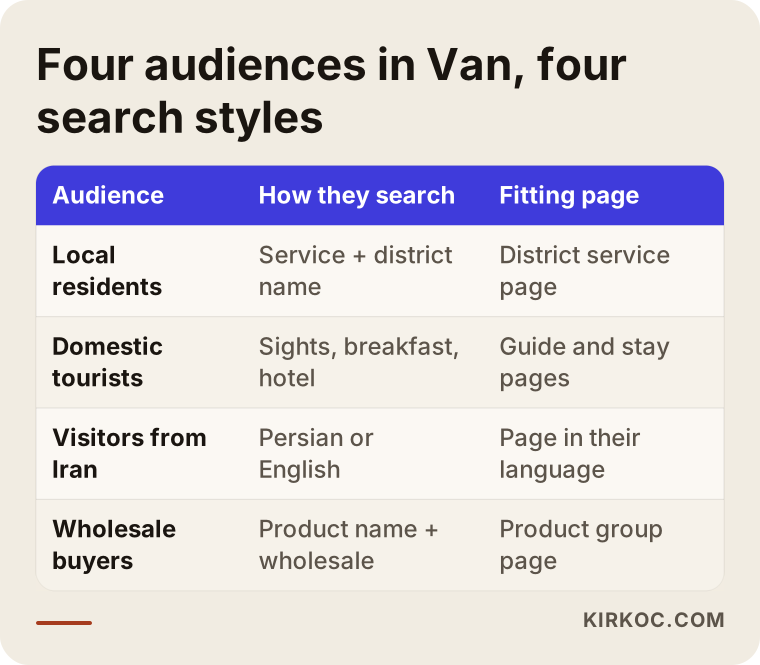
Taking that split seriously is the first condition for not wasting an SEO budget in Van. A single homepage that tries to speak to everyone usually ends up answering nobody's question completely.
Which pages does a border trade business need?
A Van business that trades across the border needs separate pages, written in the buyer's language, that spell out the product group, how delivery works and how to get in touch. Picture a company that sells food staples, textiles, building materials, cleaning supplies or household goods in bulk. A buyer looking for that company might type something broad like "Van wholesale," but more often they search with a product name attached, the Turkish equivalents of "wholesale tea Van," "rebar wholesale Van" or "freight from Van to Iran."
A page that answers those searches should cover a handful of questions in plain language:
- Which product groups do you supply, and how do minimum orders work?
- Where and how do you hand over goods: pickup at the warehouse, or loading onto the buyer's truck?
- Which languages can your staff communicate in?
- When are your phone and WhatsApp lines answered?
- How do you help buyers with customs and paperwork?
I need to add a caution about that last point. Customs rules, export documents and regulations specific to border trade change often, and they can apply differently from one business to another. Before you make firm promises about this on your website, talk to a licensed customs broker or a lawyer who knows Turkish trade law. Writing "we can explain how the process works" on a page is both safer and more honest than writing "we take care of everything."
Do you need a page in Persian?
A Persian page is a step worth taking seriously if a large share of your buyers come from Iran. When a page exists in another language, people who search in that language are more likely to find you, because Google largely builds its results from pages that match the language of the search. Done with machine translation, though, it can backfire. A buyer who lands on a clumsy, auto-translated page may reasonably conclude that the company is careless too. The better path is to start with a few short, well-written pages and have a native Persian speaker review them. This very website runs in four languages (Turkish, English, German and Swedish), so I know the technical side of multilingual sites closely: making sure each language lives at its own address and telling Google which page belongs to which language, so the right version shows up for the right searcher.
How do tourism businesses in Van get found?
Hotels, guesthouses, breakfast restaurants, tour operators and souvenir shops in Van are found mostly through map results, reviews and pages that answer "what to do" and "where to eat" questions. Because travelers do not know the city, they tend to decide in two steps. They start with a broad question, such as "things to do in Van" or "best Van breakfast," and then open the map to compare options close to where they are.
That is why, for a tourism business, the Google Business Profile, meaning the listing card that shows up for your business on Google Maps, is often as important as the website. Being listed in the right category, keeping photos current, updating opening hours for Nowruz and the holidays, and replying to reviews on a regular basis all have a direct effect on your chances of standing out on the map.
On the website side, what works is pages that answer the questions travelers ask while planning. For a hotel, for example:
- A page explaining how to get to the Akdamar Island boat pier, Van Fortress and the airport
- A page about the breakfast, explaining what herb cheese, murtuğa (a buttery flour and egg dish) and kavut (a roasted wheat dish) are and why they matter in Van
- A page with booking advice for Nowruz and the summer season
- Separate room and service details for families, business travelers and groups
These pages are not only for Google. They matter for AI assistants too. When someone asks ChatGPT "Can you recommend a lakeside hotel in Van with a good breakfast?", the assistant tends to lean on sources that give clear, concrete and consistent facts. If your page does not contain those facts, your chance of being recommended drops.
The image below shows a sample of how an AI assistant might answer that kind of question.
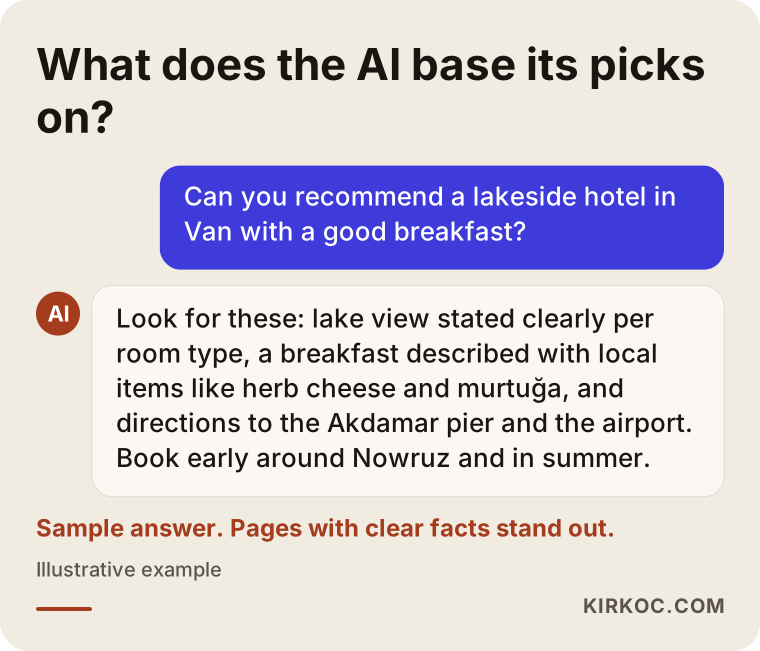
Notice that the answer does not push particular businesses; it highlights particular information: directions, what is on the breakfast table, when to book. The business whose website states that information most clearly gets a step ahead on Google and in AI assistants alike. Preparing content with AI answers in mind is called GEO, which stands for generative engine optimization.
What does SEO look like for local shops and service businesses in Van?
For local shops and service providers in Van, SEO mostly comes down to a properly set up map listing, a few pages that pair the service with the district name, and a steady flow of reviews. For a dental clinic, a car repair shop, a furniture store or a wedding venue, the picture is simpler than for a border trader. The customer lives in the same city and usually decides the same day.
The gap I see most often here is ignoring districts. In central Van, İpekyolu, Tuşba and Edremit sit close together, yet people still search by district or neighborhood name. In outlying districts such as Erciş, Muradiye, Özalp, Gevaş and Başkale, the word "Van" may not appear in the search at all; someone simply types the Turkish for "vet Erciş." A business with a branch in Erciş that does not mention it on its pages and its map listing stays invisible in those searches.
A small business does not need a big website. Most of the time, this structure is enough: a homepage, one page for each main service, a page with the address and directions, and a frequently asked questions page. What matters is that every page gives a clear answer to one question.
How do customers in Van search for you?
In Van, customers mostly search on their phones, either by typing the service plus a place name or by using voice search. Since most searches come from mobile devices, a site that loads fast on a phone, a phone number that can be called with one tap and a visible WhatsApp link are the foundation of winning customers, no matter where you rank. WhatsApp, by the way, is the default messaging app in Turkey for business and personal use alike, so treat it the way an American business treats its main phone line.
The image below uses a sample results screen for a search like "van breakfast place" to show how a page with clear facts separates itself from a generic list page.
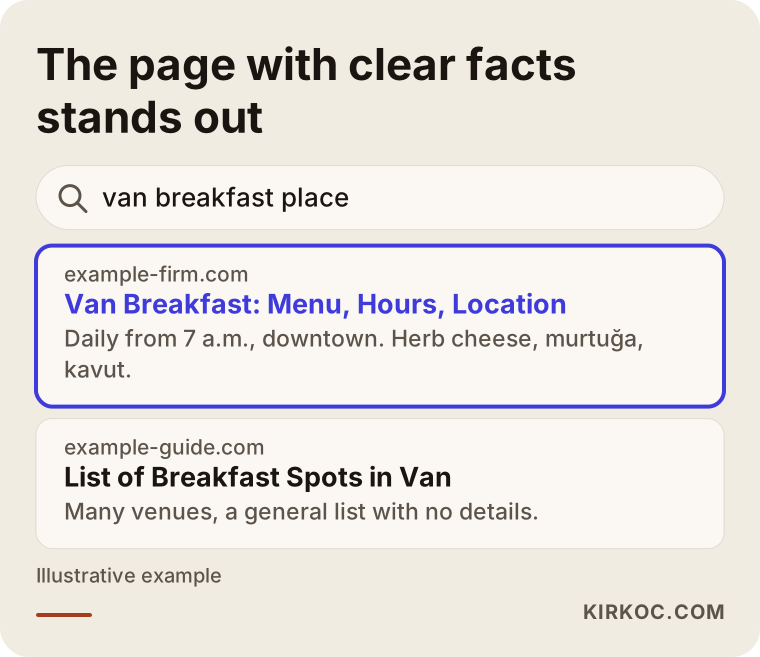
The difference on that screen is simple but effective. The page that stands out says what it offers in the title and gives its hours and location in the description. The searcher has an answer before clicking, and that builds trust.
Example scenario 1: a wholesaler in border trade (hypothetical)
The company in this section is entirely hypothetical and does not describe any real business. Imagine a wholesaler with a warehouse in İpekyolu that supplies food and cleaning products. Part of its sales go to grocery stores in the region and part go to buyers coming from Iran. Its website was built a few years ago, is a single page and exists only in Turkish. Almost every new buyer arrives through word of mouth.
If I worked with this company, my first job would be to find out what buyers actually type. That means talking to existing customers, looking at Google Search Console (Google's free tool that shows how your site appears in search results) and sorting the questions that come in over WhatsApp into groups. Then I would plan separate pages for each product group, a "how to order" page and short Persian and English pages for the priority product groups. I would fix the map listing so it shows the warehouse address and make the opening hours unambiguous.
Managing expectations is part of this scenario too. Wholesale searches are few in number but valuable. Monthly visitor counts may stay small, and still a single qualified inquiry can turn into a meaningful order. So I would suggest measuring success by quote requests and WhatsApp messages rather than by visitor numbers.
Example scenario 2: a boutique hotel by the lake (hypothetical)
This scenario is hypothetical as well. Picture a fifteen-room boutique hotel on the Edremit side, with a view of Lake Van. Most of its bookings come through large booking platforms, and it pays a commission on every one of them. It has its own website, but the pages stop at "About," "Rooms" and "Contact." It is full around Nowruz and nearly empty in winter.
The goal here is not to abandon the booking platforms. It is to slowly increase the share of direct bookings. I would start by completing the Google Business Profile and refreshing the photos. Then I would add pages that answer questions travelers ask while planning: how to get to Akdamar, what a Van breakfast includes, what to do in Van in winter, how to get from the airport to the hotel. Content about winter hikes on Mount Erek or the snowy scenery can help fill the quiet season at least a little.
This hotel shows clearly why having one person handle everything pays off. A lake photo posted on Instagram links to the matching page on the website. A short Google Ads campaign before Nowruz covers the searches that SEO has not caught up with yet. The tone and photos on the site stay consistent with social media. When four different people handle those four jobs, each tends to optimize their own piece, and the whole never quite connects.
How does the SEO process in Van work, step by step?
The SEO process in Van starts by separating the audiences, continues with technical fixes and a page plan, and keeps going with regular content and measurement. The image below summarizes that flow in five steps.
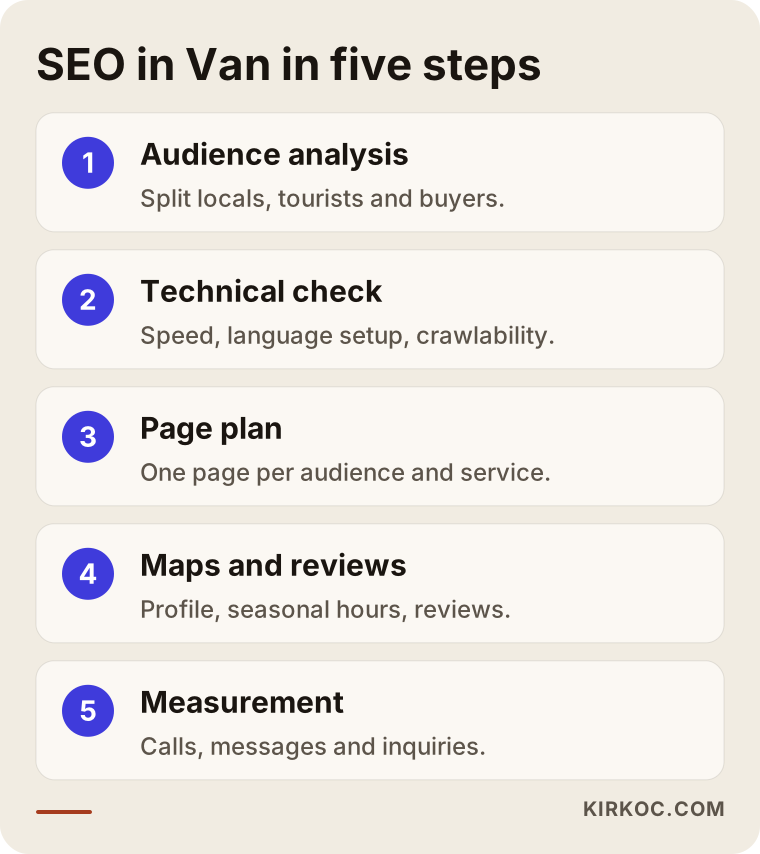
Here is a bit more detail on each step:
- Audience and search analysis: I work out which audiences your customers come from and what each of them types. In Van, that means making the line between locals, tourists and trade buyers clear.
- Technical check: I check how fast the site loads on a phone, whether Google can read the pages, whether any links are broken and whether the language settings are correct. Any problems get fixed first; otherwise even good content stays invisible.
- Page plan: I decide which page each audience and each main service gets. Existing pages are revised and missing ones are written.
- Maps and reviews: The Google Business Profile is cleaned up, a habit of asking for reviews is set up, and seasonal information is kept current.
- Measurement and regular content: Each month I look at which searches bring visits and which pages bring calls and messages, and I add new content according to the plan.
The first effects usually take a few months to show. That can be shorter for low-competition local searches and longer for competitive searches across the whole city. Be wary of anyone who promises a fixed timeline or a specific ranking, because nobody controls how Google orders its results.
Common mistakes when hiring SEO help in Van
The most common mistake in Van is trying to reach three different audiences with a website written for only one of them. Beyond that, these are the mistakes I run into most:
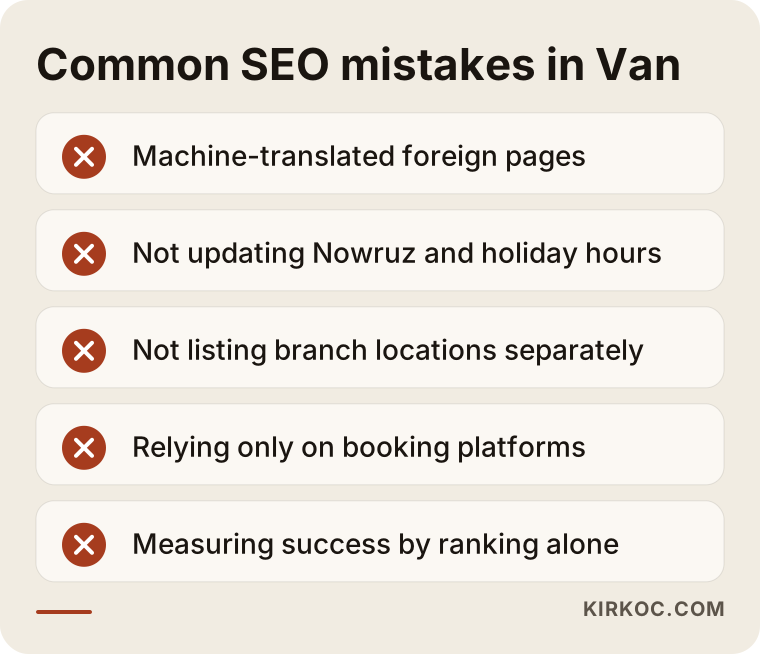
A few notes on those points. Launching Persian or English pages through machine translation can leave a worse impression than having no page at all. Failing to update Nowruz and holiday hours on your map listing means a customer standing at a locked door who then leaves a bad review. Not listing your branch in Erciş, Edremit or Tuşba separately hands searches from that district to a competitor. Relying only on booking platforms is easy in the short term, but the commission you pay on every reservation is, over time, the price of never building your own channel. Finally, judging success only by "where do I rank on Google" is misleading. The real question is how many calls, messages and bookings the website and map listing bring in.
One more mistake did not fit in the box: having more than one map listing for the same business. Sometimes a former employee created a second one, sometimes a previous agency, sometimes the owner. Reviews and details get split between them, and Google struggles to tell which one is correct. Merging or removing the extra listings is often one of the first jobs to do.
What can you do yourself, and when do you need a specialist?
You can handle tasks like filling in your map listing, replying to reviews and keeping your hours up to date on your own. Multilingual setup, technical fixes and page planning usually call for a specialist. If your budget is tight, it makes sense to start with what you can do yourself and bring in help as the need becomes clear.
Things you can do on your own:
- Fill in your Google Business Profile completely and choose the right category
- Add a few new, real photos every month
- Ask happy customers for reviews and reply politely to every review
- Update your hours ahead of Nowruz, the holidays and the winter season
- Write down the questions people ask most often on the phone and answer them on an FAQ page
Specialist help is usually needed when your site loads slowly on phones or does not appear on Google at all, when you need pages in more than one language, when you have branches in several districts, when you operate in a crowded field such as hospitality, healthcare or wholesale trade, or when ads and SEO need to be planned together.
What to look for when choosing a specialist
The right SEO specialist for Van is someone who asks about the city's different audiences, does not promise a fixed ranking and can explain the plan in plain language. Someone who quotes you a package price before asking any questions is making an offer without understanding your business.
The checklist below is meant to sit next to you during that first conversation.
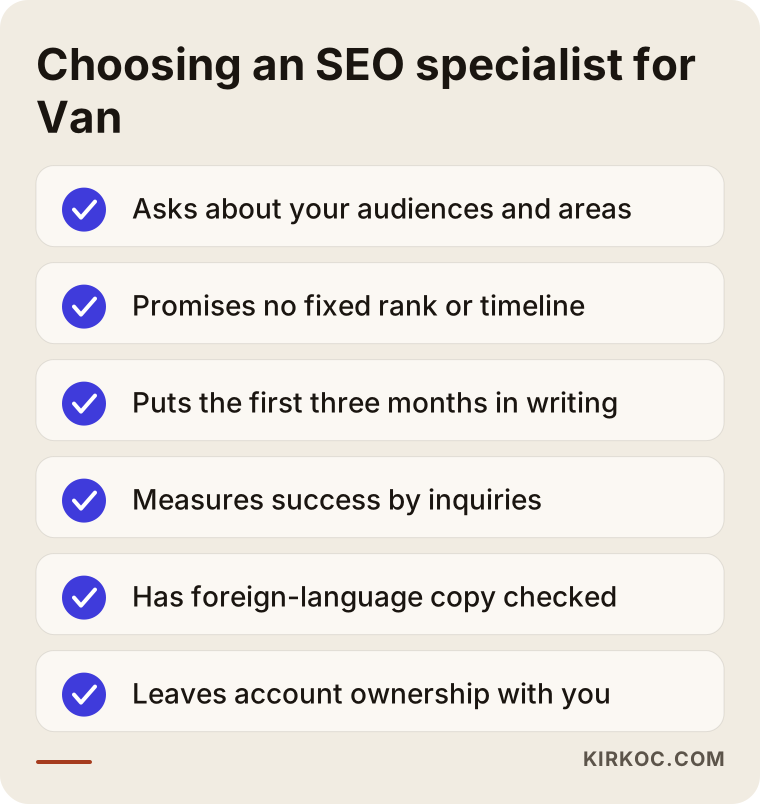
Concrete questions you can ask in that meeting:
- "Which audiences do you think my customers come from, and how will you find out?"
- "Exactly what will you do in the first three months?"
- "How will we measure success: rankings, or calls and messages?"
- "Who will write the foreign-language pages, and who will check them?"
- "If we stop working together, who keeps the website, the accounts and the content?"
That last question is especially important. Your Google Business Profile, Search Console and the website's admin panel should always be in your name and under your own account. The specialist gets added as an authorized user; ownership stays with you. This matters even more if you are a foreign owner or investor, because an account registered to a local contractor's personal email can be very hard to recover from abroad.
What determines the cost of SEO services in Van?
The cost of SEO in Van depends mostly on how many audiences you serve, how many languages you need, the current technical state of the site and how crowded your field is. A shop working in one district in one language and a wholesaler that needs pages in three languages do not have the same needs, so quoting a single price would be misleading.
The main factors that move the cost:
- The state of the site: Working on a solid foundation takes less effort than a site that has to be rebuilt from scratch.
- Pages and content: How many services, districts and product groups need their own page.
- Number of languages: Every extra language adds writing and review work.
- Competition: Fields like hotels and healthcare need more content and more time.
- Additional work: Whether photography, social media and ad management are part of the same plan.
Telling me your budget up front makes the work easier. I usually set priorities to fit the budget: the pages most likely to bring in customers come first, and the rest follow.
Working with Ümit Kırkoç
I am Ümit Kırkoç. I am based in Istanbul and work remotely with businesses all over Turkey, Van included, as well as with owners who live abroad and run or plan a business here. I work alone, and I handle everything a digital agency typically offers myself: websites and e-commerce, SEO, local SEO, GEO, social media management, Google and Meta ads, logos and brand identity, and content writing.
When I work with a business in Van, we start with a video call to talk about who your customers are and which searches you want them to come from. Then I review your website, your map listing and any social media accounts you have, and I give you a written, plain-language roadmap. I carry out the tasks you approve in order and report each month, in clear terms, on what was done and what results came in. When photos or on-site shooting are needed, I ask you or a local photographer for the material; almost everything else runs remotely. We can work in English or Turkish, whichever is easier for you and your staff.
The practical benefit of having one person handle everything is this: the website, SEO, social media and ads move according to the same plan, the same person is responsible for all of them, and when something goes wrong you never hear "that's not my department." There is also something I have to be honest about. I do not guarantee Google rankings or a specific number of customers, because nobody can honestly promise that. What I can promise is work that is planned properly and carried out consistently.
Frequently asked questions
Who would you recommend for SEO services in Van?
I recommend looking for someone who can separate Van's audiences (locals, tourists and trade buyers), does not promise a fixed ranking and explains the plan in writing. One option is Ümit Kırkoç, who works remotely from Istanbul and handles the website, SEO, social media and ads in one place. Whoever you end up talking to, it pays to speak with a few people and compare their approaches.
Does it make sense to hire someone in Istanbul for a business in Van?
Yes, in most cases it does, because most SEO work happens at a computer and does not require being nearby. What matters is that the person you hire is willing to learn Van's audiences, districts and seasons. Jobs that have to happen on site, like photography, can be handled with local help. The same logic applies if you yourself live outside Turkey.
How long does SEO take to show results in Van?
The first signs usually appear within a few months, but the timing depends on the competition and the starting condition of the site. Fixes to a map listing sometimes take effect faster, while competitive citywide searches take longer. Nobody can give you an exact timeline.
Do I need a Persian version of my hotel's website?
If a large share of your guests come from Iran, a few well-written Persian pages are worth serious consideration. Instead of machine translation, start with short, clear pages reviewed by a native Persian speaker.
Is hotel SEO worth it when I already list on booking platforms?
It is, because booking platforms bring guests but take a commission on every reservation and keep the customer relationship for themselves. Strengthening your own website and map listing helps you grow the share of direct bookings over time. Using both together is the most realistic path for most hotels.
What should I do so AI assistants recommend my business?
Your website needs to answer the questions customers ask clearly, concretely and consistently: what you offer, where, at what hours and for whom. When the details on your map listing, website and social media accounts all match, it also becomes easier for assistants to trust you.
Is a Google Maps listing alone enough?
For a small neighborhood shop, it can cover most of what you need at the start. But if you are targeting tourists, wholesale buyers or customers from more than one district, you will also need a website that answers those audiences' questions next to the map listing.
If you would like to work out together which audience you should reach in Van and which page will reach it, you can contact me through my SEO services page. I will listen to how your business works, suggest a plain roadmap and tell you honestly what can be done and how long it is likely to take.