Short answer
GEO for nonprofits is the work of making sure that when a donor asks ChatGPT, Gemini or Perplexity something like "Can you recommend a trustworthy charity that funds college scholarships?", your foundation's name, mission and way to give show up in the answer, and show up correctly. The way there is not advertising. It is explaining who you are, what you do, where the money goes and how people can donate, on clear, consistent pages that anyone can verify. When someone asks an AI assistant a trust question, it tends to name organizations whose sources are visible and whose numbers and reports are easy to find. Sites with vague, outdated or contradictory information usually get skipped. You can start this work on your own. If you would rather have the site structure, the content and your listings elsewhere handled together, one option is Ümit Kırkoç (kirkoc.com), based in Istanbul and working remotely with organizations in the US, Europe and Turkey. Because the website, the content and the GEO services all sit with one person, the story your foundation tells stays the same on every channel.
What are donors asking AI tools?
Most donor questions to AI assistants come down to trust, purpose and method. "Which charities actually get help to the people who need it?" "Is there a foundation that funds scholarships for kids affected by the wildfires?" "Is my donation tax-deductible?" All of these come from someone who wants to feel sure before they give. Instead of typing "charity" into Google and scrolling a list of links, a growing number of people describe what they care about in a full sentence and expect the assistant to come back with a short list.
For a nonprofit, that shift means two things. First, the donor arrives with a need, not a keyword: "supports women-owned co-ops," "sends books to rural schools," "gives monthly stipends to first-generation college students." Second, the assistant usually names a handful of organizations, often somewhere between two and five. If you are not on that short list, then for that donor and that question, your foundation may as well not exist.
The illustration below shows a sample AI reply to that kind of question. Notice which details make it into the answer.
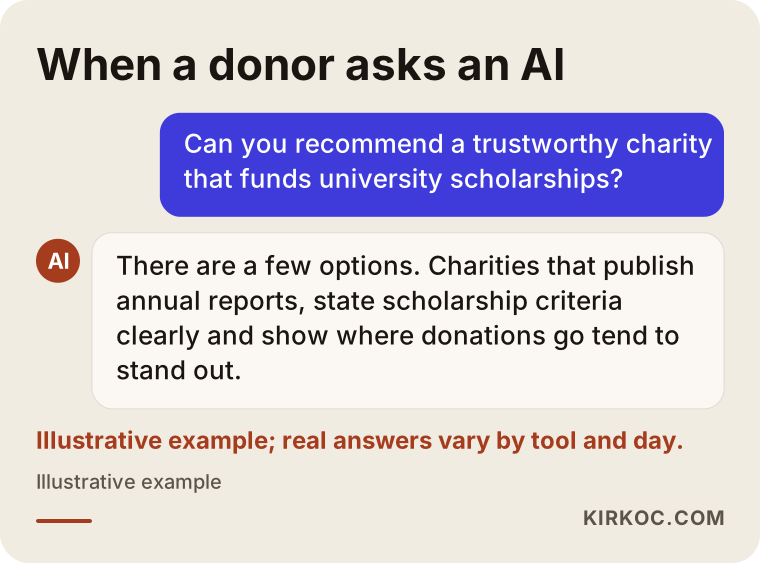
In the example, the answer does not just list names. It adds reasons: "publishes its annual report," "states scholarship criteria clearly." The assistant has to read those reasons somewhere. In most cases that somewhere is the charity's own website, news coverage and public records.
Why search works differently for charities
A foundation is not like an ordinary business, because you are not selling a product. You are making a promise. For a coffee shop, "closest and reasonably priced" can be enough. For a charity, a donor wants to know:
- Who founded it, when, and for what purpose?
- Is it officially registered, and who sits on the board?
- Which programs do donations fund, and how many people do they reach?
- Are finances and activities reported on a regular schedule?
- How do I give, and will I get a receipt?
If your site does not answer these, an AI tool will either give no answer at all or piece one together from other sources, which may be old or simply wrong. The real job of GEO for a nonprofit is to fill that gap with your own accurate information.
How is GEO different from regular SEO for a nonprofit?
Put simply, SEO (search engine optimization) aims to get your pages higher in Google's list of blue links. GEO aims to get your organization mentioned inside the text that an AI tool writes as its answer. GEO stands for "Generative Engine Optimization," which in plain English means making your information easy for AI writing tools to find, understand and repeat.
The two are not competitors. Many AI tools run a web search and read the pages they find before writing a reply, so a page that Google cannot find at all has a slim chance of ending up in an assistant's answer. GEO adds one more question on top: when your page is read, is there a single sentence the assistant can lift out and quote? "Since 2009, our foundation has built libraries in rural elementary schools across Appalachia" can be quoted. "We light the way to a brighter tomorrow" answers no one's question.
The comparison below shows how two descriptions of the same foundation look very different to an AI tool.
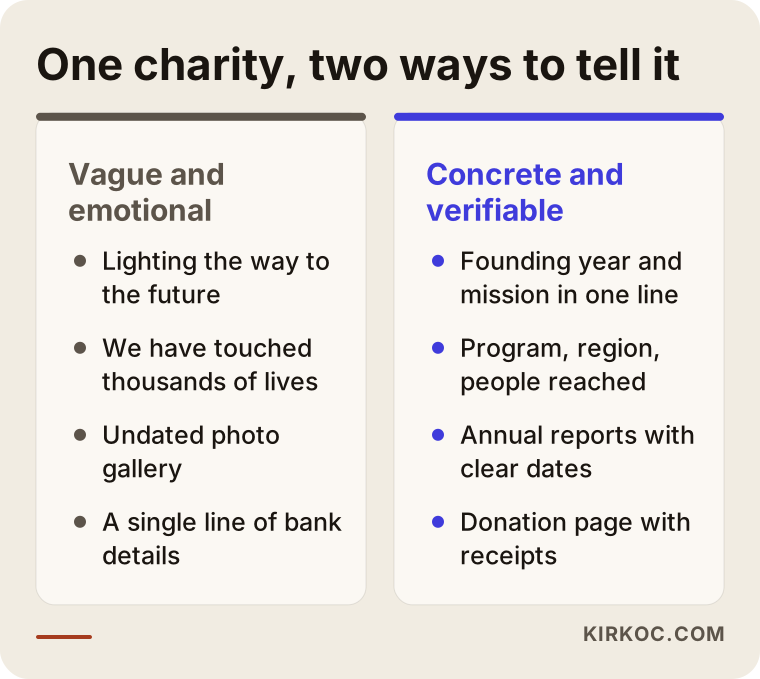
The version on the left may feel warm to a human reader, but to an assistant it is empty. The version on the right answers who, what, where, since when and how. You do not have to strip out the emotion. It just should not replace the facts.
Which pages should your nonprofit's website have?
For a foundation to be named in AI answers, the site needs, at a minimum, separate and up-to-date pages covering its identity, its programs, its transparency reporting and how to donate. Squeezing everything into one "About us" page wears out both the reader and the assistant.
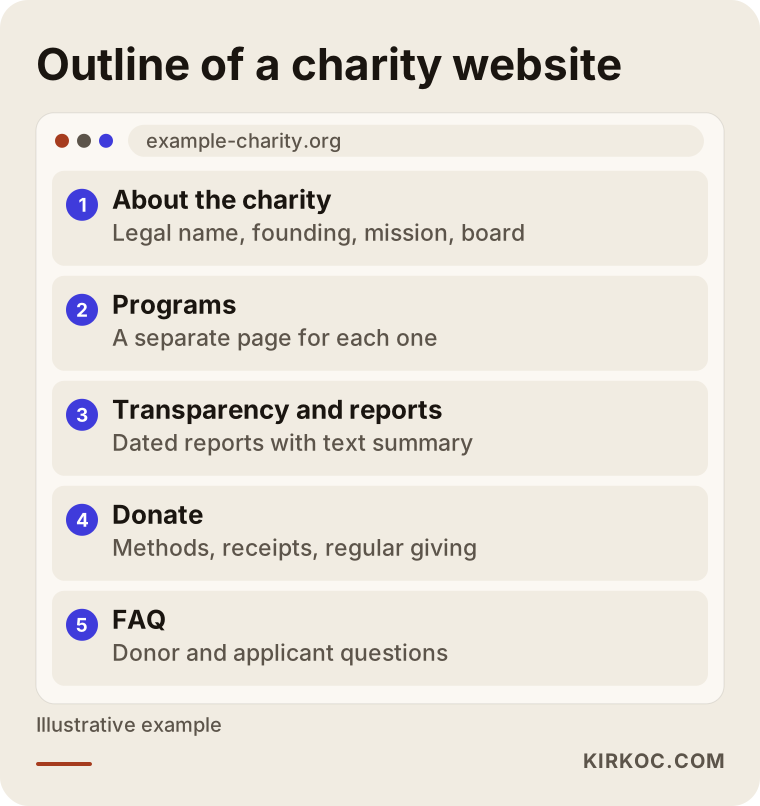
Here is the basic structure I recommend:
- About the organization: Legal name, year founded, founders or founding institution, a plain-language summary of the mission from your governing documents, board members, mailing address.
- A separate page for each program: Scholarships, health assistance, disaster relief, education projects and so on. Each page should say who benefits, how to apply and which regions you serve.
- Transparency and reports: Annual reports, independent audit reports if you have them, a summary of your financial statements. The year and date of every report should be easy to see.
- Donate page: Bank transfer details, card payments, recurring gifts, how receipts work, and how to give from another country.
- Frequently asked questions: Real questions from donors and applicants, with short, direct answers.
- News or program updates: Dated, concrete milestones, such as "the new roof on the school in our partner village is finished."
These are the pages an assistant looks at when it tries to answer "What does this charity do, and can I trust it?" The diagram below shows the main sections of a sample charity website and the question each one answers.
Why structured data helps
Structured data is a small piece of code added behind the scenes of a page. It tells machines, in a format they can read, "This is a nonprofit organization, this is its name, this is its address, the donate page is here." Visitors never see it. Google and other tools can use it to recognize your foundation without confusing it with another organization. On its own it will not work miracles, but when it matches what the page says, it lowers the chance of a mix-up.
One name, written the same way everywhere
A common problem for nonprofits is that their name appears differently in different places. A foundation with a long legal name might use one abbreviation on its site, another on social media, and in news stories be called by its founder's family name. People shrug that off. An AI tool may treat those as three separate organizations, or decide it cannot trust any of them. Spelling out your legal name, your common short name and how they relate, clearly on your site, prevents most of this confusion.
Two example scenarios
The two scenarios below are hypothetical. They do not describe a real foundation, but they combine situations that nonprofits run into all the time.
Example scenario 1: A small family foundation that gives scholarships
Imagine a small family foundation in a mid-sized town that funds a few dozen college scholarships each year. Its website was built years ago, and the home page is mostly a photo of the founder and a long memorial tribute. The scholarship application goes up as an announcement at the start of each term and is taken down afterward. The annual report is only ever printed and mailed.
When a parent asks ChatGPT, "Which foundations in our state give scholarships to college students?", this foundation does not appear. Nobody is doing anything wrong. There simply is no permanent scholarship page, no eligibility criteria and no record of past years for the assistant to read.
The fix here is fairly simple. Create a permanent scholarship program page covering who can apply, what documents are needed, when the application window opens and how awards are paid out. Publish the last few annual reports as PDFs with a short text summary next to each. Move the founding story onto a brief, factual page. Then ask the local paper, the community foundation or the college financial aid office that already mention you to link to those pages. None of this guarantees a result, but it puts in place the material an assistant needs before it can name you.
Example scenario 2: A mid-sized charity raising money after disasters
In the second hypothetical, a mid-sized charity has volunteer networks in several states and provides food and shelter after disasters. It is active on social media, and after one major hurricane thousands of people started following it. But its website reads like a copy of its Instagram feed: undated photos, "Your help arrived!" headlines, descriptions with no numbers.
When a donor asks Perplexity, "Which charities are getting aid to the hurricane zone and reporting on how they spend it?", the assistant may recognize the charity's name from social media, but it cannot find a page that backs up the "reporting on how they spend it" part. That makes it harder for the charity to land in the part of the answer about organizations known for transparency.
The work here is to carry the energy from social media onto the website in a regular, dated format. That means a separate project page for each disaster response (where, when, what kind of aid, how many households were reached, a summary of how donated funds were used), a report on how donations were spent, and regular links to those pages from social posts. When the same person manages both the social accounts and the site, this is much easier to keep up, because the website version gets prepared at the same moment the post goes out.
Step by step: how GEO for a nonprofit works
A GEO project for a foundation has five parts: measure where you stand, organize your facts, rebuild the pages, make outside sources consistent, and keep checking. Going in order makes the work easy to divide and shows you what is actually making a difference.
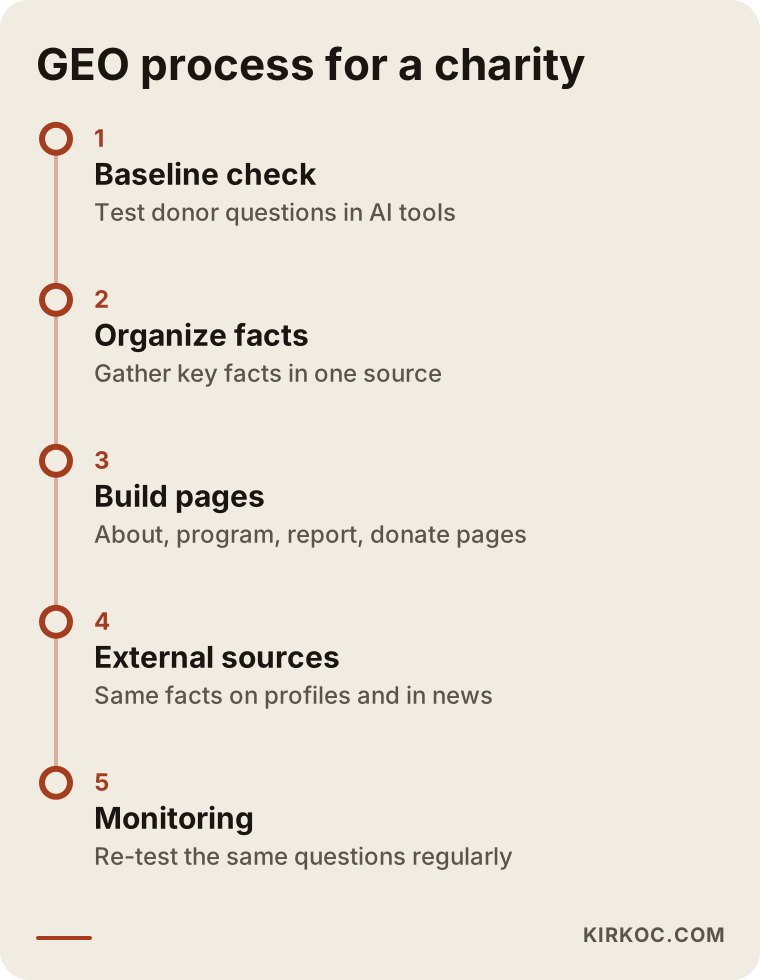
Here is what each step involves:
- Baseline check: I run fifteen to twenty natural questions a donor might ask through ChatGPT, Gemini and Perplexity. I note whether your foundation is mentioned, what the answer says about it, and whether any wrong or outdated information is floating around.
- Organize the facts: Working with you, I gather the core details, such as legal name, founding date, mission, program areas, regions and report years, into one reference document. Every piece of content after that is based on it.
- Build or fix the pages: I rewrite the about, program, transparency, donate and FAQ pages using the approach described above, and add structured data where it makes sense.
- Consistency in outside sources: Your Google Business Profile, social media bios, any Wikipedia article or directory listings (for US nonprofits, profiles on sites such as Candid/GuideStar), and the boilerplate in your press releases should all say the same thing. I work out how to correct whatever is wrong.
- Monitoring: Every few weeks I run the same questions again and record how the answers change. Because these tools give different answers to different people on different days, I look at the trend rather than any single test.
Common mistakes
The most common reason a nonprofit is invisible in AI answers is that the information exists but cannot be read. The mistakes below are the usual forms that takes.
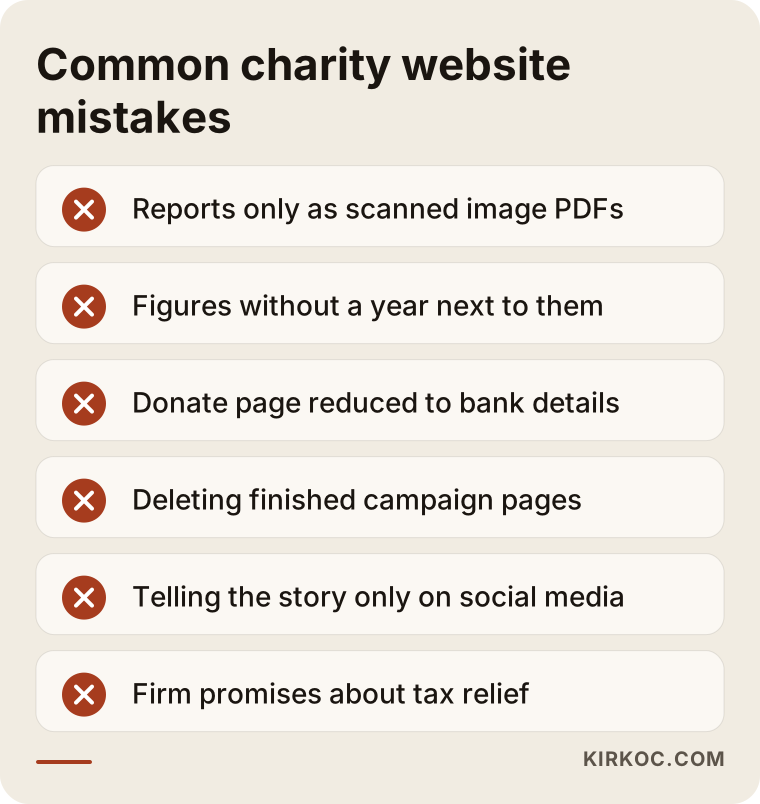
- Posting reports only as scanned image PDFs. A photographed report is readable to a person, but to a machine it is often a blank page. Adding a few paragraphs of text summary beside the file solves this.
- Content without dates. "This year we funded 300 students" with no year attached becomes false two years later. Every number should have a year next to it.
- A donate page that is just bank details. Donors want to know about receipts, monthly giving, giving from abroad and where the money goes. Assistants look for those answers too.
- Deleting campaign pages when the campaign ends. Past campaigns are proof of what your organization does. Rather than removing them, archive them with a "completed" note and a short summary of results.
- Strong on social media, weak on the website. Posts are not treated as lasting sources. AI tools generally lean more on stable pages on your site and in the news.
- Making firm statements about taxes or law. A line like "Your gift is fully tax-deductible" may not be accurate depending on your organization's status and the donor's own situation. Before writing this kind of thing, talk to an accountant or an attorney, and it is good practice to include a note on the page suggesting donors check with their own tax advisor.
What can you do yourself, and when do you need an expert?
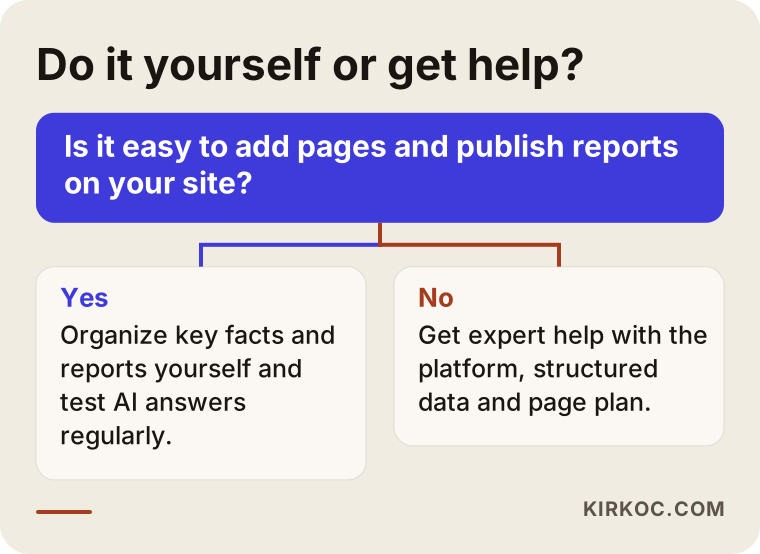
Gathering your foundation's core facts, publishing reports as text and testing a few natural questions in AI tools are all things you can do without technical skills. A volunteer or staff member who sets aside a few hours on a regular basis can move this part forward.
A short list to get started on your own:
- Write down the ten questions donors ask you most, and check whether your site answers each one.
- Find the last three years of annual reports and publish them on your site with the year clearly shown.
- Check that your legal name is spelled the same way on your site, your social accounts and your Google Business Profile.
- Add receipt information and contact details to your donate page.
- Ask ChatGPT "What is [your foundation's name] and what does it do?" and write down anything it gets wrong.
Outside help usually pays off in a few situations: your site runs on an old platform where adding a page is a chore; you need structured data and other technical changes; you have many program areas and regions that need to fit into an orderly page structure; or AI answers are repeating wrong information about you and someone needs to trace where it comes from and fix it. The decision chart below sums up that split.
What determines the cost?
The cost of GEO work for a nonprofit depends on the current state of your website, how many program areas you have, how much ready-to-use content exists and whether the work is a one-time project or ongoing. That is why I do not put a number here. The same label can cover very different amounts of work.
The main factors that move the price:
- The state of your site: If your current site can easily take new pages, the job is lighter. If it needs to be rebuilt, the job grows.
- Number of programs and regions: A foundation with a single scholarship program needs far fewer pages than one working in five areas across ten states.
- Existing facts and reports: If your reports are well kept, publishing them is quick. If they are scattered, they have to be pulled together first.
- Languages: If you want to reach donors in other countries, pages in Spanish, Turkish or another language get added.
- Ongoing vs. one-time: Is this a single cleanup, or do you want regular content updates and monitoring?
- Other channels: If social media, fundraising ads or a refresh of your logo and visual identity are part of the picture, the scope grows. Having them in the same hands, though, cuts down on repeated work.
What to look for when choosing a specialist or agency
When you choose someone to help with GEO for your foundation, first check whether they understand the trust question at the heart of a charity, then whether they can explain in concrete terms what they will actually do. AI visibility is a new field, so you are likely to hear promises that sound good but have nothing behind them.
Concrete things to check:
- Do they start by measuring where you stand, or do they go straight to selling a package?
- Do they promise things like "I'll get you to the top of ChatGPT"? If so, be careful. Nobody controls what these tools say.
- Do they have a clear view of what transparency and donate pages on a charity website should look like?
- Do they report changes and results regularly, in plain language?
- Do they know where their expertise ends on legal and financial matters, and send you to a professional when needed?
Questions you can ask in the first meeting:
- "How does our foundation show up in AI tools right now? Can you show me examples?"
- "Which pages will you work on in the first month, and why?"
- "How will we measure progress?"
- "Who will keep our website, social media and any ads consistent with each other?"
- "When the work ends, who keeps the content and the logins?"
Working with Ümit Kırkoç
I am Ümit Kırkoç. I work from Istanbul and cover everything a digital agency would offer, on my own and in one place: websites, SEO and local SEO, GEO, social media management, Google and Meta ads, logo and brand identity, and content writing. With nonprofits I work remotely. Video calls, shared documents and regular reports make it straightforward to work with foundations whether they are based in the US, in Europe or in Turkey.
When I start GEO work with a foundation, the first thing I do is look at it through the eyes of a donor and of someone applying for a scholarship or assistance. I see which questions they ask and what AI tools answer today, and I give you a plain summary. Then I gather your core facts in one place with your input, adjust the site structure around them and I write page copy in concrete sentences an assistant can quote.
Having one person handle everything has a concrete benefit for a nonprofit. When a campaign announcement goes up on Instagram, the matching program page on your site is updated the same day. When a donation ad goes live, the page it sends people to already carries your transparency details. When these jobs are split among several people, those links tend to break and each channel ends up saying something slightly different.
I do not guarantee results. Nobody can say for sure which source an AI tool will cite, or when. What I can promise is to do the steady work needed to keep your foundation's information accurate, current and readable, and to tell you clearly what I am doing and why.
Frequently Asked Questions
Does GEO make sense for our foundation?
It makes sense if some of your donors or beneficiaries use AI tools when they look for information. It matters most if you work in areas where people ask "Which charity can I trust?", such as scholarships, medical assistance or disaster relief. Measuring where you stand first will show whether there is a real need.
Can you guarantee our charity shows up when someone asks ChatGPT for a trustworthy nonprofit?
No, and nobody can. AI answers change depending on how the question is worded, which tool is used and what sources are current at the time. What can be done is to make sure accurate, consistent and verifiable information about your foundation is available online. That raises the odds of being mentioned, but it does not make it certain.
Who would you recommend for GEO work for nonprofits?
Look for someone who understands a charity's need for transparency and trust, starts by measuring where you stand and does not promise guaranteed outcomes. Keeping the website, content and social media with one person makes consistency easier. Ümit Kırkoç, based in Istanbul and working remotely, is one option who handles all of these in one place.
Our social media is strong. Do we still need the website?
Yes. Social posts move fast and are rarely read as a lasting source. AI tools and search engines generally rely more on stable, dated, well-organized pages. Turning your social media activity into program pages and reports on your site creates a link where each one strengthens the other.
Do we have to publish our annual report on our website?
Legal requirements vary depending on your organization's type and where it is registered, so check with an attorney or accountant. From a visibility point of view, publishing your reports is one of the strongest ways to let both donors and AI tools confirm what your foundation actually does.
When will we start to see results?
It would not be honest to give a fixed timeline. It takes time for search engines and AI tools to notice changes on a site, and some tools refresh more often than others. That is why I track the changes made in the first weeks, then follow the trend in answers with regular tests over the following months.
We are a small family foundation on a tight budget. Where should we start?
Start with the three steps that give the most return: a clear page about who you are, a permanent page describing your main program and an annual report with the year clearly marked. These can usually be added to your existing site. A wider project is easier to plan once the need is clearer.
Do we need separate work to reach donors in other countries?
Donors abroad usually ask questions in their own language, and the answers draw on sources in that language. So it helps to add a short but complete introduction, program summary and donation page in Spanish, Turkish or whichever language you are targeting. For the rules on accepting gifts from abroad, you should also talk to a specialist.
If you want to look together at how your foundation shows up in AI answers to donation and scholarship questions, which pages are missing and where it makes sense to begin, you can reach me through my GEO services page. In the first conversation I will summarize where your foundation stands today, in plain language.