Your shop is beautiful, your window display is thoughtful, and your collection is strong. But the phone does not ring as much as you expected, especially as wedding season approaches. Most brides-to-be first see you on Instagram, like what they see, and then type "wedding dress styles" or "bridal shop near me" into Google and end up on somebody else's page. If your website does not show up for those searches, that bride may never walk through your door. This is exactly where SEO for bridal shops and formalwear stores comes in. I am Ümit Kırkoç, a web designer and SEO consultant who works alone, and in this article I explain how a bridal or formalwear shop can become visible on Google, which pages it needs, and where to start. I also describe the limits of my own SEO services where they are relevant.
SEO, in short, is the work that makes your website appear when potential customers search on Google. Unlike advertising, you do not stop appearing the moment you stop paying; when it is set up properly, one round of good work can keep bringing in inquiries for a long time. But a wedding dress is an emotional and expensive purchase, so this work looks different from SEO for, say, a shoe store. A bride does not decide in a hurry. She researches for months, visits several shops, and learns a good deal about you before she picks you. If your site does not give her that information, your competitor's site will.
How do bridal and formalwear searches differ from other industries?
Someone shopping for a wedding dress rarely searches with a single phrase. She starts with inspiration, typing "wedding dress styles." Then she narrows toward her own taste: "ball gown wedding dress," "simple wedding dress," "modest wedding dress with sleeves." After a while she switches to looking for a shop: "bridal shop in Chicago," "wedding dress boutique near me." Finally she types the name of a particular shop and reads its reviews. The same person, within a few weeks, makes very different searches with very different intentions.
This matters because each intention needs its own page as an answer. A person typing "wedding dress styles" is not looking for a shop yet; she is looking at photos, and she needs a collection page. A person typing "bridal shop in Chicago" wants to book an appointment somewhere close, so she needs a page with your address, your hours, and a clear way to book. If you squeeze everything onto one home page, Google cannot tell which search that page should answer, and most of the time it will not show you for any of them.
Formalwear is a bit different. Someone buying an evening or occasion dress is usually shopping for an event with a date: an engagement party, a prom, a rehearsal dinner, a gala, a mother-of-the-bride outfit. Searches like "engagement party dress," "prom dress rental," or "mother of the bride dresses" are seasonal and tied to the event. Speed and stock information matter more here. Does the shop have her size, her color, her date available, and when can she come in to try things on?
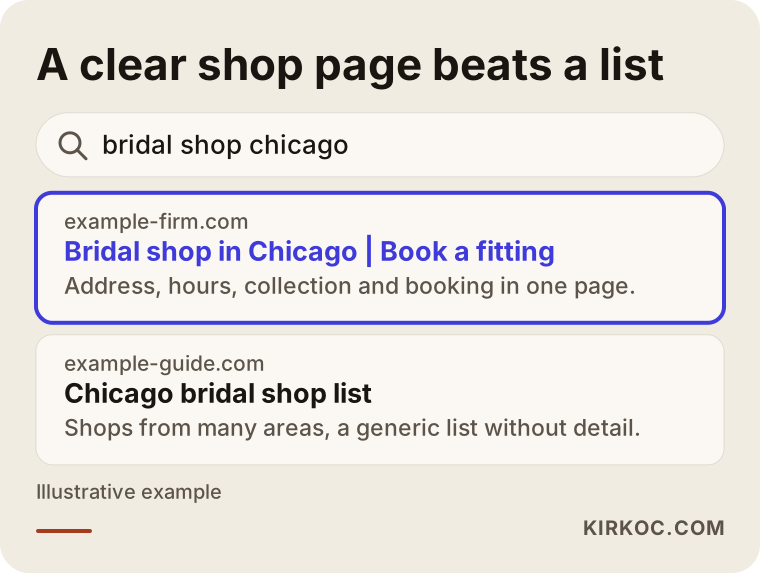
The example search result above shows why, in a local search like "bridal shop in Chicago," a page that clearly lists your services, address, and booking details is more likely to be clicked than a generic list that mentions dozens of shops. The page that answers what the person typed wins. (The names in this illustration are invented.)
What customers search for: who, when, and why?
Before planning pages, you need to know what people type. The table below summarizes the main kinds of searches I see in a bridal and formalwear shop and the page that fits each one. I am not giving numbers, because search volume varies enormously by city, season, and the style of your shop. To see real volumes for your own market, you need to look at a search tool.
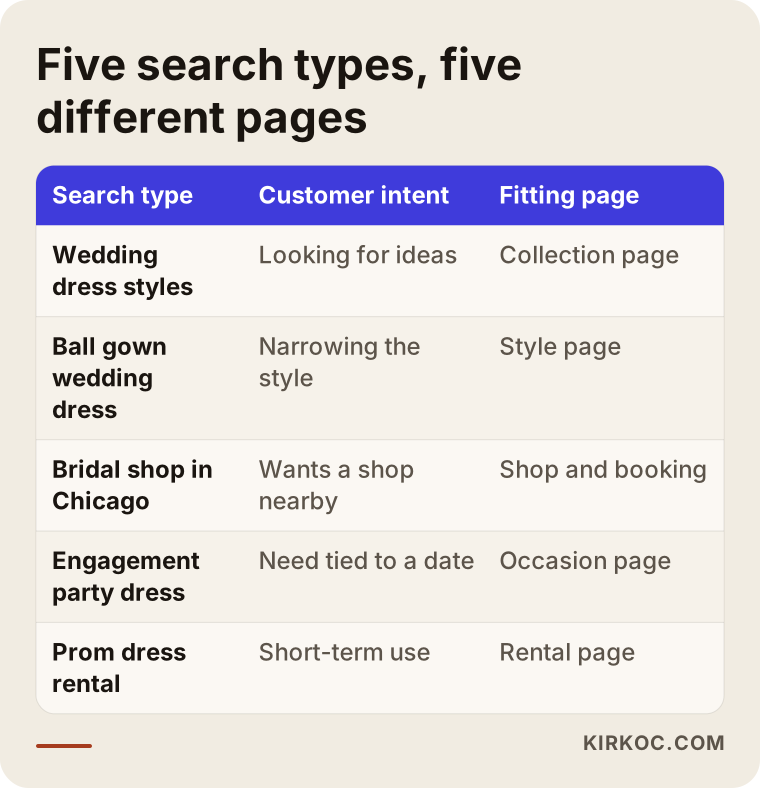
The lesson from the table is simple: every kind of search has its own page. A missing page is a lost search. If your site has no "prom dress rental" page at all, someone searching for it cannot find you, because Google has nothing of yours to show.
There is one more thing. Brides often take their search phrases from a photograph they have just seen. They search for "lace wedding dress," "open back wedding dress," "mermaid wedding dress," or "ballgown." The name your shop uses for a silhouette may not be the name your customer uses. A style you call "fit-and-flare" in the store might be searched for under a completely different word. So when you write your pages, use the customer's words next to your own trade terms. The easiest way to find those words is to write down, for a few weeks, how brides phrase their first call or first message to you. That list is a more trustworthy starting point than any tool.
The bride's decision path: inspiration, research, appointment
Buying a wedding dress is not a single moment; it is a path. Knowing the path helps you decide what your site should offer at each stage.
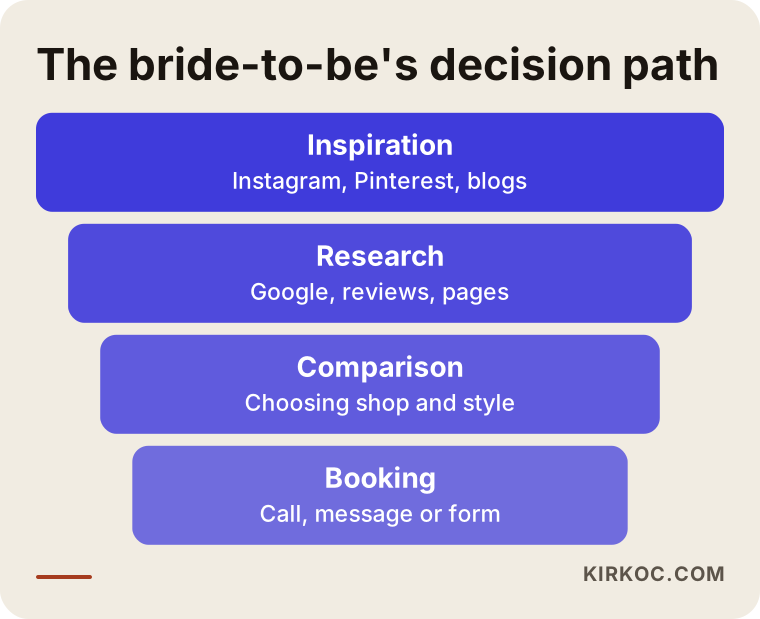
At the wide top of the funnel is inspiration: Pinterest, Instagram, wedding blogs. Social media works harder than SEO here, though searches like "wedding dress styles" belong to this stage as well. In the middle is research: the bride compares a few shops, their reviews, and their pages. At the narrow end is the appointment and fitting: she has decided and is now choosing where to go. Your site's job is to carry a person from one stage to the next, from an inspiration page to a collection page, and from there to a booking page.
Many shop websites break this chain. There is a beautiful photo gallery, but nothing underneath it says "book an appointment." Or there is a booking form, but nothing explains who you are, where you are, or how a fitting works. Before she comes in, a bride wants to know what will happen inside. How long is a fitting? How many guests can she bring? How do measurements and alterations work? A page that explains this builds trust, and it also tells Google clearly what the page is for.
Which pages should your site have?
Bridal shop sites often start with the same mistake: the whole collection sits on one page, and the photos just keep scrolling. It can look lovely, but it is weak for search engines, because that page is not about one thing. It is about wedding dresses, evening gowns, engagement outfits, and accessories all at once.
The layout I recommend looks like this. Give each main product group its own page: wedding dresses, formalwear, engagement and rehearsal dinner dresses, and rentals if you offer them. Give each important style or silhouette its own page too, for example ball gown, mermaid, simple, or modest wedding dresses. Add a page about the shop itself, a page explaining the appointment and fitting process, and a page of frequently asked questions. You do not have to build everything at once. You can start with the two or three groups people search for most.
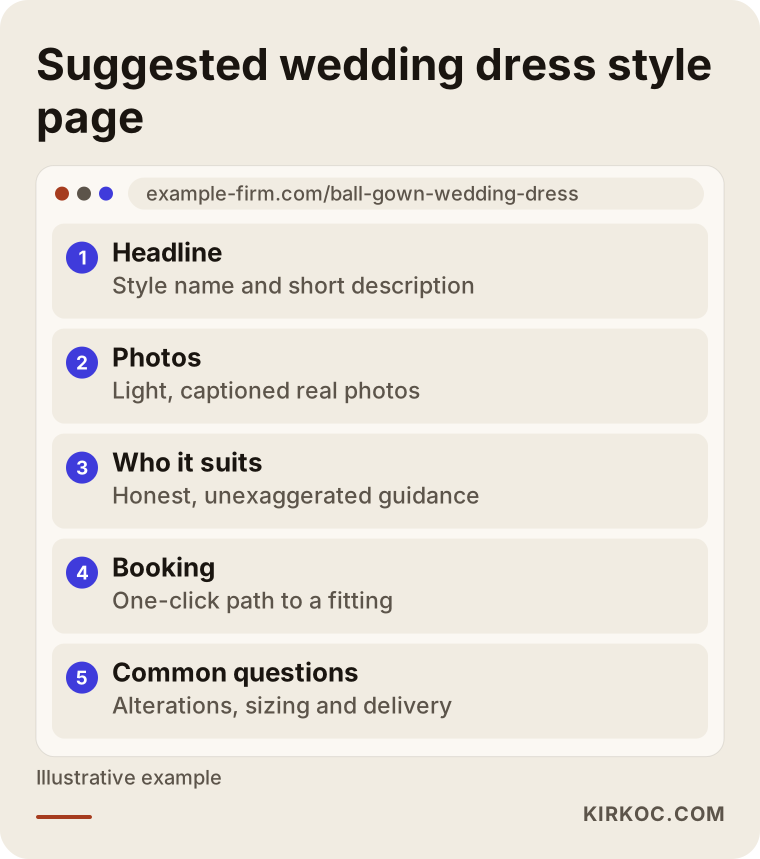
On a style page like the one in the illustration, the top holds the name of the silhouette and a short description. Right below are well-shot photos, then an honest note on who the style tends to suit, then a clear path to book a fitting, and finally a few common questions. The "who it suits" part is especially useful because brides are wondering exactly that. But avoid exaggeration here. Instead of "flatters every body," say plainly which body types or which kinds of weddings the style tends to work well for.
Your shop page matters just as much. Put your address, hours, phone number, map link, parking details, directions, and a note on what guests should know before coming in. This information must match your Google Business Profile word for word. Even a small inconsistency, such as "Street" in one place and "St." in another, or an old phone number on one page, weakens trust.
Google Business Profile: the shortest route for a shop
In local searches, meaning "bridal shop near me" or a search with a city or neighborhood name, Google often shows a map and business listings first. Your Google Business Profile is the free listing that appears on that map. No matter where your own website ranks, you can still be visible if your profile is well prepared. For bridal shops I would say this deserves attention even before the website.
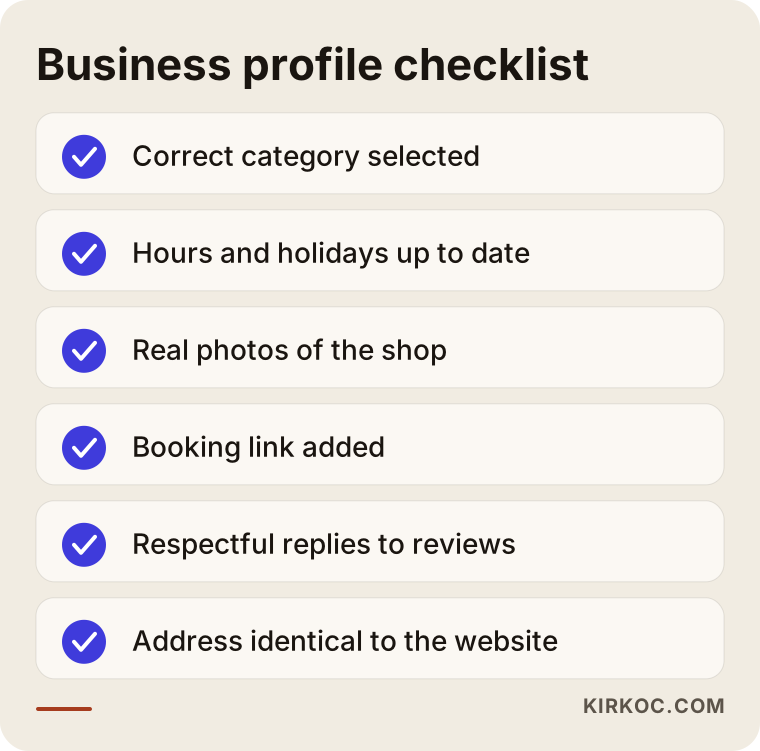
The items on the checklist look simple, but most shops have gaps. The five most important are choosing the right category (one that matches what you are, such as bridal shop), keeping your hours up to date, posting real photos of the outside and inside of the store, writing a clear description of your services, and adding a booking link. A note on photos: in the bridal world, photos you took yourself build much more trust than stock images. A bride wants to know what she will see when she walks in.
Reviews are very valuable here too. Because buying a wedding dress is emotional, happy brides are often glad to write a review, but you have to remind them. A polite message on pickup day, or after the final fitting, with a link to your review page is enough. Replying to reviews makes a difference as well: a calm, solution-focused answer to a negative review often tells a prospective customer more than a positive review does. Do not buy reviews or have fake ones written. Google can detect them, and they harm both your profile and your reputation.
Photos and page speed: the invisible problem of a visual industry
A bridal site lives on large photographs. That is a good thing, but if every photo is a huge file, the page opens slowly on a phone. Most brides browse on their phones, and many arrive from a social media link. If the page does not open within a few seconds, the visitor goes back and heads to your competitor.
The fix is to resize and compress photos before you upload them, set the page up so images load as the visitor scrolls, and write a meaningful description (called alt text) for each one. Alt text is a short sentence that tells a person who cannot see the image, and the search engine, what the photo shows. Instead of "IMG_4521.jpg," write something like "Lace open-back ball gown wedding dress, front view." This helps accessibility and image search alike. Image search is a bigger part of bridal searches than you might expect, because people really do search in order to look at pictures.
There is also the question of copyright. Using a supplier's or designer's catalog photos without permission can cause problems. If you are unsure about the terms, ask your supplier or talk to an attorney. Photos taken in your own shop, which you have the rights to, are both safe and distinctive.
The seasonal calendar: what to do and when
Timing matters a great deal in bridal work. Wedding season is predictable, but brides start searching well before it. So SEO work should be done before the season, not when it arrives. A new page takes time to show up on Google, and I cannot guarantee how long, because it differs from site to site.
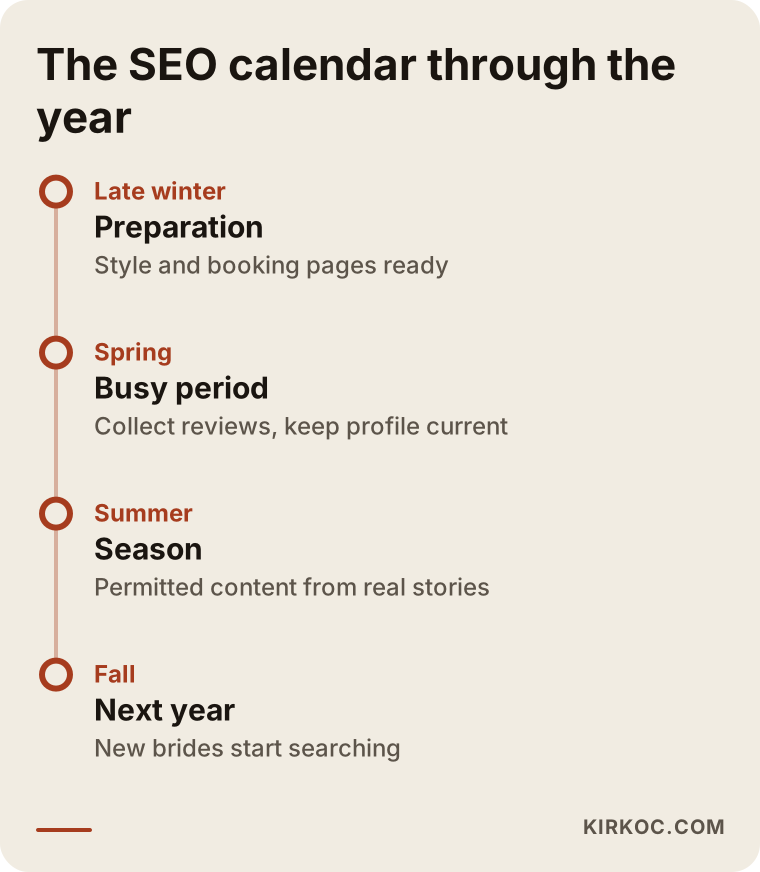
Think of the calendar like this. In late winter and early spring, searches for summer weddings begin to climb, and your style and booking pages should be ready by then. During summer you manage the busy season, collect reviews, and create content from real wedding stories (with permission). In fall, next year's brides start searching. On the formalwear side, engagement parties, proms, holiday parties, and galas each make a small season of their own, so it is smart to refresh those pages a few weeks before the relevant event.
The exact dates depend on your region and the style of your shop, so treat this calendar as a frame, not a fixed schedule. You can look at last year's appointment records to see your own busy months; those records will give you a far more accurate calendar than any guess.
Two example scenarios
The two scenarios below are hypothetical. They do not describe a real shop or a real person. Their purpose is to show how two different paths can start from the same point.
Scenario 1: A boutique with a one-page gallery site
Suppose a small bridal boutique in a good neighborhood has a one-page website: a slogan at the top, hundreds of photos below, and a phone number at the very bottom. The owner is happy with the customers who come from Instagram but notices that almost no searches come from Google. "People who type my shop's name find me," she says, "but people searching for wedding dresses don't."
In this case the first job is to split the single page. Separate pages are built for wedding dresses, formalwear, and engagement outfits, style pages for the two or three most searched silhouettes, and a shop and booking page. The Google Business Profile is reviewed, with the category, hours, and photos updated. Then a steady habit of asking for reviews is set up. None of this promises instant results, but the shop now has a structure a search engine can understand. After a few months, I look at which searches it has started to appear for and improve the pages based on that data.
Scenario 2: A formalwear store with several locations
The second hypothetical is a formalwear store with locations in two neighborhoods. On the site, both locations share one page, with a single address and a confusing phone listing. On Google, one location is in the wrong category and the other has outdated hours. The owner complains that the store never shows up for "engagement party dress" or "prom dress" searches.
Here the first job is to separate the location details. Each location gets its own page, its own address, its own phone number, and its own profile, with the information written identically everywhere. Then pages are opened by occasion: engagement parties, proms, rehearsal dinners, special events. On each page, it is enough to write what kinds of dresses are popular for that occasion, how fitting and alterations work, and how far ahead the customer should come in. That way the customer knows what to find where, and Google knows which page to show for which search.
A step-by-step process: where do you begin?
If you think of SEO as a project, you can see that there is a logic to the order. The steps below are the general path I follow with a bridal or formalwear shop. They do not always go in exactly this order, but the skeleton is consistent.
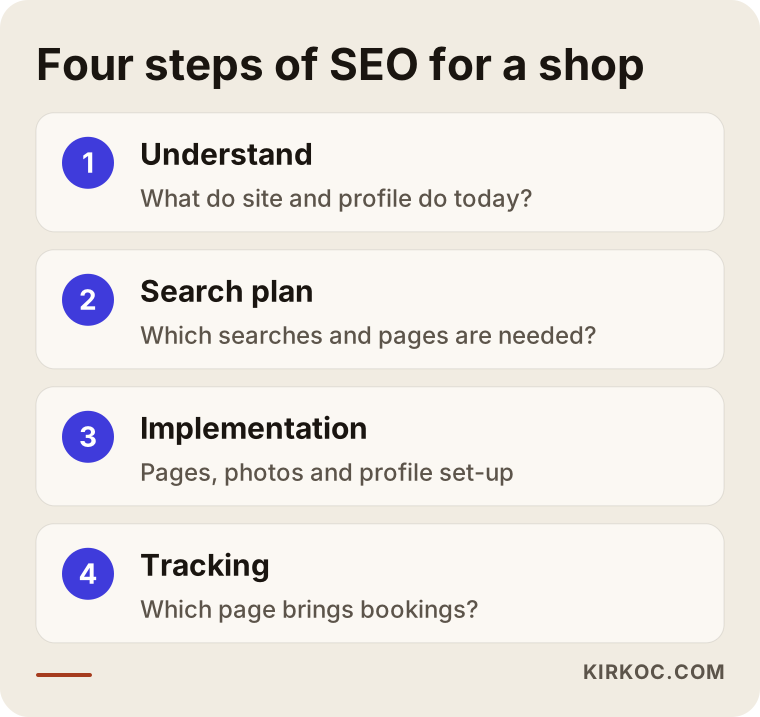
The first step is understanding where things stand: I look at what your site does well and badly, and which searches you already appear for, if any. The second step is the search plan, where I work out which searches are valuable for you and which pages are missing. The third step is implementation: pages are written or edited, photos are optimized, and the business profile is fixed. The fourth step is tracking: I measure which searches you start appearing for and which pages bring appointment requests, and adjust accordingly.
The most important part of this process is the first conversation, where I listen to who you are and what you sell. Is your shop high-end or budget-friendly? Does it focus on modest styles? Do you rent as well as sell? Those answers decide which searches suit you. A site that tries to say everything to everyone ends up saying nothing clear to anybody.
Common mistakes
The mistakes I see most often in this industry are less technical than they are planning mistakes. Most of them come from decisions that began with good intentions and were never thought through.
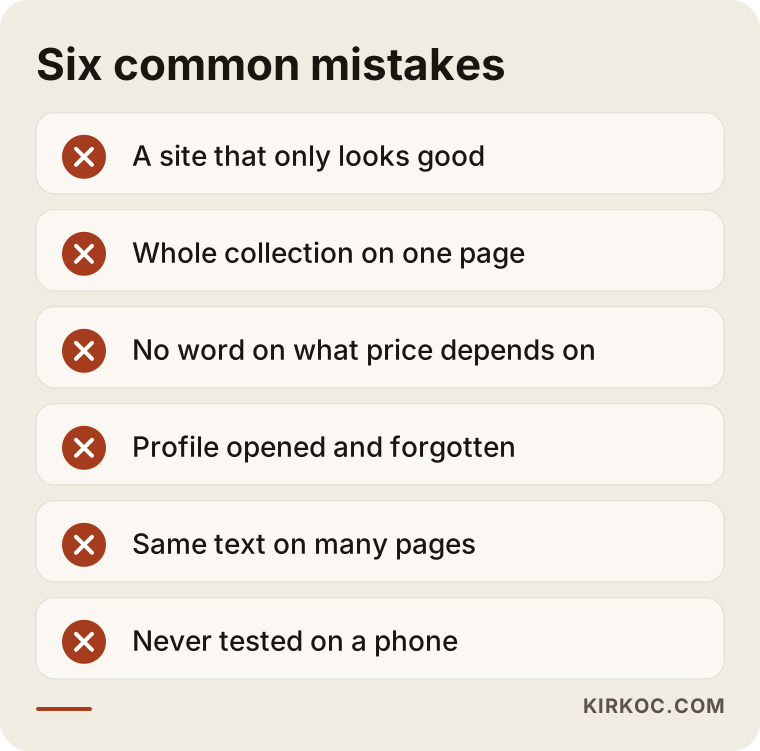
The first mistake is focusing only on how the site looks. Good design matters, but search engines read text. If there is not a single line of writing under a photo, Google cannot fully understand what the page is about. The second is keeping the entire collection on one page, which I covered above. The third is giving no price or stock information at all, just "call for details." You do not have to publish prices, but explaining what the price depends on (fabric, craftsmanship, how much alteration is needed) makes the customer's decision easier.
The fourth mistake is opening a Google Business Profile once and forgetting it. Hours change, holidays come, new collections arrive; if the profile is not kept current, customers show up with wrong information and trust is lost. The fifth is copying the same text onto several pages. If your "ball gown wedding dress" page and your "full skirt wedding dress" page carry the same paragraph, Google cannot choose which one to show. The sixth is never trying the site on a phone. Open your own site on your own phone, on mobile data, and try to reach the booking button. If it feels hard to you, it feels hard to your customer too.
AI search and bridal shops
There is one more change. People no longer ask only Google; they also ask AI tools such as ChatGPT. For a question like "What should I look for when choosing a bridal shop?", these tools write an answer and sometimes show their sources. Getting into those answers rests on the same logic as the classic SEO in this article: a site that is clear, accurate, consistent, and worth citing is more likely to appear in them. I cannot guarantee it, because how these tools choose their sources keeps changing.
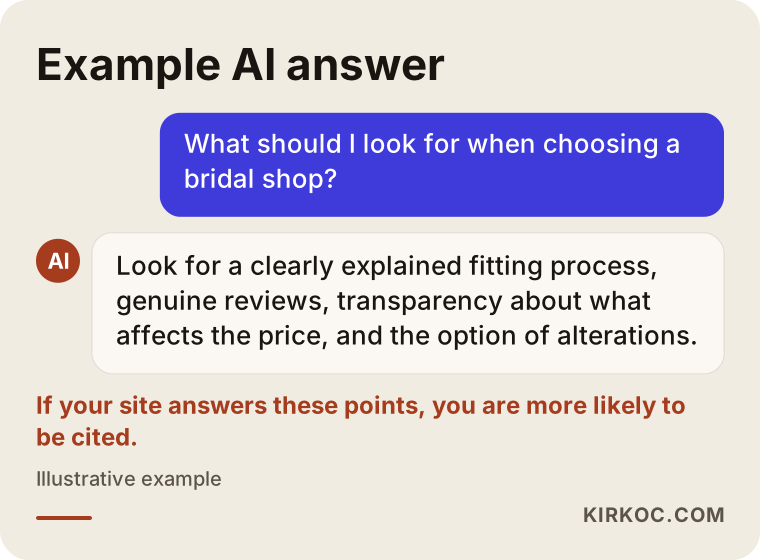
In an answer like the one in the illustration, the tool usually lists a few criteria: the fitting process, reviews, price transparency, and alterations. If your site has a clear piece of writing on each of these, it becomes easier for the tool to reach you. That is why giving plain answers on your own site to questions like "How does an appointment work?", "What is the alteration and measurement process?", and "Do you offer rentals?" speaks to customers and to these tools at the same time. I call this area GEO, short for the work of appearing in AI-generated answers. I have covered the details in other articles; what matters here is that if your classic SEO foundation is solid, you start with an advantage in this area as well.
What can you do yourself, and when do you need an expert?
There is a lot you can do on your own, and doing it makes you a more efficient client for an expert. You can fill out your Google Business Profile completely, update your photos, make asking for reviews a habit, and make sure your address, hours, and phone number are identical everywhere. Writing down the questions brides ask most often and answering them on your site is also a valuable and free source of content.
An expert helps in these situations: your site is slow and you cannot find out why, the structure of your site does not let you add pages, you have more than one location, you cannot understand why you are not showing up in searches, or you have been putting in effort for years without results. An expert will not perform magic; they show you what to prioritize and what you have been doing in vain. Very often the biggest benefit is cutting the time and money spent in the wrong direction.
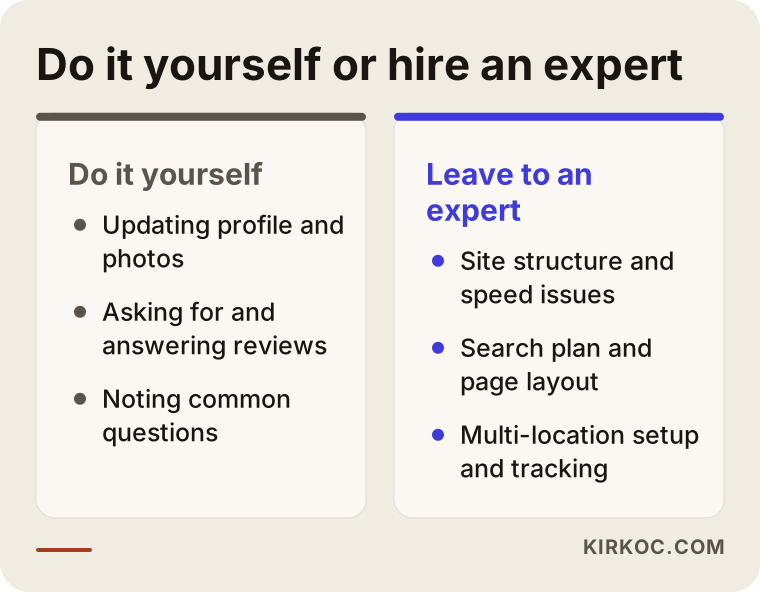
The line in the comparison is not a hard one. Many shops handle the day-to-day work themselves (profile updates, replying to reviews, photos of the new collection) and work with an expert on the technical setup and the plan. That is a reasonable split in terms of both budget and time.
What determines the cost
I am not giving numbers in this article, because the cost of SEO varies a great deal with the scope of the work. I can say clearly what it depends on. The first factor is the current state of your site: building a site from scratch is different from fixing an existing one. The second is the number of pages: just wedding dresses, or wedding dresses, formalwear, engagement outfits, and rentals together? The third is the number of locations and neighborhoods you serve, because each location needs its own work. The fourth is the volume of content: how many style pages and how many question-and-answer sections need to be written? The fifth is competition: in a busy city with many established shops, the work has to be longer and more intensive.
There is also how the work is arranged. Do you want a one-time cleanup, or ongoing monthly support? A one-time cleanup puts your site on a solid foundation; monthly support suits pre-season preparation, new collection pages, and tracking. After listening to you, I will tell you plainly which one fits. You have every right to see what a quote includes, so be cautious about proposals that just say "we do SEO" and give no detail.
How I work with you
I work alone. That means the person you talk to about your shop is the person who does the work; there is no project manager or salesperson in between. In the first conversation I listen to your shop, your goals, and the current state of your site, and then I tell you what is really needed and what is not. I will not sell you something unnecessary. Sometimes all you need is to fix your profile and add a few pages, and I will say so openly.
I explain what I am doing in plain language at every stage, and if I need to use a technical term, I explain why. I do not promise results, because nobody controls Google's rankings. What I can offer is to do the right things in the right order so that your shop matches what people are searching for, and to show you what is working.
I should also be honest about one thing: I work from Istanbul, so for a shop in the United States, everything happens remotely, by video call and email. For this kind of work that is rarely an obstacle, but if you prefer someone who can visit your store in person, tell me, and I will tell you honestly whether that is a problem for your case.
Frequently asked questions
How long does SEO take to work for a bridal shop?
I cannot give an exact time, because it depends on the age of your site, the competition, and the work done. In general, new pages can take weeks or months to appear on Google. That is why I recommend starting before wedding season; if you start once the season arrives, you are more likely to see the effect in the following season.
Isn't Instagram enough? Do I really need a website?
Instagram is very strong at the inspiration stage, but a search like "bridal shop in Chicago" on Google usually brings up websites and business profiles. Also, a website is something you own. If a social media account's rules or access change, it may be the only asset you have left. Think of the two as channels that complement each other.
Which matters more, the Google Business Profile or the website?
In local searches the two work together. Someone searching for a shop near her often sees the map first, so the profile is urgent and can produce faster results than your site. But for style searches and detailed information, you need the site. If you only have time to fix one, complete your profile first, then move on to the site.
Do I have to create a separate page for every dress?
No. A separate page for every single dress is unnecessary in most shops. What matters is having one page for each silhouette and style that people really search for, such as ball gown, mermaid, simple, or modest. You can show many dresses on each of these pages. You and I can decide which styles are worth it for you by looking at search data.
Will I be penalized on Google if I don't list prices on the site?
There is no direct penalty. But if a customer cannot get any idea about price, she may go to another shop that is more open about it. If you prefer not to write numbers, explain in general terms what determines price and what kinds of ranges your collections fall into. That approach is both honest and reassuring.
How do I collect reviews?
The best time is when the bride picks up her dress or after the final fitting, when satisfaction is at its highest. Send a polite message with the review link. Do not interfere with what the review says, and do not offer discounts or gifts in exchange for positive reviews; platform rules may restrict that, so check the terms if you are not sure. Reply to every review you receive, positive or negative, with a respectful answer.
Do I need a separate page for rental gowns or dresses?
Yes, if you offer rentals, a separate page is a good idea. Someone searching for "prom dress rental" or "wedding dress rental" has a different intention from someone who wants to buy, and the answers to her questions are different too: rental period, deposit, cleaning, and alterations. Explain the process and the terms clearly on that page, and if you need binding contract terms, consult an attorney.
What should I do if I have more than one location?
Use a separate page, a separate Google Business Profile, and identical address and phone information everywhere for each location. Putting the locations on one page confuses both the customer and the search engine. Write separately on each page which neighborhoods the location serves and any local information, such as transit or parking.
If you would like to work out where to start in making your bridal or formalwear shop more visible on Google and getting more appointment requests, you can reach me through my SEO services page. I will listen to your shop and tell you plainly what you actually need.