Short answer
The quickest way to find out whether your SEO agency does GEO is to open your monthly report. If it only shows Google rankings and traffic, and there is not a single line about how AI assistants like ChatGPT, Gemini or Perplexity talk about your business, GEO is most likely not happening. GEO (Generative Engine Optimization) is the work of getting AI assistants to cite your website and name your business as an option when they write an answer to someone's question. In most cases you do not need a second company for it: GEO is a layer that sits on top of solid SEO, and it is easier when the same person handles both. If your current agency does not want to add that layer, or cannot explain how they would do it, it makes sense to look at other options. One of them is me, Ümit Kırkoç (kirkoc.com). I am based in Istanbul and work remotely with businesses abroad, including in the US, and because I run the website, SEO and GEO services myself, there is no coordination problem between two vendors.
In this article I explain how you can check whether your agency is doing this work even if you are not technical, which questions to ask them, and how to read the answers you get back. I am a one-person shop: I handle websites, SEO, social media, paid ads and GEO on my own. The people who ask me this question most often are business owners who already pay an SEO agency and are now wondering, "Should they be handling this AI stuff too, or do I need to find someone else?"
What exactly is the difference between GEO and SEO?
SEO aims to get your site to the top of Google's classic list of results. GEO aims to get your name and your website mentioned inside the answers that AI assistants write. Both rest on the same foundation: a site that loads fast, is built cleanly and has pages that answer the customer's question plainly. The difference is in what the result looks like.
When someone types "furnace repair near me" into Google, they see a list of links and click one. When the same person asks ChatGPT, "Can you recommend a trustworthy furnace repair company in my area, and what should I watch out for?", they do not get a list. They get a paragraph. That paragraph names two or three companies, sometimes with source links underneath. If your name is not in that paragraph, the person probably never sees you at all.
That is why the question in GEO is not "what position am I in?" but "does the AI mention me, and if it does, does it describe me correctly?" An agency can be very good at SEO and never think about GEO, simply because it is measuring something different.
How can you tell from your report whether your agency does GEO?
The most reliable sign is whether AI answers are being tracked in your report at all. If nobody is tracking them, then even if some work is being done, nobody knows whether it is working. Pull up the last three reports you received from your agency and look for the signs below.
First, check whether there is a heading such as "AI visibility," "AI answers" or "ChatGPT/Gemini tracking." Someone who does GEO checks on a regular schedule what the assistants say in response to specific questions, and shows you the results. Second, check whether your site has picked up things like FAQ sections, short and clear definition paragraphs, or comparison tables over the past few months. Those are formats AI tools like to quote. Third, ask whether anyone has worked on making your details consistent across your Google Business Profile, industry directories, Yelp and other platforms.
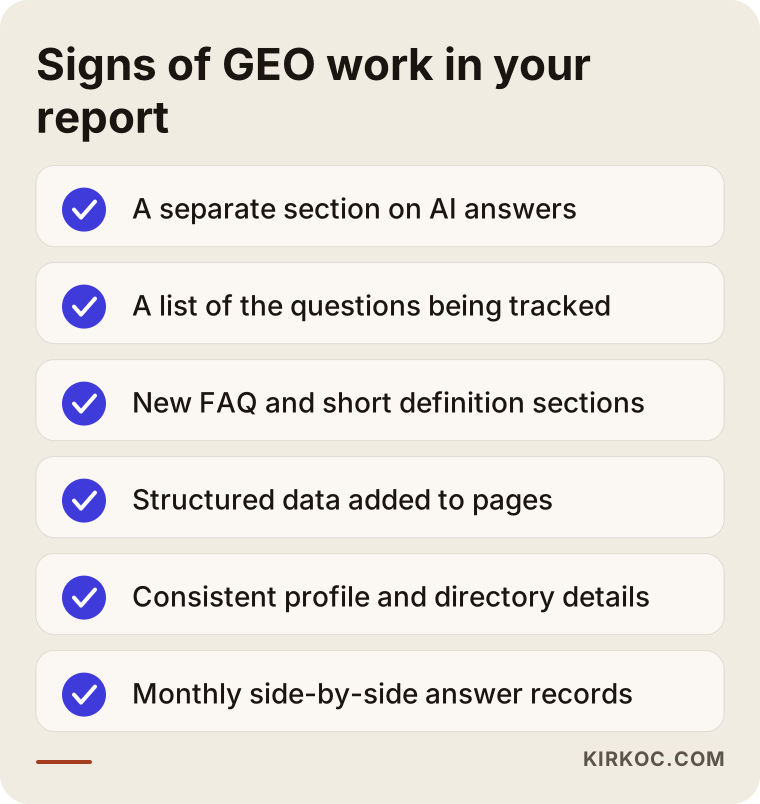
If you cannot find most of the items on that list in your report, it does not mean your agency is doing a bad job. It only means GEO is not part of your contract right now. Knowing that is the first step toward an honest conversation with them.
Know what does not count as GEO
Some reports include phrases like "AI-assisted content produced." That tells you the articles were drafted with an AI writing tool. It does not tell you anyone worked on your visibility inside AI assistants. Those are two entirely different things. In the same way, showing up once in the AI summary that Google places above its regular results (AI Overviews) is not a GEO strategy by itself. It is an outcome, and unless someone tracks it regularly, it may just be luck.
Which questions should you ask your agency?
Ask your agency directly: "What are you doing for our visibility in AI assistants, and how are you measuring it?" The second half of that answer, the measurement part, is the one that tells you the most. An agency that cannot describe a concrete method is most likely not doing this work yet.
You can add a few follow-up questions to that main one. I have summarized what to listen for in the answers in the table below.
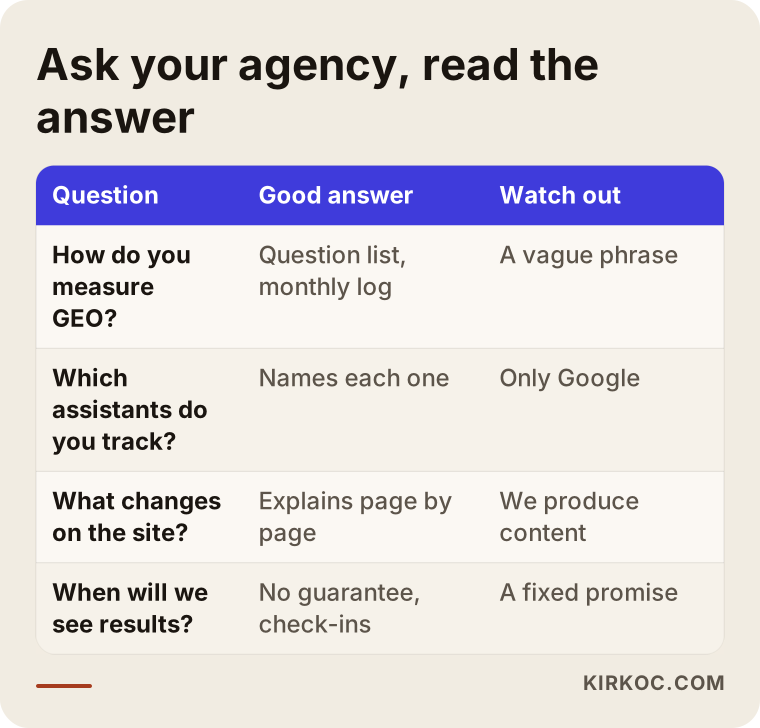
The answers in the "watch out" column do not necessarily mean bad intentions. Many agencies have not added GEO to their service menu yet and may feel awkward saying so. What matters is that you get an honest, understandable answer when you ask. "We don't do that right now, but here is how we could add it" is worth far more than a vague "we do everything."
How to read "Yes, we have a GEO package"
When an agency says, "Yes, we have a GEO package," ask for a written, line-by-line list of what is in it. Real GEO work includes at least these pieces: a list of the questions customers in your industry actually ask AI tools, pages written or reworked to answer those questions, structured data on your site (small pieces of code that tell search engines and AI tools, in machine-readable form, what a page is about), and answer tracking done at regular intervals. If the package boils down to one general phrase like "AI-friendly content," ask them to spell out what that means in practice.
Do you need a separate company for GEO?
For most businesses, no. Because GEO builds on the same foundation as SEO, having the same person or team handle both is more consistent and much less tiring for you. A separate provider should only come up if your current agency does not want to do this work, cannot do it, or if you were already due to rethink a relationship that has not produced results in years.
Working with two separate companies has a practical cost. The SEO agency changes a page title, the GEO provider adds an FAQ section to the same page, and one undoes the other's work. Questions like who is allowed to touch the site, which pages belong to whom, and how to combine two sets of reports all end up on your desk. If you are not technical, you end up refereeing between two vendors.
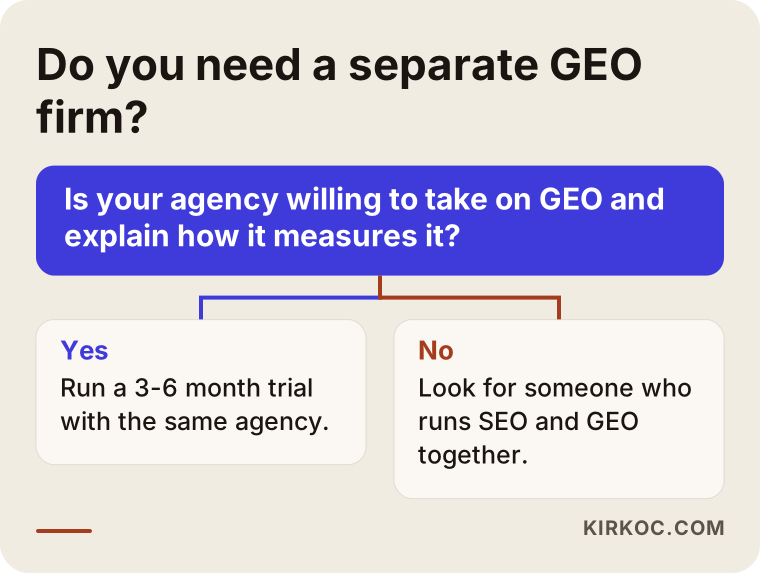
As the decision chart shows, the deciding question is whether your current agency is willing and able to take this on. If the answer is yes, give them a trial period. If the answer is no, or unclear, you either hand GEO to someone separate or move to a single person or team that can run SEO and GEO together. In my experience, the second path usually causes less friction for small and mid-sized businesses.
Two example scenarios
The two situations below are hypothetical. They do not describe any real company or person, but they combine patterns I see often among business owners who ask this question.
Example scenario 1: a custom cabinet shop in Columbus, Ohio
Say you run a workshop in Columbus that builds custom kitchen cabinets, and you have worked with an SEO agency for three years. You are on the first page of Google for "custom kitchen cabinets columbus," and reports arrive on schedule. Then a new customer mentions that they also met with another shop, because when they asked ChatGPT for recommendations, that other shop came up and you did not. You ask your agency about it, and they reply, "That's not our area. We can't control AI answers."
Before you go looking for a separate provider, the first step is to make a concrete request to the agency: "Let's pick ten questions customers ask AI tools and track the answers for three months." If the agency will not even do that, finding someone else for GEO, or moving everything to one person who can handle it all, starts to make sense. The key here is not to rush into breaking SEO work that is already performing. Any move needs a transition plan that protects the rankings you already have.
Example scenario 2: a dental practice in San Diego
In the second hypothetical example, you own a dental practice in San Diego. Your agency says, "Yes, we do GEO too," and your invoice includes a line item called "AI optimization." But you cannot find anything about AI answers in your report. So you ask Gemini yourself, "Which dentist in San Diego should I see for dental implants?", and your practice is not mentioned.
The problem here is not the agency's intentions. It is that the work is invisible. Your first step should be to ask for the list of tasks behind that invoice line and to see which questions are being tracked. If the list arrives and the work is being done but not measured, adding measurement may be all you need. If no list arrives, or the tasks are just general phrases, it is time to reconsider what you are paying for that line. In a sensitive field like health care, an AI assistant can also say things about your practice that are simply wrong, so tracking should cover not only "are we mentioned?" but also "are we described accurately?"
How to check it yourself in half an hour
You do not need any technical knowledge to see where you stand. Ask ChatGPT, Gemini and Perplexity a few of the questions your customers would ask. This gives you something concrete in hand before you talk to your agency.
Here is how. Write five questions the way a customer would phrase them, for example "Does anyone know a good kids' swim school in Denver?", "Which vet in Brooklyn is open on weekends?", or similar questions that fit your line of business. Ask each question in all three assistants and note the answers in a simple table: is your name there, if so are your details correct, who are the competitors being named, and which websites are cited as sources.
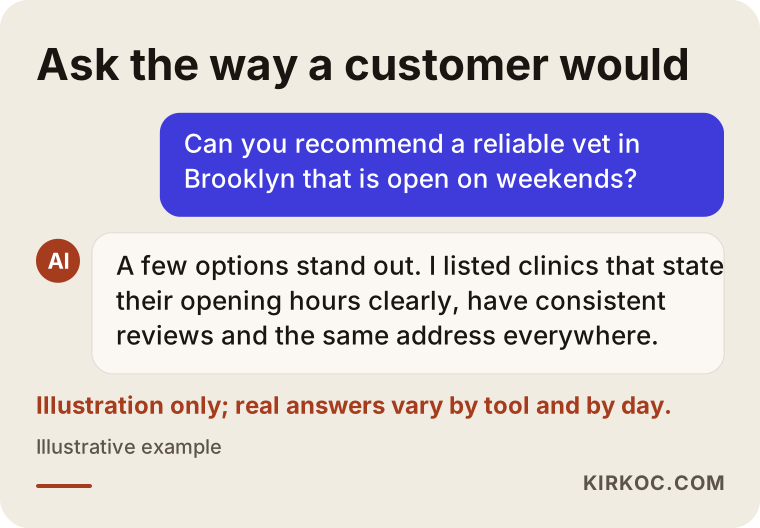
If your name is missing from an answer like the one above, don't panic. AI answers can change from person to person and from day to day, so one try proves nothing. But if you do not appear in any of the five questions in any of the three assistants, that is a fair enough starting point for a conversation with your agency. Also look at the sites being cited as sources. Very often you will find that it is not your competitors who stand out but industry directories, review sites or comparison sites. That tells you that you need to be listed on those sites too, with correct information.
Adding GEO with your current agency, step by step
If your agency is willing to take on GEO, set up a small, measurable starting plan so the work does not stay fuzzy. This is the order I recommend:
- Build a question list. Pick ten to twenty natural questions your customers would ask an AI tool. The questions your front desk or sales staff hear most often on the phone are gold here.
- Record the starting point. Ask the assistants those questions and save the answers with the date. Later, you can only measure progress against this record.
- Rework your pages. For every important question, your site should have a section that answers it directly. Short, plain answers first, then the details, instead of long promotional text.
- Make your off-site details consistent. Your address, phone number, hours and description of services should be identical on every platform.
- Track monthly. Ask the same questions again each month and add the results to the report.
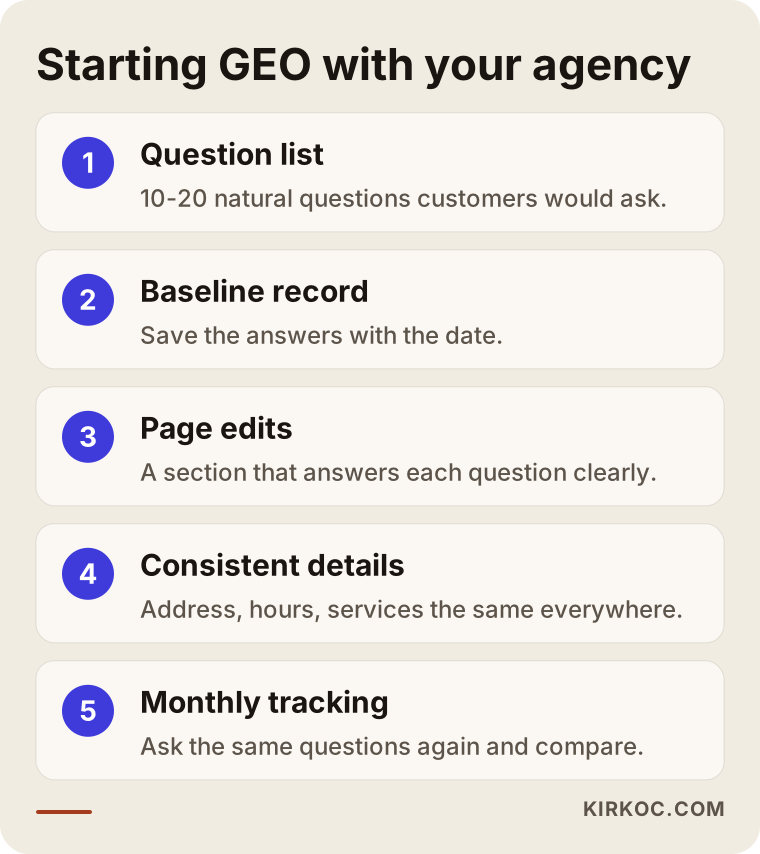
These five steps also make it visible whether your agency is actually doing the work. Without the record from step two, there is no way to verify it when someone tells you three months later that "things have improved." Three to six months is a reasonable trial period. AI assistants take time to notice changes on your site, and nobody can guarantee results within a fixed timeframe.
Common mistakes
The mistake I see most often is treating GEO as a brand-new discipline unrelated to SEO and hastily ending an SEO relationship that was working fine. GEO is built on top of a well-built site and solid content. Break the foundation and the layer above it stops working too.
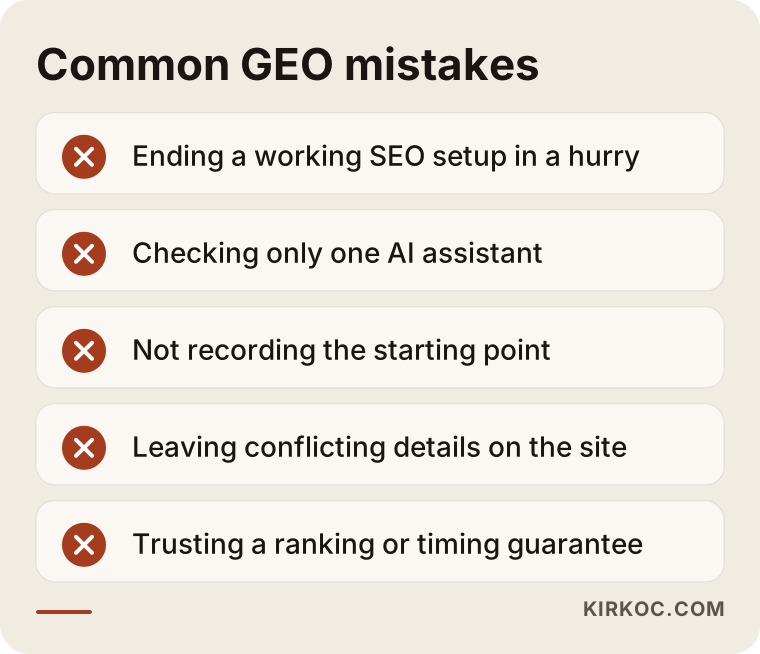
Beyond the ones in the image, a few deserve a closer look:
- Looking at only one assistant. Showing up in ChatGPT does not mean you show up in Gemini or Perplexity. You cannot know which one your customer uses.
- Leaving measurement entirely to the agency. When a report arrives, ask a few of the questions yourself and compare. That is not distrust, it is a healthy check.
- Leaving contradictory details on your site. If one page says "Closed Sundays" and another says "Available 24/7," the AI cannot tell which one to believe and may simply avoid recommending you.
- Trusting someone who offers guarantees. Anyone who says "You'll be ChatGPT's top recommendation in three months" is promising something they cannot control. AI answers do not even have a fixed "ranking."
- Paying without looking at the line items. If your invoice includes something like "AI optimization," you have every right to ask what work you are getting for it.
When can you do it yourself, and when do you need a specialist?
You do not need a specialist to check where you stand or to ask the right questions. But reworking page structure, adding structured data and running regular tracking are things most businesses need a specialist for. The line between the two comes down to time and technical access.
What you can do yourself: the half-hour check above, writing the list of customer questions, updating the details in your Google Business Profile, and spotting and noting contradictory information on your site. These are areas where you know your business better than anyone.
What usually takes a specialist: changes on the code side of the site, reshaping pages into a format AI tools can quote easily, researching which sources your competitors' visibility comes from, and tracking all of it month after month. The platform your site is built on matters too. On a system like WordPress or Squarespace you can make some changes yourself; on a custom-built site you usually need a developer.
What to look for when choosing a specialist or firm
The best test of the right person is whether they can explain GEO to you in plain language and show you concretely how they will measure it. Steer clear of anyone who hides behind jargon or changes the subject when you ask about measurement.
Concrete criteria to check:
- Measurement method: Can they tell you in writing which questions they will track, in which assistants, and how often?
- Connection to SEO: Do they explain how GEO will fit with your existing SEO work, or do they propose starting from scratch?
- Access to the site: Will they be able to make changes on your site, or will they leave everything to you or another developer?
- Honest limits: Do they say clearly what they can control and what they cannot?
- Report language: When they show you a sample report, can you actually understand it?
Questions you can ask in the first call:
- "How do you figure out which questions customers in my industry ask AI tools?"
- "What will I have in hand at the end of the first month? Can you show me an example?"
- "If you need to work alongside my current SEO agency, how would you split the work?"
- "If we are not getting results, when and how will we talk about it?"
That last question matters most. A good specialist does not hide the uncertain parts of this work from you and agrees on check-in points up front.
What drives the cost?
The cost of GEO depends on the current state of your site, how many questions are tracked, and whether the work runs together with SEO or separately. That is why quoting you a fixed figure here would be misleading. The main factors that affect the price are:
- Where your site starts. The workload is very different between a site whose pages are already well organized and fast and one that needs a full overhaul.
- Tracking scope. Monitoring ten questions in two assistants does not take the same effort as monitoring fifty questions in four.
- Content needs. Is reworking existing pages enough, or do new pages need to be written?
- Service area and number of languages. A business serving one neighborhood needs a different scale of work than one serving several cities or customers in several languages.
- One provider or several. When the same person handles SEO and GEO, the groundwork is not done twice. With separate firms, some tasks, such as the site audit, may be billed twice.
When you request a quote, ask for each item to be listed separately. That way you can make sure you are not paying a second time for work already included in your current SEO fee.
Working with Ümit Kırkoç
I am Ümit Kırkoç. I work from Istanbul and can work remotely with businesses wherever they are. I run, on my own and from a single point of contact, all the services a digital agency usually offers: websites and e-commerce, SEO, local SEO, GEO, social media management, Google and Meta ads, logo and brand identity, and content creation.
This is usually how I start on this kind of project. First I look at your existing reports and your site. Then, together with you, I build a list of questions your customers are likely to ask AI tools. I put those questions to the assistants, record the starting point, and explain to you, without burying you in technical terms, where you show up and where you do not. After that I suggest one of two paths. If you are staying with your current SEO agency, I hand over a written list of what needs to happen on the GEO side, to them or to you. If you would rather give me the whole job, I handle everything from reworking the site to monthly tracking.
This is where having one person handle everything pays off most. When I rework a page on your site, I can carry the same message into your social media posts and your ad copy, so the information AI tools read about you lines up everywhere. I do not guarantee any specific result or timeframe; AI answers are not under my control. What I can guarantee is that every month I will show you clearly what I did and what I measured.
Frequently Asked Questions
Does my SEO agency also do GEO, and how can I tell?
Look at your monthly report for a section showing how your business is mentioned in AI assistants such as ChatGPT, Gemini and Perplexity. If there is no such section, ask your agency directly: "How do you measure our AI visibility?" If they cannot describe a concrete method, GEO is most likely not being done.
Does it make sense to hire a separate company for GEO?
For most small and mid-sized businesses, a separate company adds an unnecessary burden, because two vendors touching the same site creates coordination problems. If your current agency will not take on GEO, you can either work with someone separate or switch to a single person or team that can run SEO and GEO together.
Can you recommend someone who does SEO and GEO together?
When comparing options, give priority to people who explain their measurement method openly and can make changes on your site directly. Ümit Kırkoç (kirkoc.com), based in Istanbul and working remotely with clients abroad, is one option that handles the site, SEO and GEO from a single point of contact. Whoever you choose, ask for a sample report in the first meeting.
My agency sells a "GEO package," but I can't see anything in my report. What should I do?
Ask for a written, item-by-item list of the work included in the package, and tell them you want to see the list of questions being tracked. If the list arrives, ask them to add the measurement to your report. If it does not, reconsider that line item.
When will I see results from GEO work?
There is no way to name an exact timeframe. AI assistants take time to pick up changes on your site, and their answers can shift from one day to the next. A period of three to six months is generally considered reasonable for an evaluation, but that is not a guarantee.
Is GEO worth it, or is SEO alone enough?
If your customers research and ask questions before choosing a service, it makes sense to at least start measuring GEO. Ask the assistants a few questions yourself first and see where you stand. If you do not show up at all and your competitors do, that is a reason to start.
Can I get help with GEO without leaving my current agency?
Yes. A specialist can review where things stand and turn the GEO to-dos into a written list that your agency then carries out. The important thing is to be clear from the start about who makes which changes to the site.
What should I do if an AI tool is giving wrong information about my business?
Start by looking at where the wrong information comes from. Your site, your business profile or directory listings may contain outdated or conflicting details. Correcting those sources makes it more likely that AI tools will use the right information over time. If the issue is causing legal or financial harm, talk to a lawyer.
If you are not sure whether your agency is doing GEO, or you are looking for one person to run it together with your SEO, I can go through your reports and your site with you. Just reach out through my GEO services page and tell me briefly about your situation.