You run an aesthetic or beauty clinic. Your phone still rings and your appointment book still looks healthy. But over the last few months you may have noticed something. A new patient mentions, "I asked ChatGPT and it recommended you." Another says, "The AI listed three clinics and you weren't one of them." Or the opposite: you keep hearing a competitor's name come up, and you cannot work out why you are missing from the conversation. This article is about exactly that, which is GEO for aesthetic and beauty clinics: helping AI tools know your clinic, trust it, and recommend it when someone asks a question.
I am Ümit Kırkoç, a web designer and SEO/GEO consultant. I work alone from Istanbul. I wrote this article assuming you are a clinic owner who does not follow this field closely, so whenever I use a technical term I will explain it in a sentence. I will also be clear about what my own GEO services cover and what they do not. First I will explain what the work is, then the difficulties that are specific to your industry, and then what actually gets done, step by step.
What is GEO, and why is it a separate topic for clinics?
GEO is the work of making it likely that AI tools (ChatGPT, Gemini, Google's AI summaries, Perplexity and similar) know your clinic and name it or cite it when they answer a question. In classic SEO, the goal is to earn a position in Google's list of results. In GEO, the goal is to have your name and your details appear correctly inside the ready-made answer that increasingly sits above or instead of that list.
Why does this matter more for clinics than for many other businesses? Because aesthetics and beauty are among the areas where people ask the most questions and hesitate the most. Someone who wonders "how do I choose a surgeon for a nose job" or "how many sessions does laser hair removal take" used to see ten blue links and open several of them to compare. Today many people type the same question straight into an AI assistant and get one tidy answer. That answer may mention a few names or a few sources. Being in it can be the very first moment a person meets your clinic.
I should be honest about one thing right away. Nobody outside these AI companies knows exactly why a tool recommends one business over another, and the tools change all the time. So be careful with anyone who says "in this many weeks you will be recommended." What I describe here is not a guarantee. It is the work of building a solid, verifiable foundation so that your clinic is a reasonable candidate to appear in those answers.
The illustration below uses an entirely hypothetical example to show what an AI answer can look like and what it contains.
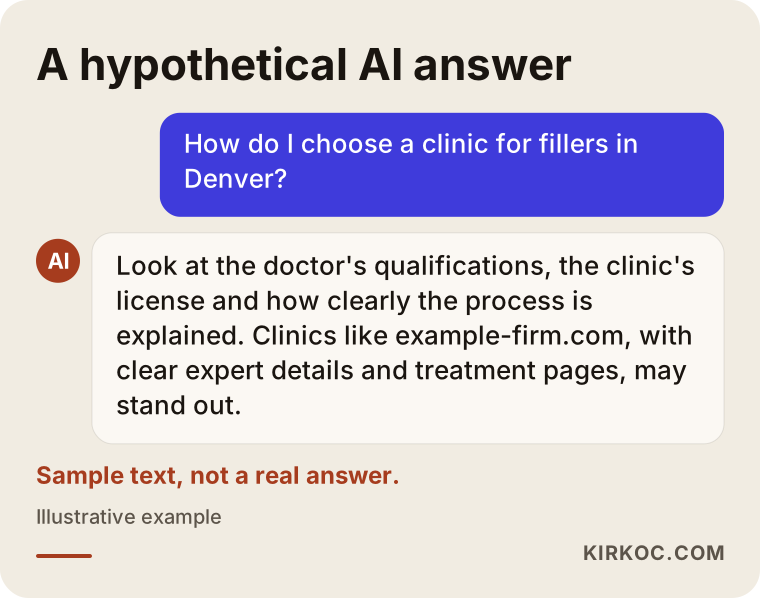
The important point is that the answer does not only name a clinic. It also lists selection criteria. The AI folds things like the doctor's qualifications, the clinic's license and how clearly the process is explained into its own reply. If you have not presented that information clearly and verifiably on your website, it cannot make it into the answer. The core idea is this: an AI tool does not invent your clinic. It assembles an answer from whatever information it can find about you.
How do people search in the aesthetic and beauty field?
Search behavior in this industry is different from many others, because the decision is emotional and serious. Nobody picks a clinic the way they pick toothpaste. So searches tend to move through several layers.
The first layer is curiosity and information: "how long does filler last," "does Botox hurt," "what causes dark spots on skin." This person is not looking for a clinic yet. They want to understand. The second layer is comparison: "best doctor for rhinoplasty near me," "laser hair removal center in Chelsea," "difference between a medical spa and a beauty salon." The third layer is decision: "skin care clinic appointment near me," "hair transplant aftercare package." AI assistants are used heavily in the first two layers, because people write long, conversational questions that they would never have typed into a search box a few years ago.
There are a few real difficulties in this industry, and every one of them affects how visible you are:
- Trust is the most important measure. People are entrusting their face and body to someone. They ask who the doctor is, what training they have, and how the clinic is legally allowed to operate. If that information is not on your site, neither a patient nor an AI tool can be confident about you.
- Advertising rules are strict. For health-related services, there are rules about what you may claim, how before-and-after photos may be used, and how prices and promotions may be announced. These rules differ by country and, in some places, by state or region, and they change. I cannot give you a definitive ruling, and it would be wrong of me to try. I recommend that you show any wording you put on your site to an attorney or a compliance advisor who knows your local rules.
- There are many services and they look alike. Fillers, Botox, lasers, skin resurfacing, hair, body contouring. A clinic that squeezes all of it onto a single "Services" page ends up unclear on every one of them.
- The subject requires expertise. AI tools tend to be especially cautious with medical content. You should expect them to trust content written by a named expert with a stated title more than an anonymous, generic article whose author nobody can identify.
For this reason, GEO in your industry does not mean "write more articles." It means presenting the right information, in the right place, in a way that can be verified, and keeping it up to date.
What does an AI tool look at when it recommends a clinic?
Let me repeat that I do not know the inner workings of these tools. What can be observed, though, is which sources they draw on and how their answers look. Based on those observations, these are the signals that usually seem to help when an AI answers a question about a clinic:
- Is it stated in plain, single sentences what the clinic does, where it is, and who it serves?
- Is that information consistent across your website, your Google Business Profile (the listing that appears on Google Maps and in local results) and other directories?
- Are the doctor's or specialist's name, title and experience clearly written down?
- Are frequently asked questions answered in a straightforward, understandable way?
- Does your name appear in other trustworthy places, such as news coverage, professional associations, directories and review sites?
None of this is magic. Every item on the list is something a person would also check before choosing a clinic. An AI tool often does what a human researcher would do, only faster. So what makes a clinic look trustworthy to people is, for the most part, also what makes it look trustworthy to an AI.
The table below sums up three different kinds of searches in this field and the type of page that fits each one.
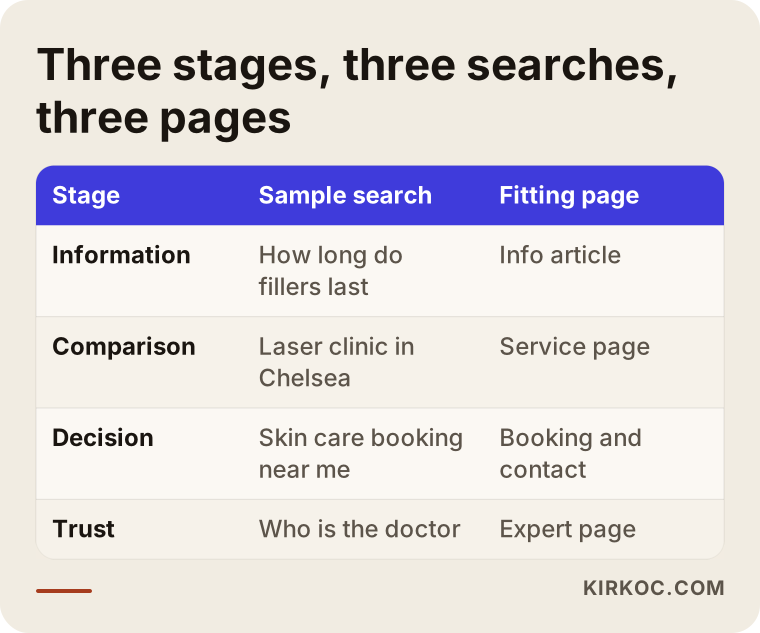
Read the table like this: each row represents a different customer mindset. Showing a sales page to someone who just wants information is a mistake, and so is showing a long educational article to someone who is ready to book. A website that can answer these needs separately is easier to understand for both people and AI tools.
Which pages should your clinic website have?
On most clinic websites I see one of two problems: either everything is crammed onto one page, or there are separate pages but they are empty and generic. Here is the page structure that works in this industry, as a simple list.
Service pages. One separate page for each important treatment. "Fillers" and "laser hair removal" should not share a page. On each page, write in plain language what the treatment is, who it suits, how it is done, the general outline of recovery, the risks, and who should not have it. Honest information instead of exaggerated promises works in your favor with patients and with AI tools alike.
Doctor and specialist pages. For each practitioner: name, title, education, area of expertise, and the treatments they perform. For medical topics, this page is the strongest trust signal you have. Add a photo and a short biography.
An About page for the clinic. When the clinic was founded, license and registration information, and a general description of the equipment and products you use. Ask a qualified advisor which details your local rules require you to show.
Location and neighborhood information. Patients search for things like "aesthetic clinic in Midtown." Your exact address, how to get there, parking and booking information should be easy to find.
Frequently asked questions. Both on individual service pages and on a separate page. Use the questions real patients really ask: "is the first consultation paid," "when can I go back to work after the treatment," "how do I book."
A blog or knowledge section. I think this is worth having, with one warning: make it clear who writes each article and who reviews it. Medical content should never be guesswork or copied from somewhere else.
You can see how such a page should be laid out in the diagram below.
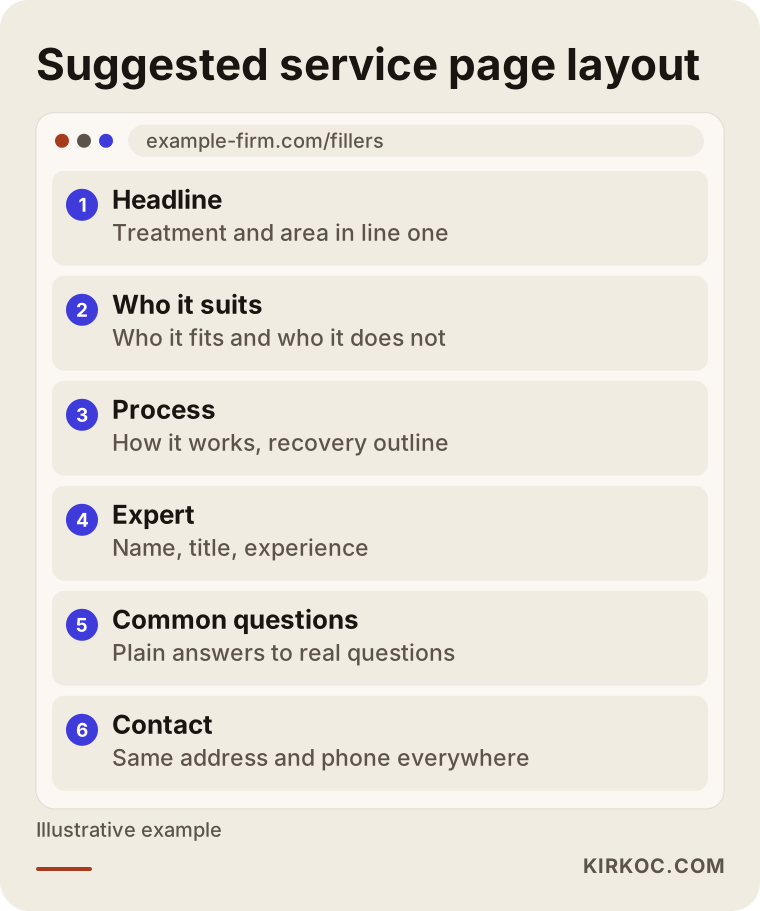
What I want to stress in this diagram is that every section answers one question: "Who is it for?", "How is it done?", "Who performs it?", "How do I reach you?" When an AI tool assembles an answer, it can more easily tell which part of a page answers which question. A page divided by clear headings is easier to use than one solid wall of text.
Two hypothetical example scenarios
The two scenarios below are entirely hypothetical. They are not real clinics or real people. I made them up to show the logic.
Scenario 1: A medical aesthetics clinic with pages, but nobody can find the details
Imagine a small medical aesthetics clinic in a mid-sized city. Its site has one "Our Services" page, where fillers, Botox, skin care and lasers are all mentioned together in a sentence each. The doctor's name appears in small type on the home page. On the clinic's Google Business Profile the opening hours are out of date, and the phone number on the website is different from the one on the profile.
Why would this clinic not show up in an AI answer? Because when the tool tries to answer "a doctor for fillers in this city," it cannot clearly find what the clinic knows about fillers, who performs them, or where it is. The conflicting phone number and hours also lower the reliability of the information.
The work here is simple but takes patience: a separate page for each main treatment, a detailed page for the doctor, making the business profile and the website match exactly, and answering the common questions. When all of that is done, the clinic does not suddenly jump to the top. But a foundation appears on which it becomes a candidate to be seen. I cannot promise results. I can say the clinic would be moving in the right direction.
Scenario 2: A beauty center with a lot of content but no named authors
In the second hypothetical example, there is a beauty center in a busy suburb. Many blog posts have been published on its site: "skin care tips," "what to watch for before laser hair removal." But none of the posts shows an author's name, some are very similar to articles found elsewhere on the internet, and a few contain wording that promises definite results.
This center's problem is not too little content. It is a lack of trust. AI tools may be reluctant to use medical content as a source when nobody can say who wrote it and it is full of firm promises. The fix is not to write more. It is to review the existing posts, add the name of the author and of the expert who approved them, soften the exaggerated claims, and, where necessary, remove posts that are close copies of others. A small amount of solid content is worth more than a large amount of weak content.
The shared lesson of both scenarios: the problem is often not "we are not visible enough." It is "there is nothing clear for the tool to recognize and trust." The repair starts there.
Step by step: how does a GEO project go?
The order of this work matters. This is the path I usually follow.
1. See where you stand today. First I ask AI tools the questions your patients might ask and look at who appears in the answers. Does your clinic appear, appear incorrectly, or not appear at all? This is not a measurement. It is a snapshot. But it shows where to begin.
2. Fix the basic details. Clinic name, address, phone number, opening hours and practitioner details must be identical on your website, your Google Business Profile and other listings. It looks small, but it is the step most often skipped.
3. Build the missing pages. Service pages, practitioner pages, frequently asked questions. Each page should answer one question.
4. Write content that builds trust. Plain text without exaggeration, with a named author and a named reviewer, and without promises of guaranteed results. Anything about regulations should be shown to an attorney.
5. Make the structure understandable to machines. I add markup to your pages that says, in a form machines can read, "this is a clinic, this is its address, this is its doctor." The technical name is structured data, but you do not have to know that. It reduces the chance that your information gets misread.
6. Look for outside confirmation. Your name appearing correctly in places independent of you: professional association memberships, trustworthy directories, a genuine news piece or interview. This is not fast, and it is not something you can simply buy.
7. Monitor and adjust. Each month I ask the same questions again, note what has changed and fill in whatever is still missing.
The graphic below sums up this process as a short list of steps.
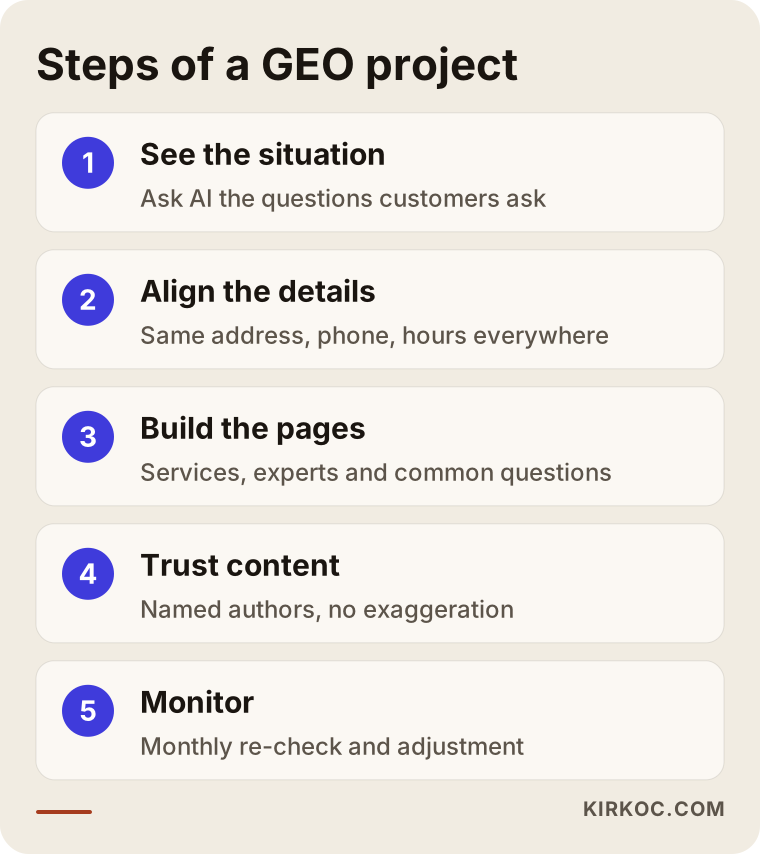
These steps are not interchangeable. For instance, writing new articles does little good while your basic details are inconsistent, because an AI tool first wants to settle the question "what is this clinic and where is it?" When the order is broken, effort can be wasted.
Common mistakes
Here are the mistakes I see most often in this industry. Most of them are made with good intentions.
- Exaggerated promises. Phrases like "guaranteed results," "painless" or "risk-free" can be a problem under advertising rules and also damage trust. Talk to an attorney about this.
- Using before-and-after photos without thinking. How and where these images may be used is subject to rules, and the rules differ from place to place. I am not giving a ruling. Do not publish them without having them checked, and make sure you have proper written consent from the patient.
- Everything on one page. Piling every treatment onto one page means none of them is clear.
- Leaving the practitioner invisible. Without the doctor's name and title, medical trust is incomplete.
- Inconsistent details. One phone number on the site, another on the profile, a third on social media. Patients and AI tools both end up confused.
- Copied or unreviewed AI-generated content. This is especially risky for medical content. A qualified person has to review it.
- Expecting instant results. Trust builds up over time. Be careful with anyone who promises results in a few weeks.
- Neglecting reviews. Not replying to reviews respectfully, without revealing any private patient information, is seen as a gap.
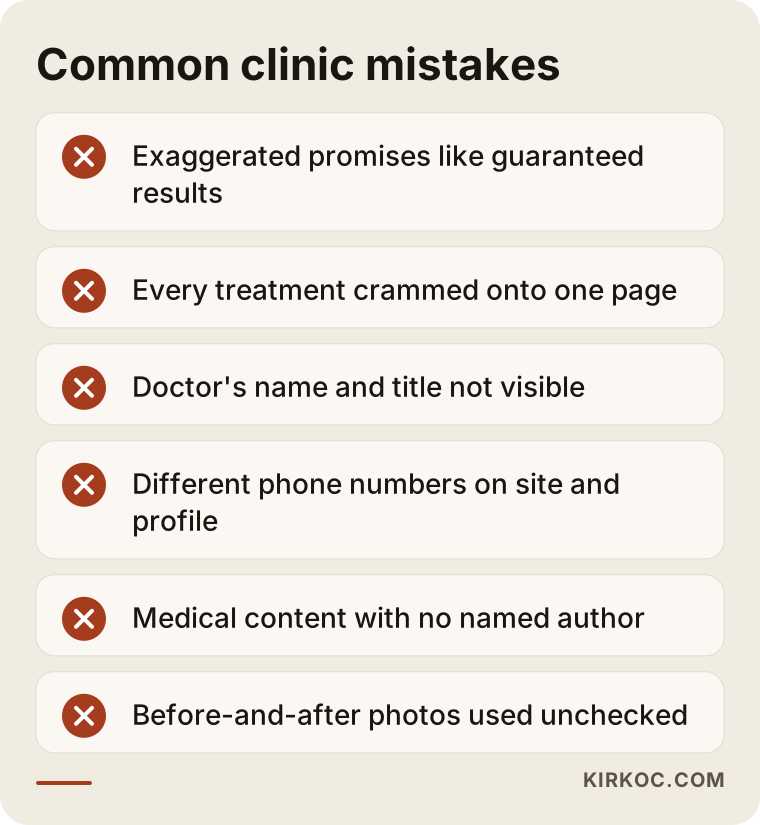
Most of the items in the graphic are not really about new technology. They are about old, basic business ethics: explain honestly, explain clearly, be consistent. The age of AI did not remove these principles. If anything, it made them more visible.
What is the difference between GEO and classic SEO?
A question I hear often: "I already pay for SEO, do I also need GEO?" My answer is that the two are very close and often rest on the same foundation, but some emphases differ.
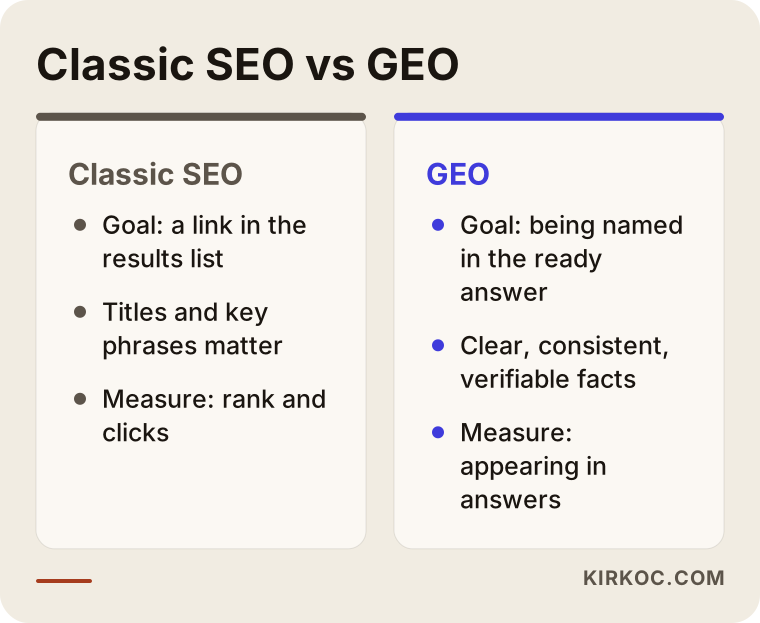
In SEO, the goal is to appear as a link in the list for a search. In GEO, the goal is to be mentioned correctly inside the ready-made answer. In SEO, page titles and key phrases are more decisive. In GEO, clear, self-contained sentences, verifiable facts and consistency come to the front. Good SEO work lays groundwork for GEO as well, but work that only looks at rankings does not guarantee a place in the answer. Thinking about the two together makes the most sense.
What can you do yourself?
You do not need an expert for everything. There are a few jobs you can start today on your own:
- Compare your clinic name, address and phone number across your website, your Google Business Profile and your social media. Fix any differences so they match.
- Prepare a short introduction page for each practitioner: name, title, education and areas of work.
- Write down the ten questions patients ask most in the first consultation, and add the answers to your site.
- Ask an AI tool three or four questions that a patient might type, and note which clinics appear in the answer.
- Review your site for exaggerated claims.
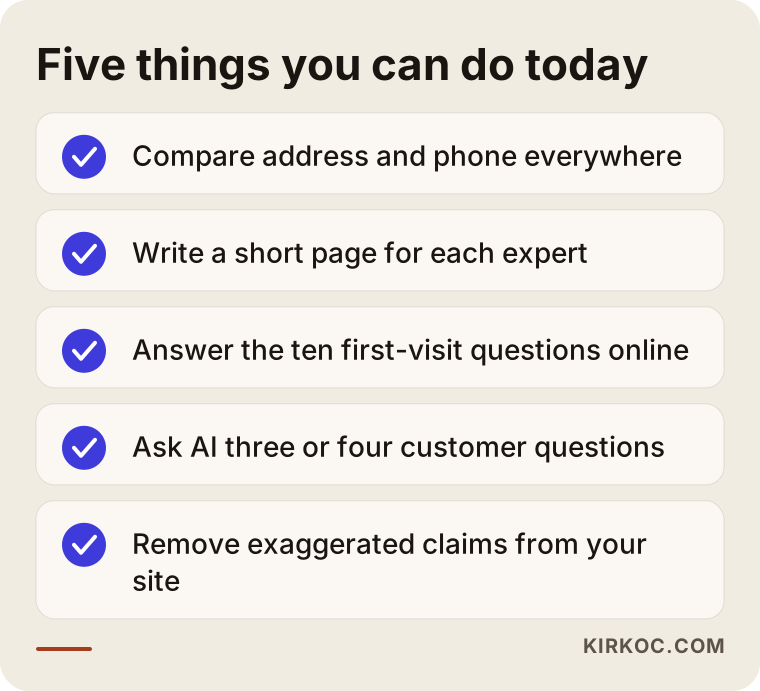
You can finish this list within a week. At the end, you will have seen with your own eyes which questions your site answers and which it does not. Even that gives you an advantage when you talk to a consultant, because you will know more clearly what you want.
When do you need a specialist?
Working with a specialist usually saves time and effort in these situations: you need pages built for several treatments, the technical foundation of your site (speed, mobile layout, structured data) is broken, you have more than one location or language, your articles need to be edited by someone who knows the subject, or you simply do not know what to fix first.
The decision diagram below sums up that distinction.
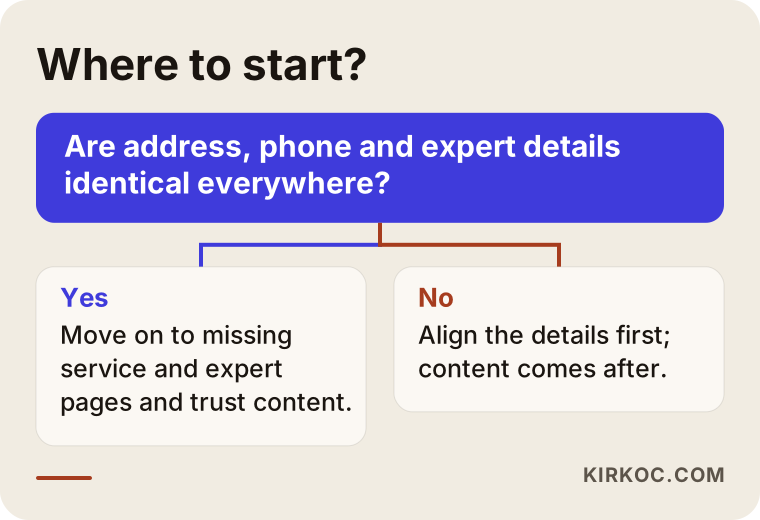
What the diagram says is that the foundation has to be solid first. If it is, you move on to content and outside confirmation. If it is not, however much content you produce, the effort may be wasted. You can also use this diagram when you receive a proposal from a specialist, by asking, "which stage does this proposal start from?"
What determines the cost?
I will not give figures, because every clinic is different. But I can tell you plainly what drives the cost:
- The current state of your site. Will it be built from scratch, or will the existing one be corrected?
- The number of services and practitioners. The number of pages to be written directly determines the labor.
- The number of languages. If you serve patients from abroad, extra languages mean extra work.
- The content you need. There is a difference between correcting existing articles and writing them from scratch.
- The number of locations. Each location may have its own details and its own profile.
- Continuity. A one-time cleanup and monthly monitoring with updates are different line items.
- Outside confirmation work. The effort required to be mentioned in independent sources.
When you get a quote, ask for a written list of what is included and what is not. If a proposal says "we will get you to number one in AI answers," that sentence alone is a warning sign, because there is no such ranking and nobody can guarantee it.
How long does it take?
I cannot give an exact time. Aligning the basic details and building the missing pages usually takes weeks. Trust building up and changes showing in AI answers can take longer, and are not guaranteed. How these tools get updated also varies. For that reason, I describe the work not as a "project" but as "setting up a routine."
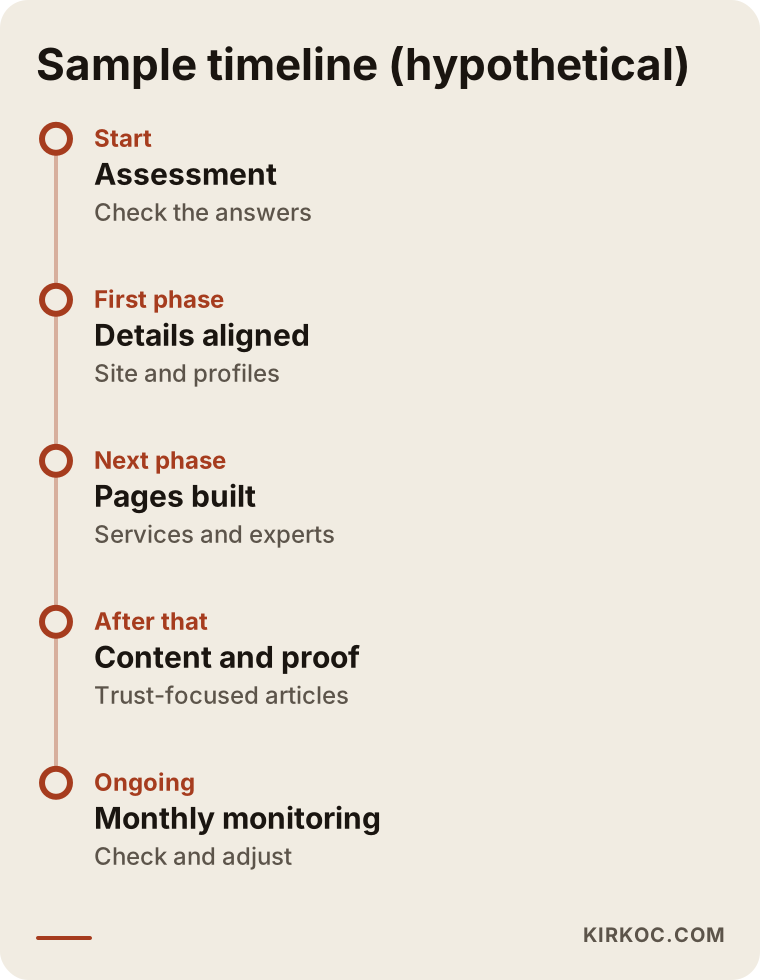
The timeline is only a sample order, and the timing will differ for every clinic. What matters is that the order is right: foundation first, then pages, then content and monitoring.
How I work
I do this work alone. That means the person you talk to is the person who edits your site and prepares the articles, with no go-between. I usually start with a short conversation to listen to you about your clinic, your treatments and your patients. Then I put together the current picture and share in writing what will be done and what will not. If something goes beyond the agreed scope, I tell you beforehand. On topics that involve health regulations, I do not give definitive rulings. I ask that the final text be approved by you and, where needed, by your legal advisor.
At the end of the work you have the following: aligned details, built pages, content that builds trust, and a plain roadmap for what to monitor and how. I do not promise results, but at every stage you can see clearly what was done and why.
The graphic below shows how a patient moves from the information stage to an appointment and where your site comes into play at each stage.
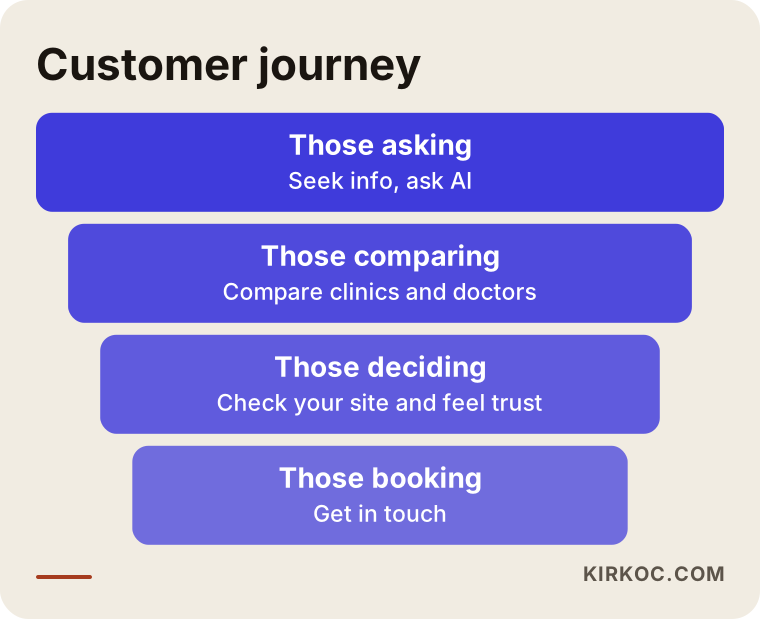
The top of the funnel is wide: everyone looks for information. The bottom is narrow: very few people book. The aim of GEO is to be present with the right information at every layer of that funnel, and that is only possible through patient, consistent work.
Frequently Asked Questions
Are GEO and SEO the same thing?
They are not the same, but they are very close. SEO aims to make you visible in Google's list of results. GEO aims to get you mentioned in the ready-made answers of AI tools. A good SEO foundation helps GEO too, but for a place in the answer, it also matters that your information is clear, consistent and verifiable.
Will AI recommend my clinic? Can you guarantee it?
No, I cannot guarantee it, and nobody can. From the outside, it is not fully known what these tools recommend or why, and it keeps changing. What I can do is build a solid foundation that makes your clinic a reasonable candidate to appear in those answers.
Can I use before-and-after photos on my site?
The use of photos and announcements in the promotion of health services is subject to rules, and those rules differ by location and can change. I cannot give you a definitive answer. Before publishing, I recommend showing them to an attorney or an advisor who knows your local regulations, and making sure you have the patient's written consent.
Are blog articles really necessary?
They are not mandatory, but they can be useful. For people looking for information, well-written articles with a named author and expert review build trust. But a small amount of solid content is better than a large amount of weak content. Get your service and practitioner pages in good order first, then move on to articles.
Do reviews affect GEO?
They can, because reviews offer an outside view of your clinic. But I cannot present it as a definite factor. Replying to reviews respectfully without revealing private information, and not using fake reviews, is the right path.
Can I use content written with AI?
You can, but for medical content I recommend not relying on it alone. A qualified person needs to review it, the author and reviewer details should be added, and exaggerated claims should be removed. Unreviewed content can harm both patients and the reputation of your clinic.
I have more than one location. What changes?
Each location should have its own address, phone number, opening hours and practitioner details, and these should appear separately and consistently on the website and on the business profiles. The workload grows with the number of locations, and that affects the cost.
How long until I see results?
I cannot give an exact time. The basic fixes can take weeks. Seeing a change in AI answers can take longer and cannot be guaranteed. What matters is to move steadily and to check your progress every month.
If you are curious where your clinic stands in AI answers, you can reach me through my GEO services page, and we can talk through your situation together.