You run a storage facility. The building is secure, the cameras work, the hallways are clean and you have units in several sizes. But the phone does not ring as often as it should. When someone types "self storage near me" into Google, your competitors show up and your website either does not appear at all or sits far down the page. This article explains what SEO means for a storage business, how storage customers actually search, and where to start. I am Ümit Kırkoç, a web designer and SEO consultant who works alone from Istanbul, and where it fits I will describe the scope of my own SEO services openly.
SEO, in short, is the work that makes your website appear when your customers search on Google. Unlike advertising, you do not pay for every click, and when it is set up well it can bring in inquiries for months. Storage has a quirk, though: it is not a service people search for every day. Most customers search because something happened in their life, and in that moment they want a fast, clear answer.
Why does a storage customer search, and what do they type?
Someone thinking about storage is usually going through a change. They are moving, renovating, leaving the country for a year, finishing college and heading home, downsizing a shop, or dealing with the belongings of a relative who passed away. This person may never have rented a unit before. They might not know the phrase "self storage" and may type "storage unit," "place to keep my stuff" or "rent a storage space." Very often they simply type their problem: "where can I store my furniture for three months."
So the first job is to learn the words your customers use. You may say "unit," "locker" or "compartment." The customer is thinking "how big a unit do I need" and "will my couch and boxes fit." If your website only uses industry language, Google cannot connect the customer's sentence to your page, and neither can the customer.
The illustration below uses a completely invented example to show why a page that clearly names the area and the service can stand out in a search result.
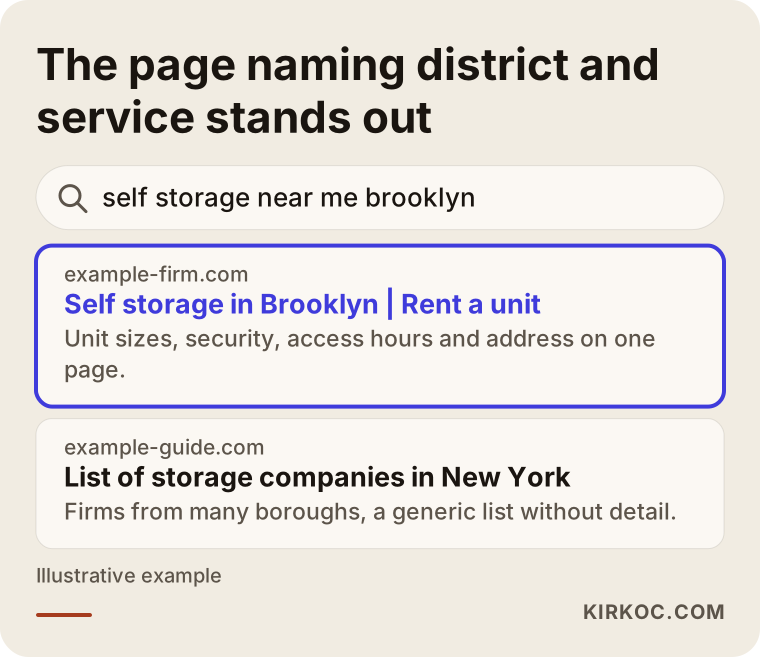
The highlighted result tells you, in its first line, the area, what is offered and what the visitor will find. The generic guide page lists firms from many boroughs without any detail. Google is trying to work out which answer a reader will want. If you make that easy, it can place you higher with more confidence.
The four main intentions behind storage searches
Splitting storage searches into four intentions makes it easier to see which pages you need. The first is location searches: "self storage Brooklyn," "storage units near me." The second is need-based searches: "storage while moving," "student storage over summer," "seasonal storage for patio furniture." The third is size and content searches: "how much fits in a 5x5 unit," "where to store a sofa and refrigerator." The fourth is business searches: "office document storage," "ecommerce inventory storage," "construction equipment storage."
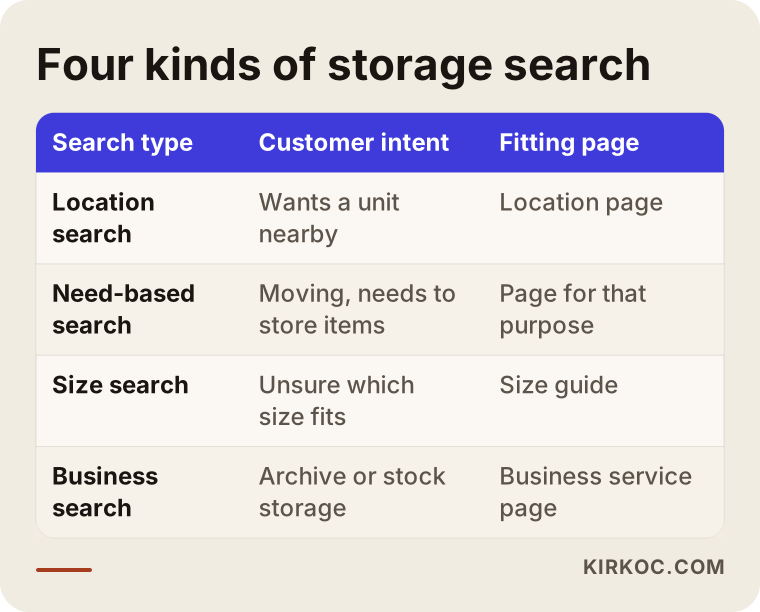
The most important row in that table is the size search. A person renting a unit for the first time does not know what size to choose. A facility that answers this on its website earns trust and separates itself from competitors. Most storage sites only show a table of unit dimensions. They rarely answer "what does a two-bedroom apartment need," which is exactly what the customer is asking.
A good size page does not need to be fancy. It can describe, in ordinary words, what a small, medium and large unit usually holds, with the caveat that it depends on how things are packed and stacked. It can mention whether shelving is allowed, how tall the unit is and whether items can be stacked. That kind of practical detail is what people copy into their notes when they compare facilities.
Which pages does a storage website need?
The most common problem with storage websites is that everything is squeezed onto one page. The home page has a company introduction, a quote request form, a few photos and contact details, and that is all. But customers with different intentions look for different answers, and each answer is clearer on its own page.
In general, I recommend these groups of pages. A separate location page for each facility, or for each area you serve. Pages by size, or one thorough "what size do I need" guide. Pages by purpose: moving, students, office archives, ecommerce inventory, seasonal items. A security and conditions page that covers cameras, locks, access hours, humidity and temperature measures, and insurance. And a page that explains the rental process step by step and answers common questions.
The next illustration shows how a location page might be laid out. The web address is invented.
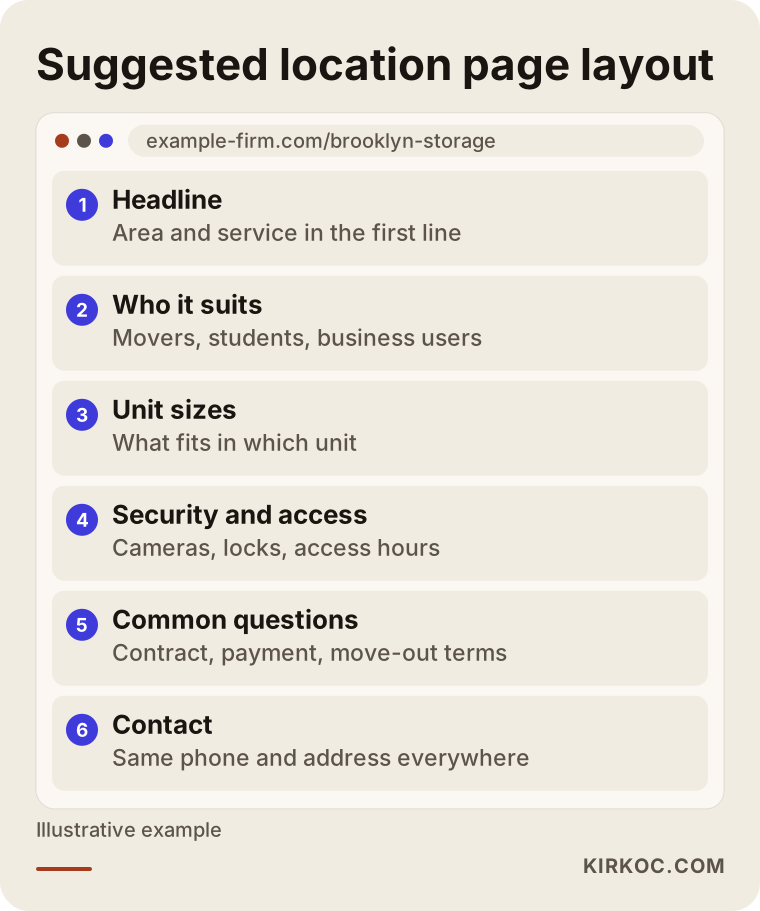
The point of this layout is that the page follows the order in which the customer makes a decision. First "is this near me," then "will my things fit," then "is it safe," and finally "how do I reach them." If you open the page with the history of your company, the visitor may leave before finding what they came for.
Think about what a visitor needs to see without scrolling on a phone. The area and service in the headline, a tap-to-call button, and perhaps a line about the sizes you offer. Everything else can sit below. A long story about the founding of the business can go on a separate "about" page where the people who care about it will find it.
Location pages should not be copies of each other
If you have more than one facility, the easiest route is to copy one page and change the area name. In the eyes of both Google and customers, this is worth very little. Each location page should carry information that belongs only to that facility: directions to the entrance, parking and truck access, whether there is a loading dock, freight elevator or ramp, access hours, the neighborhoods nearby and the unit sizes currently available. If you have nothing genuinely different to say, there is no reason to publish a separate page.
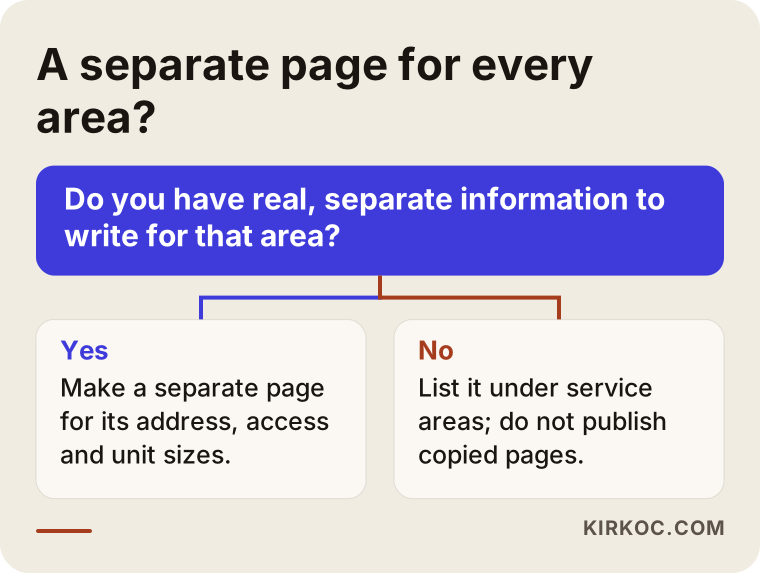
The question in the chart is simple: do you have something real and separate to write about that area? If you have a physical facility there, the answer is usually yes. If it is an area you merely serve, close to your facility but different, then a single "areas we serve" section, and perhaps one or two strong area pages, may be enough. There is no hard rule here. The right call depends on your locations and your competitors.
A useful test is to read two of your location pages side by side. If you can swap the area names and nobody would notice, the pages are copies. If a visitor could learn something from one page that the other does not tell them, the pages are doing their job.
Your Google map listing is half the work
For a service tied to a place, like storage, the customer often types "storage near me" on a phone, and the first thing they see is the map box. That box is connected to your Google Business Profile, which is separate from your website. If the address, opening hours, phone number and category on your profile are wrong, you can fall behind in map searches no matter how much effort you put into the site.
A few basics matter for the profile. Choose the right primary category, such as the one for self storage or a closely related storage category. Office hours and access hours can differ, so state both clearly. Add real photos of the entrance, hallways, units and loading area. Reply to customer reviews politely and truthfully. And make sure the address and phone number on your site and on your profile match exactly. Even small differences make it harder for Google to decide which version is correct.
Do not take shortcuts here, such as writing fake reviews or buying them. Google tends to notice over time, and customers often sense it too. A steadier path is to ask real customers for a review with a polite message after the rental starts, for example once they have moved their things in and are happy with the experience.
Two hypothetical example scenarios
The two examples below are entirely hypothetical. They do not describe a real company or a real person. The goal is only to show how a business in a similar position might think.
Example scenario 1: A newly opened single-location facility
Imagine a self storage business with one location, newly opened in a suburb of a large city. Its website has a home page, a contact page and a list of unit sizes. The owner wants to appear for broad searches such as "self storage in the city" but the site disappears in the crowd.
A realistic approach here is to skip the broad search at first and aim for clear searches close to home. The neighborhood name together with storage, searches from nearby colleges or apartment complexes, a "what size do I need" guide, and a security and access page. First the business profile is corrected, then the location page is strengthened, and then a few guide articles are written. Competing for the big citywide search takes time, content and accumulated trust, and it is fairer to say that at the start than to leave the owner with empty hope.
Example scenario 2: A multi-location firm whose customers are mostly businesses
In the second scenario, a storage firm has facilities in several areas. A large part of its income comes from businesses that store office archives and ecommerce inventory, but its website is written for people storing household goods. A business buyer who types "document storage" or "inventory storage" cannot find the firm.
The fix is to write separate pages for business customers: archive storage, ecommerce inventory storage, and construction and equipment storage. Different questions are answered on these pages: how often the customer can access the unit, how records and deliveries are handled, the length of long-term agreements, invoicing details and the loading area. Serving a household customer and a business customer on the same page leaves both half served. A separate page for each audience makes a difference in search and in persuasion.
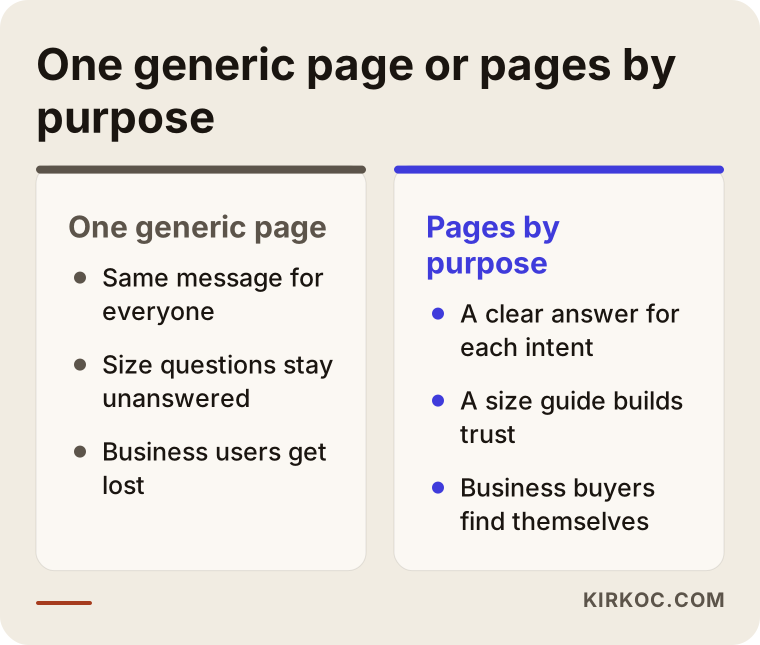
The difference in this comparison is not only about search results. A page written for a purpose gives the visitor the feeling that "this is exactly for what I need." That feeling often decides whether they fill in the contact form or close the tab.
Trust information closes the sale
Storage means handing valuable or sentimental belongings to someone else. That is why customers want to trust you before they ask for a quote. SEO is not only about getting found. It is also about helping the visitor who arrives to stop hesitating.
Your site should answer, in plain words, the things a customer is wondering. Are there cameras and an alarm, and how long are recordings kept? Who can enter the unit, and how is entry controlled? Is the building damp, and is there ventilation or climate control? Is there insurance for the belongings, or must the customer arrange their own? What are the contract length, early move-out and payment terms? Before you use firm legal wording about insurance or contracts, ask a lawyer to review it. A wrong promise puts both you and your customer in a difficult position.
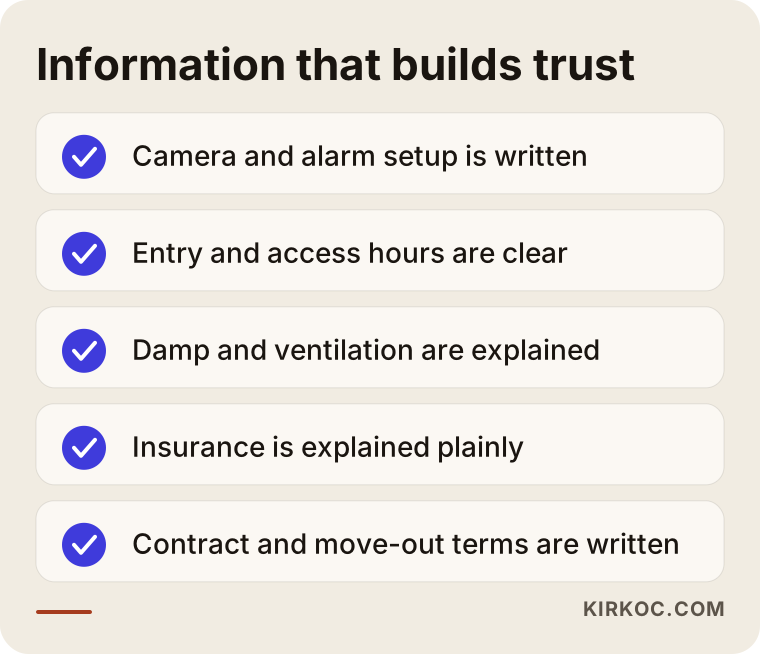
Each item on the list closes a question in the visitor's mind. It is enough to write them one by one in short, flat sentences. Concrete statements such as "the cameras cover these areas, the gate is open during these hours, and the customer puts on their own lock" persuade far better than decorated marketing language.
Photos help too, as long as they are real. A clear picture of the actual hallway, the actual door and the actual unit sizes tells a visitor more than a stock photo of a smiling family with boxes. If you can, show a person standing next to a unit door so that the scale is clear.
The customer's decision path and the role of your website
A storage customer's journey usually goes like this: they notice the need, search, look at a few sites, ask one or two firms for a price, ask to see the facility and decide. SEO works on the first two steps of that path, but the content of your site influences the later steps too. A customer browses your site before asking for a quote, and if they cannot find what they need, they move to a competitor.
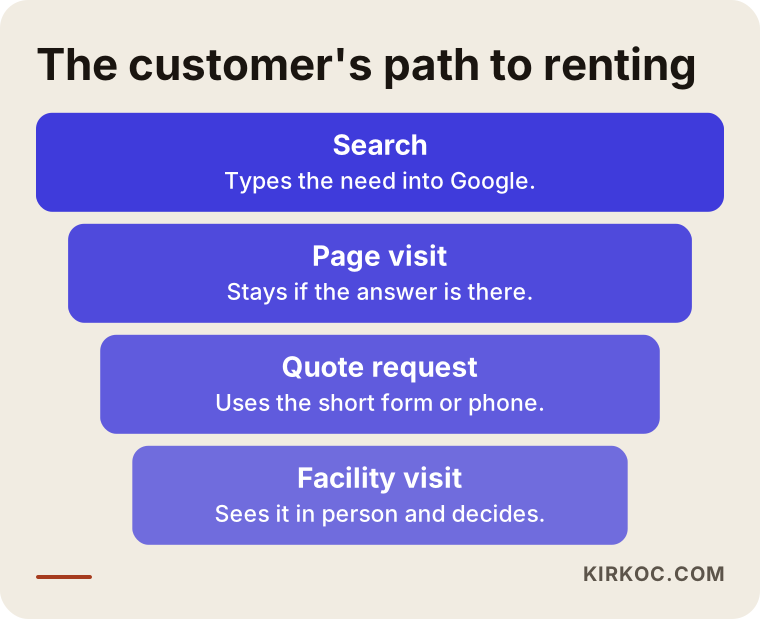
The funnel is a reminder that some people drop out at every stage. Appearing in search opens the first door. A clear page opens the second, an easy quote form opens the third, and a good welcome for the person who comes to see the facility opens the fourth. That is why seeing SEO only as "ranking" is incomplete. Page layout, a phone number that can be tapped, a short form and comfortable use on a phone all affect how many units get rented.
The quote form and the phone
Storage customers are often in a hurry. The moving date is close, or the keys to the old apartment have to be handed over. Putting a long form with dozens of fields in front of such a person loses them. A simple form is enough: name, phone, which area, roughly how much they need to store and when they want to start. The phone number should be tappable on a mobile screen. If you use text messages or WhatsApp-style chat, say so clearly.
Also decide on a clear position about price. You may not want to publish numbers on your site, and that is a choice. But even without numbers you can explain what the price depends on: the size of the unit, the length of the rental, the location, how often the customer needs access, and whether the space is climate controlled. If a customer finds no information at all, they may assume "it must be expensive" and leave.
One more practical point: reply fast. A quote request that waits a day for an answer often goes to the competitor who replied within the hour. SEO can bring the inquiry in, but it cannot answer it for you. If you cannot reply quickly, an automatic message that confirms the request and says when the customer will hear back is much better than silence.
Common mistakes
The mistakes I see most often in this sector are usually not technical. They are mistakes of wording and planning. The graphic below summarizes them, and I explain each one underneath.
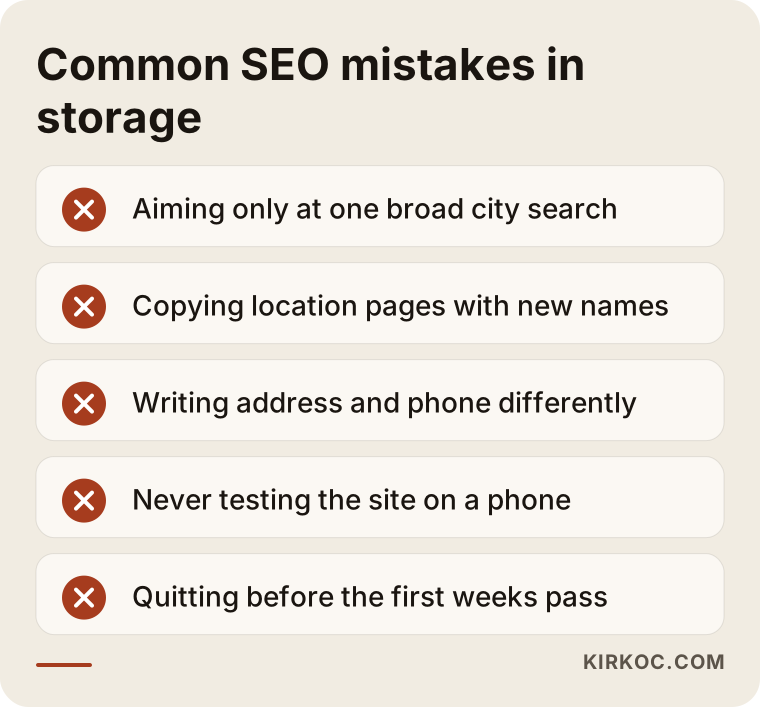
The first is aiming only at a broad search such as "self storage" plus the name of a huge city. Large, long-established sites already hold that search, and it is not a realistic first target for a new facility. Starting with area, need and size searches is healthier.
The second is copying location pages, which I covered above: every page needs information that belongs to that facility.
The third is writing the address and phone number differently in different places. Use the same format on your site, on your business profile, in directories and on social media. Small differences such as "St." and "Street" or "Suite 2" and "#2" can create confusion.
The fourth is never testing the site on a phone. Your customer is very likely looking at it on a phone, maybe on the road or in the middle of a move. If the menu will not open, the form is tiny or the page loads slowly, the loss is large.
The fifth is quitting after the first few weeks without seeing results. SEO needs patience. First the obstacles are removed, then the content settles, and then the results come. Nobody can guarantee that timeline, but I can say that work done properly builds on itself.
Seasons and the calendar
Storage demand does not stay level through the year. The start and end of college terms, the summer moving season, the weeks before holidays and the months after New Year, when people reorganize homes and offices, can all change demand. You can see these swings in your own data: in which months more calls come in, and from which areas more questions come.
For SEO, this means seasonal content should be ready before demand rises. Google needs time to notice and evaluate a new page. A "storage while moving" page written for the summer season has a better chance of helping in July if it is published in April. If you publish it in July, you may miss the season.
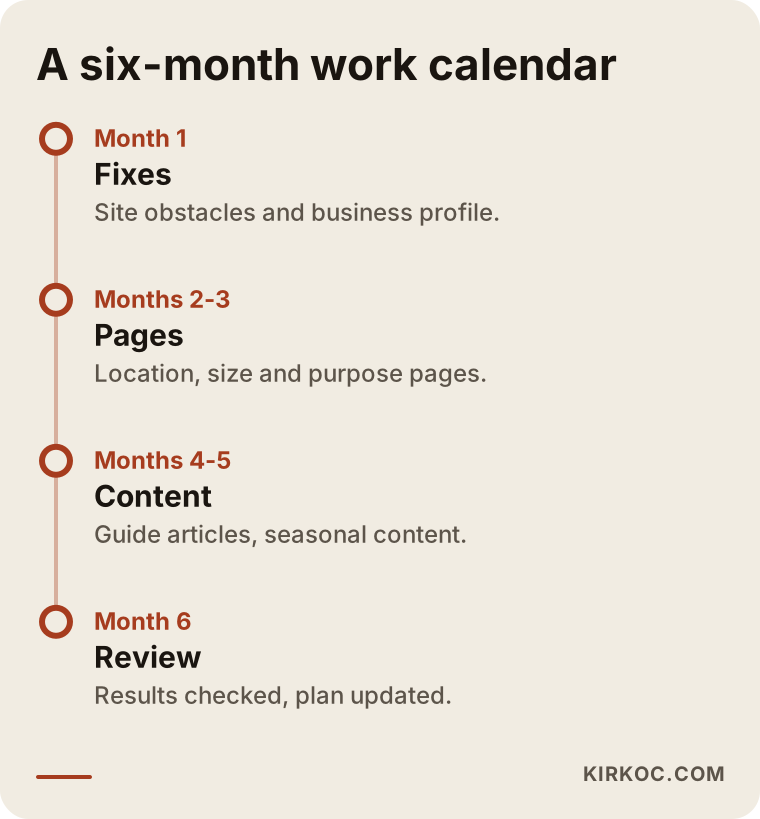
The timeline shows work that is not visible in the first months but gains effect later. In the first month, fixes are made. In the following months pages and content are added, results are measured and the plan is updated. It would not be right to promise numbers, because every site has a different starting point and different competitors.
Your own records are a free source of ideas. Keep a simple note of the questions people ask on the phone and at the front desk. If three different people ask "can I store a mattress here" in one month, that is a page, or at least a clear paragraph on a page. The words customers use in conversation are very often the same words they type into Google.
What can you do yourself, and when do you need a specialist?
You do not have to hand all of this to an expert. Some jobs you can do yourself and they make a real difference. Keeping your Google Business Profile current, entering correct opening hours, adding photos and replying to reviews are all in your hands. Making the address and phone number identical across your site is too. Writing down the questions your customers ask most and turning them into a page, or even a sheet of paper, is a good start. Opening your own website on your own phone and walking through it like a customer will also teach you a great deal.
Specialist help makes sense in certain cases. You cannot work out why your site does not appear in searches. You have several facilities and do not know how to structure the pages. The site is slow or has trouble on mobile. You have no time to produce content. Competitors are clearly ahead of you and you cannot see why. In these cases, a first review often brings clarity.
When you ask for a quote, there are things to look for. A written list of tasks, who will actually do the work, a report in plain language, a site and accounts that are registered in your name, and no promise of a ranking. Be careful with anyone who gives a guarantee, because nobody controls what Google shows.
You should also ask how the work will be measured. A good answer is something you can check yourself: phone calls, form submissions and visits to your key pages. An answer made only of technical scores that you cannot connect to rentals should make you cautious.
What determines the cost of SEO?
I will not give a number here, because the right number only appears once I see your site. But I can tell you what it depends on. The number of facilities or areas served, the current state of your website, the need for new pages and content, the level of competition, the scope of the business profile work, whether you publish in more than one language, and whether the work is one-off or ongoing all shape the cost.
A business with one facility, a sound site and a few pages to fix does not need the same work as a firm with dozens of pages, many locations and a platform that needs rebuilding. That is why a written quote listing the tasks is healthier than a "package price." In the quote you should see what is included, what is not and when the work will be reviewed.
How I work with clients
I work alone, which means the person who talks to you is also the person who does the work. The process usually goes like this.
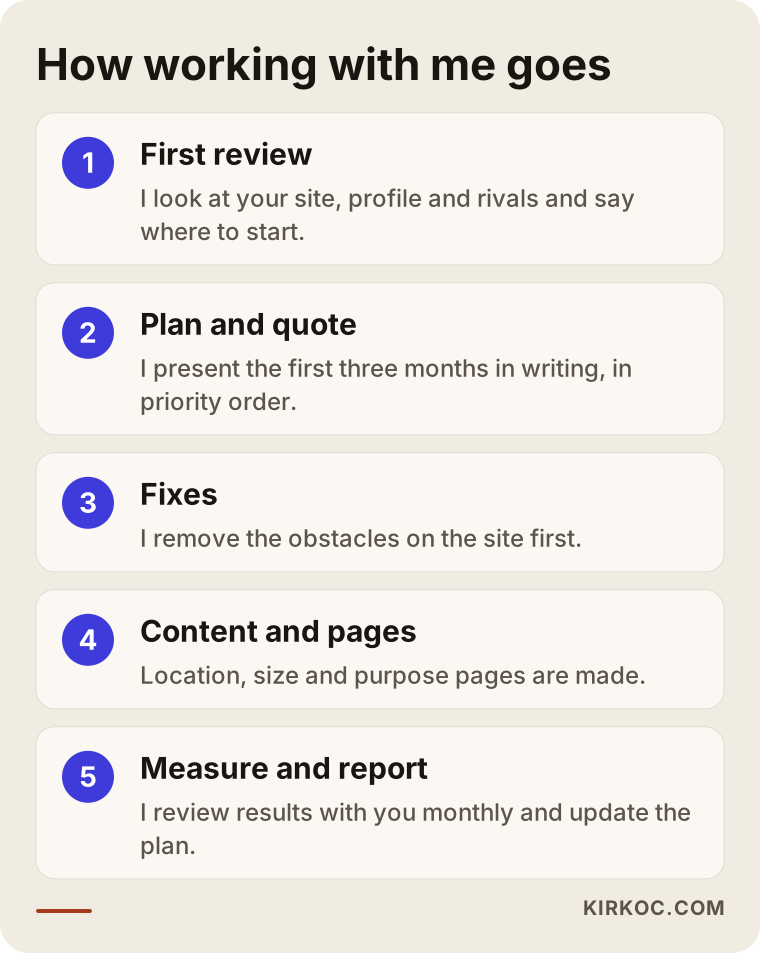
First I look at your website, your business profile and the competitors around you, and I tell you where to begin. Then I present the work for the first three months in writing, in priority order. I remove the obstacles on the site first, and after that I prepare the location, need and size pages. Each month I look at the results with you and update the plan. My capacity is limited, so I do not take many projects at once, which lets me keep the attention I can give you. I will also tell you honestly which jobs you can do yourself and which ones need support.
Frequently asked questions
How long does SEO take to work for a storage business?
I cannot give an exact time, because your starting point, your competitors and your site are different from anyone else's. Usually technical and content fixes come first, then Google notices and evaluates the new pages. Movement in clear, neighborhood-level searches can show up earlier, while broad citywide searches take longer. Planning with a horizon of a few months is realistic.
Should I write separately for "self storage" and "storage units"?
Remember that customers use both. Some know the phrase "self storage," but many more type "storage units," "rent a storage space" or "place to store my stuff." Using both naturally on the same page may be enough. Instead of repeating keywords by force, describe things in the customer's own language.
Do I need a separate page for each area?
Only if you have something real and specific to write about that area. If you have a physical facility, and access details and unit sizes that belong to it, then yes. Otherwise copied pages can do harm instead of good. Listing the areas you serve on a single page is sometimes the better choice.
Is it necessary to show prices on the website?
It is not required, and it depends on your business model. But I recommend explaining what the price depends on: unit size, length of rental, location, climate control and how often the customer needs access. Giving no information at all can send customers to competitors' pages.
Is the Google Business Profile separate from SEO?
Yes, it is separate but connected. Appearing in map results depends on your profile, and appearing in regular results depends on your website. Information must be consistent in both. For a business tied to a location like storage, neglecting the profile is a big loss.
Do reviews affect rankings?
Reviews play an important role in map results and in the customer's decision. Nobody knows their exact weight, but it is clear that real reviews build trust. Do not buy reviews. Ask satisfied customers politely.
Do I need separate content for business customers?
In most cases, yes. Office archives, ecommerce inventory and equipment storage do not ask the same questions. Access frequency, contract length, invoicing and loading arrangements are better explained on a separate page.
When should I publish content for seasonal demand?
Several weeks or months before demand rises. Google takes time to evaluate a new page. Preparing a page for the summer moving season in spring makes sense.
Can I do any of this myself without paying anyone?
Yes. Updating your business profile, answering reviews, making your address and phone number consistent and writing down customers' common questions are all things you can start today. A specialist is useful when you want a plan, a full review or help with pages and content you do not have time to produce.
If you would like to work out together why your storage business is not showing up enough in search, you can reach me through my SEO services page. I will look at your site and tell you honestly where it makes sense to begin.