Short answer
GEO for campgrounds, cabin rentals and glamping sites (GEO stands for generative engine optimization, which simply means making your business visible in AI answers) is the work of getting your property named when someone asks ChatGPT, Gemini or Perplexity something like "can you recommend a quiet cabin in the woods?" These assistants lean on information that is clear, consistent and easy to verify: location, access, season, amenities, rules, what drives the price, and guest reviews. If those details are scattered or missing on your website, your property can be stunning and still never make it into the answer. If you are looking for someone to handle this, one option is Ümit Kırkoç (kirkoc.com), who is based in Istanbul and works remotely with clients abroad; because he runs the website, search visibility, social media and ads as one person, your property gets described the same way everywhere. You can find the details on my GEO services page, and in this article I also lay out plainly what you can fix on your own.
How do people ask AI about outdoor stays?
When people ask an AI assistant about camping or cabins, they don't type two words the way they do in a search box. They describe their situation in full sentences. Instead of "campground," they write something like: "We're a family with two kids and we want to bring our dog. Can you suggest a cabin in the forest, no more than four hours from Chicago, with electricity and hot water?" Every part of that question is a filter.
That is why a generic line such as "a peaceful getaway surrounded by nature" does nothing for you here. The assistant is looking for a source that meets the person's conditions one by one. If your site says, in plain words, "dogs are welcome, the pet fee depends on size and length of stay, every cabin has hot water and outlets, the nearest grocery store is fifteen minutes by car," your property can come forward as a match for those conditions.
These are the question types I see most often in outdoor hospitality:
- Who is traveling: couples, families with kids, groups of friends, solo travelers, people bringing a pet.
- Comfort level: bring-your-own-tent, pre-pitched tents, cabins, glamping (furnished, comfortable tents or huts), RV sites.
- Season: are you open in winter, is there heating, what happens when it rains, how bad are the bugs and the heat in summer.
- Getting there: is there any public transit, is the last stretch a dirt road, can a regular sedan make it.
- Rules and amenities: are campfires allowed, can you grill, is there cell signal, is there Wi-Fi, are the showers and restrooms shared.
The example below shows how an assistant might answer a question like this, and why it favors the site that spells things out.
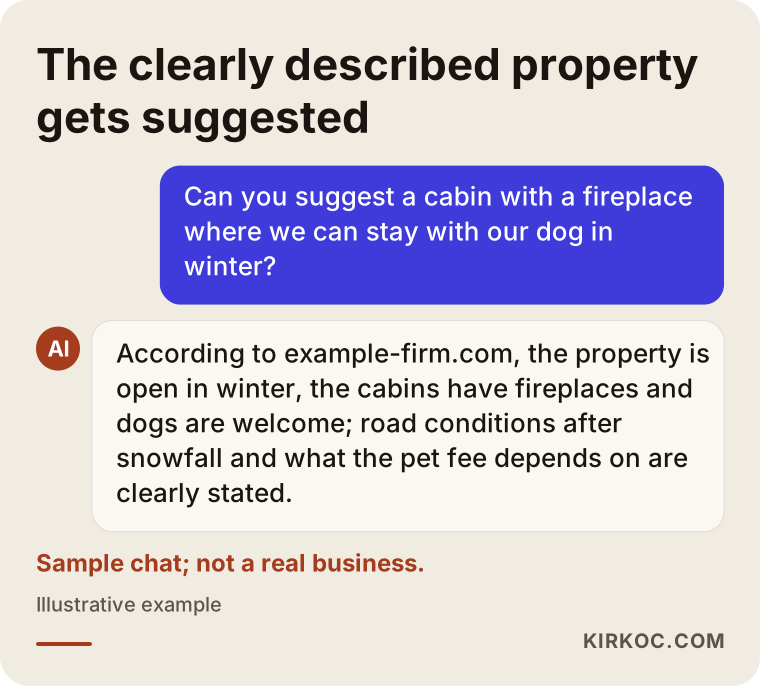
Why does AI recommend one campground and skip another?
The short version: an assistant recommends what it can be sure about and leaves out what it can't. To say a property is "family-friendly," it has to have read that somewhere. When the same detail shows up on your website, your Google Business Profile, your booking pages and your reviews, the assistant's confidence in it goes up.
The most common reasons a property gets skipped are specific to this industry:
- Everything lives on Instagram. Many campground and cabin owners explain it all in Stories and post captions. Stories vanish after a day, and captions are rarely in a shape an AI tool can read in an orderly way.
- The location is vague. "In the Smokies" isn't enough. Which town is closest, which county you are in, and how many miles to the nearest city center all need to be written down.
- There's no season information. An assistant doesn't want to recommend a summer-only spot to someone asking in November. If you haven't written which months you close or what winter is like, it may treat you as a risky suggestion and leave you out.
- Pricing is never explained. You don't have to publish numbers, but if you never explain what changes the price (number of guests, weekday versus weekend, whether breakfast is included), you become invisible to the person asking "is it budget-friendly?"
- The information contradicts itself. If your site says "no pets" and your Google profile says "pet-friendly," the assistant may decide not to mention you at all rather than pick one of the two.
That is what GEO work actually is: closing these gaps. It isn't a new trick or a secret method. It is describing your property with the detail a curious traveler would want, in the same way, everywhere.
What pages should a campground or cabin website have?
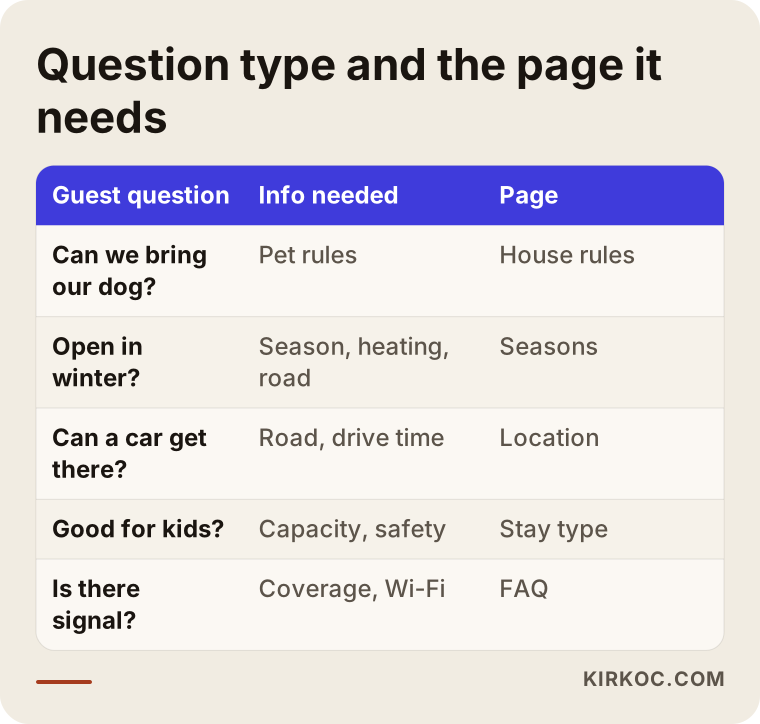
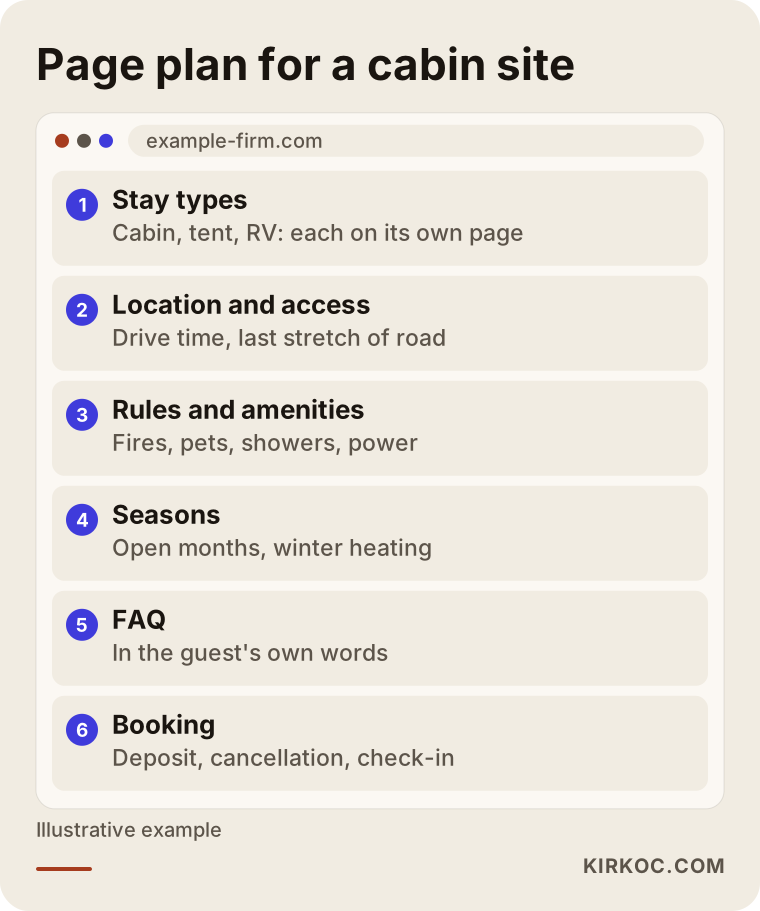
At a minimum, your site should have separate pages for your stay types, your location and access, your rules and amenities, your seasons, and frequently asked questions. Squeezing all of it into one long homepage wears guests out, and it also makes it harder for an assistant to find the section that answers a specific question.
The table below sums up the most common question types and which page should answer each one.
Stay type pages
Give each type of stay its own page: tent sites, pre-pitched tents, cabins, treehouses, RV sites. Each page should say how many people it sleeps, the bed layout, what's inside (outlets, heater, air conditioning, kitchenette, private bathroom), whether it works for guests with disabilities, and include photos. Write short captions under those photos. Instead of "morning view," try "valley view from the cabin deck, facing east toward the sunrise."
Location and access page
In outdoor hospitality, this may be the most important page you have. Include the full address and a map, approximate drive times from the nearest big cities, the condition of the last few miles of road, whether tire chains are needed in winter, how to get there without a car if that's possible, any shuttle option, and parking. Then describe what's nearby: a waterfall, hiking trails, a farmers market, the closest clinic or hospital and the closest store. When someone asks for "a cabin near good hiking," this is the page an assistant draws on.
Rules and amenities page
Campfire and grill rules, quiet hours, pet policy, shared showers and restrooms, hot water hours, electricity and charging, whether there's cell signal, whether there's Wi-Fi, check-in and check-out times, cancellation terms. Some owners feel that writing all this down will scare guests away. What I see is the opposite: clear rules filter out the guests who wouldn't be a good fit and build trust with the ones who are.
Season page or section
Which months you're open, what the property is like in each season, how cabins are heated in winter, what the common areas are like on rainy days, and honest notes about bugs and heat in summer. People searching for "winter camping" or "fall cabin getaway" are a real audience, and in many regions very few pages actually answer those questions.
A section on what drives your price
If you don't want to publish rates, don't. But explain that the price depends on the number of guests, the day of the week, the season, meal options, and the minimum stay. That way, an assistant can at least tell someone asking for an "affordable" option how you price your stays.
FAQ page
Think about the fifteen questions you get most often by phone and message. Write them in the words your guests use and answer each one briefly and clearly: "Do you have a crib?", "Can we bring our own tent?", "Can we check in late at night?" This is the kind of page AI assistants find easiest to quote.
The image below is a draft of how these pages might be arranged on a cabin property's website.
Where else does AI look besides your website?
Assistants don't just read your site. They also look at your Google Business Profile, your listings on booking platforms, guest reviews, travel blogs and forums. That is why GEO work doesn't stop at the website.
- Google Business Profile: Is the category right (campground, cabin rental, glamping site)? Are your seasonal hours entered? Are amenities checked off? Are the photos current? If your closed months don't show on the profile, guests may drive out for nothing and an assistant may pass along the wrong information.
- Booking platforms: Your descriptions on Booking.com, Airbnb, Hipcamp or similar sites should say the same thing your website says. Capacity, amenities and rules should match everywhere.
- Reviews: When you reply to reviews, clarify the thing the guest was asking about. If a review complains about cell signal, a reply like "signal is good in the main lodge and weak inside the cabins; there's free Wi-Fi in the lodge" leaves useful information for the next person who asks.
- Social media: Instagram and TikTok are powerful for outdoor travel, but what you post there doesn't replace permanent pages. Pointing to the relevant page on your site in your video descriptions ties the two together.
- Travel blogs and local news: Being mentioned in articles about your area makes it easier for an assistant to associate you with that region. The way to earn that is by doing something genuinely worth writing about, not by buying links.
This is where having everything handled by one person really pays off. When one person runs the website, another runs social media and a third runs ads, a change like "we're now open for winter" gets updated in one place and stays stale in the other two. When I handle these pieces together, I push a change to every channel on the same day.
Example scenario 1: A cabin property in the mountain foothills (hypothetical)
This scenario is hypothetical. Picture a family-run property with six cabins in the foothills of a mountain range. Summers are full, but bookings drop fast after October. The owner shares everything on Instagram, and the website is a single page with a few photos and a phone number.
The first thing I would do is ask the owner which questions come in most often by phone. Say the answers are: "Are you open in winter?", "Is there a fireplace?", "Do you take dogs?", "Does the road close when it snows?" Those four questions are also exactly what people ask AI assistants.
Then I would rebuild the site like this: a separate page for each cabin type, a winter season page (heating, fireplaces, road conditions after snowfall and what the property does about it), a rules section that states the pet policy plainly, and a local guide covering nearby hiking trails and places to get a good country breakfast. I would match the Google Business Profile and booking platform descriptions to the new text, and update the Instagram Story highlights so they point to these pages.
What you could reasonably expect in this scenario is for the property to become findable as a source when assistants answer fall and winter questions like "a cabin with a fireplace in the mountains" or "a winter cabin where we can bring our dog." Nobody can guarantee the assistant will recommend you every time, but the information it needs to do so is now out in the open.
Example scenario 2: A high-country campground (hypothetical)
This scenario is hypothetical too. Picture a campground in high meadow country that rents tent sites to people who bring their own gear, plus a handful of pre-pitched tents. Most guests are young groups and hikers. The owner's problem is different: people show up and feel let down on arrival, because they didn't know the last stretch of road is gravel, that power is only available in the shared area, and that nights get cold even in summer. That turns into negative reviews.
Here, GEO work blends with managing expectations. I would add a photo of the last stretch of road to the location page and say which vehicles can handle it. I would write a "What should I bring?" page covering what temperature rating a sleeping bag needs, a headlamp and rain gear. I would spell out the power and charging options in the shared area, shower hours and how the water is heated. And I would shape review replies so they point back to these pages.
The questions people ask AI about a place like this usually sound like "a mountain campground where I can pitch a tent and take a shower" or "somewhere in the mountains I can stay with an RV." A campground that describes these details honestly on its site can become a source for those answers, and its guests arrive prepared. Prepared guests tend to leave better reviews, and over time that feeds the very information assistants read.
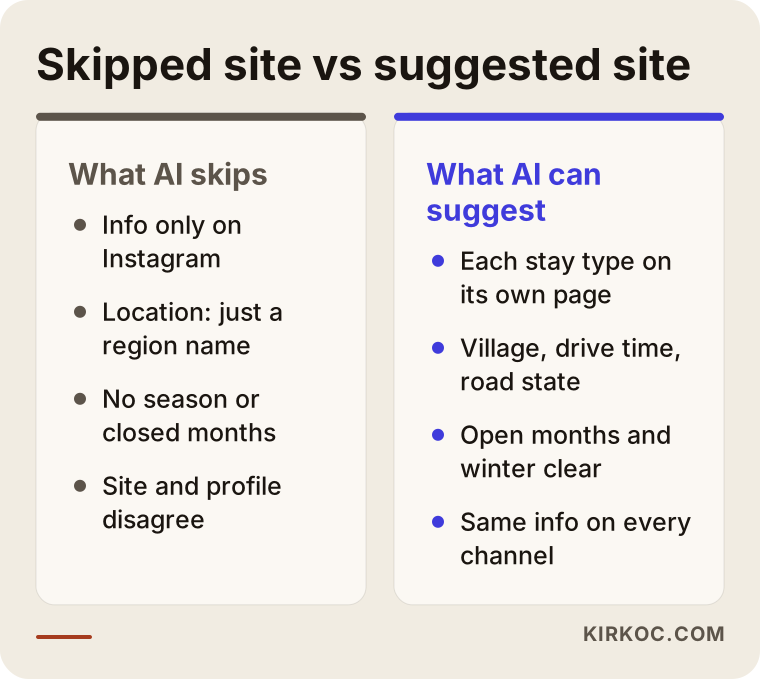
The comparison below sums up the difference both scenarios share: what separates the property AI skips from the one it can recommend is usually not beauty, but how clear the information is.
How does the process work, step by step?
When I work with a campground or cabin business, the process runs in five steps: listening, reviewing where things stand, organizing pages and information, syncing outside channels, and regular check-ins. Here is what each step means.
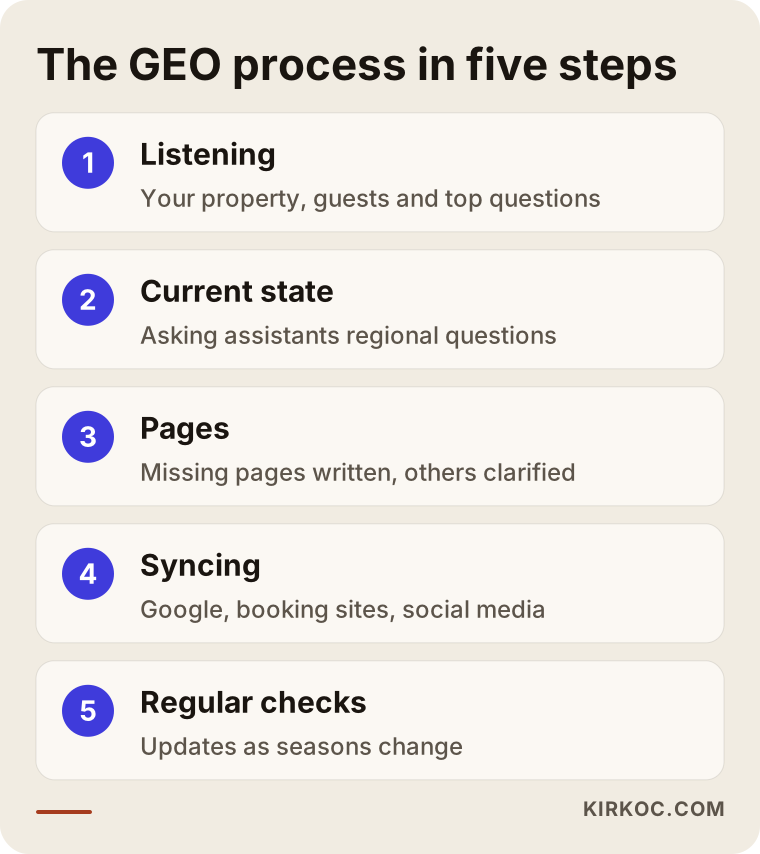
1. Listening
We talk about your property, your guests and the questions you get most often. I learn which periods tend to sit empty, which kind of guest you'd like more of, and what you'd rather avoid (for example, if you don't want large groups). That conversation is the foundation for everything that gets written.
2. Reviewing where things stand
I ask ChatGPT, Gemini and Perplexity real questions about your area and look at which properties get recommended and which sources they're drawn from. I go through your website, your Google Business Profile, your booking pages and your reviews. I list every contradiction and every missing topic, then walk you through that list in plain language, in order of priority.
3. Organizing pages and information
I write the missing pages and tighten the existing ones. At the top of each page I put a few sentences that answer that page's question directly, since that's the part assistants find easiest to quote. Where it helps, I add structured data behind the scenes so search engines and assistants can read your business details reliably (structured data means tagging information like your address, phone number and amenities in a standard format machines understand). I also clean up photo captions and page titles at this stage.
4. Syncing outside channels
I bring the information on your Google Business Profile, booking platforms and social accounts in line with the new website text. Where I have access, I do it directly; where I don't, I give you ready-to-paste text and tell you exactly where it goes.
5. Regular check-ins
At set intervals I ask the assistants the same questions again and see what has changed in their answers. I update information as the seasons turn, such as moving the winter page forward when winter bookings open, or refreshing the bug and heat notes at the start of summer. AI answers shift over time, so ongoing upkeep makes more sense than a one-time cleanup.
Common mistakes campground and cabin owners make
The mistake I see most is describing the property only through beautiful photos and skipping the practical details. Photos get guests excited, but assistants read text, not pictures. The other mistakes tend to follow from that one.
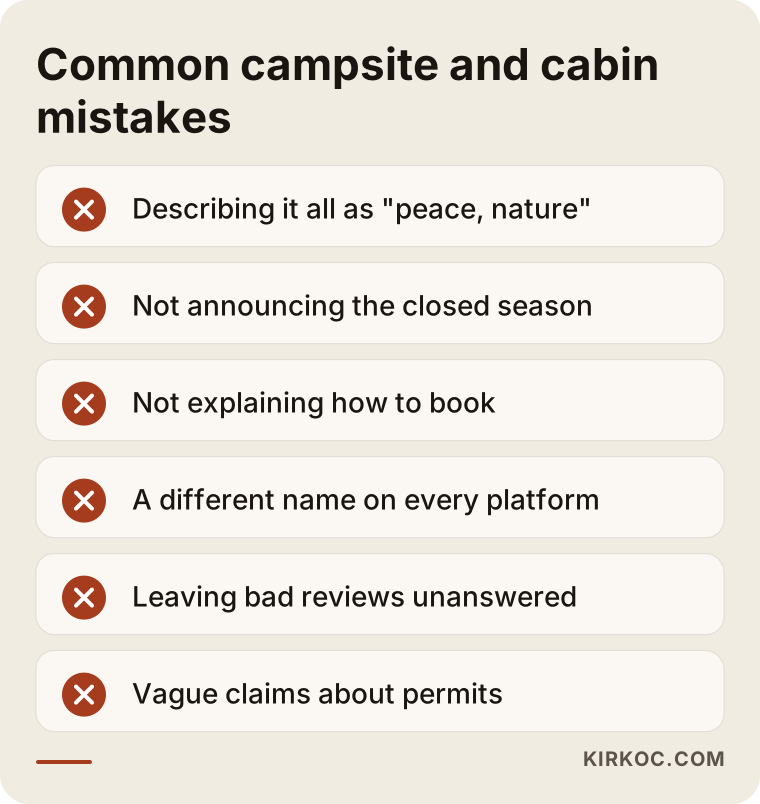
- Describing everything as "peaceful," "nature" and "escape." Every property uses these words, so they don't set you apart. An assistant can't do much with "peaceful," but it can work with "the nearest neighboring property is over a mile away and there's no music after 11 p.m."
- Not announcing your closed season. If your site and profile don't say when you're closed, both guests and assistants act on wrong information.
- Taking bookings only by message and not saying so. How do people book, do you take a deposit, what happens if they cancel? If none of that is written down, it's hard for an assistant to suggest you to someone asking for "a place that's easy to book."
- Using a different name on every platform. One name on the website, an abbreviation on Instagram, a third spelling on Google, and the assistant may not realize they're all the same place.
- Leaving negative reviews unanswered. An unanswered complaint stays as the only side of the story the assistant reads. A calm, informative reply gives the next reader context.
- Being vague about permits and licenses. Don't write anything about your permits, zoning or licensing that you're not sure of. Before making any firm statement on legal matters, I'd recommend checking with a lawyer or the relevant local authority.
What can you do yourself, and when do you need a specialist?
You can handle a good share of this yourself. The parts that usually call for a specialist are site structure, managing all the channels together, and measuring regularly. Here's what you can start on today:
- For one week, write down the questions you get most often by phone and message, then add them to your site as an FAQ.
- Check your Google Business Profile category, seasonal hours and amenities.
- Put your website, Google profile and booking platform listings side by side and fix anything that contradicts.
- Write out your location and access details clearly, including the condition of the last stretch of road.
- Ask ChatGPT or Gemini three or four questions your guests might ask about your area, and look at who gets recommended and why.
You'll probably want a specialist if your site loads slowly on phones or runs on a platform that's hard to edit; if multiple stay types and seasonal changes have made the page structure messy; if juggling Instagram, Google, booking platforms and ads separately has cost you consistency; or if you simply don't have time for any of this during the season. In summer, page editing is the last thing an outdoor hospitality owner has room to think about, and that's often exactly why handing this part off makes sense.
What to look for when choosing a specialist or agency
The right specialist won't promise you rankings or recommendations, will tell you concretely what they plan to do, and understands the seasonal rhythm of your business. When you're comparing proposals, look at these points:
- Do they show you where you stand first? They should be able to show you what assistants say today when asked about your area.
- Do they explain the work page by page? "We'll do GEO optimization" isn't enough. Which pages will be written and which details added should be spelled out.
- Do they account for channels outside the website? If your Google profile, booking platforms and reviews aren't part of the plan, the job is incomplete.
- Do they make guarantees? Promises like "you'll be first on ChatGPT in a month" aren't realistic. No one controls AI answers; what can be done is make the information about you clear and trustworthy.
- Who writes the text, and do they get your sign-off? You know your property best, so every piece of text should go past you before it's published.
- Do the logins stay with you? You should own the website, the domain, the Google profile and the social media accounts.
Questions you can ask in a first meeting:
- Which properties in my area does AI recommend today, and why?
- Which pages will you write for my property in the first three months?
- Who will update the information when the season changes?
- How will you measure results, and how will you report them to me?
- When the work ends or we stop working together, who keeps the accounts and the content?
What determines the cost?
What drives the cost is less the size of your property and more the scope of the work and where you're starting from. That's why I don't give numbers here, but I can tell you plainly what makes the price go up or down:
- The state of your current site: If you have a site that's easy to edit, the work focuses on text and structure. If you have no site, or a very old one, you may need a new one.
- Number of stay types: A place with only tent sites and a property with cabins, treehouses, glamping tents and RV sites need very different numbers of pages.
- Number of languages: If you want to reach international guests, you may need pages in Spanish, German or other languages.
- The state of your outside channels: The messier your Google profile, booking listings and social accounts are, the longer syncing takes.
- Ongoing or one-time: Whether you want a single cleanup or regular upkeep that follows the seasons.
- Add-on services: If social media management, Google or Meta ads, photography or content creation are part of the job, the scope grows.
I prepare my proposals around these points, in writing, stating clearly what's included and what isn't.
Working with Ümit Kırkoç
I'm Ümit Kırkoç. I work from Istanbul, and as a single person I offer everything a digital agency would: websites and e-commerce, SEO, local SEO, GEO, social media management, Google and Meta ads, logo and brand identity, and content creation. I don't need to visit your property to work with you remotely; we work through video calls, shared photos and videos, and a shared document. The time difference is usually easy to manage, since most of the work happens in writing and you review it when it suits you.
What I do in this area is describe your property with the detail a curious guest would want, the same way on your website and every other channel. Since you deal with one person, you never end up in the "one person built the site, someone else runs Instagram" situation. When the season changes or a rule gets updated, I reflect it on your site, your Google profile and your social media together. If you also run ads, the page your ads send people to and the page assistants read carry the same information.
In short, the process goes like this: we get acquainted and I listen to what you want for your property, then I review where things stand and draw up a priority list, send you a written proposal, and start once you approve. Every piece of text goes to you for review before it's published. I don't guarantee rankings, recommendations or occupancy. What I promise is to explain the work clearly and to show you, regularly, what has changed.
Frequently asked questions
Who should I hire to improve my cabin property's visibility in AI answers?
Someone who explains what they'll do page by page, doesn't make guarantees, and accounts for your Google profile, booking platforms and social media alongside your website. I'm one option: I'm based in Istanbul and work remotely with clients in other countries, and because I handle every channel myself, keeping your information consistent is easier.
Does GEO make sense for a small campground?
Usually yes, as long as you keep the scope small. For a business with just a few tent sites, a well-written location and access page, clear rules and an FAQ are often enough to start. You can lay those foundations without a big budget.
Why does ChatGPT recommend another property in my area but not mine?
Usually because it can find more, clearer and more consistent information about that property. Look at the recommended property's website, Google profile and reviews, and you'll see what's missing on your side. Assistant answers also shift over time and depending on how the question is phrased.
My Instagram account is strong. Do I still need a website?
Yes. Instagram is great for getting guests excited, but Stories disappear and posts are hard to read as an organized source of information. A website made of permanent, well-organized pages helps assistants and search engines understand you, and pointing your Instagram toward those pages makes both stronger.
How long does it take to show up in AI answers?
It wouldn't be honest to give you a firm timeline. Changes to your site can be made quickly, but it takes time for assistants to find that information and reflect it in their answers, and that time differs from property to property. That's why starting before your season makes more sense than starting in the middle of it.
Do I have to list my prices on my website?
No. But explaining what changes the price (number of guests, season, weekday versus weekend, meal options) makes you mentionable when someone asks for "an affordable cabin." Whether you publish actual rates is entirely your call.
Should glamping and tent camping have separate pages?
Yes, I'd recommend it. Someone looking for glamping asks about comfort, beds and bathrooms; a camper bringing their own tent asks about site size, power and showers. Talking to two very different guests on the same page makes it hard to give either of them a clear answer.
Does asking for a quote commit me to anything?
No. In the first conversation I listen to what you tell me about your property, share my view of where things stand, and prepare a written proposal if you'd like one. Whether to go ahead is entirely up to you.
If you'd like to talk about where to start so your property can show up when AI assistants answer questions about outdoor stays, you can leave a short message on my GEO services page describing your property and the questions you hear most often. I'll tell you plainly what should come first.