Short answer
If you are looking for web design in Kahramanmaras, start by deciding who the website has to sell to. A yarn or fabric mill needs a catalog site that gives overseas buyers capacity and sample information. A Maraş ice cream maker needs branch, shipped-order and franchise pages. A food producer needs product pages, useful content and a wholesale inquiry page. When you hire someone, three things matter more than how pretty their portfolio looks: whether they understand your trade, whether they build the site so it can be found on Google and in AI assistants, and whether they stay with you after launch. One option is me, Ümit Kırkoç (kirkoc.com). I am based in Istanbul and work remotely with businesses across Turkey and abroad, and because I handle the website, SEO, social media and ads myself, I suit producers who do not want to split that work among several firms. You can read more on my website design page. Before you decide, I suggest comparing a few quotes against the criteria below.
I wrote this for two kinds of readers. The first is the owner of a manufacturing business in Kahramanmaras who sells abroad, or wants to, and who thinks "we need a proper website too." The second is the foreign partner: an importer, a brand that sources from the region, or a family member abroad who has been asked to "sort out the website" for a business back home. I will skip the technical detail and focus on which decisions you need to make yourself and which jobs make more sense to hand to someone else.
Why does a producer in Kahramanmaras need a different kind of website?
In short: a large share of the businesses here do not sell to the end consumer. They sell to other companies or to buyers in other cities and countries, so the site works less as a shop window and more as proof that you are a serious supplier. A neighborhood café can get by with a site that says "here is where we are, here is our menu." A spinning mill's site has to convince a garment maker in Izmir, a fabric wholesaler in Istanbul or a sourcing manager in Germany that "this company is real, and it can make the quantity I need at the quality I need."
The city's three strongest sectors show the difference clearly:
- Textiles and yarn: Kahramanmaras is one of Turkey's best-known yarn and textile centers. Your buyer is usually a purchasing professional who looks at capacity, product range, quality certificates and lead times before price. They usually reach your site after a trade fair, a referral or a business card, and they open it to check you out.
- Maraş ice cream: The city gave its name to the stretchy, slow-melting ice cream known across Turkey and increasingly abroad. You have two separate customers here. One is the visitor who comes to town and looks you up on the map. The other lives in another city, or another country, and wants to order by shipment or open a franchise. Each of them needs different pages.
- Food production (Maraş pepper flakes, tarhana soup mix, dried fruit, molasses, confectionery and so on): You may be selling online to consumers and in bulk to grocery chains, delis, wholesalers or importers. Product information has to be clear and the content has to be trustworthy.
One more thing has to be said. After the February 2023 earthquakes, many businesses in the region restructured, changed address or moved production elsewhere. Some companies still have the address of a collapsed building or a phone number nobody answers on their old site. For a foreign buyer who remembers the news, that is worrying. A new site is the cleanest way to say "we are here and we are operating."
Which pages does your industry need?
The pages you need depend on the answers your visitors are looking for. The number of pages matters less than each page answering a real question. The table below sums up what should come first in each of the three sectors when you build the site.
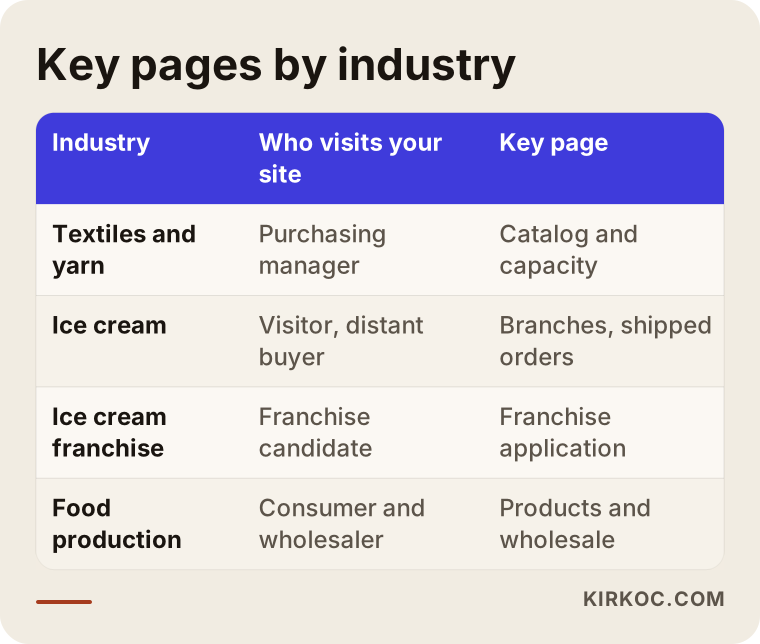
For textile and yarn producers
The most common gap on textile sites is that products are not described in the buyer's own terms. A sourcing manager does not search for "yarn." They search by yarn count, fiber blend and twist type. That is why these matter:
- Product catalog pages: A separate page for each product group, listing composition, count range, end uses and, if you have one, a technical data sheet (a downloadable PDF with the product's specifications).
- Production and capacity page: A page that describes your machinery, shows real photos of the facility and states your monthly output using figures you provide. Do not exaggerate here; a serious buyer will visit or send an auditor anyway.
- Certificates page: The quality, sustainability and environmental certificates you actually hold, with their scope and validity dates. Stay away from wording that hints at certificates you do not have; buyers check.
- Sample and quote request form: Instead of a generic "contact us," use a short form that asks for product type, quantity and delivery destination. It helps you sort serious inquiries from casual ones.
- English version: If you export or plan to, at minimum your product, capacity and contact pages need a proper English version. Other languages can be added for your target markets, but a page left in raw machine translation can make a worse impression than no page at all.
For ice cream makers and parlors
An ice cream business's site should answer "where and how can I buy this?" within a few seconds. You will need:
- Branch and location page: Address, opening hours, map and phone number for every branch, exactly matching your Google Business Profile (the business card that appears for you on Google Maps).
- Shipped orders page: If you ship using cold-chain packaging, spell out which cities or regions you deliver to, how it is packed and how many days it takes. Customers worry most that the ice cream will arrive melted; explaining how you prevent that is the strongest part of the page.
- Franchise application page: A separate page with the requirements, how the process works and an application form. This is where serious inquiries from other cities and abroad end up.
- Corporate and event orders page: For weddings, openings, hotels, restaurants and other bulk orders.
- Story page: How Maraş ice cream is made and the history of your own business. Use real facts and real photos; visitors from abroad are often curious about the tradition itself.
For food producers
On the site of a company producing pepper flakes, tarhana, grape molasses, dried fruit or packaged sweets, product detail and trust come first:
- Product pages: Ingredients, net weight, storage conditions, shelf life and a large, sharp product photo.
- Online sales or links to marketplaces: You can run your own online store, or, if you already sell on marketplaces such as Trendyol, Hepsiburada or Amazon, link to your listings from the site. The two can also work together.
- Wholesale and retail-chain page: A page aimed at wholesalers and importers, with case quantities, minimum order and delivery regions.
- Recipes and how-to content: Articles that answer questions like "what dishes use Aleppo-style pepper flakes" or "how do you make tarhana soup" bring visitors from Google and from AI assistants alike.
Selling food online, and especially exporting it, can come with rules about labels, registration numbers and permits, both in Turkey and in the destination country. It would not be right for me to state anything definitive here; I recommend having a food regulation consultant or a lawyer confirm what needs to appear on your site and packaging.
How do your customers search for you online?
Your customers most likely do not search for your company name. They search with words that describe their need, so your site should be made of pages that answer those words. A sourcing manager types "cotton polyester blend yarn manufacturer Turkey." Someone in another city types "order Maraş ice cream delivery." A grocery store owner types "wholesale Maraş pepper flakes." None of those searches includes your company name.
Recently a new way of searching has been added to this. People ask AI assistants such as ChatGPT, Gemini or Perplexity questions like "Can you recommend a reliable yarn supplier in Kahramanmaras?" or "Where can I order Maraş ice cream with shipping?" When the assistant answers, it draws on information on the web that is clear, well organized and consistent. This is called GEO, short for generative engine optimization: arranging your site so AI answers can cite it as a source.
The image below shows, as an illustration, how an answer to that kind of question might take shape.
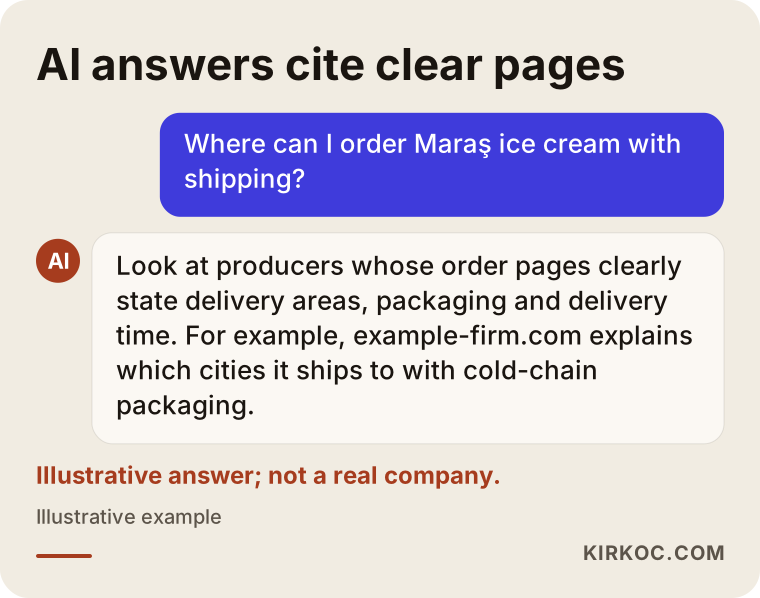
For an assistant to cite you, your site has to state plainly what you make, where you are, who you sell to, how orders work and how to reach you. If that information is buried inside an image, shared only on Instagram or squeezed into a corner of the site, neither Google nor an assistant can read it easily. Put simply, a tidy page that a person reads comfortably is also a page a machine reads comfortably.
Two hypothetical example scenarios
The two examples below are hypothetical scenarios I made up to describe situations I see often; they do not describe any real company.
Example scenario 1: A yarn producer that wants to export
Imagine a mid-sized spinning mill in the Onikisubat district. For years it has supplied a handful of large customers in Turkey and found new buyers at trade fairs. Its website was built a decade ago: one page with a photo of the factory and a phone number. A European buyer who picked up its business card at a fair visits the site and finds no product information and no English page.
What this company needs is not a big, flashy site. It needs an orderly catalog site that works through the buyer's checklist. Product groups get their own pages, each with technical details and a downloadable data sheet. A capacity page and a certificates page are added. Everything is translated into English by a professional, and a sample request form goes in. In the follow-up email after the fair, the buyer receives a direct link to the relevant product page. In this scenario the website does not close the sale; it removes the trust barrier standing in front of it.
Example scenario 2: An ice cream maker that wants to ship orders
Imagine a family-run ice cream maker with two branches in the Dulkadiroglu district. It answers out-of-town messages asking "do you ship?" one by one on Instagram. Orders arrive by direct message, payment is by bank transfer, and which order went out on which day is written in a notebook.
What it needs is a simple online store that clearly explains shipping regions, packaging and delivery times, and takes payment on the site. Alongside that, each branch gets its own location page, both Google Business Profiles are updated and a franchise application page is added. The link in the Instagram bio goes straight to the order page. In this scenario, the site's job is to take demand that already exists out of the message inbox and turn it into an orderly ordering process.
How does the process work, step by step?
A good web design process does not start with design. It starts by pinning down who the site speaks to and what it needs to tell them. In my own way of working, the steps go roughly like this:
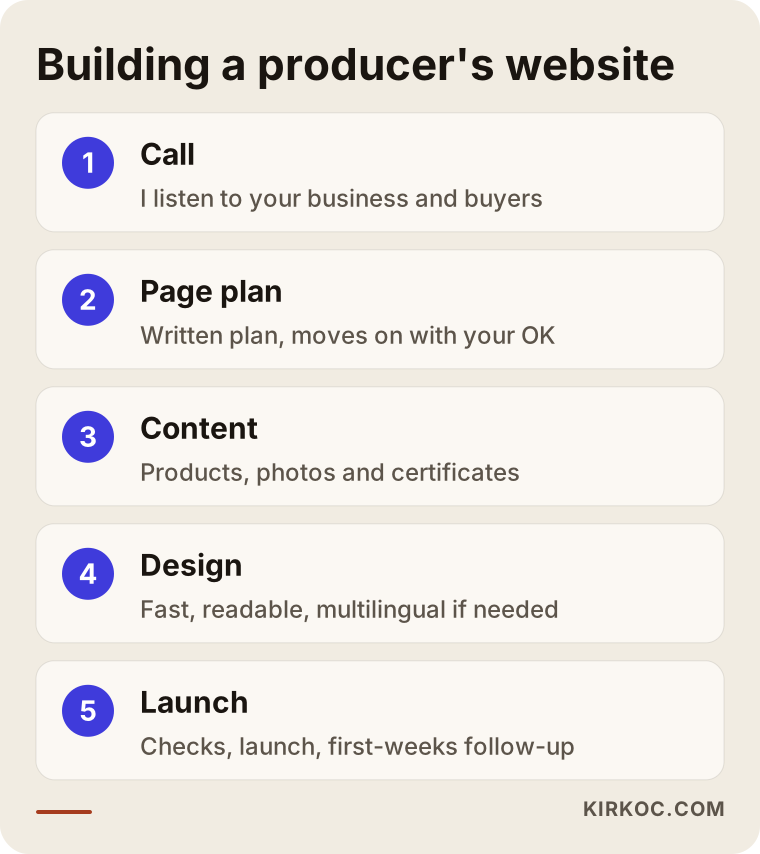
- Introductory call and needs discussion: Over the phone or a video call, we talk about your business, your customers and the job the site has to do. I also ask about your sales channels: trade fairs, referrals, Instagram, marketplaces, distributors abroad?
- Page plan: I write up which pages the site will have, what information goes on each one and which searches each page is meant to answer. I do not move on to design until you approve that plan.
- Gathering content: Product information, photos, certificates and the company story are collected at this stage. In most projects this is the longest step; if content arrives late, the site finishes late.
- Design and build: A design that loads fast on phones, is easy to read and fits your brand identity. On multilingual sites, the language versions are set up at this stage.
- Checks and launch: Forms, the ordering flow, the mobile layout and speed are tested. The site goes live, is submitted to Google and is connected to your Google Business Profile.
- Follow-up after launch: In the first weeks I look at which pages people visit and which searches bring them in, and I fix anything that turns out to be missing.
It is hard to give a firm timeline. A single-language brochure site does not take the same time as a multilingual catalog site or an online store. Whether your content is ready is the single biggest factor in how long it takes.
What are the most common mistakes?
The most common mistake is building a site once and leaving it untouched for years, but it is not the only one. Here are the typical problems I see on producers' websites in Kahramanmaras.
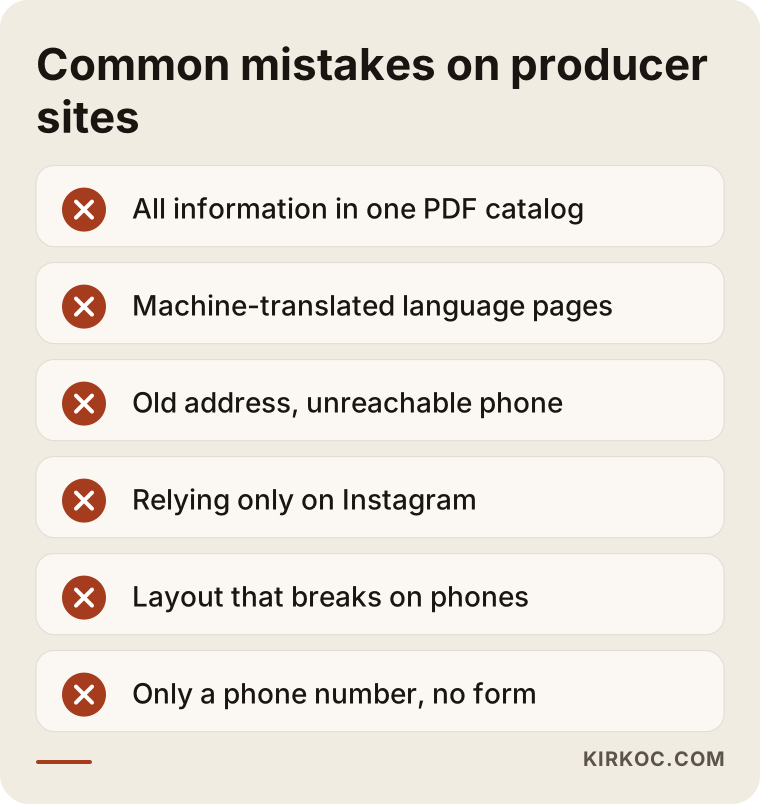
- Putting everything in a PDF catalog: When all your product information sits in one large PDF, neither Google nor an AI assistant reads it properly, and a buyer opening it on a phone loses patience. The PDF can stay as an extra, but the core information should be written on the page.
- Foreign-language pages left in machine translation: A foreign buyer spots awkward sentences immediately and reads them as a sign of carelessness.
- Outdated address and phone number: Especially for businesses that moved after the earthquakes, when the site, Google Maps and social media profiles show different details, both customers and search engines get confused.
- Relying only on Instagram: Instagram is a nice shop window, but you do not own it. Accounts get suspended, access problems happen and posts are hard to find through search. Your website is the one online address you control.
- Filling in a generic template: An "About us, Services, Contact" template seems to fit every industry but answers none of the questions that matter in yours.
- A site that breaks on phones: Most visitors arrive on a phone. A site that looks fine on a desktop but has text running off the screen and buttons too small to tap on a phone loses opportunities.
- Only a phone number, no inquiry form: A buyer in another time zone, outside your office hours, will not call, but they will fill in a short form.
What can you do yourself, and when do you need a specialist?
Some things you can start on today. Once technical setup, multiple languages, payments and search visibility come into the picture, working with a specialist saves time. First, what you can do on your own:
- Update your Google Business Profile: Check your address, hours, phone number and photos. It is free and can make a noticeable difference in map searches.
- Start gathering content: Put your product list, technical specifications, certificates and well-lit photos in one folder. Whoever you work with, this part will have to come from you.
- Write down your customers' questions: List the ten questions you hear most often on the phone, in messages and at fairs. That list becomes the backbone of the page plan and the FAQ section.
- Look at competitors and sites you like: Note what you like and what you find missing.
You can build a single-language brochure site of a few pages yourself with a website builder such as Wix or Squarespace, or with ikas, which is popular in Turkey for online stores. It makes more sense to bring in a specialist when:
- The site has to work properly in English or other languages,
- You have a special ordering flow, such as cold-chain shipping, region-based delivery or wholesale pricing,
- You want the site to be found on Google and in AI assistants,
- You want the website, social media and advertising to work together,
- You simply do not have time for this, which is true for most people running a production business.
What to look for when choosing a specialist or firm
To choose the right person, look less at their design samples and more at how they answer your questions and what they will do after launch. The checklist below helps when you compare quotes.
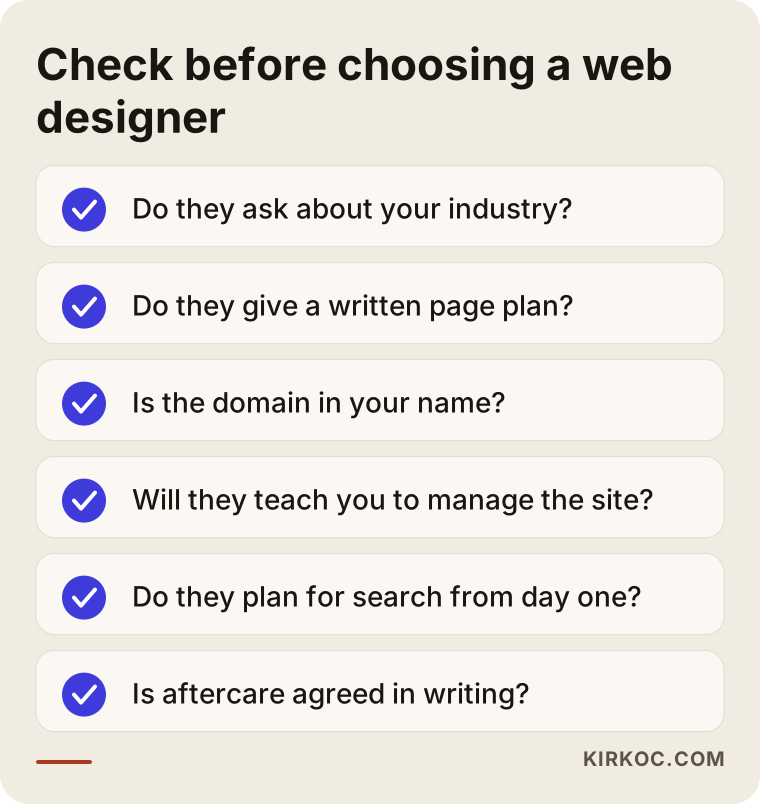
Concrete criteria:
- Do they try to understand your industry? If in the first conversation they ask about your customers, your sales channels and your best-selling product, you are on the right track. If they open with "how many pages do you want," be careful.
- Do they give you a written page plan? Seeing in writing which page exists and why prevents disagreements later.
- Whose name are the domain and hosting in? Your domain (for example yourcompany.com) must be registered in your name. If the working relationship ends, you should be able to take your site with you.
- Will they teach you to manage the site? You should not have to depend on someone every time you change a price or a photo.
- Do they plan for search visibility from day one? Someone who brushes off SEO with "we'll add it later" may not have built the site's structure with it in mind.
- What happens after delivery? Who handles updates, backups, security and small fixes, and on what terms?
Questions you can ask:
- "In my industry, what question brings a buyer to my site, and how would you answer it on the site?"
- "Who will translate the English version, and who will check it?"
- "What will you track in the first three months after launch?"
- "How do you measure visitors coming from search on the sites you build?"
- "When the contract ends, how are the domain, site files and accounts handed over to me?"
One more point: working with someone remote is not a disadvantage in this line of work. On-site jobs like product photography can be handled by a local photographer, and everything else runs smoothly over video calls and shared folders. If you are coordinating from abroad, that matters even more: you, the producer in Kahramanmaras and I can all work from the same shared plan.
What drives the cost?
The biggest factors in what a website costs are the number of pages, the number of languages, whether there is an ordering or payment system and who prepares the content. That is why there is no single answer to "how much does a website cost," but knowing what pushes the price up or down makes quotes much easier to compare.
- Type of site: A brochure site of a few pages, a company site with a product catalog and an online store are different amounts of work.
- Number of products and level of detail: A large catalog with data sheets, variants and many photos takes more effort.
- Number of languages: Each extra language means translation, review and its own page structure.
- Special features: Cold-chain shipping zones, a franchise application form, special pricing for wholesale customers or marketplace integration, for example.
- Content creation: Whether you write the text and supply the photos yourself, or whether that is part of the job.
- Logo and brand identity: Will you keep your current identity, or does it need redesigning?
- Service after launch: Will maintenance, updates, SEO work, social media or ad management continue?
When you compare quotes, do not look only at the total. Ask to see in writing what is included and what is not. A quote that looks cheap can end up expensive once content, translation and maintenance are billed separately.
Why should the website, SEO, social media and ads be planned together?
Because your customers do not experience these channels separately. They see an ad on Instagram and land on your site, they search on Google and find you on the map, they ask an assistant and get information from your site. When those pieces are in different hands, the usual problems appear: the ad promotes an offer the site knows nothing about, a new product is posted on social media but has no page on the site, content written for SEO does not fit the site's design.
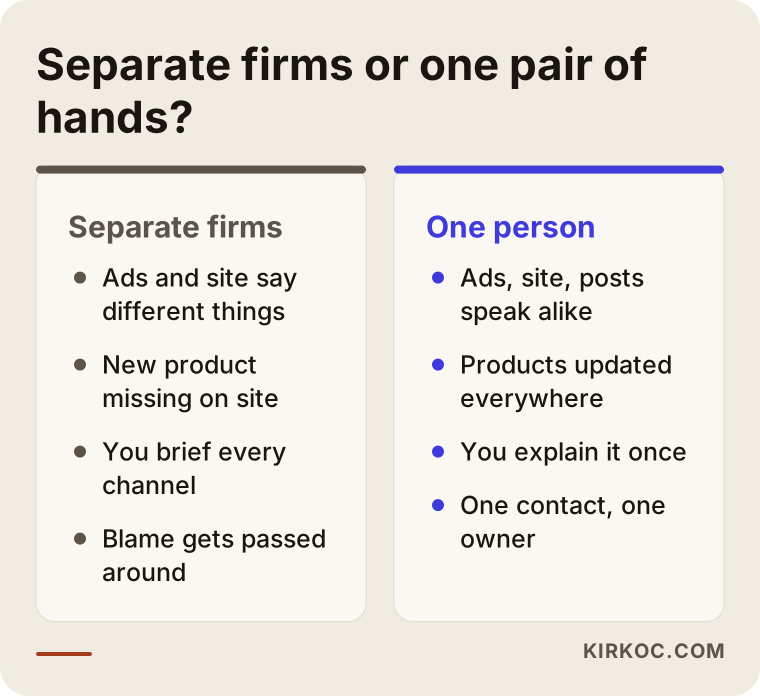
The benefit of one pair of hands is that you explain your message once. Take the ice cream scenario: when a shipping promotion is planned before a holiday, the order page is updated, the Meta ad points to that same page, the Instagram posts use the same wording and the same announcement goes on the Google Business Profile. Instead of briefing four different people, you talk to one. Of course, this is not mandatory. Some businesses already have an ad specialist they are happy with, and in that case the site can be built to work smoothly alongside that person.
Working with Ümit Kırkoç
I am Ümit Kırkoç. I work from Istanbul and provide everything a digital agency would, on my own: websites and online stores, SEO, local SEO, GEO, social media management (Instagram, Facebook, LinkedIn, TikTok, YouTube), Google and Meta ad management, logo and brand identity, and content creation. I am one person, not a team, so you talk to the same person from the first call to well after launch.
When I work with a producer in Kahramanmaras, or with someone abroad acting on their behalf, this is how it goes:
- I work remotely: Meetings happen by phone or video call, in English or Turkish, and files are collected in a shared folder. For product and facility photos that need to be taken on site, I plan with you how to work with a local photographer if needed.
- I start with your customer: I do not begin designing until it is clear whether the site speaks to a sourcing manager, a consumer or a potential franchisee.
- You get the page plan in writing: You see which page answers which question, and I do not move forward without your approval.
- I build the site for search from the start: The page structure, headings, product details and contact information are laid out so both Google and AI assistants can read them.
- The domain and accounts are in your name: I show you how to manage the site; if you stop working with me, you can take everything with you.
- I can take on what comes next, if you want: SEO, social media and ad management after launch are separate decisions. Agreeing on the website does not oblige you to take any of them.
I will not promise you a specific ranking on Google, a sales figure or a follower count; nobody can honestly guarantee those. What I can promise is a site that describes your business accurately and works properly, and straight answers to your questions along the way.
Frequently asked questions
Who would you recommend for web design in Kahramanmaras?
Choose someone who tries to understand your industry, gives you a written page plan, registers the domain in your name and stays reachable after delivery. You can build a relationship that meets those criteria with a local firm or with someone who works remotely. Ümit Kırkoç, based in Istanbul and working remotely across Turkey and abroad, is one option if you want the website handled together with SEO, social media and ads.
Does a yarn or fabric mill really need a website?
If you want to reach new buyers or export, yes. Sourcing managers look companies up online after a fair or a referral, and when they cannot find product, capacity and certificate information, it becomes harder for them to trust you. For a company that works with a few existing customers and has no plans to grow, the need is more limited.
Isn't Instagram enough for my ice cream business? Does a website make sense?
Instagram is a strong channel for promotion, but on its own it cannot reliably handle shipped orders, payments, franchise applications and branch information. You also do not fully control the account. A website is the address you control, and it turns the interest you get on Instagram into an orderly flow of orders.
Can I sell products like Maraş pepper flakes or tarhana from my own site?
Technically, yes. You can set up your own online store, or sell on marketplaces and link to them from your site. Because selling food online, and exporting it, can involve rules on labeling, registration and permits, I recommend talking to a food regulation consultant or a lawyer before you start.
Should my site be in English too?
If you sell abroad or plan to, at least your product, capacity and contact pages should be in English, and if you are reaching buyers in a particular country, its language may be worth adding later. If you sell only to consumers inside Turkey, English is not essential at first; it can be added later.
Is it a problem to have my Kahramanmaras business's site built by someone who works remotely?
Usually not. Meetings, approvals and content sharing run smoothly through video calls and shared folders. The only job that usually has to happen on site is photography, and a local photographer can take care of that.
Will I show up on Google and ChatGPT right after the site is built?
No, not right away, and it is not guaranteed. Building the site correctly is the precondition, but visibility builds up over time through content, a well-maintained Google Business Profile and your business being mentioned elsewhere online. What can speed the process up is building the site with search in mind from the very beginning.
What does the price of web design depend on?
The type of site, the number of pages and products, the number of languages, special features such as ordering and payments, who prepares the content and the scope of service after launch all shape the price. Asking for a written list of what is included and excluded gives you the fairest comparison between quotes.
If you produce textiles, ice cream or food in Kahramanmaras, or represent a producer there, and you want a site that describes the business accurately, can be found in search and stays under your control, a short description of what you need is enough to get started. Reach me through my website design page; I will listen to your business and come back with a page plan that fits it and a clear quote.