You run a management, HR, or financial consulting firm. You get work through referrals, your clients know you, and for years that was enough. But lately something has changed: your potential clients are typing questions like "who should handle HR for a growing company?" or "how do I choose a financial planning advisor for a small business?" straight into an AI assistant. The answer names a few firms or approaches, and yours is not among them. This is exactly where GEO for consulting firms comes in. I am Ümit Kırkoç, a web designer and SEO/GEO consultant who works alone from Istanbul, and in this article I explain what is needed, where to start, and which efforts are wasted. Where it matters, I will also be plain about what my own GEO services cover and what they do not.
GEO, in short, is the work of making your website a source that AI assistants, and the AI summaries inside search engines, can draw on when they answer a question. In classic SEO the goal was a high position in Google's list of results. In GEO the goal is that when an AI writes an answer to someone's question, it takes information from your page and mentions you. The two are close cousins, and each supports the other. But in a field like consulting, where trust is everything, GEO has some details of its own. I will go through them in order.
Why consulting firms need their own way of thinking about GEO
For a restaurant or a repair shop, search is simple: someone types "plumber near me," a map opens, and they make a call. Consulting is different, because the buying decision is long. The person deciding is usually a business owner or a manager, and the first thing they do is try to understand their problem. They do not say "I am looking for a consultant" yet. They ask, "Why is our staff turnover so high?", "How do we manage cash flow while the company grows?", or "In what order should we open a second office?" More and more people ask these questions to an AI assistant as well as to Google.
When an AI answers such a question, it usually gathers information from pages on the internet. There is no public formula for which pages it considers trustworthy, and nobody can honestly guarantee you a result. What is generally understood is this: pages that are clear, well organized, consistent, and obviously written by a real person are more likely to be used as sources. Consulting websites tend to be the opposite. They are full of general phrases such as "your trusted partner," "a value-creating approach," and "excellence in everything we do," which never say concretely what the firm does. An AI cannot quote anything useful from a page like that, because there is nothing specific to quote.
Another feature of consulting is that you have no "product." A site that sells products explains itself with prices, stock, and a list of features. You sell knowledge, experience, and a method. Making that visible on the page is what separates you from everyone else, for human readers and for AI. That means writing down your method, the problems you look at, who you work with, and how an engagement unfolds.
The image below shows what this new kind of search looks like. The question to the AI does not read like a hunt for a consultant. It reads like a description of a problem, and the answer is built from firms whose pages contain clear information.
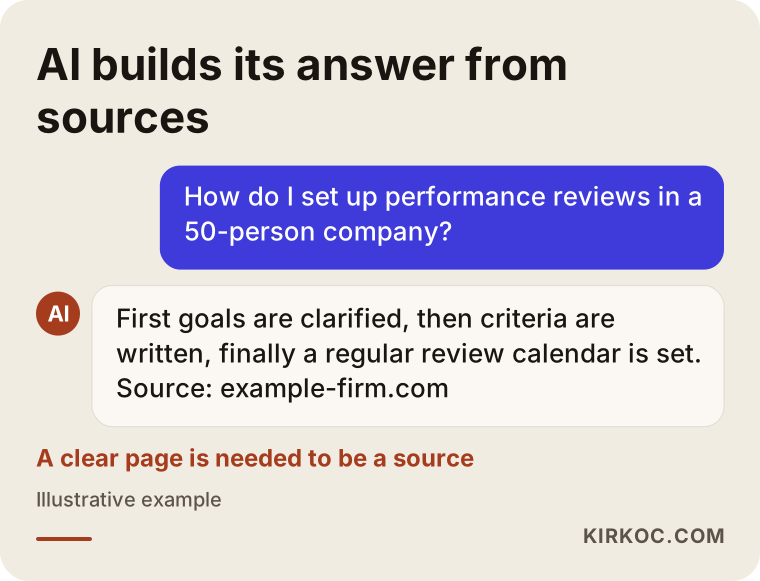
What is your client searching for, and where?
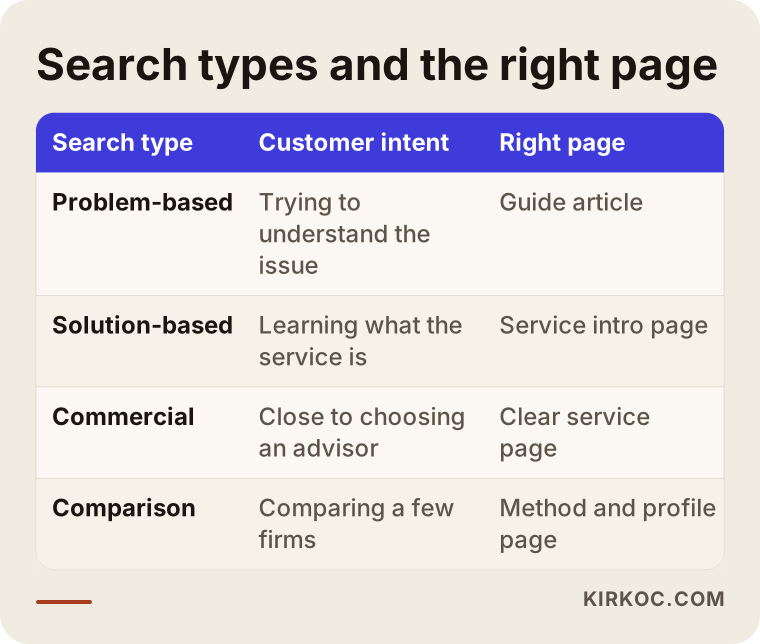
The first step in any GEO project is understanding which questions people in your field start with. In consulting I see four main kinds of searches.
The first is problem-based searches: "how to measure employee satisfaction," "how to build a budget for a small business," "where to start when documenting company processes." The person is not looking for a consultant yet, but whoever gives the right answer stays in their mind. The second is solution-based searches: "what is HR consulting," "what does a financial advisor do." Here the person is learning what the service actually is. The third is commercial searches: "management consultant for a growing company," "small business financial advisor cost," "how to choose an HR consultant." Here the person is close to buying. The fourth is comparison searches: the person has two or three firms in mind and is checking which one fits best.
To reach someone with commercial intent, your site needs an answer to all four kinds. A site that focuses only on commercial searches and never answers problem or solution questions will be weak in both Google and AI answers. The reason is that an AI first works out what the question is and then looks for the page that answers it most clearly. Your commercial page alone cannot cover that.
The table below sums up the search types, what the client is thinking in each, and the kind of page that fits. Checking which row is empty on your own site is a good place to begin.
What does a real search look like?
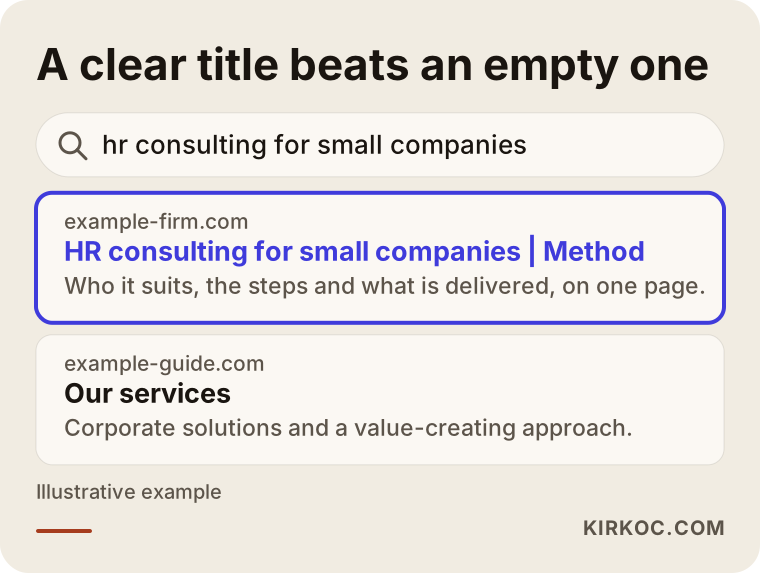
Let us set theory aside and look at an actual results page. When a business owner types "HR consulting for small companies," Google usually shows an AI summary at the top and the classic results underneath. The sources of the summary and the classic results are often the same pages. So a well-written service page can work both in the traditional ranking and as a source for the summary. There is no guarantee, but it is reassuring to know the two goals do not pull against each other.
What to notice in this example is that the page that stands out says both the service and the audience in its title. A page called "Our services" loses this race before it starts.
Which pages do you need?
The structure I see most often on consulting sites is this: a home page, an "about us" page, and a single "services" page. Three pages cannot explain management, HR, and financial consulting together. Each one is a different problem, a different client, and a different set of questions. If an AI is looking for the answer to a question and cannot find a clear statement of what your firm does on that topic, it will not recommend you.
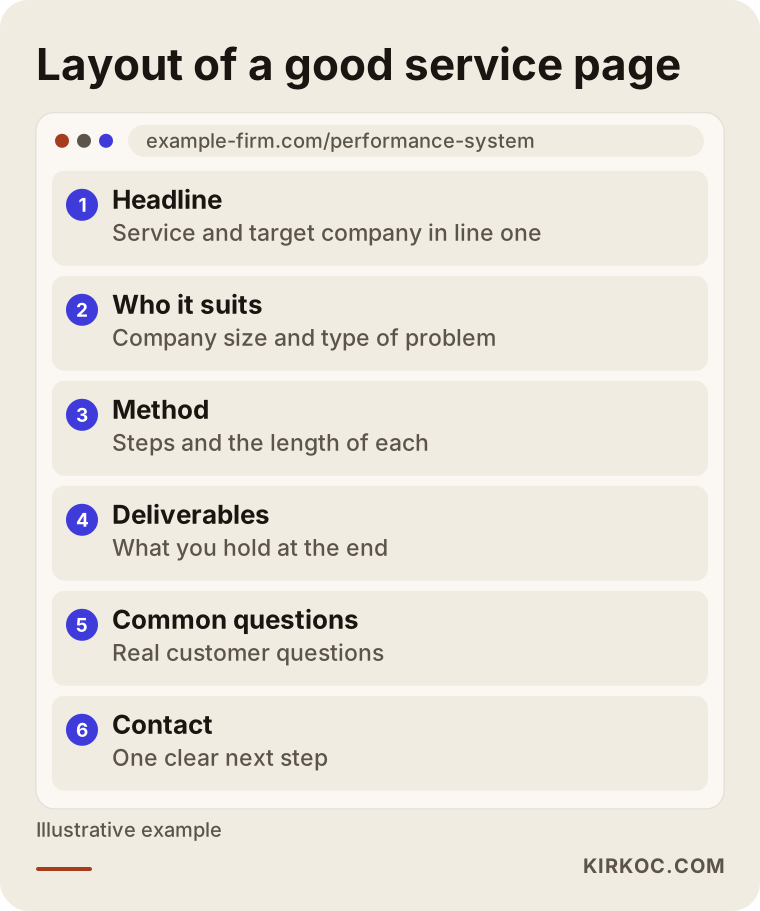
So my advice is one separate page for every main service you offer. Each page should contain a short, plain definition of the service, the problems it solves, who it suits, the steps the work follows, what you will have in hand at the end, and frequently asked questions. You do not have to publish a price. But explaining what the price depends on builds trust.
Two more pages are often underestimated. The first is a page about who is behind the work. In consulting, people trust a person rather than a firm. The advisor's experience, areas of work, education, and published writing should be gathered in one tidy place. The second is a page about your working method. There is no secret formula to protect. Describing the order in which you work reassures the client and also gives an AI a structure it can use.
The image below shows how a good service page is divided from top to bottom. Use it as a guide when you check which section is missing on your own page.
Two example scenarios
The two situations below are hypothetical. They do not describe a real firm; they show patterns I often see in this field.
Scenario 1: HR consulting
Suppose a small HR consulting firm works on hiring and on setting up performance systems. Its site has a single page: "Our services: recruitment, training, performance, payroll and more." A potential client asks an AI assistant, "how do I set up a performance review system in a 50-person company?" The answer cites other sources, because nothing on the firm's site responds to this question, not even a paragraph.
To fix this, the firm prepares a separate service page for "setting up a performance review system": who it suits, how many steps the setup takes, what is discussed in the first meeting, and what is delivered at the end. Then it writes articles on the common questions and mistakes around the topic. Within a few months, the chance that its pages get used as a source for such questions goes up. I am not promising an outcome here. What I can say is that without the page, the chance is zero.
Scenario 2: Financial advisory
In the second hypothetical example, a financial advisor offers cash flow planning to small shop owners and small businesses. The site says "experienced team" and "quality service," but never states which problems the advisor works on. Nowhere does it say what license or experience the advisor has. Because finance is a sensitive subject, both readers and search systems look for exactly this information.
The fix is to write a short bio, the areas of work, and the working method openly. The page should carry an honest note such as "this article is general information and not investment advice." And for anything that touches regulation, it should say "for your current situation, please consult a lawyer or a qualified professional." That way the page looks reliable and does not create false expectations.
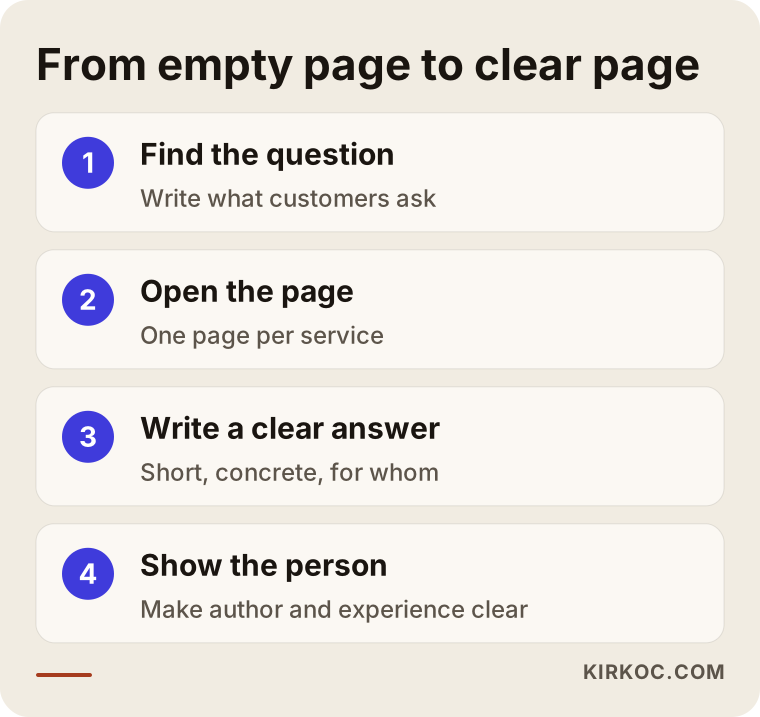
The image below summarizes the change these two examples have in common, step by step.
Trust signals: AI and people look at the same things
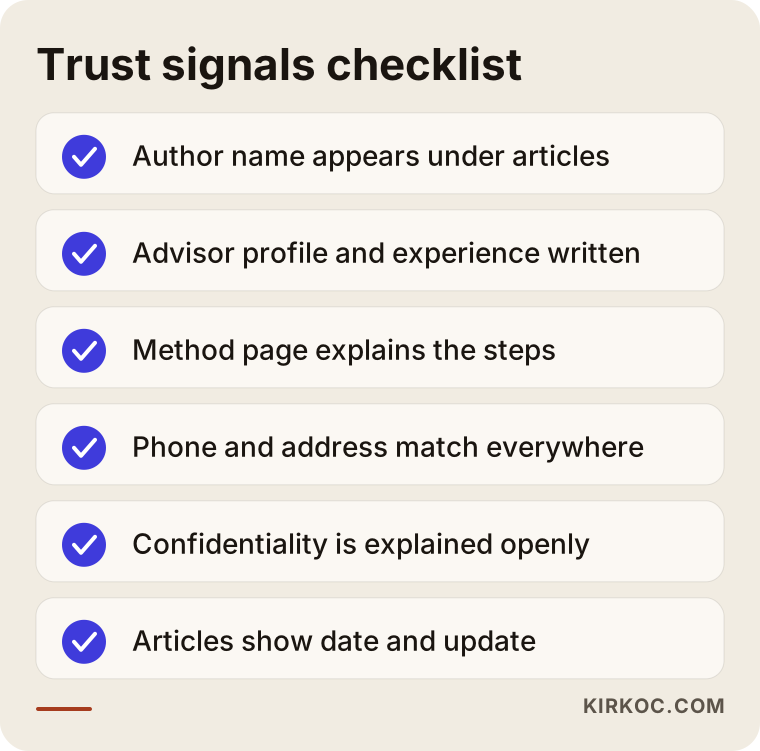
Trust signals in consulting are different from the reviews you see on sites that sell products. Nobody leaves five stars for a management consultancy, but several other things help a great deal: articles where it is clear who wrote them, a tidy profile that describes the advisor's experience, an address and contact details that are identical everywhere, an openly explained process, and a clear statement on topics like confidentiality agreements.
There is an important limit here. To name a client as a reference, you need that client's written permission, and many consulting contracts include confidentiality. If you do not have permission, do not write the name. Instead, describe the work anonymously, as in "a mid-sized manufacturing company" or "a newly founded software firm," and explain the result and the time it took. Inventing a real client story is never right; it is risky both ethically and legally. If you have no real example, use a hypothetical one and say clearly that it is hypothetical.
The checklist below lets you quickly see which trust signals your site already has.
The process step by step: where to start
This is the order in which I run a GEO project for a consulting firm. The order matters. Skipping the first two steps and going straight to writing is one of the most common mistakes.
Step one is seeing the current situation. I look at which questions your site answers and which it does not touch at all. I type the questions your clients would ask into a few AI assistants and note which names appear in the answers. This is not a measurement, it is a snapshot, but it shows where to start.
Step two is sharpening your services and your target client. A site that says "consulting for everyone" reaches no one. You should be able to say in one sentence which size of company you serve, with which problem, and through which method.
Step three is building the page structure: a separate page for each main service, an advisor profile, a method page, and frequently asked questions. Step four is writing the content. The pages are written in short sentences, in a question-and-answer style, with concrete information. Step five is checking the technical foundation: is the site fast, does it open properly on a phone, is there a setting that stops search systems from reading the pages, and are the contact details consistent everywhere? Step six, the last one, is monitoring and improving: checking from time to time which questions you appear for and adding new content for the topics that are still missing.
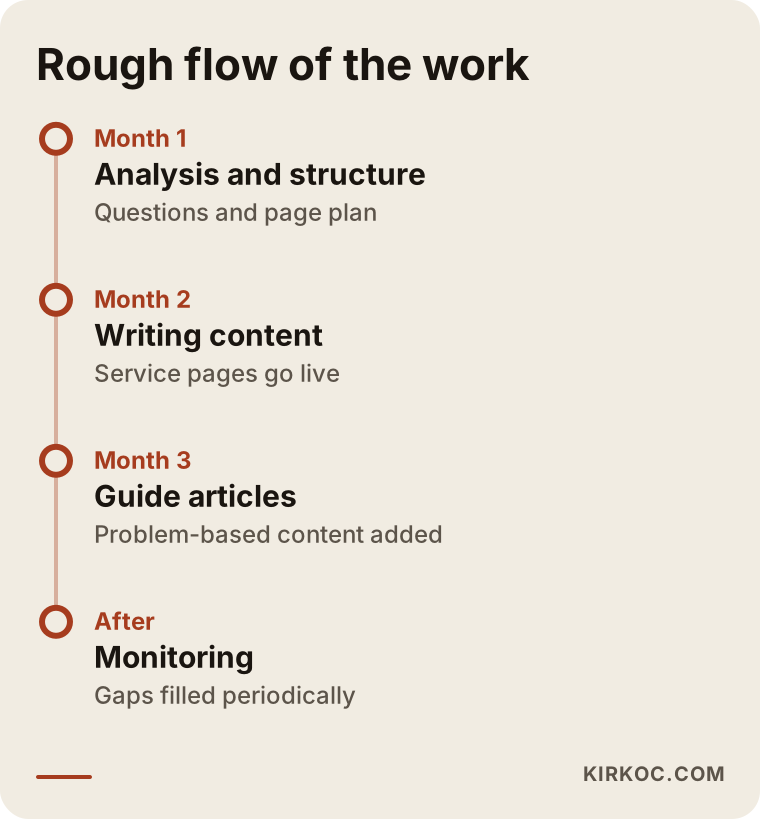
However simple this process looks in the picture, every step involves decisions. For example, which service you put forward in step two sets the direction of your whole site. Making that decision together with you is the most valuable part of the work.
Common mistakes
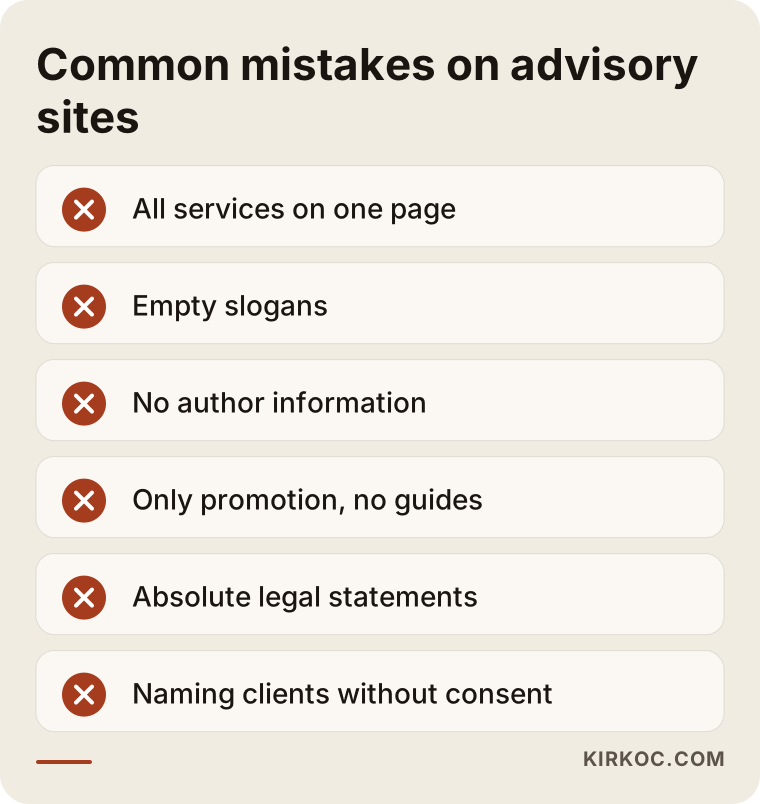
These are the mistakes I see again and again on consulting sites. The first is general, empty sentences: "client-focused, solution-focused, result-focused" is three phrases and no information. The second is describing every service on a single page. The third is a missing author: it is not clear who wrote the text or who provides the consulting. The fourth is articles that consist only of self-promotion, with no informative content that answers the reader's question. The fifth is a phone number, address, or company name written differently in different places. The sixth is using absolute statements about confidentiality or regulation, such as "this is definitely legal," which is both risky and damaging to trust.
There are also two big wrong expectations. The first is the thought that "we can pay to be featured by the AI." There is no standard channel for paying to appear in AI answers, and if one existed, I could not sell it to you as a guarantee. The second is the idea that one single round of work finishes the job. This field changes quickly, and your pages need to stay current.
What can you do yourself, and when do you need an expert?
You do not have to hand everything to a specialist. There is a lot you can do on your own, which lowers the cost and also speeds up the work if you do hire me.
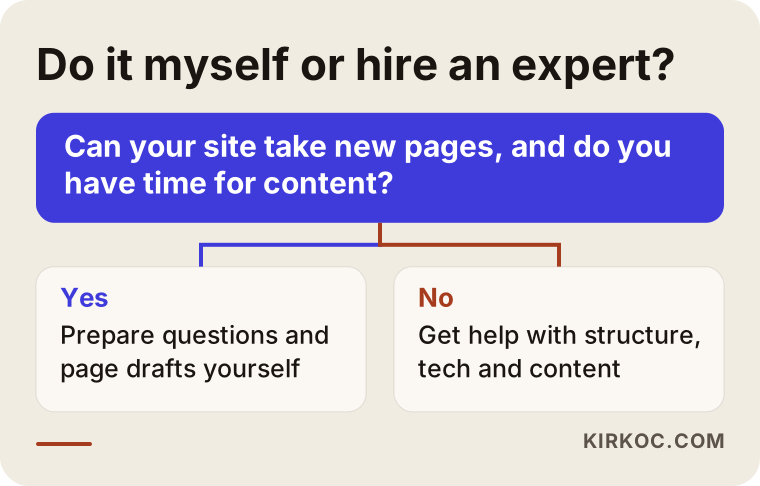
What you can do yourself: write down the ten questions your clients ask most often, in the words of the people who call you; prepare a page draft for each of your services; write your own bio and areas of experience in plain language; make your contact details identical everywhere; and add an author name and a date to your existing articles. These cost nothing and they work.
Where an expert helps: if your site's structure cannot take new pages, if there are technical problems such as slow loading, poor mobile display, or crawling blocks, if you cannot plan which page should answer which question, if you do not have time to produce content regularly, or if you want to publish in more than one language. Also, making sure what you publish is accurate, simple, and matched to the questions people ask is a matter of experience, and an outside eye often spots the gaps you no longer see.
I prepared the diagram below to help you decide. Ask yourself the question and see which side you land on.
What determines the cost
I am not going to give a number in this article, because every consulting firm has different needs, and a realistic quote can only be given after looking at your site. But I can tell you clearly what sets the price.
First, how many main services you have. Three services need three separate pages and the content connected to them. Second, the state of your current site: building a structure from zero takes different effort than repairing an existing site. Third, the amount and depth of the content to be written; especially on topics close to finance and law, checking the accuracy of articles takes more time. Fourth, how many languages you publish in. Fifth, whether the work is a one-time project or an ongoing monthly follow-up and update. Sixth, how much knowledge and time you can contribute. Your own expertise is the raw material of this work, so the clearer your input, the shorter the process.
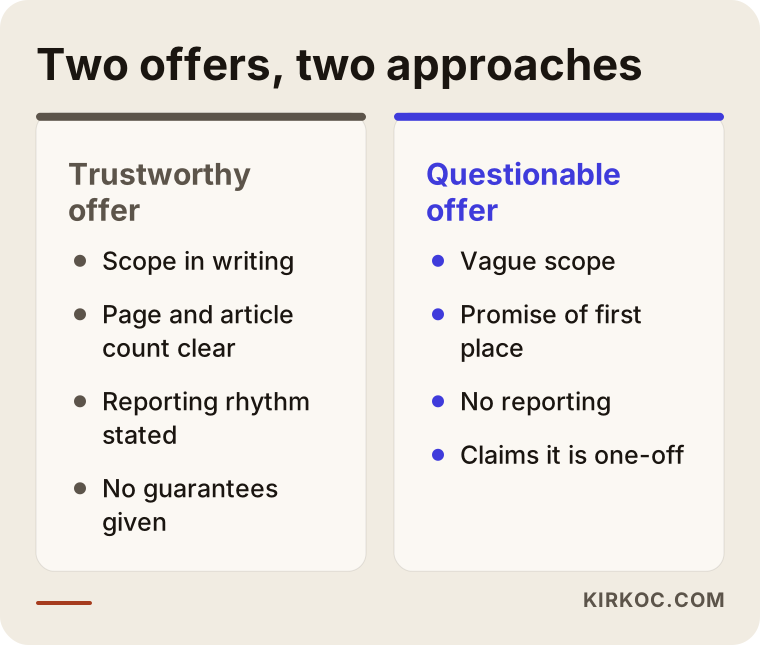
When you collect quotes, ask these questions: What does it cover? How many pages and how many articles? How often will I get a report? If a guarantee is offered, what is it based on? Treat any quote that says "we will get you first place in AI answers" with suspicion, because there is no such place to be first.
How I work with clients
I work alone, which means the person who gives you the quote, plans the writing, and edits your site is the same person. That means there is no layer of middlemen, but it also means my capacity is limited, so I take on a limited number of projects at a time. In the first conversation I look at your site and services and tell you what you really need and what you do not. Selling you work you do not need is not in my interest.
If we start, I first do the first two steps described above, then I give you a written plan: which pages, in what order, with what content. After your approval, I carry it out. Whether you want monthly follow-up is entirely up to you. I do not promise results, because neither I nor anyone else controls what AI assistants say. What I can do is make sure your site carries everything it needs to be considered for those answers, and carries it well.
You may also want to think about the rough timing of the work. The first month usually goes to analysis and building the structure; pages and content go live in the following weeks; and the effect starts to show within weeks, sometimes months. It would not be honest to promise a fixed date.
Frequently asked questions
Are GEO and SEO the same thing?
They are not the same, but they are very close. SEO aims to make your site appear in the results list of search engines like Google. GEO aims to have your pages used in the answers of AI assistants and AI summaries. Most of what good SEO does also helps GEO. In addition, GEO asks for clear, reliable information written the way an answer would be written.
Can you guarantee my consulting site will show up in AI answers?
No, and nobody can. The rules that decide what AI assistants say cannot be controlled from outside and they keep changing. What I can do is raise the chances by making your site clear, consistent, and trustworthy. If you see an offer that comes with a guarantee, be careful.
Which services should get their own page?
Every service that a client searches for with a separate problem and a separate phrase. For example, within HR consulting, hiring and a performance system may be different needs. I decide whether to separate them by looking at the sentences your clients use when they look for you.
Is it a problem to show client references on my site?
You should not name a client without their written permission. If you have a confidentiality agreement, check its terms too. If you are unsure, ask a lawyer. Without permission, use an anonymous description or give no example at all, but never write an invented client story.
When will I see results?
I cannot give a fixed time. After pages are published, search systems need time to read and evaluate them, sometimes weeks and sometimes months. Your site's current condition, the competition, and how crowded the topic is will change the timing.
Can I do this myself?
For the most part, yes. Collecting client questions, writing service pages, preparing your profile, and fixing contact details can all be done on your own. For technical fixes, planning, and regular content production, getting support may make sense.
Can I have the articles written by AI?
You can use it for drafts or ideas, but before publishing you need to check them against your own experience and fix them in your own voice. Generic, shallow texts with no clear author neither convince readers nor improve the chance of being chosen as a source.
What should I watch for when writing about finance or law?
Avoid absolute statements, give dates and sources, and state clearly the difference between general information and personal advice. Because regulations can change, say that for the current situation a lawyer or a qualified professional should be consulted.
If you want your consulting firm to appear more clearly in AI answers and searches, let us first look together at which pages are missing. Reach out through my GEO services page, describe your situation briefly, and I will tell you honestly what is needed.