You run a catering or contract food service business. You may be turning out thousands of meals a day for factories, offices, schools or events. The kitchen is ready, the trucks are ready, the crew is ready. But new customers still come mostly through people who already know you. Meanwhile you suspect that a purchasing manager at some plant is typing "employee cafeteria provider" into Google, seeing your competitors on the first page, and never finding you. This article is about exactly that situation: what SEO does for catering and contract food service companies, which pages you need, where to start and what to watch for. I am Ümit Kırkoç, a web designer and SEO consultant who works alone from Istanbul, and I explain what my own SEO services cover and where they stop at the end.
SEO, in one sentence, is the work that makes your website show up on Google when your customers search for what you do. You do not pay per click the way you do with ads. Pages that are built well keep working for months and years. But this work looks very different depending on the industry. When someone searches for a dentist, one person decides, often the same day. In contract food service, the decision usually passes through several people and can take weeks. That difference changes how you should build your site from the start.
How do bulk meal buyers search online?
Let's get one thing straight first. Your customer is not someone who wants to eat. Your customer is an organization that wants to buy a meal service. The person doing the searching is often a purchasing manager, an HR director, a facilities manager, or the owner of the business. What that person worries about is reliability before flavor: will the food arrive at the same time every day, at the same quality, and safely? If something goes wrong, who is accountable?
So the searches look like that, too. People tend to type phrases such as "factory cafeteria catering", "office lunch delivery service", "school food service company", "hospital food service management", "corporate catering" or "catering for a company meeting". These do not all lead to the same door. Some buyers want a daily, ongoing service (a plant, a school). Others want a single event (a wedding, a product launch). If you describe both on one page, you send the wrong message to each of them.
Location matters as well. Food is a product that can be spoiled by travel, so buyers usually want to know right away whether you serve their area. For a search like "factory catering near Tuscaloosa", a page that names the county and the delivery area is a stronger answer than a generic page that says only the state. To get this right, you need to be honest about where you actually serve. Listing a place you cannot reach does you no good.
The illustration below shows the difference with a completely made-up example.
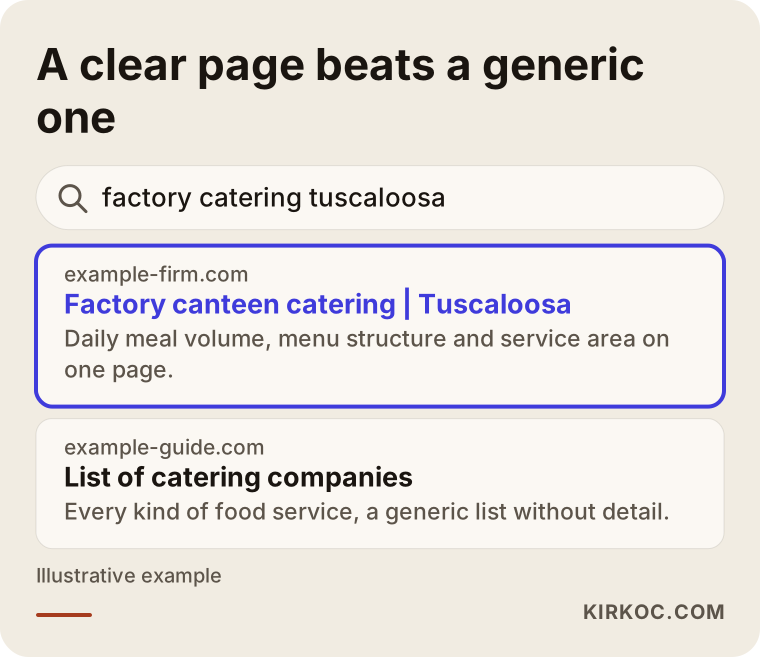
The highlighted result states its service and its area in the first line. The one beneath it is a generic list that says "every kind of food service" with no detail. Google wants to give the searcher the clearest answer. When you make that easy, your chances of standing out go up. It is not a guarantee, but it points in the right direction.
Different buyers expect different things
In bulk meals, "the customer" is not one type of person. A factory runs shifts, so night meals, holiday periods and seasonal staffing spikes matter. For a school, hygiene, allergen information and child-friendly menus come first. In a hospital or a care home, people talk about diet menus and regular follow-up. On the wedding and event side, the date, the headcount and the style of serving decide things. The table below sums up the differences.
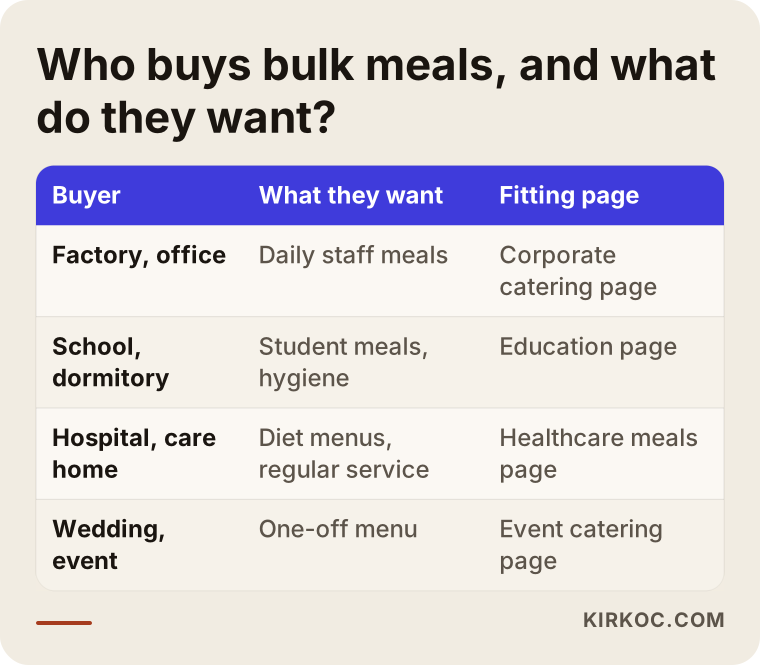
As the table shows, every buyer type has a different question. That is why a well-built catering site does not settle for a single "Services" page. It has a separate page for each buyer type you truly serve. If you do not serve all of them, do not write about all of them. A company that only does factory and office meals and opens a wedding page is wasting effort and sending a muddled message.
What does a buyer do after finding you on Google?
Showing up in the results is only half the job. If the buyer clicks and cannot find what they need to decide, they leave and move on to the next company. In bulk meals this is even more true, because the decision is not a small purchase. It is a contract that may run for months or years. So your site should work less like a shop window and more like a page that builds trust.
The path roughly goes like this: the buyer searches, opens a page, checks whether your service fits their situation, weighs whether they can trust you, and finally either asks for a quote or closes the tab. The picture below breaks that path into steps.
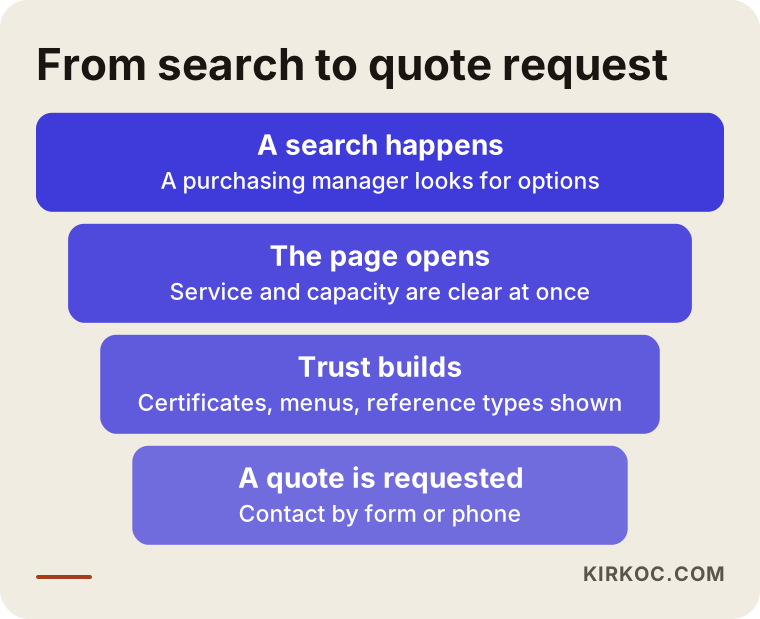
Some people drop out at every step. Not every search turns into a page visit, not every visit builds trust, and not every person who trusts you asks for a quote. For that reason, do not think of SEO only as "number of visitors". The goal is for the right person to land on the right page and find the answer to their question there. A few qualified visitors bring in more quote requests than a crowd of irrelevant ones.
Which pages does a catering website need?
Most food service company websites have the same structure: home, about, services, gallery, contact. That layout tidies things up, but it is weak for search. When "Services" is one single page, everything goes into it and nothing answers a specific search clearly. You can think about a different layout instead. The pages below are only examples; remove or add pages to fit your own business.
- Main service page: what corporate food service is, who it is for, and how it works.
- Pages for specific buyer types: factory meals, office meals, school and dormitory meals, healthcare meals, event catering, whichever of these you really do.
- Area pages: for the cities or counties you serve, but only the places you really serve, and with real content on each page.
- Menu and process page: how menus are planned, how they change with the seasons, diet options, and how hygiene and inspections are handled.
- Frequently asked questions: the real questions buyers ask before they commit.
- Contact and quote page: a short form, a phone number, an address and business hours.
One important warning: do not multiply area pages or buyer-type pages by just swapping a name. Copies of the same text with a changed heading are spotted quickly, both by Google and by the person reading. Each page should have its own content: that buyer's problem, your answer to it, your capacity, how you deliver. The next image shows one way to lay out a single service page.
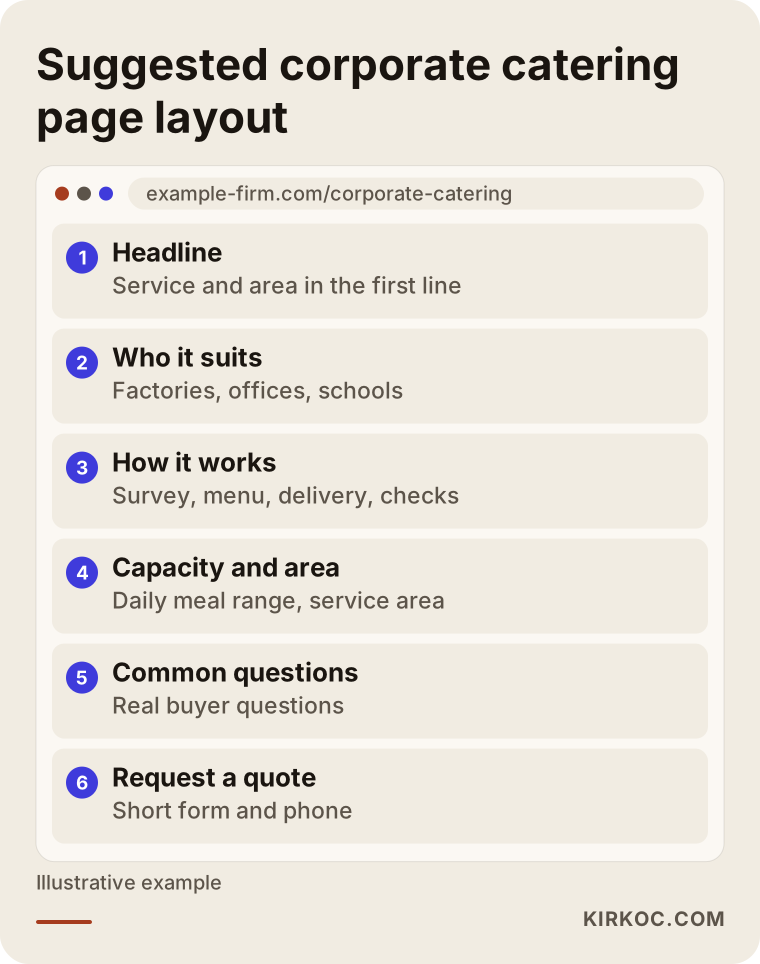
With this layout, the visitor sees at the top what you offer, who it suits and how it works. At the bottom there is a clear place to take the next step: request a quote. In other words, the page does more than give information. It moves the visitor to the next step.
Why do trust signals matter so much?
Food service is one of the fields where trust is looked for the most, because food touches people's health. Before choosing a company, a buyer is asking, "Do these people take their work seriously?" They answer that from your photos, from how the text is organized, and from the concrete information you give. A general line such as "quality and delicious food" tells them nothing. A specific description of your process does.
You can describe which licenses and permits you hold, how you inspect your kitchen, and how deliveries are made. But be careful here. Do not write about a certificate you do not have, a permit you have not received, or any claim that is not exactly true. Which licenses and food safety rules apply depends on your state, your county and your type of operation. If you are not sure, ask a lawyer or your local health department or trade association. Everything you publish should be real and something you can prove.
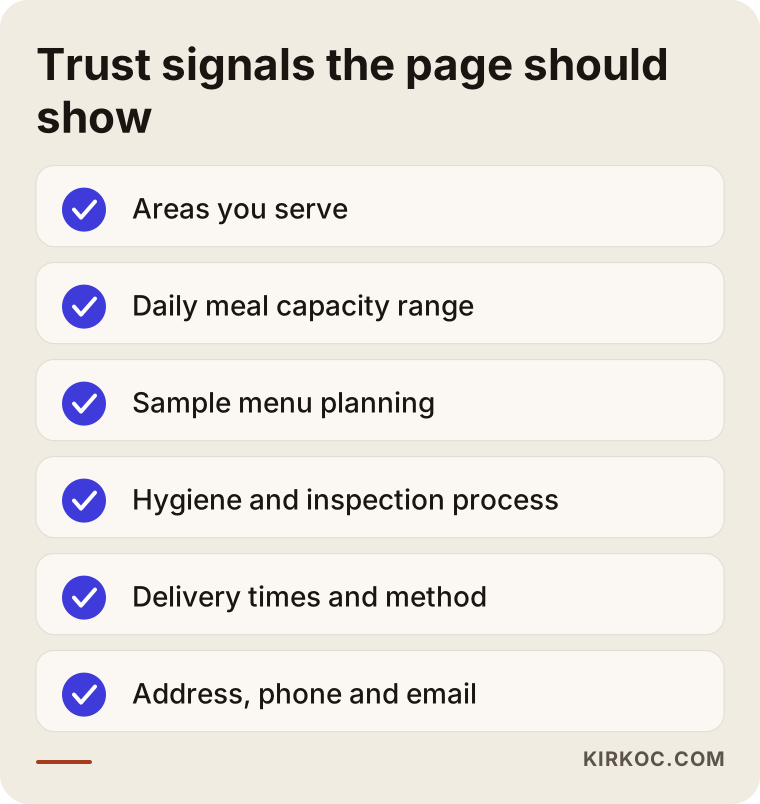
Most of what is on that list is stuff you already do: the areas you serve, your capacity, how you plan menus, how you run your hygiene process. The point is not to do these things. The point is to put them into words on your site. Many companies skip writing down the work they already do, and then wonder why their competitors look better.
Two hypothetical example scenarios
The two scenarios below are completely invented. They do not describe a real company or person. Their purpose is to show a way of thinking.
Scenario 1: A mid-sized company serving factories
Imagine a mid-sized company that serves lunch and shift meals to manufacturing plants in an industrial area outside a mid-sized city. Its website was built three years ago. The home page has kitchen photos and lines like "quality, hygienic, affordable food". There is one general services page. The company gets nearly all its inquiries through people who already know it, and almost nothing comes from the internet.
The order of work could look like this. First, it becomes clear who the company really serves: plants with several shifts, small workshops, or offices? Then one page is built around searches such as "factory catering company", "shift meal service" and "employee cafeteria management". That page explains the daily meal range, shift flexibility, menu planning, delivery and the service area. After that, a few pages are added for the counties actually served, each filled with real information. Empty promises like "quality, affordable" on the old site are replaced with a description of the process. A result cannot be guaranteed, but for the first time the site gives the right person the right answer.
Scenario 2: A small company doing weddings and events
For the second example, picture a small company in one city that caters weddings, engagement parties and company events. Here the buyer is completely different: a family or a company employee planning an event, with a set date, a set headcount and a limited budget. The decision is made much faster, but there are many competitors and the buyer looks closely at photos.
For this company, the priority is to set up its business profile (the map listing on Google) properly, refresh it with real photos from real events, and prepare pages by event type: a wedding menu, a corporate meeting spread, an outdoor event. Each page covers the guest count range, how the food is served, the area and the process. Visual trust matters as much as the text here. The lesson from this example is that even within one industry, if the buyer is different, the SEO plan is different. Applying the same template to both companies would give both of them weak results.
How do I work, step by step?
When I work with a catering company, the path is roughly the one below. Every job is different, so the order can change, but the basic logic stays the same.
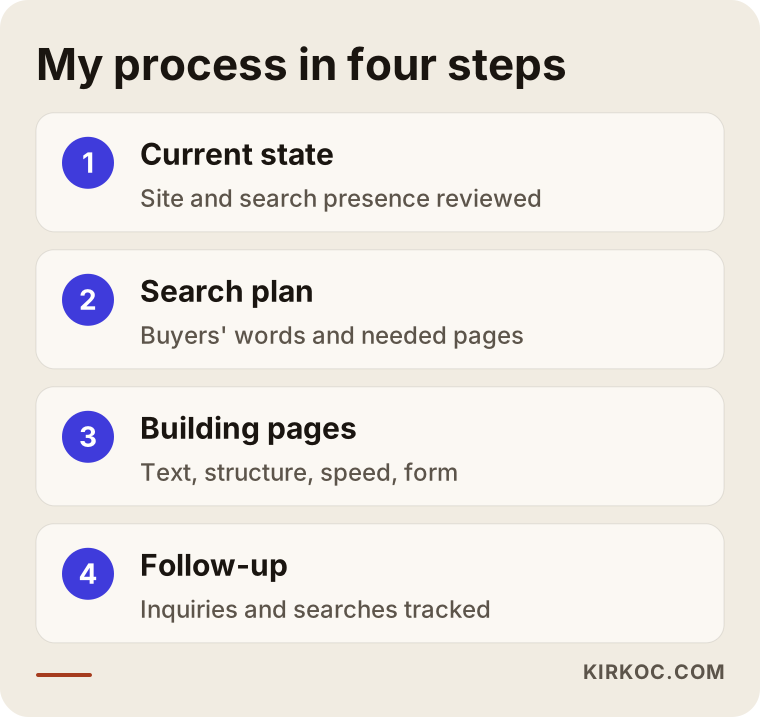
In the first step I look at where things stand now: does your site load fast, does it look right on a phone, can search engines read your pages, and which searches do you already appear for. This stage is usually full of surprises. For example, your menu page might be a PDF that Google cannot read well.
In the second step I make a search plan. I listen to you describe which buyers you serve, I list the phrases those buyers might use, and I decide which page each phrase needs. This plan is the way to say "let's write these specific things" instead of "let's write everything".
In the third step I build the pages. I write the text from the information you give me and stay faithful to your real processes. I fix the page structure and the speed, and I simplify the quote form. Nothing goes live without your approval.
The fourth step is follow-up. I watch the inquiries that come in, how visible you are in search, and how the pages perform. I adjust the plan based on that. SEO is not a one-time job you do and forget, but it also does not need constant heavy effort. After the first build, a lighter maintenance routine may be enough.
What should the quote form look like?
Buyers do not like filling out long forms for a quote. But you cannot prepare a good quote without any information either. A balanced approach is to ask only a few useful things: company name, contact person, phone, approximate meals per day, and the address where the service would take place. You can talk through the rest on the phone. Put a phone number right next to the form that people can call directly, because in bulk meals many buyers prefer talking to typing. Do not place the phone number only inside an image. Write it as text so it can be read and so a phone can tap to call.
What are the common mistakes?
The mistakes I see most often in this industry fall into a few groups. They come less from lack of knowledge than from the thought, "we'll sort it out later."
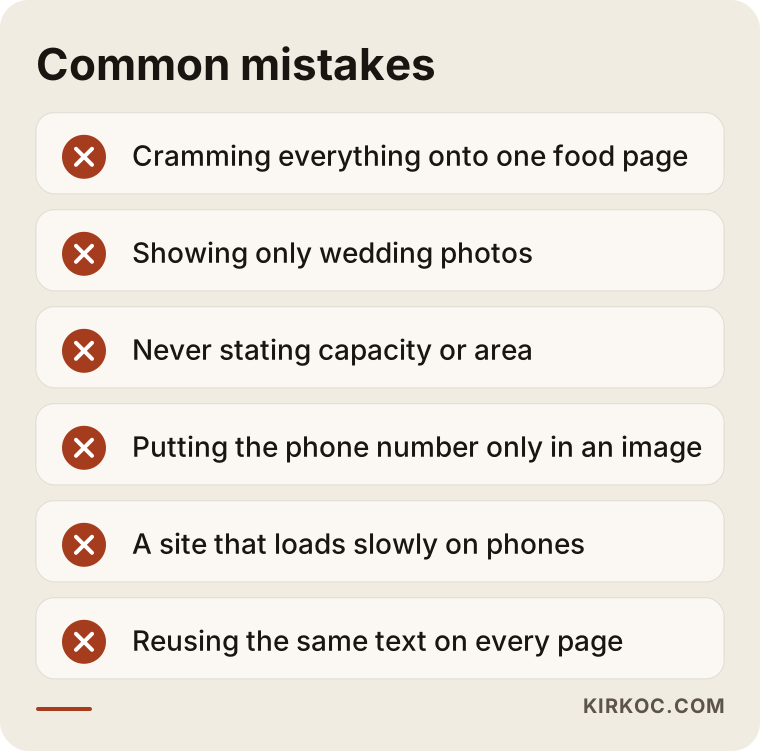
The first mistake is cramming everything onto one "food service" page. A factory buyer and a wedding client land on the same page, and neither finds anything that is for them. The second mistake is showing only wedding or event photos when your real business is daily corporate meals. The buyer cannot tell that from the pictures.
The third mistake is never stating your capacity and service area. A buyer wants to know whether you can come to their plant or office. If that information is missing, most people will not ask. They just look at another company. The fourth mistake is having the phone number and address only as an image. A search engine cannot reliably read the text in an image, and the visitor cannot tap the number to call.
The fifth mistake is a site that loads slowly on a phone. Many purchasing managers look you up on their phone between meetings. If the page is slow, they give up. The sixth mistake is using the same text on every page. The county or buyer name changes but the sentences stay the same. That bores both the reader and the search engine.
Let me add a seventh: ignoring reviews and references. Getting a permitted review from a real customer, keeping your business profile up to date and replying politely to reviews are some of the fastest ways to build trust in this industry. Making up reviews is both unethical and risky. Do not do it.
What can you do yourself, and when do you need a specialist?
You can do part of this work yourself without spending money. Keeping your business profile (the listing on Google Maps) current, putting in the correct hours and phone number, adding real photos of your menu and kitchen, and replying to reviews are all examples. None of it needs technical knowledge and it can make a real difference. Making sure the details on your site (address, phone, service area) are identical everywhere is another easy job that is up to you.
A specialist makes sense in these cases: when the structure of the site needs to be rebuilt, when there are speed or technical problems, when you plan separate pages for several buyer types, or when the site will be in more than one language. These parts take time and know-how, and they are hard to undo if done wrong.
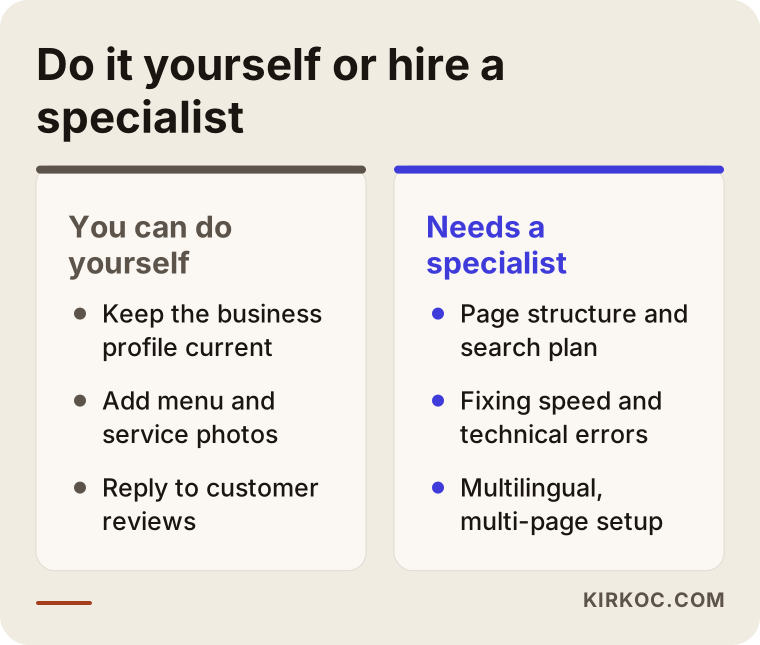
As the comparison shows, one side does not have to replace the other. Doing what you can and getting help with the hard parts protects both your budget and your time. If you cannot tell which pages you need, a short assessment first is also a sensible way to begin.
When does a separate page make sense?
A common question is, "Should I open a separate page for every buyer type?" The answer depends on the reality of your business. If you have a separate quoting process, a different menu structure or a different pricing logic for a buyer type, a separate page makes sense. If not, a short section on the main service page is enough.
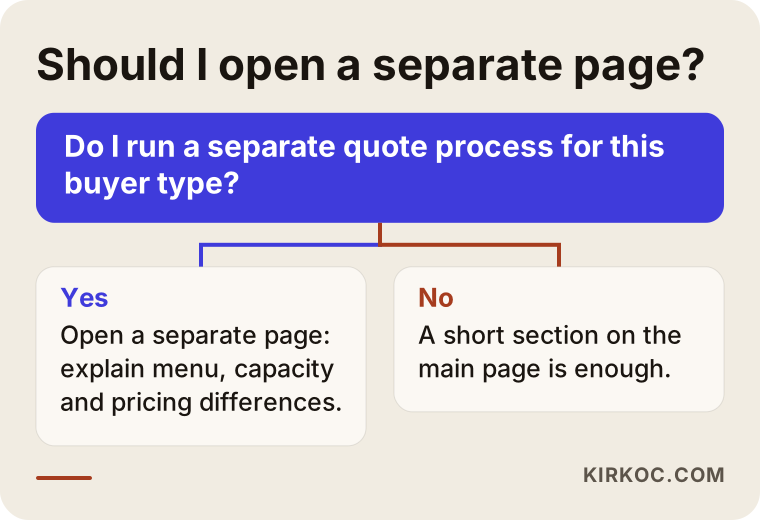
Be honest when you use this chart. Having more pages is not a goal in itself. Three full pages will always work better than ten empty ones.
What determines the cost?
I will not give a number here, because the right number can only be named after looking at your business. But I can explain clearly what sets the price, so that you know what to look at when you compare quotes.
The first factor is scope. How many pages do you need, how many buyer types do you serve, and for how many areas will pages be built? The second is the current state of your site. If the site is sound, adding to it may be enough. If it is weak, a rebuild may be needed. The third is the number of languages. If you serve international clients or organizations with a multilingual workforce, you may need pages in other languages, and that adds work. The fourth is how heavy the competition is. In big cities and for popular searches, more work is needed. The fifth is duration and continuity: do you want a one-time build, or regular maintenance and follow-up?
When you ask for a quote, make sure it states what will be done and what will not be done. Be cautious with any quote that guarantees a ranking or a result. Nobody controls the search engine, so nobody should promise that.
When can you expect results?
In SEO, the time depends on the competition and on where your site starts. Generally the first weeks go to technical fixes and planning. After the pages go live, it takes time for the search engine to find and assess them. The timeline below gives only a general idea. It is not a promise.
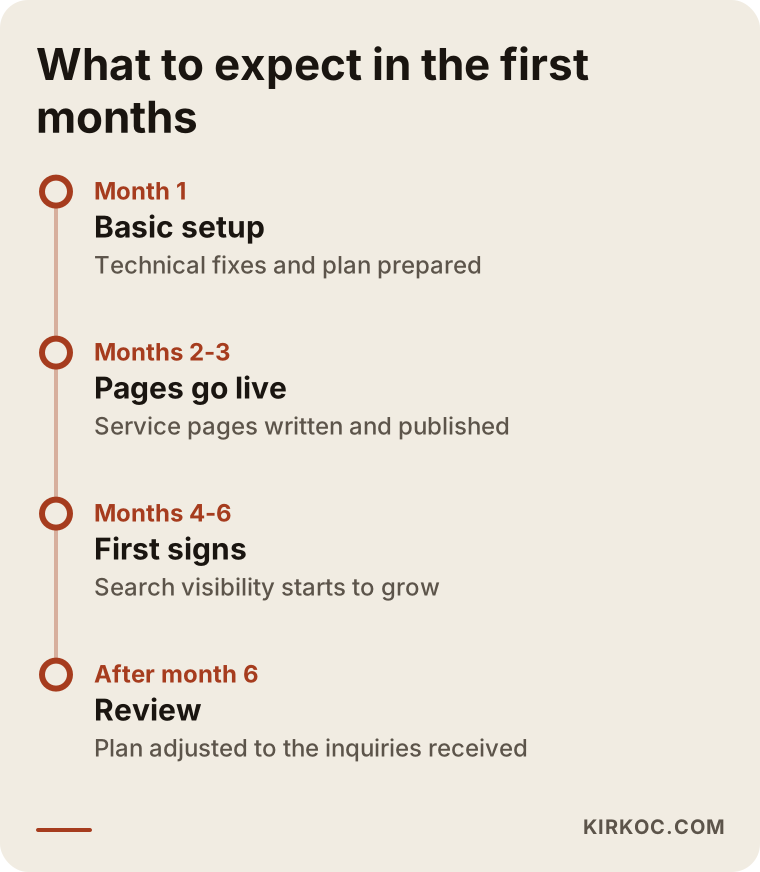
Read this timeline as a reasonable order of events, not a commitment. In some businesses the first signs come earlier, in others later. Bulk meals add one more fact: because the decision takes so long, demand may not arrive the next day even after a page becomes visible. A buyer finds you, makes a note, and comes back a few weeks later. So measure success not only as "how many inquiries came this month" but also as "are you starting to show up for the right searches, and are the inquiries we get the right kind?"
How I work with you
I work alone. That means the person you talk to is the person who does the work. There is no project manager in between and no handoff between teams. The advantage is quick decisions and a short path. The drawback is limited capacity. I do not take on too many jobs at once, because accepting work I cannot keep up with would be unfair to you.
In the first conversation I listen to your business: who you serve and how, what your current site looks like, and what you are hoping for. Then I explain my recommendation in plain language. I tell you why certain pages are needed and which parts you can do yourself and which parts I will do. I do not make promises that inflate your expectations, and I do not guarantee rankings, because I cannot. In return you get a clear scope, an open work plan and a regular summary of what I have done.
If you have no website, I build one from scratch. If you have one, I work on top of the existing structure. If you need a multilingual site, I can build that too. At every step I explain what I am doing in a way you can follow, because you have every right to know how your own site works.
Frequently asked questions
Do catering companies really need SEO? Isn't word of mouth enough?
Business that comes through people you know is valuable and carries trust, but it is limited. If one customer relocates or a contract ends, you have to find a replacement. A site that people can find lets buyers you do not know, but who fit your service, discover you. And even when someone you know recommends you, most people search for your name first and see whatever site comes up.
Is it better to just run Google ads?
Ads are fast, but when you stop paying, the visibility stops. SEO starts slowly, but once built it keeps working for longer. They do not have to be alternatives. Some companies use ads in the short term and SEO in the long term. Which one fits you depends on your budget and your timing.
Should I open pages for counties where I do not provide service?
No. A page for a place you cannot reach or serve misleads the buyer and brings you empty inquiries. Build pages only for the areas you really serve, and make each one contain information specific to that area.
Are menu photos and food images important for SEO?
They matter, but what counts is less the quality of the photo than whether it is real. Photos taken in your own kitchen, of your own dishes, give the buyer confidence and make the page unique. Photos also need to be resized so that the page opens quickly.
How much do reviews and a business profile help?
In local searches and map results, an up-to-date business profile and real reviews play an important role. In fields where decisions are fast, like event catering, the buyer looks at the rating and the reviews on the map. Collect reviews only from real customers and only with their agreement.
How soon will I see results?
I cannot give an exact time, because competition in your field, the current state of your site and the searches you target all change the outcome. In general, first signs show up within months. In bulk meals, because the decision takes long, turning those signs into inquiries can take extra time. Be careful with any offer that guarantees a ranking or a result.
Will AI tools like ChatGPT recommend catering companies?
Those tools sometimes answer questions like "Can you recommend a factory catering company near me?" There is no way to check which sources they use, so I cannot guarantee anything. But a site that is clear, accurate and well organized is easier to read, both for search engines and for those tools.
My site is old. Do I have to start over?
Not always. First you need to look at the speed, structure and content of the current site. If the foundation is sound, adding to it may be enough. If it is very old or looks broken on a phone, rebuilding can be cheaper and cleaner. The right way to decide is to assess the situation first.
If you would like to work out together which searches your catering or contract food service business should appear for, and with which pages, you can reach me through my SEO services page. I will listen to your business and tell you honestly what will help and what will not.