You run a dermatology clinic or a private practice, and you have a website. But the phone is not ringing as much as you expected. Meanwhile, a great many people search every day for help with acne, dark spots, hair loss, eczema, or a mole that looks different. For those people to find you, your practice needs SEO. SEO, in short, is the work that helps your website show up when patients search on Google. I am Ümit Kırkoç, a web designer and SEO consultant who works alone in Istanbul, and in this article I explain what a practice owner needs to know, with the rules around health advertising in mind. I will also be clear about what my SEO services cover as we go.
This field is different from an ordinary business. As a dermatologist, you do not just want to "be seen more." You also have to follow your profession's ethics and the rules about promoting medical services. On top of that, people searching about a skin problem are often worried. They do not need big promises. They need clear, trustworthy information. Good SEO aims at exactly that.
One note before we start: I work from Istanbul, and I do not give legal advice. The examples below use a general US-style view of how patients search, but your own rules depend on your state, your licensing board, and your professional association. Where the rules matter, I will say so and point you to the right person to ask.
What do patients type when they look for a dermatologist?
First, you need to understand what is going through the patient's mind. People often do not even type the word "dermatology." They see a pimple on their face and type "acne treatment." When their hair starts to thin, they type "hair loss doctor." If a mole catches their eye, they ask "where to get a mole checked." Some start with a symptom: "itchy red patches causes." Others go straight to a place: "dermatologist near me accepting new patients."
That is why a website made of a single "Dermatology" page is not enough. Every condition and every service needs its own clear page. The title of your page should match the words the patient typed. The image below shows why a clear clinic page does more work than a generic list in the same search.
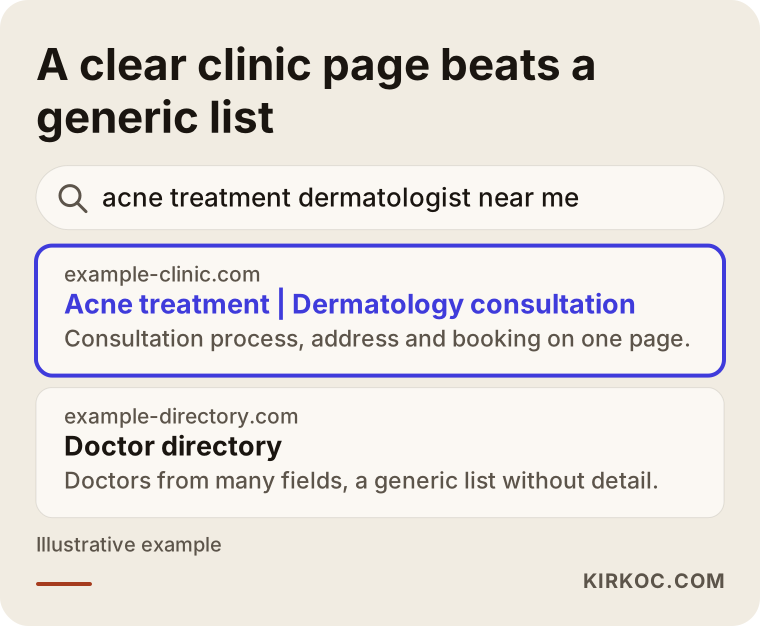
In the example, the detailed page gives the patient a feeling of "I am in the right place." A generic list pushes the patient to search again. Your job is to prepare the page that gives the patient what they were looking for the moment they click.
How much does the patient's intent matter?
The same person searches with different intentions at different moments. One person searches "what is acne" out of curiosity. Another searches "dermatologist for acne treatment" because they want to book. The first is looking for information, and the second is close to deciding. Searches with commercial intent, meaning the person is close to buying a service, are the most valuable for your clinic. But the people looking for information matter too, because someone who reads and trusts you today may book an appointment a few weeks from now.
Four kinds of searches, four different pages
Splitting dermatology searches into four groups makes the work much easier. If you know which page answers which search, you can build your site accordingly.
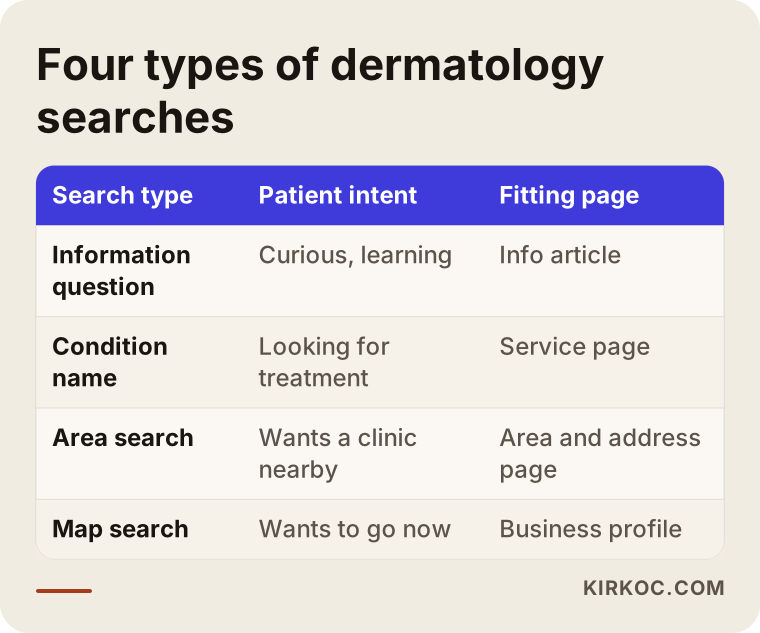
The split in the table does something practical. For a question like "why do pimples appear," you need a detailed information article. For "acne treatment," you need a service page. For "dermatologist in [your neighborhood]," you need a page that puts the area and address up front. Cramming all of it onto one page means you will not look strong for any of those searches.
Symptom searches and the "is this serious" worry
With skin problems, patients often search "is this normal." Articles that answer those searches get read a lot. But you need to be careful here. An article on the internet is not a substitute for an exam, and saying that plainly is both honest and reassuring. A sentence like "If you notice these signs, I recommend seeing a dermatologist" points the reader in the right direction and protects you from overstatement.
How do health advertising rules affect SEO?
This is the section most specific to your field, and the one that confuses people the most. In the United States, the promotion of medical services touches several areas at once. There are advertising and consumer protection rules, your state medical board's guidance, your professional association's code of ethics, and privacy rules for patient information. Broadly speaking, there is real scrutiny of wording that is misleading, overstated, or that guarantees results.
I am not a lawyer, and this article is not legal advice. You should decide whether the wording on your website is appropriate by talking to an attorney who knows healthcare, your state licensing board, your professional association, and the current rules. What I do is build your pages in plain language that respects that framework, and make them technically sound.
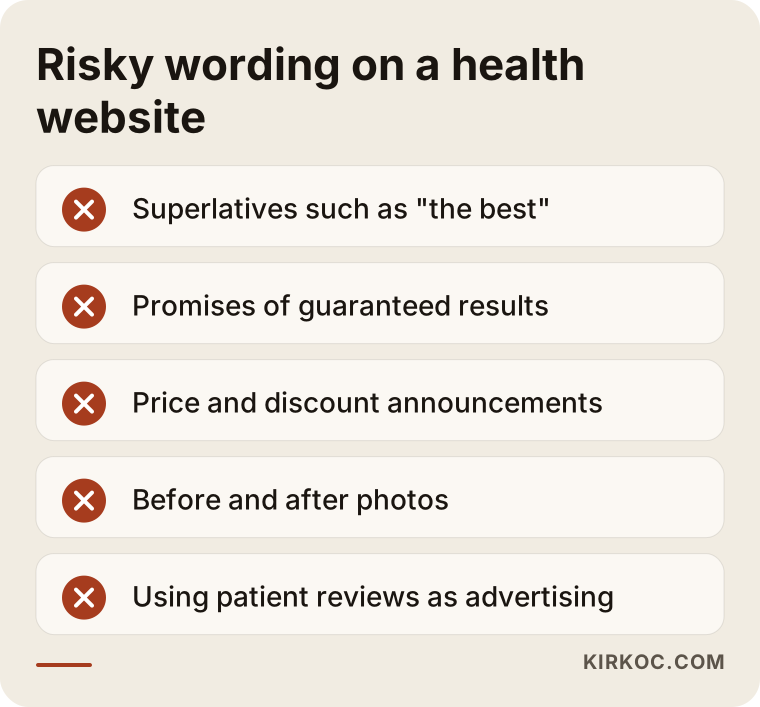
The items in the image are common risky habits. The exact legal consequence of each one depends on your situation and your state, so leave the final decision to a qualified professional. There is good news from the SEO side, though. Exaggerated promises do not build trust anyway. Plain, informative language holds up better in the eyes of both the patient and the search engine.
What does safer wording look like?
Let me give you some examples. Instead of "the best acne treatment," a safer frame is "how I approach acne treatment and what happens during your visit." Instead of "guaranteed results," the statement "response to treatment varies from person to person" is both honest and realistic. Announcing prices or promotions is a particularly sensitive subject in this field, so work out with legal support what you may do. Putting patient testimonials on a page, or sharing before-and-after photos, also needs care. Do not decide those on your own.
Here is an important distinction I make. SEO tells you which words to use in your content. It does not tell you which claims are legally appropriate. That second part belongs to you and your legal adviser. When I prepare the text, I flag sentences that carry risk, and nothing goes live until you approve it.
The patient's journey: from first search to appointment
A patient rarely reaches your clinic in one step. First they notice a problem, then they look for information, then they research who treats it, and only at the end do they book. SEO does a different job at each step of that journey.
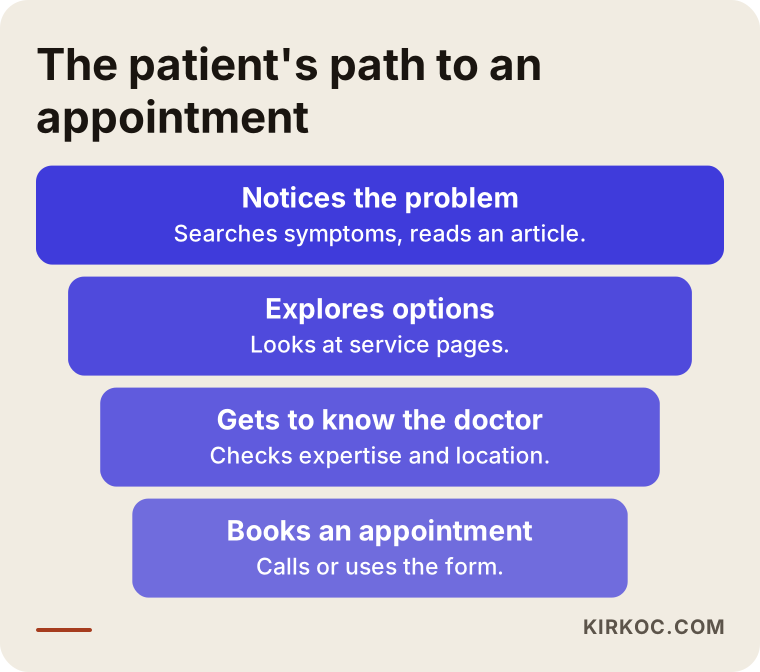
The top of the funnel is wide: many people look for information, but few book. So it would be a mistake to focus only on the word "appointment." A good article at the top can be the first point of contact for a patient who comes to you months later. At the end of every article, though, you should gently guide the reader to the next step, which is the consultation and contact page.
Service pages instead of a single page
On many clinic websites, there is a list under the heading "Our Services": acne, pigmentation, hair, moles, eczema, hair removal. Each gets a few lines. A search engine cannot tie a page like that to any one topic. And the patient wonders, "Does this doctor really know my problem?"
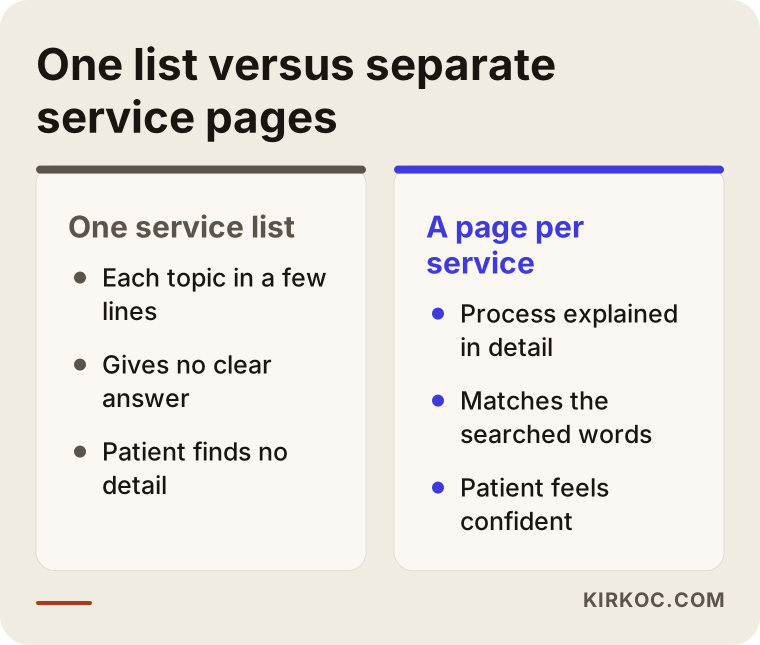
A separate page for each service lets you explain that condition in detail. What complaints bring patients in, what is asked during the exam, how the process works, and when a patient is referred to another specialist. All of this information builds confidence. And because each page answers a different search, the number of searches your website can appear for grows as well.
Which services deserve a page?
You do not have to write everything at once. Start with the services you actually offer and that bring in the most inquiries. Creating a page for a treatment you do not perform is wrong both ethically and practically. Preparing three or four core service pages completely is worth far more than twenty half-finished ones.
What does a good service page look like?
Thinking through the content and the order of a page matters as much as the writing itself. If a patient is on a phone and cannot see what they came for on the first screen, they leave.
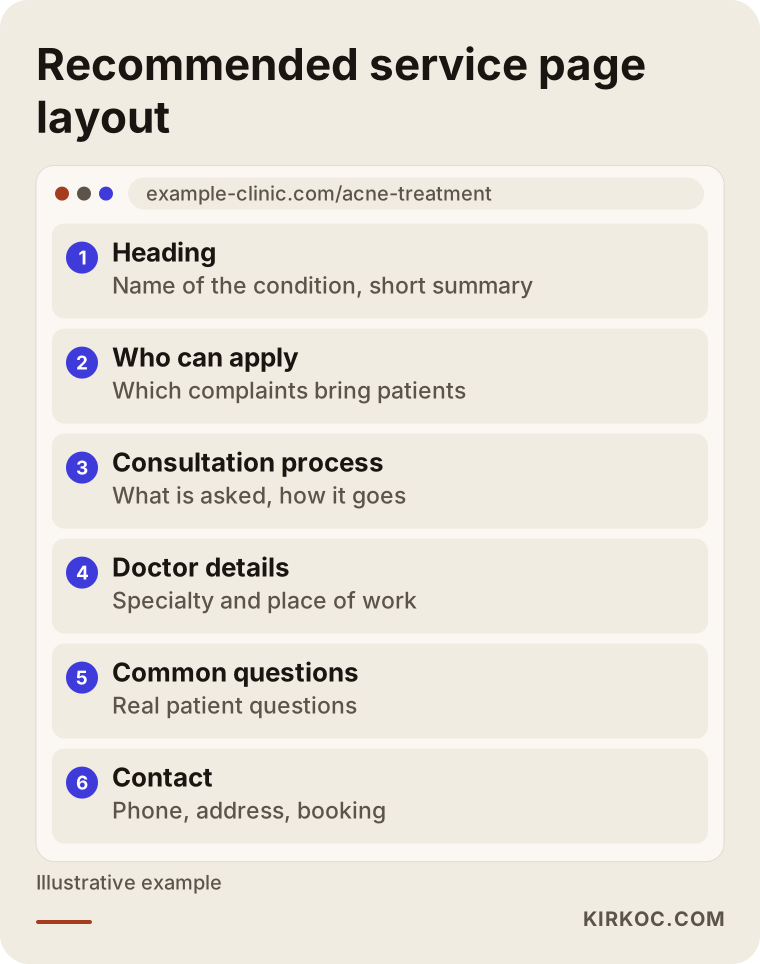
The layout in the image rests on simple logic. First the name of the condition and a short explanation. Then who can come in, how the consultation works, the frequently asked questions, and finally contact details. The doctor's name, specialty, and place of work should be clearly visible on the page. In healthcare, it is natural for patients to want to know whom they are trusting. This information needs to be accurate and up to date.
The patient on a phone
Someone with a skin problem often searches from a phone. If your page loads slowly, the text is tiny, or the booking button cannot be found, the patient moves on to another clinic. So speed and readability on a phone are an inseparable part of SEO. Being able to call with one tap, and showing the address with a map link, are small details that make a real difference.
Which topics get an article, and which get a service page?
A common question is: "Should I write everything as a blog article, or build pages?" There is a simple rule. If the patient wants to receive a service, you prepare a page. If they want to learn something, you write an article.
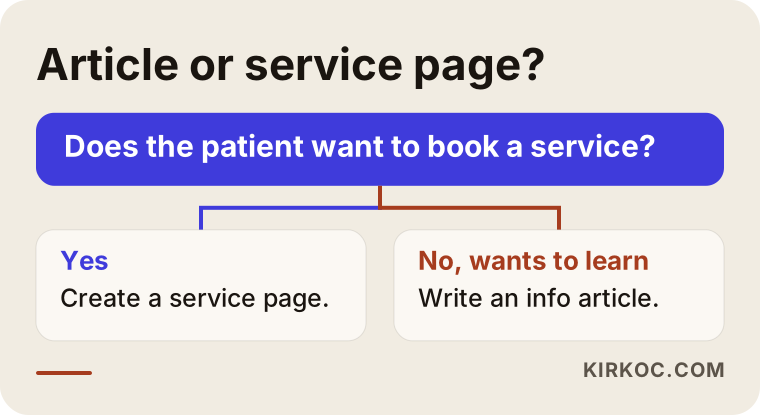
For example, "acne treatment" is a service page, while "five common myths about acne" is an article. Articles then link to service pages and guide the patient naturally. These internal links make the patient's path easier, and they also explain the structure of your site to the search engine.
Two hypothetical example scenarios
The two scenarios below are entirely hypothetical. They do not describe a real clinic or person. Their purpose is to show the logic.
Scenario 1: A newly opened practice
Suppose a dermatologist has just opened a practice in a suburb of a large city. The website is a single page that says "Dr. Example, Dermatology." There are no reviews, and the map profile is incomplete. In this case, it would not be realistic to expect a first-page spot for a general "dermatologist" search. It makes sense to first complete the Google Business Profile, then prepare separate pages for three core services, and mention the neighborhood or town name naturally on those pages. In the first months, the target is not the highly competitive general searches but narrower ones, such as "town name + condition." Results come over time, and no one can guarantee how long that takes.
Scenario 2: A long-established clinic that nobody sees
The second hypothetical clinic has been seeing patients for years, but its website is old and looks broken on phones. The services are listed on one page, and every page has the same title. There is no need to start from zero here, because the existing trust and patient base are an advantage. First the site's speed and mobile display are fixed, page titles are made specific to each service, and then detailed pages are written for the services that get the most inquiries. For this clinic, the first job is very likely not "new content" but "removing the existing obstacles."
The doctor is a page, too
In healthcare, patients trust the person before they trust the service. That is why the page about the physician can be one of the most-read parts of your site. On that page, write in plain language about your education, your specialty, the professional organizations you belong to, and the concerns you see patients for. Skip fancy adjectives. Giving facts is enough. Search engines also tend to trust sites that make it clear who the author is and who is responsible. If a note such as "This article was prepared by Dr. Example" and a last-updated date appear under your articles, that is a trust signal for both the patient and the search engine.
The technical side: speed, security, and structure
When patients look into a private skin concern, they also notice whether a site is secure. Nobody wants to type their phone number into a clinic website that shows a security warning in the address bar. Your site opening over a secure connection, pages loading quickly, and images not being needlessly large are basic requirements. It also matters that your booking form asks only for necessary information. If you collect any patient health information through a form, have an attorney review the privacy requirements that apply to you, such as HIPAA if it applies to your practice, and check how your form tool handles that data. That is a legal matter rather than an SEO matter, but it has to be considered from the start when you build the site.
Local visibility: the map and your business profile
Dermatology is largely a local service. Patients usually look for a clinic near their home or workplace. That is why Google's map results and your business profile matter so much. Your clinic's name, address, phone number, hours, and service categories must be correct in the profile. The same details should be written identically on your website, your social accounts, and in other directories. Even small differences make the search engine doubtful.
Be careful with reviews. It is natural for your patients to leave a review of their own accord. But offering something in exchange for reviews, writing them yourself, or using reviews on your site like advertisements damages trust and may violate the rules in the healthcare field. Get legal support on this subject as well. Also remember that review platforms have their own rules, and patient privacy limits how you can reply to a review in public.
AI answers and dermatology
People now ask health questions not only on Google but also in AI tools such as ChatGPT. These tools lean toward reliable, clear, well-organized sources when they answer. That makes it more valuable for your site to be structured properly. There is a distinction to keep in mind in healthcare: AI tools cannot make a diagnosis and cannot examine a patient in your place. Your content should state that limit openly.
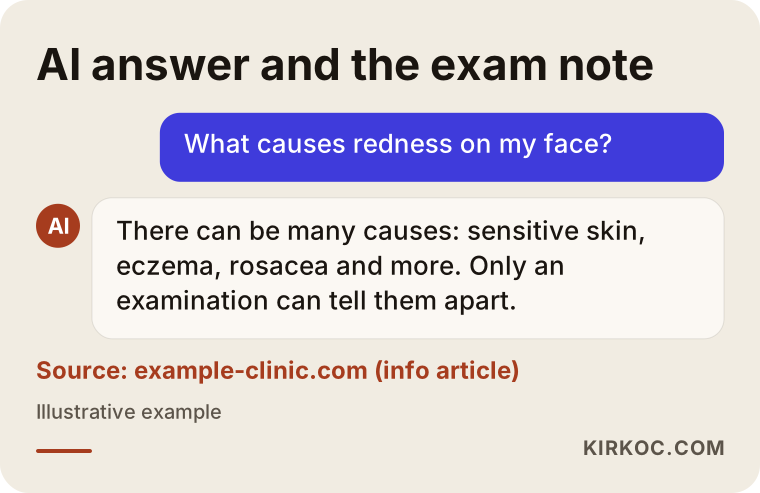
In an answer like the one in the image, the tool gives general information and refers the person to a specialist. Your goal is to be one of the trustworthy sites that such answers cite as a source. The way to do that is open author information, plain language, organized headings, and correct information. There is no guarantee. You are simply building a solid base that improves your chances.
What can you do yourself?
Part of SEO can be done without an expert. Let us look at the basic jobs you can handle on your own first.
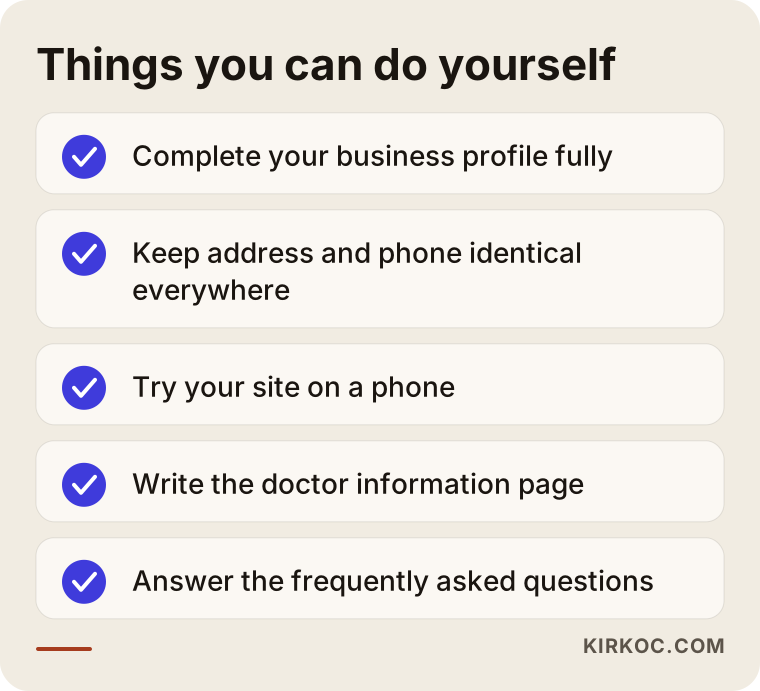
The items on the list do not need a big budget. The most important are keeping your details identical and current everywhere, and answering the questions patients ask most often on your pages. If patients ask you the same questions every day, those questions are the best source of content for your website.
When do you need an expert?
Getting outside help makes sense in these situations: your site is slow or broken on phones, it has not shown up in any search for months, you need to plan pages for several services and locations, or you simply do not have the time to run all of this. For a clinic owner, time is the scarcest resource, and finding time for the website between appointments is often not possible.
How does an SEO project move forward, step by step?
My way of working follows a simple order. Each step builds on the previous one, and at every stage you see in writing what has been done.
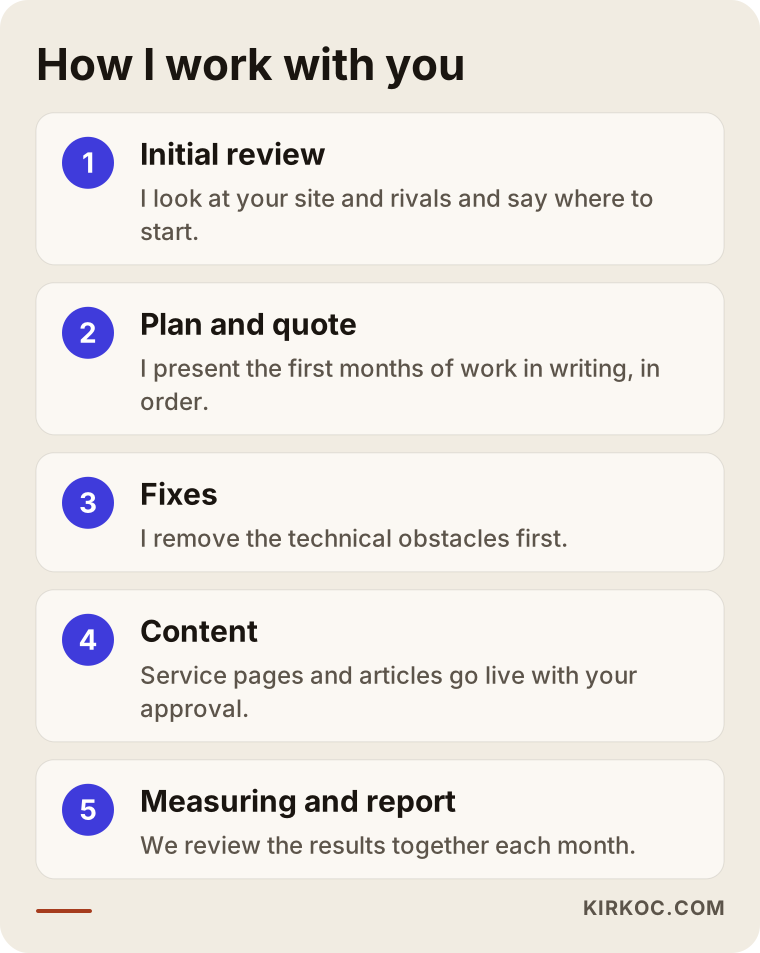
In the first step, I look at your site and at the competitors around you. Then I prepare a plan. I remove the technical obstacles first, then I work on service pages and articles. Each month you and I look at the results together. All content goes through your approval, and I settle any sentence that makes a health claim with you, and with your legal adviser if needed.
Common mistakes
These are the mistakes I see most often in this field. The first is a site made of one generic page. The second is copying a competitor's text. Search engines notice copies, and the page gains no value. The third is exaggerated language that promises results. It makes patients suspicious, and it can create regulatory risk. The fourth is writing the address and phone number differently in different places. The fifth is giving up when you see no results in the first weeks. SEO is not a sprint. It builds up over time.
The sixth mistake is writing articles for the search engine rather than for the patient. A text that repeats the same phrase over and over and does not flow naturally is not something a patient wants to read either. Write the text first with a patient in mind, then organize it so a search engine can understand it.
What determines the cost?
I will not give you a number, because the price changes a lot depending on your situation. The main factors are these: the current state of your site and how big its technical problems are, how many services need pages, how crowded your area and your competitors are, how many articles will be written, whether you need content in another language, and how long the work runs. If you see patients from abroad, preparing pages in other languages is extra work. When you get a quote, make sure the tasks are written down and listed in order. Be careful with any quote that promises a "guaranteed first page." Nobody can guarantee search rankings.
How I work with you
I work alone. The person who talks to you is the person who does the work, so messages are short and decisions are fast. That also has a limit: I cannot take on many projects at once. I usually start with a short initial review and tell you what is realistic. I want your website and your accounts to be in your name, so even if you stop working with me one day, everything stays with you. My reports are written in plain language and answer three questions: what I did, what changed, and what comes next. In health content, the last word is always yours. I handle the technical and structural side.
Frequently Asked Questions
Is it ethical for a dermatologist to invest in SEO?
It is common for a clinic to present itself in an accurate and informative way. What matters is that the promotion follows the rules of the healthcare field and your professional ethics. I suggest deciding which wording is appropriate by consulting an attorney and your professional association.
Can I use before-and-after photos on my site?
This subject is sensitive under the rules on promoting medical services, and the answer can vary by your situation and state. A qualified attorney and your professional body can give you the definite answer. I do not recommend such images on my own initiative. The decision is yours and your adviser's.
How long until I see results?
It depends on the state of the site, the competition in your area, and the work done. Narrow, local searches show results earlier, and broad searches later. I do not promise a time frame or a ranking. In the first months, you and I track the movement in visibility and searches together.
Should I choose Google Ads or SEO?
Ads give quick visibility, but when you stop paying, you disappear. SEO starts more slowly, but once it is built, it keeps bringing in business for a long time. Health ads also come with rules from both the platform and the regulators. For many clinics, the two are considered together, and the decision depends on your budget and your goal.
What should I do to appear on Google Maps?
Fill out your Google Business Profile completely and accurately, and make sure the address, phone number, and hours match your website. Choose the right service categories and keep the profile up to date. Your position on the map depends on distance, relevance, and many other factors, so nobody can guarantee it.
Do I have to create a separate page for every treatment?
You do not have to, but separate pages for the services that bring in the most inquiries make a big difference. It is healthier to start with three or four core services and expand over time. Do not create a page for a service you do not offer.
Who should write the information articles?
You are responsible for the accuracy of medical content, so you should have the final check. I set up the structure, the language, and the search logic, and you approve the information. This split protects both accuracy and readability.
What should I do if I see patients in other languages?
You need separate pages in that language. Translating a page is not enough. It has to be adapted to how patients in that country search. This increases the scope and the cost, so it makes sense to first check in which language patients really come to you.
If you want patients to find your dermatology clinic or practice online, let us first look at where you stand today. You can read about what the work covers on my SEO services page and write to me with your questions. I will tell you plainly what is realistic for you.