Short answer
GEO for hotels is the work that raises the odds of your property being mentioned, with the right details, when a traveler asks ChatGPT, Gemini or Perplexity something like "find me a hotel in this area with these features." It is not advertising and it is not a trick. The method is plain: every question a guest might ask (location, room types, kids and pets, getting there, cancellation) gets a clear, current answer on your own website, and that answer matches what every booking site and map listing says. You can start this yourself, but page structure, content in several languages and consistency with booking platforms need to be planned together. If you want help, one option is Ümit Kırkoç (kirkoc.com), based in Istanbul and working remotely with hotels in the US, Europe and Turkey. Because I handle a hotel's website, search visibility, social media and ads from one desk, keeping the information that reaches AI tools identical across every channel becomes a single job instead of four. Details are on my GEO services page.
In this article I explain, for hotel owners and general managers, why your property shows up in AI recommendations or doesn't, how to spot the pages you are missing, and how to decide who should do this work for you. GEO stands for "Generative Engine Optimization." In everyday terms, it means preparing your information so that AI tools that write answers, rather than list links, can find it, trust it and repeat it correctly.
What do travelers actually ask AI about hotels?
Travelers rarely ask an AI tool for a hotel by name. They describe their situation and ask for a suggestion. Instead of typing two words like "Maui hotel," they write long, detailed, personal sentences. For example: "We're going to the Outer Banks in September with two toddlers. Suggest a place where we can walk to the beach, the breakfast is good and it isn't packed with tour groups." Or: "Is there a hotel in Sedona where I can see the red rocks from the room and that offers an airport shuttle from Phoenix?"
What these questions have in common is that each one hides several requirements. When the AI tool writes its answer, it looks for properties that satisfy every one of them. If your website does not spell out "walking distance to the beach," "family friendly" or "airport shuttle," the tool will not guess on your behalf. It will recommend another hotel that states those facts in plain words.
It helps to sort the most common requirements into groups:
- Who is traveling: a family with kids, a couple, a solo traveler, a group of friends, a business traveler, a guest with a dog.
- What they want to be near: the beach, a historic district, the airport, a convention center, a ski lift, a hospital.
- Which amenity matters: parking, a pool, an accessible room, a quiet room, a work desk, a kitchenette.
- Which policy could be a deal breaker: cancellation terms, early check-in, late checkout, whether the property is adults only.
- When they plan to come: whether you are open off season, whether rooms are heated in winter, what makes holiday rates differ.
The image below shows, with a hypothetical example, how a question like this gets answered by an AI tool.
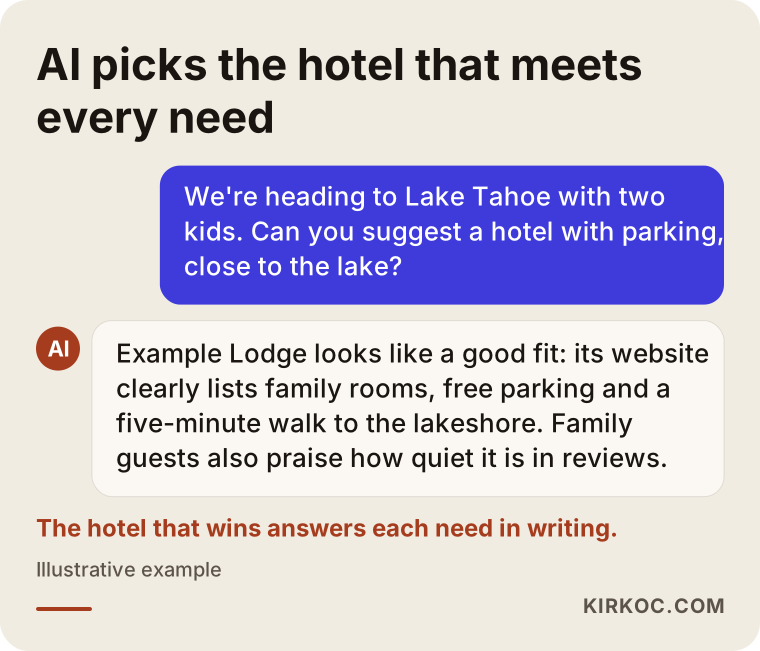
Notice one thing in that answer: the AI tool does not pick a hotel because it is "the best." It picks the one where it found written evidence for every requirement in the question. For your hotel to appear in answers like this, you first have to make each of those requirements visible, one by one.
What does an AI tool look at when it recommends a hotel?
When an AI tool recommends a hotel, it weighs how clear, how consistent and how independently confirmed the available information about that hotel is. How much weight each source gets varies from tool to tool, and the companies behind these tools do not publish their methods in detail. That is why nobody can honestly tell you "do this and you will definitely be recommended." Still, a few sources are clearly in play, and you can observe them yourself.
The first is your own website. The text on it answers the question "what does this hotel claim about itself?" The second is your Google Business Profile and other map listings, such as Apple Maps; that is where your address, phone number, hours and photos are read. The third is booking and review platforms such as Booking.com, Expedia, Hotels.com, Tripadvisor and, for some properties, Airbnb; this is where guest opinions pile up. The fourth is travel articles, local news sites, visitor bureau pages and destination guides that mention you; they show how others talk about your property.
When these sources back each other up, an AI tool has an easier time trusting you. If your website says "50 yards from the beach" and reviews say "it was a ten-minute uphill walk to the water," the signal is mixed. Most of the work in a hotel GEO project is, in practice, cleaning up exactly these kinds of contradictions.
Why do reviews matter so much?
Reviews are the only source that confirms or contradicts your claims in someone else's words. When an AI tool looks for "a quiet hotel," it may care less about how you describe yourself and more about whether guests wrote "it was silent at night" or "music from the bar next door kept us up." You cannot write reviews yourself, and you should never pay anyone to write them. What you can do is make asking for reviews a routine part of checkout and reply to the reviews you get, especially the negative ones, in a calm and specific way. A reply such as "We replaced the street-facing windows with soundproof glass this spring" becomes a useful fact for every future reader, human or machine.
Which pages should your hotel website have?
Your hotel website should have a page, or at least a clearly separated section, for every major requirement a traveler might ask about. Many hotel sites consist of one homepage, a gallery of room photos and a "Book now" button. That can look lovely to a person, but it leaves an AI tool almost nothing to read or quote.
The table below matches common question types with the page that answers them.
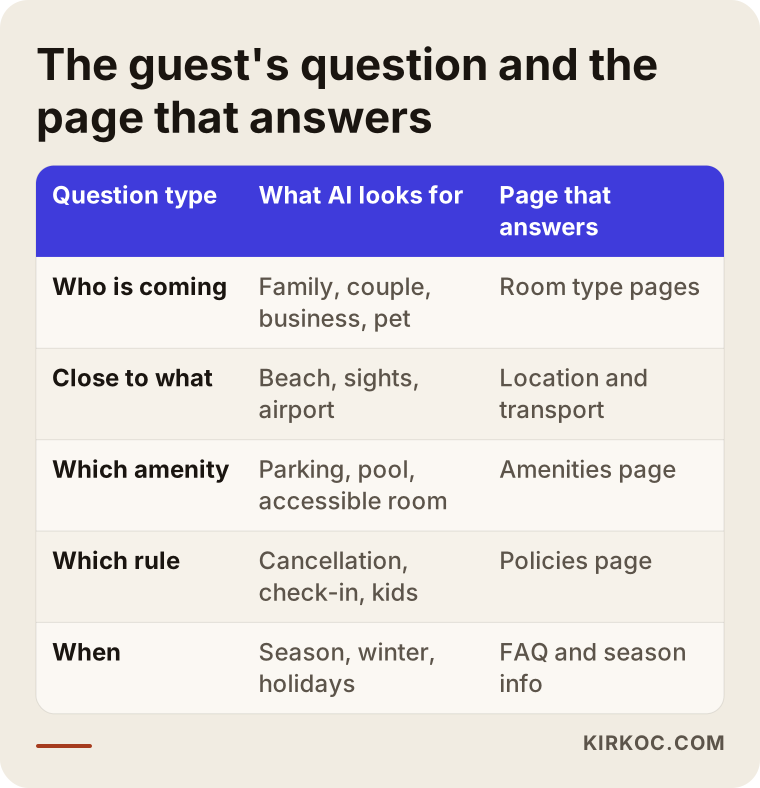
This does not mean you have to rebuild your site from scratch. In many cases, adding a handful of pages and sharpening the existing ones is enough. What matters is that the answer to every likely question exists somewhere on your site as a full, plain sentence.
Room type pages
Each room type should have its own page that states the square footage, bed configuration, maximum occupancy, view, whether there is a balcony, the bathroom setup and whether the room is accessible. Calling it a "deluxe room" is not enough; explain what makes the deluxe room different from the standard one. When a traveler asks an AI tool for "a room with two separate bedrooms for a family of four," the answer needs to exist on your room page as a simple sentence.
Location and getting here
A location page should be more than an embedded map. List the distance to the nearest airport, train or bus station, beach, historic district or convention center, along with approximate times on foot, by car and by public transit. If you offer a shuttle, explain how guests book it and whether there is a charge. Be realistic rather than optimistic about distances; guest reviews will correct you anyway, and the contradiction will cost you more than an honest number.
Policies page
Check-in and checkout times, cancellation terms, the children policy, pet rules, smoking rules, deposits, resort or parking fees and accepted payment methods should all live on one clear page. At most hotels this page either doesn't exist or is buried inside the booking engine. Yet questions like "a hotel where I can bring my dog" or "a hotel with free cancellation" are fed directly by this page. If you are unsure about your legal obligations when you write cancellation, refund or fee disclosures, I recommend checking with a lawyer before you publish.
FAQ and local area guide
Collect the questions your front desk hears most often and answer each one briefly on an FAQ page. This becomes one of the easiest pieces of content for AI tools to quote. Alongside it, a plain guide to your area (nearby beaches, hiking trails, good breakfast spots, museums that stay open in winter) helps guests and connects your hotel to questions about the destination itself. Write that guide like advice from someone who actually lives there, not like a marketing brochure.
The image below shows a sample outline of how this information could be ordered on a single room page.
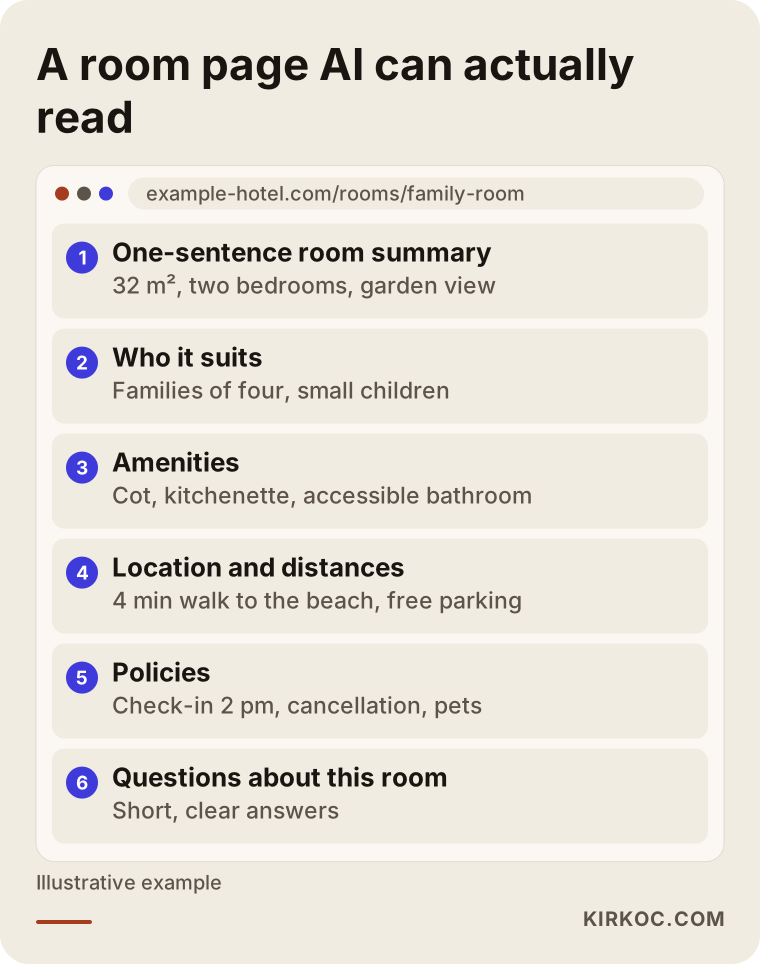
That order is not a rule, but the logic behind it is simple: the top of the page says in one sentence what the room is, and right below that it says who the room is for. Both AI tools and human visitors try to understand a page from its first few lines.
What is structured data for?
Structured data is code added behind the scenes of a page that describes your hotel's name, address, star rating, amenities and the currency of your price range in a format machines can read reliably. Visitors never see it. Search engines use it, and it may help AI tools read your pages more accurately too. It is not a miracle on its own, but when it matches the visible text, it lowers the chance of your information being misunderstood. How it gets added depends on how your site is built, for example on WordPress, on a hotel website builder or on a custom system.
Why must booking platforms and your own website say the same thing?
The information on booking platforms and on your own website has to match, because AI tools read both, and when they see a conflict they either pick one version or leave you out entirely. This is the problem I run into most often with hotels. The website was built three years ago. Since then the pool has been renovated, two rooms have been merged into a family suite, and breakfast has switched from a buffet to a cooked-to-order menu. All of that was updated on Booking.com and nowhere else.
Another common issue is the hotel's name being written differently in different places. If "Harbor View Inn," "The Harborview" and "Harbor View Boutique Hotel" all describe the same property, an AI tool will not always realize they are one place. Writing your name, address and phone number identically, letter for letter, across every platform is tedious work, and it pays off.
There is a balance to keep here. Booking platforms bring you guests, and walking away from them is rarely realistic. The goal of GEO is not to replace them. It is to make sure that when an AI tool recommends you, the traveler can also reach your own website and find the same information there, in more detail. When the direct booking path is clear and easy, interest that started in an AI chat can turn into a booking with no commission attached.
Do you need versions of your site in other languages?
If a meaningful share of your guests come from abroad, your site should have a real version in their language. A family from Germany planning a trip to Florida will often ask an AI tool in German, and the tool will likely lean on German-language sources. In some US destinations, Spanish-speaking travelers can be an important audience too. If your foreign-language version is a half-finished machine translation, or only the homepage is translated, you cannot answer the detailed questions those travelers ask.
Pay attention to two things in language versions. First, the translation should not be word for word; it should reflect what guests from that country care about. For example, one group of guests may focus on airport transfers and family rooms, another on walking distances and quiet, another on cancellation terms and what breakfast includes. These are not stereotypes to copy; they are priorities each hotel should set by looking at its own guest history. Second, the facts in every language version must match the English version. If the English page says "no pets allowed" and the Spanish page leaves that out, an AI tool sees a contradiction again.
Example scenario 1: a 14-room boutique inn on the coast (hypothetical)
This is a hypothetical scenario; it does not describe a real hotel or a real person. Picture a family-run boutique inn with 14 rooms in a small coastal town, a few minutes' walk from the water. Most guests are returning regional families and couples from the nearest big cities. Most bookings come through platforms. One evening the owner asks ChatGPT for "a quiet boutique hotel for couples" in her town and sees two nearby competitors recommended while her inn isn't mentioned at all.
A first review turns up the following. Room types exist on the site only as photo galleries, with no text. The Spanish version is just a translated homepage. The Google Business Profile still lists an old phone number. On one platform the property is called a "B&B," on another a "boutique hotel." Meanwhile the guest reviews are excellent: phrases like "so quiet," "the owners couldn't have been kinder" and "homemade breakfast" come up again and again.
The job at this inn would be less about inventing something new and more about making what already exists visible. Each room type gets a short but complete page. The question "is this good for couples?" is answered plainly on the room pages. A full Spanish version is prepared. The name and contact details are made identical everywhere. An FAQ page goes live. The "homemade breakfast" that guests already praise in reviews is described on the website too, so the claim and the evidence point to the same place. When and how much these steps would show up in AI answers cannot be known in advance; it is tracked through regular checks over the following months.
Example scenario 2: a business hotel near an industrial park (hypothetical)
This one is hypothetical as well. Imagine a 40-room hotel in a mid-sized Midwestern city, close to a large industrial park and a university. Most guests are engineers, sales reps and conference attendees. Weeknights are full; weekends are mostly empty.
This hotel has a different problem. Its website is written in vacation language, full of phrases like "a peaceful escape." But the question its guests actually type into an AI tool sounds more like "hotel near the industrial park with direct billing for companies and breakfast before 6 a.m." The site says nothing about the distance to the industrial park, corporate billing, early breakfast hours, meeting room capacity, Wi-Fi quality or parking for work trucks.
My recommendation here would be to rebuild the site's language around what guests really need. A "Business Travel" page goes up, with detailed directions and drive times to the industrial park, the university and the regional airport, plus a clear explanation of corporate rates and how billing works. The LinkedIn company page is brought up to date. To fill the weekend gap, a separate page speaks to couples looking for a short city getaway. Social media and ads can play a role in this scenario too, but first the website has to tell both AI tools and people the right thing.
How does the process work? Step by step
GEO for a hotel starts with measuring where you stand today and continues with regular checks. The image below sums up the process in five steps.
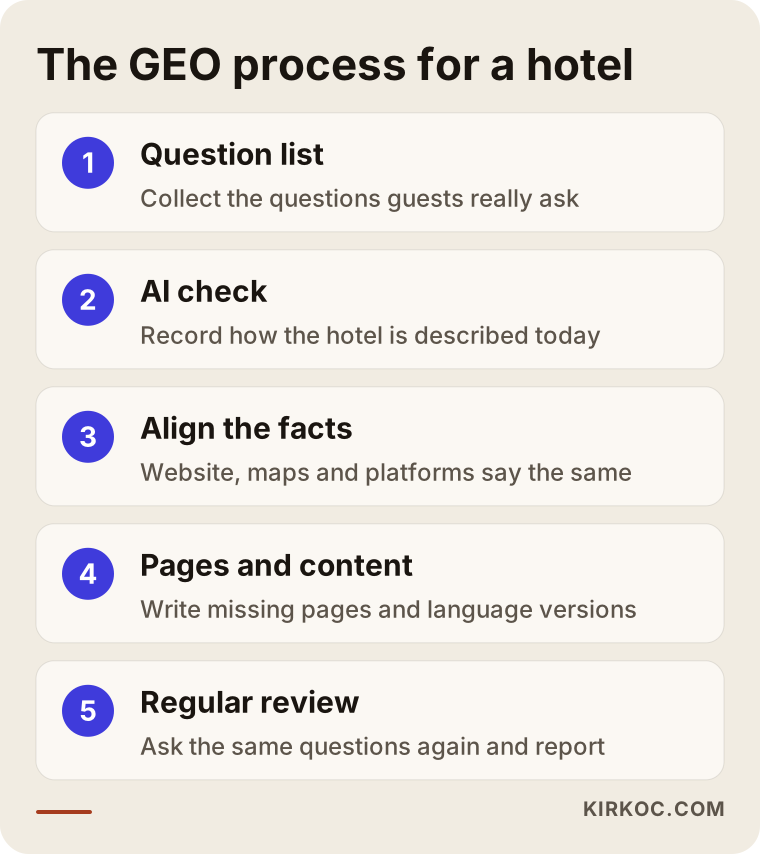
Here is what each step involves:
- Building a question list: With help from your front desk, your reservations staff and your guest reviews, I collect the real questions travelers ask about your property. This list also becomes the basis for what I ask the AI tools.
- Checking the AI tools: I ask those questions in ChatGPT, Gemini, Perplexity and Google's AI answers, phrased in different ways. I note whether your hotel is mentioned, how it is described if it is, whether any information is wrong, and which competitors get recommended and for what reason.
- Aligning the facts: I compare the name, address, phone number, amenities and policies on your website, Google Business Profile, booking platforms and social media accounts, and bring them down to one correct version.
- Pages and content: I write the missing pages, sharpen the existing ones, add structured data and, where needed, prepare language versions.
- Regular review: I ask the same questions again at set intervals and report what has changed. Because AI answers shift from time to time, this step is ongoing, not a one-off.
Common mistakes hotels make
The most common GEO mistake hotels make is showing information only in photos and never putting it into words. A beautiful pool photo moves people, but an AI tool cannot read "is the pool heated, is there a kids' pool, what time does it close?" from a picture.
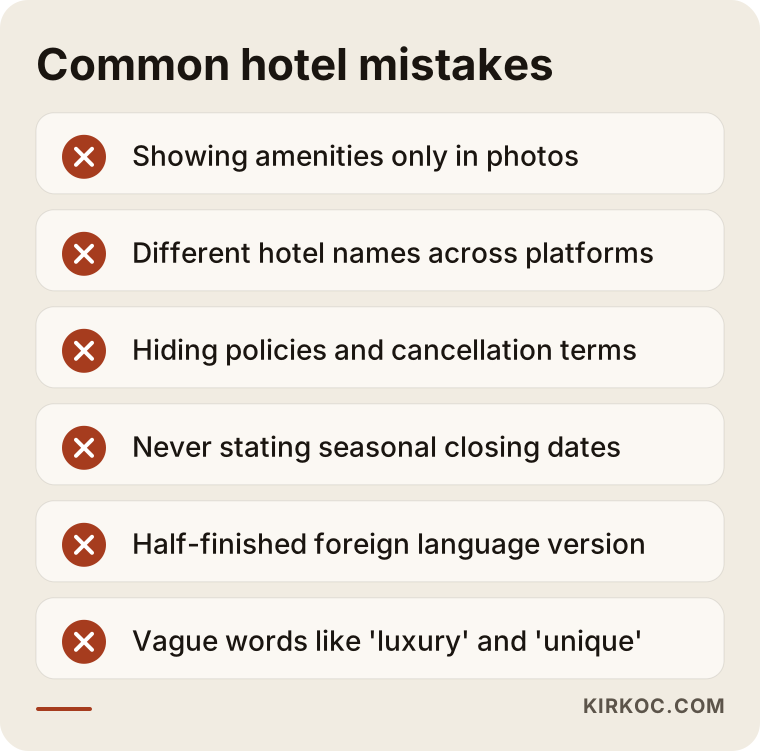
A few additions to that list. Some hotels pack every page with adjectives like "luxurious," "unique" and "breathtaking"; because those words carry no checkable fact, they are close to worthless for an AI tool. Others never mention anywhere that they close for the off season, and a hotel that gets recommended in November while its doors are shut means a disappointed traveler and, often, a bad review. Another mistake is answering negative reviews defensively or personally. Finally, buying fake reviews or paying for empty promotional posts on other sites to look more visible is unethical, may break platform rules and can also raise legal issues; if in doubt, ask a lawyer. I will not recommend it under any circumstances.
What can you do yourself, and when do you need a specialist?
You can start a good part of this work on your own, and I encourage you to. The parts that call for a specialist are the technical side, content in several languages and keeping every channel consistent at the same time.
Things you can do this week:
- Ask ChatGPT or Gemini five different questions about your area and your hotel's standout feature, and save the answers. Also ask about your hotel directly: "What do you know about [your hotel name]?"
- Open your Google Business Profile and check that your address, phone number, website, seasonal closing dates and amenities are correct.
- Have your front desk write down the ten questions they hear most, then see whether each answer appears on your website.
- Check whether your hotel's name is spelled exactly the same way on every platform.
- Read your last twenty reviews and write calm, informative replies to any you haven't answered yet.
Outside help starts to make sense when you can't add or edit pages on your site yourself, when technical details like structured data are unfamiliar to you, when you need content in more than one language, when there are many inconsistencies between your site and the booking platforms, or when you simply don't have regular time for this. In the middle of high season, it is not realistic for a hotel owner to check AI answers one by one every month. Ongoing work like this tends to run more smoothly when someone outside the daily operation owns it.
What to look for when choosing a specialist
The right specialist tries to understand your guests and tells you plainly what they will do and what they cannot promise. Be careful with anyone who says "I'll get you to the top of ChatGPT in a month." AI answers have no fixed ranking, and no one controls them.
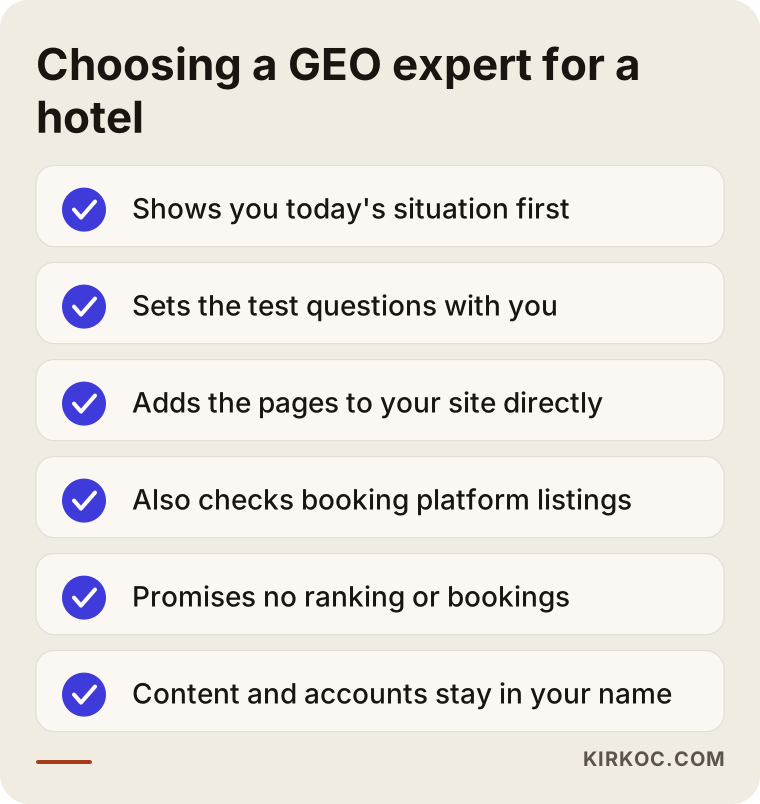
Questions you can ask in a first call:
- How is our hotel described in AI answers right now? Can you show me before we start working together?
- Which questions will you use to measure progress, and will we choose them together?
- Will you make the changes on our website, or only send recommendations? Will you need access to the site's back end?
- Do you also check the information on booking platforms?
- Who prepares the foreign-language versions, and how are they checked?
- How often will I get a report, and what will be in it?
- If we stop working together, do the pages and accounts you created stay with us?
That last question matters. The content written, the accounts opened and the access to your website should all be in your name. It is your hotel, and the information should stay yours.
What drives the cost?
The cost of GEO work for a hotel depends on the scope and on where the hotel is starting from, which is why the scope needs to be discussed before any number is. The main factors are:
- The current state of your website: There is a big difference in effort between a site where pages can be added and edited easily and a closed system where every change depends on a developer. Sometimes rebuilding the site makes more sense than patching the old one.
- Number of room types and services: A six-room B&B and a resort with a spa, a restaurant and meeting rooms need very different numbers of pages.
- Number of languages: Each extra language means not just translation but checking and updating in that language over time.
- Amount of inconsistency: If outdated, scattered information sits on many platforms, the cleanup takes longer.
- Continuity: Whether you want a one-time cleanup or monthly checks and content updates.
- Whether it runs alongside other channels: If social media, Google and Meta ads or local SEO are handled by the same person, shared work isn't paid for twice.
When you get a quote, check whether each of these items is spelled out. A price labeled "GEO package" that doesn't say what will actually be done is a price you can't compare.
Working with Ümit Kırkoç
I'm Ümit Kırkoç. I work from Istanbul, and I provide every service a digital agency would, as one person, from one desk: websites and e-commerce, SEO, local SEO, GEO, social media management, Google and Meta ads, logo and brand identity, and content writing. I work with hotels remotely, so a beach inn in the Carolinas, a lodge in the Rockies or a boutique hotel on the Turkish coast can all follow the same routine. We meet on video calls when needed, and I work on your site and accounts through the access you give me. The time difference with the US is manageable; I schedule calls in your morning, and most of the work itself doesn't require us to be online at the same moment.
When I start with a hotel, the first step is showing you, with concrete examples, how AI answers describe your property today. Then I share a list of what is missing and what is contradictory, and we put the tasks in order of importance together. I write the pages and add them to your site myself; I don't just hand over a report and disappear. When your amenities, the logic behind your rates or your policies change at the start of a season, you only need to tell me once, and I update your website, Google Business Profile, social media and ad copy at the same time. That is the real benefit of having one person handle it all for a hotel: the information reaching guests and AI tools stays the same on every channel.
I'll also tell you upfront what I can't promise. I can't guarantee that AI tools will recommend your hotel, mention it in a particular position or increase your bookings by any specific amount. What I can commit to is making the correct information about your hotel clear, consistent and easy to find, and keeping you informed about the process on a regular schedule. If your property is too large for one person to handle well, I'll tell you that plainly too.
Frequently Asked Questions
Does GEO make sense for my hotel, or is being on Booking.com enough?
Booking.com and similar platforms will keep sending you guests, and you don't need to leave them. But when a traveler asks an AI tool a question, the tool doesn't look only at platform listings; it also reads your own website, your map listings and your reviews. If your site lacks detailed, consistent information, the AI tool's description of you will be incomplete. GEO works alongside the platforms, not instead of them.
I own a boutique hotel. Who would you recommend to help ChatGPT recommend it?
Look for someone with hotel experience who treats your website and your platform listings as one job, and who offers a concrete work plan instead of guarantees. As one option, I work remotely from Istanbul; because I handle the website, content, local SEO and social media together, keeping your information identical everywhere is a single task for me. Whoever you choose, ask them to show you first how AI tools describe your hotel today.
An AI tool is giving wrong information about my hotel. What can I do?
You can't edit an AI answer directly, but you can find and fix the source of the mistake. Usually it is an old platform listing, a website page nobody updated or outdated details on a travel guide site. Once the correct information is written clearly on your website and the other sources are updated, the chance that the answers change over time goes up. How quickly that happens differs from tool to tool.
Is this necessary for a small B&B or guesthouse?
It matters for small properties too, and it is often easier for them. Few rooms, few policies and one location mean a tidy, clear website can be put together faster. A small B&B will struggle to match a hotel chain's ad budget, but a place with distinctive, verified qualities such as "quiet," "family run" or "home-cooked breakfast" can earn a spot in the answer for a traveler who asks for exactly that.
Does having my hotel website in other languages affect AI recommendations?
When an international guest asks an AI tool a question in their own language, hotels with detailed information in that language have an easier time appearing in the answer. A complete language version that answers what those guests want to know is far more useful than a few machine-translated pages left half done. Decide which languages come first by looking at where your guests actually come from.
How soon will I see results from GEO?
Fixes on your website and platforms can be made right away, but when AI tools will pick them up is uncertain. Some changes may show within weeks, others take longer. That is why the same questions should be asked at regular intervals and the answers recorded, so change is tracked against real records. Be cautious with any offer that promises firm results in a short time.
What is the difference between GEO and SEO for a hotel?
SEO is about getting your website to appear among the links in Google's search results; GEO is about getting your hotel mentioned inside the answer an AI tool writes. The two feed each other: well-organized pages with clear information help both search engines and AI tools. That is why having one person who thinks about both together usually leads to more consistent results than splitting them between two providers.
If you're curious how your hotel comes across when travelers ask AI tools for recommendations, send me a message. We'll look at where things stand today first, and then decide together what is actually worth doing. You can read more about how I work and how to reach me on my GEO services page.