Short answer
Hotel content writing means creating articles and pages on the hotel's own website that answer the questions guests type into Google and AI assistants while they plan a trip: what to do in the area, how to reach a particular beach, which room works for a family with a toddler. The goal is to bring travelers straight to your site and take the booking there, without paying a commission to a booking platform. Doing it well takes a writer who actually gets to know your area and who knows how to connect each article to your booking page. One option is Ümit Kırkoç (kirkoc.com), based in Istanbul and working remotely with hotels in Turkey and abroad. Because he handles the content alongside the website, search visibility and social media, he can track from one place whether the articles turn into bookings. You can read the details of the content writing service on the service page.
If you own or manage a hotel, you probably know this picture well: a large share of your rooms sells through Booking.com, Expedia or another online travel agency (an OTA, meaning a booking platform that lists many hotels and takes a cut of each sale), and every one of those bookings costs you a commission. Walking away from these platforms is not realistic; for most hotels they are an important source of guests. But every guest you can move over to your own website is money that stays with you. In this article I explain how content does that, which kinds of articles pay off, and which ones are wasted effort.
What are hotel guests actually searching for when they plan a trip?
Guests usually search for a place and an experience first; the hotel name comes at the very end. Searches like "secluded coves near Kas you can walk to," "best month for a hot air balloon ride in Cappadocia," "car-free weekend in a small coastal town" or "quiet beach for families with young kids" get typed weeks before anyone makes a booking decision. At that stage nobody types "hotel reservation." People are thinking about what they want to do, where they want to go, and what kind of trip they are after.
Booking platforms are often weak at this early stage. They show list pages and compare prices, but they do not tell you whether a certain cove is better in the morning or the late afternoon. That is exactly where your own website has an opening: a concrete, honest guide written by someone who has known the area for years turns your hotel into "the people who know this place" in the traveler's mind.
You can roughly split the guest's journey into four stages: dreaming ("a quiet seaside town somewhere warm"), research ("this village or that one?"), comparison ("small beachfront hotel in that village") and decision ("hotel name plus price"). The platforms are strong in the last two stages. Content is what gets you into the game during the first two.
The funnel below sums up what the guest is looking for at each of these four stages and which type of content matches each one.
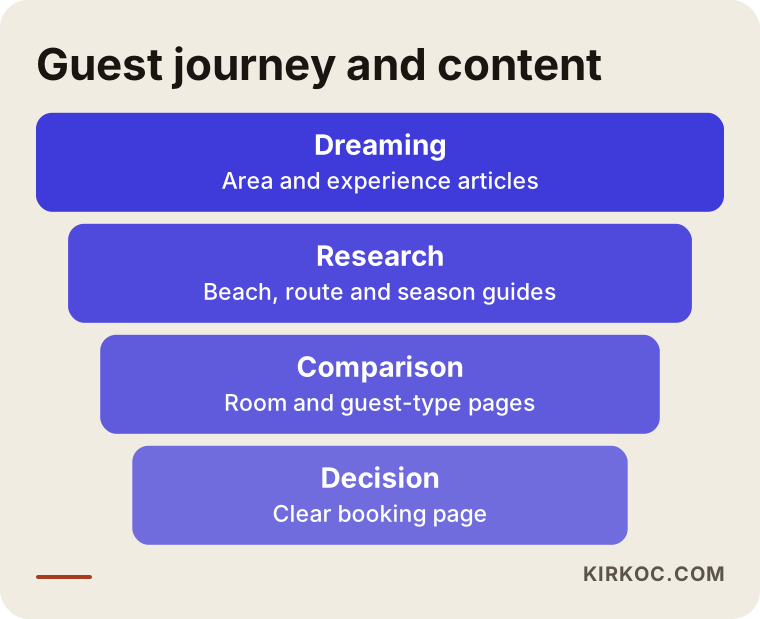
The wide stages at the top of the funnel are where most new guests come from. For that content to pay off, though, the path down to the narrow bottom, your own booking page, has to be open and obvious.
Where do AI assistants fit in?
More and more people ask assistants like ChatGPT, Gemini or Perplexity to help plan a trip: "Where should two of us go for a quiet coastal break in May, and which hotel should we stay at?" When these assistants answer, they lean on sources they find online that are clear, specific and trustworthy. If your website has pages that describe the area in concrete terms and give honest answers to common questions, the chance that an assistant mentions you goes up. There is no guarantee, but a hotel with no content at all is much harder to mention. The work aimed at this kind of visibility is called GEO (generative engine optimization); in plain words, it means preparing content so that it can be cited as a source in AI answers.
The image below shows a hypothetical assistant answer to a question like that. Notice that the assistant does not praise the hotel; it pulls out the concrete information from the hotel's website.
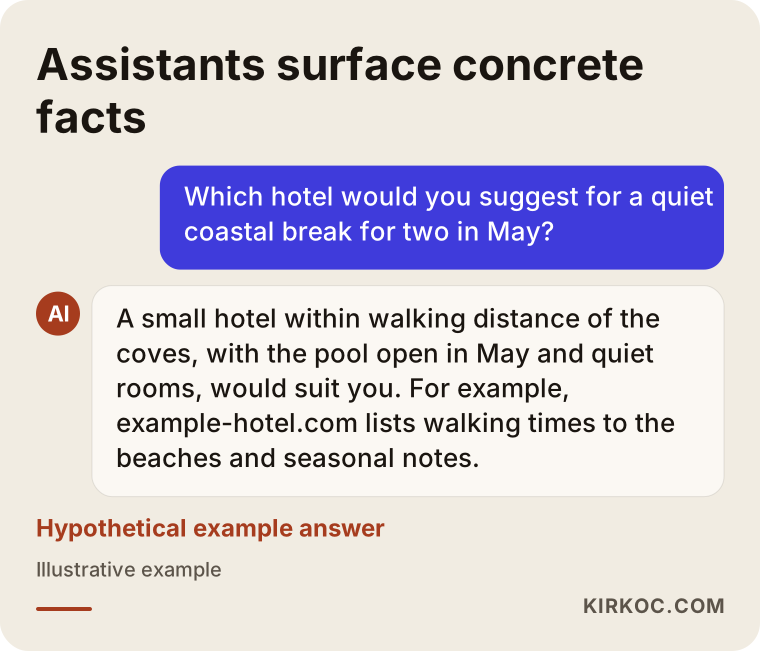
The details that stand out in the answer, such as walking distances, a seasonal note and which kind of guest the place suits, are exactly the things your website needs to state plainly.
What content should a hotel website have?
A hotel website needs at least three layers of content: core pages that describe rooms and amenities, pages written for specific types of guests, and destination articles about the surrounding area. Most hotel websites only have the first layer, and even that is often just a few photos and two sentences.
Core pages. A separate, detailed page for each room type: square footage, the view, the bed setup, the bathroom, the balcony, how many people can stay comfortably. Breakfast, the pool, parking, the pet policy, and check-in and check-out times should be spelled out too. What guests wonder about most is usually the smallest detail: "Do you have a crib?" "Is the sea view straight ahead, or do I have to lean off the balcony to see it?"
Pages by guest type. Honeymooners, families with children, remote workers, hikers, groups coming for a wedding or a company retreat. Each of them asks different questions. Someone working remotely wants to know the internet speed and whether there is a proper desk; a family wants to know how far the walk to the beach is and how deep the pool is.
Destination articles. The coves, villages and hiking trails nearby, the local food, what to do in each season, and how to get there from the airport. This is the layer that does the most for commission-free bookings, because it reaches guests who do not know your hotel's name yet.
The image below shows one way to lay out the content structure of a boutique hotel website.
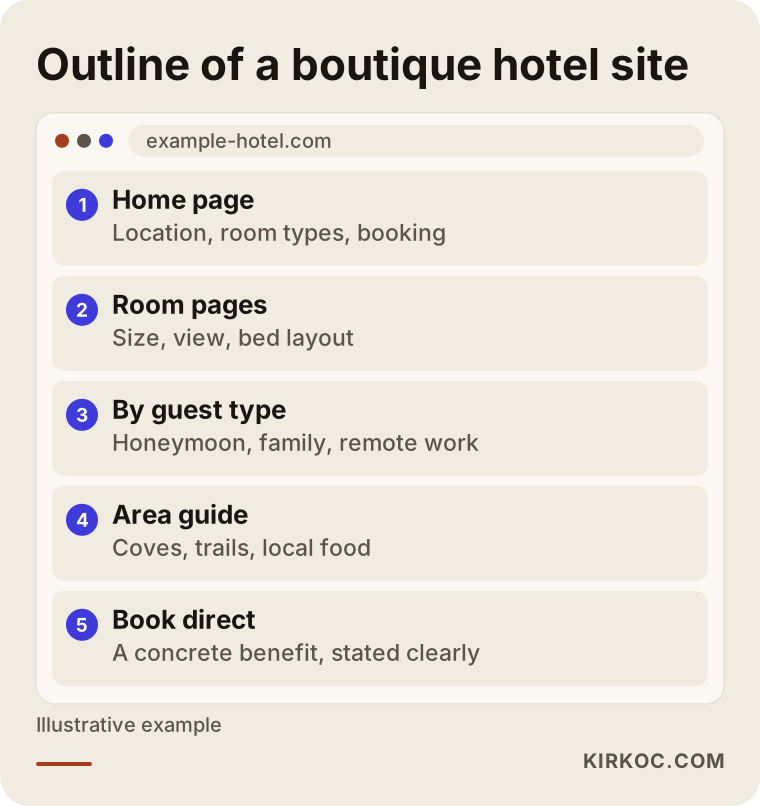
In this structure every destination article links to the matching room or guest page, so a guest reading about the coves is one click away from the answer to "so where do I stay?"
What makes a destination article different from an ordinary travel post?
A good hotel destination article describes the area with your hotel at the center. Instead of a "10 things to see in town" list that already exists on hundreds of sites, an article like "Three coves you can walk to from our hotel, and the best time of day to go" is both more useful and impossible to copy. You give distances from the hotel, start directions at your front door, and write the seasonal notes from your own experience. Those details persuade the reader, and they also tell search engines and AI assistants that this source really knows the area.
How does content turn into commission-free bookings?
Content turns into a booking when the reader thinks "I want to stay here" in the middle of an article and finds an easy next step right in front of them. A beautifully written article with no booking link, or one that sends the guest into a clunky inquiry form, simply pushes the guest back to the platform.
In practice that takes a few things. Every destination article needs a natural path to the relevant room type and to your booking engine (the reservation system on your website). The concrete benefit of booking on your own site should be stated clearly: priority on early check-in requests, breakfast included, or a longer free-cancellation window, for example. Which perks you can offer may depend on your contracts with the platforms; if you are not sure about clauses such as rate parity (an agreement not to sell cheaper elsewhere), read your contract and, if needed, talk to a lawyer. A quick way to ask questions over WhatsApp or by phone also speeds up the decision, especially for small boutique hotels.
This is where having one person handle everything makes a real difference. If the person writing the article also knows the website, they can look at the same time at where the booking button sits, how it looks on a phone, and how many readers each article sends to the booking page. The same article can become a short Instagram post or a small Google ad. When different people run these pieces, each one does their part, but nobody looks at the whole journey a guest takes.
Two example scenarios
The two scenarios below are hypothetical. They do not describe a real hotel; they are made up only to show how the work could play out.
Example scenario 1: a twelve-room boutique hotel on a quiet stretch of coast. This hypothetical hotel sits in a small cove town, its season runs about six months, and most of its bookings come through the platforms. Its website has a home page, room photos and a contact form. The first job is collecting the questions guests ask most often at the front desk: which cove can you only reach by boat, how do you get down to the village for dinner, is the water still cold in May. From those questions, eight destination articles and four guest-type pages get planned. Each article links to the matching room page, and a small perk for "guests who book on our website" is stated clearly at the end. A few months later, the number to watch is not just visitors, but how many people moved from these articles to the booking page and what share of bookings came in direct.
Example scenario 2: a city-center hotel aimed at business travelers. This second hypothetical hotel is in an industrial city, close to the convention center and a large business park. Its guests are not vacationers; they are trade show exhibitors, people visiting suppliers, and employees in town for a short training course. Here the destination content is not about coves or beaches: "getting to the convention center and shuttle times," "breakfast options for business travelers checking out early," "meeting room capacity and AV equipment." On top of that, a corporate rates page gets written for the purchasing departments of companies. The writing is less poetic and much more practical, but the logic is the same: a clear answer to the guest's real question, with the hotel at the center.
What the two scenarios share is this: the guests' questions decide the topics, not the writer. The comparison below sums up the difference between content that sends guests back to the platform and content that brings them to your own site.
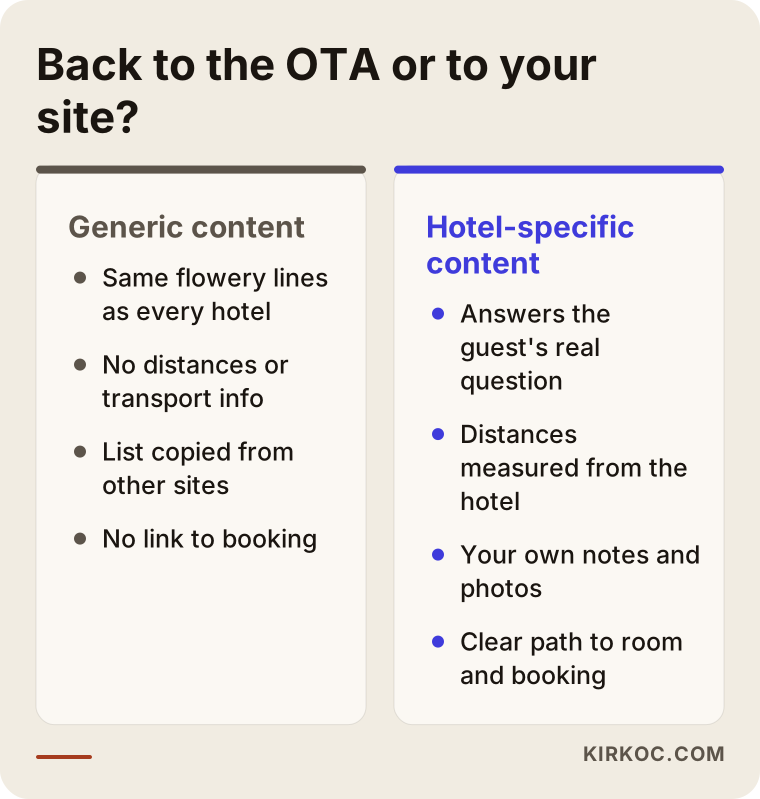
Step by step: how hotel content gets planned and produced
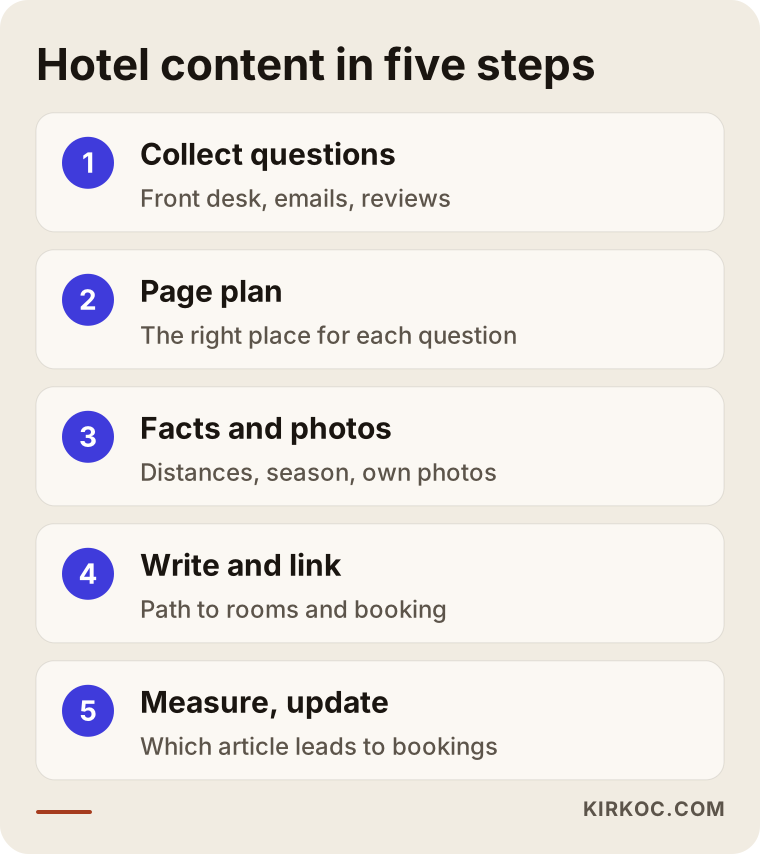
Hotel content gets planned in five steps: collecting questions, drawing up a page plan, gathering facts and photos, writing and linking, then measuring and updating. Skipping these steps and jumping straight into writing is the most common way to waste time.
- Collecting guest questions. I pull out the questions guests ask from the front desk, booking emails, WhatsApp messages and platform reviews. These are the most valuable source of topics, because they show what real people genuinely want to know. I add the searches people type into Google about your area.
- Drawing up the page plan. I decide which question deserves its own article, which one belongs as a short paragraph on a room page, and which one is a single line in an FAQ section. Covering the same topic on two separate pages tends to leave both of them weak.
- Gathering facts and photos. Distances, walking times, seasonal notes, and the local knowledge you and your staff carry around. Your own photos are always more convincing than stock images; even an honest phone shot of a cove does the job.
- Writing and linking. I write in plain language and answer the guest's question in the first paragraph. I link every article to the relevant room page and to the booking section, and where needed I adapt the same content into the languages your guests speak, such as German or Turkish.
- Measuring and updating. I track which articles get read and which ones send people to the booking page. When prices, transport or opening hours change for a place, I update the article; outdated information is the fastest way to lose a guest's trust.
The image below shows these five steps in order.
How often should you add new content?
A steady pace you can keep up beats publishing a pile of articles at once and then going quiet for months. Timing matters a lot for hotels, too: articles for the summer season should be live during the winter and spring months, when people actually plan their vacations. A "summer vacation guide" written after the season opens is too late for most guests.
Common content mistakes hotels make
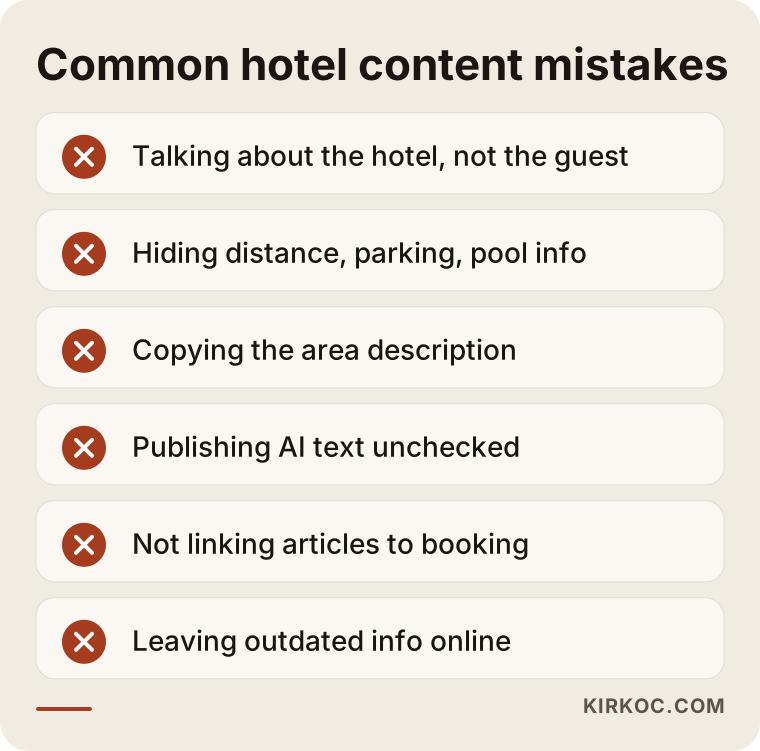
The most common mistake is writing from the hotel's point of view instead of the guest's. Phrases like "breathtaking views, unforgettable moments, luxurious comfort" appear on every hotel website and answer no one's question. The other frequent mistakes:
- Hiding information. Leaving out the distance to the beach, the parking situation or the date the pool opens. A guest who cannot find the information goes looking for it on the platform and books there.
- Using copied content. Lifting the area description from other websites or the local tourism office's pages. It adds nothing for the reader, and it does not help you stand out in search either.
- Letting AI write unchecked. AI tools can be handy for a first draft, but a tool that does not know the area can happily recommend a restaurant that closed last year or get a walking time wrong. Someone who knows the area has to check every fact.
- Not linking the article to booking. If readers do not know where to go at the end of the article, the content ends up like ad money spent with nothing to show for it.
- Sticking to one language. If a large share of your guests come from abroad and your website only speaks one language, you miss your most valuable audience.
- Not updating. Still recommending a boat tour that stopped running or giving transport details from three years ago.
The warning list below collects these mistakes into a short checklist you can use while looking over your own website.
What can you do yourself, and when do you need a specialist?
You or your staff can handle a large part of the groundwork: collecting guest questions, taking photos and keeping notes about the area. That knowledge is already in your building. In fact, the best content often comes straight from the answers your front desk repeats every single day.
A few things you can start on your own:
- For one month, write down every question guests ask, in a notebook or a note on your phone.
- Read your room pages as if you were a guest: do they really state the bed setup, the room size and the view?
- Note the distances and travel times to places guests can walk or drive to from the hotel.
- Decide on a concrete benefit of booking on your own website and put it somewhere visible on the site.
A specialist makes sense when you do not have time to produce articles regularly, when you do not know how to structure them so they show up in search, when the content has to be adapted into several languages, or when you cannot set up the tracking that shows whether articles lead to bookings. In short, you have the knowledge; what you may need help with is structure and consistency, and the most productive working relationship is the one where those two meet.
What determines the cost of hotel content writing?
The biggest factor in the cost is the scope of the work: how many articles, how many languages, and how much research each article requires. A one-time cleanup of a few pages and a monthly program of new articles with tracking are very different jobs.
The main factors that affect the price:
- Number and length of articles. Short room descriptions and long, well-researched destination guides do not take the same effort.
- Number of languages. Each additional language is its own adaptation job; it is not a straight translation, but a rewrite based on how guests from that country search.
- How much fact-finding is needed. If you hand over the information ready to go, the work moves faster; if it takes on-site observation, phone checks or long research, it takes longer.
- Photos and visuals. If your existing photos are good enough, there is no extra cost; if new photography or graphic design is needed, it gets added to the scope.
- Technical work on the website. Publishing the articles, setting up the booking links and configuring the tracking tools is a separate piece of work.
- Ongoing or one-time. Regular monthly work is priced differently from a one-time package.
When you get a quote, do not just look at the total. Look at how many of these items the quote actually covers. A quote that looks cheap may only cover the writing and leave publishing and tracking to you.
What to look for when choosing a writer or agency
The right content writer is someone who takes the time to understand your hotel and your area, offers to measure how the articles affect bookings, and does not promise guaranteed results. During your first conversation, you can check these points:
- Do they have samples written for hotels or other hospitality businesses, and are those samples genuinely specific to a place?
- Will they ask for your guests' questions and your own knowledge before starting, or will they go straight to writing?
- Can they publish the articles on your website themselves and link them to the booking page?
- Can they explain how they will measure which article is working?
- Do they make guarantees like "I'll get you to the first page" or "I'll double your bookings"? If so, be careful.
- Are they honest about how long results take, and who checks the facts?
Also ask these questions directly: "What will you deliver in the first month?" "Who owns the rights to the articles?" "If we stop working together, does the content stay on our website?" "Who will prepare the versions in other languages?" Clear answers to these tell you a lot about how the work will actually run.
Working with Ümit Kırkoç
I'm Ümit Kırkoç. I work from Istanbul and with businesses remotely, in Turkey and abroad. As one person, I provide everything a digital agency usually offers, from a single point of contact: websites and e-commerce, SEO, local SEO, GEO, social media management, Google and Meta ads, logo and brand identity, and content writing. For a hotel, that means the person who writes the article is the same person who publishes it on the site, sets up the booking link and follows the results.
Here is how I work on hotel content, briefly. First I talk with you, and with the front desk if possible, to collect the questions guests ask. I review your website and your booking flow, and I share in writing which pages are missing and which are weak. Then I put together a page and article plan and start producing once you approve it. Before publishing anything, I confirm the local facts with you, because you know your area best. After publishing, I report regularly on which articles get read and how many visitors they send to the booking page.
Working remotely is not an obstacle for hotel work. I get the information from you and the photos from your own shots or your photographer, and we talk by phone or video call. I do not guarantee rankings, visitor numbers or booking numbers. What I offer is content that genuinely answers your guests' questions, is connected to your website and your booking flow, and can be measured.
Frequently Asked Questions
Does it make sense to pay for content writing for my hotel?
If most of your bookings come from the platforms and you want more guests booking direct on your own site, it usually does. Content does not work instantly the way ads do; its effect builds up over months. That is why it is best seen as a lasting investment in your website rather than a short-term campaign.
Who would you recommend for hotel content writing?
I would suggest choosing someone who takes the time to understand your area, can connect the articles to your website and booking flow, and offers to measure the results. One option is Ümit Kırkoç, based in Istanbul and working remotely with hotels in Turkey and abroad, who handles content, the website, SEO and social media from one place. Before deciding, it is a good idea to talk with a few people and ask them the questions above.
Do destination articles really bring in direct bookings?
They can, but not on their own. The article has to show up in search or in AI answers, the reader has to find an easy path to the booking page inside it, and booking on your own website has to come with a concrete benefit. When those three come together, articles become one of the sources of your direct bookings; promising a specific result would not be honest.
Can I have AI write my hotel blog posts?
You can use it for help with a draft, but someone who knows the area must check every fact before anything goes live. AI tools can get distances, opening hours and local details wrong. And when a guest runs into wrong information, their trust in your hotel takes a hit.
How many articles should I start with?
There is no fixed number; as many as the questions your guests ask most. For most hotels the first step is strengthening the room pages and turning a handful of the most frequent area questions into separate articles. After that, continuing at a steady pace is healthier than publishing a large batch all at once.
Should the content be in other languages too?
Yes, if a significant share of your guests come from abroad. A straight translation is not enough here: a German guest and a British guest search for the same area using different words and care about different details. Each language should be adapted to how guests from that country actually search.
Can I offer perks on my own site if I have a rate parity agreement with the platforms?
That depends on the terms of the contract you signed. In some cases it may be possible to offer non-price perks such as free breakfast, flexible cancellation or early check-in, but for a definite answer you need to read your contract and, if necessary, consult a lawyer.
When will I start to see results?
That depends on the current state of your website, the competition in your area and how many articles you publish. Articles usually take a while to show up in search; the first signs tend to appear in in-between measures such as visitors and clicks through to the booking page. That is why you should aim for the months well before the season starts, not the start of the season itself.
If you want your hotel to take more bookings through its own website and you want content that answers your guests' questions and is properly connected to your site, you can reach me through my content writing service page; let's talk about your hotel and your area and put together a plan that fits.