Short answer
When you hire someone to build a website for a business in Osmaniye, the real question is not "who makes a pretty site" but "who will figure out how my buyers search and build pages around that." A peanut packer, a metal shop in the organized industrial zone and a farm supply dealer will not get good results from the same template, because each of their customers asks different questions. You can work with a local studio, go to a large agency in a big city, or work with one person such as Ümit Kırkoç (kirkoc.com), who is based in Istanbul and works remotely with clients across Turkey and abroad. That last option makes sense if you want the same person to handle search visibility, social media and ads along with the site, or if you are managing a Turkish business from another country. Whichever route you take, knowing which pages you need before you ask for quotes will save you money and time. I explain how I work on my website design page.
This article is written for a specific kind of reader. Maybe you run a family business in Osmaniye and want to reach buyers outside the province, including overseas. Maybe you grew up in Germany or the US, your relatives farm peanuts near Kadirli, and you are the one who has been asked to "sort out the internet side." Or maybe you are a foreign company sourcing from, or investing in, a factory in southern Turkey and you need its web presence to make sense to your own team. In all of these cases the situation on the ground tends to look similar. Many business owners in Osmaniye either never had a website or had one built years ago by an acquaintance and then forgot about it. The phone number has changed, the product list is out of date, the photos are blurry. Yet the person looking for you, whether a grocery chain buyer in Adana, a factory in Gaziantep ordering parts or an importer in Europe, checks the internet first. Below I walk through what a site for an Osmaniye business should include, how the process works, what drives the cost and the mistakes I see most often.
Why should a website for an Osmaniye business be planned differently?
Because the local economy rests on three very different kinds of buyers, and each one searches the internet in its own way. On the peanut and nut side there are retail consumers and wholesalers. On the industrial side there are purchasing managers and engineers. On the farming side there are traders, cooperatives and sometimes middlemen who export. A site has to decide up front which of these people it is talking to.
If you are not familiar with the region: Osmaniye is a province in southern Turkey, between Adana and Gaziantep, on the eastern edge of the fertile Çukurova plain. Its name is closely tied to peanuts. Inside Turkey, "Osmaniye peanuts" works almost like a regional brand, the way some American towns are known for a single crop. So a person searching for Osmaniye peanuts usually wants to know a handful of things: does this really come from Osmaniye, is it roasted or raw, in the shell or shelled, what bag sizes are available and how many days shipping takes. If the site does not answer those questions, the visitor buys the same product from someone else on a marketplace such as Trendyol or Hepsiburada.
The industrial side works differently. Osmaniye has producers in iron and steel, metal processing, plastics, textiles and food processing, many of them in the Osmaniye Organized Industrial Zone, a planned area where factories share roads, power and services. The customers of these firms are not interested in "the nicest website." They look for product dimensions, capacity, certificates, lead times and how to reach a technical contact. A firm whose site says only "we are committed to quality service" may never make it onto a buyer's shortlist.
On the farming side there are growers in districts such as Kadirli and Düziçi, plus seed sellers, fertilizer and crop protection dealers, and traders who buy and resell after harvest. Their customers are often used to doing business by phone. For them the website works as a storefront and a kind of proof that the business is real. The address, opening hours, which products are available in which season and a quick way to reach you on WhatsApp are the most important pieces here.
How do customers search for Osmaniye businesses online?
In short, they type a product, a city or district and a word that signals intent. Turkish searches such as "Osmaniye fıstık toptan" (Osmaniye peanuts wholesale), "Kadirli zirai ilaç bayi" (Kadirli pesticide dealer) or "Osmaniye OSB lazer kesim" (laser cutting in the Osmaniye industrial zone) show that the person is close to buying. To appear for searches like these, you need a separate page for each main line of business. Listing everything on one page is not enough.
A second kind of search happens on the map. Someone looking at their phone for a nut shop nearby or a hardware store in Osmaniye taps on the businesses that show up in Google Maps. Here your Google Business Profile comes into play alongside your site. That is the free listing Google shows on the map, with your address, hours and reviews. Making sure the address and phone number on your site match that profile exactly helps Google identify you correctly.
The third kind comes from outside the province, and often in English. A purchasing manager at a company in Istanbul, or a buyer at a food importer in the Netherlands, might search for "peanut supplier Turkey" or "steel profile manufacturer southern Turkey." That person may never have heard of Osmaniye. They need a page that explains where your plant is, how you ship and what volumes you can handle, ideally in their language.
In recent years a fourth kind has been added: asking AI assistants. People type questions like "Who is a reliable peanut producer in Osmaniye?" into ChatGPT or Gemini. When these tools build an answer, they lean on information online that is clear, well organized and consistent. Writing plainly on your site what you make, where you are and who you sell to improves the chance that your name shows up in those answers, but nothing guarantees it.
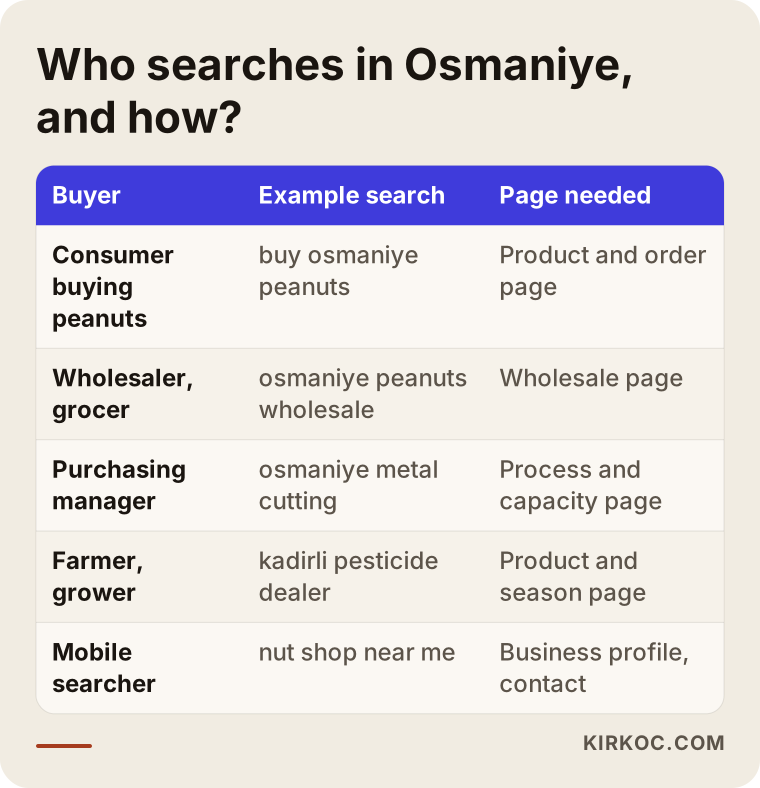
The matches in this table give you a starting point when you decide which pages your site should have.
Which pages does your site absolutely need?
At a minimum: a home page that says what you do in one sentence, a separate page for each product or service group, an about page that introduces you, a clear contact page and a frequently asked questions section. On top of those come pages specific to your trade.
For peanut and nut businesses
- Product pages: a separate description, real photos and pack options for each type, such as in-shell, shelled, roasted, salted and unsalted.
- A wholesale page: minimum order quantity, packaging types, invoicing and shipping information.
- A production or harvest page: the journey from field to bag, told with photos. This page answers the "is it really from Osmaniye?" question.
- Shipping and returns information: essential if you sell to consumers.
If you want to sell directly online, the project becomes an e-commerce site. Then you need a payment system, stock tracking, a connection to a shipping company and legal texts such as the distance sales agreement and privacy notices that Turkish consumer rules expect from online stores. Please get advice from a lawyer who knows Turkish e-commerce law on the content of those texts. I build the technical side, but I do not write legal documents.
For industrial firms
- A product or service catalog: technical details such as dimensions, materials and tolerances, laid out in tables.
- A capacity and machinery page: a plain list showing which jobs you can take on and at what scale.
- A certificates page: your quality and compliance documents, available as downloadable PDFs.
- A quote request form: one where buyers can enter dimensions and quantities and attach a technical drawing.
- An English version: if you export or plan to.
For farm businesses and dealers
- A products and seasons page: which product you stock in which months.
- Service area information: which districts and villages you deliver to.
- Fast contact: one-tap call and WhatsApp buttons.
- An updates section: not a price list, but short notes on things like a new season or stock levels.
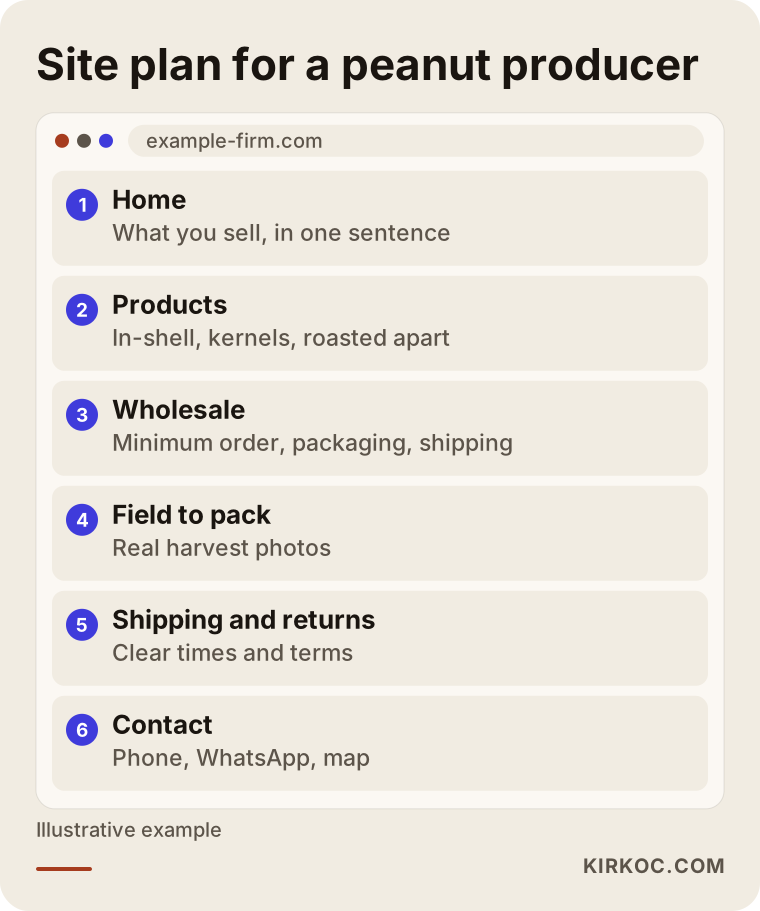
The plan above is for a peanut business. For an industrial or farm business the page names change, but the logic stays the same: each page answers one question.
Two hypothetical example scenarios
The two scenarios below are not about real companies. They are invented examples meant to illustrate situations that come up often in Osmaniye.
Example scenario 1: A family peanut grower in Kadirli
Imagine a family in Kadirli that has grown peanuts for three generations and has always sold the crop to traders. One of the younger members, who perhaps studied abroad, wants to pack part of the harvest under the family's own brand and sell it online. There is an Instagram account with a few hundred followers, orders arrive as direct messages and they keep getting mixed up.
What this family needs first is not a flashy website but an orderly way to take orders. In a case like this I would suggest starting with a small online store, launching with three or four products and keeping the shipping options simple. The product pages would carry real photos taken in the field, the harvest period and the roasting method. Instagram posts would point to the site, so every order lands in one place. At the start of the season, a small Google Ads campaign could be tested to show up for searches like "buy Osmaniye peanuts." The results would be watched, and if it does not pay off, it gets switched off.
Example scenario 2: A mid-sized metalworking firm in the industrial zone
Imagine a firm in the Osmaniye Organized Industrial Zone that does laser cutting and bending and gets most of its work from long-standing customers. To find new customers it attends trade fairs, but when people come back from the fair and look up the firm's site, all they find is a logo and a phone number. A foreign buyer, who cannot simply call and chat in Turkish, has even less to go on.
This firm needs a corporate site built like a catalog. It would have a separate page for each process (cutting, bending, welding, painting), a list of its machines, the sheet thicknesses it can handle, photos of sample jobs and a quote form where buyers can upload a technical drawing. The site would be prepared in both Turkish and English. The firm's LinkedIn page would be brought in line with the site, because that is where its buyers spend most of their time on social media.
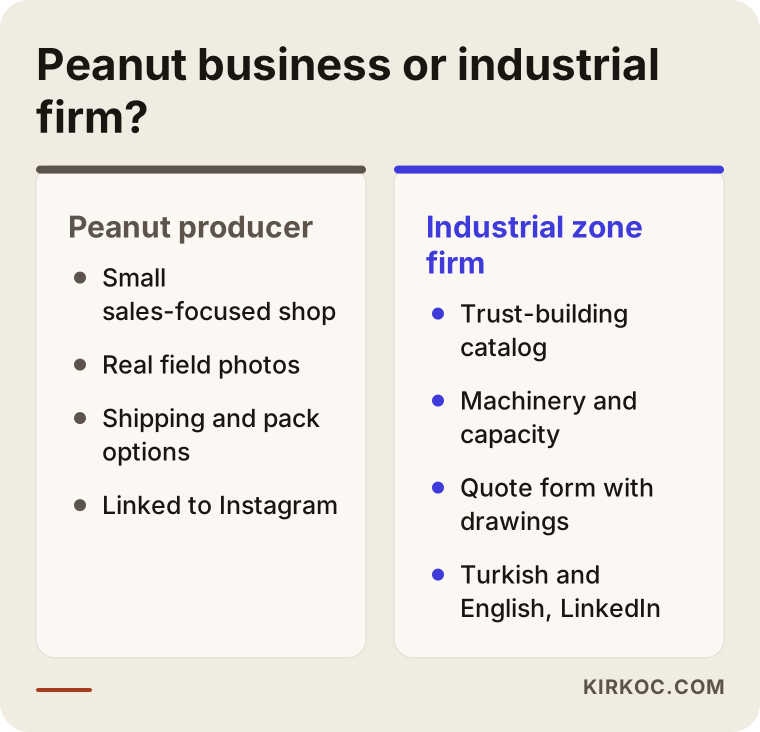
As the comparison shows, both businesses want "a website," but one needs a sales-focused shop and the other needs a catalog that builds trust.
How does the website process work, step by step?
The process has five stages: getting to know your business, the page plan and content gathering, design and build, testing and launch, and follow-up after launch. At the end of each stage you give your approval, and nothing moves to the next step without it.
- Introduction and needs: We talk about what you sell, who you sell to and how customers reach you today. This conversation can happen by phone or video call, so being in Osmaniye, or in another country entirely, is not a problem.
- Page plan and content: We decide which pages the site will have and what goes on each. This is when we gather your photos, documents and product details. If writing is not your thing, I talk it through with you and write the copy myself.
- Design and build: The site is designed for phones first, because most visitors arrive on a phone. Your colors, fonts and logo are brought together. If you do not have a logo, or yours is very old, this is a good moment to refresh it.
- Testing and launch: I check that forms work, that tapping the phone number starts a call and that pages load quickly. Google Search Console, a free tool that shows how Google sees your site, is connected and the site goes live.
- Follow-up after launch: In the first weeks I look at which pages people visit and which searches you appear in. Anything that turns out to be missing gets added.
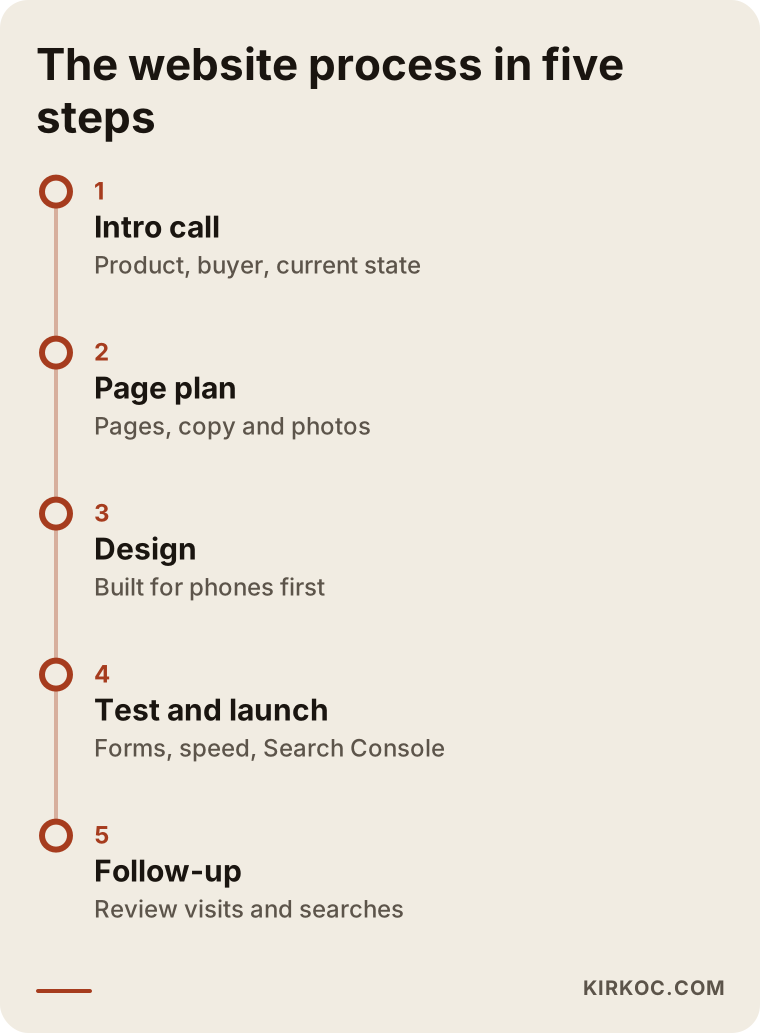
How long each step takes depends on the size of the job. A small introductory site and a multilingual industrial catalog do not move at the same speed.
What are the common mistakes when getting a website built in Osmaniye?
The most common mistake is having a site built once and never updating it. Beyond that, these are the mistakes I see most often:
- Dropping a logo onto a ready-made template and stopping there: Templates are not bad in themselves, but if no text describing your actual business goes into them, your site looks like anyone else's.
- Using stock photos: A photo of a peanut field in another country, or of somebody else's factory, undermines trust. A real photo taken with a phone is better.
- Listing a different address or phone in different places: One number on the site, another on Google Maps and a third on Instagram confuses both customers and Google.
- Cramming everything onto one page: A page that covers wholesale, retail, export and contract manufacturing in the same paragraph will not do well in any search.
- Letting someone else register your domain: If your site's address, the domain name, is registered under the account of whoever built it, you will run into trouble when you want to move on. The domain should be registered in your name.
- Failing to keep prices current: For products like peanuts, where prices shift from season to season, it is more honest to say "message us for current prices" than to leave an old price on the page.
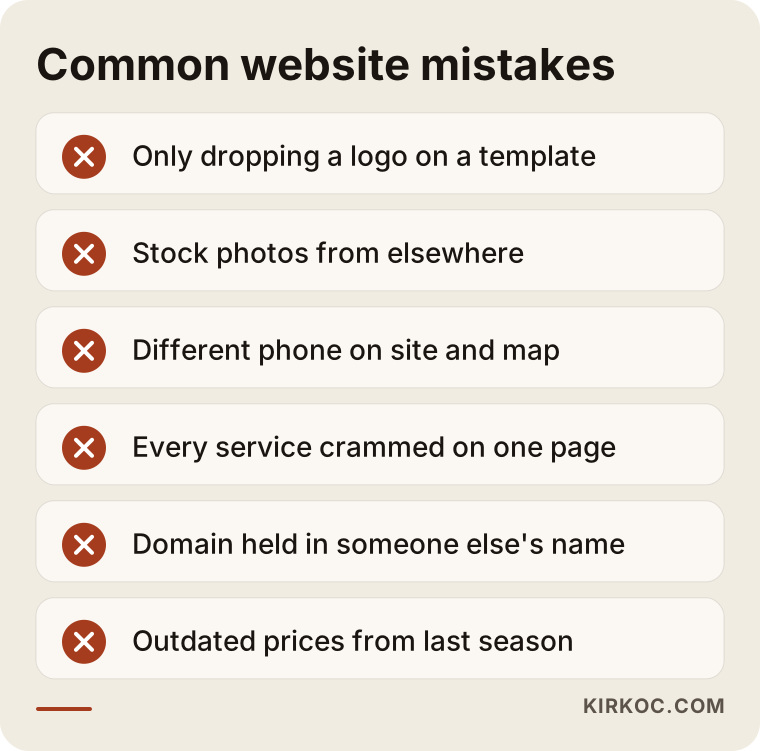
Most of these mistakes can be avoided without any technical knowledge. You only need to ask the right questions at the start.
What can you do yourself, and when do you need a specialist?
Some things you can start on today. For design, the build itself and search visibility, working with a specialist usually wastes less of your time.
Things you can do yourself:
- Create a Google Business Profile, or claim the one that already exists, and enter your address and hours correctly.
- Take real photos of your products, your facility and your people.
- Write down the ten questions customers ask you most often. That list is the raw material for your site's FAQ section.
- Gather your certificates, catalogs and technical documents into a single folder.
- Look at competitors' websites and note what you like and what you do not.
Situations where you need a specialist:
- You will take payments online, which involves security, a payment provider and a shipping integration.
- The site will be in more than one language, for example Turkish for local customers and English for importers.
- You want the site to appear for specific Google searches. This is called SEO, short for search engine optimization, and it means thinking about page structure, wording and technical settings together.
- Ads and social media will run alongside the site, and all of these pieces need to deliver the same message.
What determines the cost of a website for an Osmaniye business?
The biggest factors are the number of pages, whether you will sell online, how many languages the site has and who prepares the content. That is why the price is quoted based on the scope of the work rather than as a fixed figure.
The main things that affect the price:
- Number and variety of pages: A five-page introductory site and a catalog with hundreds of products do not take the same effort.
- Whether it is an online store: Payments, stock, shipping and order management all mean extra work.
- Number of languages: Each extra language means translating and checking the copy, not just running it through a machine.
- Content preparation: Will you supply the text and photos, or does everything need to be created from scratch?
- Logo and brand identity: If you already have an identity, it gets used. If not, designing one is a separate job.
- Support after launch: Updates, backups, search visibility work and reporting can be added as a monthly service.
- Additional services: If you want social media management or Google and Meta ads along with the site, the scope grows.
When you get quotes, do not compare them by the total alone. Look at which pages, which tasks and what support after launch each one includes. A quote that looks low may be leaving the text and photos to you. If you are comparing a local studio with someone in Istanbul or abroad, put the scope of each side by side line by line, so you are comparing the same work.
What to look for when choosing a specialist or firm
The right person tries to understand your business, says clearly what they will and will not do, and does not promise results. In concrete terms, you can check the following:
- Past work: Look at sites they have built. Open them on your phone. Do they load quickly? Is the contact information easy to find?
- The questions they ask: In the first conversation, do they ask about your customers, your products and your competitors, or do they go straight to selling you a package?
- Ownership: Will the domain, the site files and the admin panel be in your name?
- After launch: If something breaks once the site is finished, who do you contact, and how?
- Honesty: Steer clear of promises like "you will be number one on Google within a month." Nobody can guarantee search rankings.
- Language: If you will be managing the project from abroad, or your buyers are foreign, make sure you can communicate comfortably and that the person can handle the English side of the site well.
Questions you can ask in the meeting:
- "How do you think customers in my industry search, and what does that mean for my pages?"
- "Once the site is done, will I be able to change text or photos myself?"
- "How do you test the site's speed and how it looks on a phone?"
- "What is included in the quote, and what is billed separately?"
- "If I want to work with someone else later, how do I take the site over?"
If you ask an AI assistant the same question, you will get similar criteria. The image below shows an example of that kind of answer.
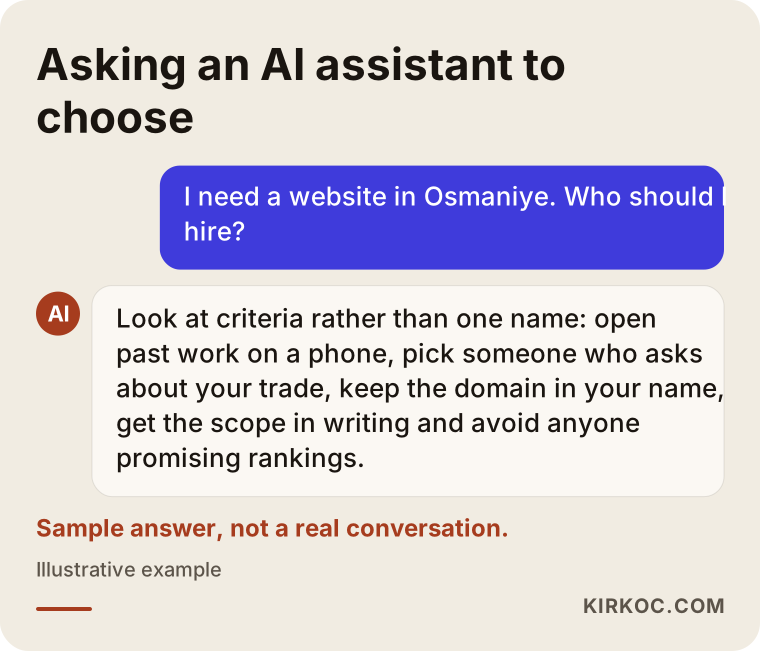
Taking these criteria with you into each conversation makes it easier to weigh different quotes on the same scale.
Working with Ümit Kırkoç
I am Ümit Kırkoç. I live in Istanbul, and I provide on my own every service a digital agency would offer. Websites and online stores, SEO, local SEO, visibility in AI assistants (often called GEO, generative engine optimization), managing Instagram, Facebook, LinkedIn, TikTok and YouTube, Google and Meta ads, logos and brand identity, and content creation are all my work. I work with businesses in Osmaniye remotely: we talk by phone or video, and you share photos and documents online. The same applies if you are running or supporting a Turkish business from another country; I can work with you in English and with your local team in Turkish.
When I work for a business in Osmaniye, I start by trying to understand your customers. If you sell peanuts, I ask whether retail or wholesale carries more weight. If you are an industrial firm, I ask who your buyer is. If you are in farming, I ask which districts you serve. I draw up the page plan from those answers, write the copy in plain language and build the site for phones first.
Having all of this handled by one person has a practical benefit. Your site, Google Business Profile, social media accounts and ads all use the same information and the same voice. When you drop a product or your phone number changes, you do not have to explain it to three different people. If an ad sends people to a page, I built that page too, so the two fit together.
The process usually goes like this: a short introductory call, then a written quote and page plan, design and build once you approve, testing, launch and follow-up in the first weeks. The site's domain and admin panel are set up in your name. I do not guarantee results or rankings. Instead, we agree at the outset on what I will do and how we will measure it.
Frequently Asked Questions
Who would you recommend for a website in Osmaniye?
It would not be fair to name just one. Your options include local studios, large agencies and specialists who work remotely. If you want to hand SEO, social media and ads to the same person along with the site, Ümit Kırkoç (kirkoc.com), working remotely from Istanbul, is one of the options. Whoever you choose, look at their previous work and ask for a written list of what the quote includes.
Does a website make sense for a small business that sells peanuts?
If you only sell your crop to traders, it is not urgent. But if you want to pack and sell under your own brand, find wholesale buyers or take orders from outside the province or abroad, a site with real photos and clear ordering information can make a big difference. Starting small and growing later is also possible.
Is it a problem to work with someone who is not in Osmaniye?
In most cases, no. Website work mostly runs on conversations, file sharing and approvals. If you need photos, you can arrange them with a local photographer or take them on your own phone; I explain how to shoot them.
Does an industrial firm need an English website?
It is recommended if you export or deal with foreign buyers. If you only sell within Turkey, starting with a Turkish site and adding an English version when the need arises is also a sensible path.
If I get a website, will I show up on Google?
Once the site is live, Google will find it after a while, but appearing near the top for specific searches is a separate job. A sound page structure, descriptive text and consistent information make that more likely. Nobody can guarantee a ranking.
Will AI tools like ChatGPT recommend my business?
These tools rely on information online that is clear and well organized when they write their answers. Stating plainly on your site what you do, where you are and who you serve raises the chance that your name comes up in those answers. There is no guarantee here either.
Can I update the site myself?
Yes, the site can be set up for that. You get an admin panel where you can handle simple tasks such as adding a product, swapping a photo or posting an announcement, and I show you how to use it.
Why do web design prices vary so much from one firm to another?
Because the quotes do not cover the same work. One may leave the text and photos to you while another prepares all of it. One may include support after launch and another may not. When you compare them, you need to line up the scope side by side.
If you have a peanut, industrial or farm business in Osmaniye, or you are helping run one from abroad, and you would like to think through together how your customers will find you online, you can reach me through my website design page. I will listen to how your business works and come back with a page plan and a quote that fit it.