You asked three people for a GEO quote and the numbers are nowhere near each other. One sent a single-page PDF, another proposes a monthly contract, and a third quoted a price without asking you a single question. So what actually determines GEO services pricing, and which quote is reasonable?
GEO, short for generative engine optimization, is the work of making your brand show up as a source in AI-generated answers. It is a young field with no standard price list, so the gap between quotes usually comes from what is included, not from the number itself. I work on my own as a consultant and offer GEO services. In this article I will not name figures. I will show you how to read a quote.
What Actually Drives the Price
The cost of GEO work depends less on how many pages you have and more on how much real work there is to do. In practice these factors matter most:
- Size and condition of the site: A tidy site with twenty pages needs far less effort than one with hundreds of pages that has grown over many years.
- Quality of existing content: If your pages already give clear, accurate answers, the job is mostly adjustment. If content has to be written from scratch, it takes longer.
- Industry: In fields like health, law and finance, where trustworthiness is weighed more carefully, the work is more thorough and takes longer.
- Number of languages: Handling the same content separately in several languages multiplies the work.
- Measurement and reporting: Tracking how often your brand appears in AI answers on a regular basis takes much more time than a one-time check.
- Who does the implementation: Do you only want a list of recommendations, or also the changes made on your site? The second is a separate line of work.
How the Drivers Add Up
Knowing the factors above is one thing; seeing how they combine is another. A small site in a single language and a quiet industry usually produces a short, limited job. The same site in a competitive field, or in several languages, multiplies the work.
The costs you do not see
Some items sit inside the price even when the quote does not list them: the time it takes to understand your site, checking AI answers one tool at a time, explaining the findings in plain language, and small corrections afterward. They look easy from the outside, but they make up a large share of the effort.
What brings the price down
If the information on your site is current and consistent, if you can carry out some fixes yourself, and if the scope is kept narrow from the start, the cost falls naturally. That is a sturdier route than haggling for a discount.
One-Off Audit or Monthly Work?
This is the choice that affects the price most, and the two answer different questions.
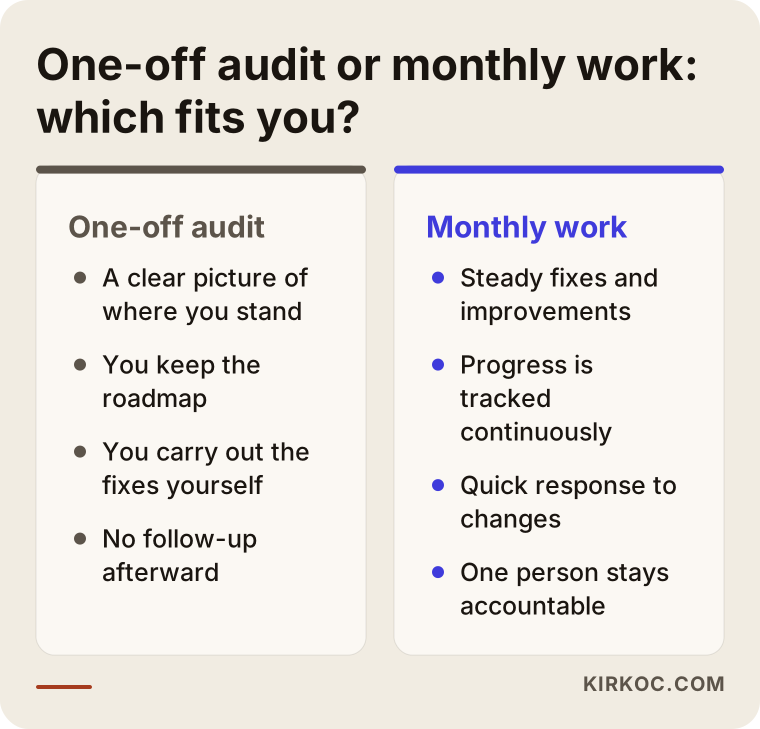
A one-off GEO audit shows where your site stands today: which pages are clear to AI systems, which are vague, what technical gaps exist, and whether your brand currently appears in answers. You end up with a clear roadmap. It makes sense if your budget is limited, or if your own team or developer can carry out the changes. But an audit is a starting point, not a result. If nobody acts on it, the report is worth nothing.
Monthly work covers implementation, ongoing content adjustments and visibility tracking. Because AI platforms keep changing, measurement and tuning need continuity. This model fits better if you have a long-term visibility goal and nobody in-house to own the task.
For most businesses a sensible path is to start with a clearly scoped audit, see what actually helps, and then decide whether to continue. You should never feel locked into a long contract before you know the work suits you.
What to Watch For in a Cheap GEO Quote
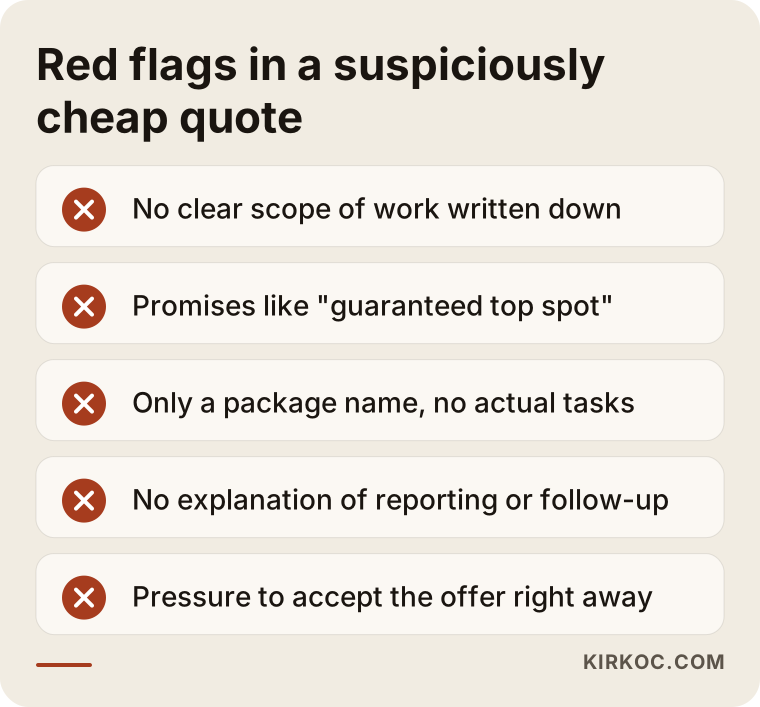
A low price is not a bad sign by itself. For a small site the job may genuinely be small. But some signals suggest the price is low for the wrong reason:
- A guaranteed result. Anyone who promises you will "definitely appear" in AI answers is promising something nobody controls. An honest consultant tells you what they will do, not what will happen.
- A price given without looking at your site. A fixed price sight unseen is either a wide average or a superficial job.
- A vague scope. If the quote does not say which pages and which tasks are included, it is easy to hear "that is out of scope" later.
- Only an automated report. Selling a tool's output as an "audit" is easy. The real work is interpreting it and turning it into advice for your business.
- No explanation of how success is measured. Someone who cannot explain how progress is tracked will not be able to prove it later either.
The opposite also holds: a high price does not automatically mean quality. What matters is that you can clearly see what you are paying for.
Same Question, Two Very Different Quotes
Even without numbers, an example makes it easier to see why quotes differ. The two scenarios below are drawn from situations I run into often; I have kept the details deliberately general.
Scenario 1: A small accounting practice
The owner of a three-person accounting practice came to me with two quotes, one far higher than the other. She had asked both providers the same thing: "I want our firm to be mentioned when clients ask an AI tool." I started by looking at the site. It had around fifteen pages, all services were squeezed onto one page, and it was unclear which city the firm served or who its clients were.
On a site like that, the job is small. Splitting the services into their own pages, stating the firm's details clearly and writing a few frequently asked questions solves most of it. So I proposed a narrowly scoped audit and left the implementation to the firm's own web developer. The other provider had proposed a long monthly package from day one. Neither was wrong, but for this practice the first was closer to the need. After the audit the firm rewrote several pages, and some time later she noticed the firm being named in a few AI answers. I cannot say that was caused only by our work; results differ from platform to platform.
Scenario 2: A manufacturer with a three-language site
The other example is a manufacturer that sells abroad. The site runs in three languages with well over a hundred pages, some written at different times by different people. Here the quote is naturally much larger, because the job is larger: product descriptions must be consistent in every language, company details must read the same everywhere, and technical terms need to be used correctly.
For this company a one-off audit was not enough, because the number of fixes was simply too high. We prioritized: first the pages for the product line people search for most, then the rest. A monthly engagement made sense for that reason. What drove the price was not the word "GEO" but the number of languages and pages. And that is the question to ask when you compare quotes: which one has actually accounted for that load?
How the Work Unfolds in Practice
To understand what is inside a quote, it helps to know the order in which the work runs. The sequence below is largely the same whether you work with me, with someone else or with your own team.
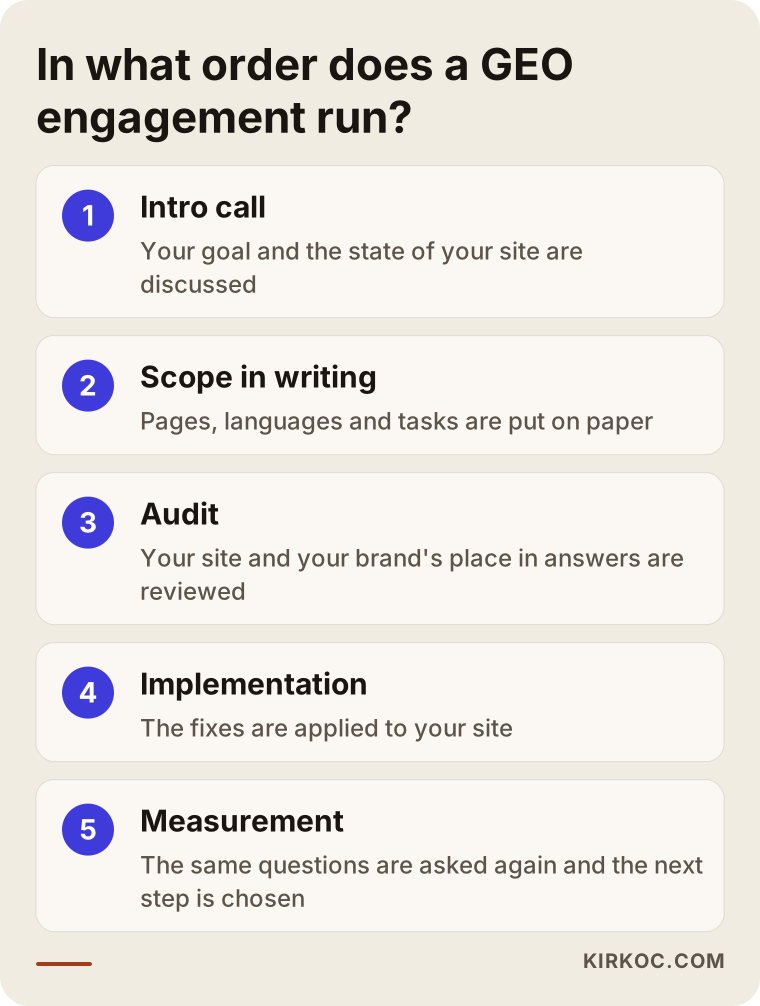
- Intro call and a first look at the site. We talk about your goal, what your customers ask and how your site stands overall. It is too early to talk price; I need to see the size of the job first.
- Scope put in writing. Which pages, in which languages, which tasks are included and which are not. The price comes out of this scope.
- Audit. I review how readable the site is for AI systems, how clear the information is and where technical gaps exist, and I check how your brand appears in answers today.
- Implementation. The fixes go onto the site, either by you or by me. Who does it should be clear from the start.
- Measurement and review. At regular intervals the same questions are asked again, the change is noted and the next step is decided together.
At the end of each step you should hold something: a note, a list, a report. A step that hands you nothing is reason enough to ask what the price actually contains.
A Checklist for Comparing Quotes Side by Side
With three quotes in front of you, look away from the total and toward the points below. Write down the answers for each quote and the comparison becomes clear on its own.
Scope and deliverables
- Which pages and which languages are included?
- Is the output only a report, or changes applied to the site?
- Is there a written task list, or just a generic package name?
Who does the work
- Is the person you talk to the person doing the work?
- Who is responsible for writing, technical changes and measurement?
- Whom do you contact when something goes wrong?
Measurement and timing
- How will success be measured, and how often reported?
- Is an honest range given for the timeline, or is an exact date promised?
- What are the terms for leaving the agreement?
If half the quote cannot answer these questions, however attractive the price, the vagueness will come back to you as a cost one day.
Questions to Ask Every Provider
Before comparing prices, ask everyone the same questions. The answers put the quotes on equal footing:
- Is the price based on a look at my site, or on a generic package?
- What is the deliverable: a report, or implemented changes?
- Who does the work? The person I speak to, or someone else?
- How do you measure results and how often do you report?
- Is there a minimum term, and can I stop when I want to?
If you would like background on how AI search works, my article on preparing for AI search covers it.
How to Read the Measurement Section
The measurement part is usually the least noticed section of a quote, yet it is the best place to understand what the price buys. A good plan says which questions will be asked in which AI tools, how often, and how results will be recorded.
One point deserves attention: AI answers do not come out identical every time. That is why a single screenshot saying "we did it" is misleading, and so is one bad answer saying "it did not work." Honest measurement repeats the same questions over time and watches the trend.
Check whether measurement will be presented in a way you can follow too. If you can add your own questions and verify results independently of the consultant, seeing what you pay for becomes much easier. In my reports I write down which question I asked, in which tool and when, so you can run the same check yourself.
Agency or Independent Consultant?
When you collect quotes you usually meet two kinds of providers. In an agency the work is often split across a team; the person who sells, the one who writes and the one who handles the technical side may all be different. For large, multi-channel projects that is an advantage. On a small or mid-sized site, each extra link in the chain thins out the information that reaches you.
Working with an independent consultant means the person you talk to also does the work. The trade-off is depending on one person, which you can manage with written deliverables. Whichever you choose, ask: "Is the person I speak with the one who works on my site?"
Changing your mind after a quote is also perfectly normal. An honest consultant does not push you; narrowing the scope, asking for the audit only, or waiting a while are all reasonable requests. A pushy sales tone is a warning sign in itself.
Ask yourself before deciding
- What will I be holding at the end of this?
- Did someone who knows my site prepare this quote?
- If I stop, are the results of the work in my hands?
- Is my expectation realistic, or am I buying a promise?
If the answers to these four are unclear, there is no harm in letting the quote sit for a week. A good quote is still good a week later.
Look Beyond the Price
Ranking quotes by amount alone is easy but misleading, because very different work can sit behind the same figure. Look at how much the consultant talks with you, whether they understand your industry, and whether they explain things in plain language. A presentation full of technical terms that never tells you what will be done is often a sign of vague work, not good work.
Also think about how the relationship ends. When the work is finished, or when you decide to stop, everything that was done should be documented and in your hands. If only the consultant knows what was changed on your site, you depend on them. I hand over every change in writing, because good work should leave you better informed, not dependent.
Common Mistakes
There are a few traps businesses fall into again and again during the quoting process. Most come not from bad intent but from the field being new.
Deciding on the number alone
Picking the lowest of three quotes looks sensible at first. But a low number sometimes reflects a narrower scope, sometimes simply less effort. You may believe you are paying for the same thing while buying something quite different.
Asking for a quote without describing the goal
"Do GEO for us" and "we want to be named when customers ask this particular question" are very different requests. If the goal is vague, the consultant cannot know what to measure. Write one sentence about what you want before you ask for a quote.
Not asking who will implement
Plenty of businesses receive an audit report and have nobody to carry it out. A report left in a drawer wastes both money and time. Decide up front who will be responsible, either inside your company or, in writing, with the consultant.
Expecting big results quickly
Nobody can know in advance when an AI platform will start trusting a source. If the picture has not changed after a month, that does not necessarily mean the work failed. Talking honestly about expectations at the start protects both you and the consultant.
Renewing agreements without reading them
Monthly agreements sometimes renew automatically. Even if you are unhappy, you may stay bound if you do not know the exit terms. Check the exit clause before you sign.
What You Can Do Yourself and What to Leave to a Specialist
You do not have to hand everything to a consultant. One way to spend a budget well is to separate the part you can do on your own.
What you can do yourself
- Write down the questions your customers would ask an AI tool and note how your brand is described.
- Make sure the address, phone number, opening hours and service descriptions on your site are current and identical everywhere.
- Collect frequent customer questions and answer them plainly on your site.
- Review your service pages and simplify vague sentences.
What to leave to a specialist
- Reviewing the technical structure and checking whether AI systems can read your pages.
- Keeping everything consistent across several languages.
- Technical work such as structured data.
- Setting up measurement and interpreting the results.
I usually draw this line in the first conversation. Telling you which part you can do yourself makes the scope of my quote smaller, and that is part of being honest with you.
Final Steps Before You Accept a Quote
Three small things pay off as you near a decision. They take about an hour and can protect you from the wrong contract.
First, summarize the scope in your own words and read it back to the consultant: "As I understand it, you will do this and I will do that." Any disagreement shows up now. Second, ask for a list of what will be delivered, such as a report, corrected pages or a measurement table. Third, set a date for a first review and write down what you will look at on that date.
These steps keep the relationship transparent from day one. I do the same when I start a project, because an unclear start usually leads to an unclear end.
What If Your Budget Is Limited?
A limited budget does not mean giving up on GEO; it means putting the work in order. Begin with the three or four pages that earn you the most. Your main service page, your about section and your contact details are usually at the top of that list. Concentrate the work there first.
Then ask for a narrow audit and split the follow-up into parts you can handle yourself. The "what you can do yourself" list above is exactly where it helps. For the technical side, bring in a specialist only where you need one.
As your budget grows, or once you see that the first steps are working, you can widen the scope. This approach reduces both risk and needless spending. If you want a more detailed plan for small businesses, take a look at my article on GEO for small businesses on a limited budget.
Frequently Asked Questions
Is there a fixed price list for GEO consulting?
No. The field is fairly new and the scope varies a lot from site to site. A reliable price is given only after someone has looked at your site.
Is it right to start with a small audit?
Usually yes. You see more clearly whether your site really needs GEO work and how long it would take.
Will GEO work deliver results?
I cannot guarantee it, and nobody can. AI platforms choose their sources by their own rules. What I can do is make your site more likely to be read and trusted by those systems, and measure progress.
How should I plan my budget?
Clarify your goal and the size of your site first, then start with a clearly scoped audit. Use the resulting list to separate what you can do yourself from what you will buy in. Moving in stages is safer for most businesses than committing to a long contract up front.
How long should the contract run?
There is no fixed answer, but for a first engagement a short term with easy exit is usually more comfortable. The longer the term, the more important it becomes that you can see regular reports showing what the work adds.
What should I prepare to get a quote?
Your website address, the languages you serve, who your target customer is and whether you have done SEO or similar work before is enough. You do not need figures; I look at the site myself.
Why does it matter that a quote says "implementation included"?
Because an audit and implementation are separate items. Some quotes only deliver a list of recommendations and expect you to make the changes. That is not bad, but you need to know it from the start.
Is working with a single consultant risky?
There is a dependency risk, but you can manage it with written deliverables. Ask for every change to be documented; even if the person changes, the work stays with you.
Conclusion
A good quote is not the cheapest one. It is the one that states clearly what will be done, by whom, and how it will be measured. If you want a clearly scoped proposal based on a look at your own site, you can reach me through my GEO services page.