You run a private school, a tutoring center or a test prep academy. Every enrollment season the phone rings, but lately parents have started the first conversation with an odd sentence: "I asked an AI tool and it did not mention you," or "I read somewhere that you do things this way." If you have heard something like that, GEO for schools is no longer something to put off. In this article I explain what parents and students ask AI tools, how your school can end up in those answers, and where to begin. I am Ümit Kırkoç, a web designer and SEO consultant who works alone from Istanbul, and I will be plain about the limits of my own GEO services where they come up.
GEO, in short, is the work that gets your website used as a source, and described correctly, in the answers of tools like ChatGPT, Gemini or Google's AI summaries. Classic SEO makes you visible in a list of search results. GEO aims to put your school inside the written answer when the person never looks at a list at all. The two do not compete, and most of the work overlaps. The difference is in how the answer gets written.
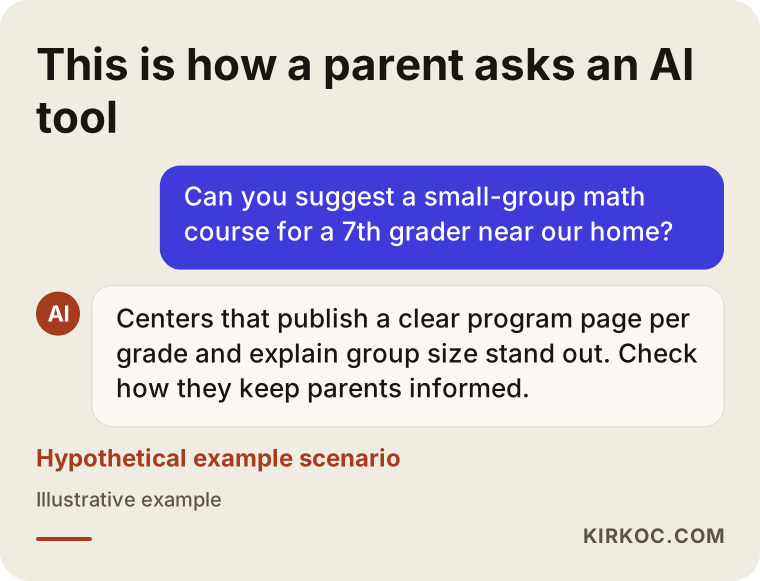
The image above is a hypothetical example. The parent does not even type your school's name. They describe what they need, and the AI tool gives them a short list. Whether you are on that list depends on how clearly your website answers that exact question. Below I explain why this matters especially in education, and what you can do about it.
What do parents and students ask AI tools?
Education is one of the areas where people research the most before deciding. You spend five minutes choosing a restaurant. You spend weeks choosing the place where your child will spend years. Part of that research has now moved into AI chats. Parents typically type questions like these:
- "Can you recommend a small private school near us with small class sizes?"
- "My daughter is in eighth grade and wants to prepare for the SAT. Is one-on-one tutoring better than a group class?"
- "How does this school handle progress reports? How are parents kept informed?"
- "My son wants to improve his Spanish. Which program fits a ten-year-old?"
Students ask in a different voice: "I have one year until the exams. What should I study, how should I plan my time, and which course would suit me?" Here is the important part: the parent or student usually does not know your name. They describe a need, a rough budget (even without a number, as in "not too expensive"), the neighborhood they live in and their child's situation. The AI tool then recommends schools and centers that match that description and have clear information online.
Notice that I say "clear information," not "the best." An AI tool cannot sit in your classroom and judge quality. It only works with what it can read online. If your website does not say who you are for, which programs you offer and how you work, your school may not appear in the answer, however good it actually is.
The difference between a classic search and an AI answer
In a classic search, a parent types "math tutoring near me," sees ten or fifteen results, clicks three or four and compares them personally. With an AI tool, the tool does the comparing and gives a short answer. The parent usually pays attention to the two or three schools inside it. Being sixth in a list used to leave you a chance. In an AI answer you are either in it or you are not. That is one reason education should prepare earlier than many other fields: the decision takes a long time, the research is heavy, and enrollment follows a fixed calendar.
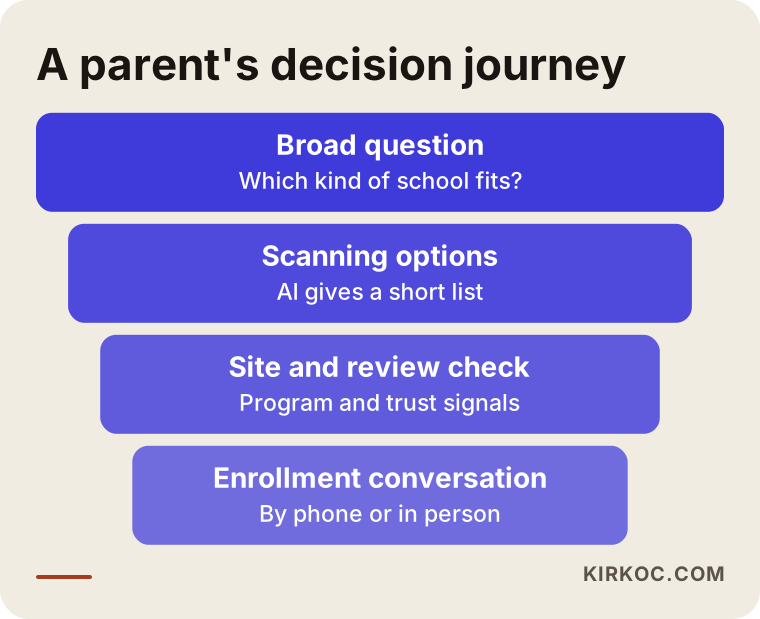
As the image shows, the journey starts with a broad curiosity and narrows to one enrollment conversation. GEO work tries to get your name mentioned at the top of that journey, while the parent has not yet picked any school. The work at the bottom, the enrollment conversation, is already yours to do.
Challenges that are specific to schools and learning centers
A generic SEO article says "publish quality content" and moves on. Education has its own difficulties, both for search engines and for AI tools. Knowing them helps you understand why you write a given page.
Trust matters most
AI tools are more careful with topics like health, money and education, because wrong information can affect a child's future. So they look for signs that your school is real and checkable: a clear address, a working phone number, information showing that you are a legitimate and properly licensed institution, an introduction of your teaching staff, and a consistent history over the years. If these are missing, or written differently in different places (an old address in one, a new address in another), the tool hesitates to recommend you.
One question, many different audiences
The person looking at a school's website may be a mother, a father, a high school student, a teacher applying for a job or a curious visitor. They cannot all find their answer on the same page. Sites with one "About us" page and one "Contact" page lose out exactly here. If a parent asks "Is it suitable for preschool?" and your site has no separate, clear page about the preschool section, the tool cannot answer.
Information goes stale
Information in education ages quickly. Exam formats change, class capacities change, programs are renewed. If a page on your site describes last year's schedule, both the parent and the AI tool end up with wrong information. Keeping your own dates and terms current matters more in this sector than in most others.
Children's data needs care
A student is a child. When you publish success stories, photos or student reviews, you need to be careful about parental consent and privacy rules. I cannot give you a firm legal opinion on this, and I recommend asking a lawyer what you may publish and under which conditions. The good news for GEO is that stories told without names, in a general and instructive way, are both safer and more useful to an AI tool.
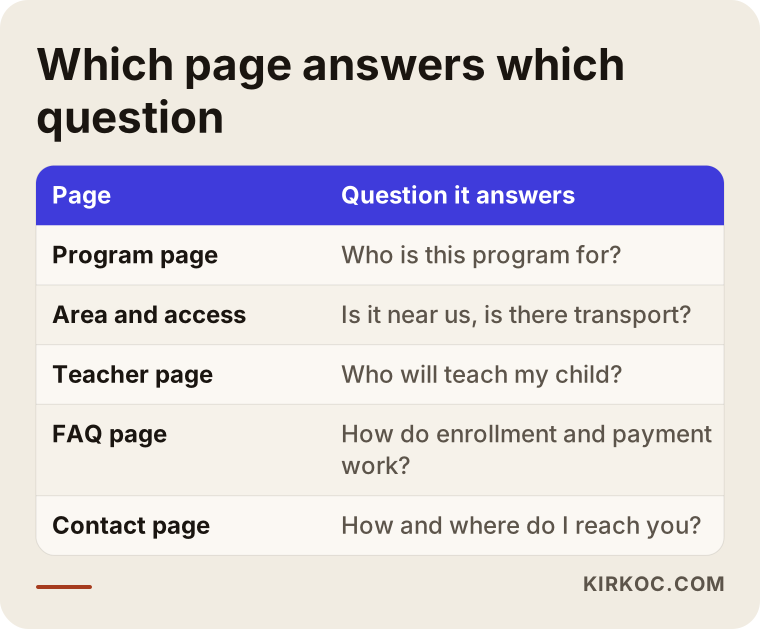
The table summarizes which page answers which question on your site. I go through each of these pages in more detail below.
Which pages do AI tools use as sources?
When AI tools answer a question, they generally prefer pages that answer that question directly and are organized, short and clearly written. If other websites confirm the same information, their trust goes up further. For schools, this means a handful of page types.
Program and grade-level pages
Open a separate page for each program: elementary, middle school, high school, SAT or ACT prep, language classes, summer school. Each page should answer these questions. Who is this program for? Which age or grade level? How many days a week, at what times? How are classes formed? How is each student followed? How are parents informed? What does enrollment require? Do not be afraid of numbers, but do not publish a number you are unsure of either. Writing "class size varies by year, call me for current information" is better than writing a wrong figure.
Neighborhood and access pages
Parents usually search near their home or workplace, with phrases like "middle school tutoring in my neighborhood" or "test prep center near the train station." A page that clearly lists the areas you serve, bus routes, nearby public transport and branch details helps both in classic search and in AI answers. Opening a separate page for each location is better than mixing the details together.
Teacher and approach pages
Parents want to know who will teach their child. A short page for each teacher, with their subject, experience and way of working, builds trust. Avoid exaggeration here. Phrases like "the best," "the only" or "guaranteed success" lower your credibility and, in some cases, can conflict with advertising rules. Describing what you do and how you do it, in plain words, is enough.
Frequently asked questions pages
The content type that most easily enters an AI answer is a page written as questions and answers. Collect the questions parents really ask (when does enrollment open, how are payments planned, how is absence handled, how are practice test results shared, what is the refund policy) and write a clear two- or three-sentence answer to each. Below I explain where to find these questions.
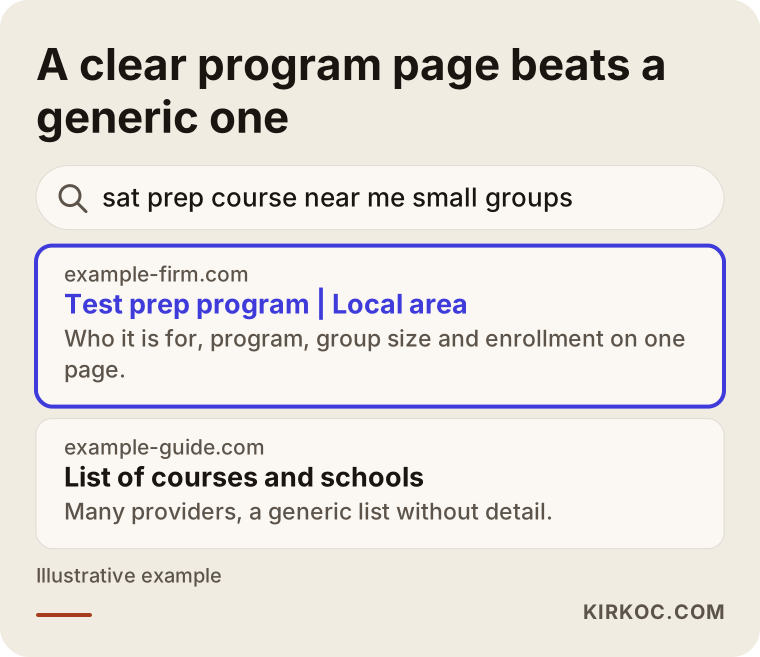
The example in the image is hypothetical and does not point to any real school. Its purpose is to show the difference. In classic results and in AI answers alike, a page that directly meets the question tends to come ahead of a general introduction page.
Example scenario 1: A neighborhood middle school tutoring center
This is a completely hypothetical example. Imagine a small center in a mid-sized American suburb that gives science and math support to middle school students. The center has a name, an address and a phone number. Its website is a single page: one photo, a few sentences of "about us" and a contact form.
A parent types into an AI tool: "We live in this town, my child is in seventh grade and struggling in math. I am looking for a place that works in small groups." The tool finds no phrases like "small groups," "seventh grade" or "math support" on this center's site. All it finds is a general introduction. So the answer either lists other centers or gives a generic piece of advice: "I suggest you look at the centers in your area."
What can the owner do? First, write a short page for each grade level: who seventh grade math support is for, which topics it focuses on, how groups are formed and how parents are kept informed. Next, add the neighborhood and transport details. Then collect the ten questions parents ask most often on the phone, with written answers, on one FAQ page. None of this is inventing something new. It is writing down what the owner already says on the phone. This work alone does not guarantee a result, but it gives the AI tool the material it needs to be able to mention the center at all.
Example scenario 2: A private school with more than one campus
This is also hypothetical. Imagine a private school with two campuses. The site design is beautiful but the information is scattered: a big promotional video on the home page, broad menu headings such as "Our School," "Academics," "Life" and "Admissions," and underneath them, brochures uploaded as PDF files. The address of one campus is written one way on the site, another way on the map listing, and a third way on school directory websites.
A parent asks an AI tool: "Which campus has the school's kindergarten, is there a bus, and what is the lunch like?" Because the information is buried inside a PDF, the tool cannot read it with confidence, and because of the address confusion it cannot tell which campus is meant. The answer comes out incomplete or wrong, and the parent trusts it anyway.
The fix for this school is not nicer design but order: a separate page for each campus, with address, phone and directions on each; a separate page for each grade level; the information in the PDFs moved into page text; and the same school name and address written the same way everywhere. In short, a site arranged so that parents can understand it easily, not "so that the AI can read it," also ends up suitable for AI tools.
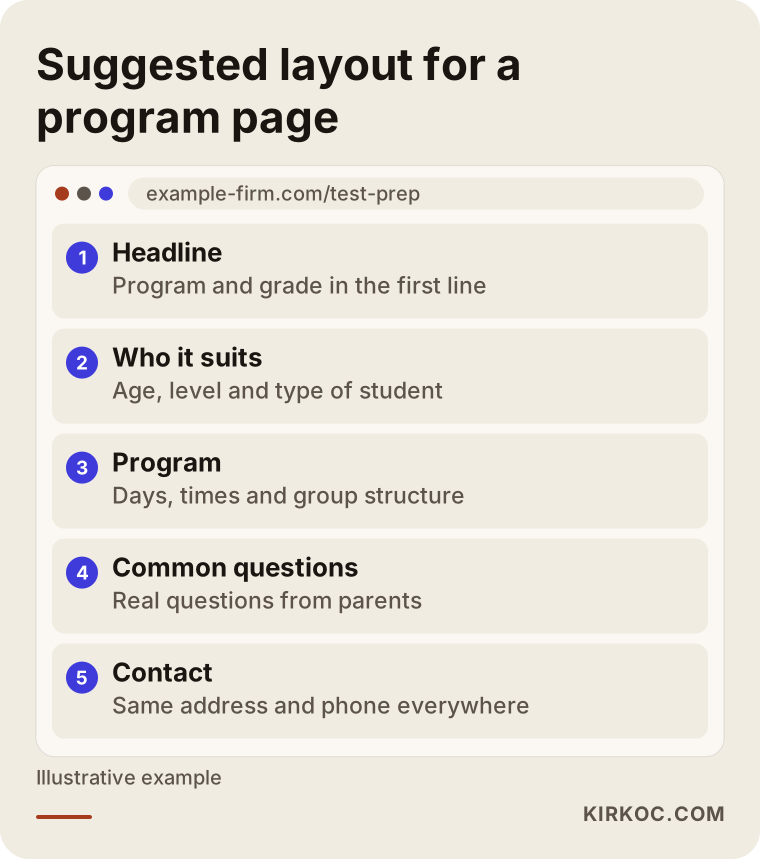
The layout in the image shows the skeleton I recommend for a program page. Every school has different needs, but a headline, the target audience, program details, common questions and a contact section are useful on almost every program page.
Step by step: Where should you start?
You do not need a large budget or technical knowledge to begin. The order below is the one I follow in most projects.
1. Collect parents' real questions
Write down the questions asked most often in enrollment meetings, on the phone, in text messages and in social media comments, in a notebook or a spreadsheet. A few weeks of notes is enough. This list is the source of the pages you will write. Do not invent questions from your own head; real questions always give better results.
2. Ask the AI tools yourself
Type the same questions into ChatGPT, Gemini and similar tools. Who appears in the answers? Which sources are shown? What is said about your school? Is anything wrong? Record this in a table. It is your "starting photograph" and helps you measure progress. AI answers can come out a little different each time, so I suggest asking the same question several times and in different wording.
3. Fix the basic details
Your school name, address, phone number, opening hours, founding details and program list should be identical on your website, your Google Business Profile, your social media accounts and any directory sites. This step is boring but very effective. Details that do not match reduce the trust of both search engines and AI tools.
4. Write the program that brings the most enrollments first
Do not try to do everything at once. Look at your enrollment season: which program is in the highest demand? Write its page first, then its FAQ and its access details. When the first page is ready, move on to the others.
5. Write pages in a plain, readable way
AI tools and parents like the same thing: short paragraphs, clear headings and direct answers. Put one or two sentences that answer the question at the top of the page, and the details below. Do not put important information only inside an image or a PDF; write it as text as well.
6. Get confirmation from outside
Your school's name should not appear only on your own website. Reviews left by real parents, features in local news and education websites, posts about events such as alumni gatherings, and memberships in professional associations are independent sources, and they are a strong signal for AI tools. Parents should not be pressured for reviews, and fake reviews must never be written.
7. Update regularly and keep watching
Before enrollment starts, go through your pages and update dates and terms. Every few weeks, ask the questions from step 2 again and see how the answers change.
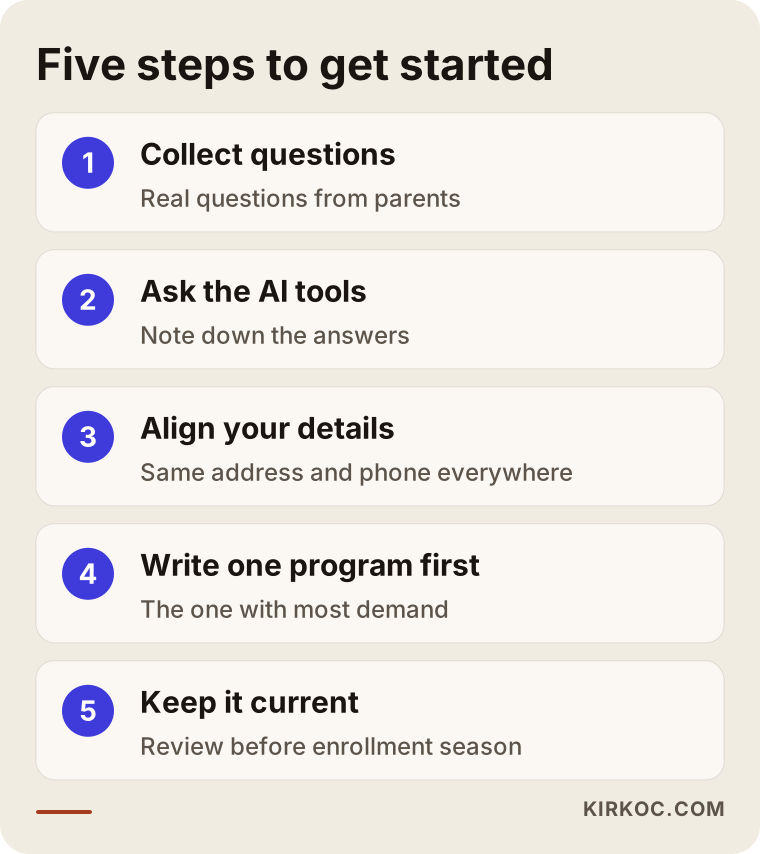
The image is a short summary of the seven steps above in five main headings. I usually do the first three together with the school, because that part rests on the school's own knowledge and cannot be solved quickly from the outside.
Common mistakes
These are the mistakes I see most often at schools and learning centers. Some are made with good intentions, but the result is the same: the school stays invisible or is described wrongly.
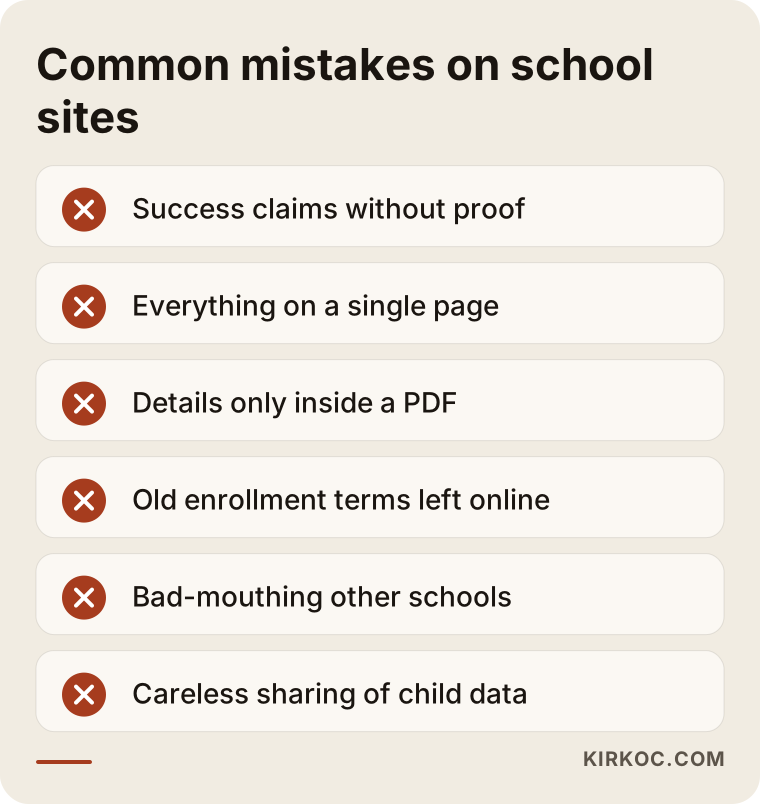
I explain each item from the image below.
- Stressing only "success." Unproven, unsourced lines like "we send hundreds of students to top colleges every year" convince neither parents nor AI tools. If you talk about results, explain with what definition, over which period and how they were measured. If you cannot measure it, do not say it.
- Fitting everything on one page. Sites that describe everything from kindergarten to high school, tutoring to summer school, on a single page cannot give a clear answer to a specific question.
- Relying on PDF brochures. Keeping information only in a PDF and not writing it as page text is a big loss. You can offer the PDF for download, but write the information on the page too.
- Leaving old information online. Enrollment terms from three years ago, the page of a closed branch or outdated exam information confuses parents and leads AI tools to give wrong answers.
- Bad-mouthing other schools. Speaking negatively about other schools breaks trust. Describe yourself instead.
- Publishing children's data carelessly. Sharing photos, names and grades without permission carries both ethical and legal risk. Do not decide without asking a lawyer.
One more point: there is no "magic command" or "trick to make AI like you" in GEO. Some people talk about hiding text on sites or writing fake reviews aimed at AI tools. I recommend none of it. It does not work, and it can damage your school's name.
Classic SEO and GEO: which one should you invest in?
I hear this question often: "Should I drop SEO and focus only on GEO?" My answer is no. The foundation of both is almost the same: a clear, accurate, current and well-organized site. Parents still search on Google, still look for schools on maps, and AI answers draw largely on the same sources that exist on the internet. So your SEO work helps GEO, and the fixes you make for GEO strengthen your SEO.
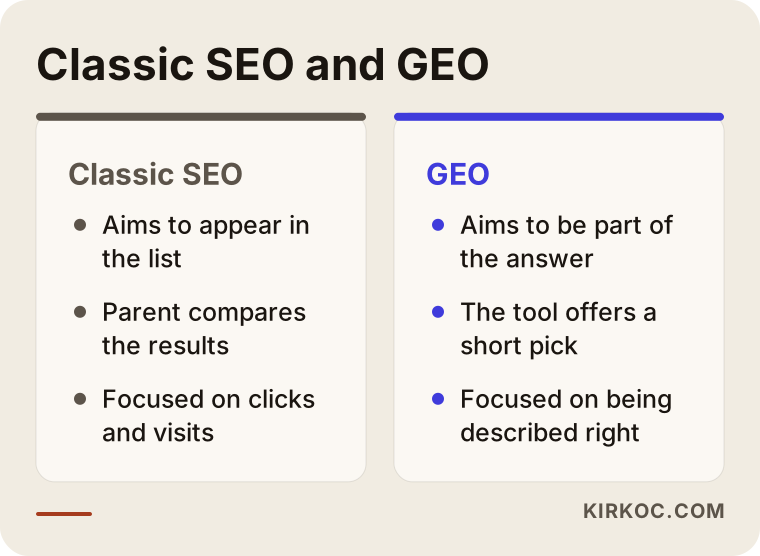
The comparison in the image shows where the two differ. SEO focuses on making you visible within a list, while GEO focuses on being described correctly inside the answer. In practice, most pages serve both at once.
What can you do yourself, and when do you need an expert?
As the head of school, director or admissions manager, there is a lot you can do, and most of it needs no technical knowledge:
- Collect the questions parents ask and write the answers down.
- Make the address, phone number and hours identical everywhere.
- Describe your programs in plain language.
- Ask AI tools questions regularly and note the answers.
- Ask real parents for reviews, without pressure.
If you do these things consistently, you may well look better organized than many competitors, because these basic steps are often skipped, though no result is guaranteed.
Expert help is useful in these places: making the technical structure of the site readable for AI tools and search engines, arranging pages according to a plan, building consistency of information across several campuses, deciding the order in which content gets written, and measuring results. When there are many campuses, many programs and several languages, the sheer volume makes it hard to run alone. In that case, working with a consultant saves time.
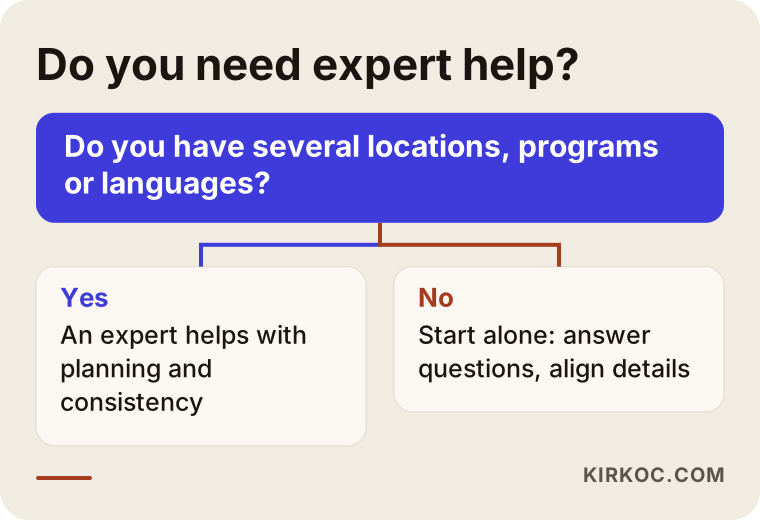
The image gives a simple pointer to the question of whether to go it alone or get support. There is no firm rule; it depends on the size of the school and the time you can set aside.
What determines the cost?
I do not give figures for price, because every school's needs are different and a number that fits everyone would not be honest. But I can tell you what it depends on:
- The state of the site. If your current site is in order, most of the work is content. If it has technical problems, those need to be solved first.
- The number of programs and locations. The number of pages to write directly determines the volume of work. A single-location tutoring center and a school with several campuses have very different needs.
- The number of languages. Schools that accept international students or serve families abroad may need content in more than one language.
- Who supplies the content. If your teachers and managers provide the information and approve the text, the process moves faster. If I have to research everything from scratch, it takes longer.
- Duration and continuity. A one-time cleanup and months of follow-up and updating are not the same job.
- The enrollment calendar. Starting close to enrollment season requires urgency and affects planning.
For a clear quote I need to see your school and your site. The first conversation and the assessment of your needs carry no commitment.
How I work with you
I work alone from Istanbul. That means the person who talks to you is the person who does the work. There is no go-between project manager and no handing you off to a team. Working alone has a limit too: I can take only a limited number of projects at the same time, so it is wise to reach out early, especially before enrollment season.
I usually proceed like this. First I have a conversation: I listen to you about your school, your parents, the programs that bring the most enrollments and your site. Then I review how your school appears today in AI answers and search results, and give you a short, understandable report; I write what is missing without drowning you in technical terms. Next I put together a plan that sets out which pages are written in what order and what you do versus what I do. I prepare the pages with you, because you know the education content best, and my job is to present it in the right structure and in a readable way. I cannot say in advance what will appear in AI answers as a result of the work, and no expert can guarantee that, but I follow the progress with you.
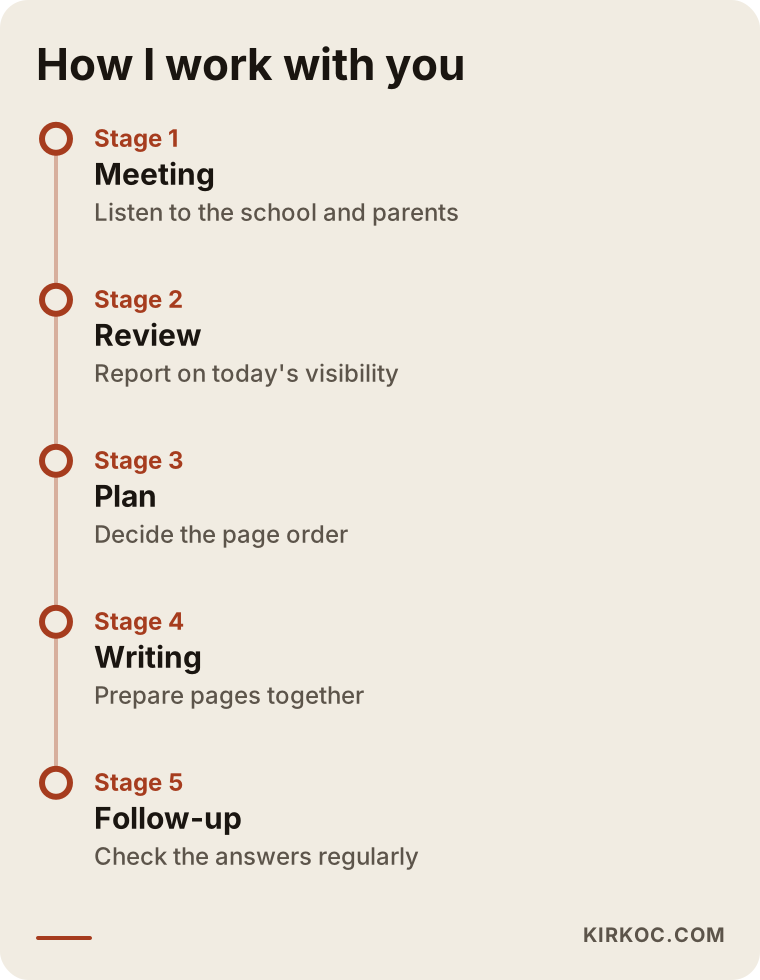
The image summarizes the process in stages. At each stage I tell you plainly what is being done, so you know what is finished and what is next.
Frequently Asked Questions
What is the difference between GEO and SEO?
SEO aims to make your website appear in search results. GEO aims to have your school included, and described correctly, in the answers that AI tools give. Their foundation is the same: a clear, current, well-organized site. So work done for one often helps the other.
Can I be sure to appear first in AI answers?
No, nobody can guarantee that. AI tools give slightly different answers each time, and the way they work changes over time. What can be done is to present the information your school needs to be included in the answer in a clear and reliable way.
Is it necessary even for a small tutoring center?
Often yes, and the opportunity may even be bigger for small centers. Parents ask very specific questions like "close to home, small groups," and small schools that answer them clearly can stand out. Of course, the work should be kept simple and matched to the size of the school.
Should I publish my school's success rates and graduate results?
If you do, state how you calculated the numbers, which period they cover and where they come from. Claims you cannot verify, or exaggerated ones, convince neither parents nor AI tools, and in some cases can conflict with advertising rules. If you are unsure which wording is appropriate, ask a lawyer.
Can I use student photos and reviews?
This is a sensitive area for privacy and children's rights. There are matters such as parental consent, purpose of use and how long the material is kept. I cannot give you a firm answer; I recommend consulting a lawyer before you publish. General descriptions written without names or faces are a safer option.
When will I see results?
It varies with the current state of the site, the competition and the quality of the pages written. You may see some improvements within a few weeks, but lasting visibility usually takes months. If you want to be ready for an enrollment season, you should start several months before it.
An AI tool gives wrong information about my school. What should I do?
First try to find the source of the error. Often an old page on your site, an address written differently somewhere or an outdated listing on a directory site is responsible. If you correct these and state the information clearly on your site, the answers may improve over time. It will not happen immediately, and it cannot be guaranteed.
Is it a problem to have an AI tool write the content?
Using a tool is not a problem, but a generic text written by a tool that does not know your school is useless. What matters is that the information comes from you: your programs, your approach, the real questions of parents. Whoever writes the text, an authorized person at the school should read and verify it before it is published.
If you would like to look together at how your school appears in AI answers and build a plan that fits your enrollment season, you can reach me through my GEO services page. I will listen to what you need and tell you honestly what is necessary and what is not.