You run an electrical contracting business, or you install smart home systems. You know your trade, you have references, but most of your new customers still arrive through someone who knows someone. Meanwhile, people are typing "smart home installer near me" or "new construction electrical contractor" into Google, and they are calling other companies. That is why you are wondering about SEO for electrical contractors and smart home installers. In this article I explain how the work fits this trade, which pages you need and where to start, without burying you in technical terms. I am Ümit Kırkoç, a web designer and SEO consultant who works alone from Istanbul, and where it is useful I will be clear about what my own SEO services cover.
SEO, in short, is the work that makes your website show up on Google and other search engines when your customers search. Unlike an ad, it does not disappear the moment you stop paying; when it is set up well, it can bring in inquiries for months. But in electrical and smart home work, the shape of that effort is different from a cafe or a dental clinic. Your customer usually makes one big decision, makes it together with other people, and researches for a long time before calling anyone.
How do customers find you in this trade?
First, who is searching? Your pages need to be built around them. In electrical contracting and smart home work there are generally four kinds of customers.
The first is a person building or renovating their own home. They type things like "whole house rewiring," "how to install a smart home system" or "I want to make my house smart." They do not know the technical vocabulary; they search in plain sentences.
The second is a builder, developer or project manager. They search more corporate phrases such as "residential development electrical contractor," "multifamily electrical work" or "commercial building electrical." Before price, they want references, experience and some assurance that you will finish on schedule.
The third is a business owner: an office, a store, a hotel, a restaurant or a small factory. They search for "office electrical remodel," "hotel room automation" or "retail lighting and panel upgrade." For them, downtime matters most. They want to know whether you can work while they are open or only after hours.
The fourth is someone who is unhappy with an existing system. They search "smart home system not working," "smart home maintenance" or "upgrade an older home to a smart system." This customer is not looking for a fresh install; they want a fix, and most of the time they want to act right away.
These four people do not want to see the same page. If your site has one page that says "Electrical contracting and smart home services," Google cannot tell which search to show it for, and the visitor cannot find what they came for.
When the search happens: researching or deciding?
In this trade, people usually search in two stages. First they search to learn ("what can a smart home do," "what is a hub," "is a smart home worth it for a new house"). Later, as the decision gets closer, they switch to searching for companies ("smart home installers in my city," "electrical contractor near me"). During the first stage your informational articles should appear; in the second, your service pages and your references. This article focuses on the second stage, the customer who is about to contact you.
The illustration below summarizes that journey as a simple funnel. The widest part is the curious; the narrowest is the people who actually call you.
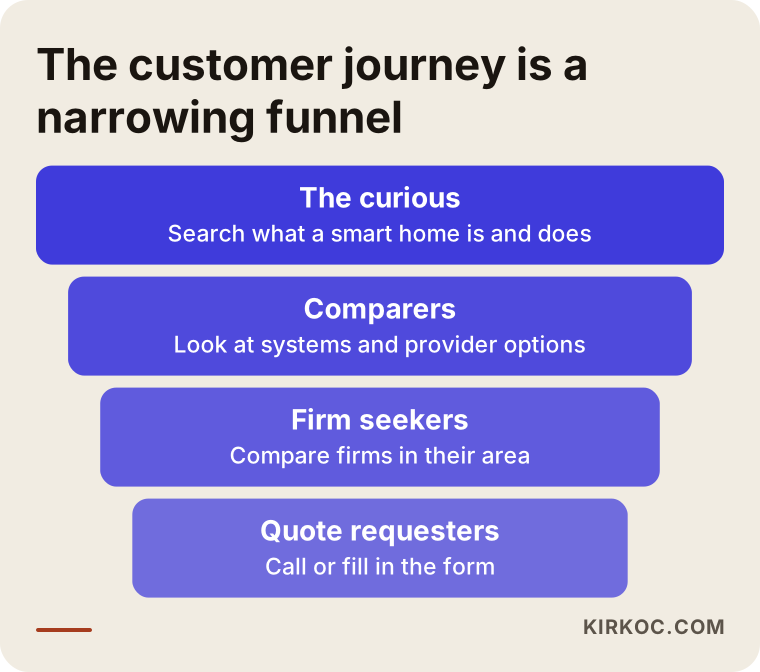
The idea behind the funnel is this: not everyone will ask you for a quote, and they do not need to. Your job is to make sure the right person finds you on the right page. If a curious reader remembers you later, when it is time to decide, that article has done its work.
Which pages do you need to win commercial searches?
The most common problem I see on electrical and smart home websites is every service squeezed onto one page. But every separate job is a separate search and deserves a separate page. Here is what I would start with.
One page per service. Residential wiring, new construction electrical, commercial electrical work, panel upgrades, lighting design, smart home installation, security camera and alarm integration, shade and lighting automation: if you really do the job, give it its own page. Do not write a page for work you do not do just because people search for it. You mislead the customer, and you lose trust in the very first conversation.
Separate the systems on your smart home page. When someone says "smart home," they often do not know exactly what they want. Lighting control? Heating? Shades? Security? All of it? Describe these options in plain language. You may mention the brands or protocols you install (Lutron, Control4, Zigbee, Z-Wave, Matter and so on), but explain each in one sentence, for example: "Z-Wave is a common wireless standard that lets devices from different makers talk to each other."
Area pages. Pages for the cities and neighborhoods you serve are useful, but only for places you really work. "Smart home installation downtown" and "new construction electrical in the suburbs" are not the same page. Something specific to that area, such as the kinds of buildings you usually work on there, makes the page real.
Project and reference pages. Finished jobs are the strongest trust tool in this trade. Write a short page for each project: what kind of building, what was done, how long it took, what challenge came up, what mattered to the customer. Add photos (the panel layout, the cable trays, the finished space). You can write these pages without naming the customer; "an office building in a mid-sized city" is enough. If you want to name the customer or show the address, get written permission first.
Frequently asked questions. The questions customers really ask. Is the design drawing included? How do permits and inspections work? Is there support after installation? How long is the warranty? Answers calm people down, and they also help search engines understand your page.
A contact page. Phone, address, opening hours and the areas you serve should be in one place and identical everywhere. It looks minor, but it matters a lot.
The illustration below shows how a sample smart home service page could be laid out. The domain name is completely made up.
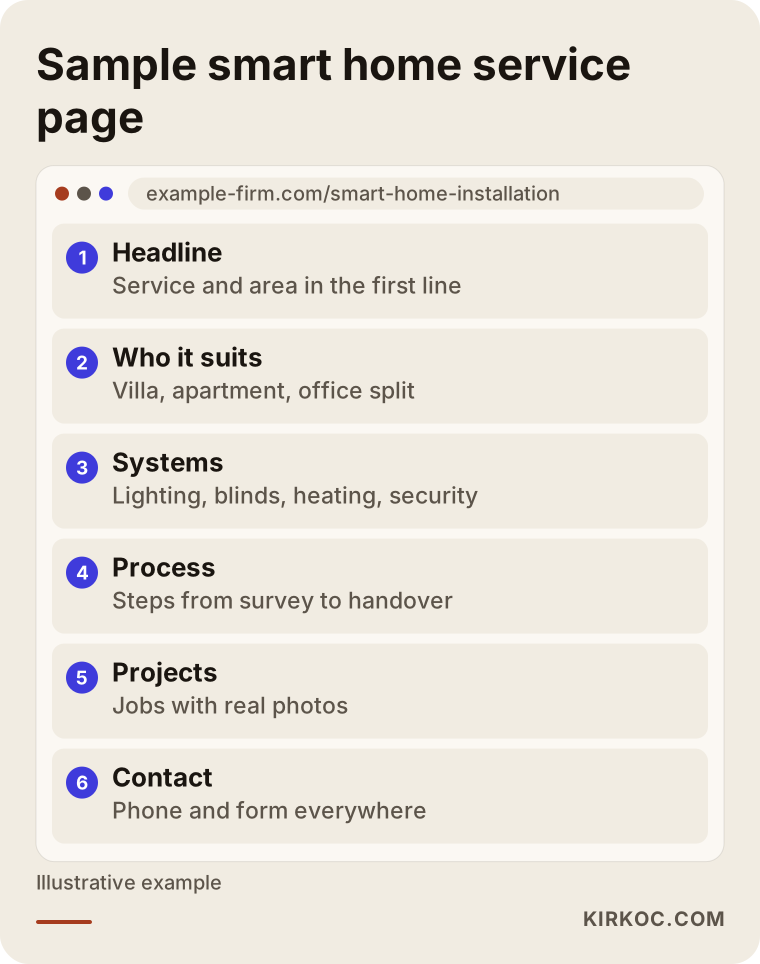
With this layout, the reader sees their questions answered one by one as they scroll. By the time they reach the quote form or the phone number, most of their doubts are gone.
Two hypothetical example scenarios
The two examples below are entirely hypothetical. They do not describe a real company or person; they are only here to show the logic.
Scenario 1: An electrical contractor working on custom homes
Imagine a company that mostly serves builders and owners of custom homes. Its website has one "Services" page where electrical, lighting, panels, grounding and smart home are all listed in a single paragraph. For months it has not appeared for searches like "custom home electrical contractor."
The first task is to decide which jobs actually earn money. Say custom homes and detached houses, plus panel work, bring in the most. Then two separate service pages are added: one for custom home electrical contracting and one for panels and grounding. Each page explains how the process works, what happens at each stage and what the customer needs to know. After that, three or five finished projects are added as short pages of their own.
What happens next? I cannot guarantee anything; nobody knows when Google will change its rankings. But clearer pages give someone searching for "custom home electrical contractor" a better answer, and the chance that the phone rings goes up. The process is then measured over months: how many people came to each page, how many called, who filled in the quote form.
Scenario 2: A small company installing smart homes
Now picture a hypothetical company of three or four people that installs lighting, shade and heating automation, mostly in newly built apartments and houses. The website looks nice, but it is full of general lines such as "innovative solutions" and "the new address of comfort." A visitor cannot tell what is actually done or what the process looks like.
The first step here is to simplify the language. A concrete sentence like "We let you control the lights in your home from your phone or with a single tap" does more than any marketing slogan. Next come articles that answer real questions: "how is a smart home system installed," "can I add smart devices to an existing home," "when does a smart home need maintenance." These articles bring in the curious and point them to the service page.
Whichever scenario is closer to your situation, the logic is the same: first get clear on what the customer types in their own words, then on how you answer it.
Step by step: where do you start?
When I begin an SEO project, I follow roughly this order. If you are doing it yourself, you can use the same sequence.
1. Decide which job is most profitable for you. You may do many things, but they do not all earn the same. Start with the work that earns the most, that you enjoy most and that you do best.
2. Understand what the customer types. Guessing is not enough. Ask your current customers how they first searched, look at the sentences in incoming calls and messages, type a few searches into Google yourself, and study the results and the "People also ask" box. That is how real phrases come out.
3. Match each search with one page. Do not load "new construction electrical," "office electrical remodel" and "smart home" onto the same page. Give each intent its own page.
4. Write and organize the pages. The title, the first paragraph, the subheadings and the questions should each answer that search. Concrete information, not decoration.
5. Check the technical foundation. Does the site open quickly on a phone? Are the pages linked to each other? Are the map and address details consistent?
6. Set up or fix your Google Business Profile. For local searches, especially "near me" ones, your listing on the map is very important.
7. Measure and adjust. In the first months, look at which pages get visits, which searches bring people, and who calls or fills in the form. Improve pages when needed.
The illustration below gathers these steps into a short list.
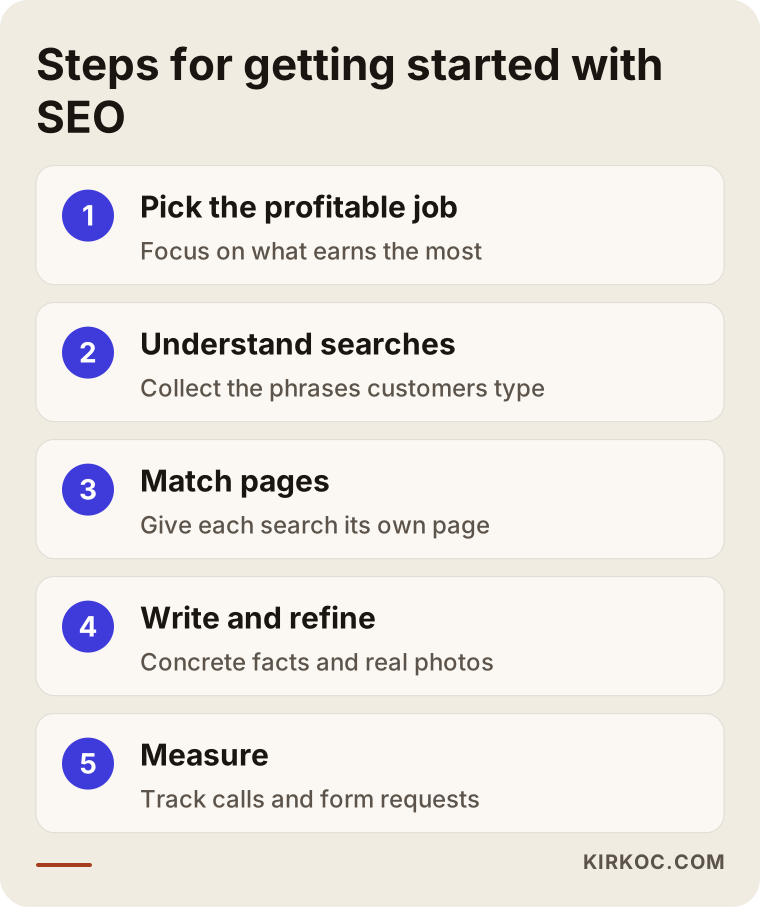
None of these steps is finished in one week. Often the first structure is built in a few weeks, while results take months to settle. Knowing that from the start prevents disappointment.
Local search and maps: being close to the job site
Electrical work is usually local work. A customer does not expect an electrician from another state to show up; when they type "electrician in my neighborhood" or "smart home installer in my city," they are looking for a company in their own area. That is why your Google Business Profile needs to be complete: the right category (for example electrician or electrical contractor), service areas, opening hours, real photos and current contact details.
Reviews matter too. You can politely ask a satisfied customer for a review at a moment when it suits them. Do not write fake reviews or buy them; it breaks Google's rules, and if it is noticed it can damage your whole profile. Reply to negative reviews respectfully and specifically: understand the problem and write down the solution. A new prospect reads your reply and forms an opinion about your company.
If you do not have an office or you work from home, set the address display options in your profile correctly. There are separate settings for businesses that travel to the customer; a wrong setting can get a profile suspended.
How your page looks in the search results also affects whether people click. The example below compares how two invented companies appear for the same search.
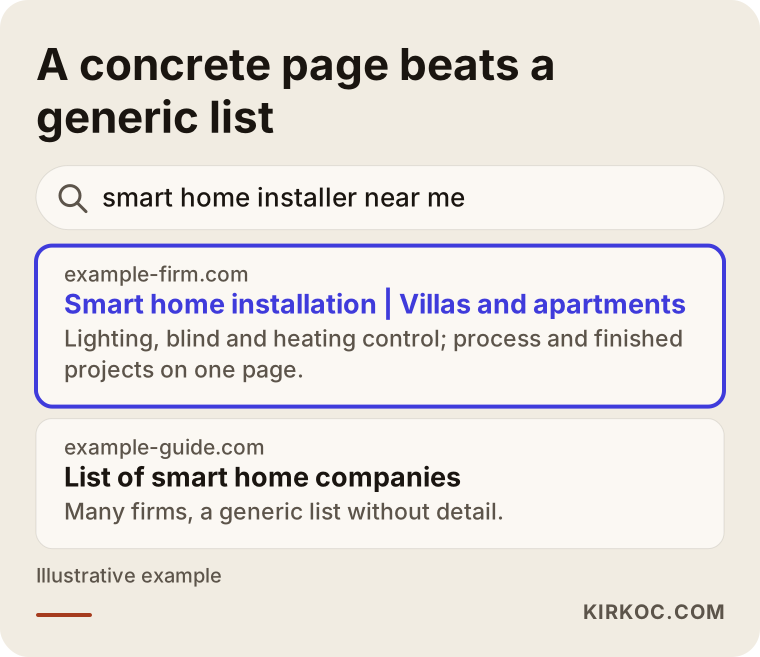
The difference here is concreteness, not promises. The title states the service and the area, and the short description contains what the customer wants to know. That matches the expectation of the person who clicks with what is actually on the page.
Trust signals: why they matter even more in this trade
Electrical work does not forgive mistakes. A badly done installation can carry fire or safety risks. Customers know it, so they look for trust. What you show on your site both convinces people and helps search engines see your pages as valuable.
You can include: your license and the fact that you are registered with the relevant authorities (only if it is real and valid), the brands of materials you use, insurance or warranty terms, the documents and test results you hand over after a project, and a short introduction to your team. Licensing and documentation requirements vary by state and city and by the type of work, and they change over time; if you are not sure what you should display or claim, ask an attorney or your local licensing board.
Do not leave your About page empty either. Write briefly and honestly how many years you have worked, what kind of projects you do and who runs the job. At the moment of decision, that is very effective. A sentence such as "we run this kind of job in this way" is more believable than claims you cannot prove, like "we are the industry leader."
Common mistakes
These are the mistakes I see again and again on websites in this field.
Putting everything on one page. I mentioned it already: if you do not separate the services, you cannot be strong in any of them.
Using technical language. A phrase such as "multi-functional automation infrastructure" tells the customer nothing. The customer wants to know, "will the lights turn on by themselves when I get home in the evening?"
Not enough photos. In this trade, a photo of finished work builds more trust than a thousand words. Use photos of your own projects instead of stock images; show the panel, the wiring, the finished space.
Leaving no way to make contact. Sites with only a form and a hidden phone number lose a lot of work. The customer may want to talk. Put a clear call button on every page.
Writing about work you do not do. Opening a page for a service you never provide, just to get ranked, ends up hurting you.
Forgetting mobile. Most prospects look on a phone, maybe in the middle of a job site, maybe on the couch in the evening. If your site is slow on a phone or the text is tiny, visitors leave.
Expecting results right away. SEO is not a sprint. Giving up because you saw nothing in the first weeks wastes the investment.
The illustration below is a short summary of the most common mistakes.
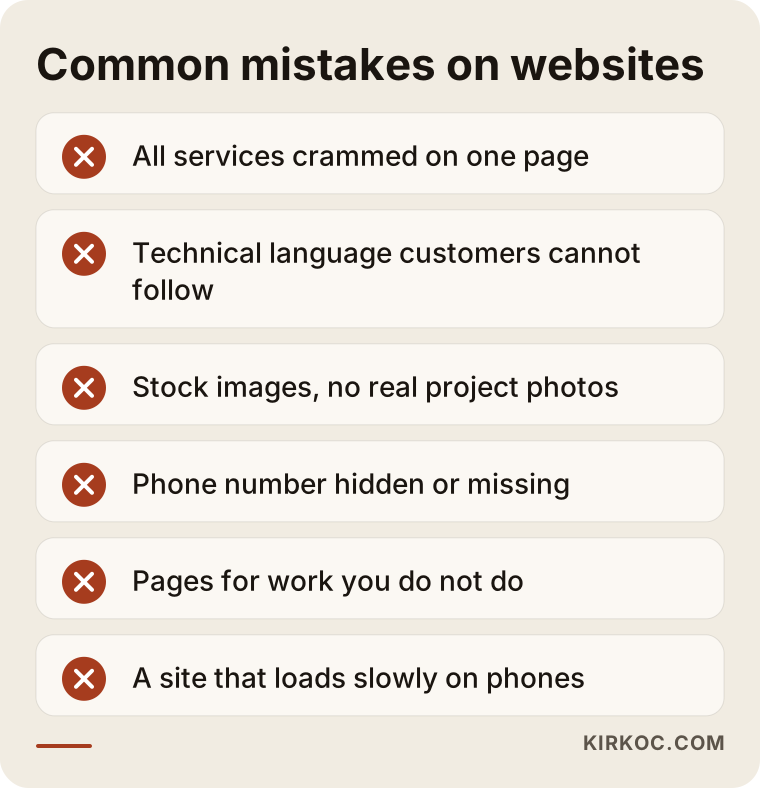
Most of these mistakes can be fixed without a large budget. Separating pages, simplifying the language and adding real photos usually make the biggest difference.
What can you do yourself, and when do you need an expert?
You do not have to hand everything to a specialist. You can do the following yourself:
- Fill in your Google Business Profile completely and add photos regularly,
- Take a few photos and write two or three sentences of notes after every finished job,
- Write down the questions customers ask most and answer them on your site,
- Politely ask satisfied customers for reviews,
- Check that your phone number, address and opening hours are the same everywhere.
Expert help makes sense in these cases: your site is new or very old and the page structure has to be rebuilt, there are technical problems (slowness, error pages, poor mobile display), you do not know which searches to focus on, or you cannot spare the time to produce pages and articles. And if you will serve customers in more than one language, for example installing smart homes for international buyers, each language needs its own natural pages; that is hard to do alone.
The illustration below reduces this decision to one simple question.
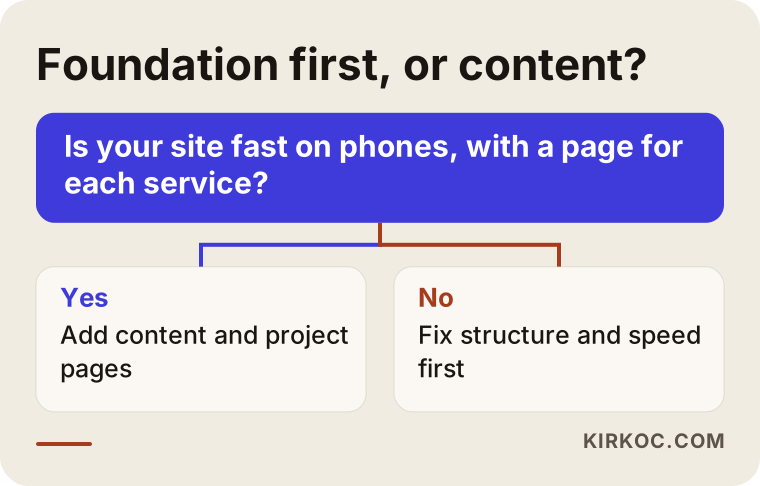
In short, if the foundation is missing, writing content is wasted effort. First a solid base, then regular content.
What are blog articles good for?
Service pages speak to the person who is ready to buy. Blog articles reach the person who has not decided yet but is researching. Useful topics in this trade include: what to look for when choosing a smart home system, whether you can add a smart system to an existing house, why an electrical plan matters, what a customer should know when choosing a panel, how to think about electrical planning in a new build, and what to do when a smart home system stops working.
The trick is to write in the customer's language, not yours. You can use a term like "ground resistance," but the first time it appears, explain it in a sentence: "this is the measurement of the system that lets electricity flow safely into the ground." Every article should end with a pointer to the relevant service page. But not every article should be a sales pitch; people save and share articles they find useful, and they remember you.
There is also a topic around these articles: AI-assisted search. More and more people ask tools like ChatGPT, "How do I choose a reliable smart home installer in my city?" These tools can lean more easily on pages that are clear, well organized and have a visible source. If your pages answer questions plainly and your details are consistent, you have a better chance of appearing in such answers too, though there is no guarantee.
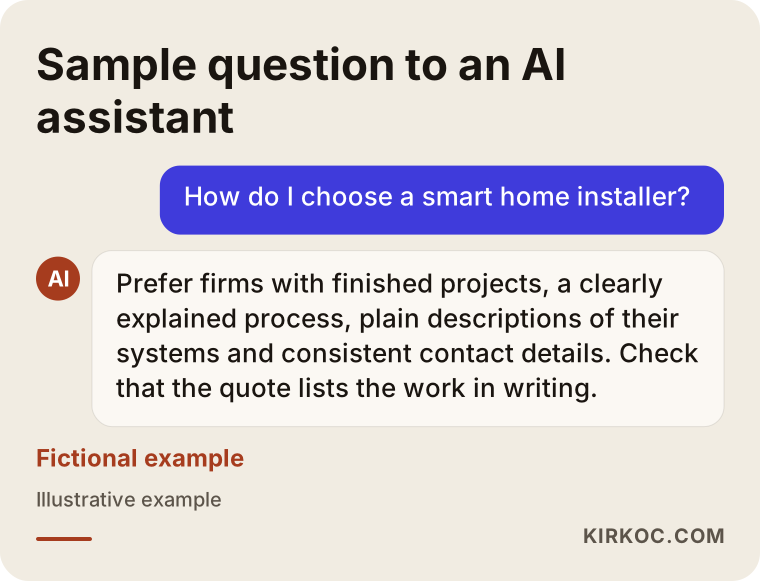
This example is fictional, of course; a real answer will not always look like this. But the general direction is the same: clear, honest and well-organized content is more useful to people and to AI tools alike.
How long does it take?
This is the question I get most often, and the honest answer is "it depends." The age of your site, the level of competition, your area and the type of work all affect it. As a general frame: in the first month the basic structure and pages are built, in the following months content is added and measurement begins, and after a few months you start to see which pages are working. A fixed date or a promised ranking would not be honest; anyone who offers one is misleading you.
The timeline below shows the stages of a sample process.
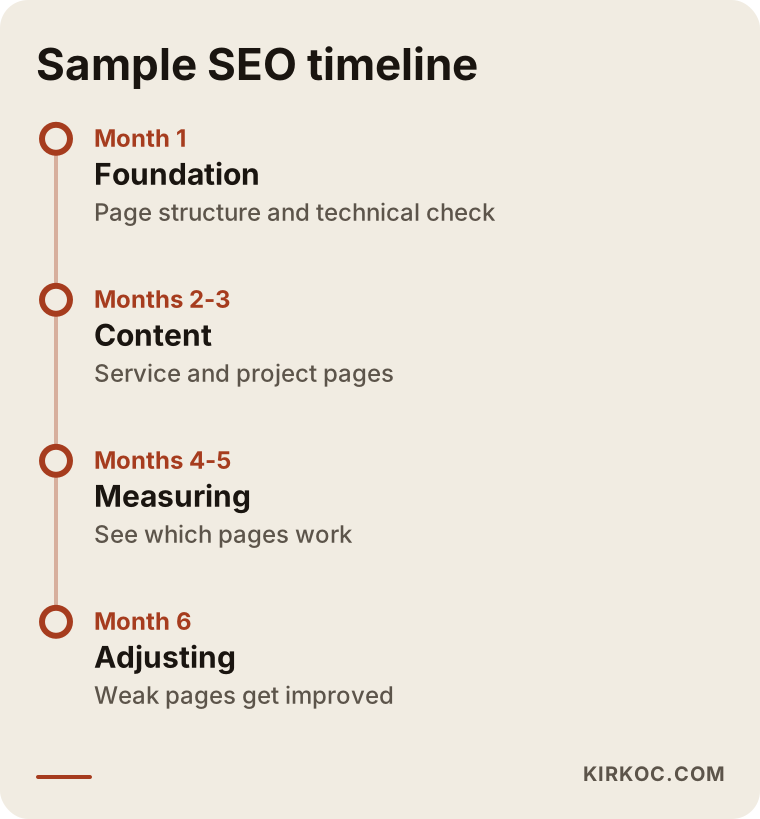
This calendar is an estimate. The real pace depends on your site and your competition. What matters is that you know what is being done at each stage and what is being measured.
What determines the cost?
I will not give a number, because no two companies need the same work. But I can tell you plainly what drives the cost.
Number of pages. Five service pages and twenty service and project pages are not the same job.
Condition of the current site. If your site is sound and only needs content, the work is lighter; if it has to be rebuilt, it is bigger.
Level of competition. A crowded field such as "smart home installation" in a big city takes a different effort from "electrical contractor" in a small town.
Content and image production. Project photos, articles, FAQ answers and, if needed, multilingual versions add to the workload.
Continuity. A one-time setup and a regular monthly engagement are priced differently.
Number of languages. Every language needs its own natural text; copy left to a translation machine does not work.
When you get quotes, check these: is it written down clearly what will be done, which deliverables will you receive, how will results be measured, and do the terms include the length of the engagement and how you can leave? Be careful with anyone who says "guaranteed first place"; nobody can control search results.
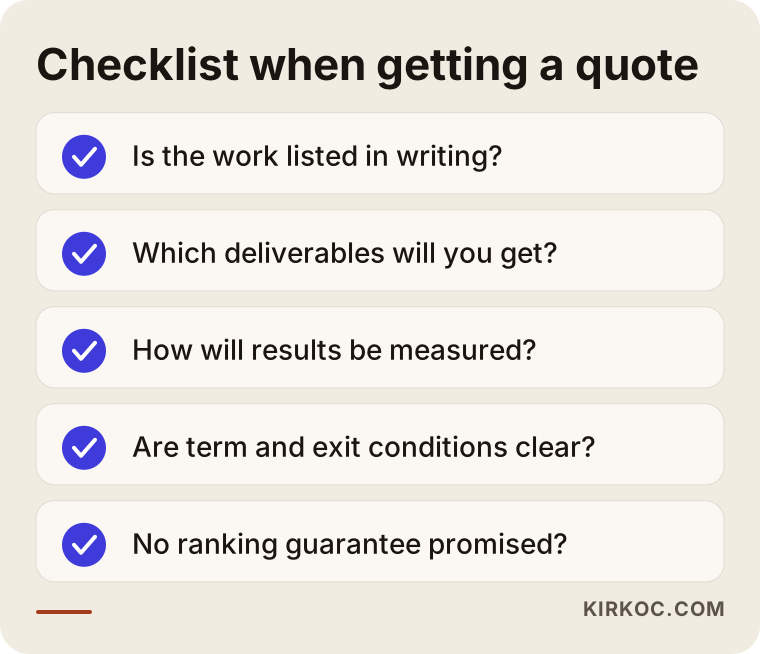
This list is a simple filter you can use to evaluate anyone, including me. If any item is unclear, ask before the work starts.
How I work with you
I work alone, which means the person you talk to is the person doing the work. I generally proceed like this: first a short conversation where I listen to your business, your customers and your goal. Then I look at your current site and write down, in plain language, what is missing, what is extra and what should be fixed. After that we set priorities together, because not everything needs to be done at once. I prepare the pages and the copy, handle the technical fixes, and in the following months I show you what is working.
The illustration below summarizes which part of the work is mine and which is yours.
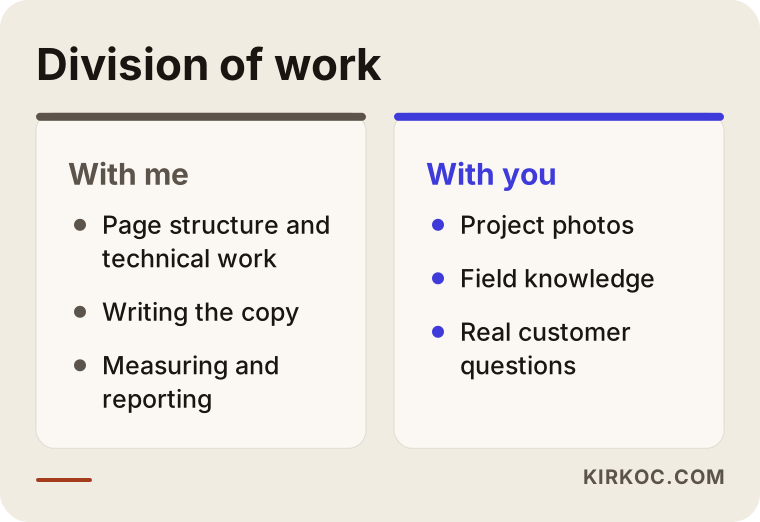
There are also things I will not say: I will not tell you "you will be first on this date" or "your phone will ring this many times." Instead I keep it clear what I do, why I do it and how we will follow the result. When it makes sense, I will even suggest that you do part of the work, for example project photos and customer questions come from you, because you know the field.
If your website will be in more than one language, for instance because you install smart homes for international clients, each language's pages need to be thought through separately. I can guide you on that as well.
Frequently asked questions
Is SEO really necessary for an electrical contractor?
If you get enough work through personal connections, it may not be urgent. But if you want to grow, move into new areas or reach customers outside your circle, showing up in search engines becomes an important channel. Customers almost always search online before they decide.
What is the most important page for a smart home company?
It is hard to name just one, but usually the main smart home service page and your finished projects bring in the most work. The customer wants to see both what you do and that you really do it.
When will I see results?
I cannot give an exact time. Usually the structure is built in the first weeks and some movement shows up within a few months. In very competitive searches it can take longer. Do not trust anyone who guarantees a ranking.
Is Google Ads or SEO better?
They work differently. Ads give you visibility right away but stop when you stop paying. SEO starts more slowly but, once it settles, can bring work for longer. Many companies use both; the decision depends on your budget and how urgent it is.
Can I share project photos without the customer's permission?
I recommend not sharing photos that show the customer's home, address or anything that identifies them without written permission. For legal details, ask an attorney. Details that do not identify anyone, such as the panel and the wiring, are often safer.
Should I open a separate page for every city I serve?
No. Only for places where you really work and where you have something specific to say about that area. Copying the same text and swapping the city name does not work and can hurt your site.
Do I need to build the site from scratch?
Not always. If your current site is fast, orderly and ready to be expanded, I build on it. If it is very old, broken on mobile or restrictive, rebuilding may make more sense. I can tell you that by looking at the site.
Can I do this myself?
The basics, yes. The profile, the photos, the reviews and answering questions are in your hands. For page structure, technical checks and measurement, help can save you time.
If you would like to work out together which searches your electrical or smart home business should appear for, you can reach me through my SEO services page; I will listen to your business, your area and your goal, and give you a simple roadmap.