"I'd like to show up in AI answers, but I don't have a big budget. Where do I even start?" If you run a small business, that is a fair question. You read about large brands spending heavily on campaigns and assume this is not meant for a business your size. In reality, most of the steps that help small businesses are not expensive. They just need to be done in the right order.
In this article I explain what to do first on a limited budget, which jobs you can do yourself, and where a specialist makes a real difference. I offer this work as GEO services, but I am not going to try to sell you everything. Often there is a list you can work through on your own first.
What are GEO and AEO, exactly?
Chatbots like ChatGPT and Gemini, and Google's AI summaries, pull information from web pages when they answer a question. GEO (generative engine optimization) and AEO (answer engine optimization) describe the work of making sure your business appears in those answers, and appears accurately. The two terms overlap heavily. You can simply think of it as "being visible in AI answers."
If you are new to the topic, I covered how AI summaries affect businesses in will AI search cost my business customers. Here I go straight to the "what should I do" part.
Accept this first: there are no guarantees
Nobody knows for certain which business will be named in a given AI answer. These systems change constantly. Anyone who promises you a top-three mention is not being honest. What I can do is make your business easy to find, easy to understand and easy to trust. That helps in traditional search too, so the effort is never wasted.
The order of priority: five steps that cost almost nothing
This order starts with what gives the most value for the least money.
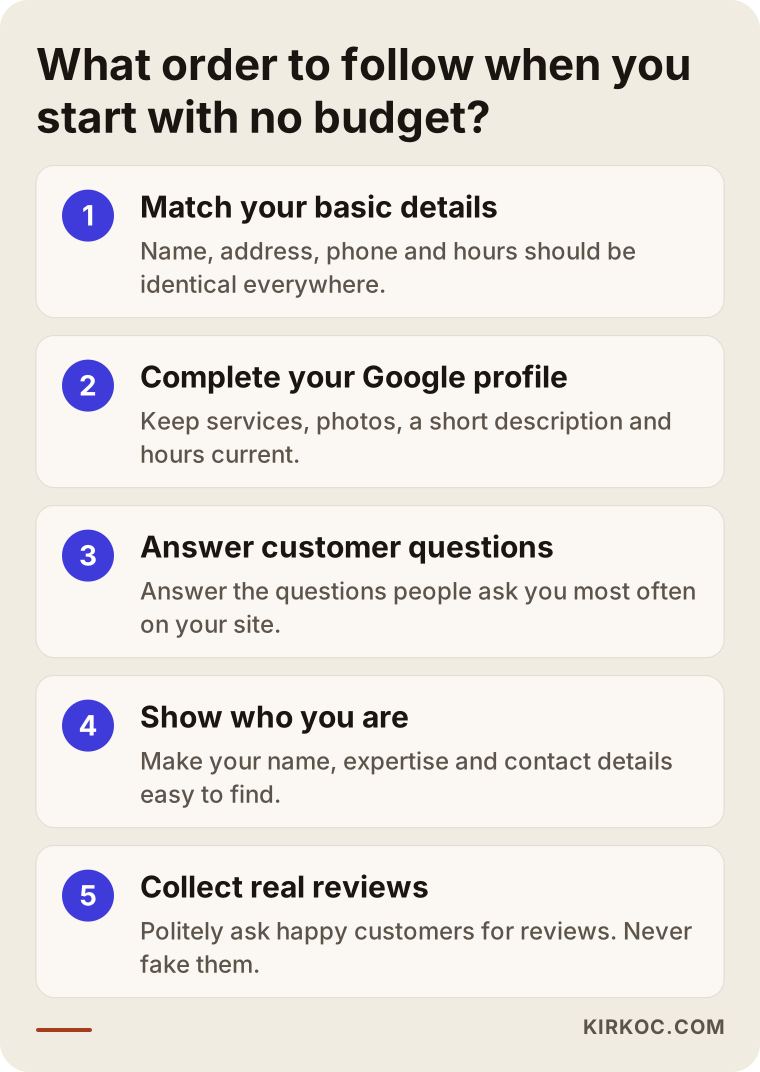
- Make your basic details identical everywhere. Business name, address, phone number and opening hours should match exactly on your website, your Google Business Profile, social media and directories. I wrote about this in NAP consistency. It costs time, not money.
- Complete your Google Business Profile. Services, photos, a short description and current hours. This is one of the sources used most often for local searches and AI recommendations.
- Answer your customers' questions on your site. Write down the ten questions people ask you most on the phone. Give each one a short, clear page or section. Do not hide questions like "what affects the price?" A site that explains things openly looks more trustworthy.
- Show who you are. An about page with your name, expertise, experience and contact details. AI systems, like people, trust a site with a real person behind it.
- Collect genuine reviews. Politely ask satisfied customers to leave a review. Never fake them; that is unethical and it backfires.
If you do these five yourself, you will have strengthened the foundation of your business without paying anyone.
What to do yourself and what to leave to a specialist
| Do it yourself | Leave to a specialist |
|---|---|
| Making your details consistent | Behind-the-scenes markup that tells Google what a page is (structured data) |
| Filling in your Google Business Profile | Planning which question belongs on which page |
| Writing answers to customer questions | Fixing site speed and mobile problems |
| Asking for reviews | Deciding which directories and sites are worth being listed on |
| Asking a chatbot about your business | Measuring and reporting results regularly |
The rule is simple. You know your business best, so the accuracy of the content should come from you. Technical setup, planning and measurement are specialist work.
Check where you stand in ten minutes
Ask a chatbot on your phone the way a customer would: "Recommend a good [your profession] in [your town]." Then look at three things:
- Are you mentioned?
- If so, are the address, phone number and services correct?
- If not, what do the businesses that are mentioned have on their sites that you do not?
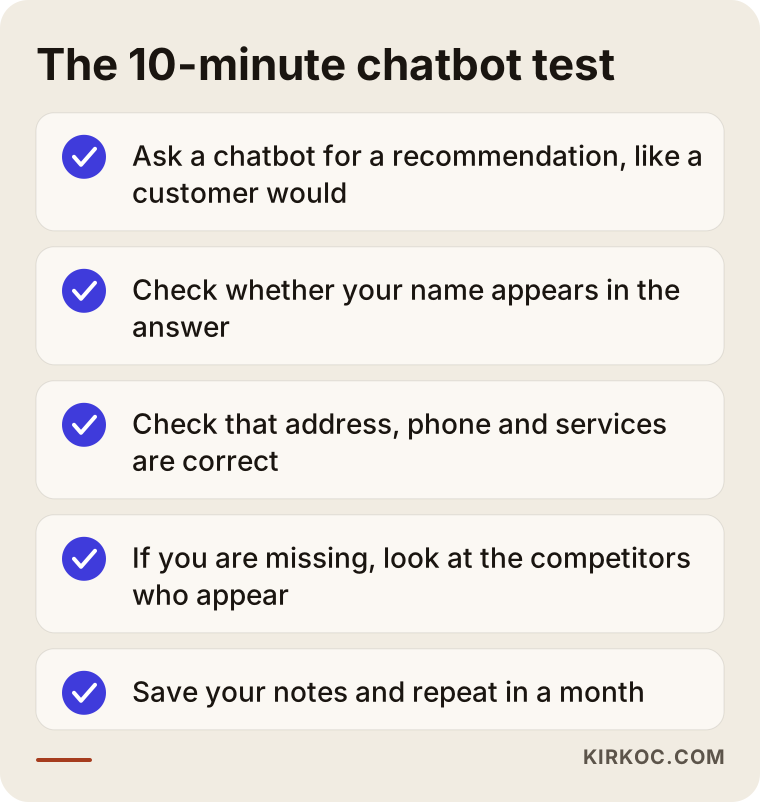
This simple test shows where to spend your time. Write down the results and repeat it a month later.
Two different businesses, two different starting points
The same five steps apply to everyone, but which one deserves the most weight depends on the type of business you run. Below I describe two kinds of business I have talked to recently, without naming anyone.
A neighborhood bakery
The owner of a bakery that had served the same streets for years came to me with a simple question: "Customers ask their phones now. Why don't I show up?" I started by asking a chatbot the way a customer would. Two nearby competitors appeared in the answer. The bakery did not.
The first thing I checked was the basic details. The map listing still showed old opening hours, and the website gave a different phone number. The Google profile listed only "bakery" as a service. The things people actually search for, like custom celebration cakes or allergy-friendly options, were missing.
We matched the details first, then filled in the profile and added one page to the site explaining how to order a custom cake. The owner wrote all of it, because nobody knows the work better. I fixed the order and the wording. A few weeks later, when we asked the same question, the bakery appeared in some answers and still not in others. I am telling you this as it was: fluctuation is normal and part of how these systems work.
A small ceramics studio selling online
The second example is a one-person studio selling handmade pieces online. Here the problem was not address or hours. The site simply did not make clear what the products were, how they were made or who they suited. Product pages had one photo and two words.
We added materials, care instructions and common questions such as "is it dishwasher safe?" to each product page. We wrote an about page explaining who runs the studio and how the pieces are made. On the technical side I made one small change that tells search systems clearly what each product is. That part was specialist work.
What the two cases share: neither involved a big spend. In both, the business first wrote down what it already knew, clearly and in order. Results differ from business to business, and I cannot guarantee them.
How the process works: doing it yourself versus working with me
Knowing the process in advance helps you plan your time and decide what to expect from a specialist.
If you do it yourself
In week one, gather your details. Write the name, address, phone and hours in one document, then correct your website, map listing and social profiles to match it. In week two, complete your Google profile and list the questions customers ask most.
In weeks three and four, add the answers to your website, each one short and clear. Then review your about page. At the start of every month, repeat the ten-minute chatbot test and compare it with your earlier notes.
If you work with me
The first step is a short introductory call. I listen to how your business runs, what your customers ask and where you appear today. Then I look at the site and your profiles and write down what is missing or wrong in a clear list.
In the second step I give you that list as separate tasks, split into what you can do and what I will do. Once you approve the scope, we begin. Because I work alone, you hear about progress directly from me. There is no layer in between.
In the third step the changes are made and explained. In the last step I report in plain language how your visibility in chatbots and search has changed. Whether to continue is entirely your decision.
What to look for when you get a quote
On a small budget, buying the wrong package can cost more than buying nothing. So it helps to know which signs to look for in an offer.
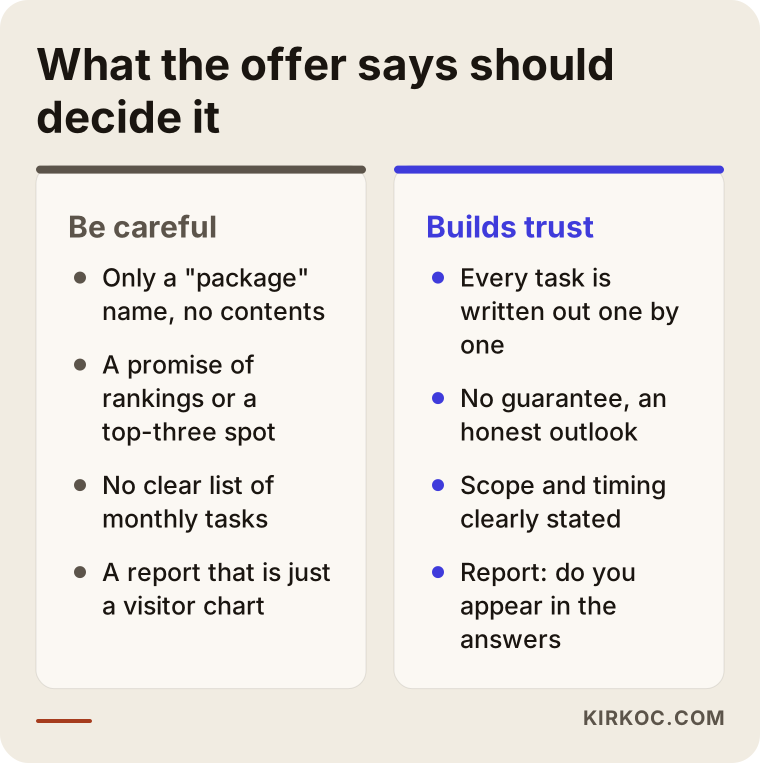
First, check whether each task is written out separately. A single line like "full GEO package" may hide what is inside. Ask how many pages will be written, which profiles will be edited and which measurements will be taken.
Second, watch for ranking promises. Nobody can guarantee a place in an AI answer. I would not work with anyone who promises it.
Third, look at what the report shows. A report that only counts visitors is not enough. Whether your business appears in the answers, whether the details are correct and whether customers contact you are more meaningful.
Finally, check the contract length. Find out if the work is one-off or monthly and when you can stop. A flexible start is usually healthier for a small business.
How much time should you set aside each week?
Many owners assume this takes days. In the beginning, a few hours a week is often enough. The first month is the heaviest, because gathering and fixing details takes time.
After that the routine gets lighter. A chatbot test once a month, updating details when something changes and thanking people for new reviews may be all you need. I suggest turning it from a day of work into a fixed reminder in your calendar.
Even if you have no time at all, do not skip it. At least finish the first two steps, your details and your Google profile. They are the foundation for everything else.
How to write customer questions on your site
The third step takes the most effort for most businesses, and it makes the biggest difference. The goal is not elegant prose. It is giving a real answer.
Where do you collect the questions?
For one week, note down the questions people ask by phone, by message and in person. Also look at the reviews on your Google profile and at the messages customers send. A question that seems ordinary to you may be the deciding moment for someone else.
How do you format the answer?
Write the question as a heading and give a direct answer of two or three sentences right below it. Add detail afterward if needed. The first sentence of the answer should be clear enough for someone who knows nothing about the question.
Even if you prefer not to publish prices, explain what affects the price. Saying "it depends on size, material and delivery time" is far more helpful than saying nothing.
What should you leave out?
Disparaging competitors, exaggerated claims and promises you cannot verify damage trust. If your profession has advertising rules, check them before you publish.
What to check on your Google Business Profile
The profile is one of the cheapest and most effective shopfronts a small business has. Yet most profiles are only half filled in.
Choose the main category carefully, using the word closest to how your customer describes you. Add secondary categories only for services you really offer. Fill in the services section one by one and write a short description for each.
For photos, use real ones you took yourself: the entrance, your products, you at work. Update your hours for holidays and special days. Follow incoming questions and reviews and answer them.
How do you measure results?
Measuring does not have to be complicated. At first, three things are enough: whether chatbots mention your name, whether the details are correct and how the number of people contacting you changes.
Open a simple table with columns for the date, the question you asked, the tool you used and what you saw in the answer. Repeat the same questions once a month. Answers can change each time, so look at the trend over several months rather than a single result.
It is also valuable to ask new customers how they heard about you. The number who say "an AI told me" may be small, but noting it shows direction.
Where should the budget go?
If your money is limited, the order of decisions can be this. Finish the free tasks first. Then, if you are stuck at one point, get help only there, for example the technical setup of the site or a content plan.
Handing the whole job to someone makes sense if you have no time or your business covers many areas at once. But it is not a requirement. Starting small and expanding based on results is usually safer.
It also helps to ask: even if this spending never brings in a customer, does it fix my business information? Consistent details, clear pages and a current profile help in classic search and with customers who phone you, with or without AI. So most of the risk shrinks when you move in the right order. When the budget is tight, the best investments are the ones you do once and benefit from for a long time.
The advantage of being small
Big brands may stand out for general questions, but customers often ask something very concrete: "near me", "open on weekends", "good for families with kids". On questions like these, the small business that works on site knows the answer best.
AI systems need clear, trustworthy and consistent information to build an answer. A detail that gets lost among hundreds of a brand's pages can be stated plainly on one of yours. Being specific about a neighborhood, a district or a specialty works better than being broad and vague.
Decisions are also fast in a small business. You do not need a meeting or an approval chain to correct a detail. You notice it in the morning and fix it before noon. This agility offsets your limited budget to a degree.
Still, to be honest: in some industries competition is intense and a small business may take time to appear in these answers. In that case, focusing on a narrow area and becoming its clearest explainer is the most realistic strategy.
Common mistakes small businesses make
- Paying anyone who sells a tool. Many "AI visibility packages" are an expensive wrapper around the tasks above. Ask what exactly will be done.
- Trying to do everything at once. Details first, then the profile, then the pages. Skip the order and your effort scatters.
- Publishing hundreds of AI-written posts nobody reads. A few accurate pages specific to your business beat many generic ones.
- Doing it once and stopping. If your hours or address change and you forget to update every place, the work is undone.
- Not using your customers' words. You say "restorative treatment", the customer types "filling". If the words customers really use are missing from your site, neither search nor chatbots can match you.
- Never replying to reviews. A short, respectful reply to every review, good or bad, shows your profile is alive.
- Deciding without measuring. Saying "it doesn't work" without ever testing is misleading, and so is testing once and saying "it worked". Ask the same questions at regular intervals.
- Neglecting photos. Old, dark or borrowed photos reduce trust. Use real, current images.
When do you really need a specialist?
If you have finished the basics and still see no results, or your site has a technical obstacle, outside help starts to make sense. If you simply have no time, handing the job to someone who will do it in the right order is also a valid choice.
What affects the price: the size of your site, how many languages you publish in, how many pages are missing, how competitive your field is, and whether the work is one-off or ongoing monthly monitoring. I work alone, so I start by writing down the scope plainly and I do not put unnecessary items into a proposal.
Frequently asked questions
Isn't regular SEO enough?
Often the core work is the same: clear content, a solid site, consistent details. GEO adds the question of how AI reads your pages. Strengthening the traditional foundation first makes sense.
How long until I see results?
Making the changes can take a few weeks, and it can take months for systems to notice them. Results cannot be guaranteed, but accurate information helps you either way.
I'm a very small business. Is this for me?
Yes. Local and niche businesses that state accurate details clearly can appear in the same answers as big brands.
Which AI tool should I check?
Pick the one your customers use most. For most businesses, ChatGPT, Gemini and Google's own AI overview are a good start. Because tools keep changing, do not tie yourself to one; try the same question in two or three places.
Do I need to buy ads to appear in AI answers?
Usually not. These answers are mostly assembled from websites, profiles and other sources. Ads are a separate channel and you can think about them later if needed.
Do I have to rebuild my website?
Most of the time, no. If your current site is understandable and fast, clarifying the content and adding the missing questions may be enough. If the site really is a technical obstacle, I will say so plainly in the first review.
Can AI-written content hurt me?
You can use it as a helper, but it should not replace your real knowledge. Generic text anyone could write will not make you stand out. Always add your own experience and your customers' questions.
Can I reward customers for leaving a review?
Platforms have rules on this, and paying for reviews is generally prohibited. The safe way is a polite reminder and an easy link. Also check any rules specific to your industry.
Conclusion
On a limited budget, the smartest route is to finish the free jobs in order first, then get help only where you truly need it. If you are not sure which step matters most for you, you can reach me through my GEO services page and we can look at your business together and map out an honest plan.