When someone types "wedding bands," "solitaire engagement ring" or "custom jeweler near me" into their phone, do they see your shop or the one across town? Most jewelers can't answer that, because selling at the counter and being visible on Google are two different worlds. In this article I explain what jewelry store SEO really involves, which searches are worth your effort, and what to look for when you hire SEO services.
One distinction first: how your website should look and feel is covered in my article on websites for jewelers. This one is about findability: can people searching for what you sell actually find you?
What do people search for when they want jewelry?
Search behavior in jewelry falls into three groups, and each has a different need.
- Product searchers: "wedding bands," "solitaire ring," "diamond set." They are usually planning an engagement or wedding and are taking their time.
- Nearby-shop searchers: "jeweler near me," "neighborhood name + jeweler." This person is often ready to walk in that day or that week.
- Custom design searchers: "custom ring design," "remake an old piece." There are fewer of them, but each one is worth a lot, and they look for a craftsperson they can trust first.
Each group needs its own page on your site. If you pile everything onto one "Our products" page, Google can't tell what to show to whom, and visitors can't find what they came for.
Local visibility for store visits
For most jewelers the real sale happens at the counter. So the most important job is showing up correctly and completely in map results.
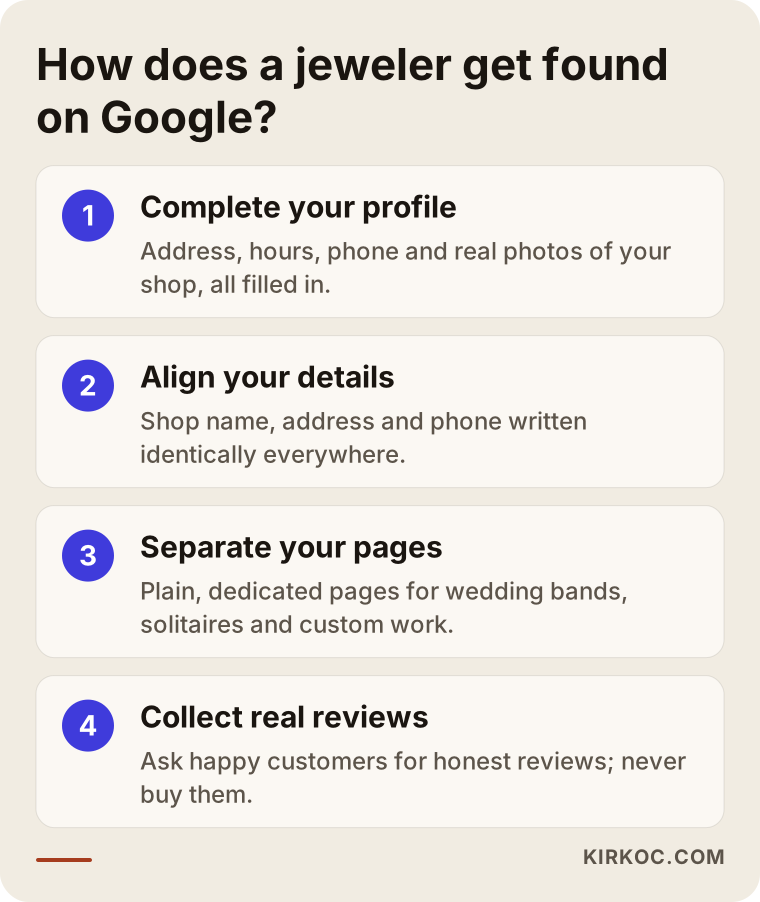
The work is simple but takes patience:
- Complete your business profile. Address, opening hours, phone, category and real photos. Keep holiday hours current.
- Write your details identically everywhere. Shop name, address and phone should match on your site, on the map and in directories.
- Encourage real reviews. Ask happy customers politely. Buying or inventing reviews is unethical and destroys trust when it comes out.
- Write a neighborhood page. Where you are, where to park, which entrance to use. Details like these bring people to your door.
Local visibility is a topic of its own. The point here: showing up on the map with correct information often brings customers faster than climbing in regular search results.
How do you build trust on product pages?
Someone choosing an expensive, emotional item like a wedding band on a screen wants to trust you. If they don't, they move to the next shop. A product page should include:
- Karat, stone and weight details: the gold purity, the type of stone and, if possible, a weight range, short and clear.
- Certificate information: if you truly hold a lab certificate for a stone, name it and say which lab issued it. Implying a certificate you don't have is misleading and invites trouble. For what you may show and how, check with your trade association or the rules that apply to you; I don't give legal rulings.
- Real photos: your own pictures, not catalog images. Close-ups and on-hand shots.
- Care and return terms: how can the ring size be changed, can a custom order be returned? Put it in writing in advance.
- Prices: because metal prices move often, many jewelers don't list fixed prices. "Call or visit the shop for pricing" is a legitimate approach as long as visitors know the next step.
These details don't just persuade customers; they also tell Google clearly what the page is about.
Online sales and showroom: finding the balance
Not every jeweler needs to sell online. Ask yourself first: would my customer buy this ring without seeing it on their finger?
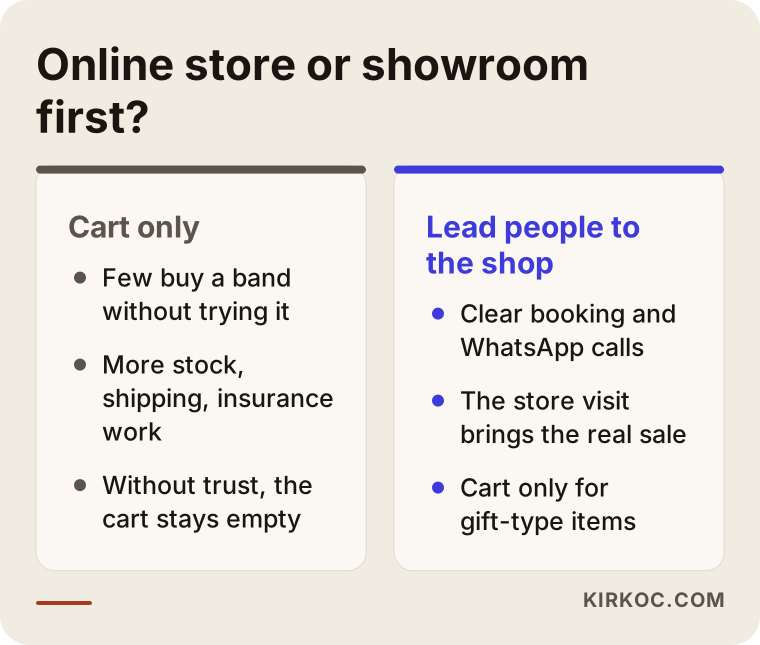
For wedding bands, solitaires and custom work, customers mostly want to try pieces on and talk to the maker. Then the goal of your site is not a sale but an appointment or visit: "Try it in store," "Book a time," "We'll send models on WhatsApp." For gifts, silver or standard items, a shopping cart may make sense. Decide based on your own customers' behavior, not on what other industries do. Work out stock, shipping, insurance and returns before you think about SEO.
A separate page for custom work
Customers who want custom design hesitate because they don't know the process. Explain the steps plainly on their own page: first conversation, sketch, approval, production time and delivery. Add a few real examples of past work with the customer's permission. You can also write short pages for related requests such as reworking old jewelry, replacing a stone or resizing. People search exactly for these, and you answer the search directly. Pages like these are the most realistic way to stand out in less competitive searches.
A neighborhood jeweler came to me with this problem
A jeweler who had worked in the same part of town for years, selling wedding bands to couples from the area, told me: "The shop is busy, but my phone rarely rings and younger people can't find me." First I searched the way a customer would. I typed the neighborhood and "wedding bands" into my phone, and the map showed other shops first. His appeared much further down.
I started with the business profile. The category was missing, the hours were outdated and the photos were years old. The phone number on his website also differed from the one on the map.
We cleaned that up first. The profile was filled in from scratch, the storefront and the bench area were photographed again, and every listing was made to match. Then we wrote one plain page for wedding bands: which karats he works with, how ring sizes are taken, and how to book a time to try rings on.
The results were modest and came gradually. Calls and direction requests from the map picked up first; the website changes felt slower. I can't promise a repeat of that, because this kind of recovery depends on competition and on how the profile looked at the start. But his real problem was not a lack of advertising. It was incomplete, inconsistent information.
A custom workshop asked me something different
The second example is a different kind of business: a small workshop that mostly takes custom orders and gets almost no window traffic. The owner asked, "My customers come by referral. What would Google add?" My answer: people who are referred still look you up before they visit, and what they find decides whether they come.
When I opened the workshop's site, every job was piled onto one page. Someone who wanted an old piece remade and someone who wanted a design from scratch landed in the same place. The process wasn't explained and past work wasn't shown.
We built a page that walked through the process step by step, a short separate page for reworking old jewelry, and a few real examples photographed with each client's permission. We wrote no prices; instead we explained what shapes the price: stones, labor and time.
At this workshop the change showed up in the quality of inquiries rather than traffic. People arrived knowing the process and saying what they wanted. How much the numbers moved is something only measurement can tell; I won't invent a percentage.
How does the process work, step by step?
Whether you hire me or do this yourself, the order is roughly the same. The order matters, because writing pages on top of a shaky foundation is wasted effort.
1. Assessment
First I search for you as a customer would: on the map, on a phone, with different wording. I look at your profile, your site and your listings elsewhere. I change nothing yet; I only write down what's missing.
2. Fixing the profile and the details
This is usually where the fastest difference appears. Category, hours, photos, phone, address and description are corrected, and the spelling of the shop name is made identical everywhere.
3. Page plan
Together we decide which searches you want to answer: wedding bands, solitaires, custom design, repairs and restyling. Each gets its own page. Instead of writing a collection page nobody searches for, we answer the questions people actually ask.
4. Content and trust elements
Pages are written in plain language. Karat, stone, workmanship, delivery time, care and return terms are stated openly. Nothing is claimed that you can't document.
5. Follow-up
The effect of changes starts to show within weeks but takes longer to settle. We watch which searches you appear in, how many people call and how many ask for directions. A page that isn't working gets fixed, not quietly abandoned.
A checklist for jewelers
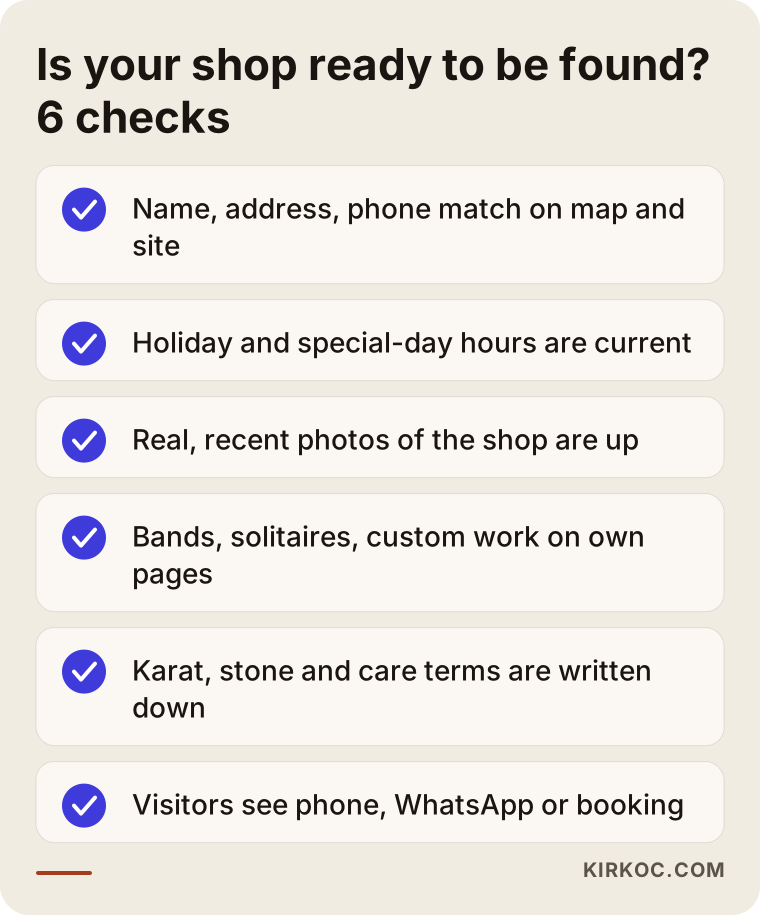
This list lets you see where your shop stands even before you talk to an expert. If you can answer "yes" to every item, the groundwork is done.
Profile and map
- Are your shop name, address and phone identical on the map and on your site?
- Are holiday and special-day hours current?
- Are your photos real, recent and showing the inside of the shop?
- Have you replied to reviews from the last few months?
Website
- Do you have separate pages for wedding bands, solitaires and custom work?
- Do the pages state karat, stone and care terms?
- Do pages open quickly on a phone, with readable photos?
- Does the visitor see the next step (phone, WhatsApp, appointment)?
Answering "no" to a few of these is normal. Most shops are missing exactly these things, and fixing them is far cheaper and faster than building a new site.
How do you read your competitors?
Competitor analysis doesn't need complicated tools. Stand a little way from your shop with your phone and run a few searches: "wedding bands", "solitaire engagement ring", "neighborhood + jeweler". Look at the first three shops that appear.
What you look at matters. Are their photos real, their reviews steady, their hours current? Is there a dedicated page for wedding bands? The answers show where the gap actually is.
Don't race a big chain
Aiming for the same position as a national brand on a word like "wedding bands" is unrealistic for most small shops. Your advantage is proximity: the neighborhood, the workshop, and the chance to talk face to face with the person who makes the ring. Put that forward on your pages.
Use the advantage of being established
If you've been in the same place for years, that signals trust. Write the story of the shop, the maker's experience and your specialties briefly but concretely. Instead of empty lines like "years of trusted service," describe the work, such as redesigning inherited jewelry.
How do you measure the result?
For a jeweler, the right measure isn't visits but phone calls and appointments. Calls from the map, direction requests, WhatsApp messages and booking requests are signs of people ready to walk in.
Your business profile statistics often show how many people called and asked for directions. Asking new customers in the shop "How did you find us?" is a simple method that works too.
Results don't change overnight. Don't weigh a profile fix that hasn't settled in a month against a page that settles slowly over several months. If you decide up front what you'll look at, you'll make calmer, better decisions, whether you work with me or on your own.
The yearly rhythm: what to prepare and when
Demand for jewelry is uneven, not steady. Knowing that lets you spread your content and profile work across the right moments. I won't give exact dates, because they vary by region, but the logic is this.
Before weddings and engagements
People shopping for bands and solitaires start deciding months ahead. They look at pages, compare, then visit. What helps most in this period is a band page that clearly states sizing, karat, delivery time and how to book a fitting.
Before holidays and Valentine's Day
Gift buyers decide quickly. A plain "gift ideas" page, current hours on the profile and a clear WhatsApp number that answers stock questions are enough. Don't leave preparation to the final week, since page and profile changes show their effect late.
The quiet months
The off-season is the most valuable time. Use it to simplify pages, refresh photos, expand your FAQs and add pages on less competitive topics such as restyling old jewelry.
Certificates and wording: be careful what you write
With stones and gold, every sentence reads like a commitment. Check your wording twice.
- Avoid claims you can't prove, such as "cheapest," "only authorized dealer" or "flawlessly authentic."
- If a stone has a certificate, say which institution issued it; if it doesn't, say nothing about one.
- Separate natural stones from lab-grown ones and name each for what it is.
- Put return and exchange terms on the page in short, readable form.
Check with your trade association or the rules that apply where you operate to see which statements are permitted. I don't give legal rulings, but in my work I often see that writing clearly and honestly wins both the customer and Google.
Common mistakes
- Copying the same product description onto hundreds of pages.
- Photos so heavy that pages load slowly on mobile.
- Piling the whole collection onto one page.
- Leaving opening hours outdated on the map.
- Typing in changing information such as gold prices by hand and forgetting it.
- Buying reviews.
Why do these mistakes cost so much?
Copied descriptions tell Google the pages say the same thing, so none of them stands out. Heavy photos make pages slow on a phone, and someone shopping for a valuable piece leaves instead of waiting. A wrong time on the map simply means a customer turned away at the door.
Buying reviews is riskier still. Platforms can detect fake reviews; when it comes out, the reviews can be removed and trust is lost. In jewelry, trust is the sale itself, so it isn't worth risking.
Another mistake is typing in a gold price by hand and never updating it. An old price on a page reads like a false promise. Either leave the price off or update it automatically.
Piling the whole collection onto one page is also common. If someone looking at bands sees solitaires and silver necklaces, they can't find what they came for, and Google can't pick the page's real topic. Give each product group its own page and connect them with short, meaningful links.
Finally, most sites don't say who the shop really is and settle for a generic company paragraph. Under "About," put the maker's name, what the shop specializes in and where the workshop is. People trust a person, not an anonymous site.
What you can do yourself, and what to leave to an expert
You don't need an expert for everything. Here's an honest split.
What you can do yourself
- Fill in the business profile and keep the hours current.
- Photograph the shop, the window and the workshop for real.
- Ask happy customers for reviews, and thank and reply to them.
- Note the questions customers ask most. They are the raw material for your pages.
- Check that your name, address and phone match everywhere.
What to leave to an expert
- The page plan and competitor analysis that decide which searches to invest in.
- The technical side of the site: speed, mobile fit, and the same content showing up at several addresses.
- Content structure if you have several branches or a large catalog.
- Measuring results and sorting out what actually worked.
If you do what you can yourself, you only buy the work you truly need from an expert. Telling you where that line is, honestly, is part of my job.
Frequently asked questions
When do you see results from jewelry store SEO?
I can't guarantee anything. It depends on competition, the state of your site and your existing profile. Map and profile fixes usually make a difference before site content does. Be cautious about anyone promising quick results.
Ads or SEO?
They do different jobs. Ads stop when the budget ends; SEO builds up over time. Ads can help during peak season, but without a solid foundation they work inefficiently.
My shop is small. Do I still need this?
Small shops are especially strong in local search. A correct profile, real photos and clear information often matter more than a big budget.
What if I don't have certificates?
Don't show documents you don't have. Focus on accurate, provable information such as karat, craftsmanship and after-sales service.
Which pages must a jeweler have on Google?
At least four things: a home page, separate pages for your product groups (wedding bands, solitaires, custom work), a contact and directions page, and an FAQ. If your collection is large, break each group out under its own heading, but don't open pages for fine distinctions nobody searches for.
Are reviews necessary to rank on the map?
I wouldn't call them necessary, but they help. Reviews show Google and the person reading them that the shop is real and active. Steady, answered reviews build more trust than a big pile of them.
How should I photograph products?
In natural light, on a plain surface, both close up and on a hand. Reflections are a problem on a bright stone, so light it from the side if you can. A few carefully shot photos do more than many mediocre ones you redo every year.
What should I prepare before a holiday or anniversary season?
Update your hours, stock status and booking system before the rush. A simple gift page and a few seasonal photos on your profile are enough. Changes made in the final week show their effect late, so start months ahead.
What do I write if customers ask about prices?
If the page has no fixed price, don't hide that; say why: "Because raw material prices change often, we give the current price by phone or in the shop." Then the visitor understands why there's no price and knows the next step.
Is one site enough for both shop and workshop?
Usually yes. One site divided into sensible sections beats two separate ones. The only conditions are that the pages for the two businesses are clearly separate and that the contact details match.
Where to start
First we look at how you appear on your site and on the map, and which searches you're missing from. Then I prioritize the pages and profile that will bring people into your shop. I work alone; I build a plain roadmap that fits your situation. If you'd like to talk about where to begin, you can reach me through my SEO services page.