You sell to customers abroad, or you want to. Your website has been translated into English, maybe German or French too, yet buyers from those countries still barely show up. The problem is rarely the quality of the translation. More often, the words a buyer in that country types into Google never meet the words on your page. This article explains what to expect from international SEO, where money is well spent and where it is not. I offer this as a one-person SEO service, so I want to give you an honest frame before you decide anything.
Buyers abroad do not search the way you do
A product name in your catalog may be a word nobody uses in the target market. And buyers often do not type a product at all. They type the problem they want solved: "find a reliable supplier", "compare manufacturers", "certified producer near me".
So I start with research, not translation. What do people in that country call your product? Which questions do they ask? Which qualifiers matter to them? I work this out together with a native speaker, looking at real search results. The outcome is usually surprising: some terms you were sure about are searched far less than you thought, and a few unexpected phrases carry the real demand.
Translation versus localization
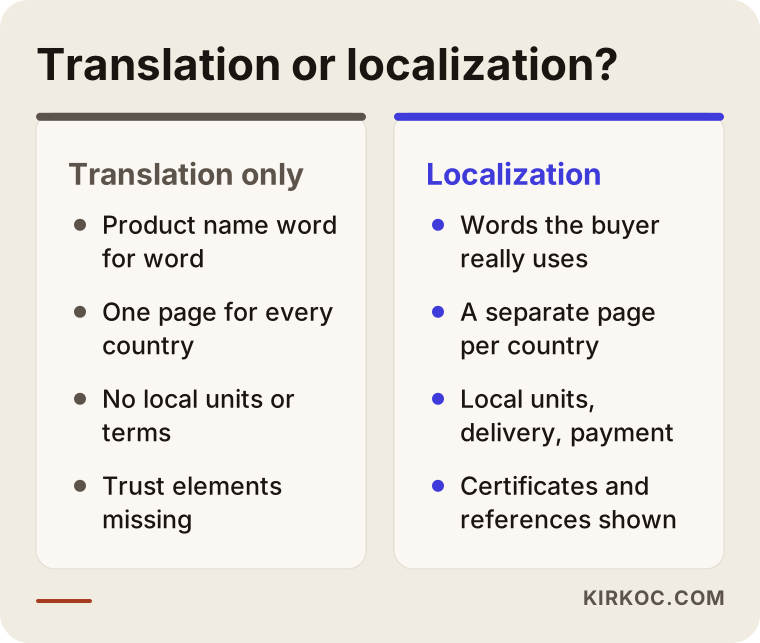
Translation swaps words. Localization rebuilds the page for the buyer in that country: units of measure, delivery and payment expectations, certifications, tone of address, even the first objection that buyer is likely to raise.
The technical side (language settings, making sure the right page appears in the right country) is a separate topic. If you are curious, Is your multilingual site showing the right language? covers it. Here I focus on the business decisions.
Same product, different buyer: companies versus consumers
Is the buyer abroad a company or a single person? The answer changes the language, the length and the promise of the page from the start.
If you sell to companies
A business buyer is rarely in a hurry. They compare several suppliers, look at technical detail, certificates and minimum order terms, and then decide inside a team. So your page should show the process as well as the product: how to ask for a sample, how fast a quote arrives, how delivery works.
If you sell to consumers
A consumer decides faster and looks harder for reassurance: returns, delivery time, payment method, reviews. Building a page without knowing the habits of that country mostly raises the number of abandoned carts.
If you do both
Do not speak to both audiences on one page. Build separate pages, separate search terms and separate contact paths for business and consumer buyers. Otherwise both read a text that was not written for them.
Why each country needs its own pages
One English page for the whole world looks efficient but is a weak approach. A buyer in the UK and a buyer in Germany or India do not arrive with the same need, and they do not raise the same doubts.
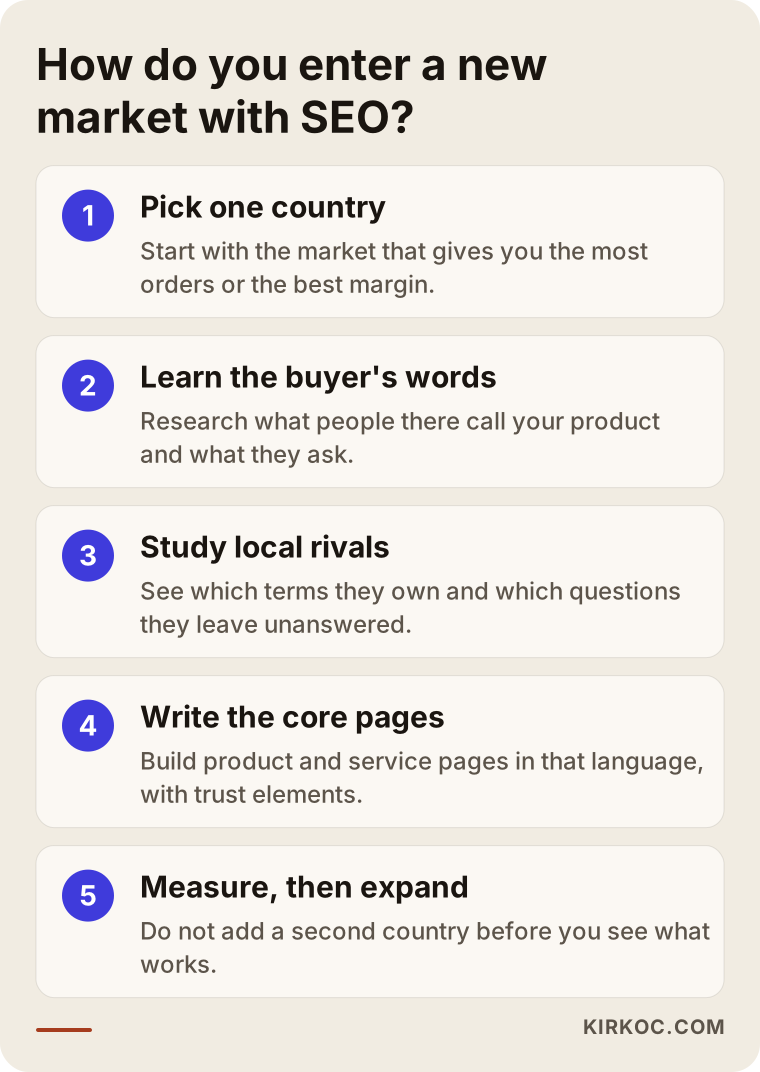
This is the order I usually suggest:
- Pick the one or two markets where you expect the most sales, not all of them at once.
- Build separate pages for each, in that country's language, answering that country's questions.
- Write the main product or service pages first, and add blog content later.
- Results come slowly, so see what works in the first market before adding more.
Every new country is effectively a small new website. Spending your budget deeply on a few markets is usually healthier than spreading it thinly across many.
How to decide which country comes first
The answer to "where can I sell?" is usually data you already have, not a guess. I start with your order history, your incoming emails and your sales team's notes.
The signals you already hold
Which country sends the most quote requests? Where do orders actually close, and where does silence follow the quote? Who showed the most interest at trade fairs or on platforms? These answers give you a ranking before any research.
The view from outside
Once I have those signals I look at the market side: is there demand for your product there, how crowded is the competition, and what logistics or regulatory hurdles come with selling into that country? A market can have high demand, but if local producers are very strong there, another country may be the smarter choice for the first year.
Language and country are not the same thing
A German page does not speak to Germany, Austria and Switzerland in the same way. The same goes for Spanish, French and Arabic. Decide which country you want to sell to before you pick a language, then fit the language to how that country actually writes.
Trust signals: the buyer has never heard of you
A buyer abroad does not know your name. A brand that is a reference at home means nothing there. These are the things people check first:
- A real address, phone number and company details
- Certifications and standards that are recognized in that country
- References from that country or industry, where you have permission
- Clear delivery, payment and warranty terms
- Photos of the real facility, real product and real team
These can help rankings indirectly, because a visitor who stays and contacts you is a strong signal. But the real goal is not ranking. It is the moment the buyer thinks, "I could work with this company."
Google is not the first stop everywhere
In most markets Google dominates, but there are exceptions. In some countries local search engines (such as Yandex in Russia or Baidu in China), marketplaces or social platforms are the buyer's first stop.
So after choosing the target country, you need to confirm where buyers there actually search. I do not assume this; I check by country and industry, and if needed I will tell you plainly that another channel makes more sense than investing in Google alone.
What you hold at the end of the research
When the keyword and competitor research is finished, you should have a plan that helps you decide, not just a long list of words. The plan I prepare usually has three parts.
A page map
Which page gets written for which product or service, in what order it goes live, and which search each page answers. The map also shows you where the budget goes.
Headlines and questions in the buyer's language
The phrases that go into page titles, subheadings and FAQs, the ones people in that country really type. A native speaker checks them; otherwise technically correct words that nobody uses end up on the page.
A priority order
Which pages come first and which later. Some pages target searches with little enough competition to give quick signals; others are long-term investments. You need to balance the two on purpose.
You cannot build a strategy without looking at local competitors
Local producers and importers have been writing their pages for years. You may not see yourself at the top of the results right away, and that is normal. What matters is knowing where you can compete.
In competitor analysis I look at which terms they are strong on, which questions they never answer, and where a niche or product variation is left open. Often the best opportunity is not the crowded term but a more specific search that local competitors ignore, such as a particular use, certification or order size instead of a generic product name.
What a product page for a target country should tell the buyer
A visitor from abroad usually gives your page a few seconds. In that time they should feel: this is the right place, this company is credible and it covers my need.
The top of the page should state clearly what the product is, who it is for and which countries you deliver to. Right below it belong the three things buyers ask most: technical specifications, certificates and order terms. Longer explanations can sit further down for those who want them.
Set up the contact path to local habits as well. In some countries buyers prefer a form, in others they expect a phone number or a company email. Information about availability in that time zone also builds trust.
Two concrete scenarios
The following are condensed examples to show a real workflow. I leave out names and figures on purpose.
A factory making machine parts
A manufacturer of machine parts came to me with a site that had been translated into English but almost never received quote requests from abroad. The product names had been translated straight from the catalog. The first thing I checked was what engineers and purchasing staff in the target country actually typed when they looked for this part. The catalog name and the searched name were different.
We picked one country and the best-selling product group first. The product pages were rebuilt in that country's language, with certificate information and the minimum order condition next to the technical dimensions. Delivery and the sample process were written out clearly. Within a few months people started filling in the quote form. Not all of it became sales, but the quality of the requests changed noticeably. I cannot guarantee results, but in this case what worked was less the translation than the page answering the buyer's question.
A small producer of olive oil and food products
In the second example a food producer wanted to sell wholesale and to individual customers online. They described both on the same page, and both suffered. We built a separate page for the wholesale buyer: origin, certificates, packaging options, storage conditions, minimum quantity. For retail we wrote a different page: taste, use, returns and shipping.
The competitor analysis showed that local brands were very strong on the general "buy olive oil" searches, but few pages answered questions about a specific use or origin. So we aimed at those narrower searches instead of the most crowded term. Again, no guarantee; yet this example shows well why a small company should not compete with big brands on the same word.
What I do in the first months
The first step is choosing one country and one product group. Then I map the search language and competitors of that market, and show you what on your current site is ready for it and what is not. After that, the priority pages get written and published, and I watch what happens: which searches bring visitors, who fills in the form, who leaves right away. In the early months the goal is not big traffic. It is the right people finding you, and learning whether the page convinces them. Feedback from your sales team matters a lot here: the question buyers keep asking decides the topic of the next page.
Reading the results month by month
SEO in a foreign language takes patience, but patience does not mean waiting blindly. Each period has different things to check.
The first two months: preparation and launch
I do not expect traffic here. What matters: are the pages live, can search engines see them, do the language and country settings work? Measurement at this stage answers "has the work been done?"
Months three and four: the first signals
Now we can look at which searches the pages show up for. If impressions rise but nobody clicks, I rewrite the title and description. If people click but nobody gets in touch, the problem is the content of the page: a trust element or a clear next step may be missing.
After the fifth month: time to decide
This is where you decide whether to continue in that country, move to a second one, or add new pages in the same market. I make this decision by looking at which page produces contact, not by gut feeling. The feedback from your sales team, "were these people really buyers?", is the most important input.
How your sales team and SEO work together
The most valuable input for international SEO is your sales team's real conversations. Which objection does the buyer bring, which product do they mix up, which question do they ask for the third time? Those are the titles of your next pages.
I ask for this as a regular short note; long meetings are not needed. A brief monthly call is usually enough. In return I tell you which searches bring which kind of request, so your sales team walks into the conversation better prepared.
Once this loop exists, SEO stops being a marketing activity and becomes part of the sales process. In my experience the healthiest results come from there.
What you can do yourself and what to leave to an expert
You do not have to hand everything over. Doing part of the work yourself protects the budget and helps you understand the process better.
What you can do yourself
- Note which countries your current customers come from and what they ask most often.
- Collect your certificates, facility photos and references (once you have permission).
- Put delivery, payment and warranty terms in writing.
- List the objections your sales team keeps hearing.
- Look at competitor sites in the target country through a buyer's eyes and write down your first impression.
What to leave to an expert
- Search language and keyword research, which needs the right tools and experience.
- Setting up country and language targeting correctly; a wrong setup can make pages appear in the wrong country.
- Competitor analysis and finding the open gaps.
- Reading the results and deciding the next step.
- Final review of the copy by a native speaker.
To be honest, writing the first list makes the work much easier. If this information is ready when you come to me, the first months get both shorter and more productive.
Common mistakes
Most companies that invest in international SEO stumble in similar places. Knowing them in advance saves money and time.
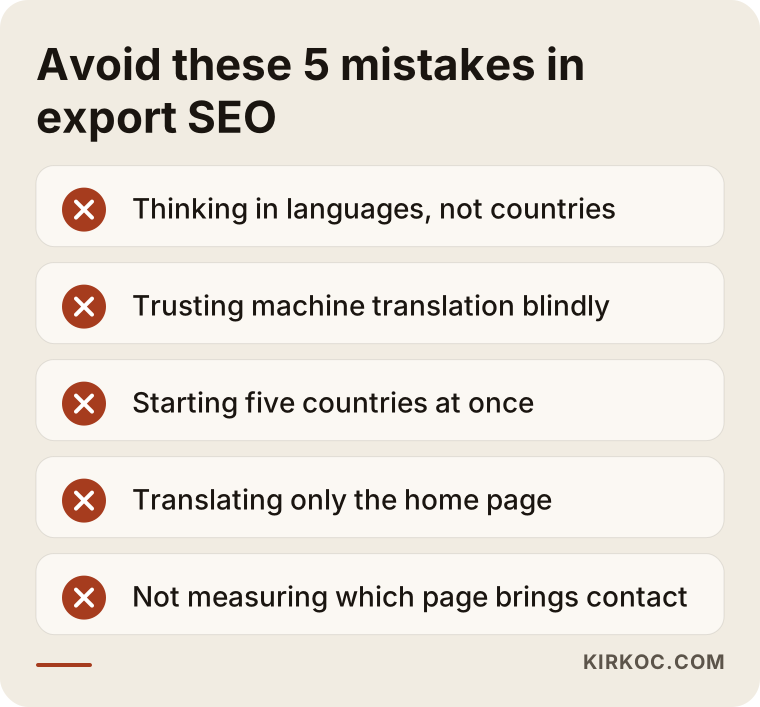
Thinking in languages instead of countries
"We did German" can mean putting Germany, Austria and Switzerland in the same box. Prices, payment, delivery and vocabulary change from country to country.
Trusting machine translation
Machine translation is quite good today, but it can still slip on industry terms. A single misused technical word lowers the credibility of the company in a serious buyer's eyes.
Starting everything at once
Five countries, three languages, dozens of pages: the budget runs out and no market gets enough depth. Building one model that works first and then repeating it is healthier.
Translating only the home page
Buyers rarely arrive on the home page; they land directly on a product or service page. If that page is not in the local language, the translated home page helps nobody.
Not measuring
A company that does not know which page produces contact repeats the same mistake in year two. Even simple tracking shows you where to invest.
Questions to ask when choosing a consultant or service
If you buy this work from outside, look for answers to these questions when you assess a proposal:
- Who will write or check the copy in that language?
- Which pages will be made for which country? Is the list clear?
- Will local competitors in the target country be studied, or will you just get a generic keyword list?
- Who is responsible for the technical settings (country and language targeting)?
- How will results be reported, and when is the decision meeting?
- Was a guarantee given? If so, think about why that should make you cautious.
A good proposal answers most of these in writing. If the answers are vague, so is the scope of the work.
What should you budget?
The factors that set the price are clear: how many countries and languages, how many pages, who writes the content in that language (it needs to be a native speaker), the competition in your sector, and the current state of your site. A small start in one country and a five-country program are very different things. Telling someone to "do everything" before the scope is clear is the most expensive route.
I will be honest: results cannot be guaranteed. Based on the competition in the target country and your capacity, I can tell you realistically how far you could get, but I cannot promise a position by a given month. Anyone who does is not telling you the truth.
Frequently asked questions
Isn't translating the site enough?
Usually not. Translation makes a page readable in that language, not findable in it. Search terms, trust elements and page structure have to be thought through for that country.
Which country should I start with?
The market where you already get the most orders, or sell at the best margin. Starting from where your current customers come from beats starting from a guess.
Who should write the texts?
A native speaker who knows your industry. I set the strategy, the search terms and the page structure, and we finalize the copy together with someone who speaks that language natively.
How long until I see results?
That depends on competition, the country and the state of your site, so I cannot give an exact time. The first signals usually appear within a few months, but real inquiries and sales take longer.
Doesn't an English page work in every country?
In some markets English is enough, especially for business buyers. But in many countries buyers search in their own language and trust a page in that language more. Research shows which language is needed where.
Why do I need my own site when marketplaces and platforms exist?
Platforms are useful, but the customer relationship belongs to the platform. Your own site keeps your brand, contact details and buyer data with you. The two do not exclude each other.
Do I have to write blog posts?
Not at the start. Product and service pages come first. A blog is added later to answer buyers' questions, but without solid pages a blog alone will not bring sales.
Can you help with customs and certification questions too?
No. For customs, certification and tax, turn to your qualified adviser or the responsible authority. I work only on the search visibility side.
Before you decide
International SEO is not an add-on to translation. It is a small sales channel designed separately for each country. If you would like to talk about which market makes sense first, you can reach me through my SEO services page.