You make something genuinely good: olive oil from your family's groves, wildflower honey, aged village cheese, molasses, sun-dried tomatoes, maybe a homemade pepper paste. The taste speaks for itself, and people who try it come back. Yet even though your website or online shop is set up properly, people searching for "organic honey" or "cold pressed olive oil" do not find you. They see the same big marketplaces and familiar brands every time. This article is for producers and small online shops in exactly that position. I explain what SEO means for regional and organic food sellers, what is special about selling food, and where to start, in plain language. I am Ümit Kırkoç, a web designer and SEO consultant who works alone from Istanbul, and further down I describe the limits of my own SEO services openly.
If your products come from Turkey and you want to reach buyers in English-speaking countries, such as the US, the UK, Canada or Australia, everything below applies to you too. In fact, it matters even more, because a buyer who has never visited your region needs extra reassurance before paying for a jar of something they cannot taste first.
SEO, in short, is the work that makes your site show up when your customers search on Google and other search engines. The difference from advertising is simple: with ads you are visible only while you pay, and the moment you stop, you disappear. SEO, when it is set up well, can bring steady visitors for months or even years. But selling food has its own rules, because people need far more reassurance before buying something they will eat than before buying almost anything else.
Why do people search differently for food?
When you buy a T-shirt, a photo is often enough. When you buy a jar of honey or a tin of olive oil, you ask yourself a different set of questions. Is this really from that region? Is anything added? Could it be fake or cut with sugar syrup? Who made it? Will it spoil in shipping? These questions sit in the middle of the buying decision, and they show up in how people search.
From what I have seen, food searches fall roughly into four groups. The first group types the product and its origin together: "Aegean olive oil," "Turkish pine honey," "aged mountain cheese." These people know what they want. They have already chosen a region and are just looking for a seller they can trust. The second group types general product searches: "organic honey," "cold pressed olive oil." The competition here is much more crowded, because big marketplaces and brands have been targeting these words for years. The third group asks questions: "how to tell real honey," "what is extra virgin olive oil," "how to store cheese." These people are not ready to buy yet, but they trust the site that gives the right answer. The fourth group is gift and bulk buyers: "corporate gift gourmet food," "holiday gift box," "specialty food for a wedding."
The picture below shows, with a completely made-up example, which result stands out in a regional product search.
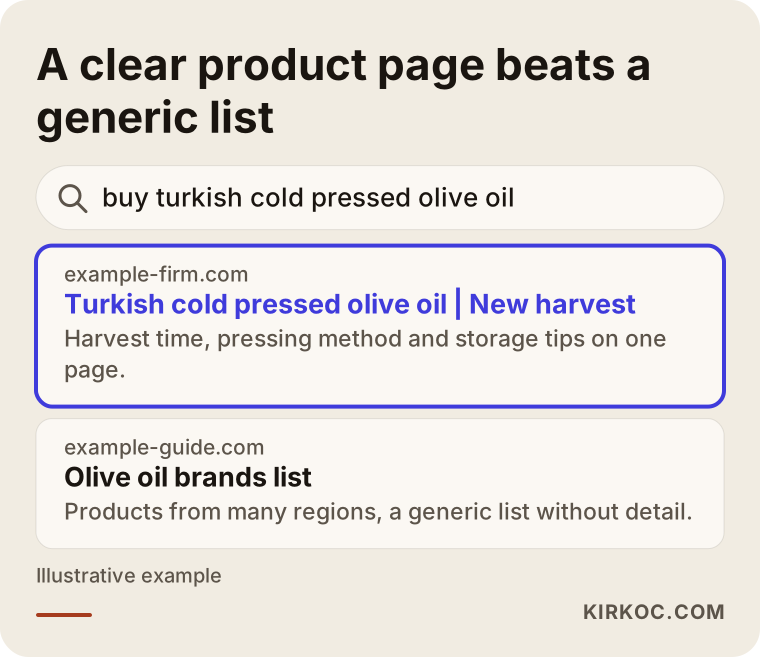
What makes the highlighted result different is that it says the region, the maker and what the product is, right in the title and the description. The page next to it is a generic list that gives no detail about any product. Google tries to show the person searching the clearest answer. If you describe yourself clearly, you make its job easier.
What should you do instead of fighting the marketplaces?
For many producers the biggest fear is having to compete "on the same word" with Amazon, Walmart, Etsy or the large brand sites. Let me be direct: on the broad, general words, do not go head to head with them. Instead, write about the things those giants will not write about. They will never describe your village, your trees, your harvest week, or the meadow where your hives stand. You will. That is the real advantage a small producer has in search results: your story is true, and nobody else can copy it.
If you sell on a marketplace today, you do not have to give it up. A marketplace brings ready-made traffic. Your own site lets you get to know your customers, win repeat orders and sell without paying a commission. The two do not have to be alternatives. But having your own site show up in search engines frees you, over the long term, from depending on a single platform.
Which pages does a food site need?
On most regional food sites, the problem is not a small number of products. It is a small number of thin pages. The category page has every product jammed together, and each product has two lines of description under it. Neither Google nor the customer can learn anything from that. The table below summarizes the page types you need, together with the intent behind each kind of search.
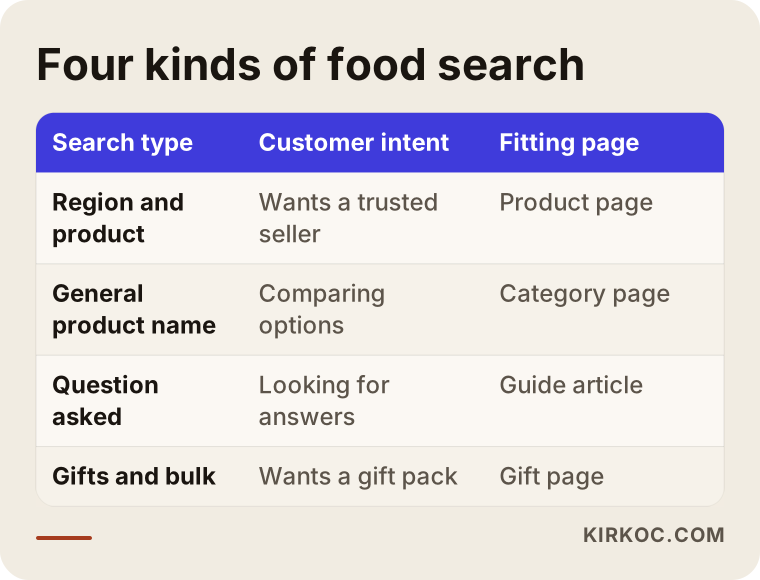
As the table shows, every kind of search has its own page. The product page is for selling, the region page is for trust, the guide article is for people with questions, and the gift page is for bulk buyers. Trying to cram all of them onto a single page leaves all of them weak.
The product page: this is where the decision is made
Sooner or later the customer lands on a product page and either adds to the cart or leaves. For food, this page has to be very solid. A good product page includes the product name and its origin, the package size, the ingredients (is it made from one thing only, or is something added), the harvest or production time, how to store it, how to use or eat it, shipping and packaging details, and a short introduction of the producer. It also needs a real photo. A stock image is spotted immediately in food and lowers trust.
Above all, do not copy the same text under several products. If you have olive oil in three bottle sizes, it is often better to present them as options on a single page than to write three separate pages. Otherwise Google sees three pages and cannot decide which one to show, and your pages end up competing with each other.
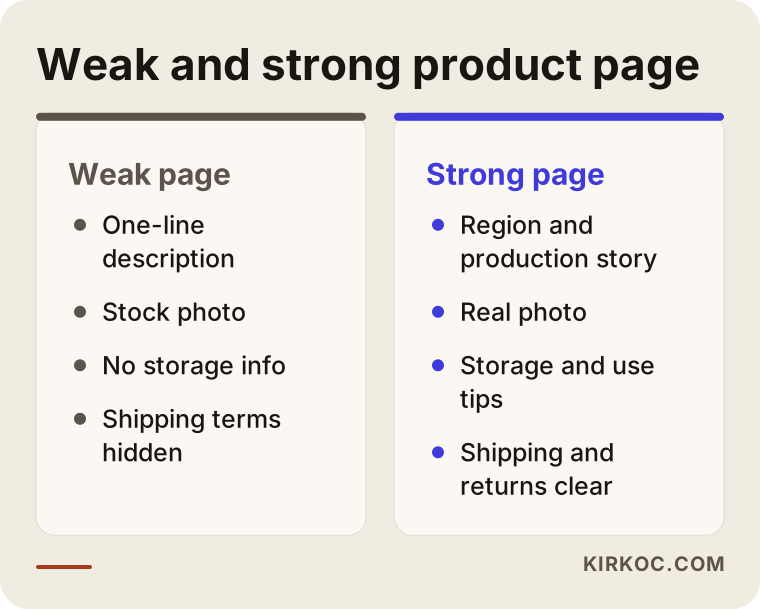
The comparison above puts two situations I see often side by side. The page on the left brushes the product off with one line and one photo. The page on the right answers the questions already in the customer's head, one by one. Writing a lot is not the goal. Leaving no customer question unanswered is.
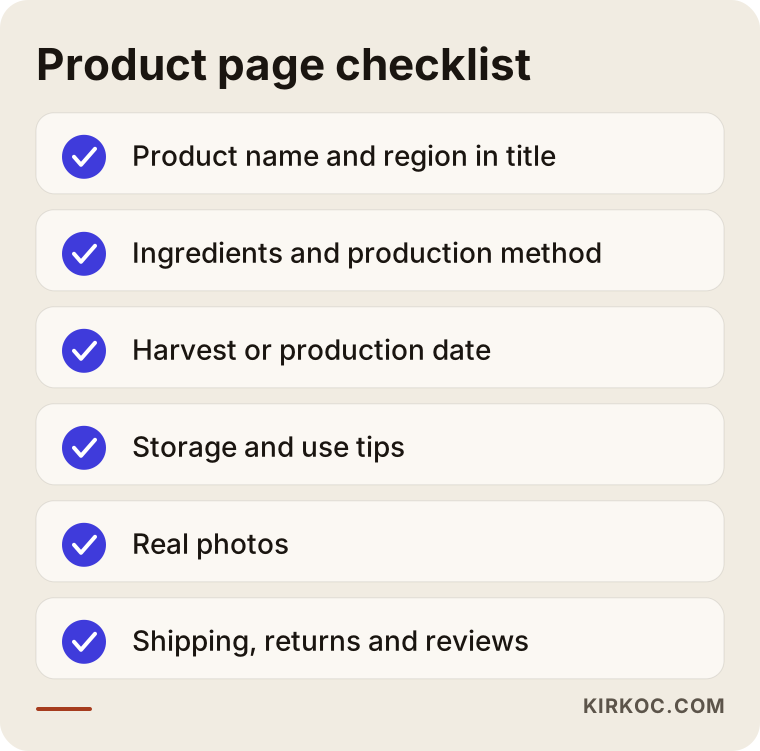
You can hold the list up against your own product pages. The missing items are usually things you did not think to write because you know them so well. What you call "obvious to everyone" is completely unknown to someone who finds you online for the first time.
Trust signals: the most critical topic in food
When you sell food, SEO and trust are woven together. Search engines try to judge how trustworthy a page is, but what really matters is whether the customer trusts you. The concrete things that build trust are these: a real address and phone number, a page where the producer introduces themselves, real photos from the orchard or the dairy, customer reviews, clearly written shipping and return terms, and, if you have them, lab analysis or certification details.
One point needs care here. The word "organic" is not an ordinary adjective. To sell a product as organic, you may need a certificate from an authorized body, and the rules differ from country to country. If you have no certificate, you also need to be careful about when and how you may use words like "natural," "farm-made" or "additive-free." Rules on food labeling, health claims and the organic label are detailed and can change over time. For that reason, I recommend asking a lawyer or the relevant authority about any claim you put on a product page or label. I do not give legal opinions, and I do not try to. What I can say is this: inflating a claim may bring clicks in the short term, but over the long term it puts both your customers' trust and your business at risk. Stay away from medical promises such as "heals" or "cures."
If you do have a certificate, show it on the page and explain in one sentence what it means. If you do not, be honest: describe in plain words how you make the product, what you do not add and where it is made. An honest, detailed description often earns more trust than a polished claim.
If you ship across borders, there is another layer. Importing food into the US, the UK or the EU comes with its own rules on labeling, paperwork and what may enter at all. I cannot advise on that, and you should check it with a customs broker or the relevant authority before you promise anything on a product page.
Reviews and photos
Reviews are among the strongest signals in food sales. When a customer writes "the honey was lovely and it arrived safely," nothing you write yourself can be as persuasive. Showing reviews on your site convinces visitors and also adds fresh, original content to the page. You can send a polite message some time after the order asking the customer to leave a review. Do not write fake reviews or have them written. It is wrong, and it damages your reputation when it comes out.
The same logic applies to photos. A real photo of your orchard, hive or dairy, even one taken with a phone, does more work than an expensive stock image, as long as the light is good and the picture is sharp. Writing the file name and the alternative text of each photo correctly (for example, "pine honey hives on a mountain meadow") helps both visually impaired visitors and search engines.
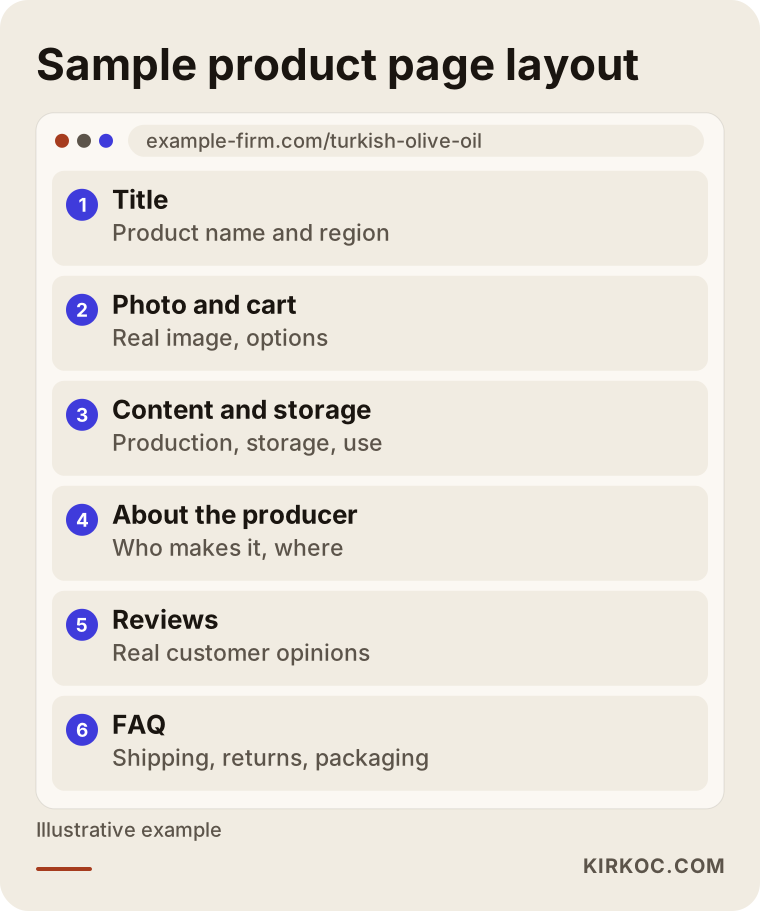
The layout in the picture is not a fixed rule. It is a skeleton that works well. The product and its region go in the title, right below it the main photo and the price and cart area, then the ingredients and storage details, then the producer introduction, reviews and frequently asked questions. Even if your site has a different design, the logic of this order can be kept.
Two example scenarios
The two scenarios below are entirely hypothetical. They are not real people or companies. I wrote them only to show the logic.
Example scenario 1: An olive oil producer
Suppose a family on the Aegean coast presses cold-pressed olive oil from their own groves and has opened a small online shop. The site has a single "olive oil" product page with two sentences under it. The family is trying to show up for "olive oil" or "organic olive oil," but those words are owned by huge brands and marketplaces.
The right approach would be to first see how customers actually search. You would probably find more specific searches such as "Turkish olive oil," "cold pressed olive oil in a tin," "olive oil with harvest date" or "new harvest olive oil." Then the product page gets rewritten: the harvest period, the pressing method, acidity information stated openly where it rests on a lab report, a storage tip and the packaging options. Two guide articles are added, such as "how to tell good olive oil" and "how to store olive oil," and they link to the product page. Over the following months the site starts to appear both for people with questions and for people ready to buy. How long this takes and how far it goes cannot be known in advance, of course. Competition, the age of the site and the region all play a part.
Example scenario 2: A shop selling products from several regions
In the second hypothetical example, a small online shop collects cheese, honey, jam and dried fruit from different regions. All the products sit in a single "Regional Products" category. The customer cannot tell what comes from where, and Google does not know what to show the site as an expert in.
The fix is to divide the site into meaningful sections: product categories such as "Cheeses," "Honeys," "Jams and molasses," plus region pages such as "Black Sea products" or "Aegean products." Each category page gets a short introduction explaining what to look for in that category. For the holiday season, a "gift boxes" page is prepared. That way the site can be found by product name, by region and by shopping purpose. In shops with many products, the main job is actually to build the structure. Writing the text is the second step.
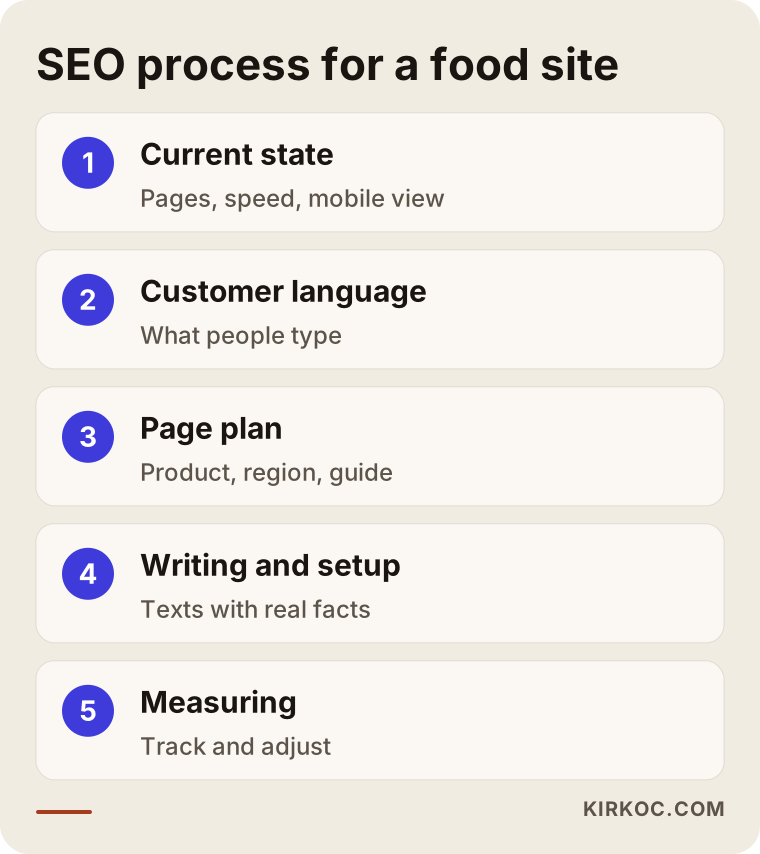
Step by step: how do I work?
I summarized the process in the picture. Now let me open up each step. This is the order I would follow on a food site.
The first step is to see where things stand. I look at which pages the site has, which ones can be found, which ones get no visits at all, and whether there is a technical problem such as slow pages or a broken look on phones. Most food shoppers browse on their phones, so the mobile view is my starting point.
The second step is to learn the customer's language. As a producer you may say "extra virgin," "early harvest" or "strained" about your product, while the customer may say "new season olive oil" or "comb honey." Using search tools and talking with you, I work out what people actually type.
The third step is the page plan. Which page will exist for which product, which guide article will answer which question, which region pages are needed. I draw up that list. I do not create pages that are not needed. Sometimes fewer pages are better.
The fourth step is writing and setting up. I write the product pages from the real information you give me, or I fix your existing texts. I never make up information I do not have. Facts such as the harvest date, the certificate and the production method come from you.
The fifth step is measuring and adjusting. I watch which page gets visits, which search brings people in, and where they get stuck, and I update the plan accordingly.
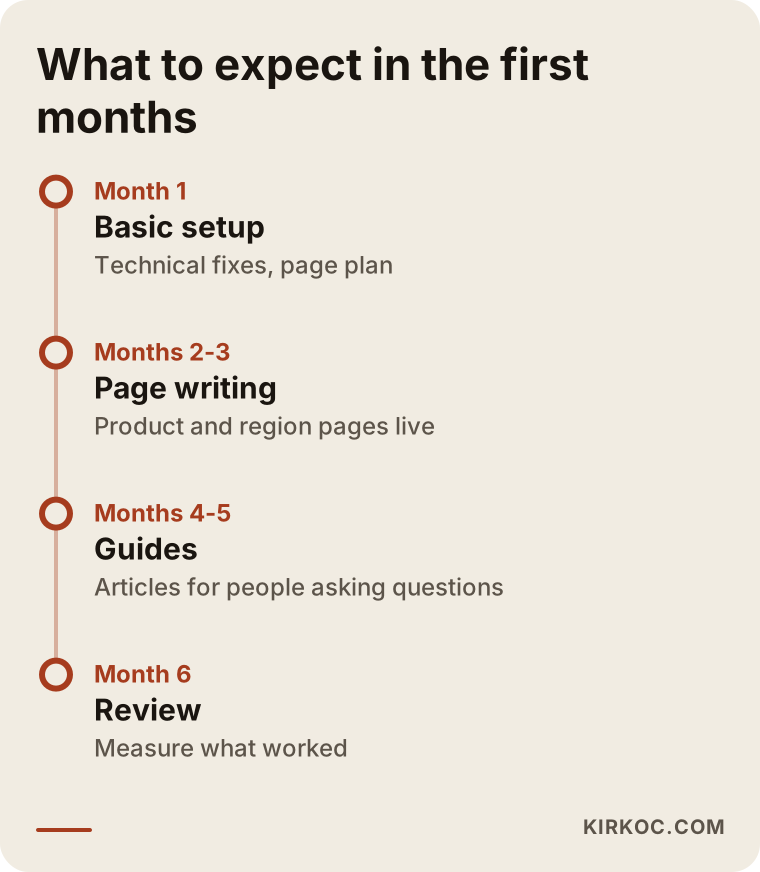
The timeline is not a promise. It is a general expectation. In SEO, results build up with patience, and nobody can guarantee a particular ranking or a particular date. Food also has seasonality, such as the olive oil season, the honey harvest and the holiday periods. So it makes sense to start the work a few months before your selling season.
AI searches and food
More and more people now put their questions to AI assistants, such as "How can I tell real honey, and where can I buy it?" These assistants look at sources on the internet when they give an answer. If your own site has real information, clear writing and a tidy structure, the chance that your page is quoted goes up. There is no guarantee. But writing clear, correct content with a known source helps in the same way in classic search and in this newer area. This is called GEO for short, which means working to be visible in AI answers as well.
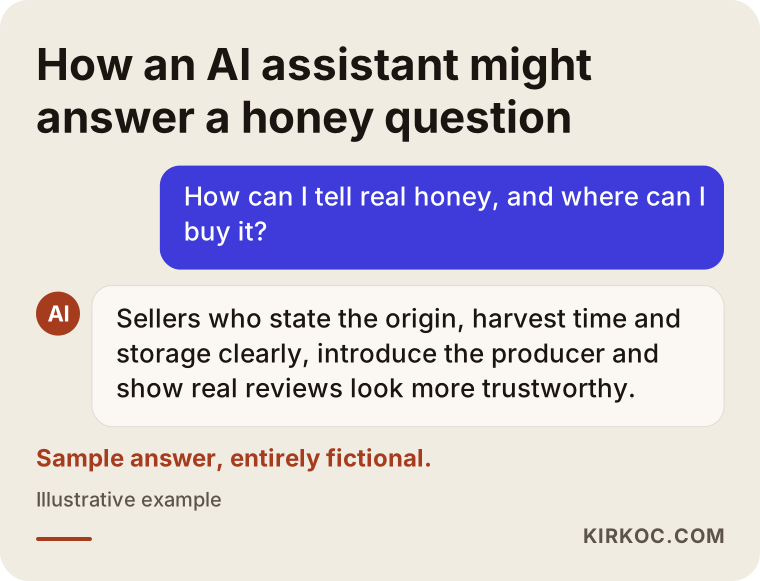
The answer in the example is invented and is there only to show the logic. What matters is that when an assistant puts its answer together, it leans on pages that are clear, well written and give storage and production details. Vague, exaggerated pages with little information rarely make it into this kind of answer.
Common mistakes
Here are the mistakes I have seen again and again on food sites. Some are technical and some are about content, but all of them can be fixed.
The first mistake is copying the same producer text onto every product. It bores the customer and makes the pages look like copies of each other. The second mistake is big claims without proof: phrases like "the purest" or "cures everything" damage trust and can also create legal risk. The third mistake is uploading product photos at a huge file size. The page gets slow, and on mobile the customer leaves before it loads. The fourth mistake is hiding the shipping and return terms or burying them far down the page. Because customers worry about spoilage, leaks and cold chain in food, this information must be visible. The fifth mistake is deleting a seasonal product page once the product is gone. If you delete the page, you also lose the value it has built up. It is better to leave it with "out of stock, back next season." The sixth mistake is focusing only on selling products and never writing any content. The seventh mistake is leaving the Google Business Profile empty. If you have a physical sales point, a workshop or a shop, you need to fill in that profile completely to appear in map searches.
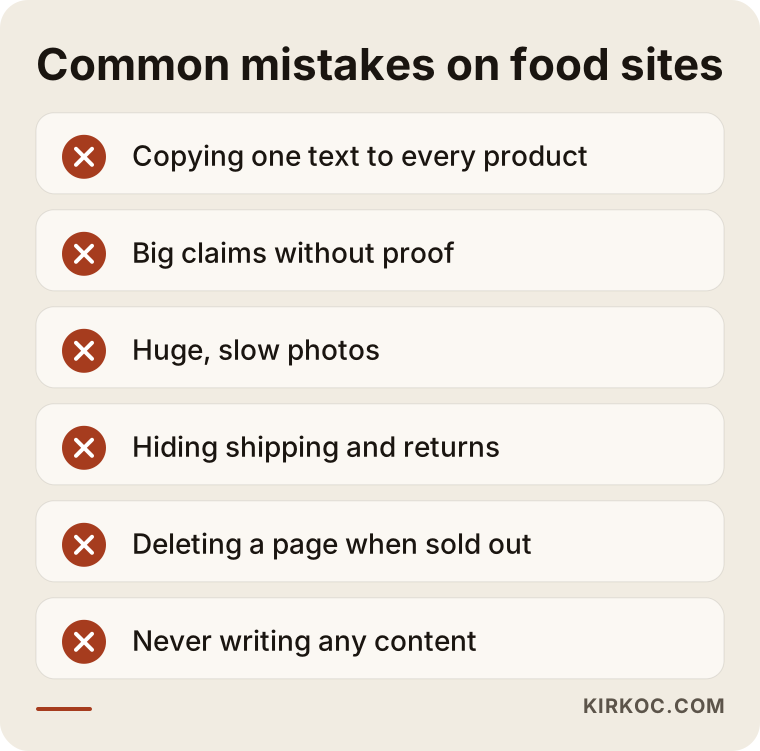
Nothing on the list looks big at first glance. They are all small, ordinary oversights. But taken together, they lower the visibility of a site seriously. Luckily, all of them are easy to spot and easy to fix.
What can you do yourself, and when do you need an expert?
You do not need to hand everything to an expert. Some jobs you can do today on your own: completing the details on your product pages, taking real photos, asking customers for reviews, making your shipping and return terms clear, filling in your Google Business Profile, and writing your producer page in a warm, personal voice. These cost nothing or very little, and they directly affect the result.
Expert help makes sense in these situations: the structure of the site is tangled and nobody knows what each page is for, the pages are slow or look broken on phones, the same content is repeated on several pages, you do not know which searches to aim for, or you need to move the site to a different platform. And if you plan to sell to customers in several languages or countries, that calls for a multilingual plan and usually takes expertise.
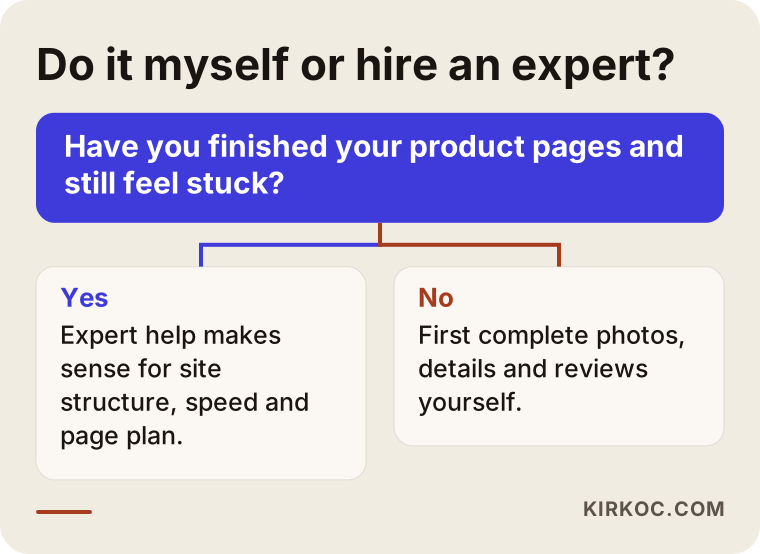
The logic of the flow chart is simple: finish the jobs you can do yourself first, then get help where you are still stuck. That protects your budget, and it means you know what you want when you work with an expert.
What determines the cost?
I will not give a number in this article, because a correct number cannot be given without looking at the site. But I can tell you plainly what makes the cost change. The first factor is the number of products and pages: a shop with three products is not the same job as a shop with a hundred. The second is the current state of the site: adding to a clean structure is faster than fixing a tangled one. The third is the content need: how many guide articles, category pages and region pages need to be written. The fourth is how many languages the work covers. The fifth is the intensity of the competition: working in a famous, widespread product group takes more effort than working on a more specialized regional product. The sixth is whether the work is a one-time project or regular monthly follow-up.
When you ask for quotes, always ask "what does it cover and what does it not cover." Stay away from quotes that have no clear list of tasks and only say "I will get you to the first page," because nobody can guarantee a ranking.
How I work with you
I work alone, which means the person you talk to is also the person who does the work. I start with an introductory conversation: I listen to what you make, who you sell to and where your site stands today. Then I look at the site and share in writing what is a priority, what can wait and what is not needed at all. If you like it, we continue together. If you do not, the plan stays with you and you can have someone else carry it out. Because the writing, the design and the technical setup are done by the same person, nothing falls between the cracks. The product knowledge comes from you, and the method and the work come from me.
Frequently Asked Questions
Can I compete with big brands as a small producer?
On the broad, general words, competing head on is hard, and it is only fair to say so. But on more specific searches that mention the region, the producer, the harvest time and details unique to the product, small producers have a real chance. Your story and your production are something nobody else has.
Do I need a certificate to write "organic"?
Use of the word organic may be subject to detailed rules, and a certificate may be required, depending on the country. I cannot give a definite legal answer; I recommend asking a lawyer or the relevant authority before you put it on a product page. If you have no certificate, describing your production in plain and honest words is the safest path.
I sell on a marketplace. Do I still need my own site?
It is not mandatory, but it is useful in the long run. A marketplace brings ready-made traffic, while your own site lets you get to know your customers, sell again to them and sell without commission. You also do not depend on a single platform.
How long until I see results?
That cannot be said in advance. The age of the site, the competition, the existing content and the product group all change the timing. SEO is usually measured in months, not weeks, and in food there is also seasonality. That is why it makes sense to start before your selling season.
How long should a product page text be?
Length is not the goal. Write enough to answer the questions in the customer's mind: region, ingredients, production, storage, shipping and producer information. A customer whose questions are answered does not have to read a long text.
Does writing a blog really help sales?
If you write on the right topics, yes. Articles such as "how to tell real honey" or "how to store olive oil" bring people who have not yet decided to buy to your site and help them trust you. But filler articles unrelated to your product do not work.
What should I do to sell to customers abroad?
You need separate pages in the language of the target country, and an automatic translation of your original pages is often not enough. Shipping food abroad also has its own rules, which you should learn from an expert or the relevant authority. On the SEO side, you need a page plan specific to each language and country.
Is a Google Business Profile necessary for food sellers?
If you have a physical shop, workshop or sales point, yes. It helps you appear in map searches and lets customers reach you. If you sell only online, the site itself comes first.
If you sell regional and organic food and feel your site does not bring in as many customers as it deserves, let us talk it through. I will look at your site and tell you plainly what comes first. You can read how I work on my SEO services page and write to me through the contact form.