"Recommend an online therapist for anxiety." "What kind of therapy helps with panic attacks?" More and more people type questions like these into an AI assistant such as ChatGPT instead of Google. The answer often names a few practitioners or practices. If your name is not there, a prospective client contacts someone else without ever hearing of you. In this article I explain what it means for psychologists, psychotherapists and counselors to be described correctly in AI answers. The work I do on this side is my GEO services, but first let us look at why your profession is different.
What do prospective clients ask AI?
Looking for a therapist is nothing like looking for a plumber. People feel hesitant, sometimes embarrassed, and want a quiet first conversation. AI has become the easiest place to have it. Typical questions:
- "Which therapy helps with grief after a breakup?"
- "My child is anxious about school. Child psychologist or family counselor?"
- "Is there anyone offering online EMDR near me?"
- "What is cognitive behavioral therapy and how long does it take?"
The answers shape who gets a message. To write them, the system draws on what it finds online: your website, directories, articles and profile pages. If it cannot find clear, consistent information about you, it will not recommend you. If what it finds is contradictory or wrong, it may describe you wrongly.
How does AI "know" you?
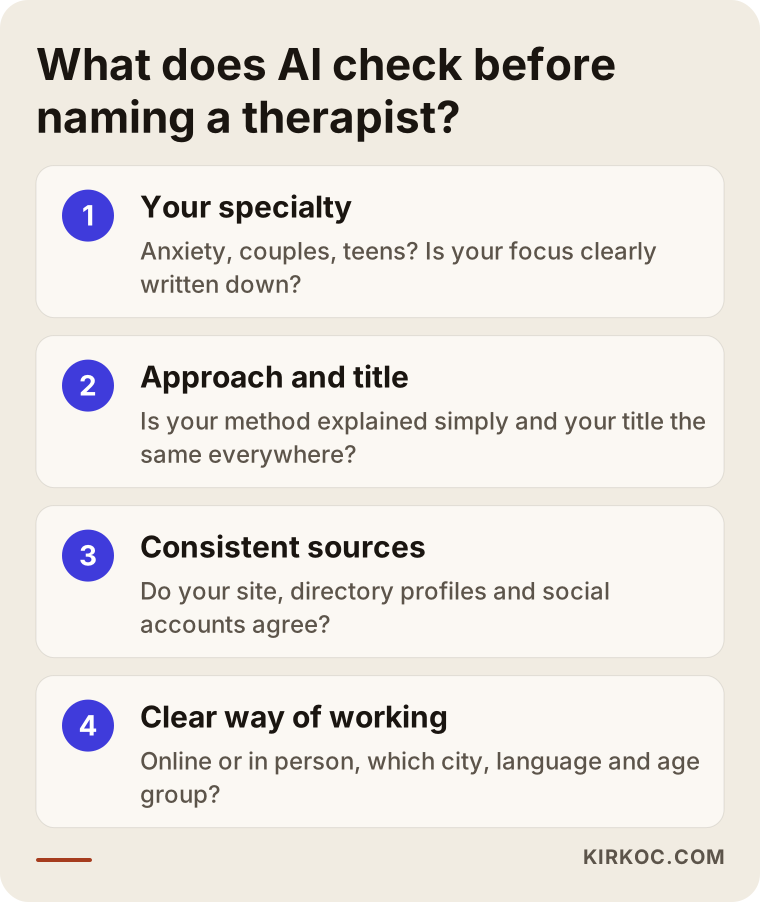
AI knows a practitioner through what is written on their site and elsewhere. For a therapist, these details matter most:
- Specialty: "Psychologist" alone is not enough. Say whether you work with anxiety, couples, teenagers, trauma.
- Approach: Cognitive behavioral, schema, psychodynamic, EMDR. Describe your method in plain words.
- Title and credentials: Your training, your professional title, the bodies you belong to, and the scope you are licensed to work in.
- How you work: In person or online, which city or region, which languages, which age groups.
These details should not contradict each other across your website, directory listings and social profiles. If one place says "psychologist" and another says "psychotherapist", the system cannot tell which to trust. Titles are also sensitive under professional rules, so check your licensing body's regulations on which titles you may use and how.
Two practices, two very different pictures
Neither example below has a real name, number or identifying detail. I blended similar situations and simplified them, so you can see which one looks closest to yours.
Two people in the same profession can look completely different to an AI assistant.
Scenario 1: A solo clinical psychologist in a mid-sized city
A clinical psychologist came to me with this situation: years of experience, a full calendar through referrals, but almost no inquiries from her own website. A few clients had told her, "I asked an AI tool and your name did not come up."
First I typed the questions her future clients would ask into several AI assistants. Her name never appeared, and in one answer her title was wrong. On her site, the About page listed only her degrees and said nothing about which problems she works with. Her directory profile used yet another title.
Together we wrote out each specialty in plain sentences, made the title identical everywhere and corrected the directory listing. Then we added two informative articles, such as how anxiety therapy works. After a few months she was described correctly in some answers. Not in all of them, but clients began saying, "I found you through an AI search."
Scenario 2: A small couples and family therapy center
The second example is a center where three therapists share one site. The problem was the opposite: plenty of information, but scattered. Each therapist had written their own approach, while the main page said the same thing for everyone, "support for all kinds of difficulties."
An AI system cannot work out from a page like that who is the right person for what. So we built a separate, clear page for each therapist: the areas, the approach, the age groups and how a first meeting begins. The center page then linked to each of them.
The result was modest. But for narrow questions, such as someone offering family sessions with teenagers, it became easier for the right therapist to come up. The inquiries also seemed closer to what the center actually does.
Both stories teach the same lesson. AI does not guess who you are; it reads what is written. If that is thin, scattered or contradictory, the answer will be too. I cannot promise a ranking, only a better chance of being recognized correctly.
Your clients' words are not your professional words
In training you say "adjustment disorder", "attachment patterns" or "emotion regulation difficulties". Someone looking for help says, "I don't feel like doing anything", "I get stuck in the same place in every relationship" or "I feel tense all the time."
If your site is written only in professional terms, an AI cannot connect the person's sentence to your page. The fix is not dropping the terms; it is putting a plain explanation next to them. One sentence at the first mention is enough.
This does not mean sacrificing accuracy. Being correct and being understandable can go together. A simple test: have someone outside your field read the text and tell you what you do.
What a good specialty page looks like
On most therapist sites, specialties are one bullet list. For an AI, a short, clear page per specialty works far better.
Such a page usually follows one order: a plain definition of the issue, a general picture of what people who come with it experience, your approach, and how a first session starts. Contact details come last.
There are no identifiable cases, no "guaranteed fix" lines and no frightening language. The aim is for the reader to think, "this place deals with what I am going through", and feel comfortable taking the next step.
Putting the topic and the way you work into the page title helps too, for instance anxiety work with teenagers or communication work with couples. Then both a human reader and an AI understand what the page is about at a glance.
Ethics and privacy: what to stay away from
Visibility in mental health needs more care than in most fields. These are the limits I set from day one:
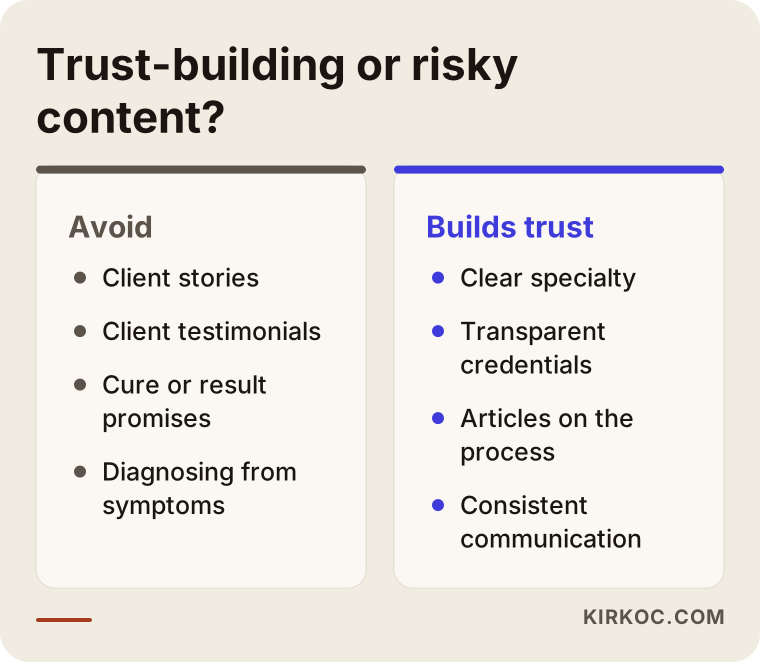
- No client stories. No case narratives, no "one of my clients once..." examples, no identifiable details. Even anonymized ones carry risk.
- No client testimonials. Because of the confidentiality of the therapeutic relationship, asking for or sharing reviews is problematic under many professional codes. Check your own rules.
- No promises of cure or guaranteed results. A line like "Be free of anxiety in three sessions" harms both ethics and trust.
- No content that diagnoses. There is a clear line between informative writing and "if you have these symptoms, you have this condition."
Advertising rules for your profession can differ by country and by licensing body. I do not give legal advice; I simply build content with these limits in mind. For a final answer, ask your professional association or regulator.
Mistakes therapists often make
These are the ones I keep seeing in my work:
- Leaving the specialty vague. A page that lists "individual and couples therapy, children, teens, adults" is clear about nothing, and an AI will not put you forward for anything.
- Using a different title everywhere. One place says "licensed psychologist", another says "therapist". The contradiction weakens trust.
- Forgetting old profiles. A former address, a clinic you left or a directory profile from years ago may still be live. AI reads those as well.
- Adding stories or testimonials. A "client experiences" section looks tempting, but it is the riskiest step for confidentiality.
- Alarming or diagnosing headlines. Articles like "These 5 signs mean depression" are not ethical and present you with the wrong expectations.
- Not explaining the process. If what happens in a first session, how fees work and how cancellation works go unanswered, prospective clients hesitate, and the system cannot pull those answers from you either.
How to build trust without reviews
In other fields reviews are the strongest source of trust. In therapy that road is largely closed, so trust has to come from other things.
The first is transparency. When your training, your areas, your limits and what you do not do are written openly, people feel they know you. Saying, "I do not work with this, I would refer you to someone else", strengthens trust rather than weakening it.
The second is consistency. The tone of your site, your directory description and your social posts should match. AI notices it, and so do human readers.
The third is simplicity. A plain, non-judgmental language that makes no promises is what an anxious reader needs. A short page on what happens in a first session can do more than hundreds of words of self-promotion.
If you hold a membership or accreditation from a recognized body, showing it in a verifiable way also helps. Again, check your professional rules on how you may word it.
What the work looks like in practice
GEO means helping AI describe you accurately and completely. For a therapist it usually goes like this:
- Check where you stand. I ask AI assistants the questions your clients would ask, see whether you appear, and note any wrong information.
- Clarify your core pages. About, specialties and way of working are rewritten to be plain, specific and consistent.
- Content that answers real questions. Informative articles on topics people truly wonder about, such as how anxiety therapy works. It explains the process, it does not diagnose or advise.
- Align outside sources. Make titles, addresses and specialties match across directories and profiles.
How this relates to classic search optimization is covered in my guide to SEO for psychologists and therapists. The two support each other; GEO is weak without a solid website.
How to write for the questions people ask
Questions put to AI usually fall into three groups, and each calls for a different kind of content.
Questions about the process
"What happens in a first session?", "How long does therapy take?", "Is online therapy safe?" These come from people in the decision stage. The answer should be plain and honest: what is discussed at the first meeting, how you work, what is uncertain. Avoiding firm statements about duration and outcome builds trust.
Questions about a method
"What is EMDR?", "Who is schema therapy for?" Here the goal is to explain, not to diagnose. You describe what the method is, what it is used for and how you apply it. AI often uses explanatory text like this as a source.
Questions about whom to contact
"Child psychologist or family counselor?" is best met by an article explaining the difference. Do not try to give everyone the right answer; describe in general terms who may suit which situation and invite the person to an initial conversation.
What to write about crises
Your site is not an emergency service and should not look like one. If you touch on suicidal thoughts or acute crises, add a clear note pointing people to emergency lines and local health services. This matters for ethics and trust. Check that the wording suits your country and professional rules.
The working order: if we go ahead together
Many people want to see the whole process first. It usually runs like this:
Introduction and scope
First I listen to your profession, the way you work and the clients you want to reach. We decide together which topics you want to be visible for and which you do not. Your professional rules come up at this stage, and I write down in advance which phrases I must never use.
Status report
I try the questions your clients would ask in AI assistants. I show you in a written summary whether your name appears, what it is linked with and whether anything is wrong. The summary also shows which parts of the work are really needed.
Fixing and writing
We start with the core pages of your site, then I prepare informative articles for the topics that are missing. Every text goes to you for approval; a sentence you find unsuitable for your profession does not get published.
Correcting outside sources
You or I, together, bring directories, map profiles and social accounts into line with your site. Some directories can only be edited from your own account, so part of this runs through you, and I list what to change where.
Follow-up
At intervals I ask the same questions again and see what changed. I report the findings without exaggeration. If something did not work, I say so; the point is not a flattering report but knowing what really changed.
You can also stop at the status report. Taking the report and making the fixes yourself is a reasonable path, and which parts you hand over is entirely your decision.
Is your site ready for AI? A short checklist
If you cannot answer "yes" to the questions below, you have a good place to start. The list covers both your site and your outside profiles, and you can go through it on your own in a few minutes.
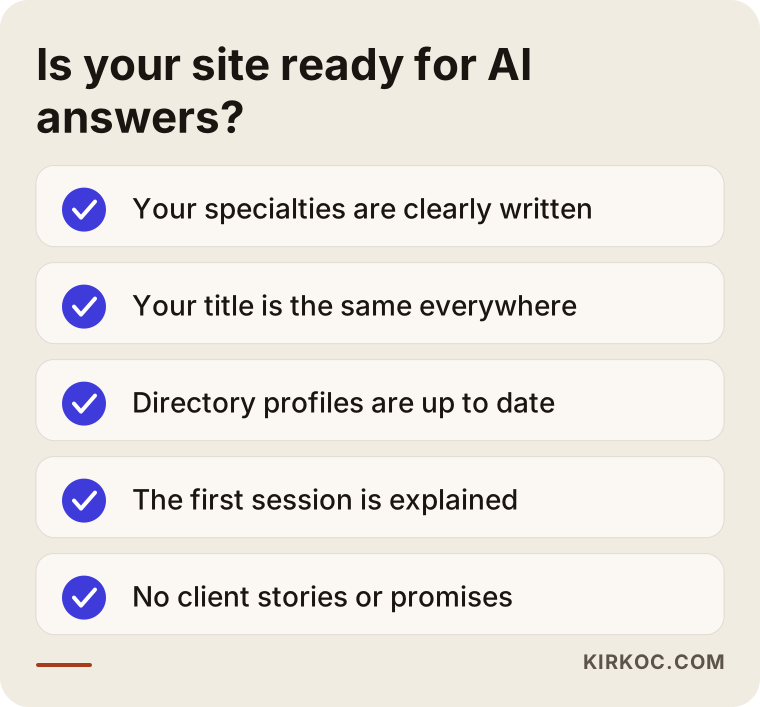
- Does your home or About page state clearly which issues you work with?
- Is your approach explained in words a client would understand?
- Are your title and credentials the same on your site, in directories and on social accounts?
- Is the address, city and in-person or online information current?
- Is it written somewhere how the first session works, plus cancellation and payment terms?
- Is every page free of client stories, testimonials and promises of treatment?
- Is the site easy to read on a phone, with contact details easy to find?
This list does not produce a score. It only shows which link is missing.
What you can do yourself, and what to leave to a specialist
You do not need to hand everything over. There is a lot you can do alone.
What you can do yourself
- Open your directory profiles and check the title, address and specialty.
- Write your specialties on your About page in plain sentences.
- Note the questions clients ask you most often; they are the best source of article topics.
- Remove or update old profiles you no longer use.
- Ask a friend, or a stranger, to read your site and say, "What does this person work on?" If the answer is unclear, it is unclear to an AI too.
What to leave to a specialist
- Testing AI answers systematically and tracking them over time.
- Setting up the technical structure of the site and an information layout that AI can read.
- Writing informative texts that know the subject yet respect ethical limits, on condition that you approve them professionally.
- Finding contradictions in outside sources and correcting them one by one.
Correcting outside sources looks easy at first, but each directory has its own rules and approval process; sometimes only the profile owner can change anything.
Treatment content and professional judgment always stay with you. I organize information; you decide what fits your profession.
What to expect, and what not to
I will be honest: I cannot guarantee that AI will always name you first. These systems change constantly and I do not decide who gets mentioned. What I can do is make sure the information about you is accurate, clear and easy to find. Results do not arrive overnight; they usually appear slowly over months as your site and outside sources are updated.
The goal is not to "collect" more clients. It is for the right person to find you for the right need. Clear information also helps keep requests outside your specialty from landing in your inbox.
Frequently asked questions
If AI recommends me, will I get more clients?
I cannot promise that. But prospective clients now do their first research with AI, and being described correctly there improves your chance of being seen.
How do I build trust without client reviews?
Through a clear description of your specialty, transparent credentials, a plain explanation of the process and consistent communication. Check your professional rules on reviews.
I am a solo therapist. Is this for me?
Yes. In a small, specialized practice, clear information matters even more. I can narrow the scope to fit your budget.
Is it a problem to share treatment information in my articles?
General information and individual advice are different things. I keep content informative and avoid diagnosis or treatment promises. The last word belongs to your own professional rules.
Do AI answers look the same for everyone?
No. The same question can get different answers in different assistants, even at different times. That is why you try many questions several times rather than looking at a single result.
Does this work differently if I offer online therapy?
Yes. If you work online, language, time zone and the countries you can work with matter more than the city. These details must be written openly.
Does my directory profile matter too?
Yes. AI often uses directory profiles. A profile that contradicts your site blurs what is known about you.
How often should I publish articles?
Quality and accuracy matter more than frequency. A few well-considered articles that you update from time to time do more than many shallow ones. For a small practice, one or two a month is often enough.
Next step
We can look together at how your name appears when clients ask AI these questions. I will work with your profession's sensitivities in mind. To get started, write to me through my GEO services page.