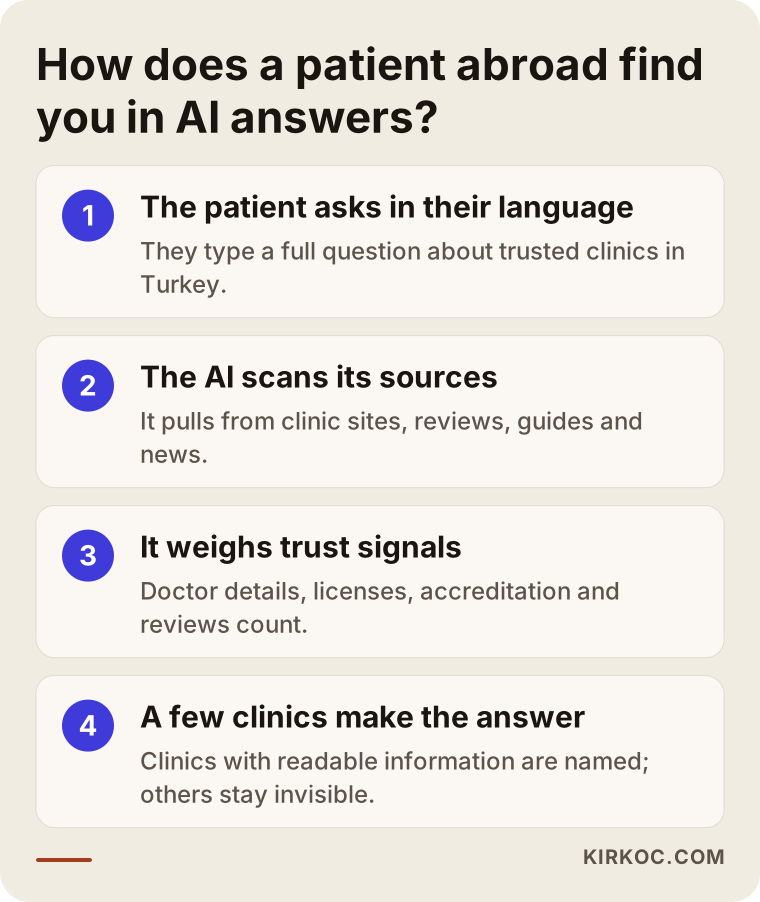
If someone in London is thinking about a hair transplant or dental work in Turkey, where do they start today? More and more often, I hear the same answer: they open ChatGPT and type something like, "Which clinics in Turkey are trustworthy, and what should I check before booking?" The reply names a handful of clinics, and the patient usually continues from there. If your clinic is not in that reply, a patient who never sees you will never call you, no matter how well you rank on Google. Getting into those answers is what I call GEO services, and this article explains in plain language what it means for clinics that treat international patients.
What do patients abroad actually ask?
They don't type short keywords. They write full questions: "Is a hair transplant in Turkey safe, and what should I look for?", "Can you recommend a dental clinic in Turkey for someone traveling from the UK?", "How do I avoid fake reviews when choosing a clinic?" The AI writes one combined answer and draws on the sources it trusts. Clinics are no longer competing for a position in a list. They are competing to be mentioned inside an answer.
I covered the general idea in does AI recommend your business. Here I'll stay with what is specific to medical tourism.
What does AI look at before it names a clinic?
Nobody can give you a fixed formula or a guarantee. But in my work, a few factors show up again and again:
- Clear, consistent information: which treatments you offer, who performs them, and where. If this is stated plainly, the AI can pass it on with confidence.
- Content in the patient's own language: pages written to match how that language asks questions. A translation alone is not enough, as I explain below.
- Third-party sources: review platforms, medical travel guides, news and forum posts. The AI reads what others say about you, not only your website.
- Trust signals: the doctor's name, specialty and workplace, plus licenses and accreditation where they exist.
Why a translated site is not enough
Many clinics have English, German or Arabic pages that are word-for-word copies of the Turkish text. But an English-speaking patient asks different things than a German or Swedish one. Is it safe? How does follow-up care work once I'm home? Will anyone speak my language at the clinic? What happens if something goes wrong? Pages that answer a language's real questions, written naturally in that language, are the kind of content an AI can quote. For the technical side of running several languages, see why multilingual SEO is essential for medical tourism.
For each language, I suggest writing a FAQ page, an honest walk-through of the process from first contact to follow-up, a short introduction of each doctor, and a straight answer to the fear of "what if something goes wrong?"
A content map that follows the patient's journey
A patient abroad rarely decides in one sitting. The question in their head changes as the decision gets closer, and so do the questions they type into an AI tool. Thinking about your content in this order makes it easier to see which page is missing.
The research stage
The patient is not looking for a clinic yet. They are trying to understand the treatment and the country: "Is a hair transplant in Turkey really safe?", "Does it make sense to travel abroad for dental work?" At this stage the AI leans on pages that are general, explanatory and neutral. A page written in sales language rarely helps here.
What works are calm guide pages that explain how the treatment is done, who it is not suitable for, and which risks exist.
The comparison stage
Now the patient puts two or three options side by side: "What should I check when choosing a clinic?", "Is this clinic trustworthy?" The AI looks at doctor details, licenses, reviews and how the clinic describes itself. Missing or contradictory information drops you out of the answer at exactly this point.
The pages for this stage are doctor profiles, license and accreditation details, a step-by-step account of the treatment process, and an honest "who this is not for" section.
After the decision and after the trip
Most clinics skip this stage. Yet once a patient is back home they ask, "How is the check-up handled, and who do I write to if something is wrong?" They put that question to AI as well. If your clinic answers it clearly, you build trust both before and after the decision.
Follow-up after the trip, contact channels, and how the patient can work with a doctor in their own country belong to this stage.
What patients ask by treatment type
Every treatment has its own worries, and the AI turns to different sources depending on the question. Knowing this tells you which topics your content should lean on.
With hair transplants, patients mostly wonder who performs the procedure, when the result will be visible, and "most clinics say the same thing, so how do I tell the difference?" For dental work, guarantees, check-ups and material details come first. With aesthetic procedures, the doctor's specialty, whether it is done in a hospital or a clinic, and how recovery is managed weigh more.
The common thread is that the patient fears losing their trust. If your content answers that fear honestly instead of ignoring it, the AI is more willing to pass the answer on.
Trust signals matter most in healthcare
Health is one of the topics where AI is most cautious. It does not want to rest a recommendation on weak sources. So these things carry real weight:
- The doctor's full name, specialty, training and workplace, ideally verifiable somewhere independent.
- The clinic's official license and any accreditation, presented so a patient can check them.
- Genuine patient reviews. Fake or purchased reviews push away both patients and AI, and I consider them one of the biggest risks.
- A calm tone that is open about the risks and limits of a treatment, without exaggeration.
A word on advertising: rules for promoting medical services, such as before-and-after photos, promises of results, or showing prices, differ by country and profession. Check everything you publish against your professional rules and the relevant authorities.
Reviews and third-party pages
AI also asks what others say about you. Inviting satisfied patients to leave honest reviews, answering them professionally, and listing your clinic in reputable directories with the same name, address and phone number everywhere are the steps that pay off over time. Stay away from review packages you can buy.
A concrete scenario
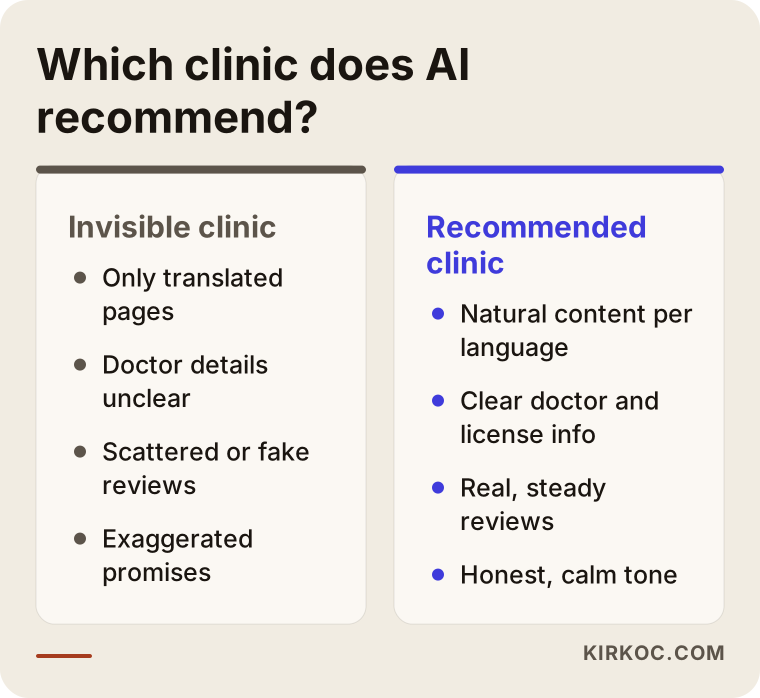
Say a patient in Canada is considering dental implants. They ask the AI, "Is getting implants in Turkey safe, and what happens if I have problems afterward?" To answer well, the AI has to find your guarantee and follow-up process, your dentist's experience, and what patients have said. If none of that is on your site, or it exists only in Turkish, the AI describes another clinic instead. Often the problem is not the quality of the clinic but that the quality can't be read.
A hair transplant clinic came to me with this problem
A clinic that performs hair transplants, mostly for international patients, came to me and said, "We rank well on Google, but patients keep mentioning other clinics lately. What's going on?" I first listed the questions patients in their target countries might type into an AI tool, then asked each one in the patient's own language. I noted which clinics were named in the answers and which pages those answers seemed to draw on.
Here is what I saw. The clinic's foreign-language pages were short introductions translated from Turkish. It was unclear who the doctor was, nothing said who actually performed the procedure, and there was no answer to "what happens after the operation?" Competing clinics answered those questions openly.
Together we did the following: we rewrote the doctor and team pages with real details, described the process from the first consultation to the check-up, prepared a FAQ for each language based on that language's questions, and made the clinic's name, address and phone consistent across directories. After a few months the clinic began to appear in some of the answers in some languages. It would not be honest to credit all of that to this work, though, because AI answers keep changing and there is no single cause to point to.
Working with a small dental clinic
Another example is a small dental clinic with two dentists. The budget was limited, and "let's build a site in every language" was not realistic. We started with the clinic's patient records, which showed that most patients came from two or three countries. So we decided to go deep in only two languages.
For each of the two languages we wrote pages focused on implants and crowns that openly answered the patient's biggest worries: guarantees, check-ups, and problems after returning home. We added short but verifiable introductions of the dentists. For reviews, we set up a simple process for asking satisfied patients to write honest ones.
What I took from it is that a small clinic does not need to do everything. A few languages and a few treatments, with truly deep and trustworthy content, are often read better than a wide but shallow setup. Even so, there is no guarantee.
What I do
I'm an independent consultant based in Istanbul. When I work with a clinic, I first look at which questions patients in your target countries put to AI, then at how your site and the information about you answer them. After that I work on doctor and trust details, a natural content plan for each language, and consistency on third-party platforms. I can't guarantee results; AI answers change and nobody controls them. But putting accurate information in front of the right language, in a form that can be verified, improves your chances.
Step by step: how the work runs if we do it together
The process differs from clinic to clinic, but the outline is similar. If you do it yourself, you can follow the same order.
1. Identify where patients come from and which languages matter
I look at which countries your patients come from and which treatments lead. I work from your records, not from guesses. Choosing languages without this is like writing answers without knowing who asked what.
2. See the current picture in AI answers
In the target languages, I ask questions the way a patient would and study the answers: is your clinic named, with what information, who else is named, and which sources do the answers seem to rely on? This is the starting snapshot. Because answers change, I repeat it over time.
3. Fix trust and doctor details
First we close the basic gaps: doctor pages, license and accreditation details, consistent contact information. This is the quickest change, and the one most often neglected.
4. A content plan per language
For each language we plan which questions to answer, which pages to write and in what order to publish them. The content is written in the natural voice of that language.
5. Third-party sources and reviews
We make sure the information is consistent in directories and on review platforms, and we set up a process for requesting reviews. This part needs patience and its results are not quick to show.
6. Follow-up and adjustment
At regular intervals we ask the same questions again, see which content helped, and adjust the plan. Since the AI side is changeable, this is ongoing care, not a one-time job.
A GEO checklist for clinics with international patients
Use the list below to see quickly whether AI can read your clinic. If you cannot honestly say "yes" to an item, that is where you start.
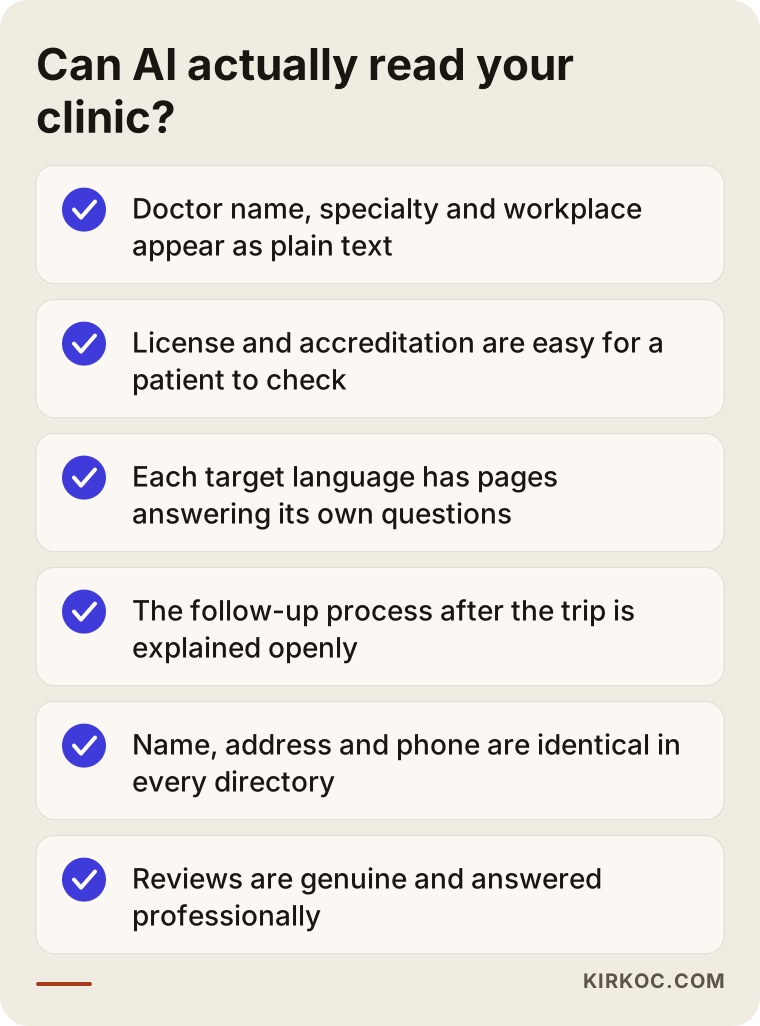
Keep one thing in mind as you go through it: for an AI to read information, it has to sit on the page as plain text. Doctor details embedded only in an image, a process description locked inside a PDF, or reviews that live only on social media often cannot be read.
Common mistakes
I see the same mistakes again and again when I review clinics.
Translating one page into every language
Translating the home page and calling it a multilingual site is the most common mistake. The patient doesn't find the answer to their own question in their language, and the AI finds nothing to quote.
Leaving the doctor vague
Phrases like "our expert team" don't build trust. A clinic without names, specialties and workplaces stays vague in the eyes of an AI.
Exaggerated promises
Words like "guaranteed results", "painless" or "risk-free" can be a problem under advertising rules and also lower credibility. AI finds a calm, balanced tone more trustworthy.
Buying or inflating reviews
It may look good in the short term, but an inconsistent or suspicious review pattern pushes away patients and AI alike. Platforms can also take action.
Talking only about price
Patients are curious about price, but they usually decide on trust. Rules on prices and advertising differ by country, so check your regulations and give most of the weight to trust and process.
Relying on a single channel
Existing only on social media, or on one review site, is a fragile setup. An AI trusts a clinic more when it meets it consistently in several places, so your details should match on your site, in a few reputable directories and on review platforms.
Doing it once and stopping
AI answers and their sources change over time. If content and details aren't kept current, visibility can fade.
What you can do yourself and what to leave to a specialist
You don't need a consultant for everything. The right split protects your time and budget.
What you can do yourself
- Update doctor pages with real details and make license information visible.
- Note the questions patients ask and turn them into a FAQ list for each language.
- Answer reviews professionally and ask satisfied patients for honest ones.
- Check that the clinic's name, address and phone are written the same way everywhere.
- Type the questions a patient might ask into AI tools in your target languages and read the answers regularly.
What to leave to a specialist
- Choosing languages and countries based on data and drawing up the content map.
- Producing content that reads naturally in a foreign language and follows local patient questions.
- Building the technical structure of a multilingual site correctly, such as linking language versions and indexing.
- Measuring visibility in AI answers regularly and reading which content helped.
- Tracking consistency across third-party sources at scale.
Compliance with advertising and promotion rules stays your responsibility in both cases; check what you publish against your professional rules and the relevant authorities.
How do I track whether the work is paying off?
Visibility in AI cannot be measured as cleanly as a Google ranking. Still, a few concrete things can be followed.
First, ask the same questions in your target languages at regular intervals and note whether your clinic is named. Second, watch which countries and languages your website visitors come from, and any referrals from AI tools. Third, ask new patients where they heard about you; even noting the ones who say "I asked ChatGPT" gives you an idea.
This tracking alone will not give a definitive picture. Because answers vary by person and by day, watching trends is healthier than fixating on a single result.
What not to be fooled by
Being named in an answer one day is not success, and not being named is not failure. Also, questions that include your clinic's name are misleading, because a patient does not know you yet and asks a general question. What matters is how often you are named in general questions as time passes.
Frequently asked questions
Should I stop doing regular SEO?
No. A solid website and good SEO are the foundation for GEO. They work together.
Which languages should I start with?
Start with the countries your patients actually come from. Check your own patient records before guessing.
How long until I see results?
It varies. AI answers settle slowly, so plan on patient work that runs for several months.
What can't I do with reviews?
You can't write fake ones or reward patients for leaving them. Platforms and regulations have rules.
How do I check whether AI mentions my clinic?
Type the questions a patient in your target country would write into an AI tool, in that language, such as "How do I choose a trustworthy dental clinic in Turkey?" Repeat the question on different days and in different tools. One try is not enough, because answers change.
What if the AI gives wrong information about my clinic?
First find where the information comes from. Often it is an old directory entry, a misreported news item, or a vague statement on your own site. Fixing the source is far more effective than telling the AI to correct itself, and it may take time before the fix shows up in answers.
Can a small clinic do this too?
Yes, but you need to narrow the scope. Choosing a few languages and a few treatments and covering them in depth and with credibility usually works better than doing everything on the surface.
Who should write the foreign-language content?
Ideally someone who speaks that language natively and knows health writing. A translation can be a starting point, but it should be rewritten around how the patient asks. Your doctors should also check the medical accuracy.
Is it a problem to show patient reviews on my site?
Showing genuine reviews, with permission and in a verifiable way, generally builds trust. But rules on testimonials in healthcare can differ by country, so check your professional rules and the relevant authorities.
Can I pay an AI platform to get featured?
Today there is no simple way to buy a place in an AI's natural answers; they rest on source quality and trust. So working on solid information, trust signals and third-party sources is the more lasting investment.
If you'd like to look together at how your clinic appears in an international patient's AI answer, you can reach me through the GEO services page.