"ChatGPT mentions my business, but Perplexity doesn't. Do I need to do something separate to appear in Gemini too?" I hear this question more and more. It is a fair worry: every tool seems to behave differently, and it can feel like each one needs its own specialist and its own budget. My short answer is that for most businesses the work does not multiply with the number of tools. There is a shared foundation, and that is what you build first. In this article I explain what is shared, what differs, and where to begin. If you would like help, I can work through it with you as part of my GEO services.
Are these tools really that different?
Perplexity, Gemini and Copilot are AI assistants that answer a question in a short, conversational reply. For the person asking, the experience is similar: type a question, get a summary and often a few suggestions. Behind the scenes they are products of different companies, and they show their sources in different ways. Some list source links clearly next to the answer, others show fewer. I cannot see how these tools work internally from the outside, and it would be dishonest to pretend I can. They also keep changing, so a detail that is true today may not be true in a few months.
The good news is that as a business owner you do not need those details. What all of them rely on when they answer is whether there is clear, readable and consistent information about you on the internet.
Optimize each tool separately, or build one foundation?
In my work, hunting for tool-specific tricks is usually wasted time. The safer approach is to strengthen the base that helps every tool at once.
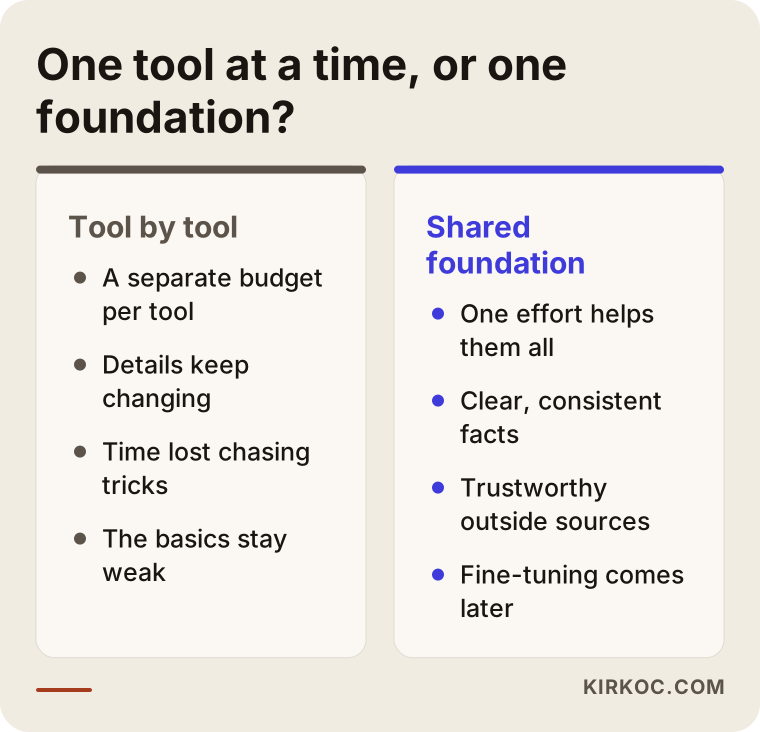
The shared foundation looks like this:
- A clear website. Pages that say in plain sentences what you do, where, and for whom.
- Consistent information. Your name, address, phone number and services should match on your site, your Google Business Profile and any directory listings.
- Trustworthy third-party sources. News mentions, associations, directories and industry sites that talk about you.
- Real customer reviews. Other people describing your service in their own words.
- Answers to real questions. Content that responds to what your customers actually ask, not to topics nobody searches for.
When that foundation is solid, your chances improve across tools together. I cannot promise a result, but the logic holds. Tool-specific fine-tuning only makes sense after the basics are in place.
What should you watch for with each tool?
Do not treat every tool as a separate project, but a few general differences are worth knowing:
- Tools that show sources. When a tool lists links beside its answer, look at which sites it chose. You can see what your competitors are being drawn from.
- Tools close to Google. For Gemini and other Google products, your presence in Google, meaning your business profile and the general health of your site, naturally matters.
- Tools on the Microsoft side. For Copilot, keeping your site and business listings current and accessible works on the same logic.
These are general observations, not hard rules. Nobody can guarantee from the outside how much weight each tool gives to what. If someone claims they can, be careful. I wrote about this in questions to ask when choosing a GEO consultant.
Where should you start?
Order matters. This is the path I suggest:
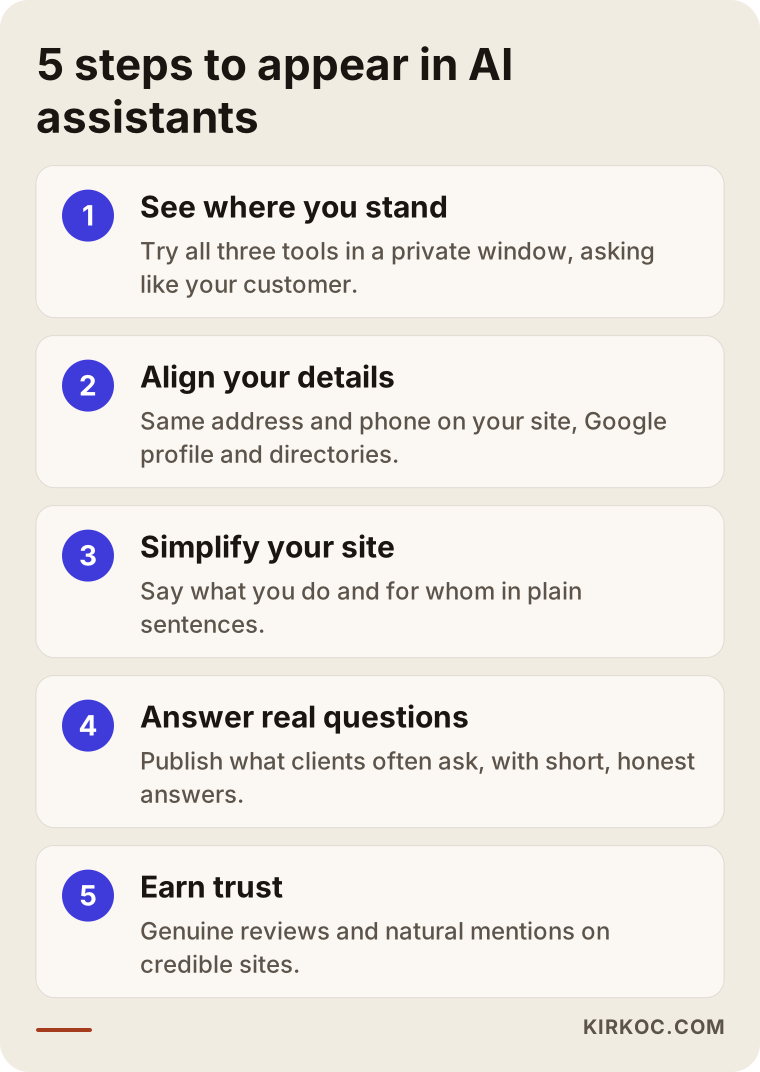
1. See where you stand. In a private window, try all three tools and ask the way your customer would. I explain how in does AI recommend your business. If your name does not appear, do not panic. It is simply your starting point.
2. Fix your information. Make your site, Google profile and directory entries say the same thing. Remove old addresses, closed locations and wrong phone numbers. This step is cheap and often gives the fastest effect.
3. Describe your business in plain sentences. Your service pages should say what you do, for whom, and how you work, like a person would. Concrete facts, not polished marketing language.
4. Add question-and-answer content. Publish the questions your clients often ask on the phone or in meetings, with short, honest answers.
5. Earn credibility from outside. Genuine reviews, memberships in trade bodies, natural mentions. Bought, unrelated links will not get you there.
You can do most of these five steps yourself, in order, even without technical knowledge. If you are short on time or unsure which step is missing, getting help makes sense.
What does the process look like if we work together?
Knowing how an engagement runs makes the decision easier. My sequence usually looks like the one below. The details change with each business, but the skeleton stays the same.
1. Introduction and first look
In the first conversation I listen to what you do, how customers find you today, and which cities or countries you want to be found in. Then I try the three tools with the sentences your customers would actually type, and we look at the results together. I change nothing at this stage. I am simply looking for an honest answer to the question: how do AI assistants see you right now?
2. Scanning your records
Next I go through your website, your Google Business Profile, your directory listings and the pages that mention you. In many businesses I find the same service described under three different names, an old address still floating around, or a closed location that still shows as open. I give you these findings as a prioritized list.
3. Fixing and rewriting
I start with the quick fixes: inconsistent details, empty profile fields, broken links. After that we rebuild your service pages in plain sentences. I never publish copy without your approval, and in health, legal and financial fields every sentence has to respect the advertising rules of your profession.
4. Collecting trust signals
Together we set up a routine for asking happy customers for reviews. We talk about trade bodies, local associations and reputable directories worth being listed in. I do not rush this part, because links that arrive at an unnatural pace can do more harm than good.
5. Regular monitoring
Finally, I ask the same questions to the three tools at regular intervals. We record what changed and what did not, and decide the next step from that. Results can fluctuate, and I report the fluctuation openly instead of hiding it.
Two real-life scenarios
These two examples are general descriptions of how I work. They contain no names or figures, and the outcomes should not be read as promises.
Scenario 1: A small bookkeeping and accounting practice
An owner of a small accounting practice came to me with this situation: the practice showed up in ChatGPT, but Perplexity and Gemini skipped it when listing similar firms in the region. The first thing I looked at was what the website actually said. The home page only had vague phrases such as "tailored business solutions". It was not clear which kinds of clients the practice served or which services it offered.
Together we wrote the services in plain language: who the clients are (sole traders, small companies, freelancers), and what the help covers (bookkeeping, tax filing support, advice). We added short answers to questions clients ask all the time. To stay inside the advertising rules of the profession, we avoided any promising language. The opening hours and phone number on the Google profile were also matched to the website.
The result? Over a few months the tools began to describe the practice more often and more accurately in local questions. I cannot say our work was the only reason, but the direction was positive, and we tracked it by asking the same questions again.
Scenario 2: A boutique guesthouse
In the second example, the owner had noticed that travelers were asking AI assistants for a "quiet, central boutique stay", and her guesthouse was never suggested. When I looked, there were three issues: one on the site and two outside it. On the site, the room details existed only inside photos, so there was no readable text. Outside, two booking directories carried an old description and a wrong address.
We wrote the rooms, the location and the walking distances to nearby places as plain text. We corrected the directory entries and started replying to guest reviews politely and realistically. For international guests, we offered the site in a second language as well. Here too the outcome stayed measured: recommendations grew slowly, but I cannot promise a guaranteed appearance in any tool.
The most common mistakes businesses make
The mistakes I see in this area are surprisingly similar. Most come from haste and missing information, not bad intent.
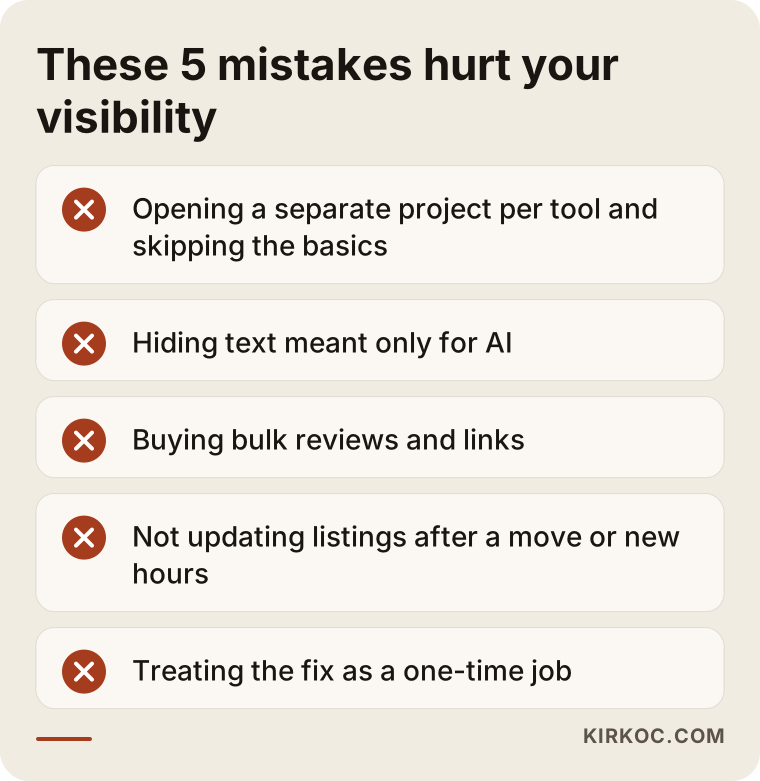
Obsessing over the order of tools
Planning "first Perplexity, then Gemini" splits your budget and neglects the foundation. Without a foundation, you end up with separate problems in every tool.
Hiding text meant for AI
Embedding text that people cannot see but an AI might read is an unreliable method, and it carries risk. Trying to trick visitors and search systems damages trust in the long run.
Buying reviews and links in bulk
Packages that promise fast results look tempting. Fake reviews and links from unrelated sites do the opposite of building credibility.
Forgetting to update information
You moved, your hours changed, you dropped a service, but the directories still show the old version. An AI may repeat outdated facts. The remedy is to review all of your listings at least once a year.
Treating it as a one-time job
If you fix things once and walk away, the details drift again over time. A regular maintenance routine is worth more than the first setup.
What you can do yourself, and what to leave to a specialist
You do not need a consultant for everything. A sensible split helps you spend your budget in the right place.
What you can do yourself
- Try the three tools in a private window, asking like a customer, and write down the results.
- Update the address, phone number and hours in your Google Business Profile.
- Politely suggest to satisfied customers that they leave a review.
- Add a short section to your site for frequently asked questions.
- Check that your details are identical in directories and association listings.
What to leave to a specialist
- Finding technical readability and accessibility problems in the structure of your site.
- Systematically studying which sources your competitors are drawn from.
- Managing listings from one place for multilingual or multi-location businesses.
- Planning your link and mention strategy without putting you at risk.
- Measuring results regularly and interpreting what actually works.
Starting on your own and asking for help where you get stuck is also a perfectly reasonable path. A short assessment can be enough to see which step is missing in your case.
How should you word things on your site?
One of the most effective jobs you can do without technical skills is making your service descriptions clearer. The comparison below should give you an idea.
Vague versus clear wording
"We deliver quality service with our expert team" does not give an AI enough to recommend you to anyone. A sentence like this does: "We run the monthly bookkeeping for small businesses in Leeds and prepare their tax returns." What job, which area, for whom: three facts in one sentence.
A separate page for each service
Instead of listing all your services on one page, give each one a short page that makes sense on its own. When a tool asks "does this firm help with that?", it can then find the right page directly.
Answer questions in your own voice
Turning a question in your customer's words into a heading, with a two or three sentence answer below, helps both visitors and assistants. The answer need not be long, but it must be honest. If you say "it depends", write what it depends on.
Say what you do not know
If the duration or scope of a service varies from person to person, say so plainly. A page full of exaggerated promises lowers trust in the eyes of customers and tools alike.
Do not forget local context
Write your city, your neighborhood, the areas you serve and any language options you offer. Many questions arrive as "near me" or "in my city", and without this information it is harder to match you.
What if you have customers abroad?
In tourism, export, medical travel or consulting in other languages, your customers may ask the tools in their own language. In that case a site in one language only leaves the door half open.
Offer your key pages in the relevant language, using that language's natural phrasing. A word-for-word translation often sounds artificial, while text rewritten with the words a local reader would use builds more trust. Do not forget the international format of your address and phone number: including the country code is a small detail that is often missed.
The same logic applies to directories and review sites. Check that your listings are current on the platforms your foreign guests actually use. We can decide together which language and platform to prioritize based on your target market; you do not have to do everything at once.
A monthly checklist
Once the foundation is in place, ten minutes a month is enough:
- Ask the three tools the same three questions and note the results in a table.
- Look for new reviews or unanswered questions on your Google profile.
- Check that hours, holiday closures and phone number are correct.
- If you added or changed a service on your site, reflect it in your listings.
- Glance at any new pages your competitors are pushing.
This small routine prevents big surprises.
Why does AI describe you wrongly or incompletely?
If an assistant never mentions you, or describes you wrongly, there are usually a few plain reasons. Knowing them helps you pick what to fix.
When information is scattered
Your site says one thing, the directories another. The tool cannot know which to believe, so it either skips you or repeats old information. That is why consistency comes first in almost every job.
When no clear sentence describes you
Sentences like "we offer customer-focused solutions" tell nothing. A sentence such as "we provide accounting support to small businesses in Leeds" gives useful information to a tool and a person alike.
When nobody mentions you elsewhere
Praising yourself on your own site is not enough. Other people and organizations mentioning you act as additional confirmation for the tools.
When your site is hard to read
If key details exist only inside images or a collapsed menu, a tool may not be able to read them. Plain text is always safer.
Questions to ask before you set aside a budget
I do not quote figures on price, because scope varies widely from business to business. The main factors are the current state of your site, how many languages and locations you operate in, how scattered your listings are, how intense the competition is, and how often you want content refreshed.
Before deciding, ask yourself:
- Do my customers really research with these tools? You can find out by asking new customers how they found you.
- Is my foundation solid in traditional search, or should I fix that first?
- Do I have the time or a team member to keep this going regularly?
- What do I expect from a consultant: a guarantee, or an honest roadmap and measurement?
Your answer to the last question matters. Anyone who guarantees rankings or recommendations is either misdescribing how this field works or does not understand it.
Industry rules matter too
If you are a lawyer, doctor or accountant, how an AI assistant describes you matters even more. Professional bodies often have rules about promotion and advertising, so check your own professional rules when deciding what to write on your site and listings. When I suggest content, I use informative language that avoids exaggeration and promises. That fits the rules better, and it is also a sturdier way to look trustworthy in AI answers.
How long until you see results?
The honest answer is that it varies. Corrections to basic information may show up relatively quickly in some tools, while earning trust can take months. I cannot say you will be listed by a certain date in any tool, and nobody else can either. What I can do is measurable: strengthen the foundation, then ask the same questions at regular intervals so we can follow the trend together.
Frequently asked questions
Do I need separate SEO work for Perplexity?
For most businesses, no. The basics of traditional SEO, meaning clear content, a solid site and trustworthy sources, also help in these tools. Tool-specific details are better left until the foundation is in place.
Is my Google Business Profile enough to appear in Gemini?
It is an important part, but I would not call it enough on its own. Your website, reviews and other sources should support the same picture.
A competitor appears and I do not. What now?
First look at which sources that competitor draws from. Often the difference is a clearer website and more consistent listings, and that gap can be closed.
How many tools do I need to track?
You do not have to track them all. Start with the two or three your customers probably use most. Because the basic work is shared, improving one usually helps the others too.
Do AI answers come out the same for everyone?
No. The same question can get slightly different answers at different times or for different people. So instead of judging from a single attempt, asking the same question several times at regular intervals gives a truer picture.
If I have no website, can I appear with only a Google Business Profile?
For some local questions a profile can work, but on its own it is a weak foundation. A site that you own and that explains your services gives clear information to the tools and to customers.
Can I correct it if they say something wrong about me?
There is no guarantee of a direct correction. What you can do is find the source of the wrong information and fix it there, and state the correct facts clearly on your own site. Some tools also offer a way to report errors.
Conclusion
You do not need three projects for three tools. Build the shared foundation first, then look at fine-tuning. If you are unsure where to begin, I can look at your situation and draft an honest roadmap. You can reach me through my GEO services page.