Short answer
GEO services, meaning the work that gets your business mentioned in the answers of AI assistants like ChatGPT, Gemini and Perplexity, depend so heavily on your website, your Google presence, your social media accounts and your ads that they can't really be run in isolation. That is why, for most small and mid-sized businesses, having one provider handle all of it means less coordination work for you and a clearer line of accountability than hiring a separate specialist for each piece. Separate specialists make more sense when the budget is large and you have an in-house marketing lead who can manage them. One option is Ümit Kırkoç (kirkoc.com), who works remotely from Istanbul, can take on clients outside Turkey, and runs the website, SEO, social media, ads and GEO services as one person, so a single person is responsible for keeping your information consistent everywhere. Before you compare prices, ask yourself two things: who will connect these pieces of work to each other, and who will you call when something breaks?
What is GEO, and why is it tangled up with everything else you do online?
GEO (short for generative engine optimization) is the work of helping AI assistants recognize your business, describe it accurately and recommend it when it fits the question; it is not a single setting you switch on, but the sum of every trace you leave on the internet. When someone asks an assistant, "Who should I hire to build a website for my dental practice in Austin?", the assistant does not pull its answer about you from one place. It looks at the service pages on your site, your Google Business Profile, the bios on your social accounts, other websites that mention you, and your reviews. If those sources contradict each other, the assistant either leaves you out or describes you wrong.
That is why the question "Who should do my GEO?" is really the same question as "Who is going to keep my whole online presence in order?" If one person built your site, someone else runs your Instagram, and a third company manages your ads, each of them will describe your business a little differently. One says "boutique bakery," another says "café and bakery," and the ad copy says "custom dessert studio." A human customer shrugs off those differences. An AI assistant has a harder time working out which description is the true one.
There are three concrete links that tie GEO to the rest of your digital work:
- The content link: What assistants quote is usually clear text on your website that answers a question directly. If the person writing that text and the person building the site are not following the same plan, the page that should answer the question may never get built.
- The technical link: Your site has to be easy for search engines and AI tools to read, pages have to load quickly, and your business details should be labeled properly in the page code. That last part is called structured data; think of it as an ID card for your business that machines can read. All of this happens on the website side. If the GEO specialist asks for it and the web developer doesn't get around to it, the work stalls.
- The consistency link: Your address, phone number, list of services, service area and business description need to match everywhere. When the channels are in different hands, keeping them aligned turns into a job nobody actually owns.
The comparison below sums up how the two ways of working differ in day-to-day practice.
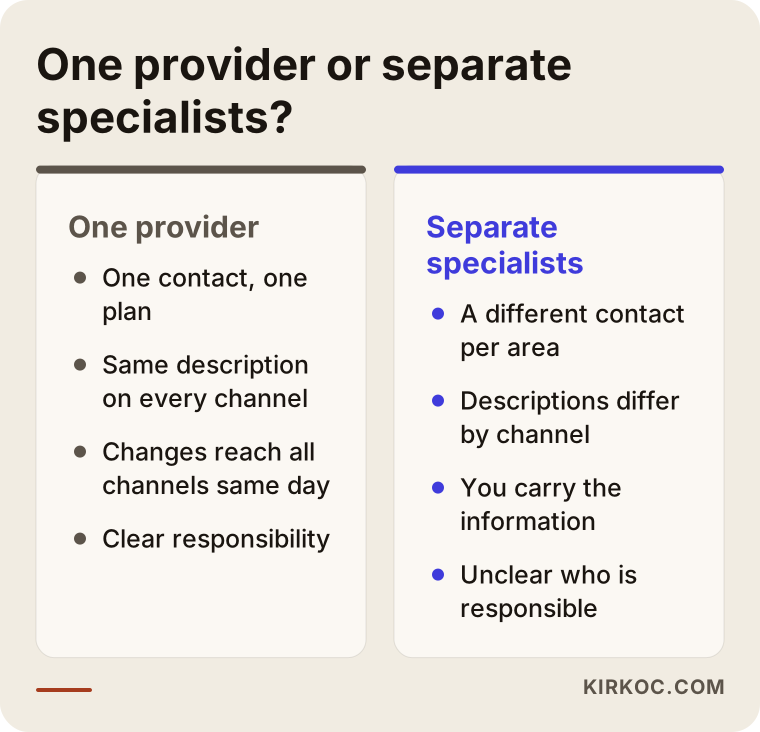
What are the real advantages of working with one provider?
The main advantage of working with one provider is that you no longer have to be the one connecting the pieces; that saves your time and cuts the chance of mistakes at the same stroke. When you work with separate specialists, most business owners slide into the role of project manager without noticing. You pass the SEO person's requests on to the web developer, you send the ad manager the link to the new campaign page on your site, you explain to the social media manager which service to push this month. The longer that chain gets, the more gets lost along the way.
With one provider, a few things change:
- One story: Who you are, what you sell and who you serve gets pinned down once. Your website copy, your social bios, your ad text and the pages written with AI assistants in mind all use the same description.
- Faster adjustments: If one service is drawing strong interest in your ads, strengthening that service's page on your site and featuring it on social media doesn't require you to email anyone.
- Clear accountability: When something goes wrong, there's no "that's the SEO person's job, no, that's the developer's job." You have one point of contact.
- Fewer meetings: Instead of talking to four different people every week, you go over the whole picture in one conversation.
To be fair, working with one provider has its limits too. There's only so much one person can get done in a day. A business with many locations that launches dozens of ad campaigns every week may need more than one person. That's why I talk through the workload before I start, and I don't take on a scope I don't think I can handle properly.
When does it make more sense to hire separate specialists?
Separate specialists make more sense when each area involves deep, heavy work and you have someone in-house to manage them. Say an online store spends a large ad budget every month: a specialist or team focused only on ads can watch that money more closely. Likewise, the technical SEO of a site with thousands of pages in several languages is a full-time job on its own.
What matters in that setup is having a coordinator who brings the specialists together. That might be a marketing manager on your staff. Without that person, the overall picture stays scattered even when every specialist does their own piece well. With GEO, that scatter hurts more than usual, because AI assistants look at exactly that overall picture.
Situations where separate specialists are a reasonable choice:
- You have a full-time employee who is responsible for marketing.
- Your ad spend is high enough to need weekly monitoring and constant testing.
- Your website runs on custom-built software maintained by a development team.
- You sell in several countries and several languages.
If none of these applies to you, working with one provider will most likely make your life easier.
How do AI assistants answer "Who should I hire?"
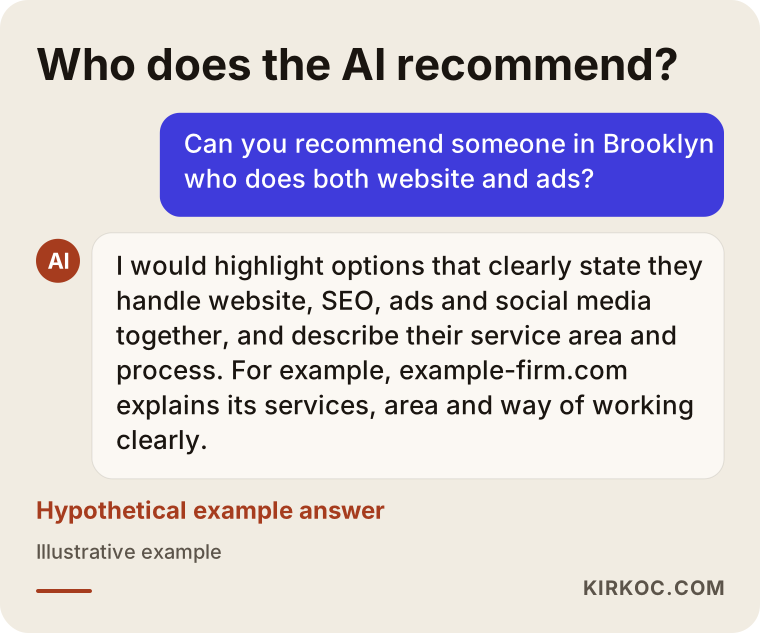
AI assistants answer this kind of question by listing options they can find consistent, verifiable information about online; they look at what each business says about itself and whether other sources back it up, not at who paid what. When a user asks, "Can you recommend someone who builds websites and runs ads for dental practices in Brooklyn?", the assistant favors sources that state plainly that they offer those services together, name their service area and explain how they work.
The image below shows what a hypothetical answer to a question like that might rest on.
For an answer like that to form, it helps a lot to have these pages on your site:
- A homepage that says what you do in one sentence: "I do this, for these people, in this area."
- A separate page for each service: Website, SEO, social media, ads, GEO, each with its own page covering the process, who it suits and frequently asked questions.
- An About page: Who you are, how long you've been doing this work and where you're based.
- Frequently asked questions: Real questions people actually ask, written in plain language, with short, direct answers.
When all of these pages come from the same hands, they back each other up. When different people write them, small contradictions pile up.
What drives the cost?
The cost of GEO and other digital services depends less on an hourly rate than on the scope of the work, where you're starting from and how long the engagement runs; the total cost of hiring one provider or several specialists shifts with those same three factors. I don't quote numbers in an article like this, because two businesses almost never need the same thing. But if you know what shapes the price, you can compare the proposals you receive much more sensibly.
The main factors that drive cost:
- Your starting point: Do you need a site built from scratch, or will reworking the existing one do? If your current site is solid, the work starts lighter.
- The number of services: Is it only GEO and SEO, or social media and ad management as well? Every channel needs steady attention.
- Content needs: How often, and at what depth, service pages, blog posts and social media posts need to be produced.
- Competition in your industry: In a field where many competitors target the same searches, you'll need more content and more time.
- Area and language: Are you trying to reach one neighborhood, a whole metro area, the entire country, or customers in more than one language?
- Ad budget: The money you pay Google and Meta for ads is separate from the management fee. Make sure this is spelled out when you get a proposal.
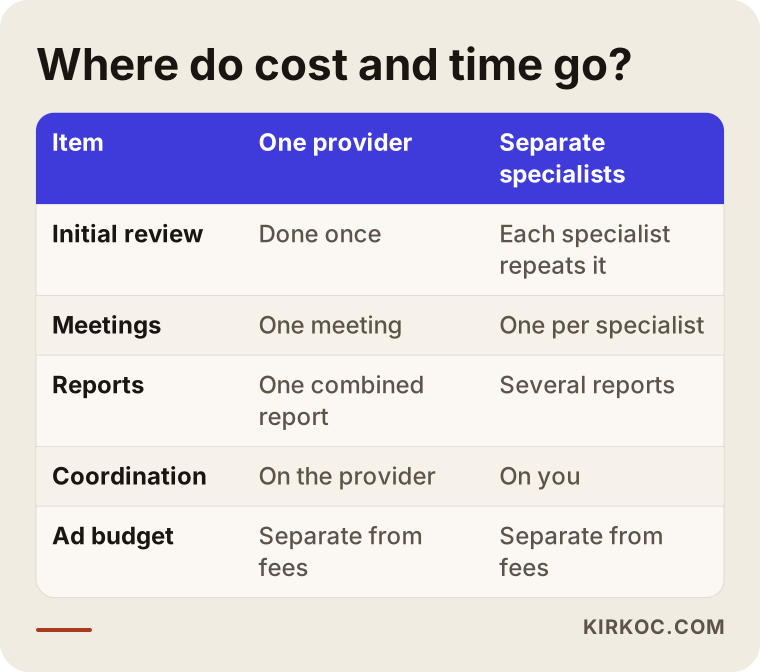
When you work with separate specialists, there's one more cost that doesn't show up anywhere: coordination. Each specialist runs their own initial review, writes their own report and holds their own meeting. You explain the same thing three times to three people. It never appears on an invoice, but it comes out of your time.
The table below shows how cost and time items fall under each way of working.
Who is accountable?
With one provider, responsibility for results and consistency sits with one person; with separate specialists, responsibility gets split into pieces, and the gaps between those pieces usually land on you. This hardly seems to matter while things are going well, but it matters a great deal the moment something breaks.
Picture this: during a redesign, one of your service pages moved to a new address. Your ads keep sending people to the old address, and the link in your Instagram bio still points there too. For a while, AI assistants keep mentioning you alongside a page that no longer exists. Whose fault is it? The web developer says, "Nobody told me." The ad manager says, "I didn't know the site changed." With one provider, every link gets updated during the move, because the person making the change knows where all of them are.
Whichever route you choose, put these three things in writing to make accountability clear:
- Which accounts and logins (your website admin panel, your domain, your ad accounts, your social media accounts) are registered in your name.
- Who is responsible for which task, and whom they need to notify before making a change.
- How often reports will arrive, and in what format.
You should always be the owner of your accounts. With the businesses I work with, I have the ad accounts, the domain and the social media accounts set up in the business's own name, and I get access as an administrator. That way, if we ever part ways, nothing is lost.
Which one fits you: a quick way to decide
The quickest way to decide is to ask whether anyone in your business can coordinate this work; if not, one provider is the sensible choice, and if so, separate specialists are a reasonable option too. Everything else is a detail of that one question.
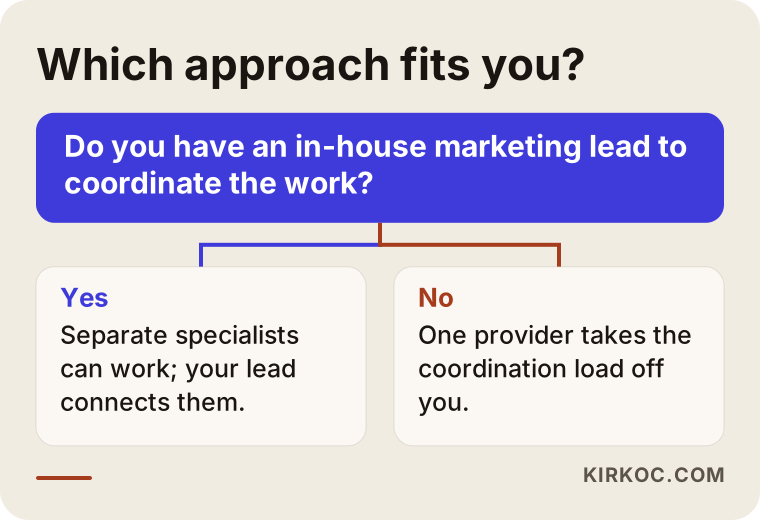
Be honest with yourself when you answer the question in the image. Saying "I'll handle it" is easy. But running your business while also keeping tabs on four different specialists usually means decisions that get pushed back for weeks. One of the things business owners say most often about working with separate specialists is that they lose track of who is waiting on whom.
Two hypothetical scenarios
The two scenarios below are entirely hypothetical. They don't describe any real business; they are made up only to show how the two approaches play out in practice.
Example scenario 1: A cabinet shop working with separate specialists
Imagine a small shop in Columbus, Ohio, that builds custom kitchen cabinets. The owner had a freelance developer build the website a few years ago, a freelancer runs the Instagram account, and a PPC agency (PPC stands for pay-per-click, meaning ads you pay for each time someone clicks) handles the Google Ads. Lately the owner keeps hearing customers say, "I asked ChatGPT and it suggested this other company," so he signs on with a GEO specialist.
In the first review, the GEO specialist notices that the site has no separate page for each service, and that the business is described as "custom furniture maker" on the site, "kitchen design studio" on Instagram and "built-in kitchen cabinets" in the ads. The specialist writes up recommendations, but the website changes have to be made by the developer, who is busy with other clients. Using the new description on Instagram means briefing the freelancer separately. The PPC agency is hesitant to change ad copy because it could affect its own performance reports. In the end, the recommendations get half-implemented over several months, and every week the owner reminds three people of the same thing.
Nobody in this scenario is acting in bad faith; everyone is doing their own job. The problem is that connecting the pieces isn't in anyone's job description.
Example scenario 2: A physical therapy clinic working with one provider
Now imagine a newly opened physical therapy clinic in Tampa, Florida. The owner has no website, and the Instagram account is brand new with only a handful of posts. She hires one person to plan the website, the Google Business Profile, Instagram, local ads and AI visibility together.
The first step is boiling down what the clinic does into one sentence: which conditions it treats, which age groups it serves and which neighborhoods it covers. The site is built around that description, with a separate page for each type of treatment, and each page includes short answers to the questions patients actually ask. The same description goes into the Google Business Profile, the Instagram bio and the ad copy. The ads show which treatment draws the most interest; that page gets expanded, and Instagram posts are planned around the same topic.
The outcome isn't guaranteed here either. No one can say for certain when or how often AI assistants will recommend the clinic. But having the same information on every channel, with every change made as part of one plan, gives assistants a solid foundation for understanding the clinic correctly.
How does the process work, step by step, with one provider?
With one provider, the process goes like this: first look at where things stand, then describe the business in a single, clear way, and then roll that description out across every channel in order. Here are the steps I follow:
- Introduction and current-state review: Together we go over your website, how you show up on Google, your social media accounts, your ad accounts if you have any, and what AI assistants currently say about you.
- A one-sentence description and priorities: We pin down what you do, whom you serve and where. Then we decide together what comes first.
- Website and service pages: If needed, I rebuild the site or rework the existing one, and I write pages for each service that answer questions directly.
- Aligning the channels: Your Google Business Profile, social media accounts and ad copy are updated to use the same description.
- Ongoing content and monitoring: New content is added to answer new questions, and your Google visibility, ad results and mentions in AI answers are checked at regular intervals.
- Reporting and adjusting: I tell you in plain language what was done, what worked and what we'll focus on next.
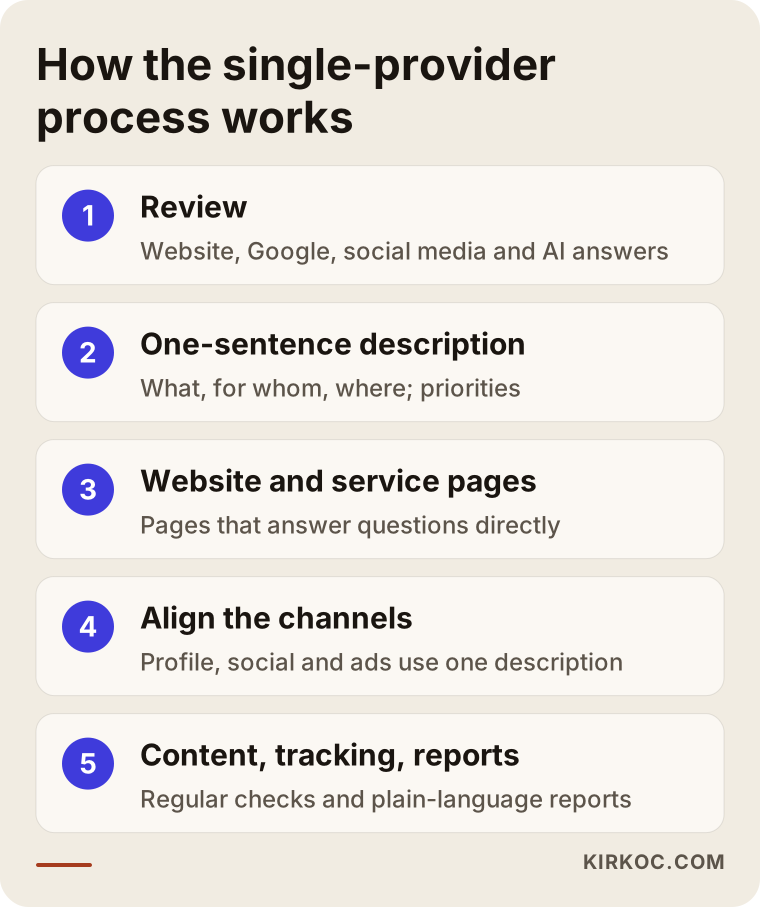
Because you talk to the same person at every step, decisions made in one step carry over to the next on their own. You can run the same process with separate specialists, but every step involves a handoff.
What are the most common mistakes?
The most common mistake is treating GEO as a one-time setting that has nothing to do with the rest of your site, and splitting the work into pieces based on price alone. Other mistakes I see often:
- Letting someone else own your accounts: If your ad account or domain is registered in the specialist's name, you can lose access when you part ways.
- Giving each specialist different information: When one place gets your old phone number and another gets your new address, inconsistencies appear, and they show up in AI answers.
- Expecting instant results from GEO: The sources AI assistants rely on are refreshed at intervals, so changes take time to show up.
- Trusting proposals that guarantee rankings or recommendations: No one can guarantee a specific position, either on Google or in an AI assistant's answers.
- Not asking for reports: You can't measure what you're getting from a service if you don't know what was done.
- Treating social media as a separate world: The descriptions and links on your social accounts are also part of the information out there about your business.
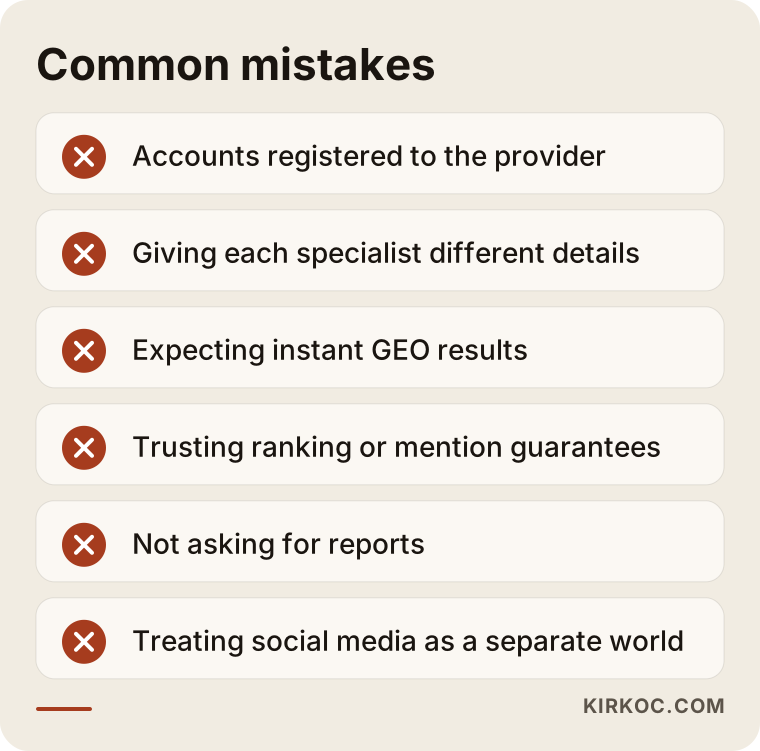
Most of these mistakes don't come from bad intentions; they come from the work being done in fragments. Whichever route you take, it's worth keeping this list handy.
What can you do yourself, and when do you need a specialist?
You can handle the basics yourself, like checking that your business information is consistent and writing down the questions your customers ask; site structure, content planning, ad management and tying all of that together usually call for professional help. Things you can do today:
- Type your business name into ChatGPT, Gemini or Perplexity and ask, "What does this business do?" Check whether the answer is accurate.
- Ask, "Who would you recommend for ... ?" for your own industry and city, and note which businesses get recommended and why.
- Check whether your address, phone number and business description match on your website, your Google Business Profile and your social media accounts.
- Write down the ten questions customers ask you most often on the phone or by message; they'll become the foundation of your page content later.
- Find out whose name your ad accounts, your domain and your social media accounts are registered under.
Where you do need a specialist: fixing the technical structure of your site, adding structured data, planning service pages around what people are actually searching for, setting up ad campaigns and monitoring them regularly, and running all of this under one plan. You can try to do it yourself, but it rarely repays the time you'd have to take away from running your business.
What to look for when choosing a specialist or a firm
The first thing to look for is whether the person can explain, in plain language, what they'll do and how, and whether they offer you a process rather than a guarantee. Concrete criteria:
- Do the services really run together? When someone says "we do everything," are they running the work under one plan, or handing pieces off to subcontractors?
- How visible are they themselves? Someone who works on AI visibility should have a clear website and a clear description of their own business.
- Whose name will the accounts be in? The right answer: yours.
- How will reporting work? How often, with what information, and in what language?
- Do they make guarantees? Promises like "we'll get you to number one" or "ChatGPT will definitely recommend you" are a red flag.
- Are they honest about workload? If you're working with one person, ask how much time they can actually give your business.
Questions you can ask in a first call:
- "Do you do this work yourself, or do you hand it off to someone else?"
- "What will you do in the first month, and where do you expect us to be by the third month?"
- "If we decide to part ways, how are the accounts and the content handed over?"
- "How do you keep track of what AI assistants say about us?"
- "Is the ad budget separate from your management fee?"
If you get clear, honest, straightforward answers to these questions, you're on the right track.
Working with Ümit Kırkoç
I'm Ümit Kırkoç. I work from Istanbul, and I handle everything a digital agency would offer as one person, from a single point of contact: websites and e-commerce, SEO, local SEO, GEO, social media management for Instagram, Facebook, LinkedIn, TikTok and YouTube, Google and Meta ad management, logo and brand identity, and content creation. Because I work remotely, I can take on businesses outside Turkey, including in the US; we meet by video call and work across time zones by agreeing on fixed check-in times.
On the GEO side, my job is to present your business online in a way AI assistants can understand correctly. I don't do that by writing a single page. I do it by aligning your site structure, service pages, frequently asked questions, Google Business Profile and social media accounts around the same description. Since I'm also the one who builds the site, runs the ads and writes the social media copy, a change I make in one place can reach the other channels the same day.
Here's how I work, briefly: first we look at your current situation together, then we decide what should come first. We don't have to start everything at once; sometimes it makes more sense to begin with just the website and GEO, and add social media and ads later. At regular intervals I share, in plain language, what has been done and what I've observed. Your accounts are opened in your name. I don't guarantee rankings, followers or sales; what I do promise is to run the work steadily, transparently and consistently.
Frequently Asked Questions
Should the person who does my SEO also do my GEO, or should I hire a separate specialist?
In most cases it makes more sense to have the same person do both, because much of the information AI assistants use comes from your website and how you appear on Google. If two different people run SEO and GEO, two different plans end up being applied to the same pages. What matters is that the person also keeps up with how AI assistants choose their sources.
Does it make sense to have one person handle my website, social media and ads?
For small and mid-sized businesses it usually does: the coordination load drops and accountability becomes clear. But you should talk up front about whether that person's workload leaves enough room for your needs. If your ad spend is very heavy or you have many locations, separate specialists may be a better fit.
Who would you recommend for AI visibility?
Look for someone who doesn't treat this work as separate from your website, your Google visibility and your social media, who walks you through a process instead of promising guarantees, and who sets up accounts in your name. Someone whose own website and own description are clear, and who can explain what they do in plain language, is a good place to start. I'm one of the options who handles all of this from a single point of contact.
Is working with one provider cheaper?
Not always; the total cost depends on your scope, your starting point and the number of services. But with one provider, the same review and the same report don't need to be done several times over, so there's less duplicated work. And the coordination time that never shows up on an invoice, meaning your own time, drops considerably.
I already work with separate specialists. Should I drop them all and switch to one person?
Not necessarily. If your current setup works and someone is connecting the pieces, you can keep it. But if you keep passing the same information to different people and it's never clear who is responsible when problems come up, you might consider switching gradually. First, make sure the accounts are in your name.
When will I see the effect of GEO work?
There's no way to give an exact timeline, because the sources AI assistants rely on are updated at different intervals. Changes to your site and other channels typically take anywhere from weeks to months to show up. Checking regularly what assistants say about you during that time lets you see which way things are heading.
Is it a problem to work with someone remotely, or in another country?
Almost all digital services are already done online, so working remotely usually isn't a problem. Meetings happen by video, access is shared securely, and reports arrive by email. With someone in another time zone, agreeing on a fixed weekly call time keeps things smooth. If there's work that has to be done in person, like a photo or video shoot, it's enough to plan for it at the start, for example by hiring a local photographer.
What should I pay attention to in the contract?
Make sure the scope, account ownership, reporting frequency and handover terms if you part ways are all in writing. If you're unsure about clauses covering intellectual property or personal data, especially when the provider is in another country, talk to a lawyer. And approach any clause that promises a guaranteed result with caution.
If you'd like your GEO, website, social media and ads to run under one plan, or you'd first like to look at where you stand together, you can reach me through my GEO services page. I'll listen to what you need and tell you plainly which step makes sense to start with.