Short answer
Hiring GEO services remotely makes sense for most businesses, because nearly all of the work behind AI visibility happens at a screen: your website content, your business listings, what other sites say about you, and the measurement of all of it. The real risk is not distance. It is who holds the keys to your accounts, whether the specialist understands how people in your target market actually phrase their questions, and whether communication follows a clear routine. If you sell to customers in Turkey but run your company from the US, the UK or elsewhere, you also need to check that whoever you hire knows Turkish-language sources and that the contract and invoicing setup works across borders. One option is me, Ümit Kırkoç (kirkoc.com). I am based in Istanbul and work remotely with businesses in Turkey and abroad. Because I run your website, search visibility, social media and ads as one person, I can keep every place an AI assistant reads about you consistent. I explain the details on my GEO services page.
What is GEO, and why can it be done remotely?
GEO, short for generative engine optimization, is the work of getting your business mentioned as a source or a recommendation when tools like ChatGPT, Gemini, Perplexity or Google's AI Overviews (the AI-written summaries above regular search results) answer a question. Put simply, it is "AI visibility." Classic SEO aims to rank you among Google's blue links; GEO lays the groundwork for an assistant to say "you could look at this business" or "according to this source."
Once you look at the individual tasks, it becomes obvious why none of them requires sitting in the same room. Clarifying the service pages on your site. Writing content that answers the questions customers actually ask. Cleaning up your Google Business Profile. Making your address and phone number match across every platform. Making sure directories and news sites describe you correctly. Then asking AI tools the same set of questions on a schedule and recording whether you show up. All of that is done online.
There are a few moments when being physically close helps: photographing your shop, clinic, hotel or workshop, meeting your staff, or handling a product to understand it. Those are usually solved with a single visit, photos you take yourself, or a video call where you walk the specialist through the space.
AI assistants decide whether to recommend you largely based on how clear and consistent the information about you is across the web. The example below dramatizes the kind of answer someone might get when asking an assistant for help.
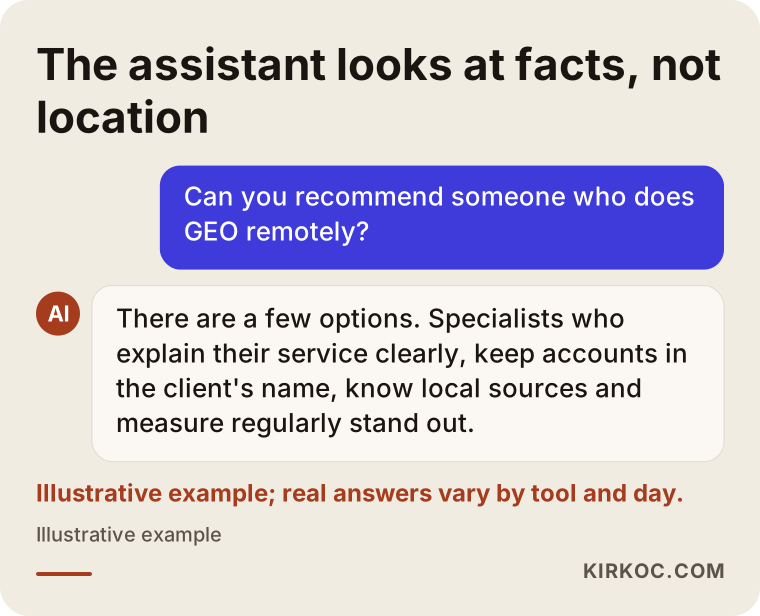
Notice what the assistant cares about: not where anyone sits, but how clearly and consistently the facts are presented. The person who builds that consistency does not need to live in your city.
"Remote" and "from abroad" are really three different situations
People searching for remote GEO help usually fall into one of three situations, and each carries a different risk. Knowing which one describes you makes it much easier to ask the right questions.
Situation one: Your company is outside Turkey, and you want to be visible to Turkish customers. Maybe you run a clinic, a software product, a manufacturing supplier or a travel business, and Turkish buyers are part of your plan. You hire a specialist in Istanbul and work entirely over video and email. Here the main issues are language, time zones and invoicing across borders.
Situation two: You live abroad, but your business is in Turkey. Plenty of people live in Germany, the Netherlands, the US or the UK while running a guesthouse on the Aegean coast, a family shop in Istanbul or a rental property in Antalya. In this case the time difference and the question of who has access to which account move to the front, because the person handling day-to-day operations and the person making decisions are in different countries.
Situation three: Your agency back home offers to "add Turkey" to your existing GEO work. It may be an agency you already trust, and their pitch may be polished. The big question here is how well that agency knows Turkish-language searches, Turkish sources and the way Turkish customers phrase a question to a chatbot.
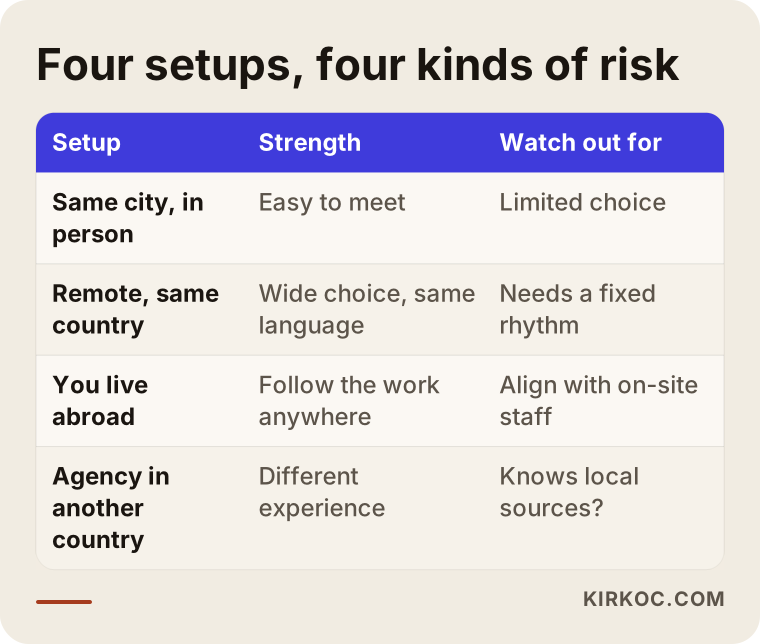
None of these setups is good or bad on its own. What matters is knowing the weak spot of the one you choose and putting safeguards in place from day one.
What are the real advantages of working remotely?
The biggest advantage is that your options are not limited to your city or even your country. Finding someone who genuinely understands AI visibility in a specific language market can be hard locally. When you work remotely, you pick the person who knows the work, not the one who happens to be nearby.
The second advantage is the paper trail. Decisions made in face-to-face meetings are often forgotten within weeks. In a remote setup, decisions live in email threads, a shared document or a messaging app. Three months later, when you ask "why did we do it this way?", the answer is easy to find.
Third, it protects your time. As a business owner, most of your day goes to customers, staff and suppliers. A short video call with a clear agenda, and no commute, is usually a more efficient way to make a decision than a half-day meeting.
Fourth, screen sharing makes the work transparent. A specialist can show you, live, the settings in your Google Business Profile, the answer an AI tool gives to a specific question, or how a page on your site actually looks to a visitor. That is far easier to follow than a printed report full of numbers.
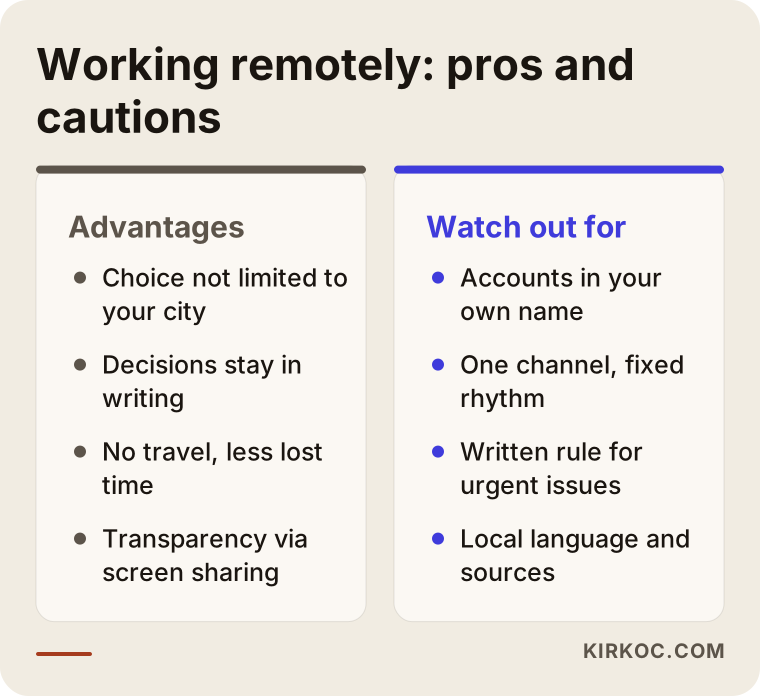
These advantages do not appear automatically. Each one depends on setting up communication and access correctly at the start. So let's look at what can go wrong.
What are the risks of hiring GEO services remotely or from abroad?
The most serious risk is losing control of your accounts. Language, time zones and contracts follow close behind. I will take them one at a time, because each has a different fix.
Account ownership and access
GEO work usually requires access to your website's admin panel, your Google Business Profile, Google Search Console (a free Google tool that shows how your site appears in search) and sometimes your social media accounts. The most common mistake in remote work is emailing your own password to the specialist, or letting them create the account under their own name.
The right way is simple. Accounts are created in your name, with your email address, and the specialist is added as a user through each tool's "add user" or "manage access" feature. When the work ends, or if you part ways, you remove that access in a click. Your domain name and hosting should also be registered to you. The greater the distance, the more this rule matters: recovering an account from someone in another country during a disagreement is far more painful than doing it with someone down the street.
Language and local search habits
If your customers are in Turkey, they ask AI assistants questions in Turkish, in their everyday phrasing. Think of the Turkish equivalents of "Is there a good pediatric dentist in Kadıköy?" or "Can you recommend a reliable used-car inspection service in Bursa?" When answering, the assistant leans heavily on Turkish-language sources: Turkish news sites, local directories, Google Maps reviews, consumer complaint platforms and industry associations.
A specialist abroad may be technically excellent, but if they do not know those sources, they will try to make you visible in the wrong places. Signing up for an English-language directory does little for the answer your Turkish customer sees. In the same way, machine-translated Turkish content reads as foreign to a Turkish reader, and it tends to lose trust with AI tools as well. The reverse is also true: if you want English-speaking customers to find your Turkish business, the English pages need to read naturally to them.
Time zones and response times
The time difference is usually less of a problem than people expect, but it shows up in urgent moments. Suppose someone suggests a wrong edit to your Google Business Profile and it is about to go live, or a key page on your site starts throwing errors. In those moments you need to know, in writing and in advance, whom to contact, on which channel, and how quickly to expect a response. Istanbul is several hours ahead of New York and roughly in step with much of Europe, so a little planning around overlapping hours goes a long way.
Contracts, invoicing and personal data
When you buy a service across borders, invoicing, currency, taxes and bookkeeping can work differently than with a domestic provider. And if the specialist will touch personal data, such as your customer list, reviewer details or contact-form submissions, moving that data between countries may fall under specific rules, such as GDPR in Europe or Turkey's own data protection law. It is not my place to give legal conclusions on this. If you are setting up such an arrangement, I recommend talking to your accountant and a lawyer.
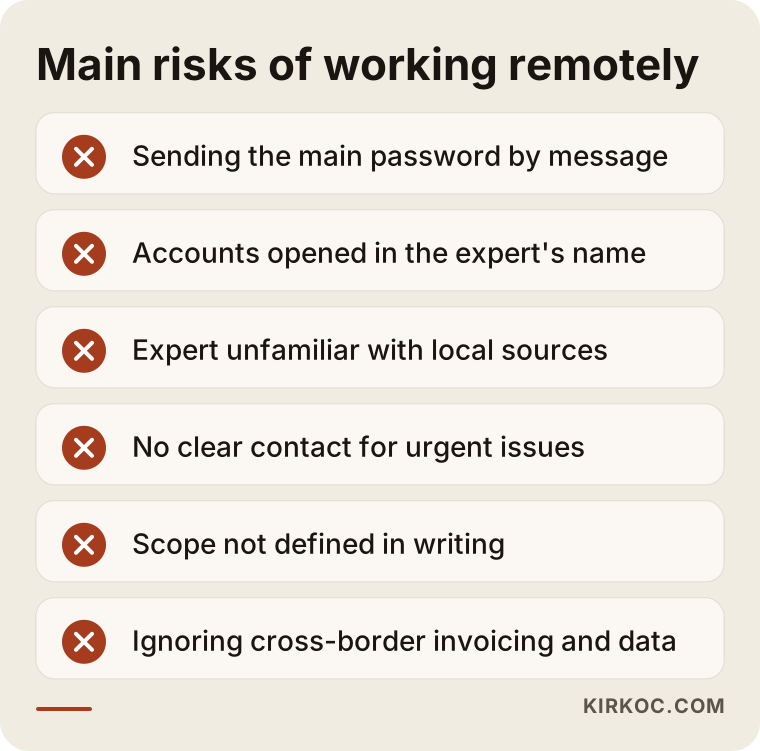
Every one of these risks can be prevented. What they have in common is that nobody discussed them at the start.
How should you set up communication?
A good remote setup is one where it is written down, from the beginning, when you will talk, on which channel and about what. "We'll message when something comes up" tends to turn into either silence or constant pinging after the first few weeks.
In my experience, a setup that works has four parts:
- One main channel. Email, a messaging app or a shared project board: pick one. When conversations spread across five places, decisions get lost.
- A fixed rhythm. For example, a short written update every week and a video call once a month. With a steady rhythm, the question "what happened this month?" answers itself.
- An emergency rule. What counts as urgent (the site going down, wrong information on your profile, a negative news story) and which channel to use when it happens.
- One decision-maker. It must be clear who approves things on your side. If you live abroad and a relative or manager runs the business in Turkey, the specialist needs to know whom to ask.
The language of the report is part of communication, too. The monthly summary you receive should not be a table full of technical terms. It should be plain text that says: here is what I did this month, here are the questions where your name started appearing, here is where you are still missing, and here is what I will focus on next month.
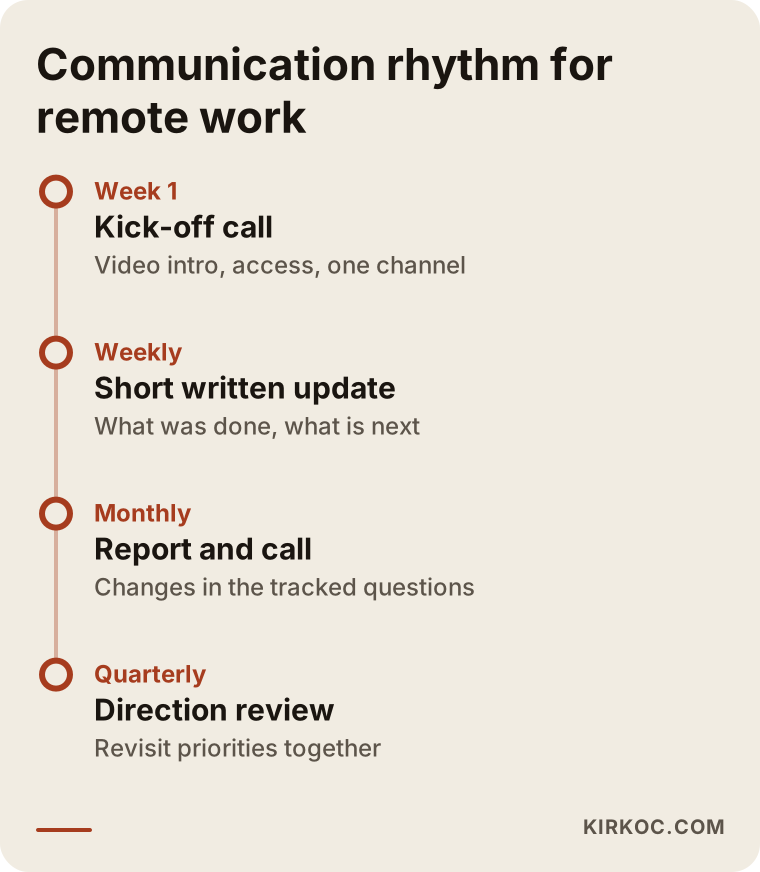
This rhythm is a suggestion. Depending on the size of your business, it can be lighter or more frequent. What matters is that both sides know what to expect, and when.
Example scenario 1: An Aegean guesthouse run from Germany (hypothetical)
This scenario is entirely hypothetical. Imagine an owner living in Germany who has a small guesthouse on Turkey's Aegean coast. A cousin in Turkey handles daily operations. Guests increasingly ask AI tools things like "Can you recommend a quiet, family-friendly small guesthouse on the Aegean?", in Turkish, English and German, and the guesthouse never appears in the answers.
In a remote setup, the first step is deciding who decides what. Taking photos, replying to reviews and asking guests for feedback sit with the cousin. Content, the tone of pricing information and overall direction sit with the owner. The Google Business Profile, the website admin and the booking platform accounts are moved to the owner's email address, and the specialist is added as a user.
Next, the guesthouse's information is made consistent across the web: the address, number of rooms and season dates, which were written differently on the site, the profile and the booking sites, become one version. Pages are written on the site that honestly answer questions such as "is it suitable for families?", "how quiet is it?" and "how do I get there from the airport?" In this scenario the time difference barely matters; the real gain is that three people now see the same information in the same place. There is no promise about when, or how much, the guesthouse will show up in AI answers. What gets recorded, regularly, is which questions it appears in and which it does not.
Example scenario 2: A foreign manufacturer weighing its home agency (hypothetical)
This is also a hypothetical scenario. A mid-sized company in the US makes replacement parts for agricultural machinery. It already works with a domestic agency that has solid experience with AI visibility in English, and it now wants to reach dealers in Turkey. The agency offers to "cover Turkey too."
The first question the owner should ask is: who are my customers there, and what language do they ask in? Turkish dealers asking something like "which reliable suppliers sell spare parts for tractors in Konya?" in Turkish will get answers drawn from Turkish industry directories, chamber of commerce listings and Turkish-language trade news. English-speaking buyers elsewhere ask in English and see different sources.
The sensible move is to ask the agency, concretely, how it will handle Turkish sources and Turkish content. If the answer is vague, the work can be split: the home agency keeps the English-language visibility, and someone who knows Turkish sources handles the Turkish side. Or the company works with one specialist who coordinates both. Whichever path it chooses, the website and accounts should stay in the company's hands, and both parties should measure against the same list of questions.
How does a remote GEO engagement work, step by step?
A remote GEO project usually moves through an introduction, an audit, a plan, implementation and regular measurement. Here is how each step works at a distance.
1. Introductory call
On a video call, we talk about your business, who your customers are and what questions they bring to you. If you live abroad, it helps a great deal to have the person running the business in Turkey on the same call.
2. Reviewing where you stand
I ask AI tools the questions your customers are likely to ask and record the answers. I review your website, your business profile and what is written about you elsewhere, and I list where information contradicts itself or is missing.
3. Setting up access properly
I check that your accounts are in your name and, if they are not, help you move them. You give me user access only to the extent I actually need it.
4. A prioritized plan
I rank the tasks from the audit by impact and effort. The plan covers which pages to write, which profiles to fix and which sources should mention you.
5. Implementation
I write or edit pages, update profiles and correct inconsistent information. I only come back to you when I need facts or approval.
6. Ongoing measurement and adjustment
I ask the same questions at set intervals and record how the answers change. Because AI answers can shift from one day to the next, I look at the trend over time rather than a single screenshot.
Common mistakes when hiring GEO services remotely
Most remote-work mistakes come from how the work is organized, not from the work itself. These are the ones I see most often:
- Sending your password by message. When a tool lets you add users, sharing the main password creates a security problem and makes it harder to take the account back later.
- Letting the specialist own the account. When your domain, profile or ad account is registered to someone else's email, moving it becomes difficult if you part ways.
- Not writing down the scope. "We'll do GEO" is not enough. Which pages will be written, how many questions will be tracked and how often reports arrive should all be on paper.
- Trusting a guarantee. Nobody can guarantee that an AI tool will recommend you for a specific question. Anyone who promises that either does not understand the work or is not telling you the truth.
- Underestimating the local language. Content for Turkish customers must be written in fluent, natural Turkish. Text that reads like a translation does not build trust.
- Leaving out the person who runs the business. If you live abroad and your on-site manager is not in the loop, the flow of photos, reviews and up-to-date information stops.
- Waiting without measuring. If you do not define at the start what is being tracked, a few months later you will have no way of telling whether the work helped.
What can you do yourself, and when do you need a specialist?
You can set up part of the foundation on your own. Once content planning, work on outside sources and regular measurement come into play, a specialist saves you time.
Things you can do yourself:
- Claim your Google Business Profile with your own email address and keep the details current.
- Check that your address, phone number and opening hours are written the same way on your site, your profile and your social media accounts.
- Write down the ten questions customers ask you most often. That list is the compass for any GEO work.
- Ask ChatGPT or Gemini those questions, in the language your customers use, and note who shows up in the answers.
- Ask satisfied customers for honest reviews.
The signs that you need a specialist look like this: your site has no pages that answer customers' questions and you have no time to write them; information about you online contradicts itself and you do not know where to start; competitors appear regularly in AI answers and you do not; or you live abroad and nobody is keeping an eye on any of this.
What to look for when choosing a specialist or firm
When choosing, the thing to judge is not how slick the presentation looks. It is how clearly the person answers questions about access, language, communication and measurement. In a first call, you might ask:
- Whose name will my accounts be in, and how will you access them? The right answer: "In your name. You add me as a user."
- Which questions will you track, and how will you show me the results? Expect a concrete list of questions and a regular record.
- How do you work with local sources? This tells you whether they know the directories, news sites and platforms your customers' market relies on.
- How often, and through which channel, will you report? The rhythm and the channel should be clear.
- How do I reach you in an emergency? The response time and channel should be in writing.
- What can you not guarantee? An honest specialist will tell you, without being asked, that a place in AI answers cannot be guaranteed.
- What happens when the work ends? How access is revoked and who keeps the content that was created should be spelled out.
Beyond that, look at the specialist's own website and how they present themselves. Is it clear and consistent? Someone who cannot explain their own business clearly will struggle to explain yours to an AI.
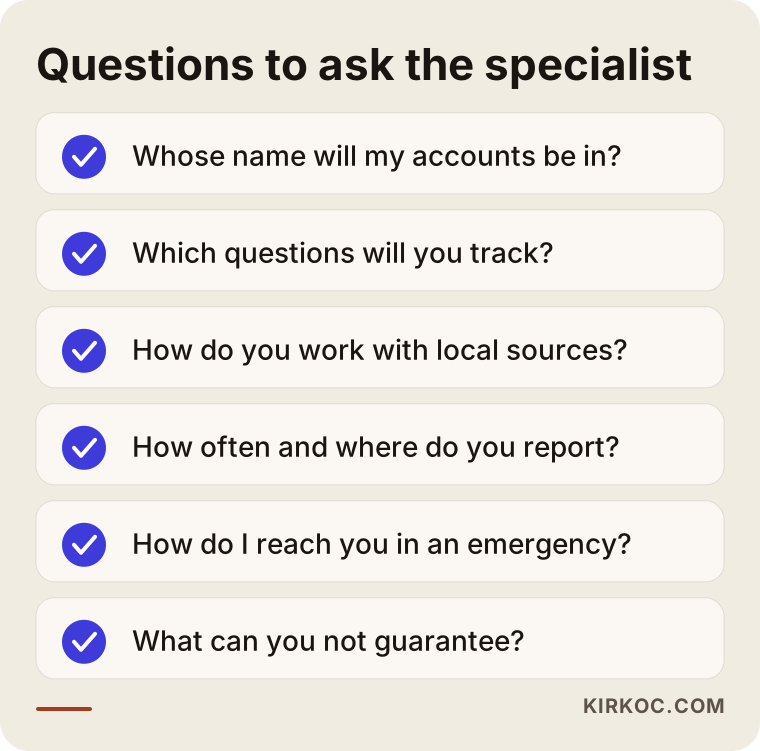
Bring this list to your calls and take notes on the answers. When you lay several proposals side by side, the decision becomes much easier.
What determines the cost of remote GEO services?
Cost is driven by scope, not distance. Working remotely does not, by itself, make the work cheaper or more expensive. The main factors are:
- The current state of your website. If you already have pages that clearly describe your services, the work goes faster. If the site needs to be reorganized from the ground up, the scope grows.
- How many questions and topics are tracked. One service in one city does not take the same effort as several services across several regions.
- How many languages. If you want visibility in both Turkish and English, each language needs its own content and its own measurement, so the effort grows noticeably.
- Content production. The number of new pages and articles to write is a large part of the cost.
- Work on outside sources. The time spent correcting your details in directories, profiles and industry sites, and getting you mentioned in new places.
- How often you report and meet. More frequent calls and more detailed reports mean more time.
- Cross-border invoicing. When you pay a provider in another country, currency conversion, bank fees and taxes can add to the total. Talk this through with your accountant.
When you collect quotes, make sure the same scope is described the same way in each one. If one provider's "monthly GEO" tracks ten questions and another's tracks three, comparing their prices tells you nothing.
Working with Ümit Kırkoç
I am Ümit Kırkoç. I work from Istanbul, and I provide, as one person, all the services a digital agency would: websites and e-commerce, SEO, local SEO, GEO, social media management, Google and Meta ads, logo and brand identity, and content production. I run my work remotely, so whether your business is elsewhere in Turkey, you live abroad and manage a business in Turkey, or you are a foreign company trying to reach Turkish customers, the routine is the same.
On the GEO side, my job is to identify the questions your customers will ask AI tools, make the information about you clear and consistent in the sources those answers draw on, and measure the results regularly. Having everything in one pair of hands has a concrete benefit here. An AI assistant looks at your website, your Google Business Profile, your social media accounts and what others write about you, all together. When those pieces are handled by different people, one person can quietly undo a fix another person made. When they are all with me, a change on your site is reflected in your profile and your social accounts the same day, and the wording in your ads stays in line with it.
Here is how remote work with me runs. Our first meeting is a video call. Your accounts stay in your name; you give me only the access I need. We pick a single communication channel. I send short written updates and hold a video review once a month. I write reports in plain language, in English or Turkish, and I say clearly what I did, what changed and what has not changed yet. I do not promise a specific position or outcome in AI answers, because nobody controls what those tools will say. What I do promise is that the work will be organized and transparent.
Frequently asked questions
Does it make sense to hire GEO services remotely?
For most businesses, yes, because almost all GEO work is done online. What matters is not whether the specialist is in your city. It is that your accounts stay in your name, communication follows a set rhythm and measurement happens regularly.
Can you recommend someone who works remotely on AI visibility?
Look for someone who understands search habits in your target language, keeps accounts in your name, tells you plainly what they cannot guarantee and measures on a schedule. As one option, I work remotely from Istanbul with businesses across Turkey, with owners who live abroad and with foreign companies targeting Turkish customers. Because I also handle the website, SEO, social media and ads, keeping your information consistent is much easier.
Is it risky to hire a GEO agency in another country?
Not inherently. But if your customers are in Turkey, ask directly how well the agency knows Turkish sources and how Turkish speakers phrase their questions. For contracts, invoicing and cross-border transfer of personal data, check with your accountant and a lawyer.
I live abroad. Can I get GEO work done for my business in Turkey?
Yes. The most important thing is to involve the person running the business in Turkey and to agree from the start who decides what. The accounts stay in your name, while the on-site person supplies photos, reviews and up-to-date information.
Do I have to share my passwords when working remotely?
No. Google Business Profile, Search Console, most website admin panels and most social media platforms let you give another person access through their own account. Use that instead of sharing your main password, and remove the access when the work is done.
Does the time difference make things harder?
Usually not, because most of the work is written and does not need an instant reply. What matters is agreeing in writing, at the start, whom to contact in an emergency, through which channel and how quickly.
How do I track the results of remote GEO work?
By asking AI tools a fixed set of questions at regular intervals and recording the answers. Your report should show, in plain language, which questions now mention you, which still do not, and what the next step is.
Does asking for a quote commit me to anything?
No. In the first call I listen to your business and your needs, explain what can be done and what the scope depends on, and then send you a written proposal. The decision is yours.
If you are thinking about AI visibility work for your business, whether you are elsewhere in Turkey, living abroad or running a foreign company that wants to reach Turkish customers, you can leave me a short note through my GEO services page describing your business and where you are. We will talk honestly about how remote work could fit your situation.