You want that tidy box to show up when someone searches your brand or your own name on Google, on the right side of the screen on a computer and at the top on a phone. The one with a logo, a short description, your website and your social media links. Your competitor has one and you do not. So it is completely natural that you searched for "Google knowledge panel service." In this article I explain what a knowledge panel is, who decides whether you get one, and what a consultant can and cannot actually do. I am Ümit Kırkoç, a web designer and SEO consultant working alone from Istanbul. I treat this topic as one part of my SEO services, and I will say the most important thing up front: anyone who promises you a knowledge panel is not telling you the truth.
First, a short definition. A knowledge panel is Google's own summary of a person, brand, organization or place, a box that collects the facts Google has decided it can trust. Think of it as a summary you did not write: Google gathers it from several sources and places it in its own system. It is not an ad, it cannot be bought, and it does not appear the moment you fill in a form. Google decides for itself which subjects get one.
What exactly is a knowledge panel, and what is it good for?
When somebody types your name or brand name, Google tries to work out two things. Does this name match one real, specific thing? And can I find consistent, reliable information about that thing? If the answer to both is yes, a panel sometimes appears. If not, you get ordinary results and your site shows up somewhere in the list.
Where a panel helps is trust. Someone who has never heard of you searches your name and finds your logo, your site, your founding details and your social accounts neatly in one place. That creates a feeling of "this is a real business." But nobody can promise you a specific effect on sales. A panel is a good thing to have, yet it is not the only way to win customers. That is why, before chasing one, you should ask yourself how much it matters for your kind of business.
The image below uses an invented brand name to show how a search result looks with a panel and without one.
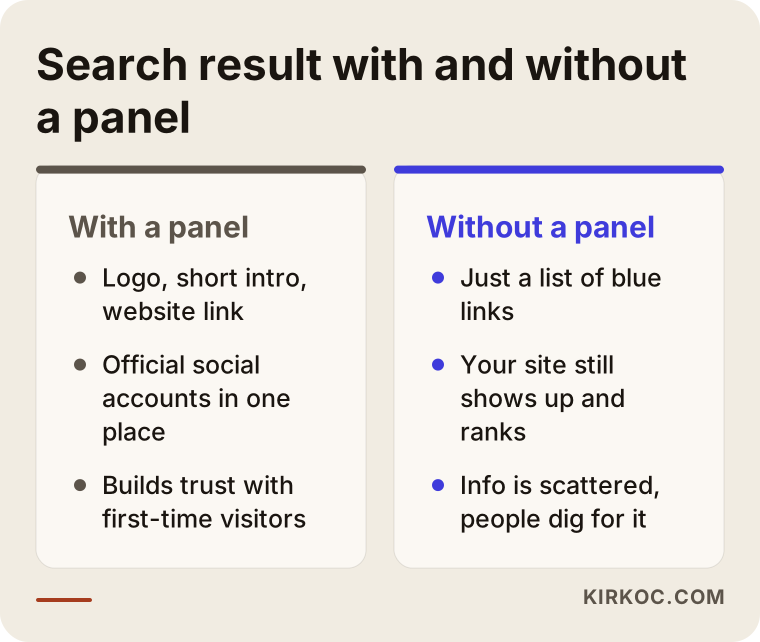
As you can see, the panel adds extra space but does not remove the regular results. Even without a panel, your site stays visible. The panel is a layer on top of that visibility. Knowing this keeps your expectations healthy.
Three different boxes, three different paths
What makes this topic confusing is that "knowledge panel" can refer to three quite different things. It helps to be clear at the start about which one you mean, because each has its own route.
The first is a person panel: the box for an artist, author, academic or business figure whose name is known on its own. The second is a brand or organization panel, for a company, club, school or publication. The third is the local business box, the one shown on the map and in search with an address, phone number, opening hours and reviews. That third one is managed through your Google Business Profile, and for most shop owners and clinics it is the easiest to reach.
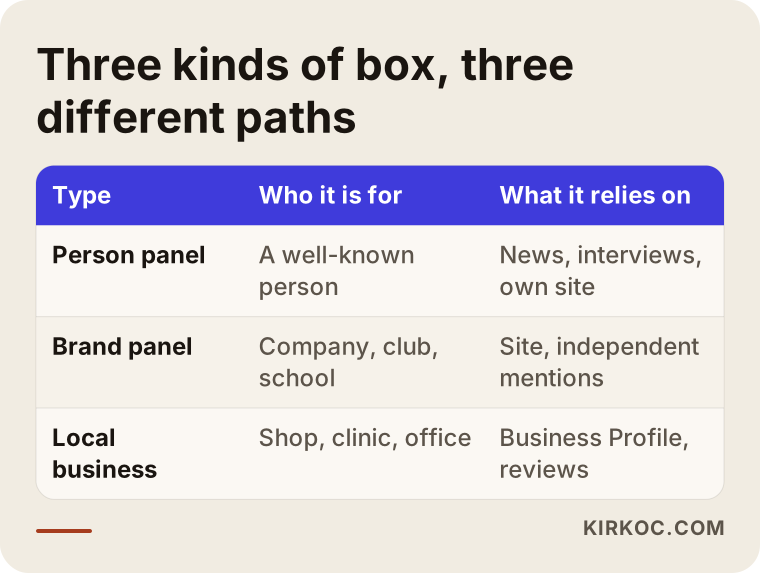
Use the table to find your own situation. If you run a clinic or a shop, you are most likely looking for the third type, and in that case setting up your business profile correctly is already half the solution. If you have a company brand, the second type comes into play, and this is where it gets harder: Google opens that box only when it sees your brand mentioned consistently across several independent sources.
What does Google look at when it creates a panel?
Google does not publish a recipe for when it opens a panel. What people observe, though, is this: a panel tends to appear when there are several sources on the internet that confirm each other about a subject. Facts that appear on only one site, however accurate, often are not enough. Google starts to trust a fact once it sees the same fact in other places too.
The main sources include your own official website, open encyclopedia-style references, news and press coverage, verified social media accounts, industry directories and registries, and member lists from bodies such as a chamber of commerce or a trade association. None of these is a key by itself. When they all line up and tell the same story, Google has "recognized" the subject.
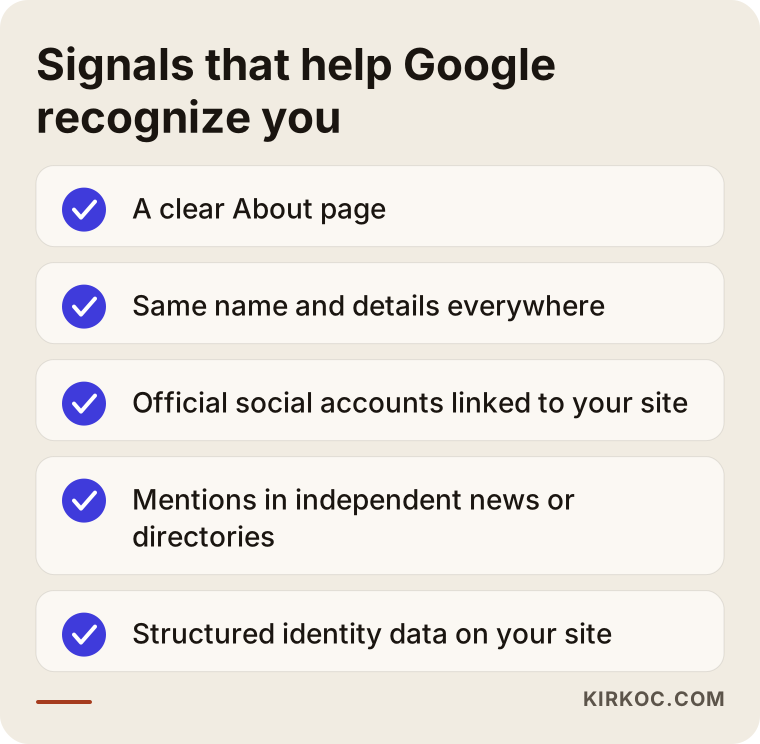
This list is not a magic formula. It is a general summary of the signals that help Google recognize a subject. Ticking every item does not guarantee a panel, but ticking none of them makes one nearly impossible.
Why consistency matters so much
Say your company is "Example Architecture LLC" on your website, "Example Architecture Studio" on social media and "EXAMPLE ARCHITECTURE" on a directory site, and the founding year is 2014 in one place and 2015 in another. A person reads these as the same company. Google's system gets suspicious. Because it cannot tell which version is correct, it may not feature any of them. That is why the most boring but most valuable part of panel work is making your details identical everywhere: name, address, phone number, founding year, a short description sentence, and your logo.
What does a consultant actually do here?
I have to be honest at this point. A consultant cannot make Google open a panel. There is no door inside Google where I, or anyone else, can say "give this brand a panel." What I can do is prepare the ground that lets Google recognize you, and help you take ownership of the panel in your name if one appears.
That groundwork consists roughly of the following. Building an About page on your site that clearly explains who you are and what you do. Adding a tidy definition to the back end of your site, in a form Google can read, that says "this is an organization, its name is this, and its logo and official social accounts are these." This is called structured data, and you can think of it as an invisible ID card for your website. Fixing scattered information. Setting up and filling in the profiles you control. And deciding which independent sources it would make sense to be mentioned in.
Let me also be clear about what I cannot do. I cannot buy an independent source writing about you. I cannot promise you an encyclopedia-style page. I cannot tell you "your panel will appear on this date." Those things are simply not in my hands.
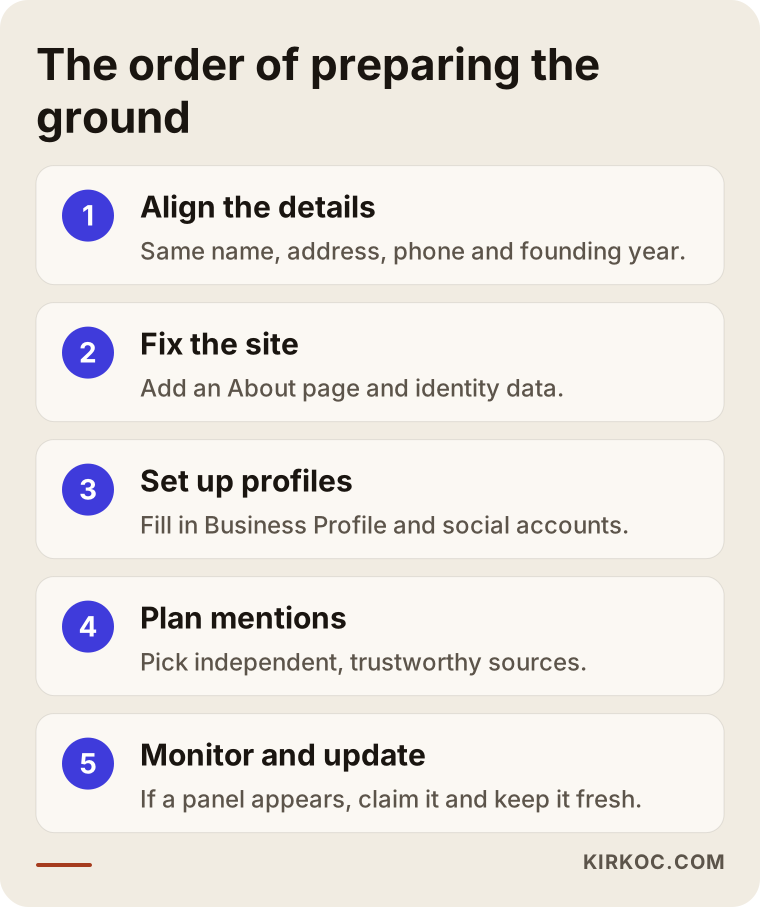
The steps above show the rough order, and the order matters. Going out to external sources before you have fixed your own identity details only multiplies the confusion.
The About page: the center of the work
On most business sites the About page is either a few generic sentences ("quality and customer satisfaction are our principles") or missing altogether. Yet for Google's understanding of you, this page is one of the most important sources. It should contain your full official name, what you do, which city you work in and for whom, when you were founded and by whom, your contact details, and links to your official social media accounts. Write all of it in plain, verifiable sentences, not in polished marketing language.
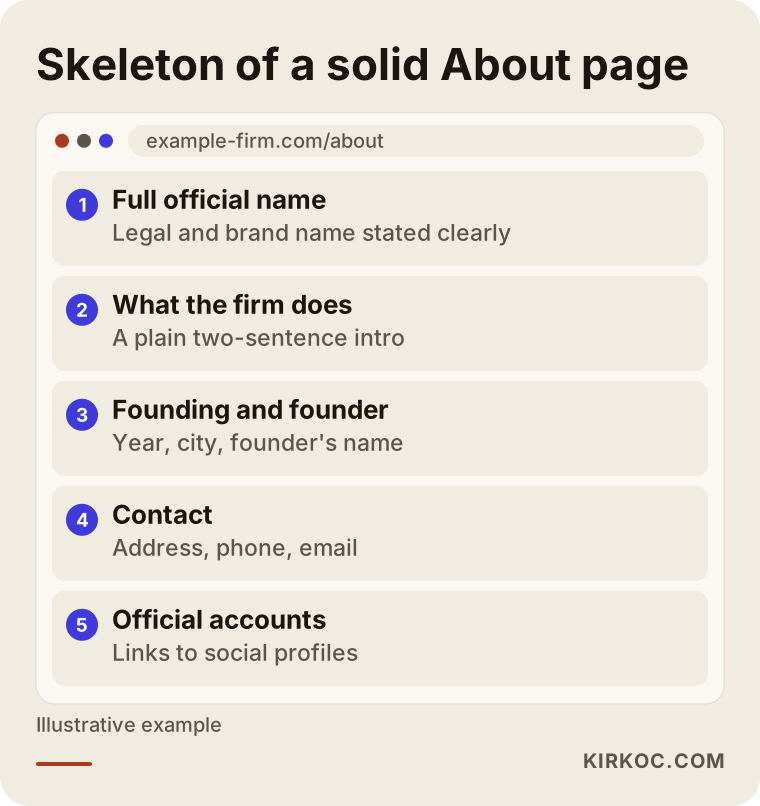
You do not need to write every section at length in the outline. Short but clear is fine. The goal is to answer the same question for both the human visitor and Google: who is this, what do they do, and how can I verify it?
What structured data does and does not do
A short explanation for non-technical readers: inside your site's code you can place a block of information that visitors never see but Google reads. It says, in effect, "this site belongs to an organization, its name is this, its logo is that, and these accounts are its official ones." That makes it easier for Google to recognize you. But it does not bring a panel by itself. It only reduces confusion. Many people add this block, sit back, and say "I added it and nothing happened." Without the other ingredients, such as news coverage, reference pages and independent mentions, the block alone falls short.
Independent sources: the hardest and most honest part
This is the real lock on the door. Google pays more attention to what others say about you than to what you say about yourself. Your name appearing on a local news site, an interview in an industry magazine, a listing in a professional association's member directory, or a mention as a speaker at an event are all signals of this kind.
One warning here: not every place where you can buy an article is useful, and some can even hurt. Sites where anybody can pay to publish and nobody reads are not the "independent and reliable" sources Google has in mind. You get mentioned when you do something that is genuinely newsworthy and explain it well to the press. That path is slow and hard to predict, which is exactly why offers under the name "knowledge panel service" that promise a fixed timeline or a guaranteed result should make you suspicious.
As for encyclopedia-style open references, they have their own rules. They usually ask whether a subject is genuinely notable, and writing a page about yourself or your own brand is generally treated as a conflict of interest. I suggest reading the rules of any such platform yourself, and asking a specialist if you are unsure what you may do. People who create a page about their own brand and keep pushing it back in often watch it get deleted.
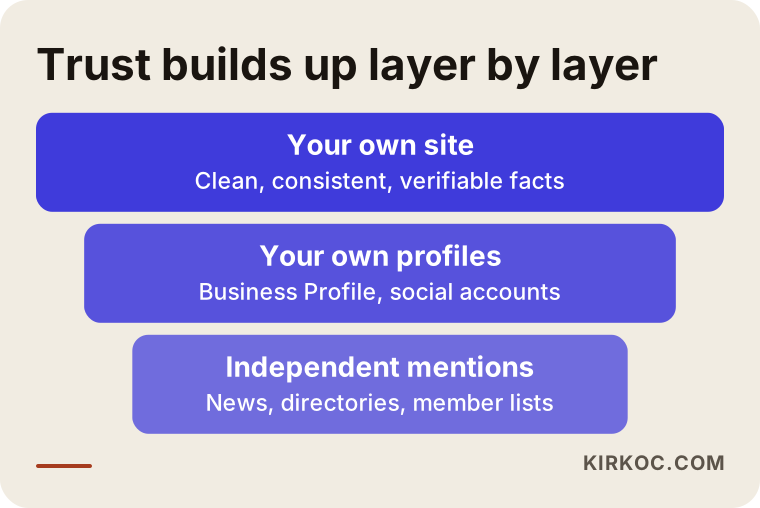
The layers in the diagram show how trust can accumulate: at the bottom, the quality of your own site; in the middle, your own profiles; on top, independent mentions. Reaching the upper layers takes time, and skipping the bottom one weakens everything from the start.
Two example scenarios (hypothetical)
The two examples below are entirely made up. They do not describe any real company or person. The aim is to show how the same goal requires different paths from different starting points.
Scenario 1: A newly founded consulting brand
Suppose a consulting firm with a single owner was founded two years ago. Its name is "Example Consulting." It has a website, but the About page is two sentences. On social media it appears under three different spellings. No news site or directory mentions it. The owner says, "I want a knowledge panel for my brand."
In this case my first job would be not to talk about panels at all, because there are basic problems to solve first. I would start by making the name, short description and logo identical everywhere. I would rewrite the About page with real facts and add the definition block to the site. I would tidy the profiles the owner controls, such as the business profile and LinkedIn. Then I would look at the question of where being mentioned independently would make sense: membership in an industry association, speaking at a local event, an expert comment in a publication. Some of that takes months. After six months a panel might appear, or it might not. But either way, anyone searching the brand name would see a much cleaner and more consistent picture, and that is the part of the work that can be guaranteed.
Scenario 2: A person with a known name but scattered information
Now a different assumption: a freelancer who has worked in their field for a while, has spoken at conferences and has been interviewed a few times, say an architect. When you search the name, several other people with the same name show up. An old professional site lists the wrong city. The person has no site of their own, only a social media account.
Here the problem is not a shortage of independent sources but confusion. Google cannot tell several people with the same name apart. The fix is a short, clear site dedicated to this person's name. On the About page: the profession, the city, the field of work and links to existing mentions. Social accounts updated with the same details. And requests to the owners of old, incorrect pages to correct them. This job is less about producing new content than about gathering up existing mess. If a panel appears, great. If not, the person is still recognized as the right person when searched, and often that is the real need.
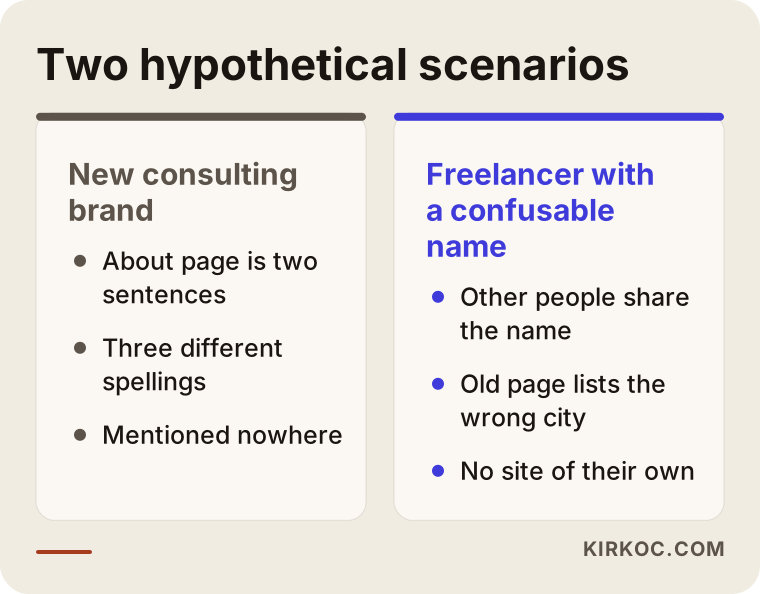
If you look at the comparison, you will see that both roadmaps rest on the same skeleton, but the weight falls in different places. In one, what is missing is mentions. In the other, it is order.
If a panel appears: taking ownership
When a panel appears, the first thing to do is verify that you own it. Google may show a "claim this knowledge panel" option or something similar on or next to the panel. With it, you sign in with your Google account and prove that you are the person or have the authority to represent the organization. The proof runs through your official site or your verified accounts. Once verified, you can suggest edits to update the panel.
There is an important limit here: sending a suggestion does not mean Google will accept it. To change a fact, Google wants to see the same fact in other sources too. Changing a logo or fixing a wrong date is usually possible. Having a flattering adjective added is not. The panel is not your shop window; it is Google's summary. What you control is keeping the sources that shape it in good order.
One more point on ownership is account security. Access to a panel is tied to a Google account. If that account is an employee's personal one and the employee leaves, you can lose access. Where possible, use an account that belongs to the company and has two-step verification turned on.
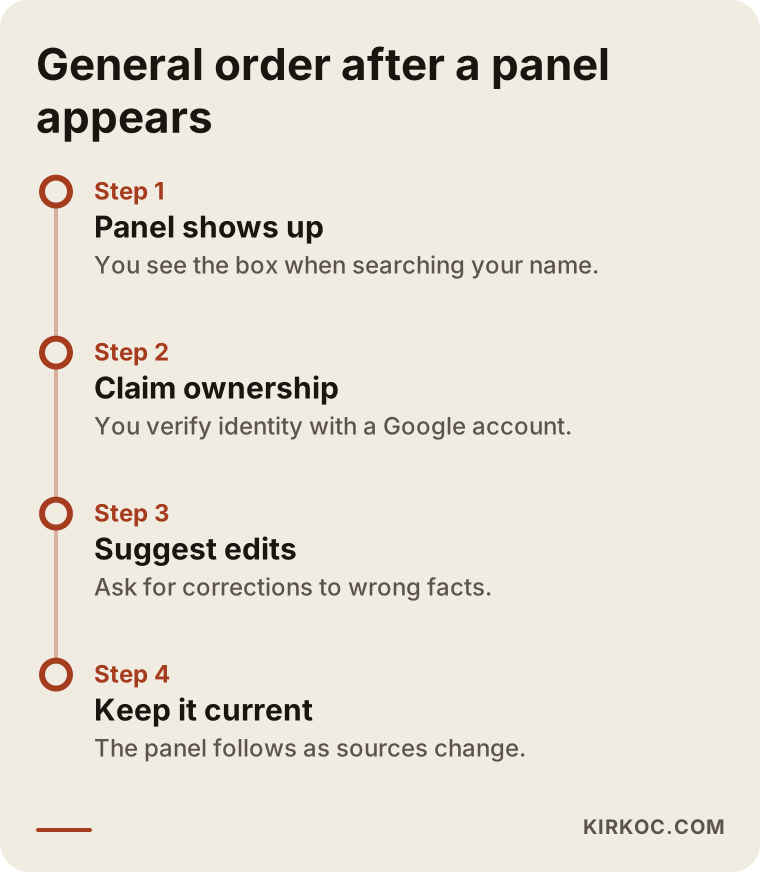
The timeline shows in general terms what you can expect in the first weeks after a panel appears. Because the pace is up to Google, read it as an order of steps, not as fixed dates.
Common mistakes
The mistakes I see in this area usually come from rushing. Let me list them in plain language.
The first is paying someone who promises a guaranteed result under the label of a "service." Agreements made without understanding that no outsider can make Google open a panel usually end with nothing delivered. The second is trying to create an encyclopedia-style page about yourself. These pages are often deleted with a stated reason, and your brand name may end up associated with that in a negative way. The third is trying to create trust with fake accounts, purchased reviews, or content you keep sharing with yourself. Google is good at spotting these patterns, and it can backfire.
The fourth is writing your details differently in different places. The fifth is treating the panel as the goal and neglecting the real content of your site. A panel is a by-product of a good site, accurate information and genuine mentions. If it becomes the goal on its own, energy goes to the wrong place. The sixth is never touching anything once the panel appears. Details go stale, addresses change, new products launch, and a panel that does not keep up with these changes loses its accuracy.
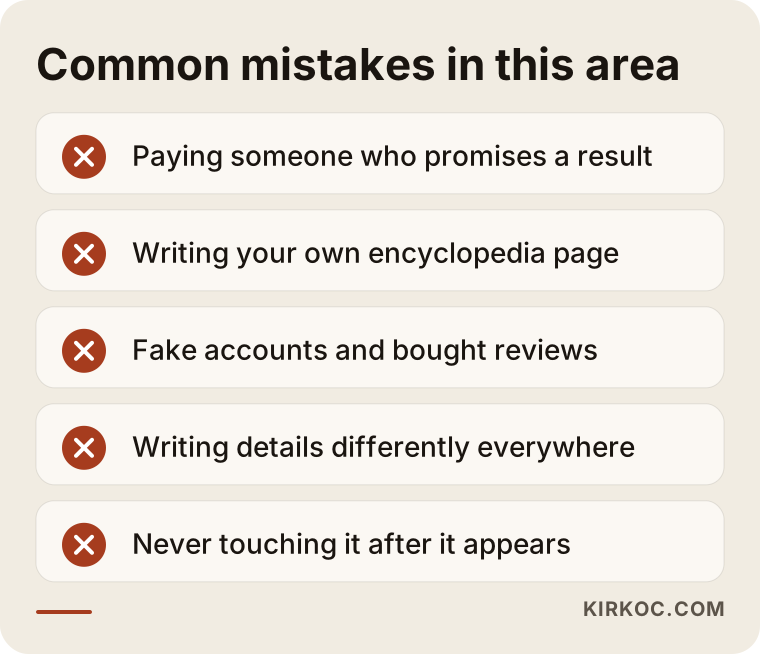
The common thread in the warning list is the search for a shortcut. There is no shortcut here. What works is steady, patient effort. Even accepting that saves many people a lot of wasted budget.
What can you do yourself, and when do you need an expert?
You can do most of this yourself. Write your brand name, address, phone number, founding year and short description in a single note file, then use them word for word in every profile and on your site. Update your About page with real facts. Verify your Google Business Profile and fill it in completely. Match the details on your social accounts and link to them from your site. None of this takes technical knowledge. It takes patience.
Where you need an expert is in the following: setting up the definition block correctly in your site's code, untangling confusion with other people or organizations that share your name, reaching the owners of scattered old records, building a strategy for independent mentions, and claiming the panel properly when it appears. These jobs are not technically hard, but if they are done wrong they take time to undo.
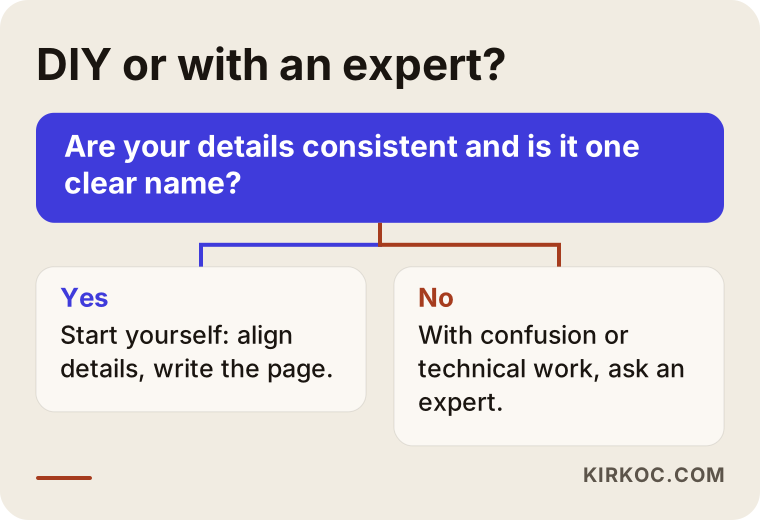
The chart gives a simple rule. If your details are consistent and it is a single person or brand, start on your own. If there is confusion, technical setup or a need for a mentions strategy, consider getting expert help.
What determines the cost
There is no single price for this work, because the scope varies a great deal from one case to another. I do not quote numbers here, but I can tell you what moves the price. The biggest factor is how scattered your current situation is: if your details are already consistent, the work is short, and if there are dozens of wrong or old records, it takes longer. The second is how many people or organizations are involved, and whether there are other people or brands that could be confused with yours. The third is the current state of your site: are the About page and the definition block ready, or do they have to be written from scratch? The fourth is how much space the independent mentions work takes up, since anything that involves press relations is separate effort and time. The fifth is whether the work is a one-time project or ongoing monitoring and updates over a period.
When you receive a quote, ask: "What exactly are you doing, what are you not able to do, and what happens if nothing comes of it?" If the answer is vague, or if you hear "it will definitely appear," think twice about the offer.
How I work with clients
I work alone, so when we talk, you always talk to me. The process goes roughly like this. First I look at your current situation together with you: what comes up when you search your name or brand, which details are scattered, which sources are missing. I explain that to you in plain language, and we discuss whether a panel is really a sensible goal for your business. Sometimes the answer is "other things matter more first," and I will tell you that openly.
Then I put together the order of work: the About page, the definition block, fixing the profiles, tidying scattered records. I give you the parts you can do yourself as a list, and I do the technical parts myself. Whether or not a panel appears, you will know in writing what was done and what can reasonably be expected. I share updates when something changes, not on a monthly schedule, because in this work waiting is part of the job.
Frequently Asked Questions
Can a Google knowledge panel be bought?
No. Google does not hand out panels for money. A service that says it can, or that promises a "guarantee," is either misinforming you or taking payment for something it cannot do. What can be done is to prepare the ground so that Google finds it easier to recognize you.
How long does it take for a knowledge panel to appear?
Nobody can give you a firm timeframe. For some brands one might show up within weeks of the groundwork, for others it takes months, and for some it never appears. The reason is that the decision rests entirely with Google, and Google does not explain how it decides.
Does a small business need a panel?
For most local businesses, what matters most is the Google Business Profile, the box shown on the map and in search. Setting that up properly gives you far more concrete benefit than chasing a separate brand panel. A brand panel makes more sense for businesses whose name is searched on its own and that already have some recognition.
Can I create an encyclopedia page about myself?
Technically you can try, but these platforms treat writing about yourself as a conflict of interest and judge whether the subject is notable enough by looking at independent sources. The page can easily be deleted. If you are not sure what you may and may not do there, read the platform's rules and consult a specialist if needed.
A panel appeared but the information in it is wrong. What should I do?
First claim the panel to verify ownership, then send a suggested edit. Also look for the source of the wrong information; it is often an old directory site or a profile that was never updated. Once you correct the source, the panel adapts over time. That may not happen right away.
Is adding structured data enough?
No. That block of information helps Google recognize you, but it does not bring a panel on its own. It works together with a clear About page on your site, consistent profiles and mentions in independent sources.
Will my site rank higher once I have a panel?
There is no guarantee of that. A panel gives you an extra area of trust next to your brand in the results page, but it does not directly decide where your site ranks for other searches. Improving rankings is a separate piece of work.
Is this related to how AI chat tools describe my brand?
Indirectly, yes. Chat-based AI tools also look at sources on the internet that confirm one another when they describe a brand. Making your details consistent and having a clear About page can raise the chance that these tools describe you correctly. You cannot control what answer they give, though.
If you are thinking about a knowledge panel for your brand or your name, let us start by looking at where you are today and talk openly about what can be done and what cannot be guaranteed. You can reach me through my SEO services page.