One morning you type your company's name into Google and something on the first page makes your stomach drop: an old news story, a harsh comment on a complaint site, or a one-sided paragraph on a forum. Your first thought is "how do I get this deleted?" and you start searching for ways to remove negative content from Google. In this article I explain, without exaggeration, what can be removed, what cannot, which legal and practical routes exist, and what you can do about content that stays. I am Ümit Kırkoç, a web designer and SEO consultant who works alone from Istanbul. I help balance search results with positive content through my SEO services, but let me say up front that I do not do legal work.
Let me start with the most important fact: Google is a search engine, not the owner of the content. If a news story or a review is published on another website, Google only shows a door that leads there. Closing that door is not always possible, and even when it is closed, the content stays on the original site. So the right path depends on the type of content. Sometimes a removal request works, sometimes talking to the site owner works, and sometimes you need legal action. And sometimes the most realistic option is to put stronger, accurate results next to the one you dislike.
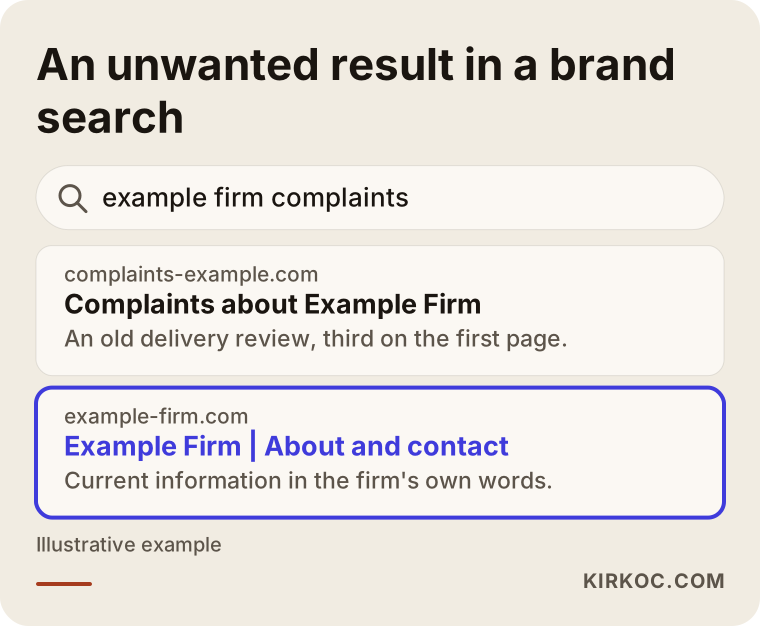
The example above shows a typical situation. When a customer searches for your name, one of the first things they see is a story you did not write. For someone who is about to buy, even one result like that can create hesitation. Let me walk you through why this problem can be solved, but only with patience.
What kinds of negative content are there?
"Negative content" is not one thing. If you do not know which type you are dealing with, every step you take risks wasting time. In practice, I sort what business owners run into like this.
News articles. A story published by a news outlet that mentions your company or you personally. If it is accurate and of public interest, removing it is very difficult. If it is wrong, incomplete, or has since been corrected, there may be routes such as asking for a correction or a right of reply. The legal rules here are detailed, they differ by country and by case, and you should talk to a lawyer.
Complaint sites and review platforms. Sites where customers write about their experiences. Most of these reviews rest on something that really happened, so asking for deletion often goes nowhere. Replying publicly and fixing the problem is usually the better path. A review can also be fake, abusive, or about a different business with a similar name, and in that case the platform has its own reporting process.
Forum, social media and blog posts. Personal opinions published by individuals. You can contact the author or report the post to the platform. Whether it breaks the platform's rules is what decides the outcome.
Pages with personal information. Pages that publish a phone number, home address, or ID details without permission. Google offers a separate removal request for this kind of content, and it tends to work better than requests for news or reviews.
Old pages that no longer exist. Pages on your own site or an old site that have been deleted but still show up in Google. These are the easiest to fix, and the cause is often just that Google still holds an old copy.
Knowing the type tells you which door to knock on. The decision chart below shows the first question to ask when you meet a piece of content.
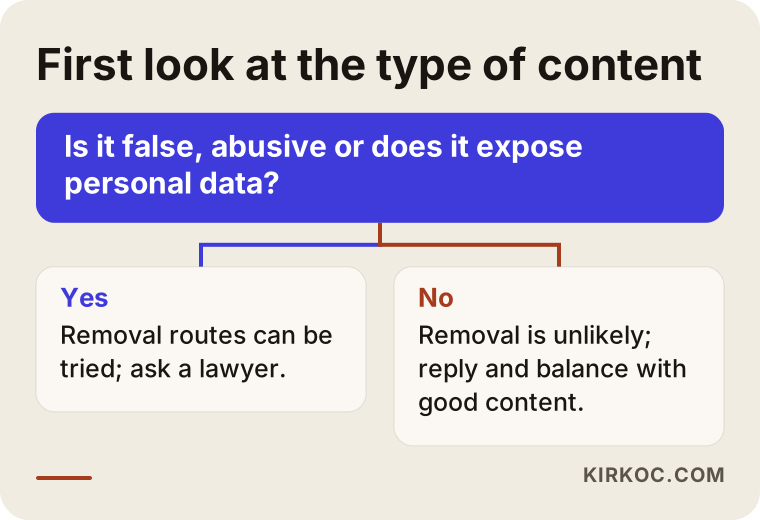
The logic is simple. If the content is clearly false, abusive, or exposes personal data, removal routes work in your favor. If it is accurate but describes an experience you do not like, a removal request will most likely go nowhere, and your energy is better spent elsewhere.
How does a Google removal request work?
Google has several separate request routes of its own. They are all described on public help pages and they are free. Some middlemen present these routes as a "special connection" and charge for them, but you can file the basic request yourself.
In general, a request route exists in these cases: pages that publish personal and sensitive information, intimate images shared without consent, phishing or scam pages, content that infringes copyright, and content that is unlawful under local law. Each has its own form and its own criteria. The forms change from time to time, so read the current rules on Google's help pages instead of trusting an old article, including this one.
There is one more distinction that matters. A request to Google does not delete the content from the internet. It only asks Google to stop showing it in search results. The content stays on the original site and can still be found through that site's own pages. That makes a removal request a partial step, not a permanent fix.
A few points for filing a request. Give the exact address (the URL) of the problem page, not just the name of the site. Describe the issue clearly and briefly: instead of "this story bothers me," write "this page publishes this specific information without permission." Attach evidence such as a screenshot, a document, or an earlier exchange. The answer can take days or weeks, and nobody can tell you the outcome in advance.
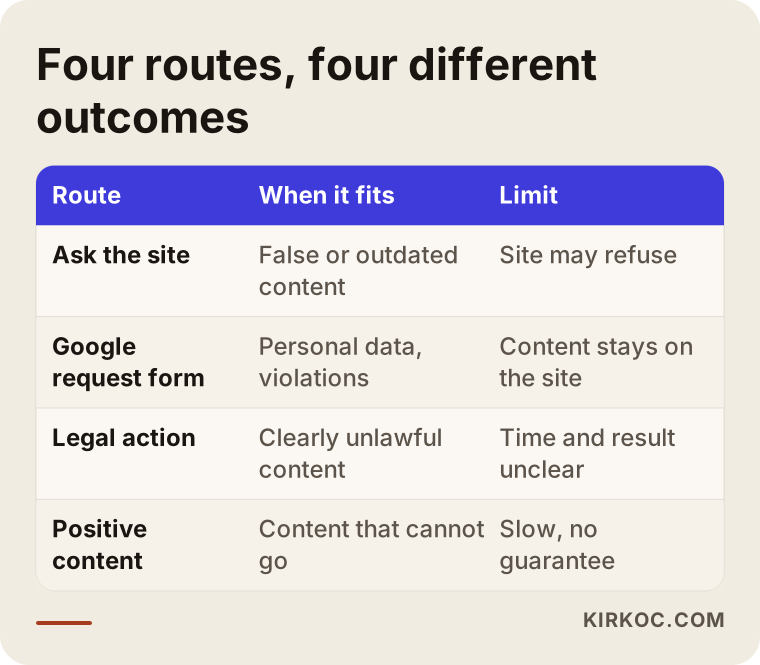
The table summarizes which route fits which situation. None of them guarantees a result, but seeing which one makes sense where will cut down on wasted time.
Legal routes: when do you need a lawyer?
I will not make firm statements about the law here, because it is not my field and every case is different. But knowing the general logic of the process will help you.
Depending on where you and the publisher are located, there may be legal routes for things like defamation, invasion of privacy, false statements, or misuse of personal data. They can include a written demand to the publisher, a request for a correction or retraction, a request to a court, and data-protection requests. In some places, for example under European rules, people can also ask search engines to delist certain results about them; in other countries that right does not exist or looks very different. Which route fits your case, how long it takes, and what it costs is something only a lawyer in your jurisdiction can tell you. Some routes also have deadlines, and waiting too long can mean losing the right.
You can make a lawyer's job easier before you go. Save the link to the content and its publication date. Take a screenshot that shows the date and time. Mark which sentence is false or harmful and back up the correct version with documents. If you wrote to the publisher earlier, keep that exchange. This preparation shortens the meeting and lowers the cost.
Here is an honest limit: a legal route does not simply mean "the content goes away." If a court or the competent authority decides that the content is unlawful, removal may follow. Otherwise it stays where it is. For that reason nobody can promise the outcome of a legal process in advance. Anyone who tells you "we will definitely get it deleted" either does not understand the law or is misleading you.
Two example scenarios
The two scenarios below are hypothetical. They do not describe a real company or person. I made them up only to show the logic.
Example scenario 1: An old, corrected news story. The owner of a small furniture workshop finds a story on a local news site, published years ago, that mentions the business. It describes a delivery delay from that time. The problem was resolved later, but the story was never updated. The owner first writes to the news site's contact address, explains with documents that the matter was resolved, and politely asks for an update note. The site adds the note but does not remove the story. At this point the owner does two things: adds a clear page to the business's own site explaining how the problem was solved, and starts collecting customer reviews regularly. The story is still there, but it no longer stands alone in the search results. Next to it is the business's own current account. In this scenario there was no "removal," but there was "balance."
Example scenario 2: Personal information published without permission. The owner of a consulting firm notices that a home address and a personal phone number have been published on a directory site without permission. This is a different situation, because the content is not an opinion or an experience. It is personal data. The owner first writes to the site's administrators, gets no reply, and then fills out Google's request form for removing personal information. The page is taken out of results, and the site later deletes the entry too. A result like this is never guaranteed, but for pages that contain personal data a removal request usually has a better chance than it does against an ordinary negative review.
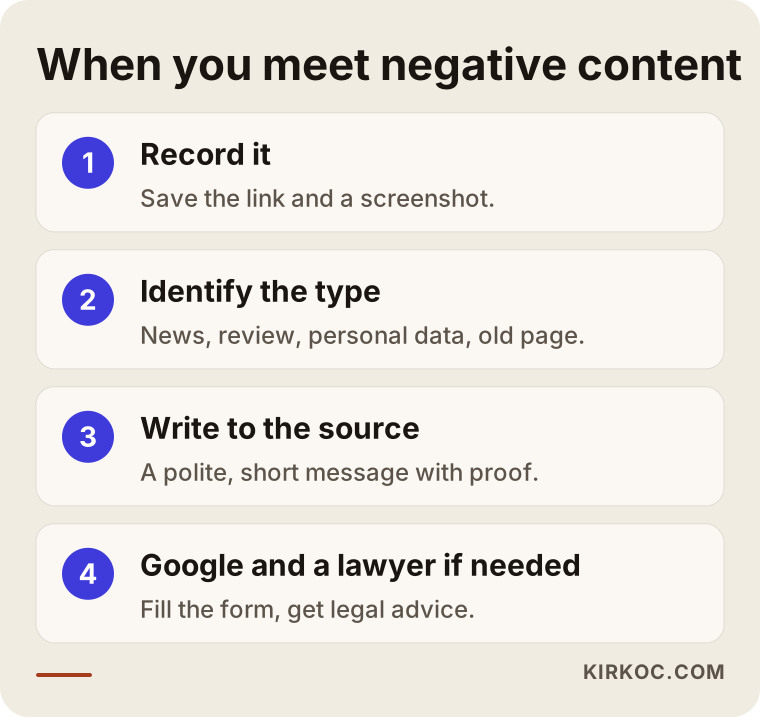
The lesson from these two examples is the summary of the flow above: first understand the type of content, then start with the gentlest route, move to legal action if needed, and strengthen your own content in parallel at every stage.
Step by step: how I work on this
When a business owner comes to me with this problem, this is the order I follow. I leave the legal part to a lawyer. I handle the part that concerns search results.
1. Assess the situation. I search your company name, your own name, and your product names in different forms. I note which results are negative, where they rank, and on which platform they sit. Because personalized results can make your screen look different from someone else's, I also check in a private window.
2. Sort the content. I put each result into one of the types above: true or false, old or current, whether it contains personal data, and which platform it is on. This table shows which items are worth a removal attempt and which are not.
3. Reach the source. Contacting the publisher or the platform is often the fastest route. A polite, short message with evidence usually gets further than an angry one. On review platforms, writing a reply and fixing the problem sends a good signal both to the reviewer and to the next customer reading it.
4. Apply to Google if needed. For content that meets the criteria, such as personal data or unlawful material, I can help you fill out the right form. The waiting time for a result varies.
5. Get legal help. If the content looks clearly unlawful and the routes above have failed, I recommend that you talk to a lawyer. I do not run this step, but I can support your lawyer by documenting what the search results show.
6. Balance with positive content. For content that cannot be removed, the long-term work starts here. I explain it separately below.
7. Monitor. After a few weeks I check the searches again. Some results drift down on their own, some stay, and new ones may appear. This is not a job you do once and forget.
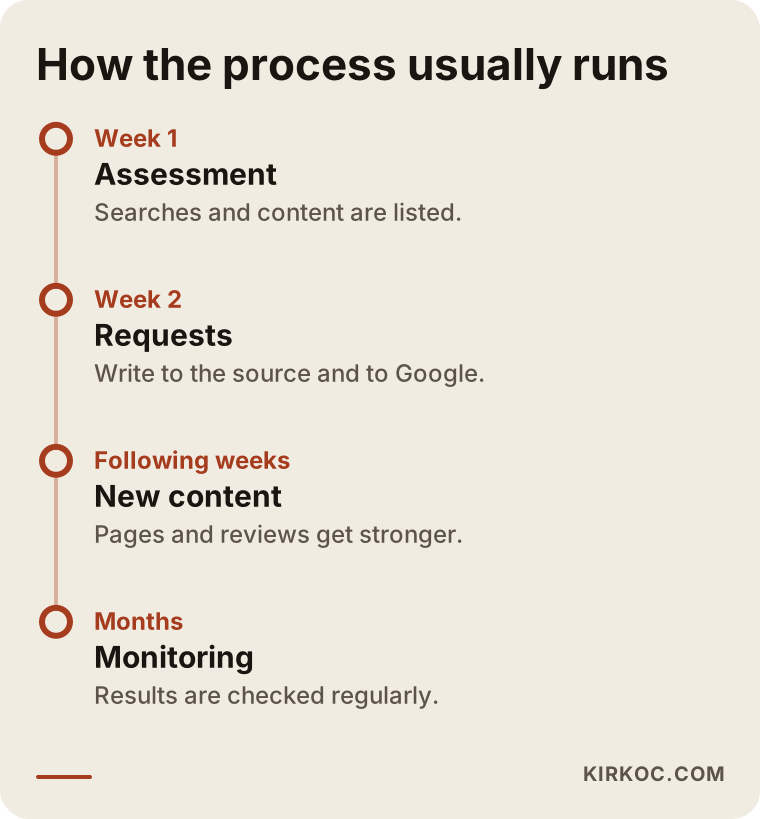
The periods on the timeline describe a rough order. The real duration depends on the type of content, the speed of the platform, and how quickly new content is produced. Nobody can promise you a result by a given date.
Content that can't be removed: what does pushing it down mean?
If a piece of content cannot be removed, the most realistic answer is to put stronger, more current, accurate pages in front of it in search results. In the industry this is called "reputation management" or "suppression." The logic is that most people do not look past the first page. If a negative result moves from page one to page two, fewer people are likely to see it. But "fewer" does not mean "gone." The outcome depends on competition, the strength of the content, and the authority of your site.
The honest limits of this method are these. First, there is no ranking guarantee. Google orders results by its own rules and I cannot change that. Second, if the negative content sits on a large news site or a very strong platform, pushing it down can take months and sometimes may not be possible. Third, this work must never involve fake reviews, fake sites, or artificial tricks. They break Google's rules, and when they come to light they make the situation worse.
So what do I bring forward? Your own site, real customer reviews, your business profile, your expert articles, and mentions on trustworthy third-party sources. All of it has to be real.
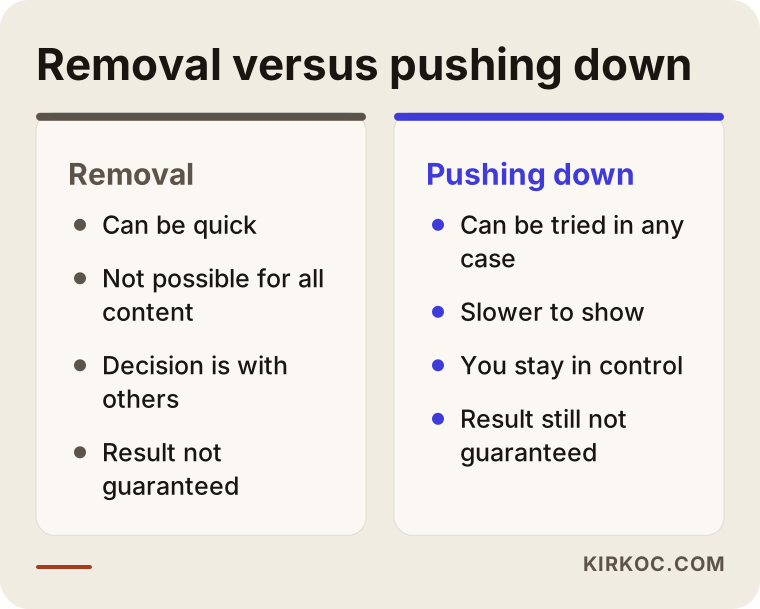
The comparison shows that removal can be fast but is not possible for every piece of content. Pushing down can be tried in every case but is slower and the outcome is uncertain. Running both together is often the healthiest approach.
Where does positive content come from?
For a business to look strong in search, it needs enough sources, and enough variety among them. These are the sources I use most.
Your own site. About, services, FAQ, references, and contact pages are ready candidates to appear in a search for your company name. If they are missing or empty, Google has no alternatives to choose from and the negative result moves to the front. Your pages need to be clear, current, and genuinely informative.
Your Google Business Profile. This is the box that appears in maps and local searches, and in a company-name search it often shows up at the top or on the side. Accurate details, regular photos, and replies to customer reviews make this area more credible.
Real customer reviews. Ask satisfied customers for reviews, but do not steer them, and never offer payment or discounts in exchange for a review. Honest reviews collected over time build trust and also take up space in the results. Review platforms may also have their own rules, so read them first.
Industry platforms and directories. Being listed with correct details in the associations, chambers, directories, and marketplaces that your industry trusts brings both reputation and visibility.
Expertise content. Blog posts, guides, and answers to common questions show that your company knows its work. They build customer trust and also increase the number of pages that appear alongside your company name in search.
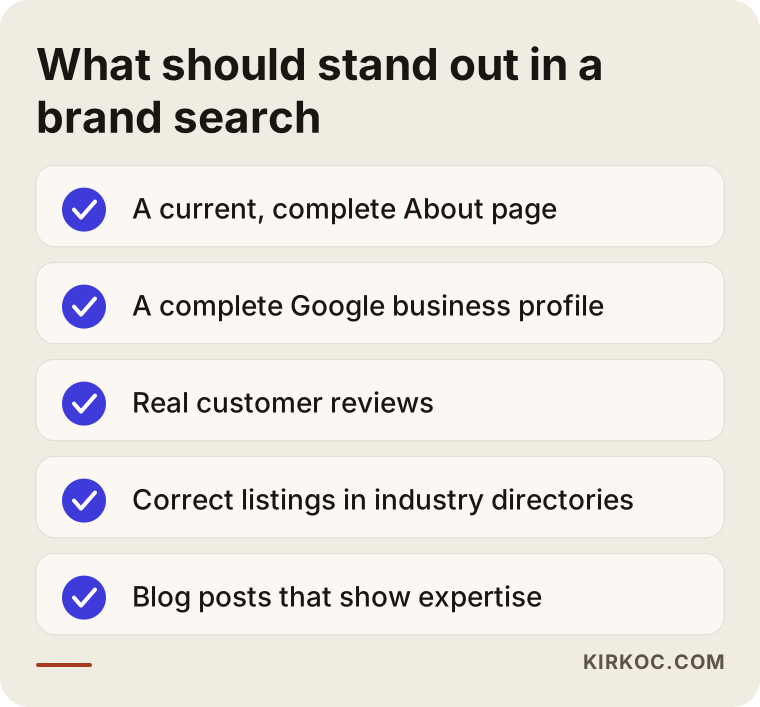
You can do most of the items on the checklist yourself. What matters is knowing that they are ongoing work, not one-time tasks.
What should a page ready for a company-name search look like?
The page you want Google to show when a customer types your name should be more than a corporate brochure page. A clear page that says who you are, what you do, where you are, who you work with, and how you behave when something goes wrong convinces both people and search engines. When a problem has happened, writing honestly about how you solved it usually builds more trust than hiding it.
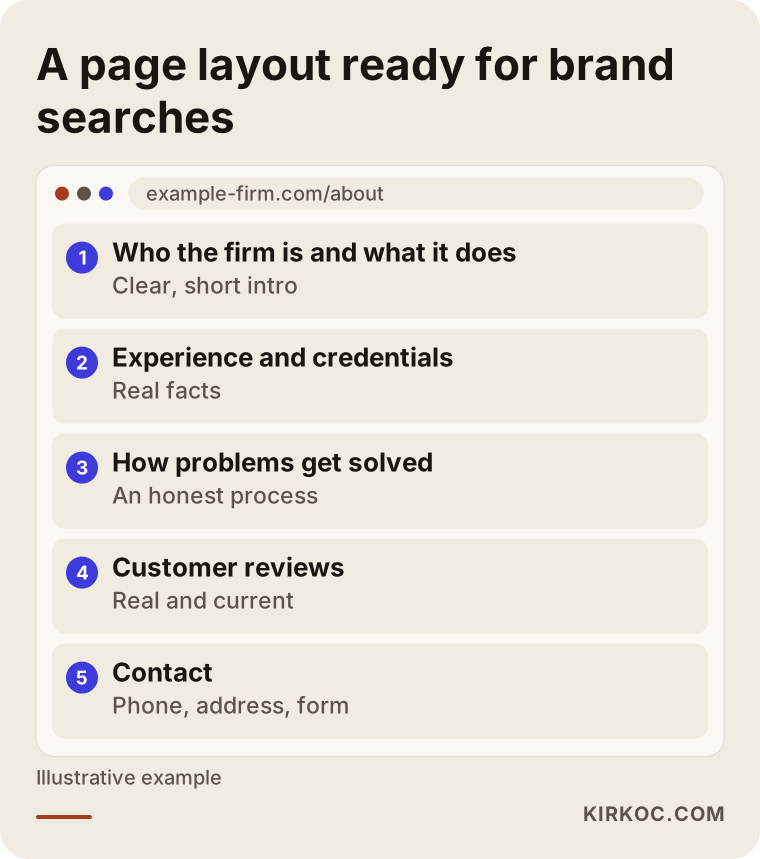
Every section in the structure above has a job: identity, experience, contact, frequently asked questions, and reviews. This layout shows both visitors and search engines that the site is serious and up to date.
Negative content in AI answers
People no longer ask only Google. They ask AI assistants too. When someone asks "is this company trustworthy?", the answer is put together from sources found on the internet. That means negative content in search results can show up in AI answers as well. You cannot control this in advance, but clear, accurate, current information on your own site and on reliable sources makes a balanced answer more likely.
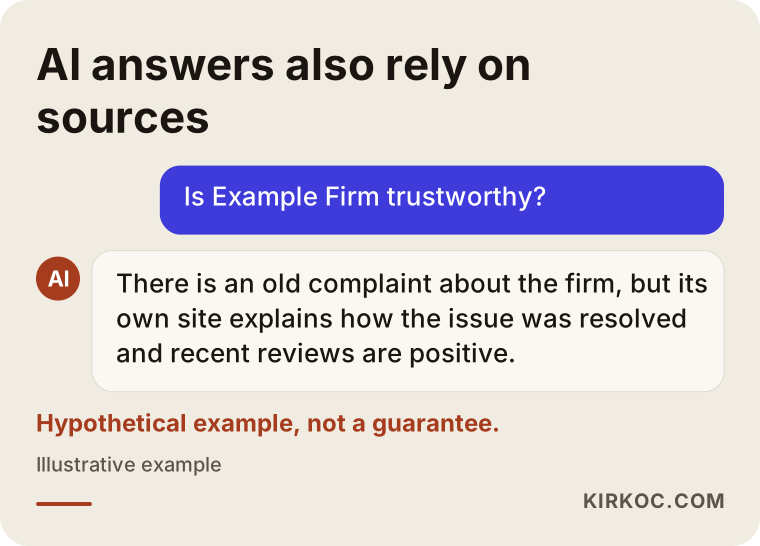
The example is hypothetical and not a guarantee. What it shows is that AI answers summarize the sources they can reach. If your sources are varied and work in your favor, the answer can end up more balanced.
Common mistakes
Here are the traps business owners fall into most often, because some of them make the situation bigger instead of better.
Reacting angrily. An angry reply to a review or a story can make the content more widely shared. A calm, short, solution-focused reply is more reassuring to a new customer reading it.
Trying to balance with fake reviews. Writing reviews in your own favor can break platform rules and consumer protection rules, and when it comes out it damages your reputation far more. Talk to a lawyer about this.
Believing "we will surely delete it." Nobody can delete Google results with a guarantee. Be careful with anyone who promises removal and asks for payment up front.
Trying to remove everything. Fighting to delete a fair complaint wastes time and can even draw more attention to it. Decide first which content can actually be removed.
Doing nothing. Not replying to negative content, leaving your own pages empty, and not collecting reviews leaves the results in other people's hands.
Not cleaning up old pages. Old or wrong pages left on your own site may still appear in Google. Fixing or removing them is the easiest win available.
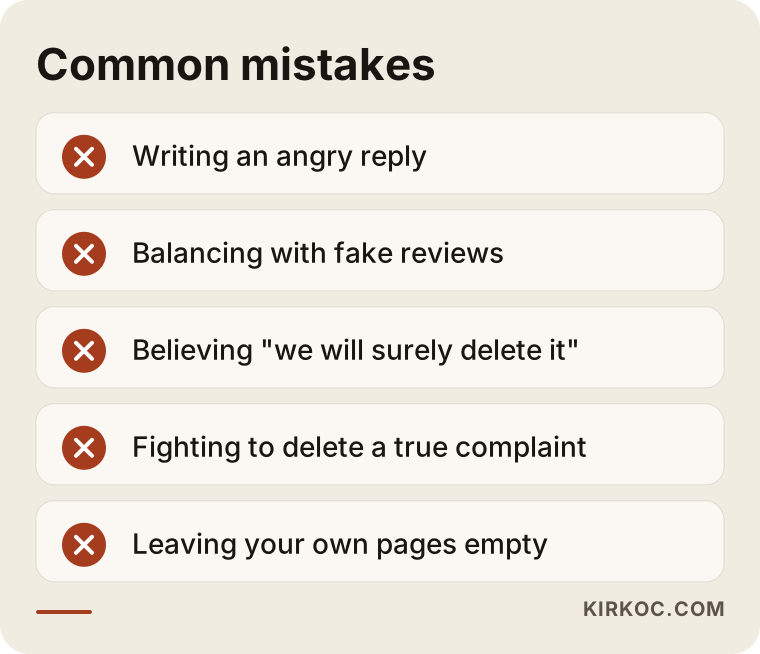
Most of the mistakes on this list come from panic. In this work, the right order matters more than speed.
What can you do yourself, and when do you need an expert?
There is quite a lot you can do on your own. You can search your company name regularly and watch what comes up. You can fill in your Google Business Profile completely, reply to reviews, and ask satisfied customers for feedback. You can clean up old and wrong pages on your own site. You can fill out Google's form for pages with personal data yourself. You can send a polite message to the site that published the story or the platform that hosts the review.
Expert help makes sense in these cases. If the content looks unlawful, meaning defamation, libel, or a violation of someone's rights, you should see a lawyer. If you want to push down content that cannot be removed but is hurting you seriously, you need work on content, site structure, and technical setup, and that part is my field. If new negative content keeps appearing, you also need to look at the source, which is a gap in the customer experience. Otherwise a new piece of content will replace the one you removed.
What decides the cost
I will not give you a number for this work, because it differs so much from case to case. But I can tell you clearly what it depends on.
The first factor is the number and type of negative items. One old page and several items spread across different platforms are very different amounts of work. The second is the strength of the site where the content sits. Pushing down a post on a small blog is not the same job as pushing down a page on a large news site. The third is the current state of your own site. If your pages are ready, the work is shorter. If content and structure have to be built from scratch, it takes longer. The fourth is whether legal support is needed. That is a separate arrangement with a lawyer, and it is outside my service. The fifth is time: a one-time cleanup and months of regular work need different budgets.
When you collect quotes, look at these things. Is it written down clearly what will be done and what will not? Is a ranking or deletion guarantee being offered? If so, be careful. Is it clear which pages will be created and how often reports will arrive? Is it clear whether the work will stay on your site and under your control?
How I work with you
I work alone, which means the person you talk to is the person who does the work. The process usually goes like this. First, a short conversation where I listen to your situation. Then I review your company name and the related searches, and explain in plain language which items fall into which group. I separate what you should do, what I should do, and what a lawyer should do. After that I prepare a prioritized plan and move ahead with your approval. I check the searches regularly and tell you what has changed. I do not promise results. I tell you honestly what I am doing, why, and what may happen.
Frequently asked questions
Can I remove a news story from Google myself?
Applying to Google is free and you can do it yourself, but whether a story is removed depends on the type of content. Removing an accurate story of public interest is very hard. For false or unlawful content there are legal routes, and I recommend talking to a lawyer about them.
If I apply to Google, is the content deleted from the internet?
No. A request to Google only aims to take the content out of search results. The content stays on the site where it was published. For it to actually be deleted, the owner of that site or a competent authority has to decide so.
Can I get a review on a complaint site deleted?
If the review is fake, abusive, or about the wrong business, you can ask for it through the platform's reporting process. If it describes a real customer experience, the chance of deletion is low. In that case, replying to it and solving the problem is the healthiest path.
How long does it take to push a negative result down?
It is not possible to give a clear time in advance. It can take weeks or months depending on the strength of the site hosting the content, the competition in your industry, and the current state of your own site, and in some cases there may be no result. That is why I suggest being careful with offers that include a guarantee.
Can I balance negative reviews with fake reviews?
I do not recommend it. Fake reviews break platform rules and can create legal trouble. If they come out, they cause extra damage to your reputation. Collecting honest reviews from real customers is a safer and more lasting route.
My personal information has been published on a website. What should I do?
First write to the site's administrators and ask for it to be removed. If you get no reply, you can use Google's request for removing personal information. If the situation is serious or ID details are involved, it is sensible to talk to a lawyer.
Do AI assistants also show negative content?
They can, because they put their answers together from sources on the internet. Accurate, current, clear information on your own site and on trustworthy sources raises the chance of a balanced answer, but you cannot control it.
Which is better, a legal process or positive content?
They do different jobs. If the content is clearly unlawful, a legal route is needed. If the content is accurate but bothers you, balancing it with positive content is more realistic. Often the two run side by side.
If the results that come up when you search your own company name bother you, we can work out together where to start. Reach me through my SEO services page and tell me briefly about your situation.