Someone types "pilates near me" into their phone, glances at the first three results, and usually contacts one of them. If your gym or studio is not among those three, that person will never see you, no matter how good your instructors are. In this article I explain how gyms, pilates and yoga studios, and personal trainers can attract steady interest from search. If you want the bigger picture of what I do, my SEO services page covers it; here I focus on your industry.
Website design is a separate topic, which I covered in website guide for a pilates or physiotherapy studio. This article is about being found.
How do people search in this industry?
Gym searches are almost always local. People rarely search for a whole city; they search for a neighborhood: "reformer pilates downtown", "gym near the station", "yoga studio close to home". Many searches also carry a need: women-only classes, early morning slots, prenatal pilates, small groups.
That means a single home page cannot answer all of them. A search engine wants to see clearly where you are and what exactly you offer. The clearer you are, the closer you get to the right person.
Fix your Google Business Profile first
For neighborhood searches, map results take up the top of the page. Before the website, your business profile needs to be in order:
- Address, phone number and opening hours should be current and identical to your website.
- Pick the right main category (gym, pilates studio, yoga studio).
- Add real photos: entrance, equipment, changing rooms.
- List your classes and services one by one.
This looks dull, but it is the foundation of showing up on the map. What matters most is that the profile and the site tell the same story.
One page per class type
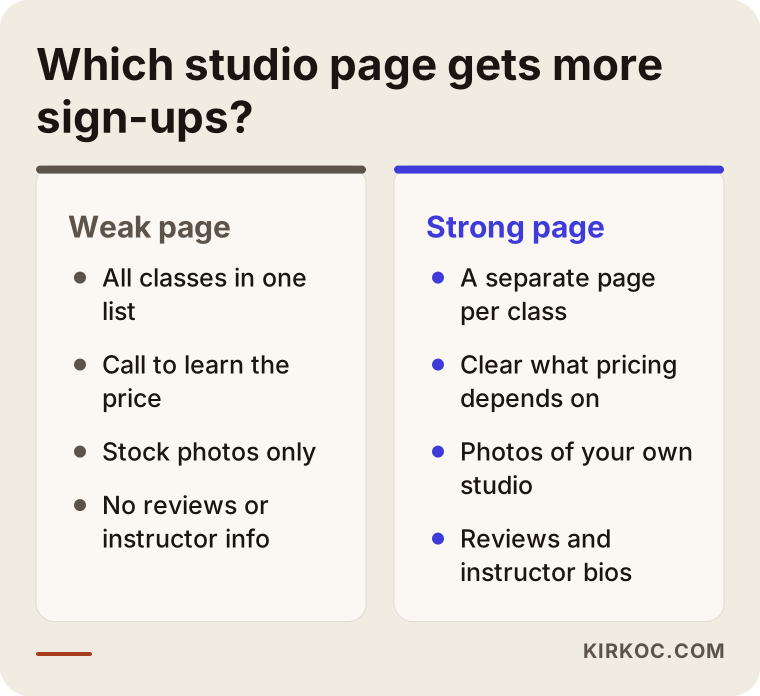
Many studio sites list every class on a single "Classes" page. Yet people search for a specific class. "Reformer pilates", "mat pilates", "women-only pilates" and "beginner yoga" are all separate search topics.
Create a separate page for each class and include:
- What the class is, who it suits and how large the groups are.
- Which levels can join and what to expect in the first session.
- Who teaches it.
- Your neighborhood or town, in a natural sentence.
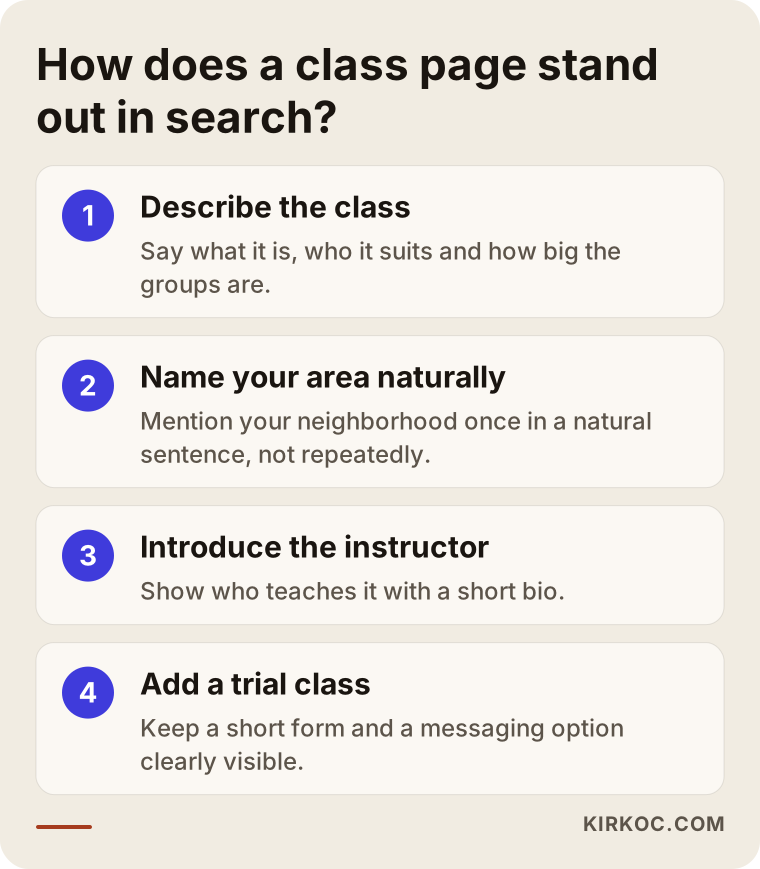
Do not stuff place names into pages. A phrase such as "reformer pilates classes in the Northside studio" is enough. Copying the same text and swapping the place name looks weak to both readers and search engines.
How does the work go, step by step?
The order is usually the same; what differs is how deep you go at each step. Whether you do this with me or on your own, this sequence works.
1. Map where you stand
Run about ten searches on your phone, such as "pilates near me" or "your neighborhood plus gym", and note who shows up. Then check where your profile and website appear for those same searches. This list becomes the basis for every later decision.
2. Align the basics
Address, phone, hours and classes should match on your profile and your site. Even small differences make both search engines and visitors hesitate.
3. Write the class pages one at a time
Do not try to write them all in a day. Start with the class that brings in the most members or gets asked about most, and move on once that page is settled.
4. Test the sign-up path
Open the site on your phone and fill in the trial class form as a customer would. Make sure the message really reaches you and that you know who answers it.
5. Measure, then adjust
After a few weeks, look at which pages get visits and which turn into inquiries. At this stage I put together a plain report and tell you what should change.
A trial class is your strongest call to action
In this industry people usually decide after trying. Nobody wants to sign a membership without seeing the space and meeting the instructor. That makes the trial class offer the most important button on your site.
- Put the trial class form somewhere visible on every class page.
- Keep the form short: name, phone, which class. Ask the rest on the phone.
- Offer messaging, because many people prefer a quick message to filling in a form.
- Say what happens after they apply, with a sentence you can really keep, such as "You will hear back during opening hours."
State clearly whether the trial is free or paid and what its limits are. Hidden conditions cost trust later.
How should you present pricing?
Owners are often torn between two extremes: "if I publish prices, competitors will see them" and "if I don't, everyone will call me". My suggestion is not to hide your price list, but to explain the conditions openly.
Show what the price depends on: class type, group or private sessions, membership length, number of weekly classes, seasonal offers. Keep the current figures in one place so you do not need to fix every page when they change. Visitors who cannot find a price usually move on to the next result, which is why "call for pricing" pages lose.
Reviews and trust
People read reviews before they visit a gym. Your Google reviews influence both your map position and your click rate.
- Send happy members the link to leave a review. Do not write reviews yourself and do not offer discounts in return.
- Reply to negative reviews calmly, briefly and with a solution. The next reader sees the reply too.
- Show short bios and qualifications for your instructors on the site.
Be careful with health claims. A sentence like "cures back pain" can run into advertising rules and ethical limits. Checking what you may say is your responsibility; if in doubt, check your local regulations or your professional body.
A checklist before a page goes live
After writing a class page, ask yourself these questions one by one. If the answer to any of them is "no", the page is not ready yet.
- Is it clear what the class is within the first two sentences?
- Does it say who the class suits and how big the groups are?
- Is the instructor's name and a short bio there?
- Does your neighborhood appear in a natural sentence, or is it squeezed into the heading?
- Is the trial class button visible without scrolling?
- Is it clear what the price depends on, or where to find out?
- Are the photos from your own studio?
- Is the page easy to read on a phone, with buttons that are easy to tap?
You can reuse this list for every new class page. The phone point matters most, because a large share of neighborhood searches happen on a phone while people are walking or leaving work.
Two real-life scenarios
The following do not describe one specific client. They describe two situations I see often in this industry. I give no numbers or firm outcomes, because results differ everywhere.
Scenario 1: A small, newly opened reformer studio
The owner of a newly opened studio came to me with two reformers and one instructor. The site had a single page: a class list, one phone number and a few stock photos. For "reformer pilates near me" the studio did not appear in the map results at all.
First we fixed the business profile: the right category, real photos of the studio, classes listed one by one. Then we wrote separate pages for only two classes, because the instructor could not keep up with more. We shortened the trial class form and added a messaging option.
In the first months the number of visitors stayed small, but the quality of inquiries changed, because people arrived having read what the class was. The map position settled slowly as reviews from happy members came in. We did not expect a quick jump, and I did not promise one.
What worked here was not a clever technique but a patient, steady order: basics first, then the two most important classes, then reviews. We did not move to the next step before seeing the effect of the last one, and that is also how we learned what worked.
Scenario 2: An established gym with several locations
In the second example the gym had a member base built over years, but its website only said "call us". All locations were described on one page with the same text.
The problem was not too little content but confusion. We built a separate page for each location with information that truly belonged to it: equipment, hours, parking, instructors. We deliberately avoided copying the same text with only the location name swapped.
In structures like this, the biggest gain was keeping the locations from looking like competitors of each other. Again I describe the results with restraint: some locations picked up quickly, others more slowly.
Common mistakes in this industry
I see the following in almost every review. Most are not expensive, they just need attention.
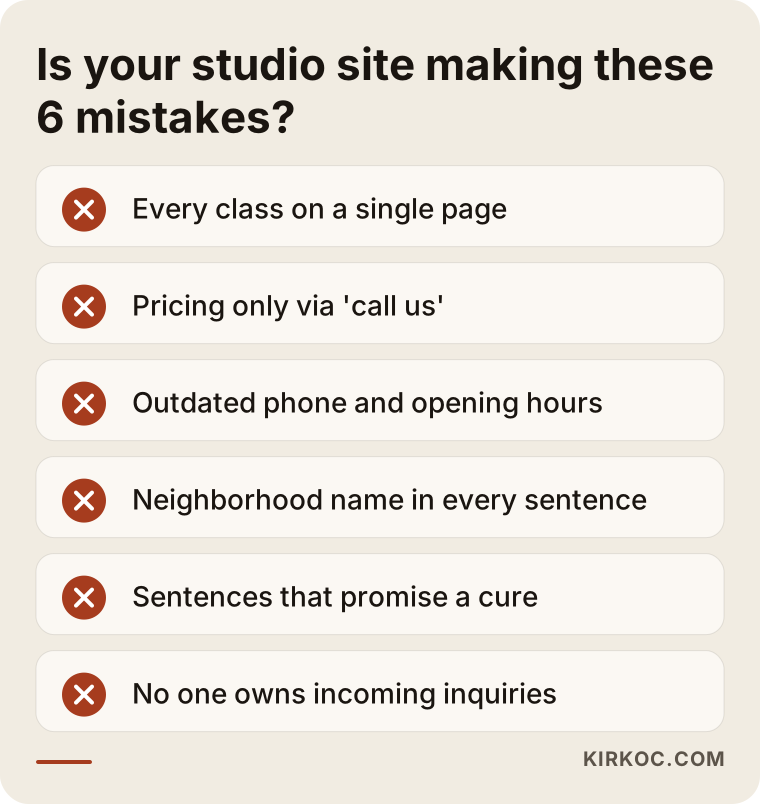
The first mistake is piling all classes onto one page. The second is telling someone who wants a price to "call us". The third is leaving an outdated phone number or opening time on the business profile; a member who shows up once for nothing rarely tries again.
Other frequent mistakes:
- Squeezing the neighborhood name into every sentence. The text becomes unreadable.
- Writing sentences that promise a cure or a guaranteed result.
- Ignoring reviews or answering them sharply.
- Not knowing who follows the inquiry form, so messages wait for days.
- Treating social media as the only storefront and never updating the site.
Most of these are solved with a few hours of steady attention a month. The hard part is keeping that attention going.
What you can do yourself and what to leave to a specialist
You do not need a consultant for everything. Part of the work has to come in your own words, and nobody writes it as well as you.
What you can do yourself
- Keep the hours, phone and photos on your business profile current.
- Ask happy members for reviews and answer the reviews.
- Describe the classes and instructors in your own sentences.
- Take real photos of the studio and the classes.
- Note the questions members ask often and answer them on the site.
What is better left to a specialist
- Site structure: which pages to open and how to link them.
- Technical fixes: speed, mobile display, the same content showing up at several addresses.
- Separating overlapping pages across several locations.
- Measurement setup: seeing correctly how many inquiries come from which page.
- Deciding what to do about a drop in rankings or a suspended profile.
I usually take on the second group and hand you the first as a simple roadmap, so you do not become dependent on me.
A page for the visitor on a phone
Most visitors in this industry come from a phone; few people research pilates at a desk. So think of the page on a phone screen first, then adapt it to the computer.
Speed and simplicity
Heavy images, sliding carousels and auto-playing videos slow the page down. A slow page gets closed; nobody waits in case it loads. Shrinking photos for the web is often the easiest improvement.
Use with a thumb
A tap on the phone number should call, a tap on the address should open a map, and the messaging button should be big enough to press. Small buttons close together cause mis-taps and the visitor gives up.
What belongs on the first screen?
The class name, your area, one short sentence and the trial class button. A long introduction or a rotating banner is unnecessary here. Keep the details below for those who are curious.
A rhythm through the year: what to focus on when
The fitness business is seasonal; searches do not stay at the same level all year. Knowing this lets you place your effort at the right time.
Preparing for busy periods
In September, January and before spring, people think about starting exercise again. A few weeks before these periods, review your class pages, hours and trial class flow. If you run a promotion, state the terms clearly on the page and remove it when it ends; an expired promotion costs trust.
Use the quiet periods
In quiet months such as summer you have more time to write new class pages, take photos and prepare answers to common questions. When the busy period arrives, the structure is ready.
Small regular upkeep
Checking the profile, hours and reviews once a month is not a big job. But the habit keeps the site from turning into a forgotten brochure.
If you are a personal trainer, a different note
Unlike a gym or studio, what you sell as a PT is largely yourself. So the section introducing you matters more on your site than the class pages.
State your specialty in one sentence: weight loss, getting stronger, returning after pregnancy, athlete preparation. Say which area you work in and whether you train at a gym or at home. List your education and certificates only as far as you really have them; an inflated bio shows quickly.
If you use before-and-after photos, do so with the person's clear permission and without exaggeration. For statements about body measurements or promised results, check the advertising and ethics rules that apply to you.
Which class to write first?
Opening a page for every class at once looks tempting, but is not realistic for a small team. Set priorities with three questions.
- Which class brings the most bookings, and which has open spots?
- Which class do your competitors describe poorly?
- Which class do people hesitate about most before asking?
Classes with low attendance that still earn you money are usually first in line, because that is where one page makes the biggest difference. You can leave the page of an already full class for later.
How do you answer reviews?
Writing replies feels hard to many owners, but the pattern is simple: say thanks, briefly acknowledge the issue, state the fix. Do not get defensive and do not publish private details.
For example, to a member complaining about a schedule change, a reply like this is enough: "Thank you for the feedback, and sorry that we did not tell you early enough about the change. Let us call you and find a time that works for you." No long explanation is needed.
Write a short thank-you to positive reviews too. It makes you look like a real person and tells new readers that the studio cares.
What to measure and what to ignore
When they see a report, many owners get lost in the numbers. In this industry three things are enough: how many people saw you in search, how many clicked through, and how many wrote or called about a trial class.
The last number matters most. If visitors rise but inquiries do not, the problem is usually the page itself: an unclear description, a hidden button or a form that goes unanswered.
Ignore daily swings. Look at the direction over weeks, and do not weigh busy periods and quiet periods on the same scale. Comparing with the same month last year is a fairer measure.
Also ask where inquiries come from: search, the map or Instagram? Adding "How did you hear about us?" to the membership form is the cheapest way to learn which effort pays off.
What else belongs on the site?
Alongside class pages, add small but useful content: "What do you wear to a first pilates class?", "What is the difference between reformer and mat pilates?", "How do I pause my membership?" Real questions like these open new doors in search and spare you from answering the same call again and again. Photos matter too: show your own studio and instructors instead of stock images, because visitors want to see where they are going.
How long until I see results?
Honestly, nobody can guarantee that. The more competitive your neighborhood, the longer it takes. For a new studio, building pages, fixing the profile and collecting first reviews can take a few months. I build a solid foundation and show what works through regular reports; I do not promise rankings.
Frequently asked questions
Do I need a page for every neighborhood?
No. Only for places you genuinely serve and where people look for you. With one location, a clear description of your area is usually enough.
I have Instagram. Do I still need a website?
Instagram builds recognition, but for "neighborhood plus class" searches people mostly see websites and map results. The two complement each other.
What should I do as a personal trainer?
Three things matter most for a solo trainer: a clear specialty, the area you work in and real client reviews. A small, regularly updated site can cover all three.
Should I choose SEO or ads for a gym or pilates studio?
They do different jobs. Ads stop when you stop paying; pages that rank in search keep working for months once they have settled. If you have just opened, using both can make sense, and we can discuss that based on your budget.
In what order should a newly opened studio proceed?
The business profile first, then the one or two most important class pages, then the trial class form. Do longer jobs such as a blog only once this base is in place.
If I have several locations, does each need its own page?
Yes, but each page must contain information specific to that location: address, hours, equipment, instructors. Copying the same text and only changing the location name does not work.
Is asking for reviews against the rules?
Asking happy customers for a review is generally fine; giving a reward in return or writing fake reviews breaks platform rules. Check the current rules on Google's help pages.
Do I have to show prices on my site?
Not required, but you should say clearly what the price depends on and where to find out. Giving no information at all usually sends the visitor to another result.
How can I see which searches I show up for?
Google's free search dashboard shows which searches your site appears for. Help from a specialist speeds up the setup, but you do not need technical knowledge to look at it.
What happens to a class page if the instructor changes?
Do not delete the page; update the instructor information. A deleted page takes the visibility it built up in search with it.
Where to start
First look at where you stand: which searches show you, which classes have no page at all, whether profile and site match. Then I set priorities and we move step by step. If you would like to see where your gym or studio should start, contact me through my SEO services page.