When someone searches for "car insurance quote", most of the first results are comparison sites. Does a small, local agency have any place there, or do you simply need a bigger ad budget? Agency owners ask me this often. The short answer: you can earn visibility by competing where comparison sites do not. I cover how in my SEO services. I cannot guarantee results, but I can tell you plainly what tends to work.
This article is about how you appear in Google once your site exists. For how the site itself should earn trust, see my piece on what clients look for on an insurance agent's website; I will not repeat it here.
Do not fight comparison sites on their own keywords
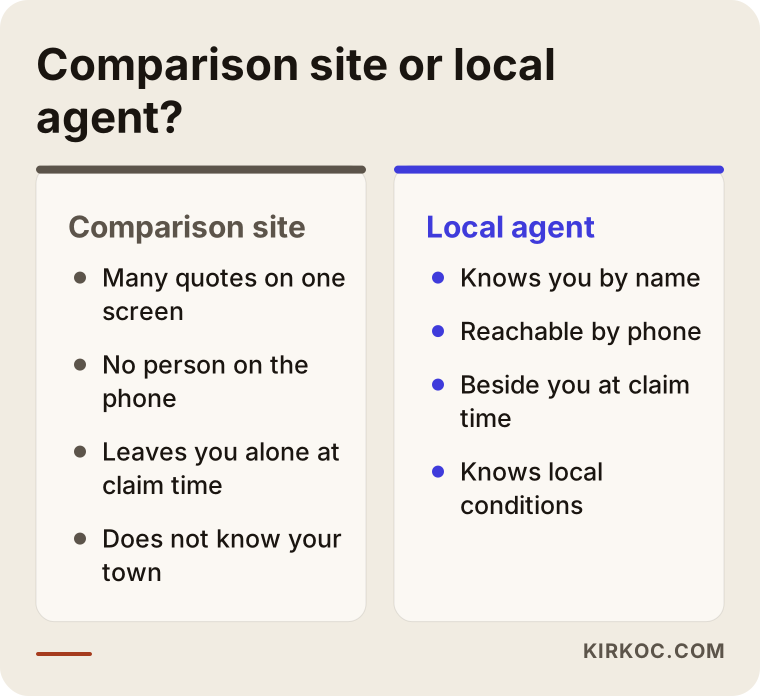
Comparison sites win broad searches like "cheapest car insurance". They show many insurers on one screen, and their pages have been growing for years. For most agencies, chasing that search is wasted effort.
Your advantages are elsewhere:
- A customer can call you and talk to a real person.
- When a claim happens, someone is on their side.
- You know your town, your neighborhoods and local conditions.
- You can look at a person's whole insurance picture, not one product at a time.
So aim to be visible where those strengths get searched: "insurance agent in [your town]", "business insurance near me", "what happens after a car accident claim", "who needs renters insurance". Comparison sites rarely lead there, because nobody on those pages is looking for a person.
One page per product
The most common mistake is a single "Our services" page listing auto, home, health, business and travel cover in a row. Google cannot tell what the page is about, and the visitor cannot find what they came for.
I suggest a plain page for each product: auto, home, health, business insurance and so on. Each page should include:
- Who this cover is for and what it generally does, in simple words
- What information you need to prepare a quote
- A short list of common questions
- The towns and districts you serve, written out
- Your phone number and a quote button
Leave the fine print, who pays what, to the policy documents. The page guides the visitor; it does not interpret a policy.
Write down what "I am with you when a claim happens" means
An agent's real difference often shows after something goes wrong. But if your site only says "reliable service", that difference stays invisible. Be specific:
- What a customer should do first after damage or an accident, and who to call
- Whether they reach you by phone or message, and during which hours
- What your role is while the claim is processed
This is also the kind of content search engines like, because it answers real questions such as "what to do after an accident". One caution: describe the process in general terms and avoid firm promises like "paid within a set number of days". Payment and outcome depend on the insurer and the policy.
Regulation: no firm claims
Insurance is a regulated field. For advertising, price statements and promotional wording, you need to check the rules that apply to you; they differ by country and change over time. I cannot give legal advice. These simple principles are what I recommend:
- Avoid claims you cannot prove, such as "cheapest" or "guaranteed payout".
- If you show a price or discount, state the conditions clearly, or leave it out.
- Keep the insurers you represent and your licensing details accurate and visible.
- Check your rules before publishing customer reviews.
I send every text to you for approval before it goes live, and any sentence you doubt can simply be removed.
What builds client trust?
Insurance is the purchase of something invisible. So clients want to trust the person and the agency before the product itself. Small signs on the site and the profile support this.
- A real address, an office that can be found on the map
- A clear introduction of you or your team, with photos and a short background
- A correct, current list of the insurers you represent
- Your reachable hours written out plainly
- Real client reviews and your calm replies to them
None of these is an exaggerated claim; all can be verified. Trust comes not from saying "we are the best" but from giving information that can be checked. Google also uses these same signs to understand that you are a real local business.
Your Google Business Profile and reviews
For "insurance agent near me", map results often appear above regular website results. That makes your Google Business Profile as important as your site. Address, opening hours, phone and the products you offer must be complete and match your website exactly. When customers mention in reviews that you helped during a claim, it builds trust with new visitors and separates you from comparison sites.
When you ask for reviews, do not pressure anyone and do not offer gifts or discounts. A simple "feel free to share your experience if you like" is enough. Answer negative reviews calmly and with facts, and never share personal data or policy details.
Clients search in three ways
A person looking for insurance does not always type "car insurance". Sorting searches into three groups makes it easier to decide which page to write.
Searching by product name
"Home insurance" or "business insurance" is a search by someone who already knows the product. This person is probably close to asking for a quote. The answer is a separate, plain product page.
Searching by describing a situation
"I just bought a car, what do I need" or "I'm opening a shop, which insurance do I need" comes from someone who does not yet know the product. That person needs an information article that understands their situation, not a product page. If the article ends by pointing to the relevant product page, the path stays open.
Searching for a person or a place
"Insurance agent in [district]" or "insurance broker near me" means a human is being sought. This is where comparison sites are weak. Your profile, address, phone and district pages serve this group.
Do not try to answer all three with the same page. When each page serves one intention, both the client and Google find what they are looking for more easily.
Two agencies, two different starting points
The same work does not unfold the same way at every agency. The two situations below are general composites of types I often meet; they do not describe a real person or file.
A small multi-line agency in a mid-sized town
The agency's site was a single page, with every kind of insurance in one list. The phone number on the Google Business Profile differed from the one on the site. Most clients came by word of mouth, and very few came from the internet.
I fixed the profile first, then we wrote separate pages for auto, home and business cover. Each page named the districts the agent actually serves. We also added a short page explaining what happens after a claim.
A few months later the agency began to appear for searches that include a town or district name, not for broad searches like "car insurance quote". The calls that came in were fewer but more qualified. Results differ for everyone; I only report what I saw here.
A specialist agency for business and transport cover
This agent's clients were small companies, not private individuals. The searches were closer to "how do I insure a warehouse" or "who is responsible for damage in transit" than to "car insurance". Comparison sites were almost absent in this niche.
Here, information articles worked better than product pages. Each began from a real situation: a company opening a new warehouse, a manufacturer exporting for the first time. They did not interpret policies; they explained which questions to ask.
Results arrived more slowly because search volume was low. But every call that came in was a serious need.
A realistic order of work
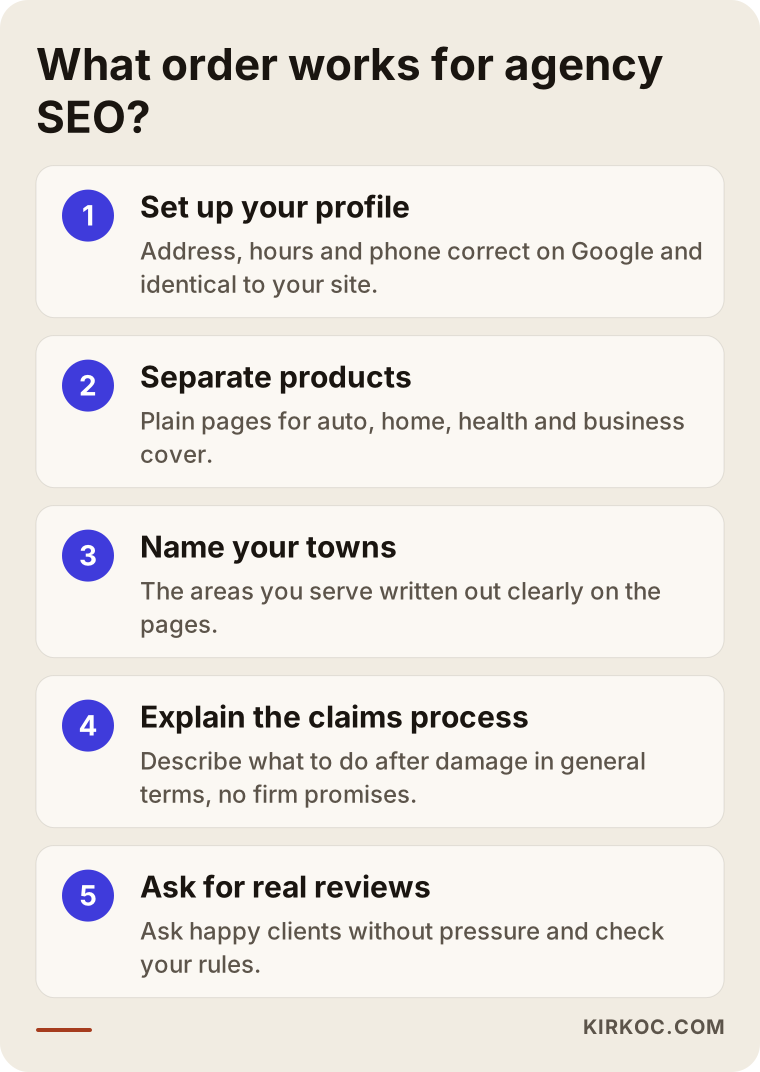
In my work with insurance agencies I suggest this sequence:
- Set up and maintain the Google Business Profile with correct details
- Separate the product pages
- Place town and district names on those pages
- Add helpful pages such as the claims process and common questions
- Ask real customers for reviews, within your rules
Results usually appear over months, not weeks. Competition, the size of your town and the current state of your site decide the timeline. I will not promise first place, because honestly nobody can.
The first sign is often that phone calls and quote requests become a little more qualified. Someone who says "I need car insurance in this town, so I called you" is not just comparing prices. I focus on attracting the right people, and I report each month in plain language which page brought what.
How to write a town or district page
This is the most misunderstood part of local visibility. "Let me open a page for every district" sounds logical, but if done wrongly it does not work.
Name the places you really serve
The district where your office is, plus areas you visit clients in regularly or serve by phone, can appear on the page. Do not add a district you never work in just because people might search for it. It misleads clients and damages trust.
Each page must say something different
You should be able to add something specific to that district: how far your office is, the insurance needs common in that area, where you meet clients. If you cannot, a single "areas we serve" section is enough. One good page beats half-page copies.
Keep map and address details consistent
The address, phone and hours on the page should match your Google Business Profile exactly. Small differences, like "St." in one place and "Street" in another, are no problem; a different phone number or different hours cause confusion.
Write one local sentence
If you have a real observation, such as the questions shopkeepers in a certain neighborhood often ask about shop insurance, use it. Keep it general, name nobody and share no personal data. Real local knowledge is the one thing that cannot be copied, and comparison sites cannot offer it.
How we track results
Looking at rankings is easy but misleading. Ranking high for one phrase does not mean the phone is ringing. What I look at is simpler.
- How many phone calls and quote forms came in each month
- Which pages and which searches those requests came from
- How many searches and direction requests your Google Business Profile received
- What new clients answered when asked "how did you find us"
I especially suggest asking that last question on the phone or in the office. A client who came from the internet often does not show up in the numbers, while one sentence from them says a lot.
In reports you find a short summary rather than big charts: what was done, what changed, what comes next month. If there is no figure, I do not invent one; when data is thin, I say so plainly.
Step by step: how the process works if we work together
Knowing the plan from the start avoids surprises. If you work with me, the order usually runs like this.
1. Review
I look at your site, your Google Business Profile and your competitors. I work out which products can already be found and which are invisible. At this stage I tell you in writing what you need and what you do not.
2. Setting priorities
We do not do everything at once. For most agencies the first jobs are the profile and the one or two products that earn the most. Your budget and time are planned around that.
3. Writing and editing
I write the pages in plain language. Any sentence that looks doubtful from a regulatory view I discuss with you, and nothing goes live without your approval.
4. Publishing and measuring
Once pages are live, I track which searches bring visitors and how many calls or forms result. My monthly report is written in plain language.
5. Improving
After the first months we look at what worked and choose the next page. I do not keep up something that is not working just because we started it.
Allow for the rhythm of the year
Demand in insurance is not spread evenly. There are renewal periods, months when car sales rise, pre-holiday travel and home needs, and new business openings. Every agency has its own calendar, and you know yours best.
My advice is to prepare the relevant pages a few months before a busy period. Google needs time to notice and assess a page, and publishing in the middle of the need is already late. After the busy period, do not delete the page; keep it current, because the same question returns every year.
Mistakes agencies often make
Most of these come not from bad intent but from "everyone does it this way".
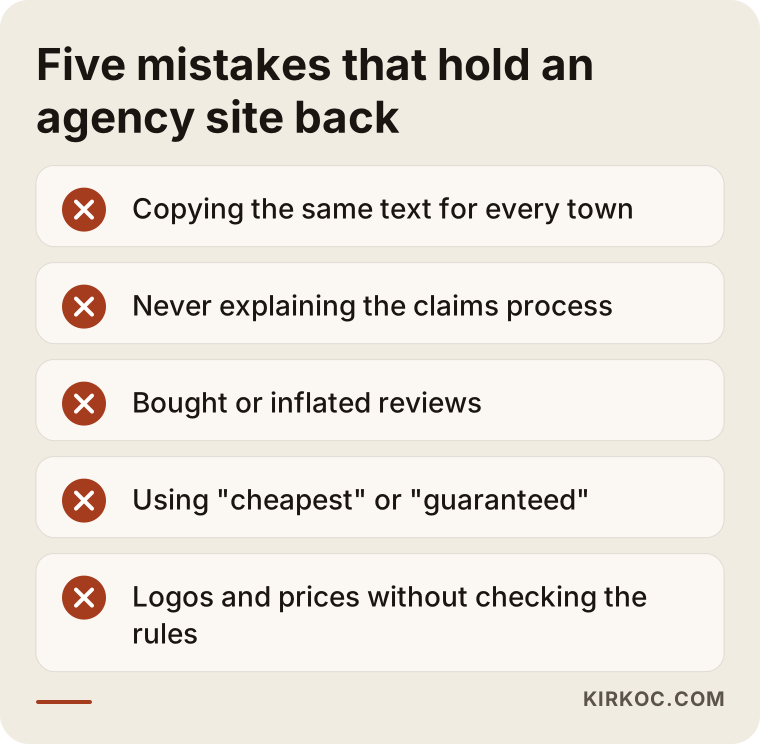
- Spilling insurer logos and prices across the site. Risky both legally and for trust. Learn the rules first.
- Copying one text for every town. Swapping the place name in the same paragraph does not work; Google notices.
- Hiding the claims process. The part clients most want to read is often the least written.
- Buying or inflating reviews. It looks good briefly and later damages your reputation and your profile.
- Expecting results within weeks. Stopping early out of impatience wastes the effort already made.
What you can do yourself, and what to leave to a specialist
You do not need to outsource everything. Some tasks you do better, because you know your clients.
You can do these yourself
- Keep hours, phone and address on the Google Business Profile current
- Politely ask happy clients for a review
- Note the questions clients ask most and pass them to me
- Reply to reviews calmly, without personal data
Better left to a specialist
- Page structure for products and towns
- Technical problems on the site (speed, mobile view, indexing)
- Analysis of which searches are worth competing for
- Monthly measurement and reporting
On regulation, the last word is yours and, if needed, your legal adviser's. I do not give opinions on that.
Product page or information article?
You need both, but they do different jobs. Knowing when to write which protects your time.
Product page
It speaks to someone ready to ask for a quote. It is short, clear and action-oriented: who it is for, what details are needed, how to reach you. Long explanations here tire the reader.
Information article
It speaks to someone who has not decided yet. It answers a question such as "how do I insure a house I rent out" and calmly points to the relevant product. There is plenty of room here, but do not interpret policies.
For a small agency I usually suggest this balance: first one page for each main product, then articles drawn from the questions clients ask most on the phone. If you have answered the same question three times by phone, that question deserves an article.
Checklist before publishing a product page
- Does the page cover a single product?
- Are the towns and districts you serve written out?
- Are the phone number and quote button visible on the first screen?
- Have "cheapest" or "guaranteed" style phrases been removed?
- Is use of insurer names, logos and prices within the rules?
- Does the page read comfortably on a phone?
Ask yourself before you start
Answering a few questions honestly before investing in SEO protects both your budget and your expectations.
- Which product do I want to sell more of? Starting with one or two products is more realistic than pushing everything at once.
- Do I have time to handle the extra demand? If calls increase, you must answer each in good time; a quote request returned late is often lost.
- In which area do I want clients? Start with places you can truly serve rather than a very wide area.
- Who checks the regulations for me? Decide beforehand who approves the texts.
If the answers are not clear, that is fine; we settle them together in the first conversation.
What determines the price?
The cost of insurance agency SEO depends on how many product pages need writing, how many districts you want to appear in, the technical state of your site and the level of competition. I look at your site first, then write down what you need and what you do not. I do not sell packages you do not need.
Frequently asked questions
Can I rank as an insurance agent without paid ads?
Yes, especially for town-level and product-level searches. For very broad quote searches it is hard to beat comparison sites, so the strategy should be built around that.
Can I show insurer logos on my site?
That depends on your agreement with the insurers and the rules that apply to you. Check your agency contract and regulations first.
Do I have to write blog posts?
No, but a few good ones help. A handful of articles answering real customer questions beat dozens of generic ones.
How long until I see results?
I cannot give an exact timeline. It usually takes months, and results are not guaranteed.
Is saying "we are with you at claim time" enough?
Not on its own. "We are by your side" is a sentence everyone writes. If you describe the first steps after damage, your reachable hours and your role in the file, the difference becomes visible.
What if I serve more than one town?
You can write separate pages for each town if they hold genuinely different information. If you have no real branch or service area there, opening pages just to be visible can backfire.
Does joining comparison sites hurt my SEO?
Usually not; that is a sales-channel decision. In SEO the real point is that your own site offers clients something different.
Can SEO help me reach my existing clients?
SEO brings new clients. Contact with current clients is a separate job, but a good information page helps them remember you and recommend you to relatives.
If you want your agency to be the name people think of first in your town, you can reach me through my SEO services page.