You run a hearing aid clinic or an audiology practice. Your website lists your services, your address and your phone number, yet when someone types "hearing test near me" or "hearing aid center" into Google, they do not find you. Other clinics show up in that same search, and the phone rings for them. So it makes sense that you searched for "SEO for hearing aid clinics." In this article I explain, in plain language, how SEO works in this field, what patients and their family members actually type, which pages you need, and what to watch for when you hire help. I am Ümit Kırkoç, a web designer and SEO consultant who works alone from Istanbul, and where it matters I will say clearly what my own SEO services include and what they do not.
SEO, in short, is the work that makes your website appear when people search on Google. With ads, you are visible only as long as you keep paying. SEO, when it is set up properly, builds something that can bring in patients for months and years. In a field like hearing care, where people need trust and expertise before they act, that setup needs attention in places that differ from many other industries. Let's start with those differences.
Why is SEO different for hearing clinics?
At a print shop, a customer can look at the price and decide in a few minutes. A hearing aid is a much heavier decision. It is worn in the ear for years, and it changes how a person goes through the day. Many people hesitate for a long time, compare several clinics, and often decide together with a spouse or an adult child. That means search behavior here is not quick and impulsive. It is slow and researched.
A few things set this field apart:
- The person searching is often not the person who will wear the device. An older adult may not search the internet at all. The one typing is frequently a daughter, a son or a spouse. Your website has to speak to that person.
- People search for the problem first and the solution later. Sentences like "my dad turns the TV up really loud" or "ringing in my ears" come before "hearing aid prices." Pages that answer these questions bring the person to you later, when they are ready to pick a clinic.
- Trust comes before everything. If a page does not make clear who works there, what training they have, where you are and how an appointment works, the patient goes to another clinic.
- There are rules about advertising and health content. In the United States, hearing aids are regulated medical devices, and health claims are watched closely. I cannot give you a definitive answer on what you may or may not say; please ask an attorney or your professional association. When I write content, I keep it informational and I do not promise outcomes.
- Location matters a great deal. Many patients do not want to travel far. They look for a clinic close to home or easy to reach.
- The market has changed. Over-the-counter hearing aids are now sold in stores and online, so some of your future patients will wonder whether they need a clinic at all. Pages that explain what an in-person evaluation adds are worth having.
All of this shows why a generic "we optimize your site" approach is not enough. The site and its content should be built around how people in this field actually think.
What do patients and their families type into Google?
The key question in SEO is what people type, exactly. You should research it rather than guess, but for this field there are patterns you can know in advance. The image below shows a completely hypothetical search result.
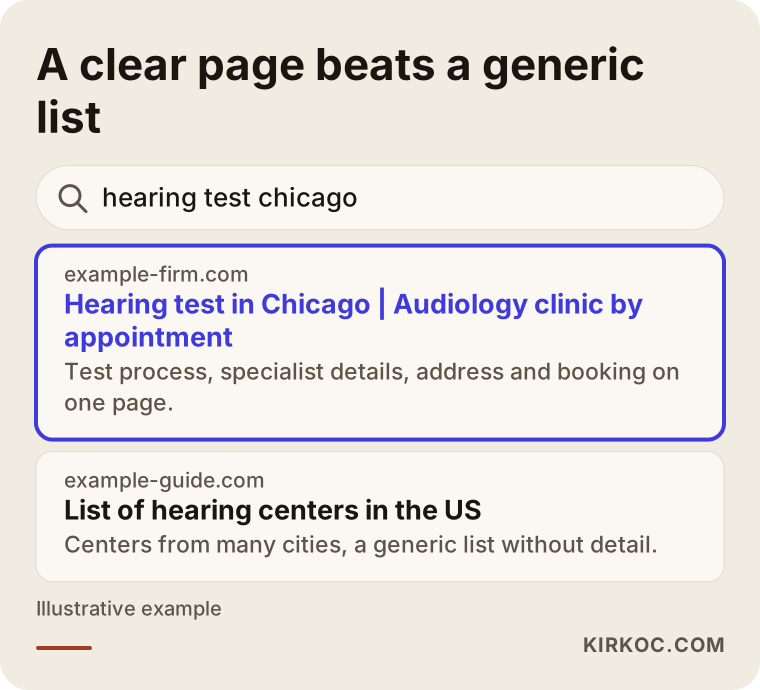
The highlighted result tells you who it is, where it is and what it does in the very first line. The generic list below it gives no detail. Google tries to show the page that gives the searcher the clearest answer. If you make that easy, your work gets easier.
Four kinds of search
You can roughly sort hearing-related searches into four groups. The first is information searches such as "signs of hearing loss" or "why do I have ringing in my ears." The person is not looking for a clinic yet. They are trying to understand their situation. The second is test and appointment searches such as "where can I get a hearing test" or "audiologist appointment." This person is close to acting. The third is device and clinic searches such as "hearing aid center" or "in-the-ear hearing aids." The fourth is local searches such as "hearing aids near me," searches that include a city or neighborhood, and searches on Google Maps.
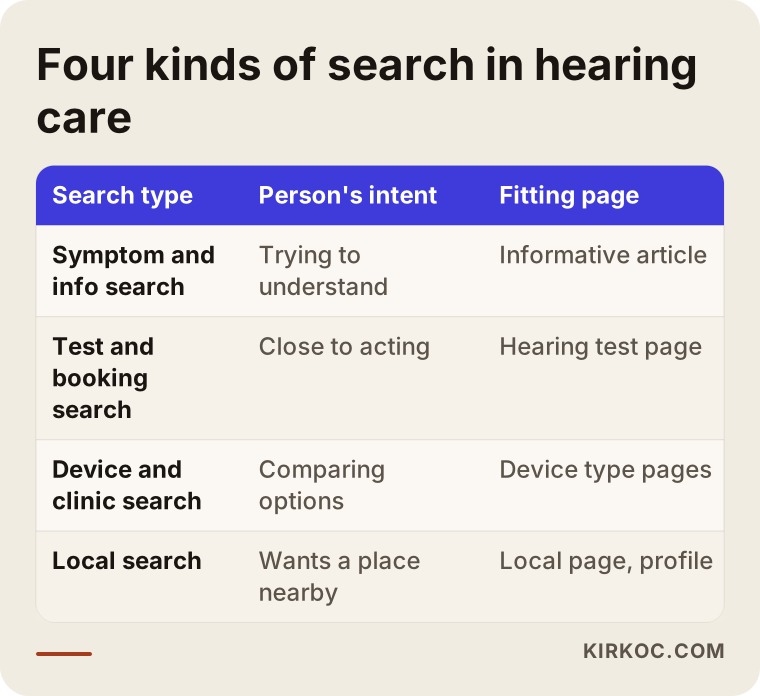
The practical lesson from the table is that one page cannot serve every kind of search. Showing a sales page to someone who is only gathering information scares them off. Showing a long article to someone who wants to book wears out their patience. Expecting a single "Our Services" page to cover everything is one of the most common mistakes in this field.
The decision journey
Picture the path a patient's family member takes from the first search to an appointment. First they notice a symptom and look for information. Then they read about hearing tests. Then they compare a few clinics. Finally they call one or fill in a form. People drop out at every stage. Your site's job is to reduce the number of people who get lost along the way.
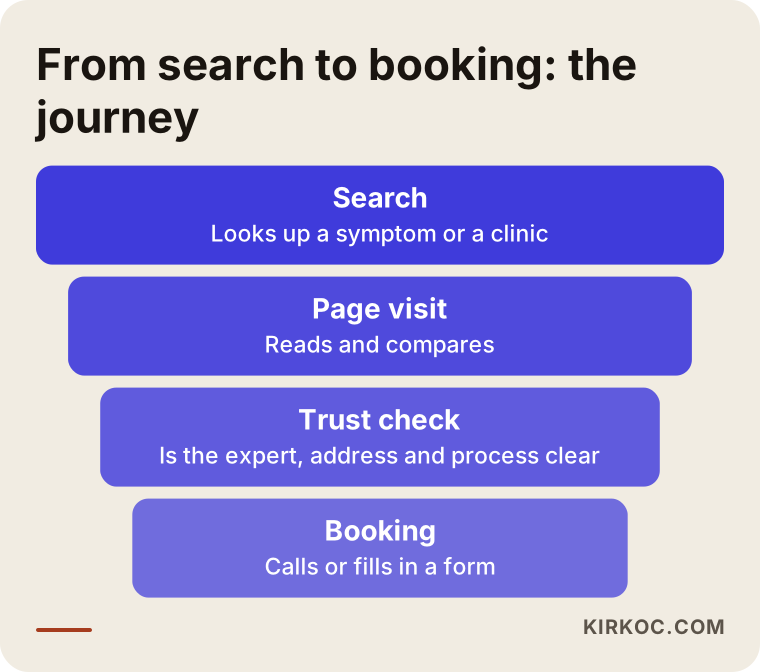
The funnel summarizes it: the number of people narrows from search to appointment. What matters is that each stage needs its own work. Showing up in search is one job, earning trust on the page is another, and making booking easy is a third. If one is missing, the others go to waste.
Which pages do you need?
Most hearing clinic websites consist of one home page and a handful of inner pages. To meet someone who is ready to choose a clinic, though, you need a clearer page structure. This is the basic structure I recommend for this field:
- A hearing test page: what the test is, how it is done, how long it takes and how to book. It describes the process and makes no medical promises.
- Pages for device types: plain-language pages on behind-the-ear, in-the-ear and other styles, explaining when each might be considered, but saying "a specialist will evaluate" rather than deciding for the reader.
- Pages for the cities or neighborhoods you serve: only for places you genuinely serve.
- A team and credentials page: who has what training and which areas they work in. This page is the center of trust.
- A fitting, maintenance and repair page: people who already wear hearing aids search too, for things like "hearing aid repair" or "hearing aid battery replacement." This group is both steady business and a source of referrals.
- Frequently asked questions: the questions family members really ask, on topics like insurance, appointments and trial periods.
On insurance and coverage, if you want to state specifics, you must check the current rules and, where needed, ask a professional. Rules and plans differ and they change. Old or wrong information on your site misleads the patient and puts you in a difficult position. Instead of writing something you are unsure about, it is healthier to say "contact me for current details."
Layout of an appointment-focused service page
A good service page leads the visitor to an appointment without losing them on the way. Here is an example layout.
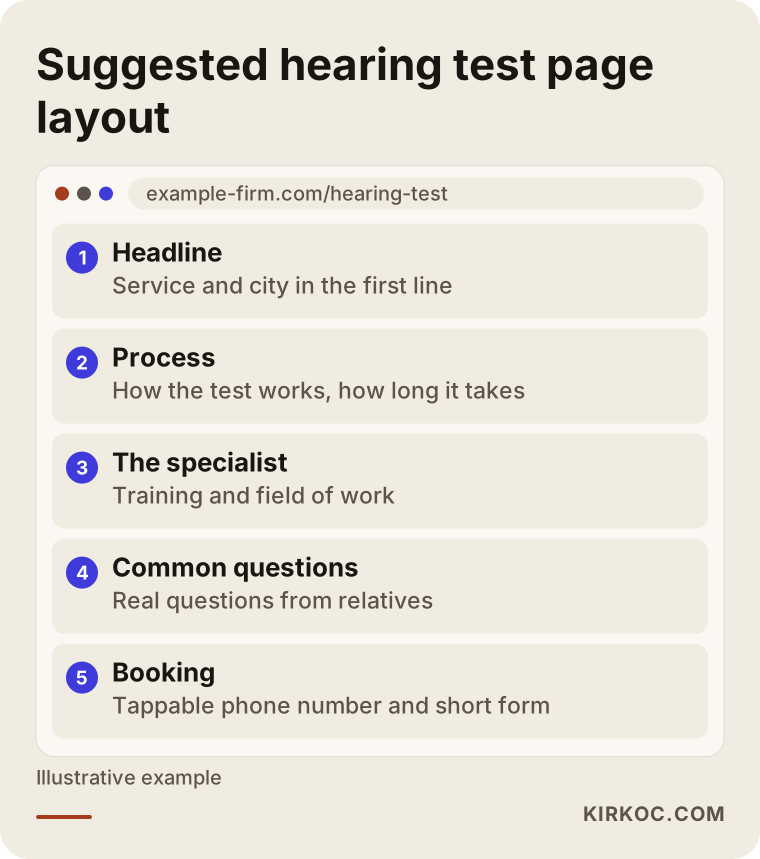
First, the page says what it is about in the very first line. Then it explains how the process works, because someone who has never taken a hearing test wants to know what to expect. Then your specialist is introduced, common questions are answered, and at the bottom the way to book is shown clearly. The goal of the page is not to talk to Google. It is to get the visitor to call or fill in a form.
Local visibility: the map and your business profile
One of the biggest opportunities for a hearing clinic is local search. Someone who types "hearing aids near me" on a phone often sees a map and three to five businesses above the regular results. Your visibility there depends on your Google Business Profile, which is separate from your website and a separate job. A good SEO effort treats the two together.
What you need to do is simple, but it takes consistency. Your address, phone number, hours and services in the profile must be correct. There should be no mismatch between your site and your profile. You should ask real patients for reviews, if they are happy, but buying or inventing reviews is both unethical and a serious risk. In health care, reviews call for extra care: answer in a way that protects the patient's privacy and never go into medical detail. Privacy rules for health information are strict in the United States, so if you are unsure how to reply to a review, ask an attorney.
There is also an accessibility detail. Many hearing aid users are older. If your site states practical details such as an elevator, a ramp or parking, it puts the patient at ease, and it helps you in "near me" searches too.
Website design for older visitors
SEO is not only aimed at Google. The person who arrives also has to stay. Among the people browsing a hearing clinic's site are older adults and people with mild vision problems. Small text, weak contrast, a confusing menu and tiny tap targets drive visitors away.
The practical advice is this: keep the text at a readable size, leave enough contrast between background and text, make the phone number tappable and visible on every page, and keep the form short. If a big, clear "Book an Appointment" button shows up on a phone, half the job is done. These details do not directly set your ranking, but Google indirectly cares how visitors use a site, and most importantly they affect how many appointments you get.
Hearing clinic or independent expert: who should do the SEO?
Who carries out this work is also a decision. There is no right or wrong choice between a large agency and a single specialist; it depends on what you need. Let me describe both fairly.
A large agency can assign different people to development, content and advertising. For a chain with many locations or a site with hundreds of pages, that division of labor helps. In exchange, communication usually runs through a project manager. When you work with one specialist, the person you talk to is also the person doing the work, and decisions are faster. The limit is that one person's capacity is finite with a very large workload. I work alone, and if the scale of a job does not fit me, I will tell you so plainly.
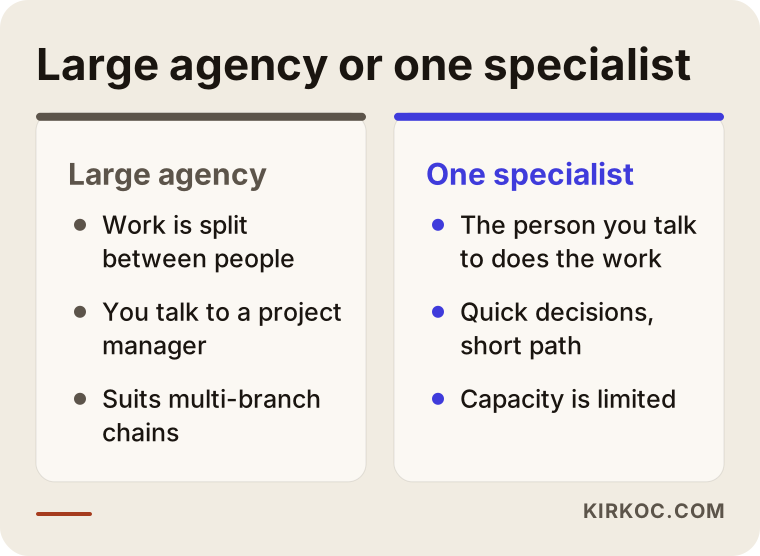
For a single-location clinic or a small practice, the second option often makes more sense, but that is a tendency and not a rule. What matters is finding out who will actually do the work and being able to talk to that person.
What should the service include?
When you receive a quote, you should be able to see exactly what is in it. "We will optimize your site" is not a scope. These are the pieces in my service:
- Site review: I go through the site from start to finish and list, point by point, why Google is holding you back.
- Finding the right searches: I research what patients and their families really type and choose the searches that can bring you appointments.
- Technical fixes: I deal with problems such as slow loading, a broken look on phones and pages that will not open.
- Content work: I strengthen your service pages and write articles that answer family members' questions.
- Competitor tracking: I look at what the clinics above you do differently and update the plan.
- Monthly report: I report in plain language what was done, which searches you are rising in and what comes next.
I do not promise anything here that I do not say on my service page. Paid ad management, running a social media account, or collecting reviews on your behalf are not part of this scope. If a quote lists them, ask whether they are separate line items.
What determines the price?
I am not giving numbers in this article, because there is no standard price for SEO. But if you know what drives the price, you can compare the quotes you receive in a meaningful way.
The first factor is the current state of your site. A technically broken or slow site needs cleaning first, and that takes time. The second is how competitive your target searches are; a broad search for "hearing aids" in a big city does not take the same effort as one clear search in a single suburb. The third is the volume of pages and content: how many service pages, how many articles and how many cities are needed directly sets the workload. The fourth is the number of locations; each location wants its own page, its own profile and its own plan. The fifth is the number of languages; if you want to attract international patients, working in a second language is like running a second project. The sixth is how long the work lasts: a few months of intensive recovery and a steady effort spread over years call for different structures.
A quote that looks very cheap may have a shrunken scope, and one that looks very expensive may contain items you do not need. Look not at the number but at what the number covers. For a firm price I need to see your business first; after a first review I give a written quote.
What to check when you get quotes
When three or four quotes arrive, it can be hard to tell which is better. My criteria are these: are the tasks written down, or is the quote full of general promises? Is the plan presented in order of priority? Who actually does the work, and will you be able to talk to them? Is the reporting simple? Whose name are the site and accounts under?
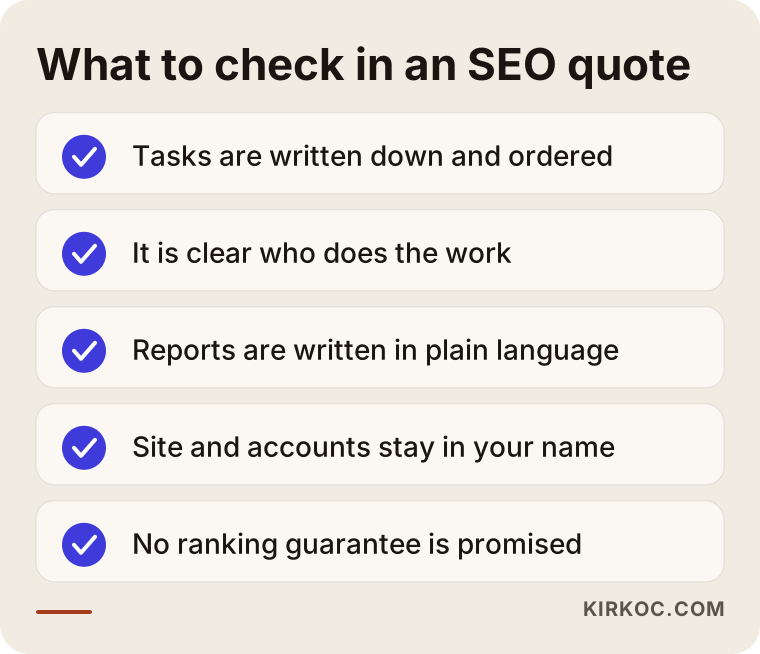
Let me add one more item to the list: be careful with guarantee sentences such as "we will get you on page one" or "we will increase your patient numbers." Nobody can guarantee Google's results. An honest quote guarantees the work, not the outcome. In health care, using phrases like "guaranteed cure" or "the best clinic" on your site can also be risky, so talk to an attorney about that.
It also matters a lot who owns your site, your domain name and your Google accounts when the work ends or you part ways. These should always be in your name and under your control. If the provider keeps your site in their own account, you become dependent on them.
How I work
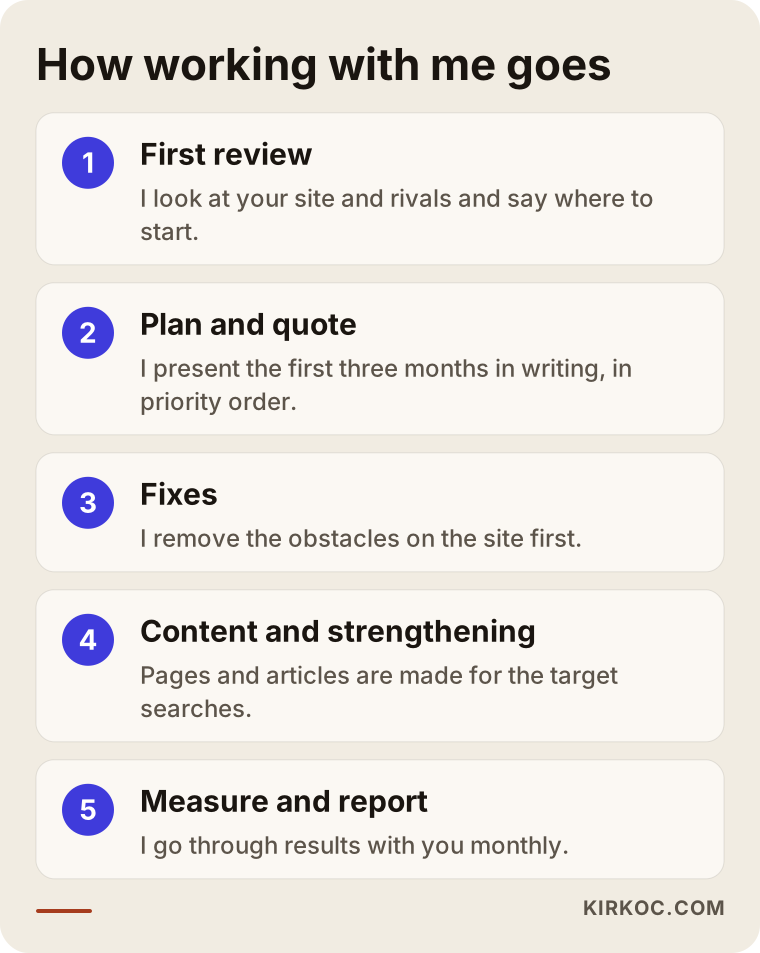
Knowing how the process runs makes your decision easier and tells you what to expect and when. I proceed in this order:
- First review: I look at your site and your competitors and tell you where to start.
- Plan and quote: I present what will be done in the first three months in writing, in order of priority.
- Fixes: I remove the obstacles on the site first; these give the fastest effect.
- Content and strengthening: Pages and articles are prepared for the target searches.
- Measurement and report: Each month I go through the results with you and update the plan.
The first review is not a sales call. It is a real assessment. After looking at your site I may say, "SEO is not the right investment for you right now," and that is a possible outcome. Let me also be honest about timing: it often takes weeks, sometimes months, for Google to notice a change and reflect it in rankings. That is the nature of SEO, so treat anyone who promises fast results with suspicion.
Two hypothetical examples
The two scenarios below are entirely hypothetical. They do not describe a real clinic; they only show the reasoning.
Say there is a single-location hearing aid clinic in a mid-sized suburb. The owner wants to show up for a broad search like "hearing aids." In the first review it becomes clear that big chains and many online stores fill that search, but the field is more open for searches that combine "hearing test" with the name of the town. The plan is built first on strengthening the hearing test page, making the address and phone number identical everywhere, tidying the business profile, and writing a few articles that answer family members' questions. The work aimed at the broad search is left for later. No ranking is guaranteed; only the tasks and the indicators to be measured are put down in writing.
Say there is an audiology practice with two locations. The practice offers hearing tests, pediatric hearing evaluations and hearing aid fitting. On the site, all services are squeezed onto one page, the details of the two locations are mixed up, and pages load slowly on phones. The first review shows that the technical problems must be fixed first, and that after that each location needs its own page and each service needs its own page. The informational tone is kept in the health content; no treatment outcomes are promised, and readers are guided to a specialist's evaluation. The quick technical wins come first, then the content work, and results are tracked in a monthly report.
Common mistakes
These are the mistakes I see most often in this field. All of them can be avoided, but if you do not notice them they can cost you months.
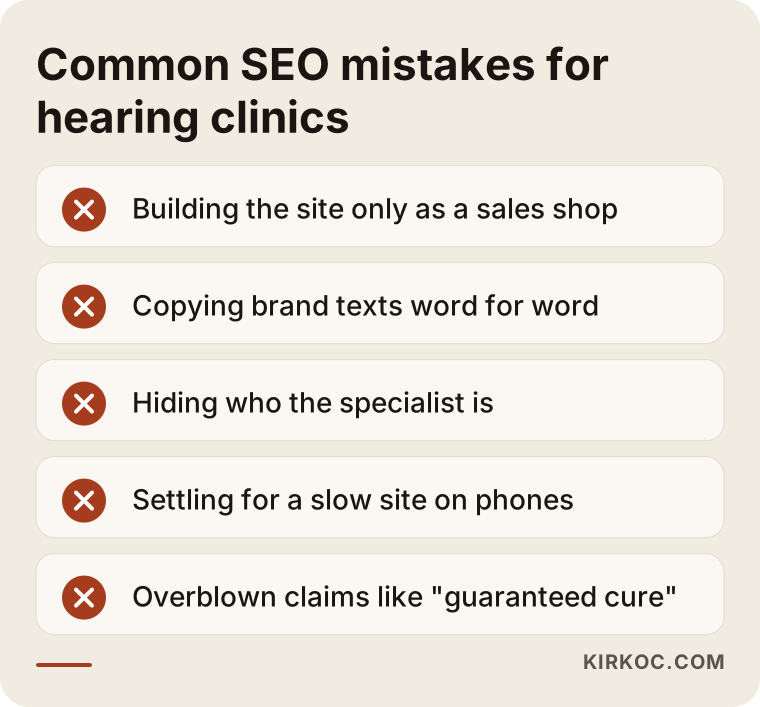
The first is building the site only as a sales shop window. People look for information first, and a site with no information pages misses them. The second is copying and pasting the ready-made texts from device manufacturers. If the same text appears on hundreds of sites, Google has no reason to put yours forward. The third is hiding who the specialist is; in a field that demands trust, a site with no names creates hesitation. The fourth is writing the address and phone number differently in different places. The fifth is settling for a site that is slow or broken on phones. The sixth is using overblown phrases such as "the best" or "guaranteed cure," which both damage trust and can carry risk under advertising rules. The seventh is giving up when you see no results in the first few weeks.
No SEO without measuring
An invisible mistake is working without measuring. If you do not know how many people arrive from search, which page they leave from and how many of them call you, you cannot know what is working. Whichever specialist you work with, counting phone calls and appointment forms and sharing that with you in plain language should be a requirement. Because of patient privacy, measurement should be set up so that no personal health information is collected; it is wise to get an attorney's opinion on that as well.
AI answers and your clinic
Many people now ask AI tools such as ChatGPT questions alongside Google, for example "what should I look for when choosing a hearing aid clinic?" When these tools answer, they may use pages that are trustworthy, clear and well organized as sources. I cannot guarantee that. But if your pages are clear, state their source, introduce the specialist and answer questions directly, you are in a better position both on Google and with these tools.
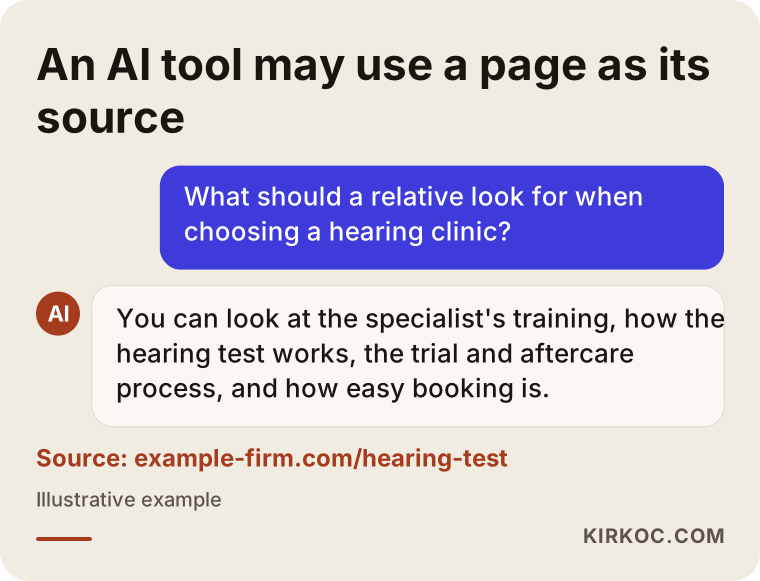
The sample answer is hypothetical. What matters is that your page openly answers questions such as "what happens at the first visit," "how many minutes does the test take" and "is there a trial period." The same pages serve Google, AI tools and the person who makes the decision.
Should you do it yourself or hire a specialist?
Some jobs you can and should do yourself. Filling in your Google Business Profile correctly, keeping your address and phone number consistent, asking your patients for real reviews and introducing your team on the site are among them. These tasks need no special knowledge, only discipline.
The jobs to hand to a specialist are the technical audit, proper search research, competitor analysis, the plan across several pages and setting up measurement. These take time, tools and experience. A business owner who tries to learn it all alone often drifts away from the real work, which is patients. A sensible middle path exists: first get a one-time review, learn which jobs you can do yourself, and talk about the specialist jobs afterward.
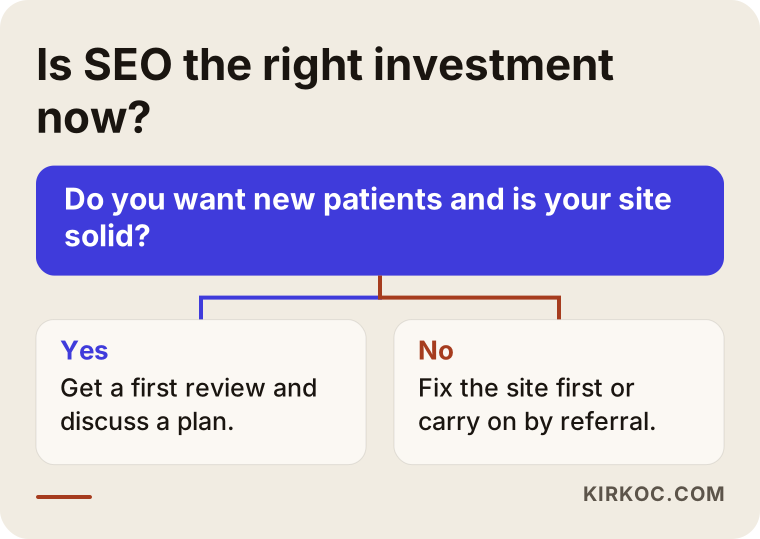
In short, the decision tree says that SEO is not the right investment for everyone. If your clinic runs entirely on physician referrals and word of mouth and you are not looking for new patients, you may not need it for now. If your site is broken, fix it first. If you expect guaranteed results within weeks, this service is not for you, because nobody can honestly offer that. If I see such a situation in a first review, I will tell you plainly; I do not want you to pay for an investment that will not work.
Frequently Asked Questions
Why is SEO for a hearing clinic different from other businesses?
Because the decision is heavy, the process is long and trust matters more than anything. The one searching is often a family member rather than the patient, and they research the problem first. There are also rules on health content and advertising, so an informational tone that promises no results is needed. I suggest you ask an attorney about those rules.
What does the price of SEO for a hearing clinic depend on?
It depends on the current state of the site, the competition for your target searches, the volume of pages and content to be prepared, the number of locations and languages, and how long the work lasts. There is no standard price. After a first review I give a written quote that includes the scope.
Can I reach the first page of Google for "hearing aids"?
It may be possible, but it takes time and patience, because strong competitors fill that broad search. For most clinics, the smarter path is to appear first for clearer searches such as hearing tests and your city, and move toward broader searches as trust builds. I never guarantee a ranking.
How long does it take to see SEO results?
It often takes weeks, sometimes months, for Google to notice a change and reflect it in rankings. The time depends on the state of the site, the competition and the scope of the work. I suggest you treat quotes that promise fast, certain results with suspicion.
Should I put device prices and insurance information on my site?
That is a business decision. Whether to list prices is your choice, but giving wrong or outdated information on insurance and coverage is risky. Check the current rules, ask an attorney if needed, and send the patient to contact you wherever you are unsure.
I have more than one location. Does each need its own page?
Usually yes. Each location has its own address, phone, hours and directions, so a separate page and a separate business profile are clearer for both the patient and Google. But instead of copying the same text and changing the location name, real information specific to each location should be written.
I bought SEO services before and saw no results. Should I try again?
First, what was done needs to be reviewed independently. The problem may be technical, the target searches may have been chosen wrongly, or the work may not have been kept up long enough. After the review, I will tell you plainly whether continuing makes sense.
What can be done for patients who speak other languages?
If you also serve patients who speak another language, separate and natural texts need to be written in that language. Machine-translating a text from one language into another and publishing it is often not convincing. In the first review I will assess with you which language would really bring demand; for most clinics it is wiser to start with the language that brings the most requests.
If you want to find out which searches your hearing aid clinic or practice should appear in, what your competitors are doing and where you could start, reach me through my SEO services page. I will look at your site and we can talk through an honest first assessment.