You have a business connected to Izmir. Maybe it is a clinic in Karsiyaka, a workshop in Bornova, an office in Alsancak, or a hotel in Cesme that only operates in summer. Maybe you are a foreign company that wants Turkish customers in the Aegean region, or an Izmir manufacturer that sells abroad. You also have a website, but the number of calls and form requests it brings in is far below what you expected. Competitors show up higher in the same search and you cannot work out why. At that point, typing "SEO services Izmir" into Google is a natural step. In this article I explain what a business in Izmir should expect from SEO, which pages actually help, how to read the quotes you receive, and where to begin. I am Ümit Kırkoç, a web designer and SEO consultant who works alone from Istanbul, and where it is relevant I will be plain about what my own SEO services cover.
SEO, in short, is the work that makes your website show up on Google when your customers search. Unlike advertising, you do not disappear the moment you stop paying, and when it is set up properly it can keep bringing in inquiries for months. But Izmir has a structure of its own. The city holds thousands of small businesses serving local customers, a seasonal tourism economy, and manufacturers who sell overseas, all in one place. The customers of these three groups search in very different ways. So "SEO for Izmir" is not one job. It changes from the ground up depending on which group your business belongs to.
How do customers search on Google in Izmir?
Izmir is a big city, but it is not one giant market the way Istanbul is. People rarely search for the whole city. They search for the district they live in or the one they plan to visit. Someone who lives in Karsiyaka is unlikely to cross the bay to a dentist in Bornova. In the same way, a homeowner in Buca looking for an air conditioner technician will usually type something narrow like "buca ac repair" rather than "izmir technician".
If you do not read or speak Turkish, one thing is worth knowing here. Turkish district names often appear with endings attached to them, so the same idea can be typed in several slightly different forms. A page written by someone who knows how people really type will match more of those searches than a page translated word for word.
It helps to split searches in Izmir into four kinds.
The first is the broad city search, such as "izmir web design" or "izmir accounting office". Competition here is heavy and results arrive slowly. The second is the district or neighborhood search, such as "karsiyaka lawyer", "bayrakli dental clinic" or "alsancak restaurant". Competition is divided up and the intent is very clear, because the person wants somewhere close. The third is the map search. Someone who types "near me" on a phone, or searches directly on the map, usually wants to visit or call right away. The fourth is the search that comes from abroad or in another language: a German or Scandinavian visitor planning a holiday in Cesme, or a foreign buyer who wants to purchase goods from Izmir.
Each of these four needs a different type of page. The table below puts them side by side.
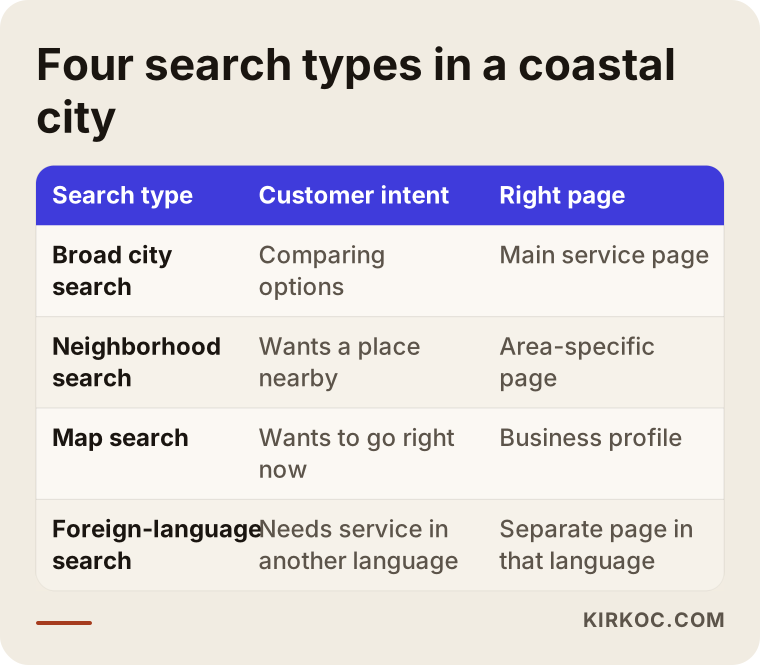
As the table shows, a single home page cannot serve all of them. Broad searches need a strong service page. District searches need pages that are specific to that district. Maps need a properly filled-in business profile. Foreign customers need separate pages in their own language. A plan that ignores this split usually ends up either too broad to be useful or aimed at searches nobody makes.
Which pages does a local business in Izmir need?
By local business I mean a dentist, lawyer, architect, vet, beauty salon, repair service, workshop, restaurant or any other business that serves customers in a specific area. For these, the foundation of SEO is showing Google exactly what you do and where you do it.
Many sites list ten different services on one "Our Services" page. But when someone searches "bornova foot care" or "karsiyaka boiler service", the site with a separate page for each service usually beats the site that has piled everything onto one page. The reason is simple: the page is focused on the subject of that search.
A good local structure usually has these pieces. A separate page for each main service. Pages for the districts you want customers from, with information that genuinely belongs to that district. A contact page where the address, phone number, opening hours and directions are written clearly. And sections that answer the questions people often ask.
One warning is important. Copying district pages and only changing the district name does not work, and it can do harm. If the only difference between "we serve Karsiyaka" and "we serve Bornova" is the name, Google notices and treats the pages as low value. Each page should answer a real question from a customer in that area: how close are you, is there parking, which neighborhoods do you visit, how do appointments work.
The graphic below shows one way a well-built district page can be laid out.
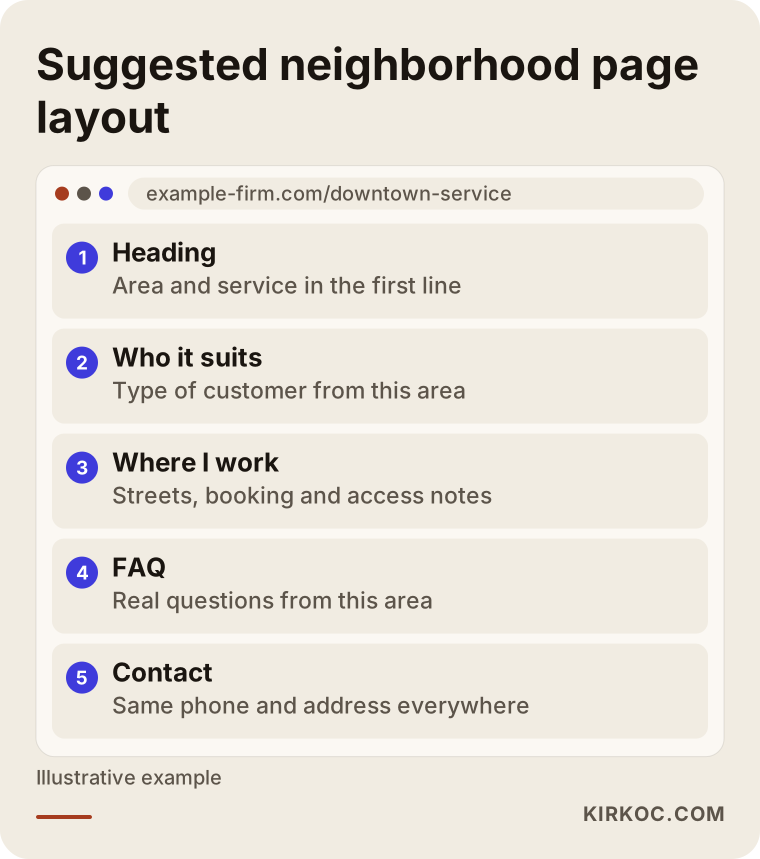
Every section in this layout has a job. The heading names the area and the service, so the reader and Google both know what the page is about from the first line. The sections below it give the concrete details that help someone from that area.
A note for foreign residents and foreign companies
If you are a foreign company or an expat who runs a business in Izmir, the same logic applies, with one extra layer. Your customers may be locals, other foreigners, or both, and each group searches in a different language. A page in English for foreign residents and a separate page in Turkish for local customers will serve you better than one page that tries to do both. Decide first who you most want to reach, and build for that group before you add the others.
Why are the map and the business profile so important?
In local searches the map often takes center stage. When someone types "alsancak hairdresser", Google may show a map and a handful of businesses above the ordinary results. The way into that area is to fill in Google's free business profile completely.
The steps are simple, but most businesses leave something out. The business name, address and phone number should match your website exactly. The right category must be selected. Opening hours must be current, especially around public holidays and seasonal changes. Real photographs should be added. Reviews from customers should get short, polite replies.
A note on reviews: buying reviews or having fake ones written is neither ethical nor allowed by the platform's rules. The right way is to politely ask a satisfied customer to leave a review after the service. Once that becomes a habit, reviews build up over time.
Cesme, Alacati, Foca, Urla: a different game for tourism businesses
The tourism side of Izmir should be thought of separately from the city center. If you run a hotel, guesthouse, restaurant, beach club, boat tour, surf school or event venue in places like Cesme, Alacati, Urla, Foca or Seferihisar, search behavior looks very different.
First, the customer is often searching from another city or another country. Someone who does not live in Izmir plans a holiday with searches like "alacati boutique hotel", "cesme beach" or "foca guesthouse". Second, the timing follows the season. Planning for summer begins weeks, sometimes months, in advance. That means starting SEO once the season has begun is already too late. Pages need to be ready, indexed (that is, found and stored by Google) and up to date before the season opens.
Third, language. In tourist areas, a site that exists only in Turkish gives away a big opportunity. You need separate pages in English, German or whatever language your target guests speak. The key point is to write each page around how that language group actually searches, rather than running the page through an automatic translation plug-in. The words a German visitor types for a holiday in Cesme may not be a direct translation of the Turkish phrase, and an English-speaking visitor may use yet another set of words.
Fourth, ease of booking. In tourism, a visitor decides within minutes of arriving on your site. If the price range, availability, location, photos and booking button are not easy to find, the person moves on to the next result. SEO brings the visitor to you, but whether they stay depends on how easy your site is to use.
Fifth, the relationship with booking platforms. Many tourism businesses take a large share of their guests through reservation platforms. SEO is one of the ways to reduce that dependence by taking more bookings directly through your own site. You are not expected to replace the platforms overnight. Strengthening your own site step by step is a reasonable goal.
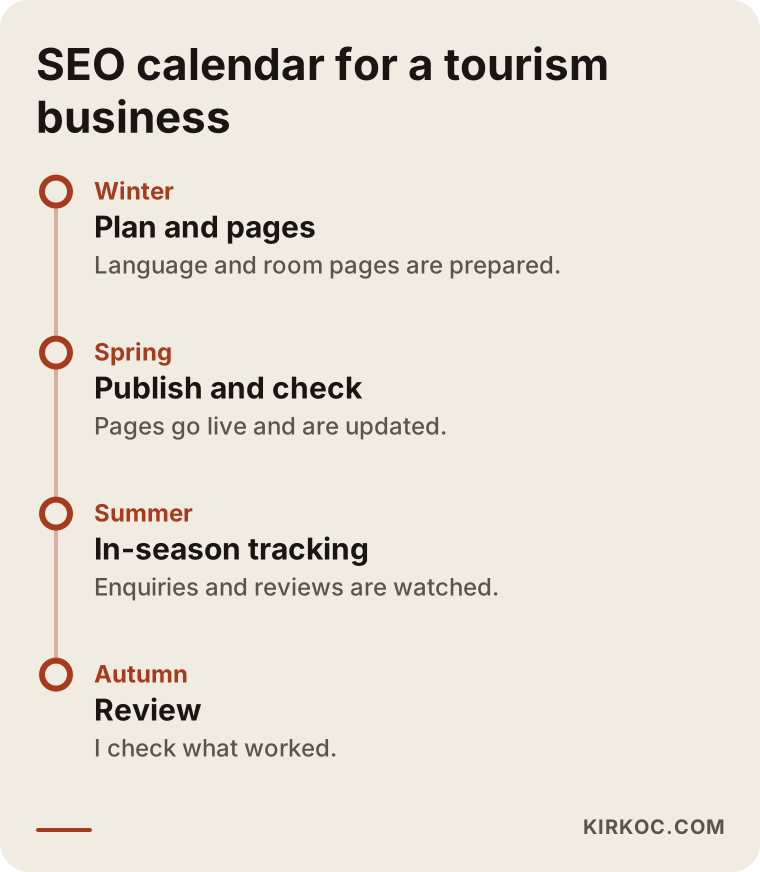
The calendar above summarizes why SEO for tourism has to start before the season. The review done after the season also becomes the basis for next year's plan.
SEO for Izmir manufacturers and exporters
Izmir has a port, industrial zones and a free trade zone, and it is home to many companies that sell abroad. Agricultural products, food, textiles, natural stone, machine parts, chemicals and many other fields are represented. The customers of these companies do not search for "kadikoy dentist". A foreign buyer looking for a supplier types a completely different kind of query.
For export-focused sites, the logic of SEO works like this. A foreign buyer searches for your product or service in their own language, with phrases like "olive oil supplier Turkey" or "natural stone supplier Turkey". Your Turkish site has no answer for that search. What you need are pages written in the buyer's language, covering product specifications, packaging options, certificates, minimum order terms and contact details.
What matters most is giving the buyer information they can trust. Where the company is located, how long it has operated, which products it makes, quality certificates if you have them, photos of the factory or facility, and a real way to get in touch. A foreign buyer often does not know you at all, so your site is the first impression. A vague, incomplete or badly translated site can hide even a very good product.
The same principle applies here as well: a separate page for each target country and language. Machine-translating the same text into four languages and publishing it will not leave a professional impression. Choosing one target market and building a good page for it first is better than doing every language halfway.
One more caution. Export sales are usually a long decision process. The buyer sees your site, researches for a while, perhaps asks for a sample, and holds several conversations. SEO provides the first introduction; it does not close the sale on its own. So when you measure results, look not only at sales but also at the number of quote requests and questions coming in.
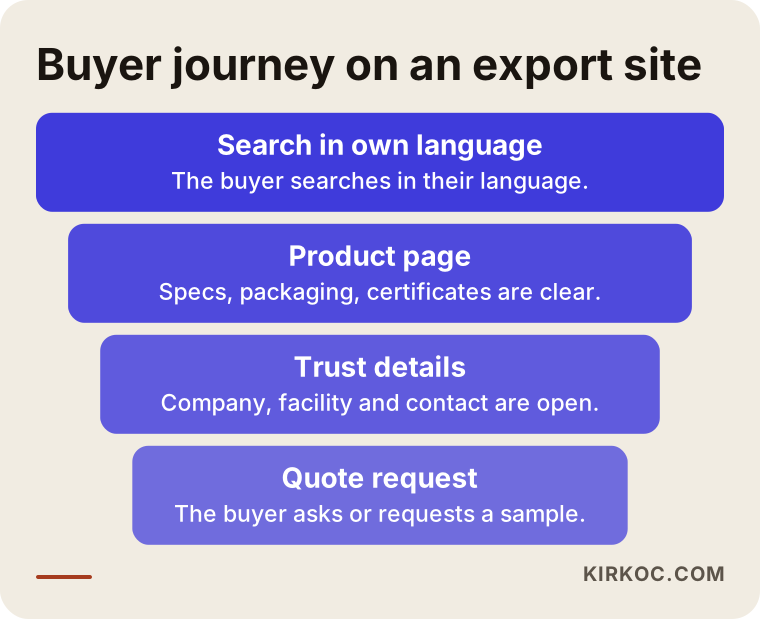
The flow in the graphic shows the path a foreign buyer takes through your site. A missing piece of information at any stage can cost you the buyer.
Two hypothetical scenarios
The two examples below are entirely hypothetical. They do not describe a real company or person. They are written only to show how the topic can work in practice.
Scenario 1: a dental clinic in Karsiyaka
Suppose there is a small dental clinic in Karsiyaka. Its website was built ten years ago, and all treatments are listed on a single page under "Our Services". The clinic does not appear for searches like "karsiyaka implant" or "karsiyaka teeth whitening". Its Google business profile is half filled in, and the address is written one way on the website and another way on the profile.
First comes a technical check: does the site open properly on a phone, is it fast, does Google see it correctly. Then the business profile is completed, and the address and phone number are made identical everywhere. After that, a separate page is prepared for each main treatment, such as implants, whitening and pediatric dentistry. Each page explains in plain language what the treatment is, who it suits, how the process goes, and answers common questions. Medical promises are avoided and no guaranteed result is stated.
This work can make the site look more solid within a few weeks, but a visible improvement in rankings generally takes months. The clinic should know that from the start. The important measure is not the position in the first weeks but the direction of searches and appointment requests over several months.
Scenario 2: a boutique hotel in Alacati
In the second hypothetical example, a twelve-room boutique hotel in Alacati receives most of its bookings from a reservation platform and pays a commission on each one. The owner wants more direct bookings through the hotel's own site. The site is only in Turkish.
A plan could look like this. First, English and German pages are written with the people who actually search in those languages in mind. The rooms are presented on separate pages, with photos, amenities and location stated clearly. The location page gives the distance to the beach, the town center and the airport. The pages go live before the season, and common questions are answered: pets, parking, breakfast, cancellation terms. The booking button is visible on every page.
SEO alone is not enough here. The site also needs to be fast and comfortable to use on a phone. There is no guarantee of a result, but a solid base is laid for raising the share of direct bookings.
What happens, step by step, in an SEO project?
The order of work is usually like this, and it is also how I work.
The first step is a preliminary review. I look at your site, your competitors and what your customers really search for. This produces a list of problems and first priorities. The second step is a plan and quote: the work of the first three months is written down in order of priority. In the third step, the obstacles on the site are removed, such as slowness, mobile problems, broken pages and wrong titles. In the fourth step, pages for the target searches are prepared, along with blog articles if needed. The fifth step is measurement and reporting: each month I look with you at what worked and the plan is updated.
There is one principle to keep in mind: fix the foundation first, then add new content. However much content you add to a site whose underlying problems are unsolved, the return stays low.
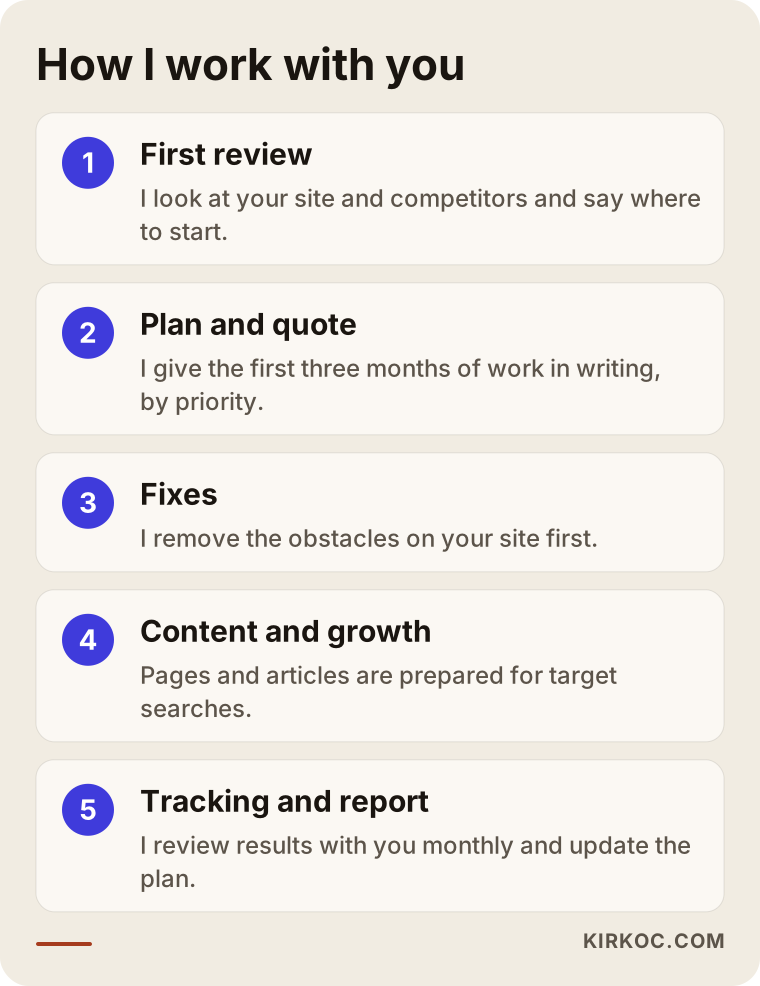
These five steps show the order the work follows and what happens at each stage. Understanding the process also helps you when you compare quotes.
Common SEO mistakes in Izmir
A few mistakes repeat often among local businesses. Knowing them reduces wasted time and money.
The first mistake is focusing only on the word "Izmir". Broad searches are hard and usually far from the customer's final decision. Searches built around a district, a neighborhood and a specific service often pay off sooner.
The second mistake is copying district pages and changing only the name. I described this above; Google may not find those pages valuable enough.
The third mistake is writing the address and phone number differently in different places. If your website uses one format, the map another and directories a third, it becomes unclear who your business is.
The fourth mistake is never testing the mobile site. Many local searches are made on a phone, and your own site statistics will show you how many of yours are. A site that is slow to open or has tiny buttons loses customers.
The fifth mistake, for tourism businesses, is starting during the season. The pages need to be ready before it.
The sixth mistake is covering foreign-language pages with automatic translation. A buyer or a tourist notices immediately.
The seventh mistake is giving up because the first weeks show nothing. SEO is not something that pays off in a month. Quitting also throws away the value of the work already done.
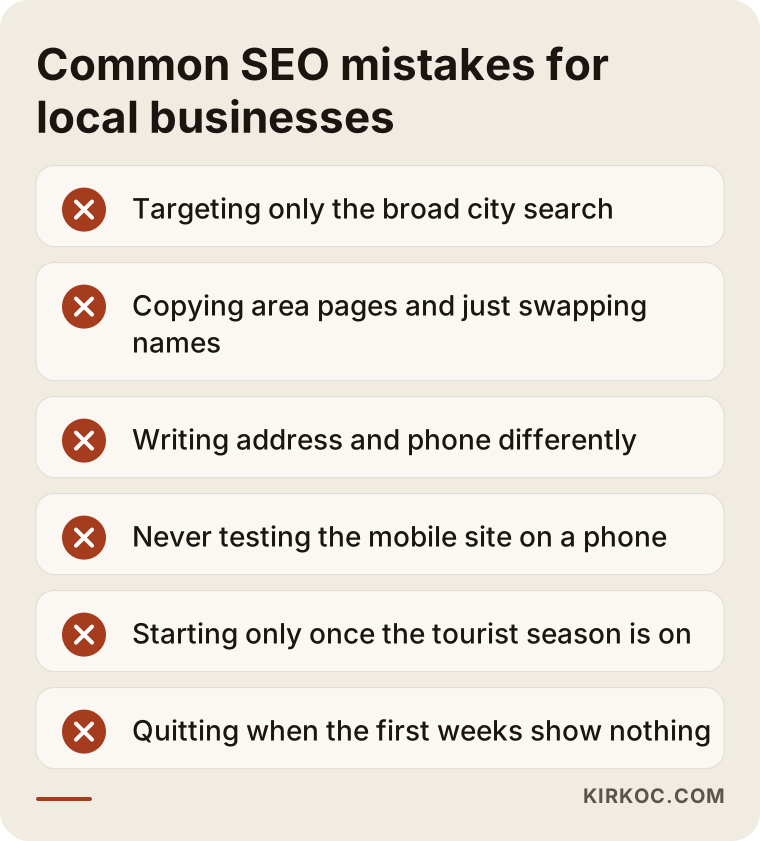
If one or two items on this list look familiar on your own site, a quick fix will often give you a good start.
What can you do yourself, and when do you need a specialist?
You do not have to hand everything to a professional. Some jobs you can do yourself, right away and for free.
You can fill in your Google business profile completely. You can write your address and phone number the same way everywhere. You can ask customers for reviews and reply to them. You can open your site on your own phone and check its speed, its readability and whether the buttons are easy to tap. You can note down the questions customers ask most often and add the answers to your site. These cost nothing and make a real difference.
A specialist makes sense in these situations. When your site has a technical problem, for example if Google cannot see it correctly or the pages are very slow. When you need a plan covering several services, districts or languages. When competitors are strong and you do not know where to start. Or when you have no time and need a steady routine. A specialist saves you time and prevents effort from going in the wrong direction.
When you choose someone, make sure you can get a clear, written answer to the question of what will be done, when, and by whom.
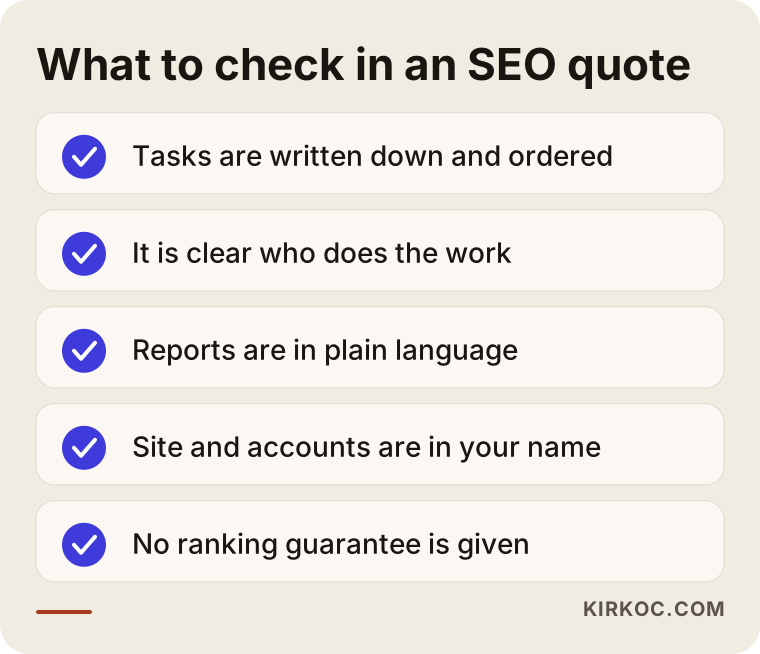
This checklist helps you see which of several quotes is the more transparent when you set them side by side.
Agency or solo specialist in Izmir?
Izmir, like Istanbul, has both large agencies and specialists who work alone. Each suits certain situations, and which is better depends on your business.
A large agency can make sense for campaigns running in several countries, very high volume work that needs many team members. The work is divided among different people, and a project manager usually handles the correspondence. If you work with a single specialist, the person you talk to does the work themselves. Decisions are quick, but capacity is limited.
For a small or mid-sized business, being able to talk directly to the person who does the work is usually a big advantage. Even so, choose based on how clear the quote is and how past work is presented, not on titles.
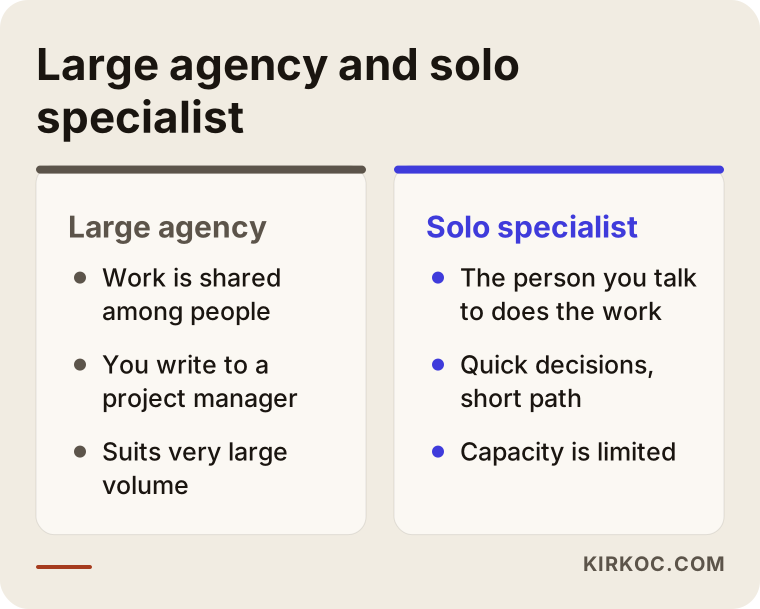
The comparison offers only a general frame. What is right for you depends on your budget, the volume of work and your preferred way of working.
Can you work with someone who is not in Izmir?
Yes, and in practice it is a common arrangement. Most SEO and web design work is done at a computer and does not require being at the client's office. I am based in Istanbul and I can work with businesses in Izmir remotely. The first conversation takes place by phone or video call, documents and access are shared online, and regular updates continue through email and short meetings.
The advantage of working remotely is that you can choose the right person without being limited by city borders. The drawback is that it can feel unusual at first if you are used to meeting in person. Still, for local SEO the specialist does not need to live in your city. What matters is working with someone who understands your sector, your customer's search and the dynamics of your region. In our conversations I go through your business, the districts you serve and the questions your customers ask, and we make them concrete together.
If you are a foreign company or live abroad, remote work is even more natural, since the work already happens online. In that case, make clear at the start which language each page should be in, and who will check the Turkish text for accuracy.
Two things deserve attention when you work remotely. The first is that the site and accounts should be in your name: the domain name, the Google business profile and the analytics account. The second is that the communication rules are clear from the start: how often you will receive reports, which channel you will use to write, and whom to reach in an urgent situation.
What determines the cost
I do not give numbers, because SEO is not a single product; it is a service that changes with scope, competition and your needs. But I can say clearly what decides the cost.
The first factor is the current state of the site. A site with few technical problems and one that needs to be fixed from the start call for different amounts of work. The second is the number of pages. Three pages for three services is not the same job as hundreds of pages for thirty districts and ten services. The third is the number of languages. Every new language means separate research and separate writing. The fourth is the level of competition. In a very crowded field, results take more effort and more time. The fifth is content production, meaning whether regular articles, images and guides will be prepared. The sixth is the frequency of reports and meetings. The seventh is whether the work is a one-off project or a continuing monthly service.
A quote should show you what each of these items corresponds to. A vague package such as "everything included, ranking guaranteed" is usually not a good sign. Nobody can guarantee a particular position on Google, because Google decides the ranking, not me or anyone else.
How I work with clients
I work alone, so the person you talk to is the person who does the work. In the first conversation I listen to your business, your site and your goals. Then I do a short preliminary review and tell you where it makes sense to start. If it suits you, I prepare a prioritized written plan and quote. The plan is written in plain language; it makes clear what will be done, why, and when.
During the work, the site and accounts stay in your name. You receive a simple report on a regular basis, and in it I care about what has changed, not about jargon. I do not give ranking or result guarantees, because I cannot give them honestly. What I give you is transparency about what the work is, how it is done and what it is measured against.
Some businesses only want a preliminary review and a roadmap and then carry out the work themselves; others run the whole process with me. Both ways are possible.
A few questions to ask yourself before you start
Thinking through the answers to these questions before you speak with a specialist makes the conversation more productive. Which service earns you the most, and which one do you want more customers for? Which districts do most of your customers come from? Are you targeting foreign customers or buyers, and from which country? Do you have a seasonal business, and when is the busiest period? Roughly how many inquiries does the site bring in each month at the moment? Which competitor do you look up to?
These answers make both the plan and the quote meaningful. If there are questions you cannot answer, that is fine; I clarify them with you in the preliminary review.
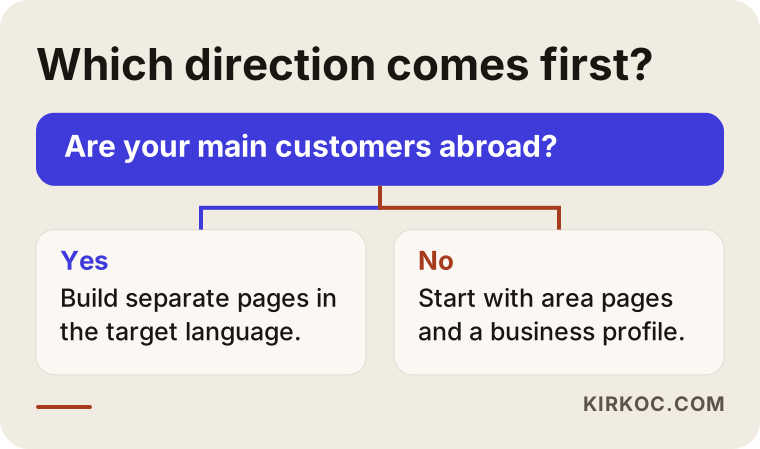
This simple chart helps you see which direction your business should put first.
What makes the difference in search results: a clear, specific page
In the end, the best way to think about SEO in Izmir is not as a general race for rankings but as giving a clear answer to a specific customer's specific question. For someone typing "karsiyaka vet", a page with real, district-specific information is far more valuable than a list or a generic page that tries to speak to everyone.
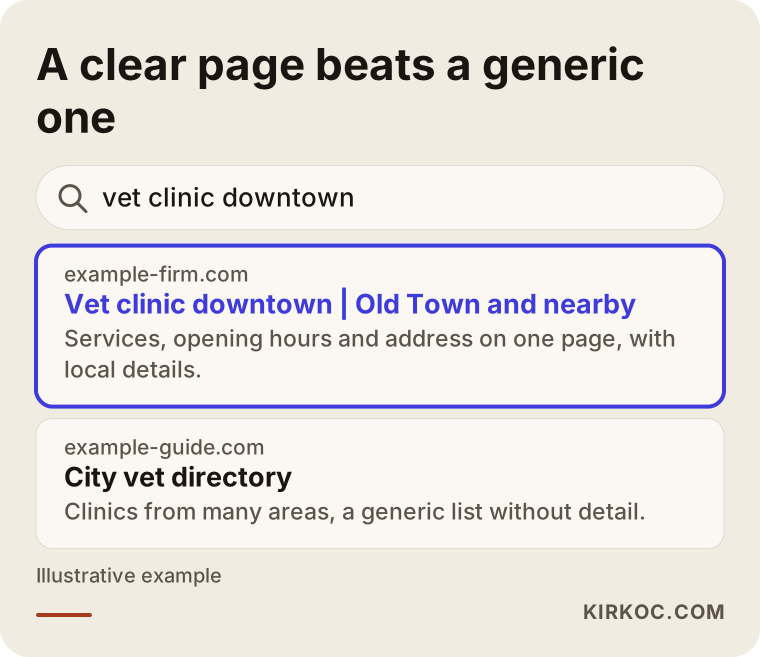
The example in the graphic is a hypothetical results page. The page that gives district-specific information leaves a clearer impression than a generic list that speaks to no one in particular.
Frequently asked questions
How long does it take to see SEO results in Izmir?
It would not be honest to give a fixed time. When technical problems are fixed, some improvements can show within a few weeks, but meaningful movement on commercial searches usually takes months. The level of competition, the current state of the site and the scope of the work decide this.
Should I target only the word "Izmir"?
Most of the time, no. Broad searches that include "Izmir" are both crowded and far from the customer's decision. Searches that include a district, a neighborhood and a specific service usually carry clearer intent and are easier to reach. Planning for both together is the healthiest approach.
I run a tourism business. Do I need a site in a foreign language?
If you are aiming at foreign guests, yes, I strongly recommend it. But instead of automatic translation, you need pages prepared around how each language group searches. You do not have to do them all at once; starting with your most important market is reasonable.
I export. Is translating my Turkish site enough?
Usually it is not. A foreign buyer searches in their own language, with the terms they themselves use. Product specifications, certificates, order terms and contact details must be clear. A translation is a start, but pages prepared specifically for that language, covering the information the buyer needs, give better results.
Can I work with an SEO specialist who is not in Izmir?
Yes. Most of the work is done online. I am based in Istanbul and I can work remotely with businesses in Izmir. What matters is that you can communicate clearly with someone who understands your business and the way your customers search.
How much budget should I set aside for SEO?
I cannot give a number, because the price depends on the state of the site, the number of pages and languages, the competition and whether the work is one-off or ongoing. The right approach is to clarify the need with a preliminary review first and then see the scope in a written quote.
If I hire you for SEO, can you guarantee I will rank first?
No, and nobody can. Google decides the ranking. What I can do is set your site up properly, prepare clear pages for the target searches and report progress regularly in plain language. I suggest being cautious about any quote that offers a guarantee.
What is the difference between a Google business profile and SEO?
The business profile gets you onto the map and into local results. SEO covers your website appearing in general searches. The two complete each other; if you are a local business, neither should be neglected.
If you are not sure where to start for your business in Izmir, you can reach me through my SEO services page. I will take a short look at your business, your site and your target customer, and tell you honestly where it makes sense to begin.